


Report Overview
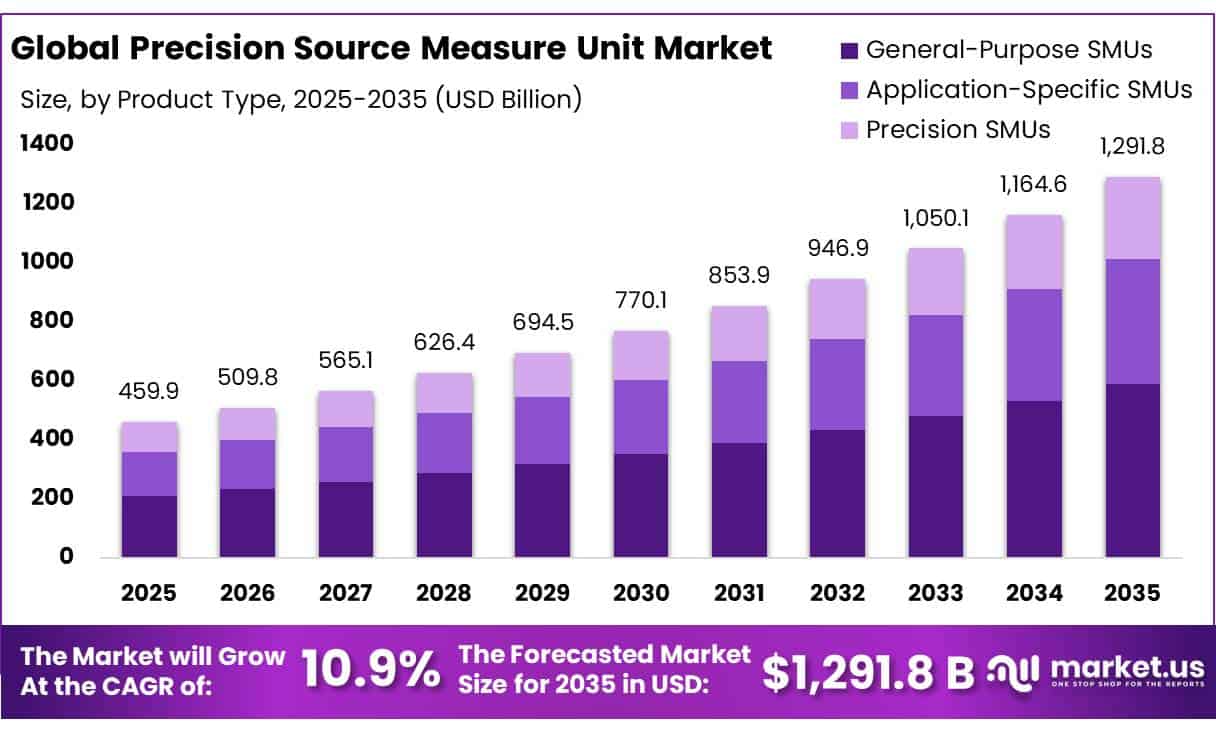
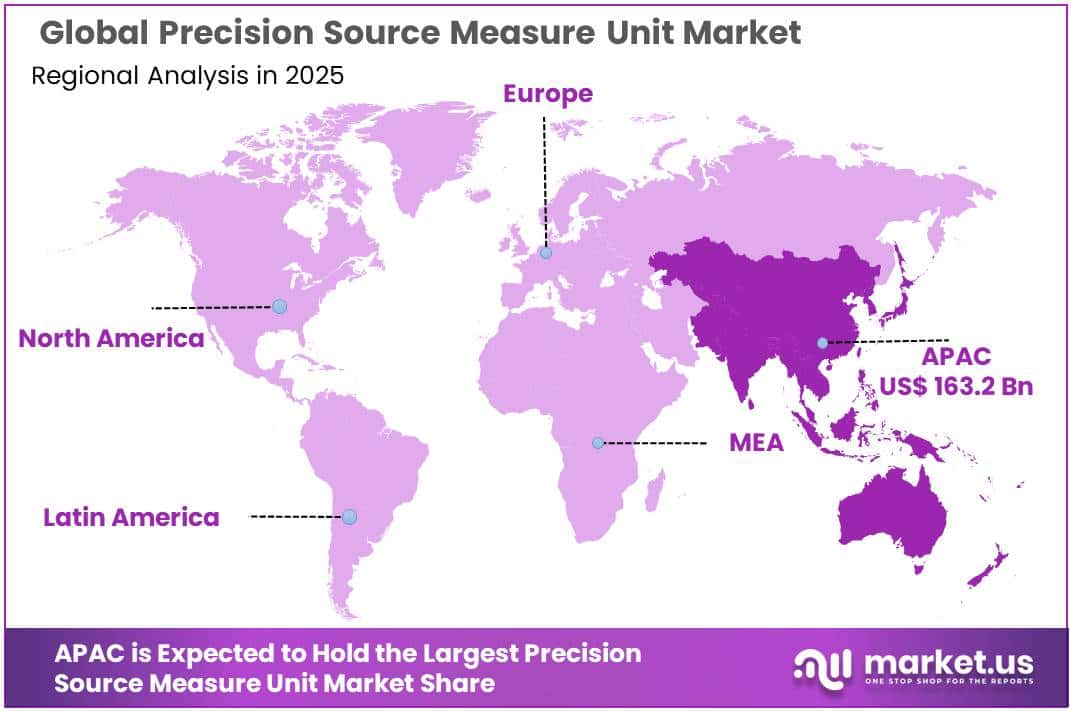
The Global Precision Source Measure Unit Market size is expected to be worth around USD 1291.8 Billion by 2035, from USD 459.9 Billion in 2025, growing at a CAGR of 10.9% during the forecast period from 2026 to 2035. In 2025, Asia Pacific held a dominant market position, capturing more than a 35.50% share, holding USD 163.2 Billion revenue.
Precision Source Measure Units (SMUs) have become important instruments in semiconductor, electronics, battery, photovoltaic, automotive, sensor, and advanced-material laboratories. An SMU combines precision voltage or current sourcing with sensitive electrical measurement in one instrument, allowing engineers to carry out I-V characterization, leakage-current testing, resistance measurements, device reliability checks, and automated production testing. Demand is moving toward higher accuracy and faster measurement as electronic components become smaller, operate at lower power, and require tighter electrical tolerances.
- The semiconductor industry provides the strongest industrial foundation for precision SMUs. Global semiconductor sales reached USD 791.7 billion in 2025, increasing 25.6% from USD 630.5 billion in 2024. Fourth-quarter semiconductor sales alone reached USD 236.6 billion, rising 37.1% year over year. Logic semiconductor sales reached USD 301.9 billion, showing the scale of advanced processors and electronic devices requiring electrical characterization during development and production.
Semiconductor manufacturing investment is also creating a larger testing environment. SEMI reported worldwide semiconductor manufacturing equipment sales of USD 135.1 billion in 2025, up 15% from USD 117.1 billion. Semiconductor test-equipment billings increased 55%, while assembly and packaging equipment sales rose 21%, driven largely by AI devices, high-bandwidth memory, and advanced packaging.
- Government semiconductor programs should further support future demand. The U.S. CHIPS Program allocated USD 39 billion for semiconductor manufacturing incentives, had awarded approximately USD 34 billion, and was associated with nearly USD 450 billion in planned private semiconductor investment.
Automotive electrification creates another strong growth area. Global electric-car sales increased by more than 20% in 2025 to reach 21 million units, representing around 1 in 4 new cars sold worldwide. Nearly 22 million electric cars were produced during the year, an increase of more than 25%. Precision SMUs support battery-cell research, power semiconductor characterization, battery-management electronics, charging circuits, sensors, and other low-current electronic measurements required across EV development.
Key Takeaways
- Precision Source Measure Unit Market size is expected to be worth around USD 1291.8 Billion by 2035, from USD 459.9 Billion in 2025, growing at a CAGR of 10.9%.
- General-Purpose SMUs held a dominant market position, capturing more than a 45.70% share.
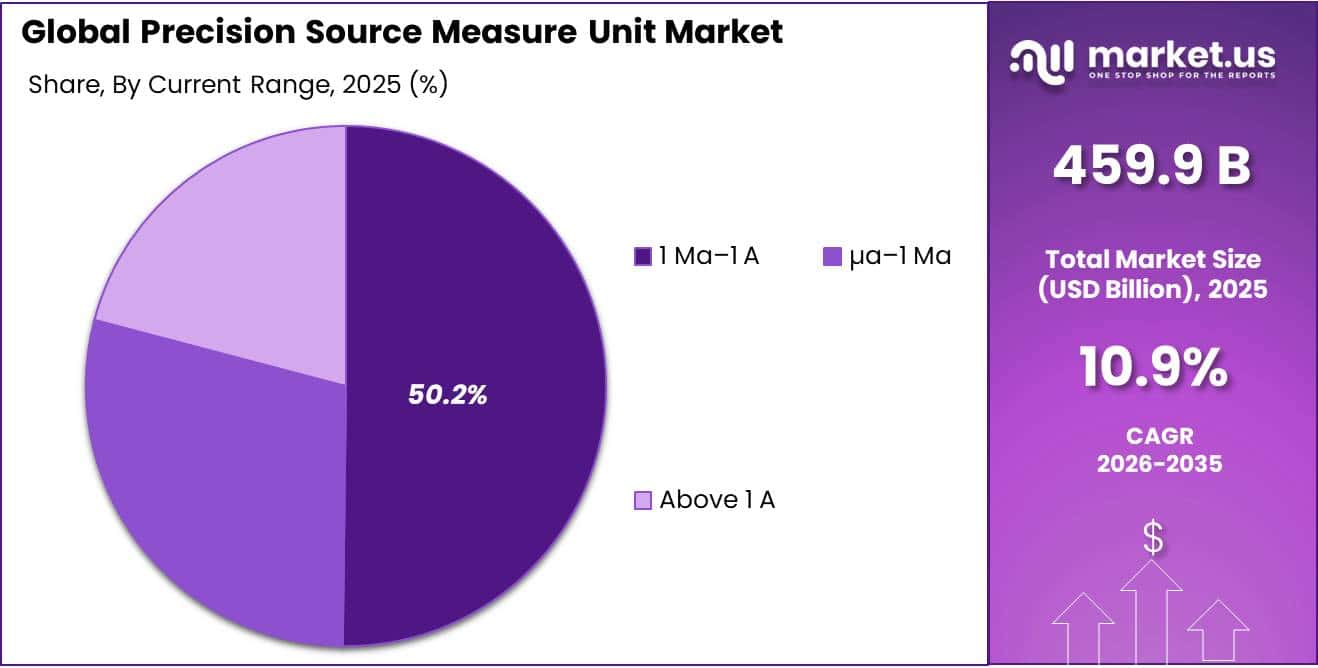
- 1 mA–1 A held a dominant market position, capturing more than a 50.00% share.
- Semiconductor Testing held a dominant market position, capturing more than a 42.00% share.
- IT And Telecommunication held a dominant market position, capturing more than a 33.00% share.
- Asia Pacific held a dominant market position, capturing more than a 35.50% share and generating approximately 163.26 BN in revenue.
By Product Type Analysis
General-Purpose SMUs dominate with more than 45.70% share as flexible electrical testing remains essential across laboratories
In 2025, “General-Purpose SMUs” held a dominant market position, capturing more than a 45.70% share. Their leadership is supported by broad use across semiconductor R&D, component characterization, sensor testing, university laboratories, power electronics, and automated production environments. These instruments can source voltage or current while measuring electrical response with high precision, allowing one platform to support several test requirements.
The industrial base remains strong, as global semiconductor sales reached USD 791.7 billion in 2025, increasing 25.6%, while logic semiconductor sales reached USD 301.9 billion. The U.S. Department of Commerce also reported USD 39 billion for CHIPS manufacturing incentives, approximately USD 34 billion already awarded, and nearly USD 450 billion in planned semiconductor investment.
Application-Specific SMUs continue to gain importance in the Precision Source Measure Unit Market because advanced semiconductor, battery, photovoltaic, power-device, and high-speed electronics applications increasingly require specialized current ranges, faster sampling, multi-channel operation, and ultra-low-current measurement. Their role is particularly strong in wafer-level testing, power semiconductor characterization, leakage analysis, reliability testing, and automated semiconductor production.
In 2025, worldwide semiconductor manufacturing equipment sales reached USD 135.1 billion, rising 15% from the previous year. Semiconductor test-equipment billings increased 55%, while assembly and packaging equipment sales expanded 21%, reflecting greater testing complexity from AI devices, high-bandwidth memory, advanced logic, and packaging technologies.
By Current Range Analysis
1 mA–1 A dominates with more than 50.00% share as mainstream semiconductor and electronics testing expands
In 2025, “1 mA–1 A” held a dominant market position, capturing more than a 50.00% share. This current range is widely used for semiconductor characterization, power-device testing, LED evaluation, sensor development, battery research, and general electronic component validation. It provides a practical balance between precision measurement and sufficient current sourcing for routine laboratory and production testing.
The U.S. Department of Commerce reported USD 39 billion under the CHIPS manufacturing incentive program, with approximately USD 34 billion awarded through 34 negotiated deals across 22 states by 2025.
µA–1 mA continues to hold an important position in the Precision Source Measure Unit Market because this range is suited to low-power semiconductor devices, photodiodes, sensors, MEMS components, IoT electronics, leakage-current measurement, and material research. It allows engineers to characterize devices where very small changes in current can directly affect efficiency and reliability.
Semiconductor test activity increased sharply in 2025, with worldwide semiconductor manufacturing equipment sales reaching USD 135.1 billion, up 15% from the previous year. Test-equipment billings increased by 55%, while assembly and packaging equipment sales grew 21%, as AI devices and high-bandwidth memory increased testing complexity.
By Application Analysis
Semiconductor Testing dominates with more than 42.00% share as chip manufacturing requires tighter electrical characterization
In 2025, “Semiconductor Testing” held a dominant market position, capturing more than a 42.00% share. Precision SMUs are widely used during wafer testing, transistor characterization, leakage-current measurement, I-V analysis, reliability testing, and validation of logic and memory devices.
- Demand remained strong as worldwide semiconductor manufacturing equipment sales reached USD 135.1 billion in 2025, increasing 15%, while semiconductor test-equipment billings jumped 55% because AI devices and high-bandwidth memory require greater test intensity. Government investment is also expanding the testing base. In 2025, the U.S. Department of Commerce reported USD 39 billion for CHIPS manufacturing incentives, approximately USD 34 billion already awarded, and nearly USD 450 billion in planned semiconductor-related investment.
Battery Testing continues to gain importance in the Precision Source Measure Unit Market as electric vehicles, battery-management systems, energy storage, and cell-development programs expand. Precision SMUs help engineers measure charge and discharge behaviour, leakage current, internal electrical response, battery-management circuits, and low-current performance during cell and module development.
According to the International Energy Agency, global EV battery deployment reached 1.2 TWh in 2025, increasing almost 30% from the previous year and reaching more than 7 times its 2020 level. Light-duty vehicles represented more than 85% of total EV battery deployment.
By Industry Vertical Analysis
IT And Telecommunication dominates with more than 33.00% share as 5G and broadband networks increase precision testing needs
In 2025, “IT And Telecommunication” held a dominant market position, capturing more than a 33.00% share. Precision SMUs are widely used for testing communication semiconductors, RF modules, optical components, network hardware, sensors, and low-power electronic devices where accurate voltage and current measurements are required.
The International Telecommunication Union reported 9.2 billion mobile-cellular subscriptions worldwide in 2025, while 36% of mobile-broadband subscriptions were already based on 5G technology. Global 5G coverage also reached 55% of the population, with coverage increasing to 84% in high-income economies. This expanding telecommunications infrastructure requires greater semiconductor characterization, reliability testing, and electronic component validation, supporting demand for precision SMUs.
- Government broadband investment is providing an additional testing base. In 2025, the U.S. National Telecommunications and Information Administration continued implementation of the USD 42.45 billion Broadband Equity, Access, and Deployment program covering 56 states and territories.
In 2025, global semiconductor sales reached USD 791.7 billion, increasing 25.6% from USD 630.5 billion in the previous year. Fourth-quarter sales reached USD 236.6 billion, up 37.1% year over year, while worldwide logic semiconductor sales reached USD 301.9 billion.
Key Market Segments
By Product Type
- General-Purpose SMUs
- Application-Specific SMUs
- Precision SMUs
By Current Range
- µa–1 Ma
- 1 Ma–1 A
- Above 1 A
By Application
- Semiconductor Testing
- Battery Testing
- Solar-Cell Testing
- LED Characterization
- Other Applications
By Industry Vertical
- Semiconductor And Electronics
- Automotive
- IT And Telecommunications
- Energy And Utilities
- Research And Education
- Other Industries
Driver Analysis
Advanced Semiconductor Characterization
A modern SMU consolidates precision voltage/current sourcing, simultaneous measurement, sweep control, and active load capability in one instrument; low-current applications commonly require sub-microamp precision, while premium products now address femtoamp-level current resolution and nanovolt-to-microvolt measurement requirements.
Advanced-node and heterogeneous packages increase the number of electrical interfaces and characterization points per device; an analyst model for a chiplet or 2.5D/3D package assumes 20–40% more DC-parametric, leakage, interconnect, and thermal test sequences than a conventional monolithic package, increasing the SMU count in a characterization laboratory from roughly 12–24 channels per program to 24–64 channels when parallel probing and reliability testing are included.
The purchase mix is consequently moving away from single, general-purpose bench units toward multi-channel modular platforms with synchronized triggering, higher channel density, automated wafer-probe compatibility, and software-controlled compliance limits, raising typical system value from approximately USD 15,000–50,000 for a basic characterization setup to USD 100,000–500,000 for an automated multi-channel parametric cell.
Tektronix’s September 2026 launch of a 200 V dual-channel module for its MP5000 modular precision-test platform underscores the market’s shift toward scalable semiconductor and optical-device validation rather than stand-alone instruments. This shifts supplier economics toward application software, probe-station integration, calibration, extended support, and multi-year service contracts, and is modeled to add approximately +1.9 percentage points to baseline CAGR across the United States, Taiwan, South Korea, Japan, and European semiconductor corridors through 2028–2030.
Drivers Impact Analysis
| Driver | (~) % Impact on CAGR Forecast | Geographic Relevance | Impact Timeline |
|---|---|---|---|
| Advanced Semiconductor Characterization | +1.9 pp | U.S., Taiwan, Korea, Japan, EU | Medium term (2–4 years) |
| SiC/GaN Power Device Qualification | +1.6 pp | China, EU, U.S., Japan, Korea | Short term (≤ 2 years) |
| Battery and Energy Storage Testing | +1.4 pp | China, North America, EU, Japan, Korea | Medium term (2–4 years) |
| PV and Perovskite I–V Research | +1.1 pp | China, EU, U.S., India, Japan | Medium term (2–4 years) |
| Modular Automated Test Expansion | +1.5 pp | U.S., EU, China, Taiwan, Japan | Short term (≤ 2 years) |
| Optical and Quantum Device R&D | +1.0 pp | U.S., EU, China, Japan, Singapore | Long term (≥ 4 years) |
Restraint Analysis
High Precision-System CapEx
High acquisition cost constrains SMU adoption because a precision source-measure system is not purchased as an isolated instrument: customers typically require a low-noise SMU, guarded or triaxial cabling, switching and multiplexing hardware, a probe station or test fixture, thermal or optical interfaces, automation software, calibration documentation, and operator training before it becomes a productive characterization platform. Current commercial price points illustrate the segmentation: a specialized eight-channel low-power photovoltaic SMU is listed near €7,999, while a four-channel higher-power configuration is near €12,500; these prices exclude fixtures, computers, probes, environmental controls, automation, installation, and service.
A credible multi-channel semiconductor, power-device, battery, or optoelectronics research cell therefore requires an estimated USD 30,000–120,000 for basic automated capability, while a 16–64 channel modular parametric platform with probe-station integration, shielding, switching, and custom test software can require USD 150,000–600,000. The cost threshold is especially prohibitive for university departments, venture-backed device startups, contract R&D houses, and regional test laboratories operating with annual capital budgets below USD 100,000–250,000; a single high-end system can consume 20–60% of the entire equipment allocation and trigger procurement review cycles lasting 3–9 months.
Vendors face a margin trade-off because price reduction is difficult when precision ADC/DAC components, electrometer-grade front ends, low-noise references, shielding, thermal design, and traceable calibration collectively account for an estimated 45–65% of the bill of materials, while distributors still require 15–30% channel margin. The result is deferred purchases, lower-channel-count configurations, continued use of separate DC supplies and multimeters, or leasing of external characterization services, imposing an estimated -1.6 percentage-point drag on attainable market CAGR in cost-sensitive global regions during the short term.
Restraint Impact Analysis
| Restraint | (~) % Impact on CAGR Forecast | Geographic Relevance | Impact Timeline |
|---|---|---|---|
| High Precision-System CapEx | -1.6 pp | Global; India, ASEAN, LATAM, Africa | Short term (≤ 2 years) |
| Precision Analog Supply Concentration | -1.4 pp | U.S., EU, Taiwan, China, Japan | Short term (≤ 2 years) |
| Calibration and Metrology Burden | -1.1 pp | North America, EU, Japan, Korea | Medium term (2–4 years) |
| Export-Control Compliance Friction | -1.0 pp | U.S., EU, China, Taiwan, Korea | Medium term (2–4 years) |
| Low-Cost Instrument Substitution | -1.3 pp | APAC, LATAM, Eastern Europe, Africa | Medium term (2–4 years) |
| Academic and SME Budget Deferral | -0.9 pp | North America, EU, India, ASEAN | Short term (≤ 2 years) |
Opportunity Analysis
SMU-as-a-Service Subscriptions
A vendor can offer a USD 8,000–25,000 two- to four-channel SMU through a 36–60 month subscription at roughly USD 250–900 per month, including traceable calibration, firmware updates, replacement coverage, remote technical support, and a refresh option, converting an upfront approval barrier into an operating expense. The commercial case strengthens because modern low-power eight-channel SMU systems are priced near €7,999 and four-channel high-power laboratory configurations near €12,500 before fixtures and automation, leaving a substantial portion of smaller customers unable to build a complete test capability from capital budgets alone.
For the supplier, a five-year subscription can create 25–60% higher lifetime account revenue than a single hardware sale, while annual calibration, support, accessories, software, and refresh cycles raise recurring revenue from below 10% of account value toward 30–45%; with 70–80% of hardware value recoverable through redeployment, certified refurbishment, or lease extension, residual-value risk can be managed through standardized configurations and remote utilization tracking.
A 10% subscription conversion rate among entry and mid-tier buyers could increase installed base penetration without requiring equivalent unit-price discounting, while reducing customer-acquisition cost through renewal and add-on channel expansion. This model is estimated to add approximately +1.5 percentage points above baseline CAGR across North America, Europe, India, and ASEAN over the next two years.
Opportunity Impact Analysis
| Opportunity | (~) % Potential CAGR Upside | Geographic Relevance | Execution Window |
|---|---|---|---|
| SMU-as-a-Service Subscriptions | +1.5 pp | North America, EU, India, ASEAN | Short term (≤ 2 years) |
| AI-Driven Adaptive Test Software | +1.7 pp | U.S., EU, China, Taiwan, Korea | Medium term (2–4 years) |
| Shared Characterization Test Hubs | +1.3 pp | India, ASEAN, LATAM, Africa, GCC | Medium term (2–4 years) |
| Calibration Intelligence Platforms | +1.0 pp | North America, EU, Japan, Korea | Short term (≤ 2 years) |
| Photonics and Quantum Test Cells | +1.4 pp | U.S., EU, China, Japan, Singapore | Long term (≥ 4 years) |
| Modular SMU Roll-Up Ecosystems | +1.2 pp | Global; EU, APAC, North America | Medium term (2–4 years) |
Challenges Analysis
Femtoamp Measurement Integrity
PXI SMU specifications demonstrate that 10 fA current sensitivity is achievable only through long integration windows, low-noise front ends, and carefully controlled test conditions; at the same time, even a well-specified instrument’s useful resolution depends on aperture, filtering, guarding, fixture design, and environmental discipline.
The commercial friction is substantial: a low-current semiconductor, photodiode, sensor, dielectric, MEMS, or quantum-device test cell can require USD 10,000–80,000 of guarded triaxial cabling, low-leakage fixtures, shielding, probe interfaces, humidity control, isolation hardware, and periodic cleaning beyond the SMU itself; measurement troubleshooting can consume 10–30% of an engineer’s characterization time and cause false device failures, retests, and delayed design decisions.
Suppliers must therefore shift from selling a precision box to providing validated measurement environments, including guarded fixture libraries, automated leakage self-tests, shielded enclosures, contamination protocols, environmental logging, and field application support, but this increases sales complexity and service cost. Until robust low-current workflow standardization becomes common, femtoamp integrity limitations impose an estimated -1.3 percentage-point friction drag on attainable CAGR across semiconductor, photonics, materials-science, and advanced-sensor markets globally.
Challenges Impact Analysis
| Challenge | (~) % CAGR Friction Drag | Geographic Relevance | Mitigation Horizon |
|---|---|---|---|
| Femtoamp Measurement Integrity | -1.3 pp | Global semiconductor, photonics, materials labs | Long term (≥ 4 years) |
| Precision-Speed Trade-Off | -1.1 pp | U.S., EU, Taiwan, China, Korea, Japan | Medium term (2–4 years) |
| Multi-Vendor Automation Integration | -1.0 pp | North America, EU, China, Japan | Medium term (2–4 years) |
| Specialist Applications Talent Gap | -0.9 pp | U.S., EU, Taiwan, Korea, Japan, Singapore | Long term (≥ 4 years) |
| Calibration Drift Governance | -0.9 pp | Global regulated test environments | Medium term (2–4 years) |
| Global Service Network Scaling | -0.8 pp | India, ASEAN, LATAM, Africa, GCC | Long term (≥ 4 years) |
Geopolitical Impact Analysis
Ongoing Wars Disrupt Semiconductor Supply Chains but Increase Demand for Precision Electronic Testing
The Russia–Ukraine war and continuing Middle East conflict are creating a mixed impact on the Precision Source Measure Unit Market. Precision SMUs depend heavily on semiconductor, sensor, power-electronics, and communication-device supply chains.
In July 2026, the European Union added 51 entities to tighter export restrictions on dual-use goods and technologies linked to Russia, including microelectronics and semiconductor-processing equipment. The same sanctions package included 37 listings directly connected with long-range drone supply chains. These restrictions can increase sourcing complexity and compliance costs for electronic test-equipment manufacturers.
Middle East shipping disruption is adding another supply risk. The International Maritime Organization reported in August 2026 that up to 400 ships carrying around 6,000 seafarers had been unable to leave the Persian Gulf safely, while at least 70 attacks on international shipping had been verified. Such disruption can lengthen component delivery times and raise logistics costs, while defense-electronics testing continues to support market demand.
Regional Insights
Asia Pacific leads with 35.50% share and 163.26 BN, while North America shows strong growth potential
In 2025, Asia Pacific held a dominant market position, capturing more than a 35.50% share and generating approximately 163.26 BN in revenue. Its leadership is supported by heavy semiconductor equipment investment across China, Taiwan, South Korea, and Japan.
SEMI reported that China, Taiwan, and South Korea together represented 79% of global semiconductor equipment spending in 2025. China invested USD 49.3 billion, Taiwan reached USD 31.5 billion after 90% growth, and South Korea spent USD 25.8 billion, up 26%. This manufacturing concentration creates a large requirement for precision electrical characterization, parametric testing, and production-grade SMUs.
North America is positioned as the fastest-growing regional opportunity as semiconductor reshoring and advanced-device investment expand local testing capacity. Semiconductor sales in the Americas increased 30.5% in 2025, according to the Semiconductor Industry Association.
The U.S. Department of Commerce also reported USD 39 billion for CHIPS manufacturing incentives, about USD 34 billion already awarded, and nearly USD 450 billion in planned semiconductor-related private investment. New fabs, packaging plants, R&D centers, AI-chip facilities, and power-electronics projects should increase demand for high-accuracy, multi-channel SMUs used across semiconductor, communications, automotive, and advanced electronics testing.
Key Regions and Countries Insights
- North America
- US
- Canada
- Europe
- Germany
- France
- The UK
- Spain
- Italy
- Rest of Europe
- Asia Pacific
- China
- Japan
- South Korea
- India
- Australia
- Rest of APAC
- Latin America
- Brazil
- Mexico
- Rest of Latin America
- Middle East & Africa
- GCC
- South Africa
- Rest of MEA
Key Players Analysis
Keysight Technologies remains a major competitor in the Precision Source Measure Unit Market, supported by its semiconductor and electronic test portfolio. In fiscal 2025, the company generated USD 5.375 billion in revenue and spent USD 954 million on R&D. Its B2900B/BL Precision SMU family covers up to 210 V, 3 A DC, and 10.5 A pulsed output, with measurement resolution reaching 10 fA and 100 nV. These capabilities support semiconductor characterization, power-device testing, photovoltaic research, and automated production environments.
Tektronix maintains a strong position in precision electronic testing through Ralliant’s Test and Measurement business, which includes Tektronix and Keithley Instruments. In 2025, this segment generated USD 801.5 million in sales. The portfolio covers oscilloscopes, probes, source measuring units, semiconductor test systems, and high-power bidirectional supplies. Ralliant serves more than 90,000 customers across over 90 countries, giving Tektronix broad access to semiconductor, defense, networking, renewable-energy, electric-mobility, and research applications where precise source-and-measure capability is increasingly required.
Keithley Instruments is one of the established names in precision source-and-measure technology, with products designed for semiconductor, materials, battery, and automated production testing. Its 2600B Series SMUs offer 1- or 2-channel configurations, current ranges extending from 0.1 fA to 10 A, voltage capability up to 200 V, and reading speeds of up to 20,000 readings per second. TSP-Link technology can connect as many as 64 channels, supporting parallel testing where throughput and measurement accuracy are important.
Top Key Players Outlook
- Keysight Technologies
- Tektronix
- Keithley Instruments
- National Instruments, an Emerson company
- Rohde & Schwarz
- Yokogawa Electric Corporation
- Chroma ATE
- Advantest Corporation
- Teradyne
- VX Instruments
- Ossila
- Marvin Test Solutions
- HIOKI E.E. Corporation
- ITECH Electronic
- Aim-TTi
Recent Developments
- In January 2026, Chroma expanded its partnership with National Taiwan University of Science and Technology by supporting a Smart Electric Vehicle Research Center equipped with its high-power test systems; the installed 1210 E-Propulsion platform handles up to 20,000 rpm, 500 Nm, and 300 kW.
- Yokogawa’s Measuring Instruments business generated JPY 34.0 billion in FY2025 sales and JPY 7.8 billion in operating profit. Group R&D spending reached JPY 33.0 billion, equal to 5.5% of sales, while capital expenditure totaled JPY 32.2 billion, showing continued investment in measurement technology and product development.
Report Scope
| Report Features | Description |
|---|---|
| Market Value (2025) | USD 459.9 Bn |
| Forecast Revenue (2035) | USD 1291.8 Bn |
| CAGR (2026-2035) | 10.9% |
| Base Year for Estimation | 2025 |
| Historic Period | 2020-2024 |
| Forecast Period | 2026-2035 |
| Report Coverage | Revenue Forecast, Market Dynamics, Competitive Landscape, Recent Developments |
| Segments Covered | By Product Type (General-Purpose SMUs, Application-Specific SMUs, Precision SMUs), By Current Range (µa–1 Ma, 1 Ma–1 A, Above 1 A), By Application (Semiconductor Testing, Battery Testing, Solar-Cell Testing, LED Characterization, Other Applications), By Industry Vertical (Semiconductor And Electronics, Automotive, IT And Telecommunications, Energy And Utilities, Research And Education, Other Industries) |
| Regional Analysis | North America – US, Canada; Europe – Germany, France, The UK, Spain, Italy, Rest of Europe; Asia Pacific – China, Japan, South Korea, India, Australia, Singapore, Rest of APAC; Latin America – Brazil, Mexico, Rest of Latin America; Middle East & Africa – GCC, South Africa, Rest of MEA |
| Competitive Landscape | Keysight Technologies, Tektronix, Keithley Instruments, National Instruments, an Emerson company, Rohde & Schwarz, Yokogawa Electric Corporation, Chroma ATE, Advantest Corporation, Teradyne, VX Instruments, Ossila, Marvin Test Solutions, HIOKI E.E. Corporation, ITECH Electronic, Aim-TTi |
| Customization Scope | Customization for segments, region/country-level will be provided. Moreover, additional customization can be done based on the requirements. |
| Purchase Options | We have three licenses to opt for: Single User License, Multi-User License (Up to 5 Users), Corporate Use License (Unlimited User and Printable PDF) |





































