Report Overview
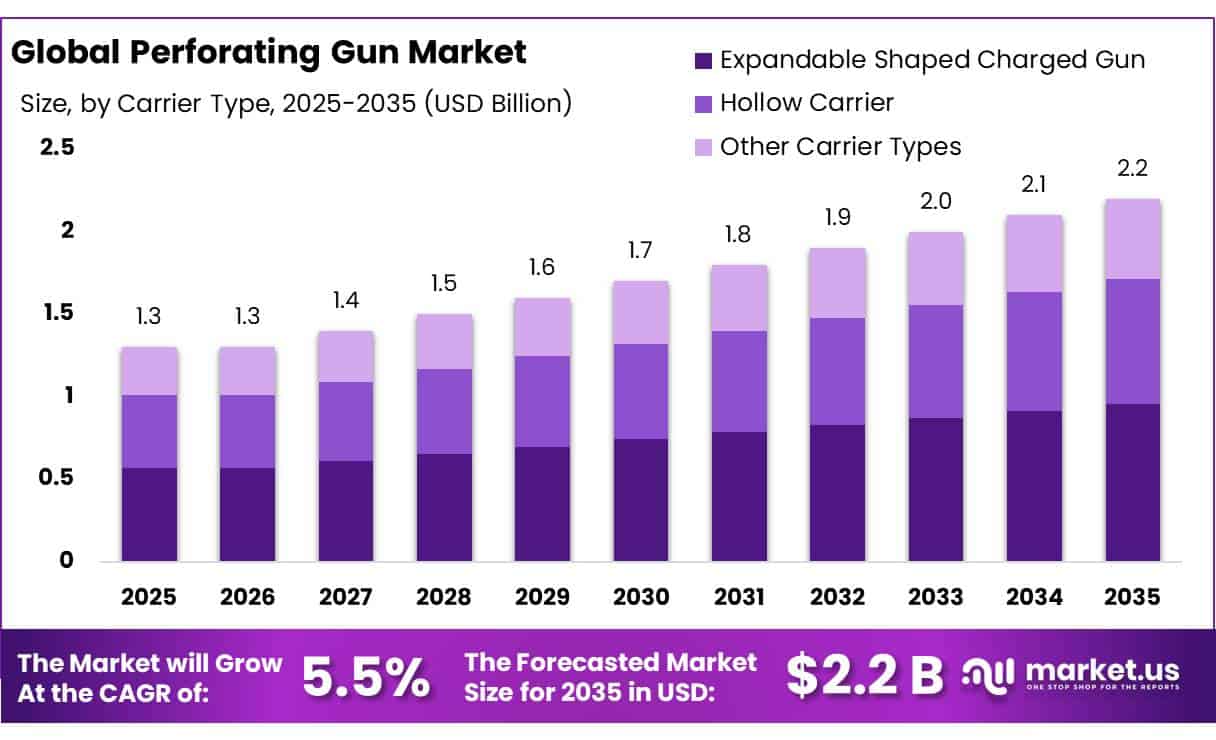
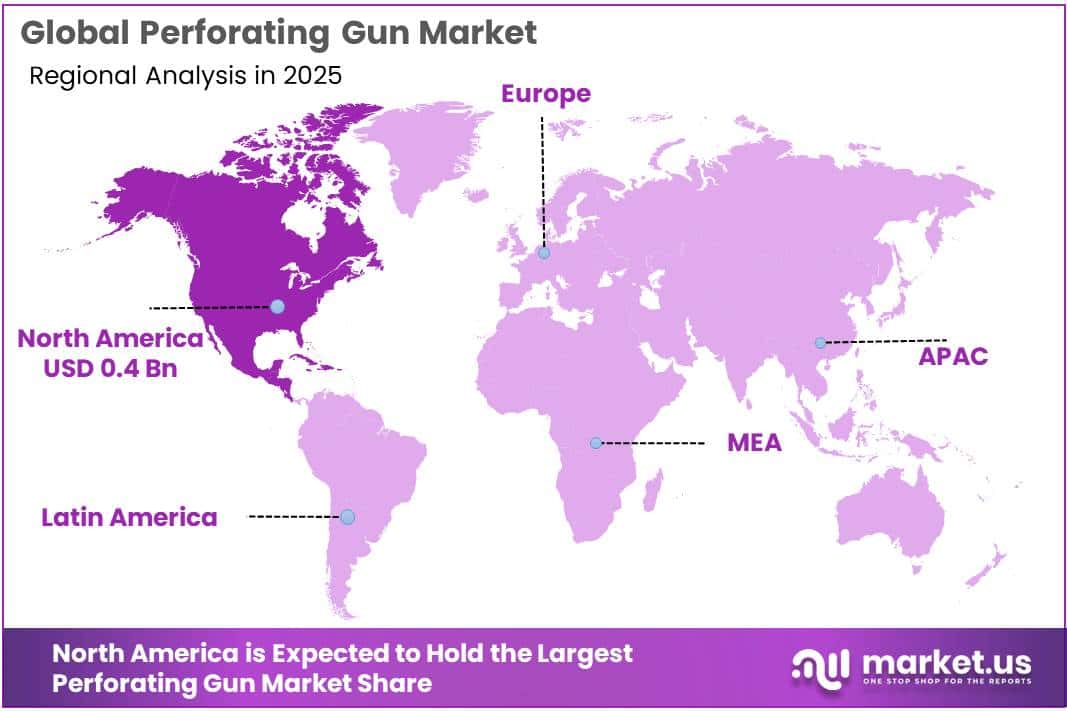
The Global Perforating Gun Market size is expected to be worth around USD 2.2 Billion by 2035, from USD 1.3 Billion in 2025, growing at a CAGR of 5.5% during the forecast period from 2026 to 2035. In 2025, North America held a dominant market position, capturing more than a 38.60% share, holding USD 0.4 Billion revenue.
The perforating gun industry plays an important role in the global oil and gas sector by supporting well completion, hydrocarbon extraction, and reservoir development. Perforating guns are specialized downhole tools designed to create controlled openings through well casing, cement, and surrounding rock formations. These openings allow oil and natural gas to enter the wellbore and move towards the production system. The equipment generally uses shaped explosive charges, detonating cords, and firing mechanisms to create perforation tunnels.
Perforating guns are available in different configurations, including hollow-carrier guns, expendable guns, through-tubing guns, and tubing-conveyed perforating systems. Their selection depends on well depth, casing diameter, reservoir pressure, temperature, and completion requirements. According to SLB, shaped-charge perforating technology became an important part of well completion after its introduction in 1948, helping operators improve access to hydrocarbon-bearing formations.
The industrial scenario is closely connected to drilling activity, unconventional oil and gas production, well intervention, and hydraulic fracturing operations. The expansion of horizontal drilling and multi-stage fracturing has increased the importance of reliable perforating systems, particularly in shale and tight formations.
According to the U.S. Energy Information Administration (EIA), the United States recorded average crude oil production of 13.6 million barrels per day in 2025, representing a 3% increase compared with 2024. The Permian Basin alone produced approximately 6.6 million barrels per day, accounting for around 48% of total U.S. crude oil production. These production levels demonstrate the continued importance of advanced well-completion equipment, including perforating guns.
The demand for perforating guns is driven by the increasing need for efficient well completion, higher reservoir connectivity, and improved production from existing oil and gas fields. Horizontal drilling is a particularly important growth factor because longer well sections require multiple perforation intervals to support effective hydrocarbon flow. EIA data show that the share of horizontal wells among U.S. producing wells increased from 10% in 2014 to 22% in 2024. This development supports demand for advanced gun systems, high shot-density configurations, precision-shaped charges, and selective firing technologies.
Technological advancements are also changing the industrial landscape. Manufacturers such as SLB and Baker Hughes are developing improved perforating systems with better penetration, consistent entry-hole sizes, and enhanced deployment reliability. Baker Hughes reports that its DeepConnect shaped charges can provide up to 50% additional penetration in certain challenging reservoir conditions. Its pump-down perforating solutions also support multiple-gun deployment and selective firing, helping operators improve operational efficiency during multi-stage hydraulic fracturing.
Key Takeaways
- Perforating Gun Market size is expected to be worth around USD 2.2 Billion by 2035, from USD 1.3 Billion in 2025, growing at a CAGR of 5.5%.
- Expandable Shaped Charged Gun held a dominant market position, capturing more than a 43.67% share.
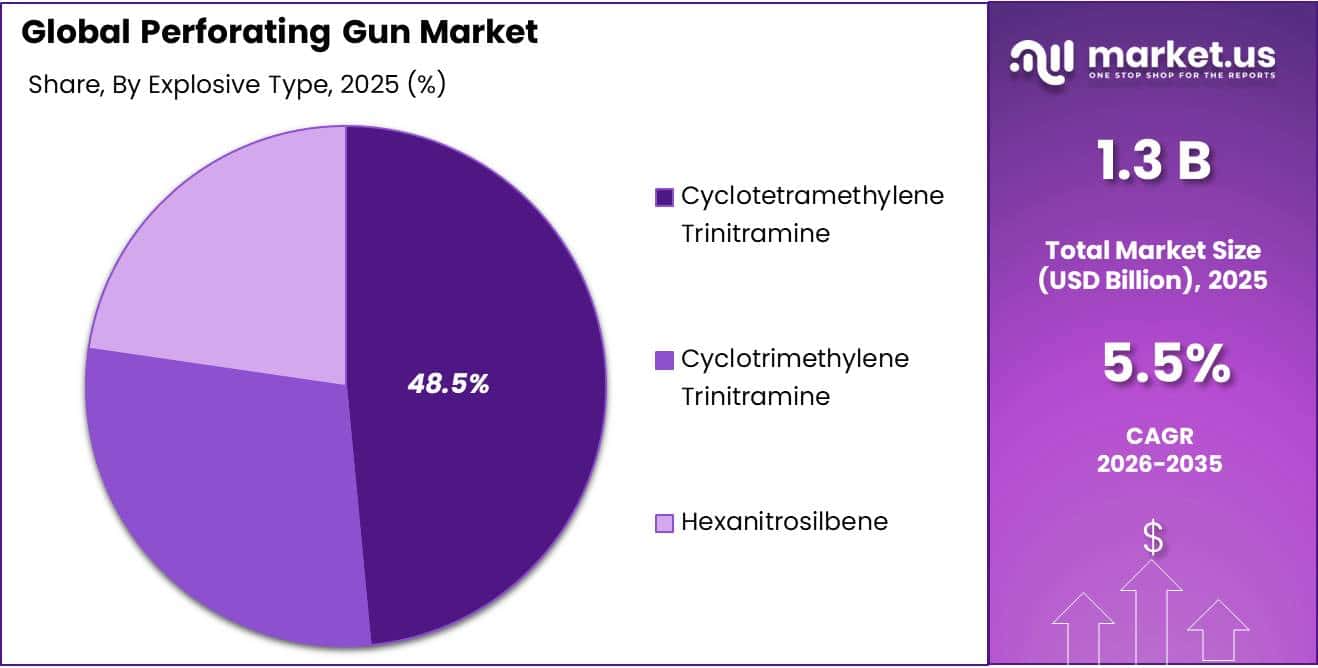
- Cyclotetramethylene Trinitramine (HMX) held a dominant market position, capturing more than a 48.56% share.
- Horizontal and Deviated Well held a dominant market position, capturing more than a 58.78% share.
- North America dominated the Perforating Gun Market, accounting for 37.56% of the market, valued at USD 0.4 billion.
By Carrier Type Analysis
Expandable Shaped Charged Gun dominates with a 43.67% share due to its reliable perforation performance and suitability for demanding well-completion operations.
In 2025, Expandable Shaped Charged Gun held a dominant market position, capturing more than a 43.67% share of the Perforating Gun Market by carrier type. Its demand is supported by its ability to deliver effective perforation performance while maintaining operational flexibility in different well conditions. Oil and gas operators increasingly focus on improving reservoir connectivity and production efficiency, supporting the adoption of expandable shaped charged gun systems.
Hollow Carrier perforating guns are widely used in oil and gas well-completion operations because their robust casing protects explosive charges during deployment and helps maintain consistent perforation performance. In 2025, this segment continued to support conventional and complex well-completion requirements. In 2026, demand is expected to benefit from the continued need for dependable downhole equipment, particularly in high-pressure and challenging reservoir conditions.
By Explosive Type Analysis
Cyclotetramethylene Trinitramine (HMX) dominates the Perforating Gun Market with a 48.56% share, supported by its high energy output and reliable performance in demanding well-completion operations.
In 2025, Cyclotetramethylene Trinitramine (HMX) held a dominant market position, capturing more than a 48.56% share of the Perforating Gun Market by explosive type. HMX is preferred in perforating applications because of its high detonation energy and ability to support effective penetration of casing, cement, and reservoir rock. Its application helps oil and gas operators achieve reliable perforation performance under challenging downhole conditions.
Cyclotrimethylene Trinitramine (RDX) is used in specialized perforating applications where controlled energetic performance is required. In 2025, the segment continued to contribute to the perforating gun industry through its established role in explosive-based well-completion technologies. In 2026, demand is expected to remain connected to oilfield perforation activities, well intervention, and production enhancement requirements. Its industrial relevance is supported by its established technical properties and continued use in specialized energetic applications.
By Well Type Analysis
Horizontal and Deviated Well dominates the Perforating Gun Market with a 58.78% share, driven by its growing importance in advanced oil and gas extraction.
In 2025, Horizontal and Deviated Well held a dominant market position, capturing more than a 58.78% share of the Perforating Gun Market by well type. These wells are widely used to improve reservoir contact and increase hydrocarbon recovery from productive formations. Their completion often requires specialized perforating guns capable of operating across multiple intervals and supporting efficient well stimulation.
Vertical Well perforating systems support oil and gas extraction by creating openings between the wellbore and the producing formation. In 2025, this segment continued to serve conventional reservoirs where vertical drilling remains technically suitable and economically practical. In 2026, demand is expected to be supported by ongoing conventional field development, well maintenance, and production enhancement activities.
Key Market Segments
By Carrier Type
- Hollow Carrier
- Expandable Shaped Charged Gun
- Other Carrier Types
By Explosive Type
- Cyclotrimethylene Trinitramine (RDX)
- Cyclotetramethylene Trinitramine (HMX)
- Hexanitrosilbene (HNS)
By Well Type
- Horizontal and Deviated Well
- Vertical Well
Driver Analysis
Longer Multistage Laterals
Longer horizontal wells increase potential perforating content per completed well, making lateral footage and completion design more informative demand indicators than rig counts alone. The US Energy Information Administration reports that average new horizontal Permian lateral length increased from 6,149 feet in 2015 to 10,867 feet in 2025, approximately 77%; wells exceeding 15,000 feet represented 15% of new completions in 2025, compared with virtually none before 2020. Meanwhile, new horizontal completions remained around 6,000 annually from 2022, demonstrating how completion intensity can increase without equivalent growth in well count.
Under an illustrative design with 200-foot stages and five perforated clusters per stage, increasing lateral length from 10,000 to 15,000 feet raises stage count from 50 to 75 and cluster count from 250 to 375, a 50% increase before changes in spacing, charges per cluster or completion architecture; these are modeling assumptions, not representative basin averages. Importantly, clusters, guns and wireline runs are not interchangeable units, so the calculation should not be translated mechanically into a 50% increase in gun shipments.
Hunting’s 2025 results presentation specifically associates North American product adoption with longer laterals and more stages, supporting the commercial link while also identifying company-specific market-share effects. Suppliers consequently compete on reliable initiation, consistent charge performance and assembly efficiency across longer strings, with consumable demand increasingly tied to completed footage rather than drilling activity. The +1.1 pp contribution assumes 22% of addressable revenue grows 5 percentage points faster than the underlying case because of additional North American completion content; improved production per well is not itself counted as additional perforating demand.
Drivers Impact Analysis
| Driver | (~) % Impact on CAGR Forecast | Geographic Relevance | Impact Timeline |
|---|---|---|---|
| Longer multistage laterals | +1.1 pp | US Permian core; Canada | Short term (≤ 2 years) |
| Middle East unconventional gas | +0.8 pp | Saudi Arabia core; Gulf | Medium term (2–4 years) |
| Vaca Muerta development | +0.6 pp | Argentina core | Short term (≤ 2 years) |
| Offshore completion programs | +0.6 pp | Brazil core; Atlantic basins | Medium term (2–4 years) |
| Integrated premium gun systems | +0.5 pp | North America, Middle East, Brazil | Short term (≤ 2 years) |
Restraint Analysis
Completion-Budget Contraction
Reduced expenditure on new well completions directly limits the number of perforating operations, even when improved productivity allows hydrocarbon output to remain resilient. EIA data show that US Lower 48 active oil and gas rigs declined from 750 in December 2022 to 517 in October 2025, approximately 31%; oil-directed rigs fell 33% to 397 and gas-directed rigs declined 23% to 120.
Over the same broad period, production reached new records, demonstrating why output growth cannot substitute for a forecast of completed wells or perforated stages. EIA’s April 2026 Annual Energy Outlook projects Brent below $70/barrel in real 2025 dollars through 2030 in its reference framework, creating a plausible planning environment for disciplined investment rather than an assurance of expanding completion budgets; this is a scenario projection, not an observed spot price or guaranteed outcome.
This explicitly recognizes the longer-lateral driver without assuming it offsets every reduction in well count. Suppliers consequently face lower production-line loading and weaker consumable demand, requiring regional diversification and order-backed capacity planning rather than reliance on production headlines. The −0.6 pp deduction assumes 30% of addressable revenue grows 2 percentage points more slowly because of reduced completion expenditure; temporary procurement suspensions at otherwise funded programs are allocated separately below.
Restraint Impact Analysis
| Restraint | (~) % Impact on CAGR Forecast | Geographic Relevance | Impact Timeline |
|---|---|---|---|
| Completion-budget contraction | −0.6 pp | US, Canada core | Short term (≤ 2 years) |
| Non-perforating completion substitution | −0.4 pp | North America, Middle East | Medium term (2–4 years) |
| Explosives approval barriers | −0.3 pp | US; cross-border supply | Short term (≤ 2 years) |
| Operator procurement pauses | −0.3 pp | Saudi Arabia; international contracts | Short term (≤ 2 years) |
| Openhole addressability limits | −0.2 pp | Offshore Brazil; conventional basins | Long term (≥ 4 years) |
Opportunity Analysis
Screened Reperforation Programs
Systematically screening existing wells for economically justified reperforation can create incremental gun demand from assets that would otherwise receive no perforating intervention, shifting the commercial model from reactive equipment supply to operator-approved candidate portfolios. Through-tubing perforating is already established: SLB markets small-diameter systems specifically for reperforation and well revitalization, including a retrievable 2⅛-inch capsule-gun configuration. The white space is therefore systematic conversion of previously untreated candidates—not the invention of a new gun category or counting ordinary workover demand twice.
A historical Alaska gas-storage case demonstrates technical feasibility rather than contemporary market growth: four wells reperforated using 1,790 feet of guns across 66 tractor descents achieved reported injection-rate increases of 50–300%; these 2013 results must not be generalized into expected uplift for other reservoirs. In an illustrative program screening 1,000 wells, a 10% technical-candidate rate followed by 40% commercial conversion yields 40 incremental interventions. At an assumed $25,000 of gun-system product content per intervention, that represents $1 million of supplier revenue, excluding logging, tractor and wireline fees.
Commercial execution requires baseline injectivity or productivity data, confirmation that perforation-related impairment is material, and a comparison with non-perforating remedies; screening without these gates risks spending on ineffective interventions. Partnerships with reservoir specialists can support access, but service revenue remains outside this market. The +0.30 pp upside corresponds to approximately 1.8 additional 2031 revenue-index points, counting only interventions above the baseline workover forecast and excluding market-share transfers.
Opportunity Impact Analysis
| Opportunity | (~) % Potential CAGR Upside | Geographic Relevance | Execution Window |
|---|---|---|---|
| Screened reperforation programs | +0.30 pp | US, Canada, Middle East | Short term (≤ 2 years) |
| Geothermal completion qualification | +0.25 pp | US core; selected European projects | Medium term (2–4 years) |
| CO₂-storage injection systems | +0.20 pp | US Gulf Coast, North Sea | Medium term (2–4 years) |
| Distributed qualification hubs | +0.20 pp | Middle East, India, Argentina | Medium term (2–4 years) |
| Performance-linked product contracts | +0.15 pp | US, Canada, Middle East | Short term (≤ 2 years) |
Challenges Analysis
Multi-Gun Initiation Reliability
Longer selective-perforating assemblies increase the number of interfaces that must function correctly, creating a cumulative reliability challenge even when individual components meet their specifications. SLB’s addressable-switch system supports up to 40 guns per descent, with individually identified switches, surface and downhole checks, positive shot indication and the ability to bypass a misfire or failed pressure switch; these capabilities demonstrate available mitigation, not an industry-wide failure rate.
Under a deliberately simplified model of independent initiation events, a 99.9% success probability per event yields approximately 96.1% probability that all 40 events succeed, whereas 99.99% per-event reliability produces approximately 99.6%. These are sensitivity calculations—not observed field statistics—and real failures may be correlated, recoverable or immaterial to the overall job outcome. For an illustrative 1,000-run program, reducing additional-trip incidence from 1.0% to 0.3% avoids seven trips; at an assumed $30,000 incremental cost per trip, gross savings are $210,000 before considering production impacts or verification expenditure.
Manufacturers must therefore manage system-level qualification, connector compatibility, serialized component genealogy and field-feedback analysis rather than rely solely on component acceptance tests. SLB’s current perforating portfolio explicitly treats carriers, charges and accessories as an integrated system manufactured under coordinated quality controls. The −0.30 pp friction estimate assumes 15% of addressable revenue grows 2 percentage points more slowly because recurring troubleshooting, warranty resolution and customer requalification consume commercial capacity; it excludes general completion-budget cuts and legal shipment barriers.
Challenges Impact Analysis
| Challenge | (~) % CAGR Friction Drag | Geographic Relevance | Mitigation Horizon |
|---|---|---|---|
| Multi-gun initiation reliability | −0.30 pp | US, Canada, Saudi Arabia | Medium term (2–4 years) |
| Laboratory-to-reservoir performance translation | −0.25 pp | US, Middle East, Brazil | Long term (≥ 4 years) |
| Extended-reach conveyance integration | −0.25 pp | US Permian, Canada, Argentina | Medium term (2–4 years) |
| Thermal exposure qualification | −0.20 pp | Gulf, offshore Brazil, US | Long term (≥ 4 years) |
| Detonation debris management | −0.20 pp | Brazil, US Gulf, North Sea | Medium term (2–4 years) |
Geopolitical Impact Analysis
Geopolitical Impact of Recent Wars on the Perforating Gun Market
The ongoing geopolitical conflicts in the Middle East and Russia-Ukraine region are influencing the global Perforating Gun Market through changes in crude oil prices, supply chain disruptions, and fluctuations in exploration and production spending.
Attacks on energy infrastructure and restrictions on shipping routes have increased uncertainty for oil and gas operators, encouraging them to reassess production strategies and investments in well-completion equipment. According to the International Energy Agency (IEA), approximately 20 million barrels per day of oil passed through the Strait of Hormuz in 2025, highlighting the importance of this route to global energy supply.
Higher crude oil prices can encourage exploration, drilling, and production activities, creating opportunities for perforating gun manufacturers. However, rising transportation costs, insurance premiums, and shortages of industrial materials may increase equipment manufacturing and deployment expenses. The U.S. Energy Information Administration reported that Brent crude prices reached USD 114 per barrel in September 2026, following disruptions to Middle Eastern oil infrastructure and shipping.
Regional Insights
Dominating Region: North America (37.56% Share | USD 0.4 Billion)
In 2025, North America dominated the Perforating Gun Market, accounting for 37.56% of the market, valued at USD 0.4 billion. The region’s leading position is supported by strong oil and gas production, advanced drilling infrastructure, and continuous investment in well completion and production enhancement activities. The United States remains a major contributor due to its established shale oil and gas industry.
According to the U.S. Energy Information Administration (EIA), U.S. crude oil production reached 13.6 million barrels per day in 2025, representing a 3% increase compared with 2024. The Permian Basin alone contributed approximately 6.6 million barrels per day, accounting for 48% of total U.S. crude oil production. Canada also strengthens regional demand, with crude oil production reaching 5.35 million barrels per day in 2025.
These production levels support continued demand for perforating guns in horizontal drilling, well completion, and reservoir development. In 2026, North America is expected to maintain its significant position through technological advancements and ongoing upstream operations.
Key Regions and Countries Insights
- North America
- US
- Canada
- Europe
- Germany
- France
- The UK
- Spain
- Italy
- Rest of Europe
- Asia Pacific
- China
- Japan
- South Korea
- India
- Australia
- Rest of APAC
- Latin America
- Brazil
- Mexico
- Rest of Latin America
- Middle East & Africa
- GCC
- South Africa
- Rest of MEA
Key Players Analysis
Baker Hughes Company maintains a strong position in the perforating gun market through its advanced well-completion technologies and perforating solutions. The company offers wireline-conveyed, tubing-conveyed, and pump-down perforating systems. Its DeepConnect shaped charges deliver up to 50% additional penetration in certain challenging reservoir conditions. In 2025, the company continued to focus on improving well productivity through advanced perforating technologies. In 2026, its product portfolio supports conventional, unconventional, and complex well-completion applications.
SLB is a major industry participant, offering perforating gun systems designed for different wellbore conditions and completion requirements. Its portfolio includes hollow carrier guns, capsule guns, and high-shot-density perforating systems. The company emphasizes manufacturing quality and performance testing in line with API RP 19B standards. In 2025, SLB continued strengthening its well-completion capabilities. In 2026, its technologies support horizontal wells, fracture-stimulated operations, and conventional oil and gas production.
Weatherford International plc strengthens its market position through perforating technologies that improve operational efficiency, safety, and well productivity. Its product portfolio includes AccuPerf digital shooting panels, AccuSelect switches, and ProShooter shooting panels. The company’s AccuSelect technology supports multizonal perforating operations and offers inventory speeds up to 3 times faster than standard switches. In 2025, Weatherford continued developing advanced well-completion solutions. In 2026, its perforating systems support horizontal well completion, well intervention, and production optimization.
Top Key Players Outlook
- Baker Hughes Company
- Schlumberger Limited
- Weatherford International PLC
- NOV Inc.
- Halliburton Company
- Hunting PLC
- DMC Global Inc.
- DynaEnergetics GmbH & Co KG
- China Shaanxi FYPE Rigid Machinery Co. Ltd
- Core Laboratories NV
- Other Key Players
Recent Developments
- In January 2026, NOV entered a collaboration with AIQ to develop artificial intelligence-enabled drilling solutions through pilot projects and field testing. In February 2026, the company reported annual revenue of USD 8.74 billion, adjusted EBITDA of USD 1.03 billion, and bookings of USD 2.34 billion for 2025.
- In January 2026, Halliburton Company reported full-year 2025 revenue of USD 22.2 billion, including USD 12.78 billion from its Completion and Production division. In January 2026, Halliburton and Singapore’s launched the Next-Generation Energy Accelerators Joint Lab (NEX Lab) to advance well-completion innovation and research.
Report Scope
| Report Features | Description |
|---|---|
| Market Value (2025) | USD 1.3 Bn |
| Forecast Revenue (2035) | USD 2.2 Bn |
| CAGR (2026-2035) | 5.5% |
| Base Year for Estimation | 2025 |
| Historic Period | 2020-2024 |
| Forecast Period | 2026-2035 |
| Report Coverage | Revenue Forecast, Market Dynamics, Competitive Landscape, Recent Developments |
| Segments Covered | By Carrier Type (Hollow Carrier, Expandable Shaped Charged Gun, Other Carrier Types), By Explosive Type (Cyclotrimethylene Trinitramine (RDX), Cyclotetramethylene Trinitramine (HMX), Hexanitrosilbene (HNS)), By Well Type (Horizontal and Deviated Well, Vertical Well) |
| Regional Analysis | North America – US, Canada; Europe – Germany, France, The UK, Spain, Italy, Rest of Europe; Asia Pacific – China, Japan, South Korea, India, Australia, Singapore, Rest of APAC; Latin America – Brazil, Mexico, Rest of Latin America; Middle East & Africa – GCC, South Africa, Rest of MEA |
| Competitive Landscape | Baker Hughes Company, Schlumberger Limited, Weatherford International PLC, NOV Inc., Halliburton Company, Hunting PLC, DMC Global Inc., DynaEnergetics GmbH & Co KG, China Shaanxi FYPE Rigid Machinery Co. Ltd, Core Laboratories NV, Other Key Players |
| Customization Scope | Customization for segments, region/country-level will be provided. Moreover, additional customization can be done based on the requirements. |
| Purchase Options | We have three licenses to opt for: Single User License, Multi-User License (Up to 5 Users), Corporate Use License (Unlimited User and Printable PDF) |