


Report Overview
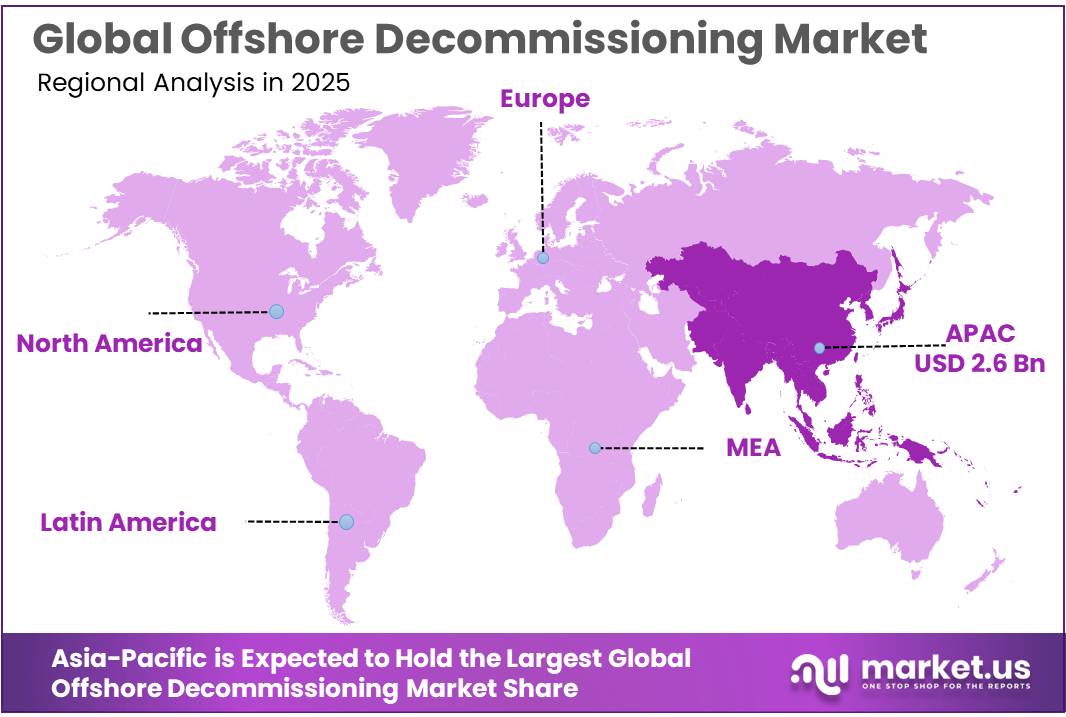
The Global Offshore Decommissioning Market size is expected to be worth around USD 14.3 Billion by 2035, from USD 7.0 Billion in 2025, growing at a CAGR of 7.4% during the forecast period from 2026 to 2035. In 2025, Asia-Pacific held a dominant market position, capturing more than a 38.21% share, holding USD 2.6 Billion revenue.
The offshore decommissioning industry plays an important role in safely retiring aging oil and gas infrastructure after production activities end. The process includes plugging abandoned wells, removing offshore platforms, dismantling subsea pipelines, cleaning contaminated equipment, and restoring marine environments. Growing environmental concerns, aging offshore assets, and stricter government regulations are encouraging energy companies to invest in professional decommissioning services.
- According to the U.S. Bureau of Safety and Environmental Enforcement, approximately 75% of the 1,430 existing offshore platforms on the U.S. Outer Continental Shelf are more than 25 years old, highlighting substantial future retirement requirements.
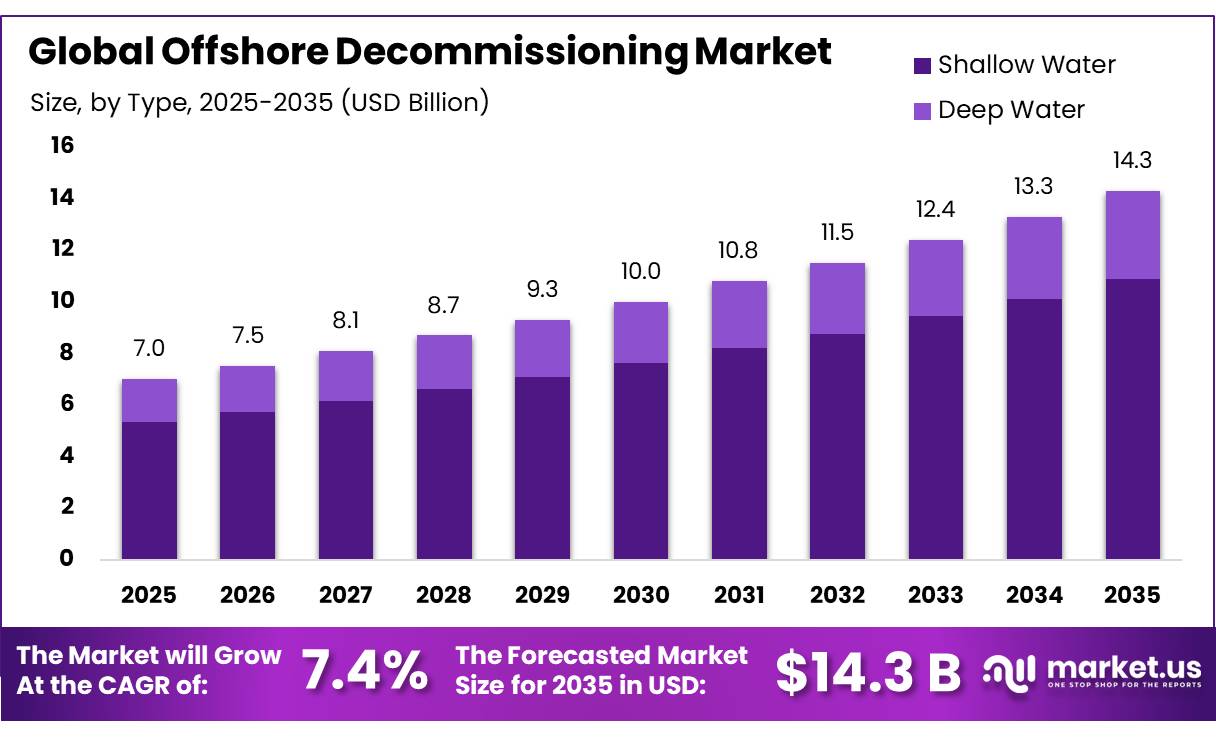
The industrial landscape is experiencing increasing activity across mature offshore production regions, particularly the North Sea and Gulf of Mexico. According to the UK North Sea Transition Authority (NSTA), August 2026, offshore operators spent a record £2.6 billion in 2025 on decommissioning activities. The regulator estimated that completing the remaining UK Continental Shelf decommissioning programme would require approximately £43.4 billion, demonstrating continued demand for engineering contractors, offshore vessels, and specialized removal equipment.
Well abandonment represents a major operating segment because permanently sealing offshore wells requires advanced equipment, experienced workers, and strict safety procedures. The NSTA’s 2026 update reported approximately £1.3 billion in well decommissioning expenditure during 2025, with activities performed on more than 250 wells. Increasing demand for cementing materials, corrosion-resistant components, chemical cleaning solutions, and subsea intervention technologies is supporting specialized industrial suppliers.
Technological advancements are also changing decommissioning operations. Remote-operated underwater vehicles, robotic cutting systems, digital inspection tools, and advanced lifting equipment are helping contractors improve operational safety and reduce offshore intervention requirements. According to Offshore Energies UK’s 2025 Decommissioning Insight, nearly 2,000 wells, more than 95,000 tonnes of subsea infrastructure, and 883 kilometres of pipelines are scheduled for decommissioning or removal by 2034, creating substantial opportunities for equipment manufacturers and specialist contractors.
Looking ahead, the industry is expected to benefit from growing offshore asset retirement programmes, improved recycling practices, and increased investment in low-emission dismantling technologies. The NSTA forecasts approximately £21 billion in UK offshore decommissioning expenditure through 2032. Rising demand for integrated project management, sustainable material recovery, and cost-efficient well abandonment services is expected to support long-term industry expansion.
Key Takeaways
- Offshore Decommissioning Market size is expected to be worth around USD 14.3 Billion by 2035, from USD 7.0 Billion in 2025, growing at a CAGR of 7.4%.
- Shallow Water held a dominant market position, capturing more than a 76.23% share of the Offshore Decommissioning Market.
- Well Plugging and Abandonment held a dominant market position, capturing more than a 42.21% share of the Offshore Decommissioning Market.
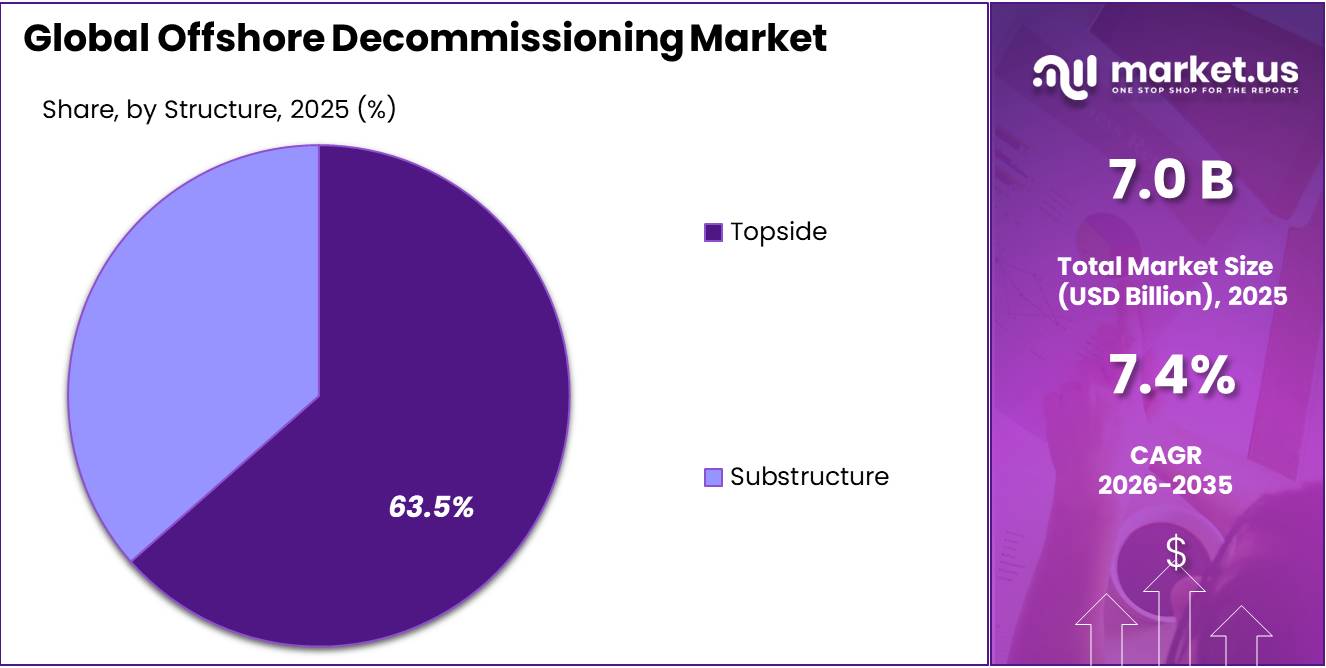
- Topside held a dominant market position, capturing more than a 63.56% share of the Offshore Decommissioning Market.
- Asia-Pacific dominated the Offshore Decommissioning Market in 2025, accounting for more than 38.21% of the market and generating about USD 2.6 billion.
By Type Analysis
Shallow Water dominates the Offshore Decommissioning Market with a 76.23% share
In 2025, Shallow Water held a dominant market position, capturing more than a 76.23% share of the Offshore Decommissioning Market. The segment remains important because mature shallow-water fields generally contain large numbers of older fixed platforms, wells, pipelines, and production structures that eventually require plugging, removal, or site clearance. Government data from the U.S. Bureau of Safety and Environmental Enforcement shows that around 75% of the 1,430 existing offshore platforms on the U.S. Outer Continental Shelf are more than 25 years old, creating a sizeable pool of assets approaching retirement.
Shallow-water activity also benefits from relatively easier vessel access, conventional lifting systems, and established plugging and abandonment practices compared with deeper offshore environments. BSEE classifies Gulf shallow-water operations as those occurring at depths of less than 500 feet. Its latest permitting statistics, updated in September 2026, recorded continued well activity within this water-depth category, indicating that the region still contains a substantial installed offshore asset base that will require decommissioning over time. BSEE
Deep Water represents a smaller but increasingly important part of the Offshore Decommissioning Market as offshore production gradually shifts toward deeper reservoirs. Decommissioning these assets requires specialized subsea intervention systems, remotely operated vehicles, heavy-lift vessels, riser removal equipment, and advanced well-plugging technologies. BSEE defines deep-water operations in its Gulf statistics as projects located at water depths of more than 500 feet, where engineering complexity and vessel requirements are generally higher than in shallow water.
By Services Analysis
Well Plugging and Abandonment dominates the Offshore Decommissioning Market with a 42.21% share
In 2025, Well Plugging and Abandonment held a dominant market position, capturing more than a 42.21% share of the Offshore Decommissioning Market. The segment remains central to offshore retirement because every producing well must eventually be isolated, sealed, and made environmentally safe. In its 2025 review, the UK government stated that well plugging and abandonment remains the largest individual area of offshore decommissioning expenditure and highlighted it as a major focus for reducing overall project costs.
The continuing volume of wells reaching retirement supports demand for cementing, casing cutting, well intervention, subsea tooling, and specialist offshore rigs. BSEE reported in January 2026 that 46 wells linked with the Harvest, Hidalgo and Hermosa platforms had already been abandoned and tested, while another 28 wells at Platform Grace and 28 wells at Platform Gail had been abandoned. Well-abandonment work also began on 20 shut-in wells at Platform Habitat during 2025.
Platform Removal is an important Offshore Decommissioning service because operators must dismantle production structures after wells are safely abandoned and offshore operations permanently cease. According to BSEE’s 2026 decommissioning information, the U.S. Outer Continental Shelf contains approximately 1,430 existing offshore platforms, creating a substantial long-term requirement for structure removal and site-clearance work.
By Structure Analysis
Topside dominates the Offshore Decommissioning Market with a 63.56% share
In 2025, Topside held a dominant market position, capturing more than a 63.56% share of the Offshore Decommissioning Market. Topsides account for a major part of offshore removal work because they contain production equipment, processing units, accommodation areas, cranes, piping, electrical systems, and other operational components that must be dismantled or lifted before final site clearance.
The U.S. Bureau of Safety and Environmental Enforcement notes that offshore platforms generally have 2 main structural sections for decommissioning purposes: the topside above the waterline and the substructure extending toward the seabed. BSEE also reports that approximately 1,430 offshore platforms currently exist on the U.S. Outer Continental Shelf, creating a large installed base for future topside removal work.
According to BSEE, the offshore energy industry has averaged around 127 platform removals per year over the past decade. During decommissioning, topsides are generally transported onshore for dismantling, recycling, or possible reuse, creating demand for heavy-lift vessels, cutting systems, cranes, transport barges, and specialized waste-handling services.
Substructure represents an important part of offshore decommissioning because jackets, piles, templates, and other foundation components must be safely separated from the seabed after topside removal. BSEE regulations generally require bottom-founded platform components to be severed at least 15 feet below the mudline before removal.
Key Market Segments
By Type
- Shallow Water
- Deep Water
By Services
- Well Plugging and Abandonment
- Platform Removal
- Permitting and Regulatory Compliance
- Platform Preparation
- Others
By Structure
- Topside
- Substructure
Driver Analysis
Mature-Asset Retirement Wave
The mature-asset retirement wave is the largest demand driver because production decline is converting previously deferrable end-of-life obligations into funded execution programmes across several offshore basins at the same time: UK Continental Shelf decommissioning expenditure reached a record £2.6 billion in 2025, up from £2.4 billion in 2024, while the remaining UKCS programme was estimated at £43.4 billion and approximately £21 billion nearly half was scheduled for expenditure through 2032.
This is not merely a forecasted liability; it is visible throughput entering vessel, rig, engineering, waste-yard, and specialist-contractor order books, with the NSTA describing the period to 2032 as critical and reporting more than £27 billion of operator commitments over 2023–2032.
Australia adds a second long-duration workload pool: the government’s 2025 estimate put Commonwealth-water decommissioning expenditure at A$43.6 billion in constant terms, rising to A$66.8 billion with inflation, with 55% of activity expected before 2040 and 61% of liability concentrated offshore Western Australia. In the Gulf, BSEE reports that approximately 200 platforms were decommissioned annually over the last decade, establishing a recurring base of shallow-water removals alongside more complex deepwater liabilities.
On an analyst-modelled basis, converting only 5% of the identified UK and Australian remaining liability into annual addressable work represents more than £2.1 billion plus A$2.2 billion of yearly activity before Gulf and other basins; it supports 70–90% utilization for specialized assets during peak campaign windows, increases backlog visibility from roughly 6–12 months to 18–36 months, and supports framework contracting rather than spot tenders.
The resulting volume and visibility should add approximately +2.4 percentage points to baseline market CAGR through 2028, with value capture strongest for contractors able to combine engineering, well services, heavy lift, subsea intervention, logistics, and disposal under a single risk-managed contract.
Drivers Impact Analysis
| Driver | (~) % Impact on CAGR | Geographic Relevance | Impact Timeline |
|---|---|---|---|
| Mature-asset retirement wave | +2.4 pp | UKCS, Norway, Gulf, Australia | Short term (≤ 2 years) |
| Well P&A backlog | +2.0 pp | North Sea, Gulf, Australia, SE Asia | Short term (≤ 2 years) |
| Full-removal obligations | +1.7 pp | North-East Atlantic, UK, Australia | Medium term (2-4 years) |
| Liability enforcement | +1.4 pp | Australia, U.S., UK | Medium term (2-4 years) |
| Campaign-scale contracting | +1.1 pp | UKCS core, Norway, Gulf | Medium term (2-4 years) |
| Recycling-led dismantling | +0.8 pp | Australia, UK, EU yards | Long term (≥ 4 years) |
Restraint Analysis
Cost Inflation and Overruns
Cost inflation and execution overruns directly suppress decommissioning-market conversion because asset owners must fund work from operating cash flow, balance-sheet provisions, tax relief, bonds, or asset-sale proceeds, and each upward revision raises the threshold for final investment decisions and contract award. The NSTA’s 2025 update found that all UK Continental Shelf decommissioning work-breakdown categories had become more expensive, raising the 2023–2032 forecast by £3 billion to £27 billion and increasing the remaining UKCS scope to £44 billion in constant 2024 prices; despite roughly £4.4 billion of scope being executed since the 2021 re-baseline, pre-inflation forecast costs increased by around 20%.
Labour, rig and vessel day rates, steel handling, fuel, marine insurance, explosives, specialist cutting tools, cement and tubular inputs, waste classification, and port capacity can each raise a project’s cost by 5–20%, while a 15% overrun on a USD 100 million platform-and-well programme removes USD 15 million from an operator’s available decommissioning provision and can defer peripheral scope by 12–24 months. The UK’s continuing benchmark of 257 wells worked but only 114 brought to final abandonment in 2025 illustrates how cost, technical sequencing, and resource availability can translate activity into partial rather than completed liability retirement.
Contracting firms face margin compression when fixed-price bids are exposed to weather downtime, unexpected well integrity failures, heavy-lift availability, or waste-disposal reclassification; a 10–15% adverse cost movement can erase a typical 8–12% engineering-and-marine project margin unless change-order rights, indexed pricing, and contingency allowances are secured. This inflation-led affordability constraint is estimated to deduct -2.1 percentage points from baseline offshore decommissioning CAGR across the UKCS, Norway, Australia, the U.S. Gulf, and complex mature basins through 2028.
Restraint Impact Analysis
| Restraint | (~) % Impact on CAGR Forecast | Geographic Relevance | Impact Timeline |
|---|---|---|---|
| Cost inflation and overruns | -2.1 pp | UKCS, Norway, Australia, Gulf | Short term (≤ 2 years) |
| Limited rig and vessel supply | -1.8 pp | North Sea, Gulf, Brazil, APAC | Medium term (2-4 years) |
| Operator funding shortfalls | -1.6 pp | Gulf, UKCS independents, SE Asia | Short term (≤ 2 years) |
| Financial assurance uncertainty | -1.3 pp | U.S. Outer Continental Shelf | Short term (≤ 2 years) |
| Port and disposal constraints | -1.1 pp | Australia, UK, EU, Southeast Asia | Medium term (2-4 years) |
| Fragmented project economics | -0.9 pp | Mature small-field basins | Medium term (2-4 years) |
Opportunity Analysis
Multi-Operator P&A Campaigns
The UKCS alone has about 1,000 subsea wells remaining for decommissioning, while operators worked on 257 wells in 2025 but progressed only 114 to final abandonment, indicating a sizable execution gap between intervention activity and complete liability retirement.
A consortium-led campaign that combines 20–40 wells across three to six operators can spread a USD 5–15 million mobilization and project-management cost across a broader scope, reduce per-well logistics and standby exposure by an analyst-modelled 12–25%, and convert a USD 10–20 million isolated programme into a USD 150–500 million multi-year framework.
If campaign standardization cuts a USD 12 million average offshore P&A cost by 15%, the USD 1.8 million saving per well can produce USD 36–72 million of released value across a 20–40-well cluster; allocating two-thirds to operator savings and one-third to contractor utilization still creates USD 12–24 million of additional contractor gross profit before engineering overhead.
This is future upside because it requires shared liability protocols, compatible technical designs, transparent cost allocation, pooled procurement, common data rooms, and regulator-endorsed collaboration rather than the ordinary retirement of individual assets. This model could add approximately +2.2 percentage points above baseline offshore decommissioning CAGR across the UKCS, Norway, Gulf of America, Southeast Asia, and other mature clustered basins within two years.
Opportunity Impact Analysis
| Opportunity | (~) % Potential CAGR Upside | Geographic Relevance | Execution Window |
|---|---|---|---|
| Multi-operator P&A campaigns | +2.2 pp | UKCS, Norway, Gulf, SE Asia | Short term (≤ 2 years) |
| Vessel-led wellhead removal | +1.8 pp | UKCS, Norway, Brazil, Australia | Short term (≤ 2 years) |
| Circular dismantling hubs | +1.5 pp | Australia, UK, EU, Gulf Coast | Medium term (2-4 years) |
| Decom-to-wind asset sharing | +1.3 pp | North Sea, UK, EU, U.S. Atlantic | Medium term (2-4 years) |
| Digital liability management | +1.0 pp | North America, UK, Australia, Norway | Short term (≤ 2 years) |
| Rigs-to-reefs conversion services | +0.8 pp | U.S. Gulf, Pacific, LATAM, APAC | Long term (≥ 4 years) |
Challenges Analysis
Well Integrity Data Gaps
In the UKCS, industry spent approximately £1.3 billion on well decommissioning in 2025 and worked on 257 wells, yet only 114 reached final abandonment; approximately 500 inactive wells were awaiting final abandonment, with more than 1,000 additional wells expected to require decommissioning over the following five years. This completion gap shows that a well can consume rig, vessel, cementing, wireline, cutting, verification, and engineering resources across multiple seasons without reaching liability closure, particularly where unexpected casing corrosion, sustained annulus pressure, failed barriers, difficult access, or unverified cement require contingency intervention.
An analyst-modelled 15–30% of late-life wells requiring at least one unplanned remediation step can add USD 2–10 million per well, extend offshore duration by 15–60 days, and reduce fixed-price project gross margin by 500–1,500 basis points; across a 50-well programme, a USD 4 million average scope increase represents USD 200 million of unbudgeted exposure. Australian regulation intensifies the operating requirement: NOPSEMA expects non-producing wells at end-of-life facilities to be plugged and abandoned within three years after production ceases, and no later than 10 years after suspension where the facility remains in production, requiring titleholders to progressively retire redundant property.
Contractors and operators must therefore construct integrated well-data rooms, digitize historical records, deploy pre-P&A diagnostics, maintain probabilistic cost models, use barrier-validation tools, and set contingency reserves of roughly 10–25% for high-uncertainty wells; these measures improve forecast accuracy but require multi-year data remediation and do not eliminate subsurface uncertainty. This data-quality friction is estimated to drag maximum offshore decommissioning-market CAGR by -1.6 percentage points across the UKCS, U.S. Gulf, Australia, Southeast Asia, and mature offshore basins over two to four years.
Challenges Impact Analysis
| Challenge | (~) % CAGR Friction Drag | Geographic Relevance | Mitigation Horizon |
|---|---|---|---|
| Well Integrity Data Gaps | -1.6 pp | UKCS, Gulf, Australia, SE Asia | Medium term (2-4 years) |
| Specialist Workforce Scarcity | -1.4 pp | North Sea, Gulf, Australia, Brazil | Long term (≥ 4 years) |
| Marine Asset Scheduling Conflicts | -1.3 pp | North Sea, Gulf, Brazil, APAC | Medium term (2-4 years) |
| Multi-Operator Coordination Friction | -1.1 pp | UKCS, Norway, Gulf, SE Asia | Medium term (2-4 years) |
| Offshore Waste Traceability | -0.9 pp | UK, EU, Australia, North America | Long term (≥ 4 years) |
| Regulatory Scope Variability | -0.8 pp | Global mature offshore basins | Long term (≥ 4 years) |
Geopolitical Impact Analysis
Russia–Ukraine and Middle East Conflicts Increase Offshore Decommissioning Costs and Supply Risks
Ongoing geopolitical tensions are reshaping the Offshore Decommissioning Market by increasing fuel costs, tightening vessel availability, and raising uncertainty across offshore supply chains. The Russia–Ukraine war continues to affect European energy planning, while the Middle East conflict has added pressure on shipping routes, marine fuel, insurance, and equipment movement. These conditions can increase operating expenses for heavy-lift vessels, subsea contractors, steel handling, well plugging, and platform removal projects.
The effect is visible in the UK Continental Shelf, where operators are dealing with inflation, market uncertainty, and competition for specialist offshore resources. In August 2026, the North Sea Transition Authority reported that industry spent a record £2.6 billion on decommissioning during 2025, while the remaining programme was estimated at £43.4 billion. The regulator also linked limited cost reduction partly to geopolitical instability and competition for supply-chain capacity.
At the same time, conflicts are encouraging governments and operators to place greater value on energy security. Some producing assets may remain active longer, delaying abandonment schedules, while older uneconomic fields still require safe closure. This environment creates opportunities for local contractors, shared-vessel models, digital planning, recycling, and lower-cost well abandonment technologies that reduce dependence on disrupted international supply chains and improve project resilience.
Regional Insights
Asia-Pacific Leads the Offshore Decommissioning Market with 38.21% Share, Valued at USD 2.6 Billion
Asia-Pacific dominated the Offshore Decommissioning Market in 2025, accounting for more than 38.21% of the market and generating about USD 2.6 billion. The region’s leadership is supported by a base of mature offshore oil and gas assets across Australia and Southeast Asia, where operators are moving older wells, platforms, pipelines, and subsea systems toward retirement. Australia is particularly important to this regional workload. The Australian Department of Industry estimates that offshore titleholders will spend about AUD 43.6 billion on decommissioning through 2070, rising to AUD 66.8 billion when inflation is included. Around 55% of this activity is expected before 2040.
Within Asia-Pacific, Australia is emerging as one of the fastest-developing offshore decommissioning hubs because its mature basins are entering heavier retirement cycles. Government data shows that 61% of Australia’s estimated decommissioning liability is located off Western Australia, compared with 23% off Victoria and 16% off the Northern Territory. The scale of physical removal is also significant, with at least 2.7 million tonnes of offshore infrastructure expected to be taken out over the coming decades. This pipeline is creating demand for well plugging, heavy-lift vessels, subsea intervention, dismantling yards, waste treatment, recycling, and engineering services across the offshore supply chain.
Key Regions and Countries Insights
- North America
- US
- Canada
- Europe
- Germany
- France
- The UK
- Spain
- Italy
- Rest of Europe
- Asia Pacific
- China
- Japan
- South Korea
- India
- Australia
- Rest of APAC
- Latin America
- Brazil
- Mexico
- Rest of Latin America
- Middle East & Africa
- GCC
- South Africa
- Rest of MEA
Key Players Analysis
Allseas Group SA is a major offshore decommissioning contractor specializing in platform removal, heavy lifting, and subsea infrastructure recovery. In 2025, its Pioneering Spirit vessel removed the 15,300-tonne Heather Alpha topsides from the UK North Sea. The vessel can lift topsides weighing up to 60,000 tonnes and jackets weighing 20,000 tonnes. In August 2026, Allseas completed the removal of North Cormorant’s 17,000-tonne topsides.
Heerema Marine Contractors provides offshore decommissioning services, including platform dismantling, heavy lifting, transportation, and recycling. In October 2025, the company secured BP’s Andrew platform removal contract, covering its topsides and a 4-legged steel jacket with 12 skirt piles. In August 2026, Heerema and AF Offshore Decom secured 3 major North Sea decommissioning contracts, involving structures weighing more than 120,000 tonnes.
Boskalis Westminster NV, operating as Royal Boskalis B.V., provides offshore decommissioning services covering platform removal, subsea infrastructure recovery, transportation, and recycling. In 2025, the company generated EUR 4.5 billion in revenue, with EBITDA reaching EUR 1.3 billion. Its Bokalift 1 vessel has a 3,000-tonne lifting capacity and previously supported the removal of 11 offshore platforms.
Top Key Players Outlook
- Allseas Group SA
- Heerema Marine Contractors
- Boskalis Westminster NV
- DEME Offshore
- Saipem SpA
- Subsea 7 SA
- TechnipFMC PLC
- Aker Solutions ASA
- AF Gruppen ASA
- DeepOcean Group Holding BV
- Other Key Players
Recent Developments
- Saipem also continued investing in offshore capability, recording €364 million of capital expenditure in 2025, including €202 million for Asset Based Services and €147 million for Offshore Drilling. During the same year, company revenue reached €15.5 billion, EBITDA reached €1.7 billion, and backlog remained above €31 billion.
- In May 2025, DEME completed the acquisition of Havfram for about €900 million, adding offshore installation capability and 2 next-generation vessels, Norse Wind and Norse Energi, to its portfolio. In the same month, DEME Offshore Holding acquired a 50% stake in BAUER Offshore Technologies, with an option to acquire the remaining 50% within 5 years, strengthening offshore drilling and foundation engineering expertise.
Report Scope
| Report Features | Description |
|---|---|
| Market Value (2025) | USD 7.0 Bn |
| Forecast Revenue (2035) | USD 14.3 Bn |
| CAGR (2026-2035) | 7.4% |
| Base Year for Estimation | 2025 |
| Historic Period | 2020-2024 |
| Forecast Period | 2026-2035 |
| Report Coverage | Revenue Forecast, Market Dynamics, Competitive Landscape, Recent Developments |
| Segments Covered | By Type (Shallow Water, Deep Water), By Services (Well Plugging and Abandonment, Platform Removal, Permitting and Regulatory Compliance, Platform Preparation, Others), By Structure (Topside, Substructure) |
| Regional Analysis | North America – US, Canada; Europe – Germany, France, The UK, Spain, Italy, Rest of Europe; Asia Pacific – China, Japan, South Korea, India, Australia, Singapore, Rest of APAC; Latin America – Brazil, Mexico, Rest of Latin America; Middle East & Africa – GCC, South Africa, Rest of MEA |
| Competitive Landscape | Allseas Group SA, Heerema Marine Contractors, Boskalis Westminster NV, DEME Offshore, Saipem SpA, Subsea 7 SA, TechnipFMC PLC, Aker Solutions ASA, AF Gruppen ASA, DeepOcean Group Holding BV, Other Key Players |
| Customization Scope | Customization for segments, region/country-level will be provided. Moreover, additional customization can be done based on the requirements. |
| Purchase Options | We have three licenses to opt for: Single User License, Multi-User License (Up to 5 Users), Corporate Use License (Unlimited User and Printable PDF) |





































