


Report Overview
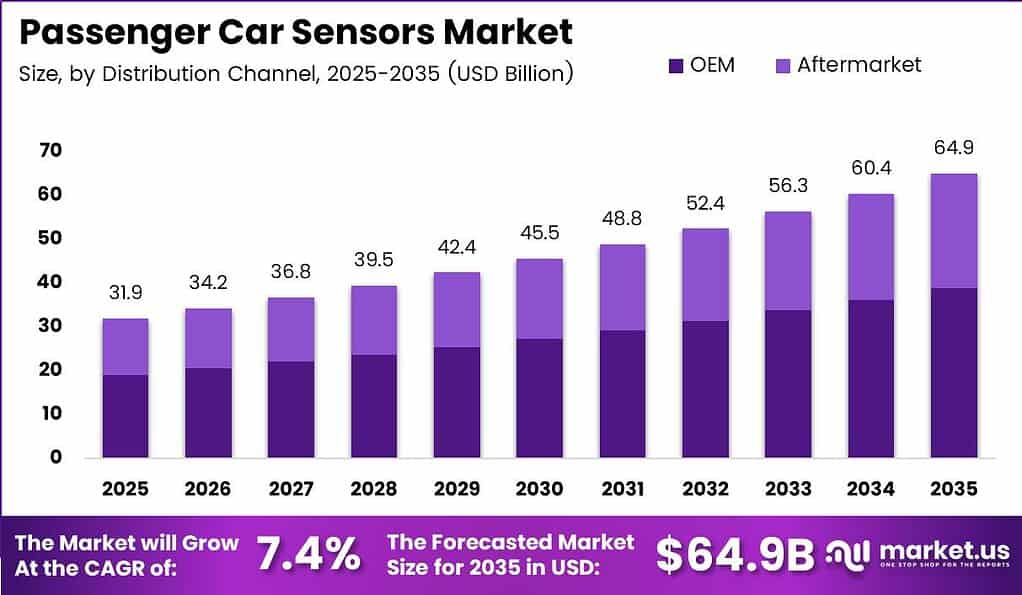
Global Passenger Car Sensors Market size is expected to be worth around USD 64.9 Billion by 2035 from USD 34.2 Billion in 2026, growing at a CAGR of 7.4% during the forecast period 2026 to 2035.
The passenger car sensors market covers electronic sensing devices embedded in passenger vehicles to measure, monitor, and transmit data on physical parameters including pressure, speed, position, temperature, and proximity. These sensors serve powertrain, safety, chassis, and cabin systems, forming the foundational hardware layer for both legacy internal combustion architectures and next-generation electrified platforms.
Regulatory mandates are accelerating sensor content per vehicle across key markets. The European Union’s General Safety Regulation expanded mandatory advanced driver-assistance system fitment from July 2024, and the US finalized upgraded ADAS assessment pathways in December 2024. These requirements convert previously optional sensing nodes into standard platform architecture, supporting the market’s 7.4% baseline growth trajectory.
Key Takeaways
- The global Passenger Car Sensors Market was valued at USD 34.2 Billion in 2026 and is forecast to reach USD 64.9 Billion by 2035, at a CAGR of 7.4%.
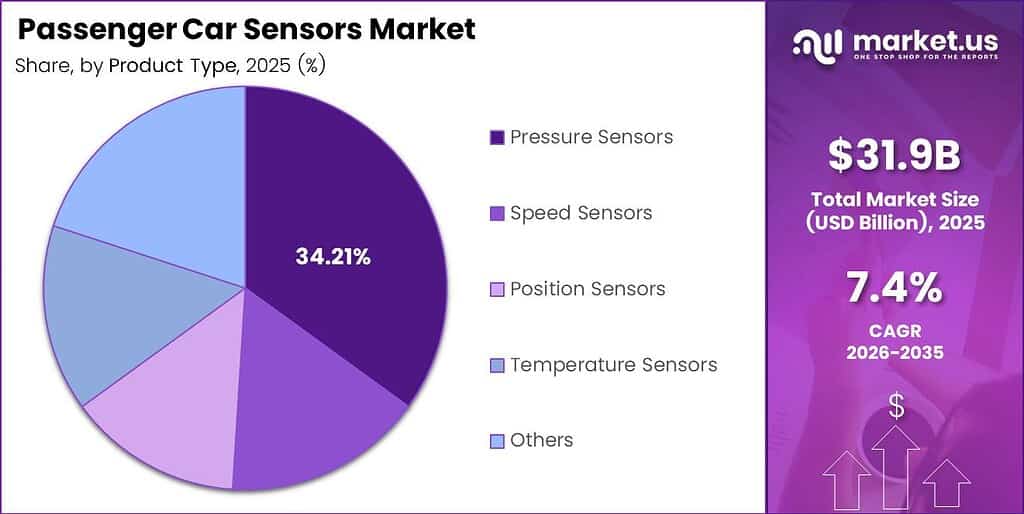
- By Product Type, Pressure Sensors dominate with a 34.21% market share in 2025.
- By Distribution Channel, OEM leads with a 54.78% share in 2025, with Aftermarket identified as the fastest-growing channel.
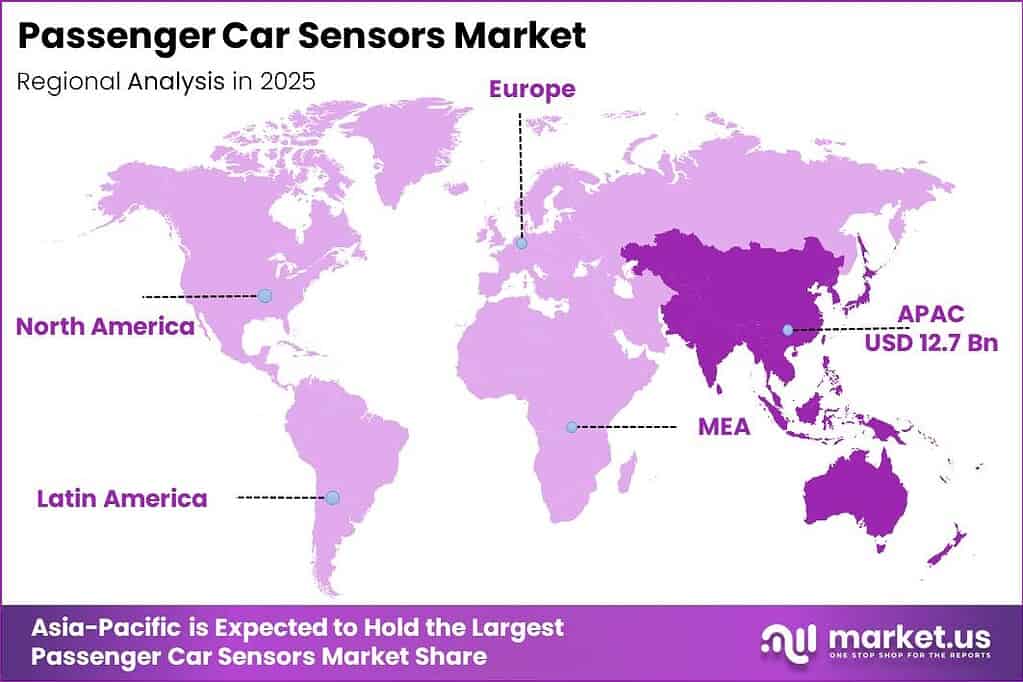
- Asia-Pacific holds the dominant regional position with a 40.11% share, valued at USD 12.7 Billion.
- Middle East and Africa is identified as the fastest-growing region for the forecast period.
- Speed Sensors represent the fastest-growing product type within the market.
According to OICA, global vehicle production rose from 92.7 million units in 2024 to 96.4 million units in 2025, a 3.9% increase. This production expansion directly broadens the addressable install base for sensor suppliers and reinforces multi-year platform nomination pipelines. As reported by OICA, vehicle production growth in India also reached 4.3 million passenger vehicle units in FY 2024–25, a 2% increase, opening a fast-scaling demand channel for mid-range sensor content.
Data from the IEA shows EU battery-electric car registrations held 20.7% of the new-car market in the first half of 2026, up from 15.6% a year earlier. Electrified vehicles carry substantially higher sensor content per unit than combustion equivalents. This structural shift rewards suppliers with platform presence across both EV and hybrid architectures.
According to the IEA, global electric-car sales exceeded 20 million in 2025, growing 20% year on year and representing 25% of all new cars sold. This electrification shift directly raises average sensor content per vehicle. Suppliers positioned across EV-specific sensing categories gain platform nominations that ICE-only peers cannot access.
As reported by OICA, Asia-Pacific vehicle production rose 7.6% to roughly 59.2 million vehicles in 2025, accounting for more than 61% of global output. This production concentration makes the region the primary battleground for sensor platform nominations. Suppliers without regional manufacturing or localization capacity face structural disadvantage in competing for program wins.
Product Type Analysis
Pressure Sensors dominate with 34.21% due to mandatory fitment across powertrain and safety systems.
In 2025, Pressure Sensors held a dominant market position in the By Product Type segment of the Passenger Car Sensors Market, with a 34.21% share. These sensors serve critical functions across engine management, braking, transmission, and tire-pressure monitoring systems. As per our research, in September 2026 Sensata launched its R290 Pressure and Temperature Sensor for EV thermal-management systems, signaling that pressure sensor applications are actively expanding into electrified platform architectures.
Speed Sensors represent the fastest-growing sub-segment within this market. Rising adoption of anti-lock braking systems, electronic stability control, and advanced traction management across mid-range and entry-level vehicle tiers drives this expansion. As the IEA reports, approximately 22 million electric cars were produced globally in 2025, more than 25% above 2024 output, and electric drivetrains require precise speed feedback for motor control and regenerative braking, reinforcing speed sensor demand.
Position Sensors occupy a structurally important role across throttle, pedal, steering, and transmission applications. As EU hybrid-electric models accounted for 35.1% of total registrations in the first five months of 2025 per the ACEA, the shift toward electrified powertrains multiplies position-sensing nodes per vehicle. Suppliers serving this sub-segment benefit from rising electrification rates without dependence on full battery-electric adoption.
Temperature Sensors monitor coolant, exhaust, battery pack, and cabin thermal conditions across both combustion and electric platforms. EU battery-electric car sales rose 28.4% to 255,489 units in January through February 2025, reaching a 15.2% market share according to the ACEA. Battery thermal management in electric vehicles demands higher-precision temperature sensing than combustion equivalents, expanding revenue per vehicle for this sub-segment.
Distribution Channel Analysis
OEM dominates with 54.78% due to mandatory integration at the point of vehicle assembly.
In 2025, OEM held a dominant market position in the By Distribution Channel segment of the Passenger Car Sensors Market, with a 54.78% share. Platform-level sensor nominations occur years before production, locking in supplier relationships for multi-year vehicle programs. IEA data shows China supplied 60% of global electric-car sales in 2025, while European and North American automakers each supplied about 15%, illustrating that OEM concentration in China creates outsized program-nomination leverage for sensor suppliers with local platform presence.
Aftermarket represents the fastest-growing distribution channel within this market. ADAS-equipped vehicles require recalibration after collision repair, windscreen replacement, or suspension work, creating repeat service revenue beyond the original fitment. As per our research, India recorded 399,216 passenger vehicle sales in December 2025 alone, with the growing installed base of ADAS-equipped vehicles in emerging markets expanding aftermarket sensor replacement and calibration volumes over the forecast horizon. In March 2025, Sensata launched its SIM200 Insulation Monitoring Device for continuous monitoring of high-voltage DC systems, targeting the aftermarket service channel for EVs.
Application Analysis
Engine Management dominates with the largest market share due to its foundational role across all powertrain architectures.
In 2025, Engine Management held a dominant market position in the By Application segment of the Passenger Car Sensors Market. Mass airflow, oxygen, knock, crankshaft, and camshaft sensors serve every combustion cycle in real time, making engine management the single most sensor-dense application across both ICE and hybrid platforms. This density locks in multi-year supplier nominations regardless of powertrain transition pace, because even electrified architectures retain thermal and battery management sensing that maps directly to engine management sensor categories.
Safety and Security sensors represent the fastest-growing application segment, driven by mandatory ADAS fitment requirements across Europe, China, and increasingly India. The EU General Safety Regulation expanded mandatory fitment from July 2024 across intelligent speed assistance, advanced emergency braking, emergency lane keeping, and driver drowsiness warning. Each vehicle transitioning from a basic warning package to a full camera-radar-braking suite adds multiple sensing nodes per unit, converting safety sensing from a trim-level option into a platform-level constant across regulated markets.
Body Control and Comfort sensors cover cabin monitoring, seat occupancy, climate control, ambient light sensing, and door and window actuation. In November 2024, Continental unveiled its Invisible Biometrics Sensing Display, integrating a 1.5 MP near-infrared camera and eye-safe laser projector behind an OLED display to monitor passenger vital parameters for safety and comfort functions. This launch signals that in-cabin sensing is moving beyond passive comfort into active safety functions, raising the average sensor node count per vehicle within this application category.
Telematics sensors connect vehicle systems to external networks for diagnostics, navigation, fleet management, and over-the-air update delivery. Rising adoption of connected vehicle platforms across North America, Europe, and China is expanding telematics sensor content beyond a single TCU module into distributed sensing nodes that feed real-time vehicle health data to cloud platforms. Chassis Control sensors, covering stability, suspension, and brake management systems, along with remaining applications, collectively account for the balance of the application segment.
Connectivity Outlook Analysis
Wired dominates with the largest share due to reliability requirements in safety-critical sensor applications.
In 2025, Wired connectivity held a dominant market position in the By Connectivity Outlook segment of the Passenger Car Sensors Market. Wired architectures deliver the low-latency, consistent data transmission that safety-critical systems demand. CAN bus remains standard across practically all vehicles manufactured globally, providing robust fault tolerance and interference resistance across engine management, ABS, and electronic stability control applications where signal dropout carries direct safety consequences for occupants and regulators alike.
Wireless connectivity is the fastest-growing sub-segment within this market. V2X communication, over-the-air software updates, and remote diagnostics are driving wireless sensor integration beyond infotainment into active safety and powertrain domains. As per our research, ADAS applications held the dominant share of the automotive Ethernet application mix in 2025, because camera, radar, and LiDAR sensors require high-bandwidth pipelines that legacy CAN bus cannot support. This bandwidth gap is the primary structural force pulling new platform nominations toward wireless and high-speed wired Ethernet hybrid architectures.
Automotive Ethernet is the connectivity technology drawing the most active investment from tier-1 suppliers and OEM platform teams. In January 2026, Bosch unveiled its Radar Gen 7 Premium, combining AI-enhanced radar processing with object detection at distances exceeding 200 meters. Transmitting that data volume in real time requires Ethernet-level bandwidth that classical CAN bus cannot deliver. This gap between sensor capability and legacy network capacity is accelerating Ethernet adoption across new vehicle programs, particularly in ADAS-heavy SUV and premium sedan platforms. Bluetooth serves short-range diagnostics and infotainment pairing, while CAN Bus retains its role in lower-speed control loops, with both holding the remaining connectivity share.
Vehicle Type Analysis
SUV dominates with the largest market share due to higher sensor content per unit and global volume leadership.
In 2025, SUV held a dominant market position in the By Vehicle Type segment of the Passenger Car Sensors Market. SUVs captured over 42% of total new passenger vehicle sales globally in 2025, surpassing sedan sales across most major markets. Each SUV carries a higher average sensor count than an equivalent sedan, covering surround-view parking systems, terrain monitoring, trailer assist functions, and more expansive ADAS suites. This higher sensor density per unit makes SUVs a disproportionately high revenue contributor relative to their unit volume share for sensor suppliers with platform presence in this body style.
Sedan holds the second-largest position by sensor revenue, supported by strong urban demand across Asia-Pacific, Europe, and Latin America. Sedans in the mid-range and premium tiers carry full ADAS suites including ABS, electronic stability control, and camera-radar emergency braking, sustaining solid per-unit sensor revenue even as their overall vehicle market share contracts against SUV growth. As per our research, global SUV share jumped from nearly 47% of passenger car sales in 2023 to 54% in 2024, a trajectory that continued into 2025 and directly shifts sensor revenue weighting toward higher-content body styles.
Hatchback sensors benefit from urbanization trends and affordability mandates across Asia-Pacific and European markets. Regulatory requirements for basic ADAS fitment create a revenue floor for sensor suppliers in this segment regardless of vehicle price point, because even entry-level hatchbacks must now comply with mandatory braking, speed assistance, and lane-keeping functions in regulated markets. Coupe and Convertible segments represent a smaller share of total sensor revenue given lower global production volumes, but command premium sensor content per unit through higher-specification infotainment, performance monitoring, and chassis-dynamics systems that support above-average unit revenue for suppliers with nominations in these body styles.
Key Market Segments
By Product Type
- Pressure Sensors
- Speed Sensors
- Position Sensors
- Temperature Sensors
- Others
By Distribution Channel
- OEM
- Aftermarket
By Application
- Engine Management
- Safety Security
- Body Control Comfort
- Telematics
- Chassis Control
By Connectivity Outlook
- Wired
- Wireless
- Ethernet
- Bluetooth
- CAN Bus
By Vehicle Type
- SUV
- Sedan
- Hatchback
- Coupe
- Convertible
Regional Analysis
Asia-Pacific Dominates the Passenger Car Sensors Market with a Market Share of 40.11%, Valued at USD 12.7 Billion
Asia-Pacific commands the largest share of the global passenger car sensors market, driven by its dominant vehicle production base. OICA data confirms that Asia-Pacific vehicle production rose 7.6% to roughly 59.2 million vehicles in 2025, accounting for more than 61% of global output. The World Bank projected East Asia and Pacific economic growth at 4.5% in 2025, providing a macroeconomic foundation that sustains consumer vehicle demand and fleet expansion across the region.
Middle East and Africa is the fastest-growing regional market during the forecast period. The IMF projected Middle East and North Africa growth of 2.6% in 2025 and 3.4% in 2026, reflecting an improving economic trajectory that supports passenger vehicle adoption. The World Bank projected Sub-Saharan Africa growth at 3.7% in 2025. Rising vehicle ownership rates combined with regulatory modernization create a growing addressable base for safety and powertrain sensors in both sub-regions.
India delivers one of the most visible near-term growth signals within the broader Asia-Pacific region. SIAM data shows India recorded 412,405 passenger vehicle sales in November 2025, an 18.7% increase versus November 2024. IEA data indicates that electric-car sales outside China, Europe, and the United States rose to 2 million in 2025 from 1.3 million in 2024, with emerging economies expected to increase electric-car sales 50% to 1 million units. Continental announced an aftermarket expansion of around 700 part numbers by 2025, increasing coverage by an average of 50%, directly targeting the growing installed-vehicle base across emerging markets including India and ASEAN.
Key Regions and Countries
North America
- US
- Canada
Europe
- Germany
- France
- The UK
- Spain
- Italy
- Rest of Europe
Asia Pacific
- China
- Japan
- South Korea
- India
- Australia
- Rest of APAC
Latin America
- Brazil
- Mexico
- Rest of Latin America
Middle East and Africa
- GCC
- South Africa
- Rest of MEA
Drivers
Mandatory safety-system deployment is the largest active demand catalyst in the passenger car sensors market. Regulatory requirements convert formerly optional sensor content into standard vehicle architecture across key markets. The EU General Safety Regulation expanded mandatory fitment for new vehicle types from July 2024, covering intelligent speed assistance, advanced emergency braking, emergency lane keeping, and driver drowsiness warning, with requirements subsequently broadening to newly registered vehicles.
A mainstream passenger car moving from a limited warning package to camera-radar-enabled braking, lane-support, and attention-monitoring functions adds several sensing nodes, dedicated processing, and higher-value calibration work per vehicle. This shifts supplier business models from trim-dependent option sales toward higher-volume platform nominations. The result is improved production visibility through multi-year vehicle programs and support for the stated 7.4% baseline growth trajectory despite continuing price-down pressure in mature sensor categories.
| Driver | (~) % Impact on CAGR Forecast | Geographic Relevance | Impact Timeline |
|---|---|---|---|
| Mandatory ADAS Safety Fitment | +1.6% | Europe, Japan, South Korea, China | Short term (≤ 2 years) |
| Premium Feature Democratization | +1.1% | China, Europe, North America | Short term (≤ 2 years) |
| Electrified Vehicle Electronics Content | +0.9% | China, Europe, North America | Medium term (2–4 years) |
| In-Cabin Sensing Adoption | +0.8% | Europe, China, Japan | Short term (≤ 2 years) |
| Connected Diagnostics Integration | +0.5% | North America, Europe, China | Medium term (2–4 years) |
| India Safety Content Upgrade | +0.4% | India and ASEAN | Medium term (2–4 years) |
Restraints
Passenger-car affordability pressure is the most immediate structural brake on sensor market expansion. Elevated financing costs, inflation-sensitive household budgets, and intense price competition force manufacturers to protect transaction prices and contribution margins. Discretionary sensor upgrades, including additional parking sensors, higher-resolution surround-view cameras, and redundant perception suites, remain vulnerable when OEMs reconfigure entry and mid-range trims to defend affordability thresholds.
A vehicle program that removes even one radar module, reduces camera resolution, or shifts from multi-sensor parking coverage to a narrower configuration cuts supplier revenue per unit while preserving basic compliance. This constraint compresses gross margins, delays higher-specification sensor adoption, and redirects capital expenditure toward lower-cost architectures. The effect is most pronounced in price-sensitive markets where component-cost reductions must exceed annual price-down expectations and where suppliers absorb additional localization, validation, and warranty costs.
| Restraint | (~) % Impact on CAGR Forecast | Geographic Relevance | Impact Timeline |
|---|---|---|---|
| Passenger-Car Affordability Pressure | -1.3% | Europe, North America, India, ASEAN | Short term (≤ 2 years) |
| Aggressive OEM Cost-Down Programs | -1.1% | Global, strongest in China | Short term (≤ 2 years) |
| EV Powertrain Sensor Displacement | -0.8% | China, Europe, North America | Medium term (2–4 years) |
| Vehicle Production Volatility | -0.7% | Europe, North America, Japan | Short term (≤ 2 years) |
| Entry-Level Feature Decontenting | -0.6% | India, ASEAN, Latin America, Africa | Medium term (2–4 years) |
| High Validation Cost Burden | -0.5% | Global | Medium term (2–4 years) |
Challenges
Automotive chip qualification bottlenecks remain the largest growth-ceiling friction in the passenger car sensors market. A sensor module depends not only on the sensing element but also on microcontrollers, radar processors, image signal processors, memory, power-management devices, and packaging capacity qualified for long vehicle lifecycles. Automotive-grade redesigns require extended reliability testing, software revalidation, electromagnetic-compatibility verification, and customer-specific production-part approval before a substitute component enters serial production.
Semiconductor supply chains retain geographic concentration across wafer fabrication, assembly, testing, and specialized materials. Multi-sourcing can introduce qualification cycles measured in quarters rather than weeks. Corporate mitigation requires design modularity, approved second-source strategies, buffer inventory for critical integrated circuits, and earlier long-term capacity reservations, all of which increase working-capital needs. This dynamic imposes an estimated -1.0% drag on the market’s achievable growth ceiling.
| Challenge | (~) % CAGR Friction Drag | Geographic Relevance | Mitigation Horizon |
|---|---|---|---|
| Automotive Chip Qualification Bottlenecks | -1.0% | Global, concentrated across Asia supply chains | Medium term (2–4 years) |
| Sensor Fusion Validation Complexity | -0.9% | Global | Long term (≥ 4 years) |
| Software Defined Vehicle Integration | -0.8% | China, Europe, North America | Medium term (2–4 years) |
| Harsh-Environment Performance Gaps | -0.7% | North America, Europe, India, Middle East | Long term (≥ 4 years) |
| Cybersecurity Compliance Burden | -0.6% | UNECE-aligned markets, China, North America | Medium term (2–4 years) |
| Calibration Service Capacity Gaps | -0.5% | North America, Europe, India | Medium term (2–4 years) |
Opportunities
Sensor-as-a-service aftermarket platforms represent the highest-potential untapped revenue stream in this market. Most current passenger-car sensor revenue concentrates at original vehicle installation, while post-sale calibration, functional verification, software-enabled diagnostics, and replacement management remain fragmented across repair networks. Camera, radar, and ultrasonic sensors require recalibration after collision repair, windscreen replacement, or software updates, creating a recurring service layer above standalone hardware sales.
A platform model combining remote health monitoring, calibration scheduling, and validated replacement-part sourcing can convert episodic hardware revenue into recurring service revenue. As per our research, this model can plausibly raise lifecycle gross-margin potential by 5% to 10% relative to standalone replacement-part transactions. Capturing this channel could add approximately +1.4% to growth above the 7.4% baseline, provided suppliers invest in secure vehicle-data access, technician training, calibration tooling, and region-specific repair-network partnerships.
| Opportunity | (~) % Potential CAGR Upside | Geographic Relevance | Execution Window |
|---|---|---|---|
| Sensor-as-a-Service Aftermarket Platforms | +1.4% | North America, Europe, China, Japan | Medium term (2–4 years) |
| Low-Cost Imaging Radar Localization | +1.2% | China, India, ASEAN, Latin America | Medium term (2–4 years) |
| Fleet Data Monetization | +1.0% | North America, Europe, China | Long term (≥ 4 years) |
| Solid-State LiDAR Adoption | +0.9% | China, Europe, North America | Long term (≥ 4 years) |
| Predictive Sensor Health Analytics | +0.8% | Global | Medium term (2–4 years) |
| Regional Sensor Module Consolidation | +0.6% | India, ASEAN, Eastern Europe, Mexico | Long term (≥ 4 years) |
Key Company Insights
Sensata Technologies anchors its market position on high-volume sensor production and deep EV platform integration. Sensata Technologies produces more than 80 million tire-pressure-monitoring-system sensors annually, reflecting scale that few competitors match. Sensata’s automotive revenue was $2.112 billion in 2025, and the automotive segment represented 55.0% of company revenue in Q2 2026, confirming that vehicle sensing remains its core commercial engine.
Continental AG holds a structural advantage through its scaled radar and electronic control unit installed base. Continental had put more than 277 million sensors and electronic control units for assisted and automated driving on roads worldwide by March 2025. In May 2025, Continental announced the production of its 200 millionth radar sensor. Continental recorded €9.7 billion in consolidated sales in Q1 2025, with Bosch Mobility sales reaching €55.8 billion in 2025 underscoring the scale of the competitive tier both firms operate within.
Radar technology has become the primary battleground for ADAS platform nominations among top-tier competitors. Continental received radar-sensor series orders worth around €1.5 billion with production starts planned for 2026 and 2027. In January 2026, Bosch unveiled Radar Gen 7 Premium, detecting objects at distances exceeding 200 meters using AI-enhanced processing. These competing radar roadmaps signal that differentiation in this sub-segment now requires AI integration, not just hardware performance.
Valeo is positioning itself at the leading edge of Level 3 automation sensing. In May 2025, a premium global automaker selected Valeo’s imaging radar system for a hands-off, eyes-off automated-driving program, with production scheduled for 2028. In December 2025, Valeo announced its SCALA 3 Evo LiDAR for CES 2026, featuring improved point-cloud accuracy and a compact design allowing integration behind a vehicle windshield. These back-to-back nominations confirm Valeo as the most aggressive challenger in high-autonomy sensing.
TE Connectivity competes across the sensor-adjacent connectivity layer that all sensing systems depend on. TE Connectivity reported quarterly net sales of $4.749 billion in Q4 fiscal 2025, up 17% reported and 11% organically. This growth rate outpaces the broader market CAGR of 7.4%, signaling that connectivity infrastructure scales faster than sensing hardware as vehicle electronic content rises. Suppliers who bundle sensing and connectivity on a single nomination hold a structural margin advantage over hardware-only competitors.
Key Players
- Sensata Technologies
- CTS Corporation
- Magna International
- Amphenol Advanced Sensors
- BorgWarner, Inc.
- LeddarTech
- Velodyne LiDAR
- Quanergy
- Aptiv plc
- Robert Bosch GmbH
- Continental AG
- Autoliv, Inc.
- TE Connectivity
- Friedrichshafen
- Valeo S.A.
- Other Key Players
Recent Developments
- December 2024 – DENSO and onsemi strengthened their long-term collaboration for ADAS and autonomous-driving technologies, with onsemi continuing to supply intelligent automotive sensors to DENSO. DENSO also announced its intention to acquire onsemi shares on the open market.
- November 2024 – Continental unveiled its Invisible Biometrics Sensing Display, integrating a 1.5 MP near-infrared camera and eye-safe laser projector behind an OLED display to monitor passenger vital parameters for safety and comfort functions.
- May 2025 – Continental announced production of its 200 millionth radar sensor and reported approximately €1.5 billion in radar-sensor orders from vehicle manufacturers during Q1 2025, with production starts planned for 2026 and 2027.
- May 2025 – Valeo announced that a premium global automaker selected its imaging radar system for a hands-off, eyes-off automated-driving program. Production is scheduled to begin in 2028, supporting unsupervised highway driving at up to 130 km/h when combined with camera and LiDAR technologies.
- September 2025 – DENSO agreed to transfer its oxygen sensor and air-fuel ratio sensor business to Niterra, covering the Spark Plug and Exhaust Gas Sensor business, subject to regulatory approvals.
- January 2026 – Bosch unveiled its Radar Gen 7 Premium at CES 2026. The new radar combines sensor technology with AI and can detect small objects such as pallets and vehicle tires at distances exceeding 200 meters, supporting advanced driving-assistance functions.
Value Chain Analysis
The upstream layer of the passenger car sensors value chain centers on semiconductor fabrication and specialty materials. Automotive chip qualification bottlenecks impose an estimated -1.0% drag on the market’s achievable growth ceiling because automotive-grade redesigns require extended reliability testing, software revalidation, and electromagnetic-compatibility verification before a substitute component enters serial production. Geographic concentration across wafer fabrication, assembly, and testing means supply disruptions in one node propagate across multiple sensor categories simultaneously.
The tier-1 supplier layer converts qualified semiconductor inputs into finished sensor modules and systems. Bosch produces more than 4 million MEMS sensors per day, and Sensata produces more than 80 million tire-pressure-monitoring-system sensors annually. These production volumes reflect capital-intensive manufacturing infrastructure that creates high barriers to entry at the module assembly stage. Tier-1 suppliers who control both sensing element design and module integration capture the highest value-add margin in the chain.
The OEM integration layer determines platform nomination outcomes and multi-year revenue visibility. OEM holds a 54.78% distribution channel share, confirming that vehicle assembly remains the dominant revenue capture point in the value chain. Platform nominations occur years before production start, locking in supplier relationships for vehicle program lifetimes typically spanning five to seven years. As per our research, this nomination cycle means tier-1 suppliers with current program wins already have significant revenue visibility through the early years of the forecast period.
The aftermarket layer is the fastest-growing and least consolidated segment of the value chain. Camera, radar, and ultrasonic sensors require recalibration after collision repair, windscreen replacement, or suspension work, creating recurring service revenue beyond original fitment. Continental announced an aftermarket expansion of around 700 part numbers by 2025, increasing coverage by an average of 50%. This move signals that tier-1 suppliers are actively extending downstream into aftermarket channels to capture margin that currently sits with independent repair networks and distributors.
Regulatory Landscape
Europe leads the global regulatory push for mandatory sensor fitment across passenger vehicle platforms. The EU General Safety Regulation expanded mandatory ADAS fitment for new vehicle types from July 2024, covering intelligent speed assistance, advanced emergency braking, emergency lane keeping, and driver drowsiness warning. Requirements subsequently broadened to all newly registered vehicles, converting sensor content from optional to structural across the EU new-car market. This single regulation adds an estimated +1.6% to the market’s CAGR through mandatory platform-level sensor nominations.
The United States finalized an upgraded assessment pathway for advanced driver-assistance systems in December 2024. This pathway raises the commercial importance of ADAS performance ratings for OEM brand positioning, creating indirect but sustained demand pressure for higher-specification sensing hardware. As per our research, EU battery-electric car registrations totaled 1,880,370 in 2025, representing 17.4% of the EU new-car market, and battery-electric vehicles require additional regulatory-compliant sensing content beyond combustion equivalents across thermal, high-voltage, and occupant monitoring functions.
China’s safety-rating protocols have elevated the commercial weight of active-safety and driver-monitoring sensor performance for all OEMs selling in the market. IEA data confirms China accounted for nearly 75% of global electric-car production in 2025. This production dominance means Chinese regulatory requirements effectively set global sensor content standards for EV platforms, as manufacturers engineer vehicles to comply with the most demanding market in their production footprint and carry those specifications globally.
India’s regulatory trajectory signals a medium-term content upgrade cycle across mid-range and entry-level vehicle platforms. India Safety Content Upgrade carries an estimated +0.4% CAGR contribution across India and ASEAN markets over a two-to-four-year horizon. SIAM data shows India recorded passenger vehicle sales of 4.643 million units in FY 2025–26, up 7.9% year on year. As safety mandates expand across this volume base, each additional required sensor node multiplies across millions of annual vehicle units, creating a structurally growing addressable market for compliant suppliers.
Report Scope
| Report Features | Description |
|---|---|
| Market Value (2025) | USD 31.9 Billion |
| Forecast Revenue (2035) | USD 64.9 Billion |
| CAGR (2026-2035) | 7.4% |
| Base Year for Estimation | 2025 |
| Historic Period | 2020-2024 |
| Forecast Period | 2026-2035 |
| Report Coverage | Revenue Forecast, Market Dynamics, Market Opportunity Analysis, Technology and Innovation Landscape, Competitive Landscape, Recent Developments |
| Segments Covered | By Product Type (Pressure Sensors, Speed Sensors, Position Sensors, Temperature Sensors, Others), By Distribution Channel (OEM, Aftermarket) |
| Regional Analysis | North America (US and Canada), Europe (Germany, France, The UK, Spain, Italy, and Rest of Europe), Asia Pacific (China, Japan, South Korea, India, Australia, and Rest of APAC), Latin America (Brazil, Mexico, and Rest of Latin America), Middle East and Africa (GCC, South Africa, and Rest of MEA) |
| Competitive Landscape | Sensata Technologies, CTS Corporation, Magna International, Amphenol Advanced Sensors, BorgWarner Inc., LeddarTech, Velodyne LiDAR, Quanergy, Aptiv plc, Robert Bosch GmbH, Continental AG, Autoliv Inc., TE Connectivity, Friedrichshafen, Valeo S.A., Other Key Players |
| Customization Scope | Customization for segments, region/country-level will be provided. Additional customization can be done based on requirements. |
| Purchase Options | We have three licenses to opt for: Single User License, Multi-User License (Up to 5 Users), Corporate Use License (Unlimited User and Printable PDF) |





































