


Report Overview
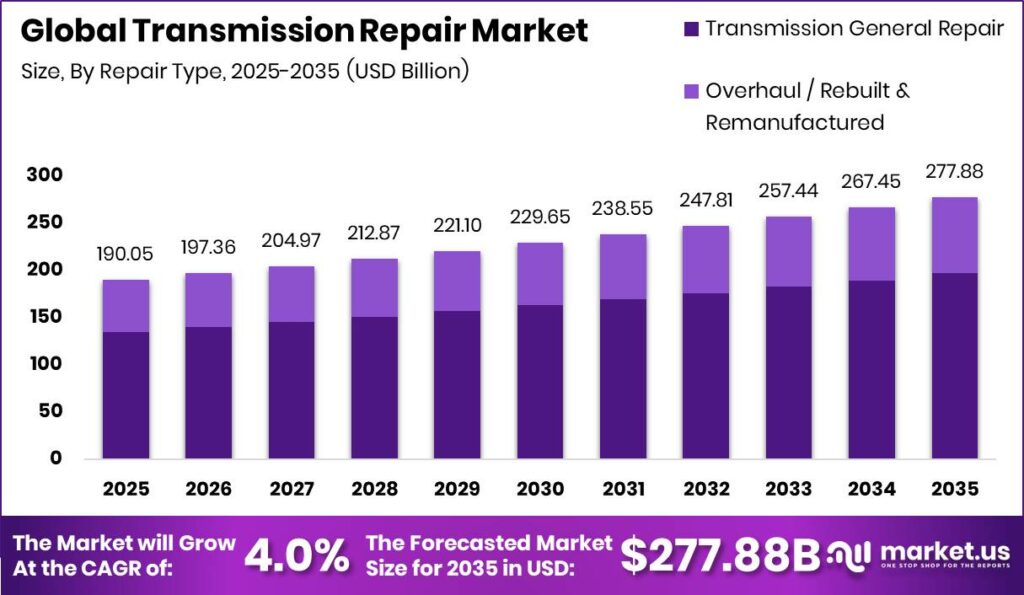
Global Transmission Repair Market size is expected to be worth around USD 277.88 Billion by 2035 from USD 190.05 Billion in 2025, growing at a CAGR of 4.00% during the forecast period 2026 to 2035. This expansion reflects sustained aftermarket spend on gearboxes that exit warranty as fleets age. Investors who track rebuild mix rather than new-vehicle cycles capture the steadiest cash flow path in this category.
Therefore, the Transmission Repair Market covers diagnosis, fluid service, component replacement, overhaul, and full unit swap for passenger and commercial drivetrains. The structure spans vehicle type, component, transmission architecture, repair intensity, service channel, end user, distribution path, and propulsion platform. Each layer steers ticket size, labor hours, and parts margin for shops and suppliers.
Key Takeaways
- The market reaches USD 190.05 Billion in 2025 and USD 277.88 Billion by 2035 at a 4.00% CAGR.
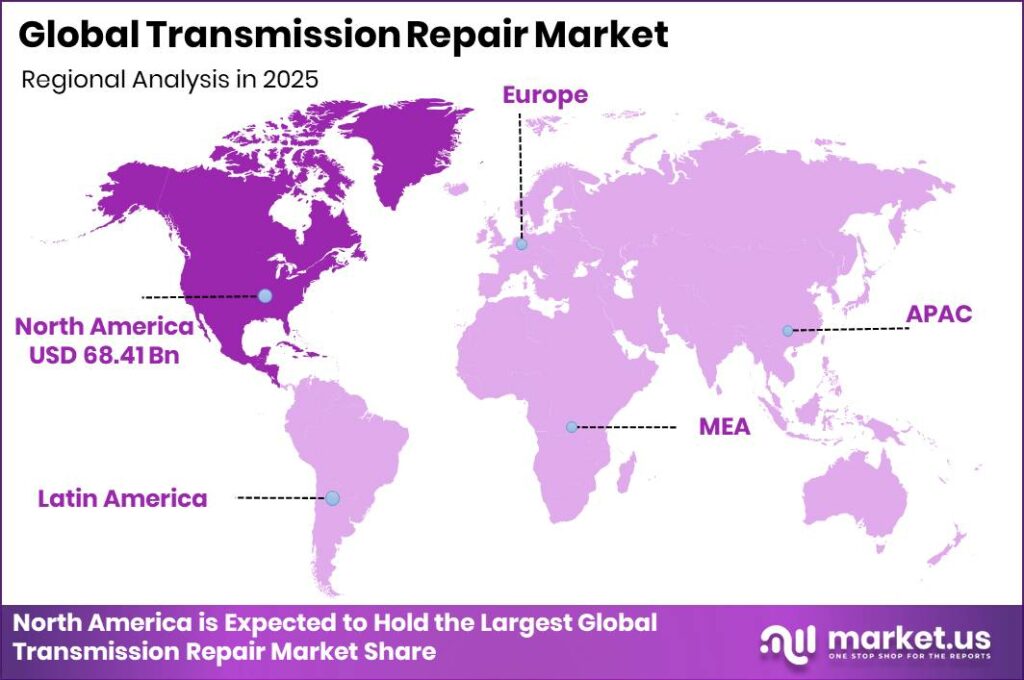
- North America leads with a 36.00% share valued at USD 68.41 Billion.
- Passenger Vehicles hold 58.00% by vehicle type, the largest vehicle cohort.
- Transmission Oil leads components with a 30.10% share.
- Automatic (AT) leads transmission types with a 53.55% share.
- Preventive Maintenance leads repair types with a 41.00% share.
- Independent Garages and Workshops lead service providers with a 39.00% share.
- Individual Vehicle Owners lead end users with a 62.00% share.
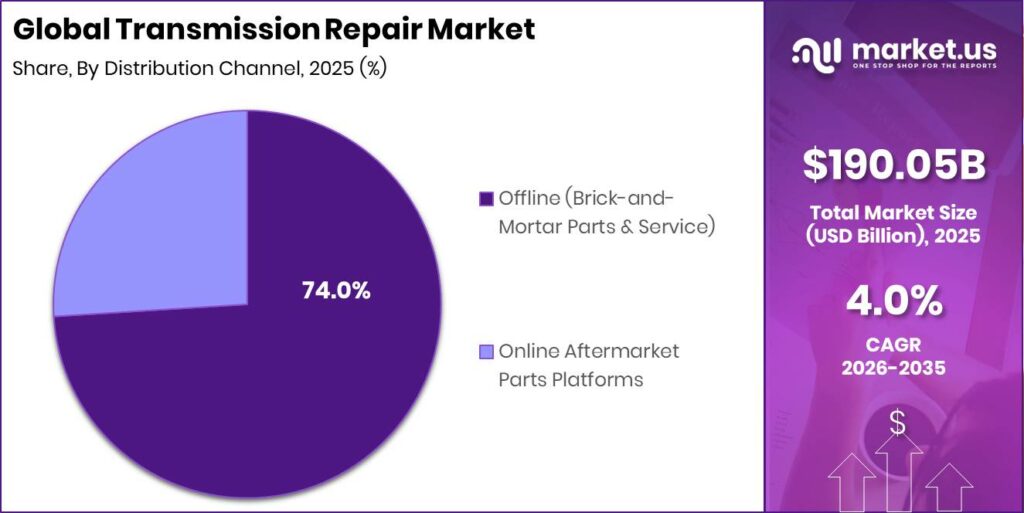
- Offline (Brick-and-Mortar Parts and Service) leads distribution with a 74.00% share.
- Internal Combustion Engine (ICE) leads propulsion with an 82.00% share.
As per our research, average shop throughput reached 2.2 vehicles per service bay per day in a 2025 survey of 752 U.S. general repair shops. This bay benchmark sets realistic capacity for transmission work that shares lifts and scheduling with general repair. Operators who raise bay turns without adding space lift revenue faster than peers who only expand footprint.
Consequently, preventive maintenance captured 41.00% of repair-type demand because fluid and sensor work finishes faster than full rebuilds. Same-day fluid service keeps cars productive and preserves cash for owners facing high replacement quotes. Shops that productize fluid packages lock recurring visits before failures force high-ticket overhauls.
Independent garages held a 39.00% service-provider share as owners sought price flexibility outside dealer networks. Minor transmission repairs typically need 1 to 2 days, while in-house rebuilds need 3 to 5 days. Providers who publish clear timelines reduce quote abandonment and improve bay utilization.
Vehicle Type Analysis
Passenger Vehicles dominates with 58.00% due to large aged light-vehicle parc.
In 2025, Passenger Vehicles held a dominant market position in the By Vehicle Type segment of Transmission Repair Market, with a 58.00% share. Global motor vehicle production reached about 96.4 million units in 2025 per OICA-linked industry tallies. This large passenger base feeds continuous gearbox wear as ownership stretches past typical failure windows. Suppliers who stock high-volume passenger kits win share before commercial programs mature.
Light Commercial Vehicles rank as the fastest-growing vehicle class because delivery and trade fleets accumulate high duty cycles. Global vehicle sales climbed to roughly 99.8 million units in 2025, lifting light commercial intensity in urban logistics. Fleet managers prioritize uptime contracts over one-off retail visits. Vendors who bundle preventive fluid plans with LCV accounts secure multi-year parts pull-through.
Medium and Heavy Commercial Vehicles require heavier torque converters, clutches, and automated manuals under sustained load. PACCAR service bulletins assign about 1.8 labor hours for targeted transmission software and air-supply diagnosis on major automated units. This quantifies how commercial repairs mix mechanical and electronic labor. Specialists who certify on heavy AMT platforms capture higher labor rates than general passenger shops.
Component Analysis
Transmission Oil dominates with 30.10% due to recurring fluid service intervals.
In 2025, Transmission Oil held a dominant market position in the By Component segment of Transmission Repair Market, with a 30.10% share. Standard fluid service usually finishes the same day because shops drain, flush, and refill without full teardown. High repeat frequency multiplies oil and filter attach rates across the parc. Distributors who lock bulk ATF contracts with multi-bay chains stabilize volume even when rebuild tickets slow.
Gasket and seal kits address leaks that appear as vehicles pass the mid-life mark. U.S. light-vehicle average age reached 12.8 years in 2025 according to fleet-age tracking cited by transport statistics outlets. Leak correction often precedes major internal work and protects fluid integrity. Parts brands that kit common pan and axle seals reduce bay time and raise first-time fix rates.
Gears, clutch plates, torque converters, filters, and electronic control units (TCU) form the higher-ticket rebuild bill of materials. A January 2025 Daimler Truck campaign lists about 0.4 labor hours for transmission-control-module programming steps. Software-linked hardware raises the value of correct TCU and sensor parts. Suppliers who pair hardware with validated flash files reduce comebacks for independent shops.
Others covers bushings, solenoids, and ancillary hardware folded into residual component spend. Shops that keep these SKUs on the shelf cut special-order delays of 3 to 7 days common on full unit swaps. Inventory discipline on small parts protects margin when large cores are scarce.
Transmission Type Analysis
Automatic (AT) dominates with 53.55% due to comfort-led global AT adoption.
In 2025, Automatic (AT) held a dominant market position in the By Transmission Type segment of Transmission Repair Market, with a 53.55% share. Multi-speed automatics dominate repair bays because owners keep comfort-focused cars longer. Global production near 96.4 million vehicles in 2025 sustains a deep AT installed base. Reman and fluid specialists focused on 8-speed and 10-speed families scale volume faster than manual-only rebuilders.
Manual transmissions remain relevant in cost-sensitive and commercial niches where drivers accept clutch service. Clutch and gear work still anchors many independent bay schedules. Shops that retain manual tooling capture price-sensitive owners who avoid dealer AT quotes. This mix balances premium AT tickets with steadier manual volume.
Continuously Variable (CVT) units need precise pressure adapt learning after repair. GM 2025 instructions require normal driving for 5 to 10 minutes, garage shifts, then repeated speed holds near 30, 40, and 55 mph. Incomplete learn cycles drive comebacks and warranty cost. Centers that document full CVT drive cycles protect both customer trust and shop margin.
Dual-Clutch (DCT) and e-Axle / Dedicated EV Gearbox complete the architecture set, with e-axle the fastest-growing line. IEA tracking shows electric car sales above 20 million globally in 2025, about one in four new cars. Early movers who tool for reduction-gear and high-voltage safety claim future EV service share. ZF introduced TraXon 2 hybrid transmission to the North American commercial market at ACT Expo 2025, expanding hybrid automated options that will need aftermarket support.
Repair Type Analysis
Preventive Maintenance dominates with 41.00% due to lower cost than full rebuilds.
In 2025, Preventive Maintenance held a dominant market position in the By Repair Type segment of Transmission Repair Market, with a 41.00% share. Fluid and filter services finish same day and fit owner budgets better than multi-day rebuilds. High frequency multiplies oil and filter revenue across aging fleets. Chains that subscribe fleets to interval plans smooth workshop load across seasons.
General Repair covers sensors, solenoids, and leak fixes that restore shift quality without full teardown. Minor jobs typically span 1 to 2 days in specialist guides. Fast diagnosis converts walk-ins before owners delay and cause secondary damage. Shops that price transparent general-repair menus raise close rates on hesitant retail customers.
Overhaul and rebuild work delivers the largest labor tickets when internals fail. In-house rebuilds commonly need 3 to 5 days including teardown and reinstall. Capacity hinges on skilled techs and core availability. Investors backing reman lines reduce cycle time versus pure custom rebuild models.
Replacement is the fastest-growing repair type when labor risk or parts scarcity favors a unit swap. In-stock replacements often take 2 to 4 days, while special-order units take 3 to 7 or more days. Reman supply depth shortens downtime for fleet buyers. Providers who hold popular cores win commercial accounts that value calendar certainty.
Service Provider Analysis
Independent Garages & Workshops dominates with 39.00% due to price-flexible local access.
In 2025, Independent Garages & Workshops held a dominant market position in the By Service Provider segment of Transmission Repair Market, with a 39.00% share. Independents attract out-of-warranty owners who compare labor quotes against dealers. Industry surveys show many U.S. shops still average under 7 technicians against double-digit daily car counts. Groups that recruit and retain techs convert this share into sustainable throughput.
OEM-Authorised Service Centres retain warranty and complex software work tied to factory tools. Campaign procedures such as Daimler’s roughly 0.4 hour TCM programming steps stay inside authorized channels when data access is restricted. Dealers monetize compliance and genuine parts margins. Independents who secure legal data access narrow this gap over time.
Quick-Service Chains capture fluid and light repair traffic with standardized bays and national branding. Mobile / Online Platforms are the fastest-growing channel as owners book diagnostics remotely. Transmission-Specialist Franchises concentrate rebuild expertise and reman pipelines. Platforms that route jobs by repair severity raise first-time fix rates across the network.
End-user Analysis
Individual Vehicle Owners dominates with 62.00% due to large retail out-of-warranty parc.
In 2025, Individual Vehicle Owners held a dominant market position in the By End-user segment of Transmission Repair Market, with a 62.00% share. Personal owners fund repairs from cash once warranties expire on aging cars. U.S. average light-vehicle age at 12.8 years enlarges this paying cohort. Retail-focused shops that offer financing on rebuilds reduce deferred-repair leakage.
Fleet Owners & Operators are the fastest-growing end users because downtime multiplies operating loss. Global commercial activity tracks with vehicle sales near 99.8 million units in 2025. Fleets prefer contracted SLAs over ad hoc retail visits. Service networks with mobile response and reman pools lock multi-year fleet agreements.
Dealership Service Departments and Rental & Car-Sharing Companies complete demand with brand and utilization-driven work. Rental fleets rotate high-mileage units that hit transmission service intervals early. Providers who integrate telematics alerts into shop scheduling cut unplanned tow events. This raises asset utilization for rental buyers and steady bay feed for shops.
Distribution Channel Analysis
Offline (Brick-and-Mortar Parts & Service) dominates with 74.00% due to hands-on fitment needs.
In 2025, Offline (Brick-and-Mortar Parts & Service) held a dominant market position in the By Distribution Channel segment of Transmission Repair Market, with a 74.00% share. Heavy cores, fluid bulk, and same-day bay needs favor counter and warehouse pickup. Shops still depend on local jobbers for emergency seals and converters. Distributors with dense branches win share when special-order delays threaten bay idle time.
Online Aftermarket Parts Platforms grow as shops order cataloged hard parts overnight. Digital catalogs speed VIN-level identification for multi-speed AT kits. Platforms that guarantee core returns and fitment data cut mis-order rates. Hybrid models that pair e-commerce with local will-call counters protect the offline majority while capturing online growth.
Isuzu 2025 procedures require fluid between 75°C and 85°C before scan tools allow Transmission Service Fast Learn, then ignition off at least 1 minute after completion. Correct fluid specification and process discipline depend on reliable parts identity. Channels that ship OEM-spec fluids with clear labels reduce failed learn events and comebacks.
Service Provider Analysis
Independent Repair Shops dominates with 39.00% due to flexible non-dealer capacity.
In 2025, Independent Repair Shops held a dominant market position in the By Service Provider segment of Transmission Repair Market, with a 39.00% share. This channel mirrors broad independent strength in out-of-warranty drivetrain work. Bay economics favor shops that mix fluid plans with selective rebuilds. Groups investing in scan tools and training defend this lead against dealer recovery strategies.
Dealerships retain complex programming, warranty, and brand-loyal service. Software update tasks on Eaton Endurant lines can require about 1.8 labor hours on specified PACCAR bulletins, and some PTO-equipped updates list 0.3 hours. Authorized tooling keeps these jobs inside dealer walls when security gates apply. Independents without equivalent access lose high-complexity tickets.
Mobile & Online Repair Platforms are the fastest-growing provider mode as digital dispatch reaches broken-down vehicles. Remote intake plus mobile diagnosis shortens time-to-quote for retail and fleet buyers. Platforms that escalate only true rebuilds to specialist bays optimize network cost. Early scale in dense metros creates density advantages hard for single-site shops to match.
Propulsion Type Analysis
Internal Combustion Engine (ICE) dominates with 82.00% due to vast legacy multi-speed parc.
In 2025, Internal Combustion Engine (ICE) held a dominant market position in the By Propulsion Type segment of Transmission Repair Market, with a 82.00% share. Multi-speed ICE gearboxes still dominate repair revenue because the installed base dwarfs young EV fleets. Global output near 96.4 million vehicles in 2025 remains majority combustion. Parts programs optimized for AT, CVT, and DCT ICE units will fund cash flow for the next decade.
Electric Vehicles (EV) are the fastest-growing propulsion line for future service specialization. IEA data show more than 20 million electric cars sold worldwide in 2025, over one-quarter of global car sales. Reduction gears and e-axles need high-voltage-safe procedures rather than classic clutch rebuilds. Shops certifying EV drivetrain techs now position for out-of-warranty volume as the parc ages.
Hybrid architectures bridge both worlds with multi-speed and e-axle content. Commercial hybrid launches such as next-generation automated hybrids expand the skill set shops must hold. Training budgets that cover both ICE hydraulics and EV isolation standards reduce lost jobs. Investors should weight ICE cash generation today against EV capability build for later share.
Key Market Segments
By Vehicle Type
- Passenger Vehicles
- Light Commercial Vehicles
- Medium and Heavy Commercial Vehicles
By Component
- Gasket & Seal
- Transmission Oil
- Gear
- Clutch Plate
- Torque Converter
- Filters
- Electronic Control Unit (TCU)
- Others
By Transmission Type
- Manual
- Automatic (AT)
- Continuously Variable (CVT)
- Dual-Clutch (DCT)
- e-Axle / Dedicated EV Gearbox
By Repair Type
- Preventive Maintenance
- General Repair
- Overhaul / Rebuild
- Replacement
By Service Provider
- OEM-Authorised Service Centres
- Independent Garages & Workshops
- Quick-Service Chains
- Mobile / Online Platforms
- Transmission-Specialist Franchises
By End-user
- Individual Vehicle Owners
- Fleet Owners & Operators
- Dealership Service Departments
- Rental & Car-Sharing Companies
By Distribution Channel
- Offline (Brick-and-Mortar Parts & Service)
- Online Aftermarket Parts Platforms
By Service Provider
- Independent Repair Shops
- Dealerships
- Mobile & Online Repair Platforms
By Propulsion Type
- Internal Combustion Engine (ICE)
- Electric Vehicles (EV)
Regional Analysis
North America Dominates the Transmission Repair Market with a Market Share of 36.00%, Valued at USD 68.41 Billion
North America leads because a large aged light-vehicle parc drives out-of-warranty gearbox work. Average U.S. light-vehicle age reached 12.8 years in 2025, with passenger cars near 14.5 years. High labor rates and dense independent networks convert this age profile into paid rebuilds. Investors overweight North American reman and specialist franchise models for near-term cash yield.
Asia Pacific stands as the scale growth engine as motorization and commercial fleets expand. China alone produced about 24.3 million vehicles in 2025 within a global total near 96.4 million. Rising parc depth multiplies future fluid and rebuild demand. Suppliers who localize cores and training in major APAC hubs secure volume before premium pricing fully develops.
Europe and other regions add stable premium repair mix on complex multi-speed and hybrid units. In June 2025, ZF Group signed a strategic supply agreement for several thousand EcoMid manual and EcoTronic Mid 9-speed AMT units for trucks above 25 tonnes. That commercial pipeline supports long-run service content in Europe and export markets. Regional portfolios should balance NA cash, APAC volume, and European technology density.
Key Regions and Countries
North America
- US
- Canada
Europe
- Germany
- France
- The UK
- Spain
- Italy
- Rest of Europe
Asia Pacific
- China
- Japan
- South Korea
- India
- Australia
- Rest of APAC
Latin America
- Brazil
- Mexico
- Rest of Latin America
Middle East and Africa
- GCC
- South Africa
- Rest of MEA
Market Dynamics
Market Opportunity Analysis - Mobile platforms, reman supply, and EV e-axle skills open white space beyond core ICE rebuilds
Replacement repair remains under-penetrated relative to preventive work even though it is the fastest repair-type growth line. Special-order unit swaps still stretch 3 to 7 days when cores are thin. Reman depth that cuts downtime wins fleet budgets currently lost to vehicle retirement. Early capital in core banks converts this friction into share.
Mobile and online platforms grow fastest among service modes yet still trail independent garage density. Retail owners accept remote intake when quotes arrive before tow decisions. Networks that triage fluid jobs to mobile techs and rebuilds to specialists raise utilization. This channel remains open for roll-ups in secondary metros.
Electric vehicle and e-axle service sits early on the curve while ICE still holds 82.00% propulsion share. Global EV sales above 20 million units in 2025 build the future installed base. Shops without high-voltage certification will cede premium tickets later. Training investment now is cheaper than emergency hiring when warranty cliffs arrive.
Asia Pacific motorization multiplies long-run service white space outside North America’s 36.00% lead. China’s production scale alone exceeds 24 million vehicles annually. Local reman and training footprints remain thinner than demand growth implies. Entrants who pair parts localization with technician academies capture compounding fleet aging.
Technology and Innovation Landscape - Software calibration, digital diagnostics, and reman platforms redefine shop capability
As reported by aftermarket technician surveys, 73% of professional technicians flagged limited original-equipment data access as a major challenge in 2025. Electronically controlled transmissions depend on that data for accurate diagnosis. Shops locked out lose complex AT and DCT jobs to authorized channels. Tool vendors who deliver lawful, current calibration access raise independent competitiveness.
Data from the same 2025 technician survey shows 67% cited vehicle network and communication systems as the hardest systems to diagnose. Transmission control modules exchange data across those networks. Incomplete network literacy drives misdiagnosis and repeat visits. Training products focused on bus architecture convert this pain into paid upskilling revenue.
Based on 2026 IMR Automotive Research survey findings, 30.0% of repair shops called keeping current with diagnostic tools and software updates a key challenge. Ratchet+Wrench 2025 results show 22% of owners allocated 6% to 10% of budgets to tools and technology. Continuous scan-tool investment is now a fixed cost of transmission work. Groups that centralize software licenses lower per-bay cost versus single shops.
ZF Aftermarket’s MultiScan launch and expanded REMAN catalog with more than 2,000 transmission variants illustrate how diagnostics and circular supply move together. Reman shortens replacement cycles while digital support lifts first-time fix rates. Competitors without paired hardware and software ecosystems face share erosion in independent channels.
Drivers
Market.us data shows the U.S. average light-vehicle age rose to 12.8 years in 2025, with passenger cars at 14.5 years. Ownership now stretches past the typical 8 to 10 year transmission failure window. More than 280 million U.S. units remain in operation, and a majority exceed 10 years. This enlarges paid overhaul volume as out-of-warranty owners fund repairs from personal cash.
As a result, shops shift toward high-ticket drivetrain rebuilds at labor rates of USD 100 to USD 139 per hour. Age moved from about 12.6 years in 2024 to 12.8 years in 2025, confirming near-term lift. Repair demand decouples from new-vehicle sales and anchors the largest incremental support to the 4.00% baseline CAGR. Buyers of specialist capacity gain insulation from OEM production cycles.
| Driver | (~) % Impact on CAGR Forecast | Geographic Relevance | Impact Timeline |
|---|---|---|---|
| Aging vehicle parc & extended ownership cycles | +1.6% | North America, Western Europe | Short term (2 years or less) |
| Rising transmission complexity (8–10 speed & CVT/DCT) | +1.1% | Global | Medium term (2 to 4 years) |
| Deferred new-car purchases amid affordability squeeze | +0.9% | North America, Europe, Latin America | Short term (2 years or less) |
| Expanding used-vehicle transactions & certified resale | +0.7% | Global | Medium term (2 to 4 years) |
| Growth of commercial & fleet drivetrain servicing | +0.6% | Asia-Pacific, North America | Medium term (2 to 4 years) |
Restraints
The U.S. extended a 25% Section 232 tariff to auto parts including transmissions effective May 3, 2025, after vehicles faced the duty on April 3, 2025. Combined vehicle-and-parts tariff burden estimates near USD 41 billion in year one and USD 45 billion in year two. That equates to roughly USD 2,580 added cost per vehicle. Aftermarket component prices rise in a band linked to projected repair-input inflation of 4% to 8%.
This means independent shops absorb margin or lose tickets when customers resist full parts premiums. Discretionary rebuild decisions freeze at the counter rather than only slowing long-run growth. Tariff pass-through is the sharpest near-term drag on the 4.00% baseline. Operators who dual-source cores and communicate price early protect close rates better than peers who surprise buyers at invoice.
| Restraint | (~) % Impact on CAGR Forecast | Geographic Relevance | Impact Timeline |
|---|---|---|---|
| 25% Section 232 tariffs on transmissions & powertrain parts | -1.3% | North America | Short term (2 years or less) |
| Elevated interest rates suppressing discretionary repair spend | -0.8% | Global | Short term (2 years or less) |
| Total-loss economics on high-mileage vehicles | -0.6% | North America, Europe | Short term (2 years or less) |
| OEM repair-data & software access lockouts | -0.5% | North America, Europe | Medium term (2 to 4 years) |
| Consumer deferral of non-safety-critical repairs | -0.4% | Global | Short term (2 years or less) |
Challenges
U.S. automotive-technician employment growth near 6.1% still leaves a projected shortfall of roughly 45,000 technicians. A September 2025 poll of about 700 U.S. shops found average staffing at 6.42 techs against a daily car count of 12.25. Gearbox rebuilds sit among the most training-intensive jobs. Unfilled bays strand revenue even when demand tickets exist.
This creates pressure as 24% of shops link shortages to low compensation, pushing labor rates toward the USD 100 to USD 139 band. Mitigation needs multi-year apprenticeships and OEM-aligned certification rather than quick hiring spikes. The friction is the highest structural drag distinct from tariffs. Chains that fund training pipelines unlock capacity competitors cannot staff.
| Challenge | (~) % CAGR Friction Drag | Geographic Relevance | Mitigation Horizon |
|---|---|---|---|
| Skilled drivetrain technician shortage | -0.9% | North America, Europe | Long term (4 years or more) |
| Rising EV/hybrid diagnostic upskilling burden | -0.6% | Global | Medium term (2 to 4 years) |
| Software-defined transmission calibration complexity | -0.5% | Global | Medium term (2 to 4 years) |
| Specialized tooling & equipment CapEx intensity | -0.4% | North America, Asia-Pacific | Medium term (2 to 4 years) |
| Replacement-part supply-chain lead-time volatility | -0.3% | Global | Short term (2 years or less) |
Opportunities
IEA tracking shows electric-car sales topped 20 million globally in 2025, with roughly one in four new cars electric. The young EV parc is still largely under warranty, so paid e-axle volume has not fully arrived. Reduction-gear and thermal-integrated drive units will command premium high-voltage labor later. Specialized tooling scarcity can expand gross margin by 8 to 12 percentage points versus conventional gearbox work.
This signals a long-window white space above the 4.00% baseline as fleets age out of warranty. U.S. EV share near 7.8% of new sales in 2025 still leaves a compounding installed base ahead. First movers who certify high-voltage teams now capture disproportionate share. Investors should fund EV drivetrain capability while ICE rebuild cash funds the transition.
| Opportunity | (~) % Potential CAGR Upside | Geographic Relevance | Execution Window |
|---|---|---|---|
| EV reduction-gear & e-axle service specialization | +1.4% | Global | Long term (4 years or more) |
| Remanufactured & circular-economy transmission supply | +1.0% | North America, Europe | Medium term (2 to 4 years) |
| Independent-shop consolidation & multi-site roll-ups | +0.8% | North America | Medium term (2 to 4 years) |
| Subscription & warranty-bundled repair monetization | +0.6% | Global | Medium term (2 to 4 years) |
| Emerging-market motorization service white space | +0.7% | Asia-Pacific, Africa, Latin America | Long term (4 years or more) |
Key Company Insights
Schaeffler Group supplies precision bearings, clutches, and transmission components that feed both OEM lines and aftermarket rebuild kits. Its breadth across ICE and hybrid architectures supports shops that need consistent hard-part quality. Deep engineering ties to multi-speed programs raise switching costs for rebuilders. Component reliability at scale protects Schaeffler’s position as repair complexity rises.
Allison Transmission strengthens commercial and off-highway coverage after announcing in June 2025 a definitive agreement to acquire Dana’s Off-Highway business for about USD 2.7 billion. The deal adds drivetrain components and aftermarket reach beyond on-highway boxes. Fleet service networks gain a wider parts and support umbrella. Integration risk remains, yet portfolio depth raises barriers for pure-play rivals in vocational segments.
Key Players
- Schaeffler Group
- Allison Transmission
- BorgWarner
- ZF Friedrichshafen AG
- Continental AG
- Mister Transmission
- AAMCO Transmissions
- Lee Myles Autocare & Transmission
- Cottman Transmission and Total Auto Care
- Firestone Complete Auto Care
- Recro Ltd.
Recent Developments
- January 2026: Allison Transmission completed the acquisition of Dana Incorporated Off-Highway Drive and Motion Systems business for approximately USD 2.7 billion, expanding drivetrain coverage across industrial, construction, agriculture, and aftermarket service applications.
- April 2025: ZF Aftermarket expanded its ZF REMAN portfolio with more than 2,000 remanufactured ZF transmission variants for conventional and hybrid passenger vehicles, strengthening replacement and repair supply for workshops.
- October 2025: ZF Aftermarket launched ZF MultiScan diagnostic solutions and the ZF [pro]Tech plus technical support program at AAPEX and SEMA 2025, adding digital diagnostics and repair support for independent workshops.
Geopolitical Impact Analysis
According to WTO-linked trade monitoring and U.S. customs implementation schedules, the 25% Section 232 tariff on automobiles from April 3, 2025 extended to transmissions and powertrain parts on May 3, 2025. Combined vehicle-and-parts burden estimates near USD 41 billion in year one. Import-heavy torque converters and valve bodies reprice quickly at the shop counter. North American rebuilders who dual-source cores limit pass-through shock on retail close rates.
Figures from UNCTAD and World Bank logistics trackers show elevated freight and input volatility still stretch lead times on specialized gearbox cores. Repair-input inflation projections of 4% to 8% compound tariff effects on discretionary overhauls. Shops holding deeper local inventory reduce bay idle days when ocean schedules slip. This favors capitalized distributors over thin-inventory independents in tariff-exposed corridors.
Report Scope
| Report Features | Description |
|---|---|
| Market Value (2025) | USD 190.05 Billion |
| Forecast Revenue (2035) | USD 277.88 Billion |
| CAGR (2026-2035) | 4.00% |
| Base Year for Estimation | 2025 |
| Historic Period | 2020-2024 |
| Forecast Period | 2026-2035 |
| Report Coverage | Revenue Forecast, Market Dynamics, Market Opportunity Analysis, Technology and Innovation Landscape, Competitive Landscape, Recent Developments |
| Segments Covered | By Vehicle Type (Passenger Vehicles, Light Commercial Vehicles, Medium and Heavy Commercial Vehicles), By Component (Gasket & Seal, Transmission Oil, Gear, Clutch Plate, Torque Converter, Filters, Electronic Control Unit (TCU), Others), By Transmission Type (Manual, Automatic (AT), Continuously Variable (CVT), Dual-Clutch (DCT), e-Axle / Dedicated EV Gearbox), By Repair Type (Preventive Maintenance, General Repair, Overhaul / Rebuild, Replacement), By Service Provider (OEM-Authorised Service Centres, Independent Garages & Workshops, Quick-Service Chains, Mobile / Online Platforms, Transmission-Specialist Franchises), By End-user (Individual Vehicle Owners, Fleet Owners & Operators, Dealership Service Departments, Rental & Car-Sharing Companies), By Distribution Channel (Offline (Brick-and-Mortar Parts & Service), Online Aftermarket Parts Platforms), By Service Provider (Independent Repair Shops, Dealerships, Mobile & Online Repair Platforms), By Propulsion Type (Internal Combustion Engine (ICE), Electric Vehicles (EV)) |
| Regional Analysis | North America (US and Canada), Europe (Germany, France, The UK, Spain, Italy, and Rest of Europe), Asia Pacific (China, Japan, South Korea, India, Australia, and Rest of APAC), Latin America (Brazil, Mexico, and Rest of Latin America), Middle East and Africa (GCC, South Africa, and Rest of MEA) |
| Competitive Landscape | Schaeffler Group, Allison Transmission, BorgWarner, ZF Friedrichshafen AG, Continental AG, Mister Transmission, AAMCO Transmissions, Lee Myles Autocare & Transmission, Cottman Transmission and Total Auto Care, Firestone Complete Auto Care, Recro Ltd. |
| Customization Scope | Customization for segments, region / country-level will be provided. Additional customization can be done based on requirements. |
| Purchase Options | We have three licenses to opt for: Single User License | Multi-User License (Up to 5 Users) | Corporate Use License (Unlimited User and Printable PDF) |





































