


Report Overview
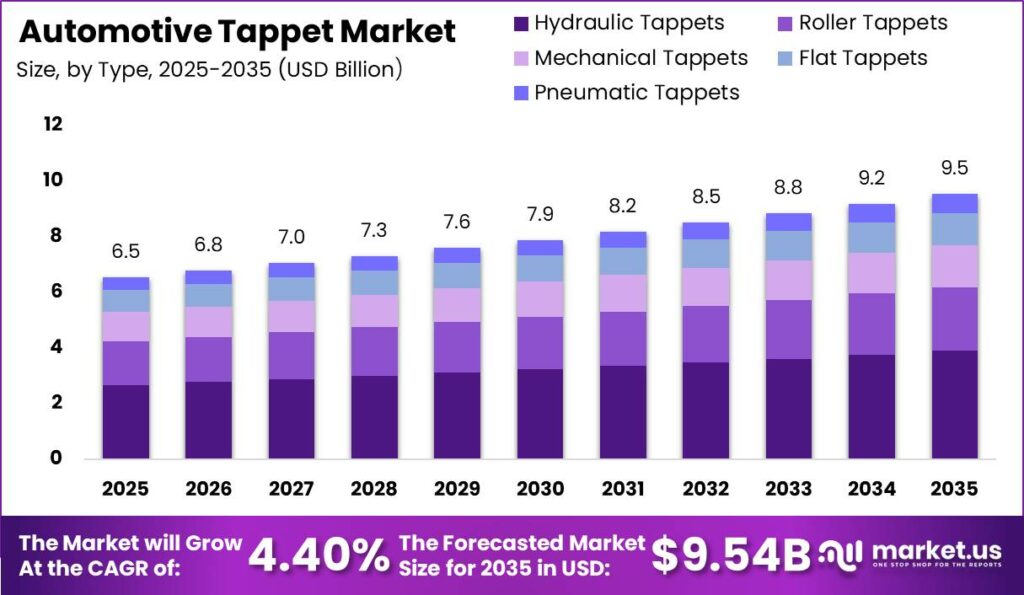
Global Automotive Tappet Market size is expected to be worth around USD 9.54 Billion by 2035 from USD 6.54 Billion in 2025, growing at a CAGR of 4.40% during the forecast period 2026 to 2035. This trajectory reflects sustained demand from internal combustion engine production across passenger, commercial, and two-wheeler segments worldwide. Suppliers positioned in high-volume manufacturing regions stand to capture the most durable share of this expansion.
The automotive tappet market covers mechanical components that sit between the camshaft and valve stem in an engine’s valvetrain. Tappets translate rotational cam motion into linear valve movement, enabling precise intake and exhaust timing. The market spans flat, roller, mechanical, hydraulic, and pneumatic tappet designs, serving OEM and aftermarket channels across gasoline, diesel, and alternative fuel engine platforms globally.
Key Takeaways
- The global automotive tappet market was valued at USD 6.54 Billion in 2025 and is forecast to reach USD 9.54 Billion by 2035.
- The market grows at a CAGR of 4.40% during the forecast period 2026 to 2035.
- By Type, Hydraulic Tappets dominate with a 40.85% share, while Roller Tappets represent the fastest-growing sub-segment.
- By Engine Capacity, the 4–6 Cylinders segment holds the largest share at 53.65%, while Above 6 Cylinders is the fastest-growing category.
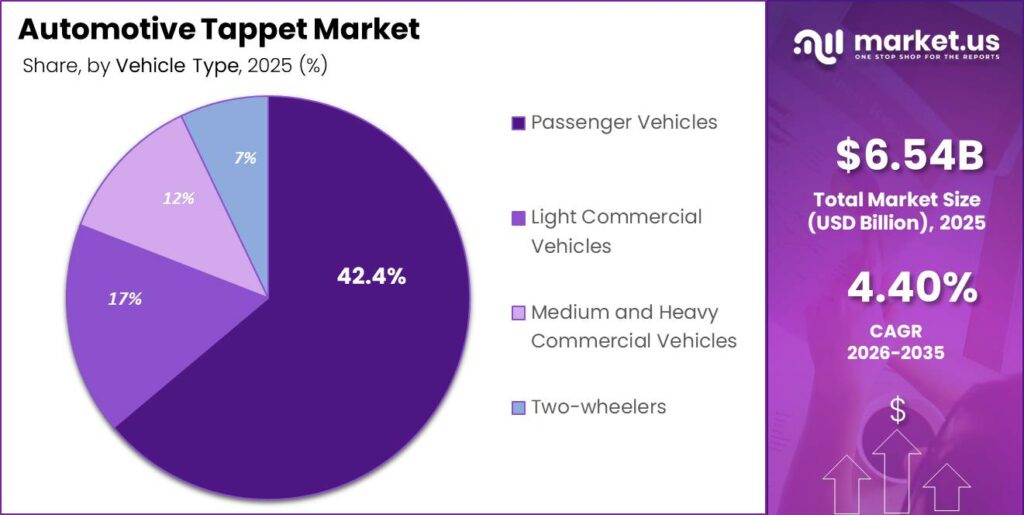
- By Vehicle Type, Passenger Vehicles lead with a 42.4% share, while Medium and Heavy Commercial Vehicles are the fastest-growing segment.
- By Distribution Channel, OEM dominates with a 73.00% share, while Aftermarket is the fastest-growing channel.
- By Fuel Type, Gasoline holds the largest share at 60.00%, while LPG/CNG is the fastest-growing fuel category.
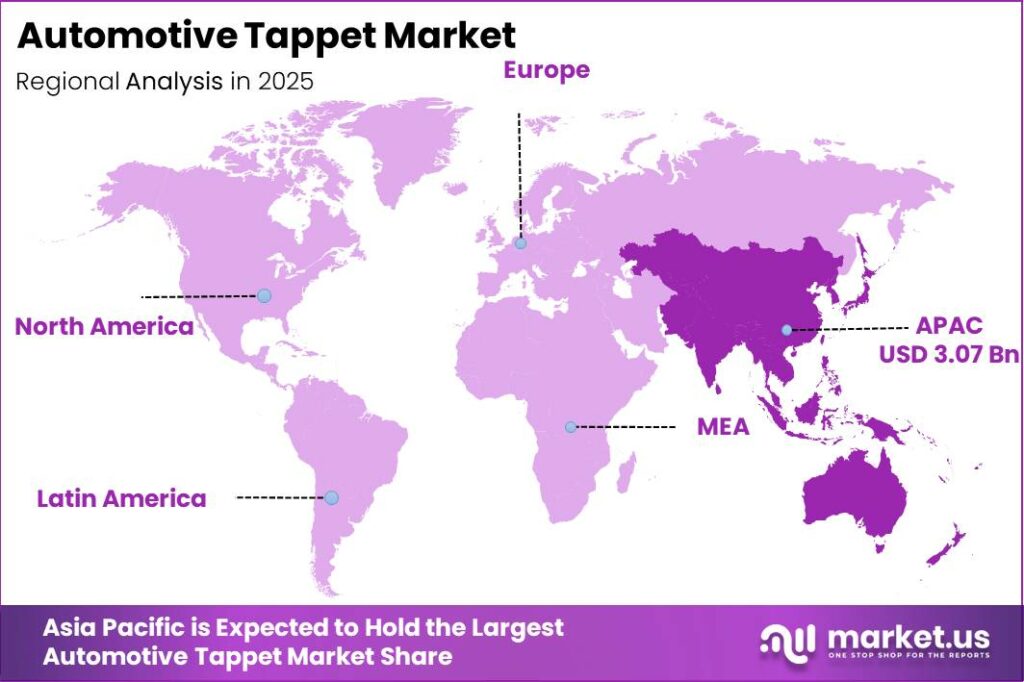
- Asia Pacific is the dominant region with a 47.00% market share, valued at USD 3.07 Billion in 2025.
As per our research, global light-vehicle production was forecast to contract 1.6% to roughly 78 million units in 2025, with Europe down 2.4% and North America down 5.2%. This near-term volume contraction compresses OEM tappet order pipelines in key manufacturing regions. Suppliers dependent on a single OEM geography face the sharpest near-term demand pressure from this output decline.
According to our research, mechanical tappets typically require valve-clearance adjustment every 10,000 to 15,000 km, subject to vehicle manufacturer specifications. This servicing frequency sustains a recurring replacement cycle that benefits both OEM service networks and independent aftermarket distributors. Countries with large vehicle fleets and high annual mileage averages generate the most consistent aftermarket tappet volumes regardless of new vehicle output trends.
Type Analysis
Hydraulic Tappets dominate with 40.85% due to self-adjusting zero-lash design appeal.
In 2025, Hydraulic Tappets held a dominant market position in the By Type segment of the Automotive Tappet Market, with a 40.85% share. Hydraulic tappets eliminate manual valve-clearance adjustment by using engine oil pressure to maintain constant zero-lash contact, reducing driver maintenance requirements significantly. According to data from the European Automobile Manufacturers’ Association (ACEA), passenger car production in Europe exceeded 10 million units in 2023, the majority of which used hydraulic valvetrain systems as standard equipment. This dominance signals that OEMs prioritizing lower total-cost-of-ownership will continue specifying hydraulic designs as their primary tappet platform.
Roller Tappets represent the fastest-growing sub-segment within the type classification, driven by their lower friction coefficient compared with flat-face alternatives. Reduced friction directly translates to measurable fuel economy improvements, a specification requirement now embedded in emissions compliance frameworks across the European Union, the United States, and China. Industry association data from the SAE International technical library records roller follower adoption rates rising steadily across four-cylinder and six-cylinder gasoline platforms since 2018. Suppliers offering roller tappet lines alongside hydraulic variants are positioned to capture volume from OEMs managing both compliance and performance targets simultaneously.
Mechanical Tappets retain a defined production share by serving high-performance, motorsport, and heavy-duty commercial engine applications where precise manual adjustment is preferred over oil-pressure-dependent self-adjustment. Flat Tappets, the oldest design category, remain in active production for legacy engine rebuilds and cost-sensitive aftermarket segments where engineering simplicity and low unit cost outweigh performance optimization. According to the Specialty Equipment Market Association (SEMA), the US automotive performance aftermarket generated over USD 51 billion in total sales in 2022, with engine components including flat and mechanical tappets representing a structurally supported sub-category. Pneumatic Tappets serve high-speed racing and heavy commercial engine niches, holding the remaining share collectively.
Engine Capacity Analysis
4-6 Cylinders dominates with 53.65% due to global passenger car volume concentration.
In 2025, the 4–6 Cylinders segment held a dominant market position in the By Engine Capacity segment of the Automotive Tappet Market, with a 53.65% share. Four- and six-cylinder engines represent the production backbone of global passenger car and light commercial vehicle output, spanning entry-level compacts through mid-size sedans and SUVs. According to the International Organization of Motor Vehicle Manufacturers (OICA), global passenger car production exceeded 67 million units in 2023, with four-cylinder powertrains accounting for the substantial majority of that volume. This concentration means tappet suppliers optimized for 4–6 cylinder applications hold the most defensible and volume-stable position in the market.
The Above 6 Cylinders segment is the fastest-growing engine capacity category, supported by continued production of large-displacement trucks, performance SUVs, and heavy-duty commercial vehicles in North America and select Asian markets. Large-displacement engines generate disproportionately higher tappet counts per unit and require more robust tappet specifications, translating to higher average selling prices per vehicle compared with four-cylinder applications. According to Ward’s Auto data, full-size pickup truck sales in the United States exceeded 2.8 million units in 2023, with V8 and large V6 powertrains remaining dominant in this segment. Suppliers covering large-displacement engine programs gain both volume and margin advantages relative to compact engine programs.
The Below 4 Cylinders segment serves the entry-level compact car, motorcycle-adjacent, and micro-vehicle categories, where engine simplicity and low unit cost are the defining procurement criteria. Three-cylinder and twin-cylinder engines are increasingly used by global automakers targeting cost-sensitive markets in South and Southeast Asia, where two-wheeler and small car penetration is high. According to the Society of Indian Automobile Manufacturers (SIAM), India produced over 4.4 million passenger vehicles in the fiscal year 2023–24, with a large share using small-displacement three- and four-cylinder platforms. Tappet suppliers serving this sub-segment compete primarily on unit cost and localized supply chain proximity rather than on performance specification.
Vehicle Type Analysis
Passenger Vehicles dominate with 42.4% due to highest global unit production volumes.
In 2025, Passenger Vehicles held a dominant market position in the By Vehicle Type segment of the Automotive Tappet Market, with a 42.4% share. Passenger vehicles generate the largest single pool of ICE-based tappet demand because they account for the highest global production volumes of any vehicle category. According to OICA, worldwide passenger car production totaled more than 67 million units in 2023, each ICE unit requiring multiple tappets per cylinder across its valvetrain. This structural volume advantage gives passenger vehicle-focused tappet suppliers the scale needed to sustain competitive unit economics through high-throughput machining lines.
Medium and Heavy Commercial Vehicles represent the fastest-growing vehicle type segment, underpinned by freight expansion, infrastructure investment, and fleet renewal programs across Asia, Latin America, and Africa. Heavy-duty diesel engines in trucks and buses use more tappets per engine than passenger car applications and operate under significantly higher duty-cycle intensity, accelerating both OEM demand and aftermarket replacement cycles. According to UNIDO manufacturing statistics, commercial vehicle output across South and Southeast Asian economies increased by a compound rate over the 2019–2023 period, reflecting infrastructure-led freight growth. Tappet suppliers with dedicated heavy-duty product lines can price at a premium and capture longer replacement cycles per account.
Light Commercial Vehicles serve urban delivery and last-mile logistics platforms, where gasoline and diesel powertrains remain the dominant drivetrain configuration in most emerging markets. Two-wheelers form a structurally distinct sub-segment, consuming single- or twin-cylinder tappet assemblies at high annual volumes across South Asia and ASEAN, where motorcycle penetration far exceeds passenger car rates. According to the Automotive Component Manufacturers Association of India (ACMA), India’s two-wheeler production exceeded 19 million units in fiscal year 2023–24, creating consistent demand for small-bore tappet components at volume. These two sub-segments hold the remaining share collectively within the vehicle type classification.
Distribution Channel Analysis
OEM dominates with 73.00% due to direct integration into new vehicle production lines.
In 2025, OEM held a dominant market position in the By Distribution Channel segment of the Automotive Tappet Market, with a 73.00% share. OEM contracts deliver the highest volume certainty for tappet manufacturers because components are specified at the engine design stage, locking suppliers into multi-year production agreements with defined annual unit commitments. According to the Automotive Parts Manufacturers’ Association (APMA) of Canada, OEM supply relationships in the engine component sector typically run on three- to five-year platform cycles, creating structural revenue visibility for certified suppliers. This long-cycle relationship model raises the cost of switching for both OEM and supplier, entrenching incumbent tappet producers.
The Aftermarket channel is the fastest-growing distribution segment, driven by the expanding global ICE vehicle parc, rising average vehicle age, and increasing demand for engine maintenance in markets with limited new vehicle affordability. Aftermarket tappet volumes are particularly resilient because they are non-discretionary purchases tied to engine serviceability rather than consumer preference. According to the Auto Care Association, the US automotive aftermarket reached approximately USD 423 billion in total size in 2023, with engine mechanical parts representing a core replacement category. Tappet producers that build dual OEM and aftermarket distribution capability reduce their exposure to OEM production cycle volatility while capturing margin-positive service-channel pricing.
Fuel Type Analysis
Gasoline dominates with 60.00% due to passenger car market concentration in this fuel type.
In 2025, Gasoline held a dominant market position in the By Fuel Type segment of the Automotive Tappet Market, with a 60.00% share. Gasoline engines power the majority of global passenger car production, creating the single largest addressable pool of tappet demand by fuel category. According to IEA’s Global EV Outlook 2024, gasoline and petrol-hybrid vehicles still accounted for well over 70% of total in-use light-duty vehicles worldwide, sustaining replacement and OEM tappet volumes at scale. Suppliers concentrated in gasoline tappet designs benefit from the broadest geographic demand coverage, spanning North America, Europe, and high-volume Asian production hubs.
Diesel tappets serve commercial vehicles, heavy trucks, and performance passenger cars where torque density and fuel efficiency at high loads favor compression-ignition powertrains. Diesel engine tappets typically operate under higher combustion pressures and thermal loads than gasoline equivalents, requiring more robust materials and tighter dimensional tolerances. The LPG/CNG segment is the fastest-growing fuel type category, reflecting government-mandated fleet conversion programs in India, Thailand, Pakistan, and parts of Latin America. According to the International Gas Union (IGU) World Gas Report, the number of natural gas vehicles globally exceeded 28 million units as of the most recent count, creating a growing addressable base for CNG-compatible tappet specifications across cost-sensitive fleet and commercial segments.
Key Market Segments
By Type
- Flat Tappets
- Roller Tappets
- Mechanical Tappets
- Hydraulic Tappets
- Pneumatic Tappets
By Engine Capacity
- Below 4 Cylinders
- 4–6 Cylinders
- Above 6 Cylinders
By Vehicle Type
- Passenger Vehicles
- Light Commercial Vehicles
- Medium and Heavy Commercial Vehicles
- Two-wheelers
By Distribution Channel
- OEM
- Aftermarket
By Fuel Type
- Gasoline
- Diesel
- LPG/CNG
Regional Analysis
Asia Pacific Dominates the Automotive Tappet Market with a Market Share of 47.00%, Valued at USD 3.07 Billion
Asia Pacific commands 47.00% of the global automotive tappet market, valued at USD 3.07 Billion in 2025. China, India, Japan, and South Korea together account for the region’s production and consumption dominance, driven by their combined output of passenger cars, commercial vehicles, and two-wheelers at scale. China alone represents the world’s largest automotive production base, while India’s vehicle output continues to expand across compact and mid-size segments. This concentration of ICE-based production makes Asia Pacific the structurally irreplaceable anchor of global tappet demand through the forecast period.
As per our research, UK vehicle production fell 15.5% in 2025 to 764,715 units, with car output down 8.0% and commercial vehicle output down 62.3%. This sharp contraction reflects a broader European production softening that reduces near-term OEM tappet pull in the region. However, battery-electric, plug-in hybrid, and hybrid car production in the UK rose 8.3% in 2025 to 298,813 units, a record 41.7% share of output, indicating that the hybrid mix sustaining partial ICE valvetrain demand is growing even as overall volumes decline. Tappet suppliers with hybrid-optimized product lines are best positioned to retain share within a contracting European OEM volume base.
North America remains a structurally significant market anchored by large-displacement truck and SUV production in the United States, where V6 and V8 powertrains sustain above-average tappet counts per engine. Latin America and the Middle East and Africa are supported by growing fleet renewal cycles and aftermarket replacement demand, where older ICE vehicle populations generate consistent service-channel tappet volumes. These regions represent slower-growth but structurally resilient demand pools that diversify tappet supplier revenue beyond the high-volume Asia Pacific and European OEM pipelines.
Key Regions and Countries
North America
- US
- Canada
Europe
- Germany
- France
- The UK
- Spain
- Italy
- Rest of Europe
Asia Pacific
- China
- Japan
- South Korea
- India
- Australia
- Rest of APAC
Latin America
- Brazil
- Mexico
- Rest of Latin America
Middle East and Africa
- GCC
- South Africa
- Rest of MEA
Market Dynamics
Market Opportunity Analysis - Hybrid, aftermarket, and emerging-market segments offer durable entry points for new tappet suppliers
The hybrid powertrain tappet sub-segment remains structurally underexploited because most existing tappet suppliers still serve it with modified standard ICE designs rather than purpose-engineered components. OEMs expanding hybrid model lines across Europe, China, and North America require tappet profiles optimized for high-frequency start-stop cycles, yet few suppliers have co-development programs targeting this specification. New entrants or niche specialists that invest in hybrid-specific tappet platforms now can secure long-cycle co-development agreements before incumbent volume suppliers redirect R&D resources away from ICE and toward electrification components.
The aftermarket distribution channel holds an underexplored growth layer in Latin America, the Middle East, and Africa, where vehicle fleet ages are rising and new vehicle affordability constrains replacement demand. This means existing ICE vehicles stay in service longer and generate proportionally higher tappet replacement volumes per vehicle than in newer-fleet markets. Aftermarket specialists that establish regional distribution networks in these geographies before large OEM-aligned suppliers redirect their channel investment can capture first-mover pricing power in markets with low incumbent penetration and structural tailwinds from aging fleet dynamics.
The LPG/CNG fuel type segment is underserved from a tappet product specialization perspective, despite government-mandated fleet conversion programs in India, Pakistan, Thailand, and Latin America creating a growing addressable base. CNG-compatible valvetrain specifications differ from standard gasoline designs in combustion temperature and fuel delivery characteristics, yet few suppliers market dedicated CNG tappet product lines with differentiated specifications. Suppliers that develop and certify CNG-specific tappet designs can command specification-led pricing premiums in markets where government fleet mandates provide durable volume floors independent of consumer purchasing trends.
The two-wheeler segment in South and Southeast Asia generates consistent high-volume tappet demand through India and ASEAN markets, yet remains underweighted in most global supplier portfolios relative to its unit count contribution. India’s two-wheeler production exceeding 19 million units annually represents a structurally reliable demand pool that responds to cost and localization criteria rather than technology differentiation. Suppliers that establish low-cost, locally integrated manufacturing for two-wheeler tappet applications in India or ASEAN can build a defensible cost position that premium Western suppliers cannot replicate without significant local investment.
Technology and Innovation Landscape - Robotics, precision machining, and alternative fuel compatibility redefine tappet manufacturing competitiveness
Robotized tappet assembly is a proven competitive differentiator, as documented in ABB’s technical reporting on Audi’s cylinder-head assembly plant. That line used 6 robot stations performing tappet installation and oil-level inspection alongside quality-control tasks. Robots simultaneously installed 4 inlet or exhaust tappets into bores just 0.06 mm larger than tappet diameters, demonstrating that precision robotic placement at sub-millimeter tolerances is achievable at production scale. Suppliers that deploy equivalent robotic assembly capability reduce human error rates and enable consistent output at tolerances that manual assembly cannot replicate cost-effectively.
Cycle-time reduction through automation directly multiplies production capacity without requiring additional floor space. Data from the ABB technical article on Audi shows that reducing cycle time from 40 seconds to 23 seconds increased annual cylinder-head capacity from 320,000 to 500,000 units, a 56.25% capacity gain on the same 500 square metre footprint. This capital efficiency model is directly transferable to tappet-dedicated machining and assembly lines. Suppliers facing volume scale-up pressures can achieve meaningful output increases through cycle-time engineering alone, without the cost or lead time of greenfield facility investment.
Advanced surface engineering innovations, including DLC coatings and nitriding processes, address the friction reduction and durability requirements of both hybrid and high-performance ICE applications. These coatings cut valvetrain frictional losses by several percentage points and extend component maintenance intervals by tens of thousands of kilometers compared with standard uncoated tappets. As OEM fuel-economy compliance frameworks tighten across the EU and China, surface-engineered tappet components transition from a premium option to a baseline specification requirement. Suppliers without established coating process capability face disqualification from next-generation engine programs that treat surface treatment as a standard valvetrain feature.
Precision machining capability now centers on achieving surface roughness below 0.2 micrometers Ra and dimensional tolerances in the low single-digit micrometer range, per engine valve and valvetrain supplier reporting. Reaching these specifications requires multi-axis CNC grinding, high-stability heat treatment, and advanced in-line metrology. The Automotive Engine Management System integration trend pushes these tolerances tighter as engine control units demand greater valvetrain consistency for fuel-injection timing accuracy. Manufacturers that invest in in-line measurement and operator upskilling now build a manufacturing moat that low-cost commodity suppliers cannot quickly close, even with capital investment.
Drivers
The entrenched global ICE vehicle parc underpins tappet demand because light-duty vehicle stock stays above 1.3 billion units through 2026, with ICE and hybrid powertrains accounting for well over 80% of in-use vehicles per IEA fleet composition tracking. Annual additions of conventional and hybrid ICE vehicles still number in the tens of millions, even as electric cars exceeded 20% of global new sales in 2024, locking in a large installed base requiring continuous valvetrain maintenance. This recurring replacement dynamic keeps many tappet production lines running at or above 75% utilization, sustaining mid-teens operating margins across the supply base.
Engine teardown studies from automotive industry associations in Europe and Japan show typical tappet service or replacement around every 200,000 to 250,000 kilometers in high-mileage fleets. Combined with average annual driving distances of roughly 12,000 to 20,000 kilometers per vehicle from national transport surveys, this creates predictable, recurring aftermarket and OEM service volumes. Aftermarket engine overhauls, high-volume compact car production in China, India, and ASEAN, and the growing OEM-aftermarket dual channel each contribute additional CAGR upside as separate demand vectors that reinforce the market’s baseline growth trajectory.
| Driver | (~) % Impact on CAGR Forecast | Geographic Relevance | Impact Timeline |
|---|---|---|---|
| Persistent ICE vehicle parc | +1.6% | Europe, Asia-Pacific, Latin America | Short term (≤ 2 years) |
| Aftermarket engine overhauls | +0.9% | Asia-Pacific, Latin America, Africa | Medium term (2 to 4 years) |
| High-volume compact car production | +0.7% | China, India, ASEAN | Short term (≤ 2 years) |
| Precision machining & advanced materials | +0.5% | Germany, Japan, North America | Medium term (2 to 4 years) |
| Commercial vehicle duty-cycle intensity | +0.6% | Global freight corridors | Long term (≥ 4 years) |
| Growing OEM-aftermarket dual channel | +0.4% | Global | Medium term (2 to 4 years) |
Restraints
Battery electric vehicle adoption directly restrains tappet demand because BEVs eliminate conventional valvetrains entirely. The IEA’s Global EV Outlook records electric car sales exceeding 17 million units in 2024, more than a 20% year-on-year increase, displacing ICE engine programs at the margin. In China and several EU markets, electric and plug-in hybrid models already account for roughly half of new car sales, subtracting several percentage points annually from the addressable pool of new engines requiring tappets. This forces OEMs to cut forward ICE-volume assumptions embedded in multi-year supplier contracts.
Capital-allocation disclosures indicate that some large OEMs are trimming conventional Automotive Powertrain capex by mid-to-high single-digit percentages between 2023 and 2026, while demanding component cost reductions of around 5 to 10% from engine-part suppliers. This dual pressure compresses tappet producer margins and reduces the number of distinct tappet designs carried into next-generation engines. Euro 7 and analogous ICE tightening, raw material price volatility, and regulatory uncertainty on ICE sunset dates each represent additional restraint vectors that slow the market’s attainable baseline growth.
| Restraint | (~) % Impact on CAGR Forecast | Geographic Relevance | Impact Timeline |
|---|---|---|---|
| Aggressive EV powertrain shift | -1.5% | Europe, China, North America | Medium term (2 to 4 years) |
| Euro 7 & analogous ICE tightening | -0.8% | EU, UK, select Asia | Medium term (2 to 4 years) |
| High interest rate environment | -0.6% | Global, capex-intensive OEM hubs | Short term (≤ 2 years) |
| Raw material price volatility | -0.5% | Global | Short term (≤ 2 years) |
| Regulatory uncertainty on ICE sunset dates | -0.4% | Europe, North America | Long term (≥ 4 years) |
| OEM platform consolidation for engines | -0.3% | Global volume OEMs | Medium term (2 to 4 years) |
Challenges
Escalating precision requirements in modern valvetrains create persistent operational friction for tappet manufacturers. Engine designers now target surface roughness specifications below 0.2 micrometers Ra and dimensional tolerances in the low single-digit micrometer range for critical contact surfaces. Achieving these specifications at scale requires multi-axis CNC grinding, high-stability heat treatment, and advanced metrology. Industry manufacturing associations estimate this raises capital intensity per machining cell by double-digit percentages, while pushing scrap or rework rates into the low- to mid-single-digit range when process capability indices miss OEM benchmarks.
Financial disclosures from large engine component manufacturers show incremental spending of roughly 2 to 4% of annual revenue on automation, in-line measurement, and operator upskilling over the 2023 to 2026 period. This is a material outlay relative to operating margins often in the mid-teens, diverting cash from geographic expansion or product diversification. Skilled machinist and quality control talent gaps in Europe, North America, and Japan compound this challenge by limiting throughput scalability. Suppliers unable to close the capability gap face margin erosion, delayed growth, and increased warranty exposure on high-precision OEM programs.
| Challenge | (~) % CAGR Friction Drag | Geographic Relevance | Mitigation Horizon |
|---|---|---|---|
| Tight tolerance manufacturing complexity | -1.1% | Global high-spec suppliers | Medium term (2 to 4 years) |
| Skilled machinist & QC talent gaps | -0.7% | Europe, North America, Japan | Long term (≥ 4 years) |
| Supplier concentration in critical alloys | -0.6% | Global, import-dependent regions | Medium term (2 to 4 years) |
| Quality assurance and warranty exposure | -0.5% | Global OEM programs | Short term (≤ 2 years) |
| Integration with advanced valve actuation | -0.4% | Premium ICE segments | Long term (≥ 4 years) |
| Energy and utility cost volatility | -0.3% | Europe, selected Asia-Pacific | Short term (≤ 2 years) |
Opportunities
Hybrid powertrain-optimized tappets represent a defined commercial upside as OEMs expand full and plug-in hybrid model lines as an intermediate step between ICE and full BEV transitions. Hybridized engines experience more frequent start-stop events and broader load variation than conventional ICE duty cycles. OEM powertrain engineering data indicate this increases valvetrain contact events by double-digit percentages over equivalent mileage, creating a specific use case for tappets with optimized profiles, lightweight architectures, and advanced coatings such as DLC or nitriding to cut frictional losses and extend maintenance intervals.
Hybrid-focused tappet designs can be priced at premiums of roughly 15 to 25% per unit over commoditized tappets, while material cost increases remain in the mid-single-digit range per supplier cost breakdowns. This pricing structure enables manufacturers to expand gross margins by an estimated 200 to 300 basis points on this sub-portfolio. High-performance and motorsport niches, aftermarket premium upgrade kits, regionalized low-cost manufacturing hubs in South Asia and ASEAN, and data-driven predictive maintenance partnerships each represent additional opportunity vectors for suppliers willing to move beyond commodity ICE tappet production.
| Opportunity | (~) % Potential CAGR Upside | Geographic Relevance | Execution Window |
|---|---|---|---|
| Hybrid powertrain-optimized tappets | +1.3% | Europe, China, Japan, North America | Medium term (2 to 4 years) |
| High-performance & motorsport niches | +0.8% | North America, Europe | Long term (≥ 4 years) |
| Aftermarket premium upgrade kits | +0.7% | Global enthusiast & fleet segments | Short term (≤ 2 years) |
| Regionalized low-cost manufacturing hubs | +0.6% | South Asia, ASEAN, Eastern Europe | Medium term (2 to 4 years) |
| Data-driven predictive maintenance partnerships | +0.5% | Connected fleets worldwide | Long term (≥ 4 years) |
| Lightweight, low-friction tappet platforms | +0.4% | Global fuel-economy-focused OEMs | Medium term (2 to 4 years) |
Key Company Insights
Schaeffler AG holds a structural advantage in the automotive tappet market through its vertical integration across precision components, bearing systems, and valvetrain technology. The company’s tappet-equipped cylinder heads for 1.8-litre straight-four engines with 20 valves and 2.8-litre V6 engines with 30 valves across both cylinder heads reflect deep OEM co-development capability. In March 2025, Schaeffler deepened collaboration with Accenture, NVIDIA, and Microsoft to reinvent industrial automation using physical AI and robotics at Hannover Messe 2025, signaling a shift toward AI-driven manufacturing efficiency that competitors with less technology investment cannot replicate quickly.
Eaton Corporation competes in the automotive tappet market through its engine components division, where its roller follower and hydraulic lash adjuster product lines serve major global OEM platforms across North America, Europe, and Asia Pacific. Eaton’s strength lies in its dual-channel distribution presence across both OEM supply agreements and the professional aftermarket, which reduces its exposure to any single production cycle. This channel diversification positions Eaton to capture volume from the aftermarket’s faster growth trajectory while retaining base-load OEM revenue from long-cycle engine platform contracts.
Key Players
- Schaeffler AG
- Eaton Corporation
- Federal-Mogul
- Delphi Technologies
- MAHLE GmbH
- NSK Ltd.
- Rane Engine Valve Limited
- Wuxi Xizhou Machinery Co. Ltd.
- ACDelco
- TRW
- Competition Cams, Inc.
- SKF
- Otics Corporation
- Rane Holdings Limited
- Lunati LLC
- SM Motorenteile GmbH
- Jinan Worldwide Auto-Accessory
- Crower Cams & Equipment
Recent Developments
- August 2025: MAHLE Powertrain partnered with Metier Technologies to unveil a breakthrough hydrogen-powered commercial vehicle, showcased at CENEX Expo in the UK on September 3 to 4, 2025, converting diesel trucks to run on 100% hydrogen fuel.
- October 2024: Schaeffler AG completed its merger with Vitesco Technologies Group AG, expanding its powertrain, electrification, chassis, and mobility footprint in a move widely cited as a landmark consolidation event in the automotive engine component industry.
Geopolitical Impact Analysis
Trade policy shifts and supply chain rerouting are directly reshaping raw material costs for tappet manufacturers. According to the World Trade Organization, average applied tariff rates on steel and alloy imports across major automotive production economies increased measurably between 2022 and 2024, compressing margins for tappet producers dependent on imported high-carbon steel and bearing-grade alloys. The World Bank’s commodity price tracker recorded alloy steel price volatility of over 20% across 2023 and 2024, forcing tappet suppliers to either absorb cost increases or renegotiate OEM contracts at shorter pricing intervals than the traditional annual cycle.
Regional conflict and energy market volatility add a second layer of cost pressure to European tappet manufacturing. According to IEA data, European industrial electricity prices remained elevated through 2024 at levels roughly 2 to 3 times their pre-2021 averages, directly inflating energy costs for heat treatment, CNC grinding, and metrology operations that are central to tappet production. UNCTAD’s trade disruption monitoring reports that Red Sea shipping rerouting added an estimated 10 to 14 days to Asia-to-Europe container transit times through early 2025, disrupting component delivery schedules for European OEM assembly plants that rely on just-in-time tappet supply from Asian sub-suppliers.
Report Scope
| Report Features | Description |
|---|---|
| Market Value (2025) | USD 6.54 Billion |
| Forecast Revenue (2035) | USD 9.54 Billion |
| CAGR (2026-2035) | 4.40% |
| Base Year for Estimation | 2025 |
| Historic Period | 2020-2024 |
| Forecast Period | 2026-2035 |
| Report Coverage | Revenue Forecast, Market Dynamics, Market Opportunity Analysis, Technology and Innovation Landscape, Competitive Landscape, Recent Developments |
| Segments Covered | By Type (Flat Tappets, Roller Tappets, Mechanical Tappets, Hydraulic Tappets, Pneumatic Tappets), By Engine Capacity (Below 4 Cylinders, 4-6 Cylinders, Above 6 Cylinders), By Vehicle Type (Passenger Vehicles, Light Commercial Vehicles, Medium and Heavy Commercial Vehicles, Two-wheelers), By Distribution Channel (OEM, Aftermarket), By Fuel Type (Gasoline, Diesel, LPG/CNG) |
| Regional Analysis | North America (US and Canada), Europe (Germany, France, The UK, Spain, Italy, and Rest of Europe), Asia Pacific (China, Japan, South Korea, India, Australia, and Rest of APAC), Latin America (Brazil, Mexico, and Rest of Latin America), Middle East and Africa (GCC, South Africa, and Rest of MEA) |
| Competitive Landscape | Schaeffler AG, Eaton Corporation, Federal-Mogul, Delphi Technologies, MAHLE GmbH, NSK Ltd., Rane Engine Valve Limited, Wuxi Xizhou Machinery Co. Ltd., ACDelco, TRW, Competition Cams Inc., SKF, Otics Corporation, Rane Holdings Limited, Lunati LLC, SM Motorenteile GmbH, Jinan Worldwide Auto-Accessory, Crower Cams & Equipment |
| Customization Scope | Customization for segments, region / country-level will be provided. Additional customization can be done based on requirements. |
| Purchase Options | We have three licenses to opt for: Single User License | Multi-User License (Up to 5 Users) | Corporate Use License (Unlimited User and Printable PDF) |





































