


Report Overview
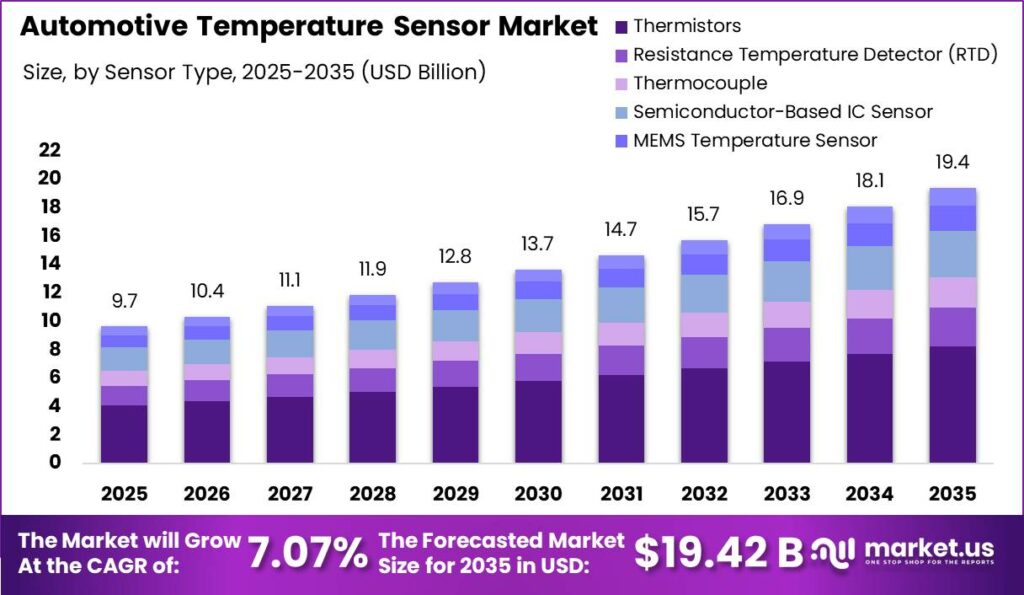
Global Automotive Temperature Sensor Market size is expected to be worth around USD 19.42 Billion by 2035 from USD 9.67 Billion in 2025, growing at a CAGR of 7.07% during the forecast period 2026 to 2035. This trajectory reflects a structural shift in vehicle electronics content rather than cyclical demand recovery. Every major powertrain transition, from internal combustion to hybrid to full electric, raises the number of thermal monitoring nodes required per vehicle.
The automotive temperature sensor market covers devices that measure and transmit thermal data across vehicle subsystems. These sensors span thermistors, resistance temperature detectors, thermocouples, semiconductor-based IC sensors, MEMS temperature sensors, and infrared sensors. They serve applications across powertrains, battery and electric drivetrains, body electronics, chassis and safety systems, alternative fuel vehicles, and telematics modules. OEM integration accounts for the dominant share of sensor deployment, with the aftermarket channel growing as the global vehicle fleet ages.
Key Takeaways
- The global Automotive Temperature Sensor Market is valued at USD 9.67 Billion in 2025 and is forecast to reach USD 19.42 Billion by 2035.
- The market grows at a CAGR of 7.07% during the forecast period 2026 to 2035.
- By Sensor Type, Thermistors dominate with a market share of 42.62%.
- By Application, Powertrain (ICE, Hybrid) holds the largest share at 38.75%.
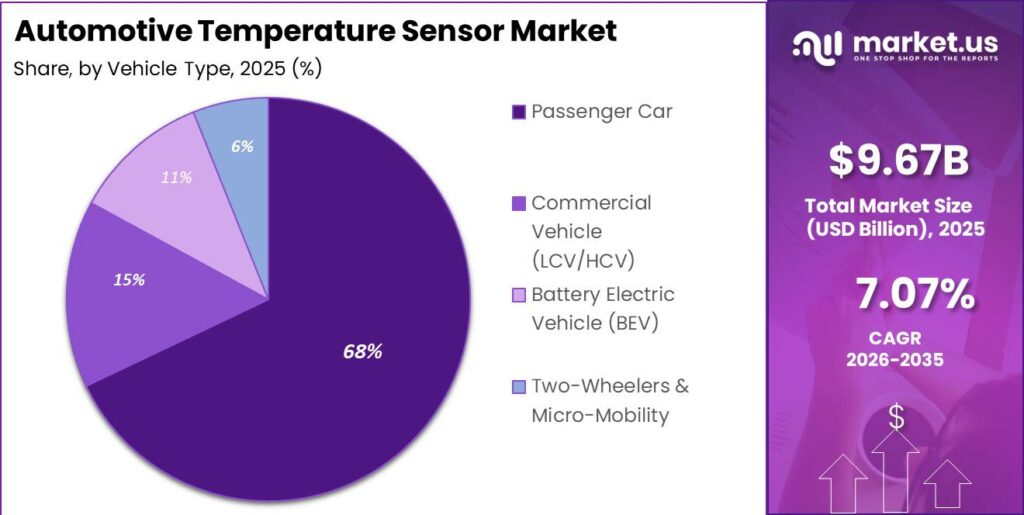
- By Vehicle Type, Passenger Car leads with a market share of 68.0%.
- By Sales Channel, OEM commands a dominant share of 90.92%.
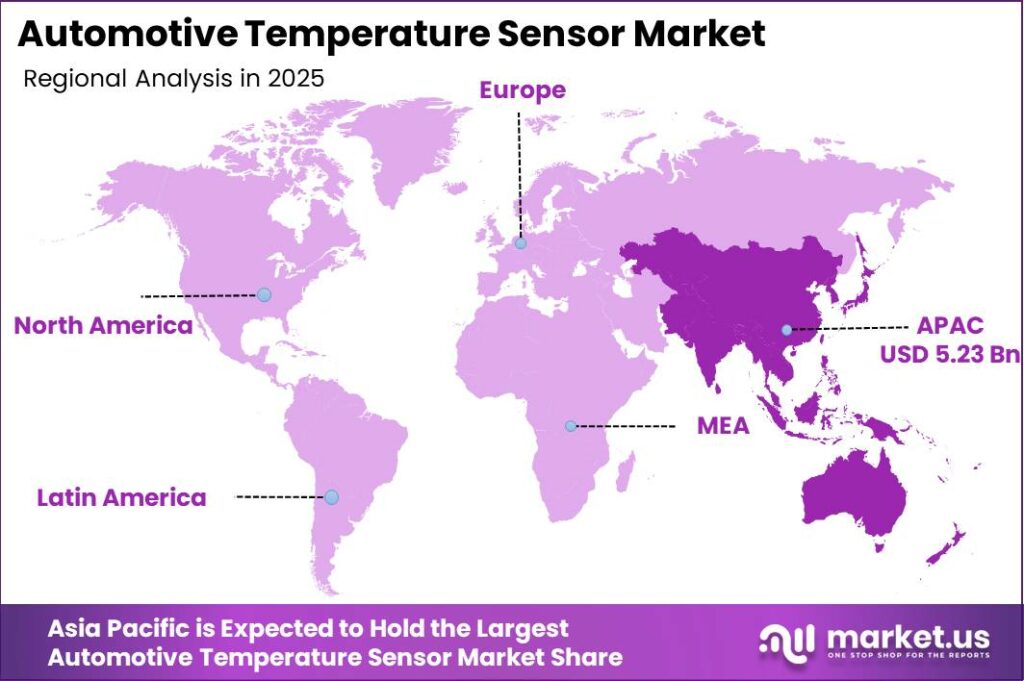
- Asia Pacific is the leading region with a market share of 54.12%, valued at USD 5.23 Billion.
Asia Pacific holds a 54.12% share of the global market, valued at USD 5.23 Billion, driven by China’s dominant EV production volumes and Japan’s established sensor manufacturing base. This regional concentration means that supply disruptions in Asia Pacific carry outsized risk for global OEM production schedules. Investors and procurement teams must treat Asia Pacific supply continuity as a tier-one strategic variable.
As per our research, the Analog Devices AD22100 automotive-capable analog sensor covers a 200°C span from −50°C to +150°C, with accuracy better than ±2% of full scale and linearity better than ±1% of full scale. This precision range reflects the breadth of thermal environments that modern vehicles generate. Suppliers able to cover this full operating window without sacrificing accuracy hold a clear design-in advantage over narrower-range competitors.
Regulatory pressure is accelerating sensor content per vehicle across all powertrain types. EU Regulation (EU) 2024/1257, known as Euro 7, enforces battery-durability monitoring provisions that keep thermal-integrity sensing central to compliant pack design. Automakers building for European sales must embed validated temperature sensing at the cell, module, and pack level. This requirement converts regulatory compliance directly into guaranteed sensor demand for qualified suppliers.
The OEM sales channel commands 90.92% of total market revenue, reflecting the design-in nature of automotive sensor procurement. Sensors specified at the platform design stage lock suppliers into multi-year production runs. This structure rewards suppliers with strong OEM relationships and punishes those relying on spot or aftermarket volumes alone.
Sensor Type Analysis
Thermistors dominate with 42.62% due to low cost and broad vehicle compatibility.
In 2025, Thermistors held a dominant market position in the By Sensor Type segment of the Automotive Temperature Sensor Market, with a 42.62% share. Thermistors deliver a high resistance-to-temperature sensitivity that makes them suitable for coolant, intake air, and battery module monitoring at low component cost. Per IEC 60539 standardization data, NTC thermistors are the most widely specified passive thermal sensing element in automotive Tier 1 supplier bills of materials. Their established qualification history under AEC-Q200 reduces new platform design risk and supports high-volume attach rates across passenger and commercial vehicle programs.
Resistance Temperature Detectors (RTDs) serve applications where measurement linearity and stability over long service life outweigh the cost premium versus thermistors. RTDs built to DIN EN 60751 standards maintain accuracy tolerances of ±0.3°C to ±0.5°C across extended operating cycles. Per ASTM E1137 calibration requirements referenced in automotive supplier qualification protocols, RTDs are preferred in exhaust aftertreatment and turbocharger monitoring where drift over 200,000 kilometers must remain within specification. This stability requirement positions RTD suppliers in high-content, lower-volume applications with stronger per-unit margins.
Semiconductor-Based IC Sensors represent the fastest-growing sub-segment, driven by digital output compatibility with modern vehicle ECU architectures. Data from NXP Semiconductors’ P3T1035xUK datasheet confirms 0.0625°C resolution through a 12-bit analog-to-digital conversion over a −40°C to +125°C operating range, with results stored in a 2-byte temperature register. This resolution level enables fine-grained battery cell monitoring that thermistors cannot match without additional signal conditioning. Suppliers integrating digital IC sensors into battery management system modules gain a path to higher system-level content revenue per vehicle.
Thermocouple sensors cover extreme-temperature environments such as exhaust gas recirculation and diesel particulate filter monitoring where operating points exceed +800°C. MEMS Temperature Sensors are entering chassis and safety system applications due to miniaturization advantages on mature semiconductor nodes. Infrared Temperature Sensors serve non-contact surface monitoring in brake and tire applications. These three sub-segments collectively serve specialized niches and hold the remaining share of the By Sensor Type segment.
Application Analysis
Powertrain (ICE, Hybrid) dominates with 38.75% due to multi-node thermal monitoring per engine.
In 2025, Powertrain (ICE, Hybrid) held a dominant market position in the By Application segment of the Automotive Temperature Sensor Market, with a 38.75% share. ICE and hybrid powertrains require temperature sensing at the coolant circuit, oil sump, intake manifold, exhaust manifold, and transmission, generating between 8 and 14 sensor attach points per vehicle depending on platform complexity. Per OICA global vehicle production data, more than 80 million light vehicles were produced in 2024, the majority of which still carried ICE or hybrid drivetrains. This installed production base sustains predictable annual sensor volume for suppliers with established OEM design-ins.
Battery and Electric Drivetrain is the fastest-growing application segment, as each EV battery pack requires dedicated thermal nodes at the cell, module, and pack level. Amphenol’s Thermometrics EV/PHEV coolant-temperature sensor datasheet confirms an operating range of −40°C to +100°C with ±0.3°C accuracy at 25°C and a response time of 5 seconds to a 25°C to 85°C water-temperature step. In March 2025, TDK launched a family of immersion NTC temperature sensors for direct temperature measurement in EV powertrain cooling systems, signaling that the supplier ecosystem is expanding dedicated EV thermal product lines. Suppliers qualifying sensors into battery thermal management systems gain multi-year platform contracts that carry higher per-vehicle content than comparable ICE attach points.
Body Electronics and Comfort systems, including HVAC, seat heating, and cabin air quality monitoring, represent a volume-stable application tier. SAE International J2176 and related cabin climate standards reference temperature sensing as a required input for automatic climate control compliance. Chassis and Safety Systems demand sensors in brake fluid and wheel-end monitoring roles where temperature exceedance triggers safety-critical responses. Alternative Fuel Vehicles and Telematics and Connectivity Modules are smaller in current volume but are expanding as hydrogen and connected-vehicle programs scale beyond pilot deployments.
Vehicle Type Analysis
Passenger Car dominates with 68.0% due to highest global production volumes.
In 2025, Passenger Car held a dominant market position in the By Vehicle Type segment of the Automotive Temperature Sensor Market, with a 68.0% share. Passenger cars account for the largest absolute unit count in global vehicle production, and modern passenger platforms carry more electronic systems per unit than at any prior point in automotive history. Per OICA production statistics, passenger cars represented more than 70 million of total light vehicle output in 2024. Higher electronic content per vehicle, including ADAS features, electrified HVAC, and battery management systems, increases sensor attach rates per unit. This makes passenger car the highest-volume revenue base for Tier 1 temperature sensor suppliers.
Commercial Vehicle (LCV/HCV) applications require sensors built to heavier duty cycles and higher mileage accumulation targets than passenger platforms. Fleet operators in long-haul trucking specify temperature sensors as part of predictive maintenance systems that reduce unplanned downtime costs. Per IRU (International Road Transport Union) fleet management benchmarks, thermal anomaly detection can reduce engine-related breakdowns in heavy commercial vehicles by a measurable margin. Suppliers serving this segment must meet extended service life validation requirements but benefit from repeat aftermarket demand as vehicles accumulate mileage beyond their initial OEM sensor design life.
Battery Electric Vehicles (BEVs) are the fastest-growing vehicle type sub-segment, with each platform carrying significantly more temperature sensing content than a comparable ICE vehicle. Per IEA Global EV Outlook data, global electric car sales surpassed 20 million units in 2025, creating a rapidly expanding installed base for dedicated EV thermal management sensors. Two-Wheelers and Micro-Mobility represent a smaller but expanding tier as electric two-wheelers in India and Southeast Asia adopt basic battery temperature protection features, adding volume at lower per-unit content value than four-wheel platforms.
Sales Channel Analysis
OEM dominates with 90.92% due to design-in lock-in across multi-year programs.
In 2025, OEM held a dominant market position in the By Sales Channel segment of the Automotive Temperature Sensor Market, with a 90.92% share. OEM procurement locks sensor specifications into vehicle platforms at the design stage, creating multi-year production commitments that typically span a full vehicle generation of 5 to 7 years. Per AIAG (Automotive Industry Action Group) supplier qualification guidelines, OEM-specified sensors undergo PPAP approval that creates significant switching costs for automakers post-launch. This structural stickiness gives incumbent sensor suppliers strong revenue predictability and protects them from mid-program displacement by lower-cost alternatives.
The Aftermarket channel is the fastest-growing sales channel sub-segment, driven by the aging of the global vehicle fleet in emerging markets and the rising cost of dealer-network servicing. Per the Auto Care Association’s industry factbook, the global automotive aftermarket was valued at over USD 500 Billion in 2024, with temperature sensors among the most frequently replaced engine management components. Independent repair shops in India, Latin America, and Africa increasingly source temperature sensors through regional distributors rather than OEM dealer networks. Suppliers building aftermarket-specific product lines with accessible packaging and distributor-friendly pricing can capture margin-positive revenue that supplements OEM volume.
Key Market Segments
By Sensor Type
- Thermistors
- Resistance Temperature Detector (RTD)
- Thermocouple
- Semiconductor-Based IC Sensor
- MEMS Temperature Sensor
- Infrared Temperature Sensor
By Application
- Powertrain (ICE, Hybrid)
- Battery and Electric Drivetrain
- Body Electronics / Comfort
- Chassis and Safety Systems
- Alternative Fuel Vehicles
- Telematics and Connectivity Modules
By Vehicle Type
- Passenger Car
- Commercial Vehicle (LCV/HCV)
- Battery Electric Vehicle (BEV)
- Two-Wheelers and Micro-Mobility
By Sales Channel
- OEM
- Aftermarket
Regional Analysis
Asia Pacific Dominates the Automotive Temperature Sensor Market with a Market Share of 54.12%, Valued at USD 5.23 Billion
Asia Pacific commands 54.12% of the global Automotive Temperature Sensor Market, valued at USD 5.23 Billion in 2025. China drives this dominance through its position as both the world’s largest vehicle producer and the leading EV market globally. Japan contributes through its deep semiconductor and sensor manufacturing supply chains, while South Korea adds battery system integration expertise that multiplies per-vehicle temperature sensing content. This regional concentration creates both scale advantage and supply-chain dependency risk for global OEM procurement teams.
Europe represents the fastest-growing region outside Asia Pacific, driven by the regulatory enforcement timeline of EU Regulation (EU) 2024/1257, which applies Euro 7 emission and battery-durability requirements to new vehicle types from 29 November 2026. European OEMs sourcing compliant thermal sensing solutions face a compressed qualification timeline, which benefits established Tier 1 suppliers already in the design pipeline. Automotive Powertrain Sensors demand in Europe is rising in parallel, as hybrid platform production shifts thermal management load toward more complex multi-node sensing architectures that increase per-vehicle content value.
North America sustains strong sensor demand through commercial vehicle fleet electrification programs and ADAS content expansion in passenger platforms. Latin America and the Middle East and Africa regions hold smaller current shares but represent growing aftermarket demand pools as vehicle fleet age increases. India is emerging as a manufacturing hub for lower-cost temperature sensor variants targeting two-wheeler and micro-mobility platforms, which positions it as a future contributor to both supply-side capacity and regional consumption growth.
Key Regions and Countries
North America
- US
- Canada
Europe
- Germany
- France
- The UK
- Spain
- Italy
- Rest of Europe
Asia Pacific
- China
- Japan
- South Korea
- India
- Australia
- Rest of APAC
Latin America
- Brazil
- Mexico
- Rest of Latin America
Middle East and Africa
- GCC
- South Africa
- Rest of MEA
Market Dynamics
Market Opportunity Analysis - Underexploited segments and regions offer clear entry points for specialized sensor suppliers
The Battery Electric Vehicle sub-segment within Vehicle Type carries the fastest growth trajectory yet remains underpenetrated by suppliers still optimizing for ICE platform attach rates. Per IEA data, global EV sales surpassed 20 million units in 2025. Suppliers that pre-qualify EV-specific sensor families now will hold design-in positions across the next vehicle generation before ICE-focused incumbents can realign their product roadmaps. This first-mover window is narrowing as more Tier 1 suppliers shift engineering resources toward EV programs.
The Aftermarket sales channel holds only a fraction of total revenue at present but is the fastest-growing channel as the global vehicle fleet ages in high-vehicle-density emerging markets. India, Latin America, and Africa represent the highest-density opportunity pools for aftermarket temperature sensor distribution. Suppliers building cost-optimized, easy-to-install aftermarket sensor variants with regional distributor packaging can access margin-positive volumes that OEM channel economics do not offer. This requires a separate go-to-market motion from OEM program management.
The Telematics and Connectivity Modules application sub-segment sits at the intersection of temperature sensing and vehicle data infrastructure. As connected vehicle platforms scale, temperature data from sensors feeds fleet management software and predictive maintenance systems. This creates a natural entry point for sensor suppliers willing to bundle data output with hardware, converting a component sale into a platform relationship. The sub-segment is currently small in revenue share but grows as commercial fleet operators in China, India, and Latin America adopt telematics mandates.
Technology and Innovation Landscape - Precision advances and multi-channel integration redefine competitive differentiation in thermal sensing
Texas Instruments’ automotive-grade TMP235-Q1 delivers a 10 mV/°C analog-output slope across a −40°C to +150°C operating range with maximum accuracy of ±2.5°C, operating from a 2.3 to 5.5 V supply. This wide supply voltage tolerance reduces the need for dedicated voltage regulation in space-constrained automotive designs. Suppliers integrating sensors with broad supply voltage compatibility lower system-level BOM cost for OEMs, which is a concrete differentiator when competing for high-volume platform design-ins where per-vehicle cost targets are measured in cents.
Texas Instruments’ TMP75B-Q1 automotive-grade digital sensor achieves 0.0625°C measurement resolution across −40°C to +125°C, with production testing performed at three calibration temperatures: −40°C, 25°C, and 125°C. Three-point production testing at temperature extremes increases per-unit manufacturing cost but provides traceability that automotive OEMs require for battery management system qualification. Suppliers bearing this testing cost upfront gain a defensible position in BMS sourcing decisions where measurement accuracy at temperature extremes directly affects battery safety certification outcomes.
Amphenol’s EV/PHEV coolant-temperature sensor specifies a nominal resistance of 2,828 Ω at 25°C with ±1.3% tolerance and a Beta value of 3,975 K with ±0.75% tolerance across 25 to 85°C. Tight Beta tolerance directly controls the accuracy of temperature calculation across the full operating range in EV cooling circuits. Suppliers publishing tightly controlled Beta specifications differentiate on system-level thermal model accuracy, which reduces OEM calibration effort and shortens the integration phase of battery cooling system validation programs.
Analog Devices’ AD22105 temperature switch specifies maximum ambient setpoint accuracy of ±2.0°C and typical hysteresis of 4.1°C, operating from −40°C to +125°C. Defined hysteresis prevents control system oscillation near temperature thresholds, which is a critical requirement in battery thermal runaway prevention logic. Suppliers offering precision temperature switch devices with documented hysteresis characteristics reduce the software calibration burden on OEM system integrators, converting a component-level specification into a measurable reduction in system validation time and cost.
Drivers
EV battery and powertrain thermal monitoring is the largest active contributor to market growth. Each EV battery pack, inverter, onboard charger, and e-motor demands dedicated temperature nodes that a comparable ICE platform never required. IEA Global EV Outlook tracking shows EV battery deployment grew nearly 30% in 2025 to roughly 1.2 TWh, while electric car sales surpassed 20 million units and exceeded a quarter of all cars sold globally. This volume shift is reshaping supplier business models from discrete thermistor sales toward integrated battery-management sensing modules with higher attach rates and expanding blended content margins by an estimated 150 to 300 basis points.
| Driver | (~) % Impact on CAGR Forecast | Geographic Relevance | Impact Timeline |
|---|---|---|---|
| EV battery & powertrain thermal monitoring | +2.4% | China, Europe, North America | Short term (2 years or less) |
| ICE emission-control sensor content per vehicle | +1.3% | EU, India, ASEAN | Medium term (2 to 4 years) |
| ADAS & e-motor electronics thermal protection | +1.1% | North America, Europe, Japan | Medium term (2 to 4 years) |
| Cabin comfort & HVAC electrification | +0.8% | Global | Short term (2 years or less) |
| Rising sensor count in commercial fleets | +0.6% | China, India, Latin America | Long term (4 years or more) |
Restraints
The tightening of Chinese rare-earth and permanent-magnet export controls represents the most acute constraint on market growth. Per the Chinese Ministry of Commerce’s Announcement No. 61 of 2025, from 1 December 2025 foreign firms must obtain licenses to export products containing at least 0.1% heavy rare earths or made with Chinese production technology. This expanded controls to 12 of the 17 rare-earth elements, following April 2025 restrictions that triggered rapid downstream disruption. Temperature-sensing assemblies rely on these inputs for magnets, specialty alloys, and doping materials, stretching procurement lead times and raising landed input costs.
An additional 100% US tariff on Chinese goods effective 1 November 2025 compounds the input cost pressure, inflating bill-of-materials costs for suppliers with China-dependent supply chains. This dual pressure compresses supplier gross margins by an estimated 200 to 400 basis points. The result forces working-capital-heavy safety stocking that delays discretionary investment into qualification of non-Chinese material sources, slowing the supplier base’s ability to reposition supply chains within the short-term horizon.
| Restraint | (~) % Impact on CAGR Forecast | Geographic Relevance | Impact Timeline |
|---|---|---|---|
| Rare earth & magnet export licensing | -1.6% | China-dependent global supply | Short term (2 years or less) |
| Punitive bilateral tariff escalation | -1.2% | US, China | Short term (2 years or less) |
| High interest rates & CapEx freeze | -0.9% | Europe, North America | Medium term (2 to 4 years) |
| Mature-node wafer capacity scarcity | -0.7% | Global | Medium term (2 to 4 years) |
| Vehicle production volume softening | -0.5% | Europe, mature markets | Short term (2 years or less) |
Challenges
Automotive-grade qualification cycles impose the heaviest structural friction on market growth. AEC-Q100/Q200 stress-testing and ISO 26262 functional-safety regimes require thermal sensors to survive extended thermal-cycling, humidity, and vibration validation before design-in approval. Qualification programs commonly span 18 to 36 months and consume significant non-recurring engineering budget. Underinvestment in mature-node wafer capacity constrains the analog process lines on which most temperature sensors are fabricated, compressing the window to monetize new part numbers before platform programs lock in specifications.
EU Euro 7 provisions under Regulation (EU) 2024/1257 apply to new vehicle types from 29 November 2026, forcing suppliers to pre-fund parallel validation ahead of firm volumes. This timeline pressure, combined with Automotive Sensor Fusion integration requirements across ADAS platforms, intensifies the engineering resource burden on Tier 1 sensor developers. The long-term corporate response is investment in modular, pre-qualified sensor platforms and dual-source foundry agreements that amortize non-recurring engineering costs across programs and reduce effective time-to-revenue.
| Challenge | (~) % CAGR Friction Drag | Geographic Relevance | Mitigation Horizon |
|---|---|---|---|
| Automotive-grade qualification cycles | -0.9% | Global | Long term (4 years or more) |
| Semiconductor talent & engineering deficit | -0.7% | North America, Europe, Japan | Long term (4 years or more) |
| Sensor accuracy in high-voltage environments | -0.6% | Global | Medium term (2 to 4 years) |
| Raw material price volatility | -0.5% | Global | Medium term (2 to 4 years) |
| Data integration & software calibration | -0.4% | Europe, North America | Medium term (2 to 4 years) |
Opportunities
Predictive thermal analytics as a recurring software layer represents the most significant unmonetized revenue pool in this market. Today’s sensor revenue is overwhelmingly hardware-transactional, while the untapped upside lies in monetizing the temperature data stream itself through predictive maintenance subscriptions and over-the-air diagnostics. Recurring software attach carries gross margins of 70% to 85% versus roughly 25% to 40% on the underlying hardware. Even a modest per-vehicle annual software fee converts a one-time part sale into multi-year lifetime value, expanding blended margins by an estimated 300 to 600 basis points.
The opportunity becomes commercially compelling as the installed EV fleet scales past the 20 million annual sales mark and battery-durability data gains regulatory weight under EU Euro 7 provisions in Regulation (EU) 2024/1257. Capturing this revenue requires investment in edge-analytics firmware and OEM data-sharing agreements consistent with UNECE cybersecurity frameworks. Early movers who embed software subscription capability into their sensor hardware design today will convert a sizable portion of the addressable base into annuity revenue before hardware-only competitors can replicate the platform architecture.
| Opportunity | (~) % Potential CAGR Upside | Geographic Relevance | Execution Window |
|---|---|---|---|
| Predictive thermal analytics as recurring software | +1.9% | North America, Europe, China | Medium term (2 to 4 years) |
| Autonomous-vehicle sensor-fusion integration | +1.4% | US, China, Germany | Long term (4 years or more) |
| Localized non-China supply chain roll-ups | +1.0% | India, Southeast Asia, Mexico | Medium term (2 to 4 years) |
| Aftermarket & retrofit sensor channel | +0.7% | India, Latin America, Africa | Long term (4 years or more) |
| Hydrogen & fuel-cell thermal sensing | +0.5% | Japan, South Korea, EU | Long term (4 years or more) |
Key Company Insights
Sensata Technologies Inc. builds its competitive position on extreme-range thermal sensing capability. Its DARTS temperature-sensor probes support continuous operation from −40°C to +300°C and peak exposure up to 500°C. Its high-temperature sensor extends that range to +1,200°C, covering vehicle exhaust-gas temperature in aftertreatment control and diagnostics. This breadth across operating environments makes Sensata a single-source candidate for OEMs seeking to consolidate sensor suppliers across ICE and EV platforms, reducing their qualification burden.
Robert Bosch GmbH holds structural advantage through its global Tier 1 OEM relationships and its integrated automotive electronics portfolio spanning sensors, ECUs, and ADAS systems. This depth means Bosch can position temperature sensors as part of broader system packages rather than competing on component price alone. However, in June 2025, Continental introduced the e-Motor Rotor Temperature Sensor that reduced measurement tolerance from approximately 15°C to 3°C, demonstrating that specialized competitors are narrowing the performance gap in EV-critical applications where Bosch’s broader portfolio breadth offers less direct defense.
Key Players
- Sensata Technologies Inc.
- Robert Bosch GmbH
- Continental AG
- NXP Semiconductors N.V.
- Amphenol Corporation
- Texas Instruments Incorporated
- TE Connectivity Ltd.
- Panasonic Holdings Corporation
- Murata Manufacturing Co., Ltd.
- TDK Corporation
- ZF Friedrichshafen AG
- Delphi Technologies
- PVB Piezotronics
- Valeo
- Balluff Automation
- Denso Corporation
- Thyssenkrupp
- Hella GmbH
Recent Developments
- February 2025: TDK launched lead-free NTC thermistors for automotive temperature measurement and compensation, targeting EV powertrain, battery, charging, and thermal-management applications.
- March 2025: Microchip Technology launched the automotive-qualified MCP998x family of 10 multichannel remote temperature-sensor devices, offering up to 5 monitoring channels, approximately 1°C accuracy, and protected shutdown-temperature settings.
- February 2026: Infineon Technologies agreed to acquire ams OSRAM’s non-optical analog and mixed-signal sensor portfolio for €570 million, including high-precision temperature, position, and capacitive sensors for automotive and other applications.
Geopolitical Impact Analysis
Chinese export licensing controls on rare-earth elements are directly raising input costs for automotive temperature sensor manufacturers with China-dependent supply chains. Per WTO trade monitoring data, China accounts for more than 85% of global rare-earth refining capacity. The Chinese Ministry of Commerce’s Announcement No. 61 of 2025 extended export licensing requirements to 12 of the 17 rare-earth elements. An additional 100% US tariff on Chinese goods compounds the cost pressure. Sensor producers reliant on Chinese-sourced specialty alloys and doping materials face immediate bill-of-materials inflation and extended procurement lead times that compress near-term delivery commitments to OEM customers.
According to World Bank commodity price tracking, global semiconductor-grade specialty metal prices rose sharply through the first half of 2025 in response to export restriction announcements, affecting the cost base of analog and MEMS sensor fabrication globally. UNCTAD supply chain resilience assessments indicate that rerouting critical material procurement from China to alternative sources in India, Southeast Asia, and North America requires a minimum of 18 to 36 months for qualification and logistics infrastructure buildout. This timeline mismatch between the speed of geopolitical disruption and the pace of supply chain repositioning forces sensor manufacturers to carry elevated safety stock, increasing working capital requirements and delaying capital allocation toward new product development.
Report Scope
| Report Features | Description |
|---|---|
| Market Value (2025) | USD 9.67 Billion |
| Forecast Revenue (2035) | USD 19.42 Billion |
| CAGR (2026-2035) | 7.07% |
| Base Year for Estimation | 2025 |
| Historic Period | 2020-2024 |
| Forecast Period | 2026-2035 |
| Report Coverage | Revenue Forecast, Market Dynamics, Market Opportunity Analysis, Technology and Innovation Landscape, Competitive Landscape, Recent Developments |
| Segments Covered | By Sensor Type (Thermistors, Resistance Temperature Detector (RTD), Thermocouple, Semiconductor-Based IC Sensor, MEMS Temperature Sensor, Infrared Temperature Sensor), By Application (Powertrain (ICE, Hybrid), Battery and Electric Drivetrain, Body Electronics / Comfort, Chassis and Safety Systems, Alternative Fuel Vehicles, Telematics and Connectivity Modules), By Vehicle Type (Passenger Car, Commercial Vehicle (LCV/HCV), Battery Electric Vehicle (BEV), Two-Wheelers and Micro-Mobility), By Sales Channel (OEM, Aftermarket) |
| Regional Analysis | North America (US and Canada), Europe (Germany, France, The UK, Spain, Italy, and Rest of Europe), Asia Pacific (China, Japan, South Korea, India, Australia, and Rest of APAC), Latin America (Brazil, Mexico, and Rest of Latin America), Middle East and Africa (GCC, South Africa, and Rest of MEA) |
| Competitive Landscape | Sensata Technologies Inc., Robert Bosch GmbH, Continental AG, NXP Semiconductors N.V., Amphenol Corporation, Texas Instruments Incorporated, TE Connectivity Ltd., Panasonic Holdings Corporation, Murata Manufacturing Co., Ltd., TDK Corporation, ZF Friedrichshafen AG, Delphi Technologies, PVB Piezotronics, Valeo, Balluff Automation, Denso Corporation, Thyssenkrupp, Hella GmbH |
| Customization Scope | Customization for segments, region / country-level will be provided. Additional customization can be done based on requirements. |
| Purchase Options | We have three licenses to opt for: Single User License | Multi-User License (Up to 5 Users) | Corporate Use License (Unlimited User and Printable PDF) |





































