


Report Overview
Global Furfuryl Alcohol Market size is expected to be worth around USD 981.6 Billion by 2035 from USD 501.1 Billion in 2025, growing at a CAGR of 7.0% during the forecast period 2026 to 2035. The market draws demand from foundry casting, resin systems, and specialty chemical synthesis. Buyers rely on furfuryl alcohol as a bio-based reactive monomer, which anchors long-term procurement contracts across industrial supply chains.
Therefore, the market structure centers on a feedstock-to-derivative value chain within the broader Chemical Manufacturing Market. Producers convert agricultural residues into furfural, then hydrogenate it into furfuryl alcohol. This chain links farm output to industrial resin demand. Companies that control both furfural and furfuryl alcohol stages capture stronger margins and shield themselves from raw material price swings.
Key Takeaways
- Global Furfuryl Alcohol Market size reached USD 501.1 Billion in 2025 and is projected to hit USD 981.6 Billion by 2035 at a CAGR of 7.0%.
- Industrial Grade led the By Type segment with a 78.3% share, driven by heavy foundry and resin consumption.
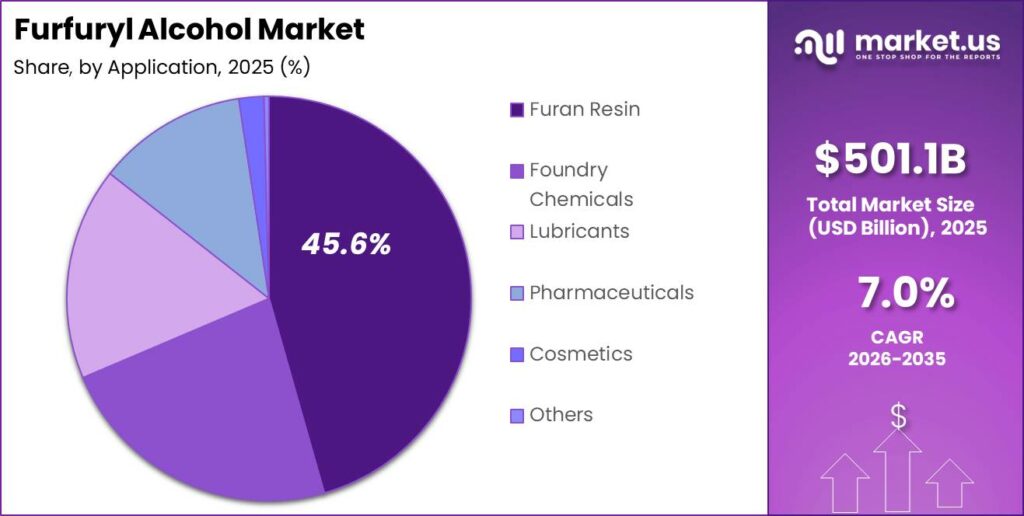
- Furan Resin dominated the By Application segment with a 45.6% share.
- Foundry led the By End Use segment with a 43.4% share.
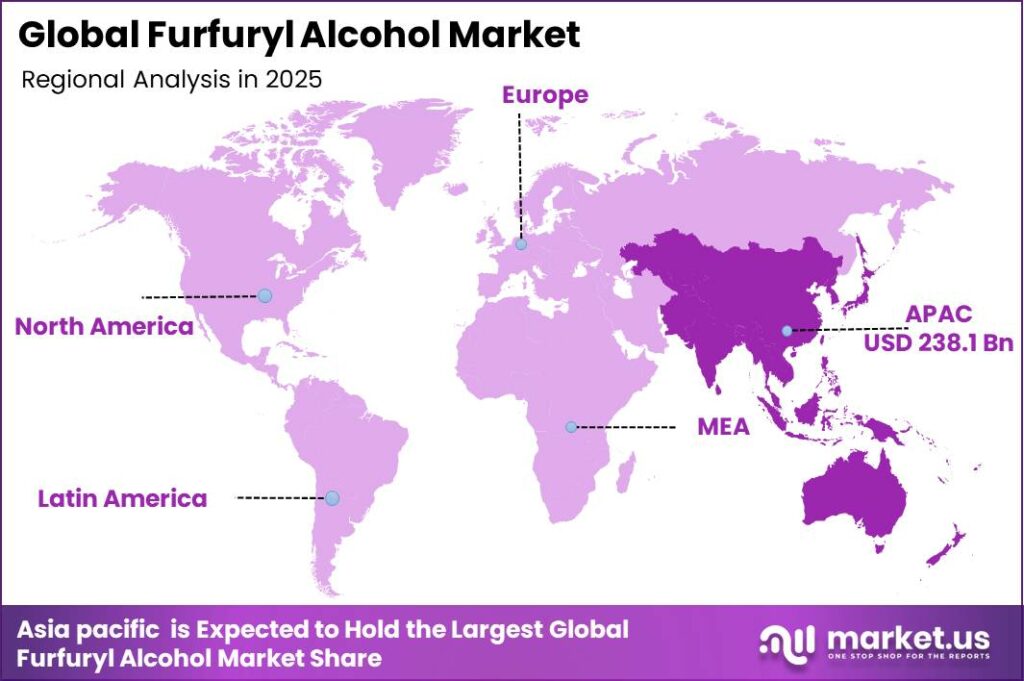
- Asia-Pacific dominated with a 47.5% share, valued at USD 238.01 Billion.
Government feedstock policies shape this market’s supply base. As per our research, sugarcane and corn cob valorisation programs expand furfural availability across producing nations. This means non-integrated producers gain steadier input access. Companies that secure residue supply agreements near sugar mills reduce feedstock risk and protect production continuity.
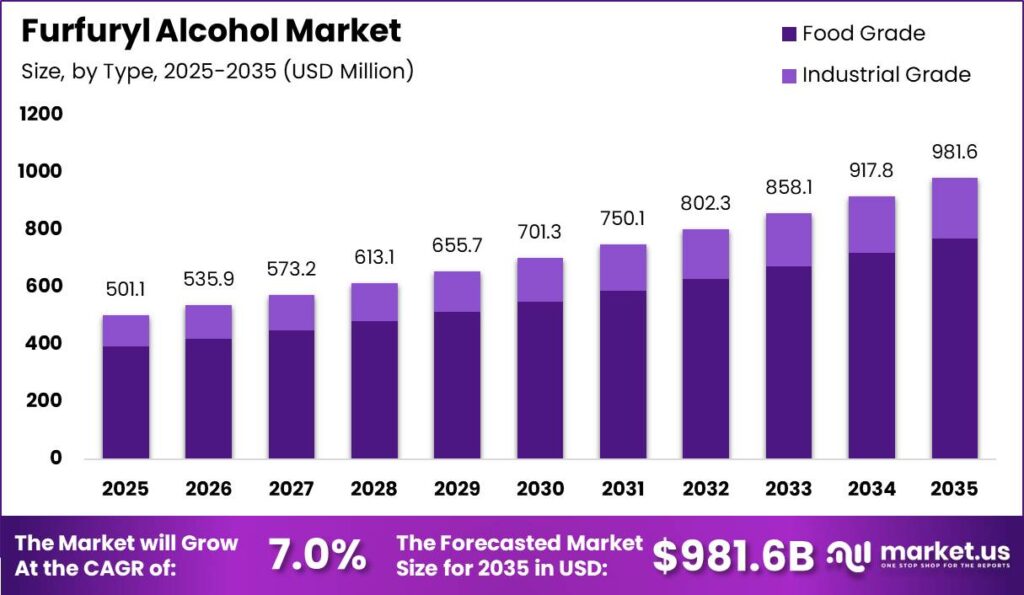
Consequently, end-use growth in metal casting pulls furfuryl alcohol demand upward through direct resin consumption. Figures from the FAO show global furfural production capacity exceeds 400,000 metric tons per year from agricultural residues. This scale supports large binder volumes for foundries. Producers who lock in feedstock now position themselves ahead of tightening supply cycles.
As reported by the FAO, corncobs account for roughly 40 to 50% of global raw material input in furfural production. This heavy dependence ties furfuryl alcohol economics to a single crop residue. This creates concentration risk for buyers. In 2025, Silvateam expanded its furfural-to-furfuryl alcohol production and logistics system in Argentina, improving supply capacity for foundry resin applications.
Type Analysis
Industrial Grade dominates with 78.3% due to heavy foundry resin binder consumption.
In 2025, Industrial Grade held a dominant market position in the By Type segment of Furfuryl Alcohol Market, with a 78.3% share. Data from PubChem shows furfuryl alcohol carries a boiling point of 170.3°C and density of 1.13 g/cm³ at 20°C, making it a high-boiling industrial solvent. This profile suits demanding resin systems. Producers targeting industrial buyers gain scale volume and stable offtake contracts.
Food Grade serves niche applications requiring higher purity and tighter contaminant control. According to CDC NIOSH data, occupational exposure above 50 ppm links to respiratory and mucous membrane irritation. This drives strict handling standards for sensitive grades. Suppliers who invest in purification capacity command premium pricing and serve regulated buyers that industrial-grade producers cannot easily reach.
Application Analysis
Furan Resin dominates with 45.6% due to high-temperature metal casting binder use.
In 2025, Furan Resin held a dominant market position in the By Application segment of Furfuryl Alcohol Market, with a 45.6% share. According to ScienceDirect research, furfuryl alcohol-based resins serve foundry binders in casting exceeding 1000°C operating conditions. This heat tolerance locks in demand. Resin formulators who standardize furfuryl alcohol content win qualified supplier status with tier-one casters.
Foundry Chemicals rely on furfuryl alcohol as a reactive monomer in no-bake binder systems. Data from ScienceDirect shows industrial hydrogenation achieves 90 to 95% yield under copper-based catalysts. This efficiency supports steady binder supply. Producers with reliable conversion economics defend margins against feedstock price swings and undercut less efficient rivals.
Lubricants, Pharmaceuticals, and Cosmetics draw on furfuryl alcohol derivatives for specialty synthesis. As reported by ScienceDirect, catalytic hydrogenation operates between 150°C and 250°C under hydrogen pressures of 1 to 5 MPa. This precision enables high-value intermediates. Firms serving these buyers, along with Others holding the remaining share collectively, gain diversified revenue beyond commodity foundry sales.
End Use Analysis
Foundry dominates with 43.4% due to structural metal casting binder demand.
In 2025, Foundry held a dominant market position in the By End Use segment of Furfuryl Alcohol Market, with a 43.4% share. As per our research, the furfural-to-furfuryl alcohol production process achieves overall energy efficiency between 60% and 75% depending on reactor design. This efficiency shapes cost competitiveness. Integrated casters that source locally cut binder costs and improve casting price stability.
Pharmaceutical and Paints & Coatings buyers use furfuryl alcohol for corrosion-resistant and intermediate synthesis needs. Figures from the FAO show furfural capacity exceeds 400,000 metric tons per year from residues. This feedstock base supports diversified end use. Suppliers who allocate volume across sectors reduce dependence on cyclical foundry demand.
Food & Beverage, Agriculture, and Others draw smaller but stable volumes for specialty formulations. As reported by the FAO, corncobs supply 40 to 50% of furfural raw material input. This ties end-use supply to crop cycles. These segments hold the remaining share collectively, giving producers who serve them a hedge against single-sector concentration.
Key Market Segments
By Type
- Food Grade
- Industrial Grade
By Application
- Furan Resin
- Foundry Chemicals
- Lubricants
- Pharmaceuticals
- Cosmetics
- Others
By End Use
- Foundry
- Pharmaceutical
- Paints & Coatings
- Food & Beverage
- Agriculture
- Others
Regional Analysis
Asia-Pacific Dominates the Furfuryl Alcohol Market with a Market Share of 47.5%, Valued at USD 238.01 Billion
Asia-Pacific leads the Furfuryl Alcohol Market with a 47.5% share, valued at USD 238.01 Billion. This dominance reflects concentrated furfural and furfuryl alcohol production across the region. China anchors this base with large casting output and resin capacity. In 2025, Hongye Holding Group continued capacity optimization of its furfural and furfuryl alcohol production lines in China, reinforcing regional supply leadership.
Europe ranks as a fast-moving region driven by sustainable resin adoption and stricter compliance standards. Producers there shift toward low-emission formulations to meet air quality norms. This regulatory push reshapes demand patterns. In 2025, European foundry chemical producers expanded use of furfuryl alcohol-based no-bake resin systems with reduced emissions to meet updated industrial air quality compliance norms.
Key Regions and Countries
North America
- US
- Canada
Europe
- Germany
- France
- The UK
- Spain
- Italy
- Rest of Europe
Asia Pacific
- China
- Japan
- South Korea
- India
- Australia
- Rest of APAC
Latin America
- Brazil
- Mexico
- Rest of Latin America
Middle East and Africa
- GCC
- South Africa
- Rest of MEA
Market Dynamics
Market Opportunity Analysis - Underserved grades, applications, and emerging foundry regions open entry points for new players
Food Grade remains underexploited against Industrial Grade’s 78.3% dominance in the By Type segment. This gap leaves high-purity buyers underserved by volume-focused producers. This creates room for niche entrants. Companies that build purification capacity can serve pharmaceutical and cosmetic buyers that commodity producers overlook, capturing premium pricing in a thin but stable channel.
By contrast, non-foundry applications trail Furan Resin’s 45.6% share in the By Application segment. Lubricants, Pharmaceuticals, and Cosmetics draw smaller volumes yet offer diversification. This reduces reliance on cyclical casting demand. New entrants targeting these applications spread risk and reach buyers less exposed to foundry downturns and metal casting cycles.
Instead of crowding mature markets, investors can target regions outside Asia-Pacific’s 47.5% concentration. Latin America and Middle East and Africa hold smaller shares yet host growing casting and infrastructure demand. This signals open regional white space. Firms establishing early distribution in these regions secure first-mover positioning before larger suppliers expand there.
Technology and Innovation Landscape - Catalyst advances, continuous-flow production, and digital monitoring redefine competitive edges
Catalyst innovation shapes competitive advantage in furfuryl alcohol production. Producers invest in improved catalyst efficiency to raise furfural-to-furfuryl alcohol conversion yields. This lifts output per tonne of feedstock. Manufacturers that adopt advanced catalysts cut variable costs and defend margins as feedstock prices fluctuate across crop cycles.
Continuous-flow production processes now improve manufacturing efficiency across facilities. This method replaces batch limits with steady output and tighter quality control. As a result, producers scale volume without proportional cost increases. Companies that shift to continuous flow gain unit economics that batch-based rivals struggle to match in high-volume foundry supply.
Process automation and digital monitoring increasingly integrate into furfuryl alcohol facilities. These systems track conversion, hydrogen use, and reactor conditions in real time. This reduces downtime and quality drift. Producers that digitize operations raise capacity utilisation and detect catalyst deactivation early, protecting throughput and lowering unplanned maintenance costs.
Certified renewable and low-carbon furfuryl alcohol adoption spreads across industrial supply chains. This shift responds to buyer demand for verified sustainable inputs. This creates differentiation for early adopters. Suppliers offering certified low-carbon grades win ESG-mandated customers and command premiums over conventional commodity furfuryl alcohol.
Drivers
The foundry industry anchors furfuryl alcohol demand through metal casting binders. The World Foundry Organization estimates global casting output at roughly 110 to 115 million tonnes per year as of 2023 to 2024, where furfuryl alcohol forms 65 to 85% of no-bake resin by weight. This link consumes an estimated 250,000 to 350,000 tonnes of furfuryl alcohol annually. This means casters drive stable, contracted resin demand.
China leads casting output at roughly 50 to 54% of world volume, producing about 54 to 58 million tonnes yearly. India follows at around 13 to 14 million tonnes, growing 7 to 9% annually. This growth pushes suppliers toward standardized binders in the Sustainable Chemicals Market. As a result, producers justify hydrogenation investments of USD 15,000,000 to USD 60,000,000 per train.
| Driver | (~) % Impact on CAGR Forecast | Geographic Relevance | Impact Timeline |
|---|---|---|---|
| Foundry Industry Expansion & Metal Casting Binder Demand Driving Furan Resin Consumption in Core & Mould Making | +2.20% | China, India, Germany, United States, Brazil, South Korea, Japan, Mexico | Short term (≤ 2 years) |
| Bio-Based & Renewable Chemical Feedstock Mandates Elevating Furfuryl Alcohol as a Commercially Viable Lignocellulosic Derivative | +1.60% | European Union, United States, Brazil, India, China, Canada, Australia | Short term (≤ 2 years) |
| Growing Demand for Furan-Based Composite Resins in Infrastructure & Marine Corrosion-Resistant Pipe Lining Applications | +1.10% | United States, Europe, China, Middle East, Australia, Brazil, Southeast Asia | Medium term (2–4 years) |
| Pharmaceutical & Agrochemical Intermediate Synthesis Using Furfuryl Alcohol Derivatives Driving Specialty Chemical Demand | +0.72% | India, China, Germany, United States, Netherlands, Switzerland | Medium term (2–4 years) |
| Sugar Cane & Corn Cob Agricultural Residue Valorisation Policies Expanding Furfural Feedstock Availability & Cost Stability | +0.52% | China, Brazil, India, Dominican Republic, South Africa, Thailand | Short term (≤ 2 years) |
Restraints
Furfuryl alcohol carries a Reproductive Toxicant Category 1B designation under EU Regulation (EC) No. 1272/2008. This triggers exposure limits and hazard communication duties for any article containing the substance above 0.1% weight. This forces European buyers to reformulate. Formulators face reformulation costs of EUR 80,000 to EUR 350,000 per affected product.
This classification shrinks the addressable market in the Green Chemicals Market. Specialty and consumer channels historically held an estimated 15 to 22% of European demand by value. Consequently, remaining demand concentrates into foundry binders where substitution is hard. This raises compliance cost by roughly EUR 15 to EUR 40 per tonne and weakens supplier pricing power.
| Restraint | (~) % Impact on CAGR Forecast | Geographic Relevance | Impact Timeline |
|---|---|---|---|
| Furfuryl Alcohol Classification as a Category 1B Reproductive Toxicant Under EU CLP & REACH Regulation Triggering Restrictions on Use & Trade | -1.60% | European Union, United Kingdom, Switzerland, Norway — CLP-aligned regulatory markets | Short term (≤ 2 years) |
| Chinese Furfural & Furfuryl Alcohol Export Capacity Concentration Creating Geopolitical Supply Vulnerability for Western Buyers | -0.85% | United States, Europe, Japan, South Korea, Australia — import-dependent markets | Short term (≤ 2 years) |
| Volatile Furfural Feedstock Pricing Driven by Agricultural Residue Crop Cycle & Energy Cost Fluctuations | -0.62% | Global — most acute for non-integrated furfuryl alcohol producers without furfural backward integration | Short term (≤ 2 years) |
| Epoxy & Phenolic Resin Substitution in Foundry & Composites Applications Limiting Furan Binder Volume Growth Ceiling | -0.40% | Global — most acute in markets with tightening VOC emission regulations on furan systems | Medium term (2–4 years) |
Challenges
Hydrogenation selectivity challenges the entire production base. Producers run furfural conversion at 130 to 200°C and 1 to 30 bar over copper-chromite catalysts, yet side reactions cut yield. Commercial Cu-Cr catalysts reach 92 to 97% selectivity at 95 to 99% conversion. This creates a technical barrier for new entrants lacking catalyst expertise.
Chromium trioxide falls under REACH SVHC authorisation, forcing European producers toward Cu-Zn catalysts at 85 to 93% selectivity. This 4 to 8 percentage point deficit raises feedstock use by 6 to 12% per tonne. As a result, variable cost climbs USD 40 to USD 90 per tonne. This opens a revenue stream for catalyst innovators offering compliant, high-yield systems.
| Challenge | (~) % CAGR Friction Drag | Geographic Relevance | Mitigation Horizon |
|---|---|---|---|
| Furfuryl Alcohol Hydrogenation Process Selectivity & Catalyst Deactivation | -0.90% | Global — affects all producers utilising Cu-Cr or Cu-Zn fixed-bed hydrogenation processes | Long term (≥ 4 years) |
| Agricultural Residue Supply Chain Seasonality & Quality Variability | -0.70% | China, Brazil, India, Dominican Republic — primary furfural feedstock sourcing geographies | Long term (≥ 4 years) |
| VOC Emission Compliance in Foundry Furan Binder Application Environments | -0.55% | European Union, United States, Japan, South Korea — stringent foundry air quality regulation markets | Medium term (2–4 years) |
| Limited Downstream Application Diversification & Customer Concentration Risk | -0.38% | Global — foundry binder segment represents ~65–70% of total furfuryl alcohol demand | Long term (≥ 4 years) |
| Technical Workforce Gap in Furan Chemistry & Green Chemistry Process Engineering | -0.22% | United States, Europe, India — advanced chemical manufacturing markets | Long term (≥ 4 years) |
Opportunities
Furfuryl alcohol offers untapped white space as a bio-based platform for renewable THF and THFA. Global THF demand sits at an estimated 350,000 to 400,000 tonnes per year, yet bio-based routes hold fewer than 2 to 3% of supply. This gap signals large conversion potential. Early movers who scale bio-THF capture certified renewable premiums ahead of rivals.
Bio-based THF production costs model at USD 1,400 to USD 1,800 per tonne versus petrochemical spot prices of USD 1,200 to USD 2,200 per tonne. This means bio routes near cost parity as furfural holds USD 600 to USD 700 per tonne. Producers investing USD 30,000,000 to USD 100,000,000 gain 35 to 60% margin expansion per tonne. This positions furfuryl alcohol within the Industrial Coatings Market as a multi-application platform.
| Opportunity | (~) % Potential CAGR Upside | Geographic Relevance | Execution Window |
|---|---|---|---|
| Furfuryl Alcohol as Bio-Based Platform Chemical for Renewable THF & THFA Solvent Production Replacing Petrochemical Routes | +1.70% | European Union, United States, Japan, South Korea, China, Canada, Brazil | Long term (≥ 4 years) |
| Wood Modification & Timber Preservation (Furfurylation) Application Expansion for Construction & Outdoor Durability Markets | +1.10% | Europe, United States, Japan, Australia, New Zealand, Scandinavia | Medium term (2–4 years) |
| Furfuryl Alcohol-Derived Polyesters & Polyurethanes for Bio-Based Plastic Packaging Replacing PET & Fossil Polyol Routes | +0.85% | European Union, United States, Japan, Australia, Canada | Long term (≥ 4 years) |
| Carbon Fibre Precursor & Battery Anode Carbon Material Synthesis from Furan-Based Resin Carbonisation | +0.62% | United States, Germany, Japan, South Korea, China | Long term (≥ 4 years) |
| India & Southeast Asia Foundry Sector Formalisation Driving First-Time Furan Binder System Adoption | +0.42% | India, Vietnam, Indonesia, Thailand, Mexico, Egypt | Short term (≤ 2 years) |
Key Company Insights
DalinYebo holds a strategic position rooted in furfural and furfuryl alcohol technology tied to agricultural residue feedstock. This backward focus lets the company control input quality and cost. This creates an advantage in supply stability for foundry resin buyers. However, its concentration in residue-based production exposes it to crop cycle swings that can disrupt output timing.
Furnova Polymers Ltd. positions itself around furan polymer and resin systems for industrial casting applications. This specialization deepens technical ties with foundry customers seeking consistent binder performance. This creates a defensible niche in qualified supplier relationships. However, its narrow application focus raises concentration risk if foundry demand softens or substitution accelerates within the Agricultural Chemicals Market adjacencies.
Key Players
- DalinYebo
- Furnova Polymers Ltd.
- Hebeichem
- Hongye Holdings Group Corp., Ltd.
- Linzi Organic Chemical Inc. Ltd.
- NC Nature Chemicals
- Shandong Crownchem Industries Co., Ltd.
- Silvateam S.p.a.
- TransFurans Chemicals bvba
- Xian Welldon Trading Co., Ltd.
- ILLOVO SUGAR AFRICA (PTY) LTD.
Recent Developments
- 2025: TransFurans Chemicals maintained expansion of its furfural and furfuryl alcohol derivatives portfolio in Europe, focusing on sustainable resin solutions for foundry and industrial casting applications.
- 2024 to 2025: Pennakem LLC, a Thermo Fisher subsidiary, continued optimization of its furfuryl alcohol production processes in the United States to support resin, coatings, and specialty chemical markets.
- 2025: Global furan resin manufacturers increased adoption of low-free-furfuryl-alcohol resin systems to comply with stricter occupational exposure and emissions standards in foundry operations.
Geopolitical Impact Analysis
Chinese export concentration exposes Western furfuryl alcohol buyers to supply and tariff risk. According to the WTO, average applied tariffs on chemical products can exceed 6.5% in several importing economies, raising landed costs. As reported by UNCTAD, container shipping rates rose more than 30% on key Asia to Europe lanes during recent disruptions. This means import-dependent foundries face higher binder costs and longer lead times.
Supply chain rerouting around conflict zones lengthens delivery for furfural and furfuryl alcohol shipments. Data from the World Shipping Council shows Red Sea diversions added roughly 10 to 14 days per Asia to Europe voyage. Figures from the IEA show energy price swings above 20% raised furfural production costs tied to steam-intensive processing. Therefore, non-integrated producers face margin pressure and buyers seek regional sourcing to cut exposure.
Report Scope
| Report Features | Description |
|---|---|
| Market Value (2025) | USD 501.1 Billion |
| Forecast Revenue (2035) | USD 981.6 Billion |
| CAGR (2026-2035) | 7.0% |
| Base Year for Estimation | 2025 |
| Historic Period | 2020-2024 |
| Forecast Period | 2026-2035 |
| Report Coverage | Revenue Forecast, Market Dynamics, Market Opportunity Analysis, Technology and Innovation Landscape, Competitive Landscape, Recent Developments |
| Segments Covered | By Type (Food Grade, Industrial Grade), By Application (Furan Resin, Foundry Chemicals, Lubricants, Pharmaceuticals, Cosmetics, Others), By End Use (Foundry, Pharmaceutical, Paints & Coatings, Food & Beverage, Agriculture, Others) |
| Regional Analysis | North America (US and Canada), Europe (Germany, France, The UK, Spain, Italy, and Rest of Europe), Asia Pacific (China, Japan, South Korea, India, Australia, and Rest of APAC), Latin America (Brazil, Mexico, and Rest of Latin America), Middle East and Africa (GCC, South Africa, and Rest of MEA) |
| Competitive Landscape | DalinYebo, Furnova Polymers Ltd., Hebeichem, Hongye Holdings Group Corp., Ltd., Linzi Organic Chemical Inc. Ltd., NC Nature Chemicals, Shandong Crownchem Industries Co., Ltd., Silvateam S.p.a., TransFurans Chemicals bvba, Xian Welldon Trading Co., Ltd., ILLOVO SUGAR AFRICA (PTY) LTD. |
| Customization Scope | Customization for segments, region / country-level will be provided. Additional customization can be done based on requirements. |
| Purchase Options | We have three licenses to opt for: Single User License | Multi-User License (Up to 5 Users) | Corporate Use License (Unlimited User and Printable PDF) |





































