


Report Overview
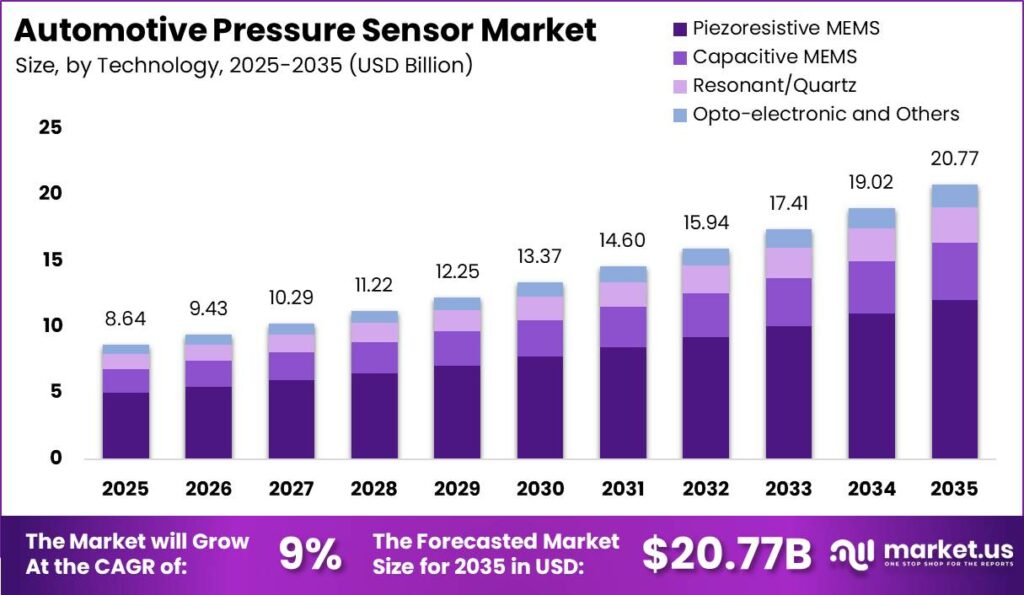
Global Automotive Pressure Sensor Market size is expected to be worth around USD 20.77 Billion by 2035 from USD 8.64 Billion in 2025, growing at a CAGR of 9.0% during the forecast period 2026 to 2035. This trajectory reflects a near-tripling of market value within a single decade. Tier-1 suppliers and semiconductor manufacturers positioned early in this expansion stand to capture disproportionate revenue share before consolidation tightens competitive access.
The Automotive Pressure Sensor Market covers electronic components that measure fluid, gas, and pneumatic pressure across critical vehicle systems. These sensors serve applications spanning tire monitoring, brake hydraulics, engine and fuel management, exhaust after-treatment, and airbag deployment circuits. The market spans OEM-fitted components supplied directly to vehicle assembly lines and aftermarket units sold through independent service and retrofit channels. This dual-channel structure creates distinct pricing, margin, and demand dynamics for each route to market.
Key Takeaways
- The global Automotive Pressure Sensor Market was valued at USD 8.64 Billion in 2025 and is forecast to reach USD 20.77 Billion by 2035.
- The market is projected to expand at a CAGR of 9.0% during the forecast period 2026 to 2035.
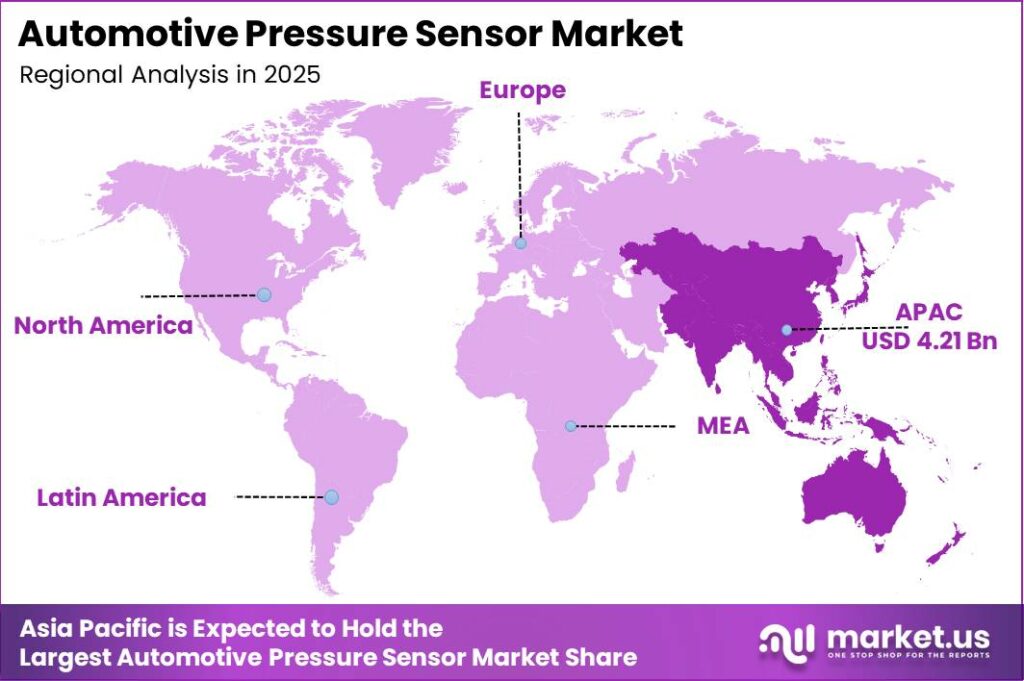
- Asia Pacific dominates the global market with a 48.80% share, valued at USD 4.22 Billion in 2025.
- By Technology, Piezoresistive MEMS holds the largest segment share at 57.90%.
- By Application, Tire Pressure Monitoring System (TPMS) leads with a 39.00% share.
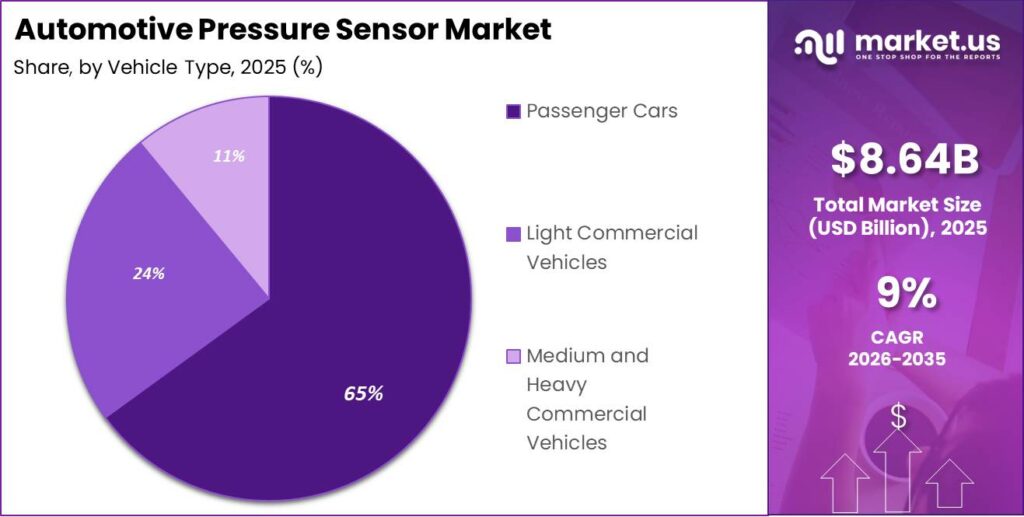
- By Vehicle Type, Passenger Cars account for 65.00% of market share, the largest segment.
- By Sales Channel, OEM-Fitted commands a dominant 87.00% share of the market.
However, regulatory mandates are now the single largest structural accelerator in this market. NHTSA survey data shows that 23.1% of vehicles without a TPMS had at least one severely underinflated tire, versus only 11.8% of TPMS-equipped vehicles. This performance gap creates a compliance and safety case that regulators across multiple jurisdictions have already converted into law. Manufacturers supplying compliant sensor modules gain first-access to regulatory-driven procurement cycles.
As per our research, the TPMS rule saved approximately $511 million across the U.S. vehicle fleet in a single year through reduced fuel consumption from properly inflated tires. This figure gives procurement officers and fleet operators a quantifiable ROI argument for sensor adoption beyond regulatory compliance. Suppliers who embed fuel-savings data into commercial proposals gain a pricing and positioning advantage over competitors who sell on specification alone.
Technology Analysis
Piezoresistive MEMS dominates with 57.90% due to mature supply chain and low unit cost.
In 2025, Piezoresistive MEMS held a dominant market position in the By Technology segment of the Automotive Pressure Sensor Market, with a 57.90% share. According to Bosch product datasheet disclosures, its automotive medium-pressure sensor based on this technology achieves an accuracy of 1.5% of full scale across a pressure range of 5 to 50 bar and an operating temperature of -40°C to +140°C. These specifications meet under-hood qualification standards, making this technology the default choice for engine and transmission pressure sensing across OEM platforms globally.
Capacitive MEMS is the fastest-growing technology sub-segment in this market. Capacitive sensing structures deliver superior sensitivity at very low pressure differentials, making them well-suited for next-generation ADAS pneumatic circuits and EV thermal management applications. The ITU’s tracking of automotive electronics adoption indicates that vehicle electrification is accelerating demand for high-sensitivity pressure feedback in battery cooling circuits. Suppliers investing in Capacitive MEMS production capacity now position themselves ahead of an OEM demand inflection tied directly to EV platform proliferation.
Resonant and Quartz pressure sensors serve precision-critical applications where measurement stability across temperature cycles outweighs per-unit cost considerations. These devices are specified in exhaust after-treatment and fuel injection systems where pressure drift directly impacts emissions compliance. Automotive MEMS pressure sensors must survive shock qualification testing at 700 m/s² with an 11 ms half-sinusoidal pulse across all six axes, per current automotive reliability test protocols. This durability requirement narrows the qualified supplier base and supports premium pricing for resonant technology specialists.
Opto-electronic and other emerging sensor technologies represent a smaller share of current deployments but attract R&D investment for specialized applications. Environmental qualification for automotive MEMS requires media-compatibility testing for durations of 6 to 8 weeks per test sequence, per industry reliability protocols. This qualification burden creates a barrier to entry that protects incumbents and discourages low-cost challengers from competing across the full technology stack.
Application Analysis
Tire Pressure Monitoring System (TPMS) dominates with 39.00% due to global mandatory fitment regulation.
In 2025, Tire Pressure Monitoring System (TPMS) held a dominant market position in the By Application segment of the Automotive Pressure Sensor Market, with a 39.00% share. The U.S. NHTSA estimates that TPMS reduces the likelihood of severe underinflation by 55.6%, and FMVSS No. 138 mandates a warning when tire pressure falls 25% or more below the manufacturer’s recommended cold placard pressure for one to four tires. NXP’s automotive TPMS MEMS sensors are rated to a full-scale pressure range of 1,500 kPa, targeted at heavy-duty vehicle tire monitoring, per the manufacturer’s current product listing. This regulatory floor converts TPMS into a non-discretionary line item across new vehicle programs globally.
Brake Booster and ABS pressure sensing is a structurally embedded application in every passenger and commercial vehicle produced globally. The Society of Automotive Engineers’ technical standards require validated pressure feedback in all brake-by-wire and hydraulic boost systems. UNECE vehicle braking regulation mandates functional pressure monitoring in vehicles produced for European markets. This mandatory compliance base means sensor demand in this application tracks directly with global vehicle production volumes, giving suppliers a stable revenue floor independent of technology cycle timing.
Engine and Fuel and Manifold Management is the fastest-growing application segment. Tighter fuel economy and emissions standards across North America, Europe, and China are forcing OEMs to adopt more precise fuel rail and manifold pressure control. World Bank data on automotive sector output shows that engine downsizing trends are increasing the number of pressure measurement points per engine as turbocharged platforms proliferate. Each additional measurement point represents an incremental sensor unit, compounding total addressable volume per vehicle platform beyond what nameplate production counts alone would suggest.
Exhaust Gas Recirculation and After-treatment, Airbag and Safety Restraint Systems, and Vehicle Dynamics and ESC collectively serve safety-critical circuits where sensor failure has direct liability consequences. NHTSA survey data confirms that direct TPMS reduces severe underinflation rates from 23.1% in unequipped vehicles to 5.7% in newer model-year equipped vehicles, demonstrating the measurable safety impact of mandatory pressure monitoring across vehicle systems. Suppliers qualifying sensors in these safety-critical applications operate under AEC-Q100 grade requirements, creating long validation cycles that protect established positions from rapid competitive displacement.
Vehicle Type Analysis
Passenger Cars dominate with 65.00% due to highest global production volume and OEM fitment mandates.
In 2025, Passenger Cars held a dominant market position in the By Vehicle Type segment of the Automotive Pressure Sensor Market, with a 65.00% share. World Bank automotive sector data indicates that passenger cars account for the largest share of global vehicle production, with annual output consistently exceeding 70 million units in pre-disruption years. Each platform carries multiple pressure sensing points across TPMS, brake hydraulics, engine management, and HVAC systems. The per-vehicle sensor content multiplier makes passenger cars the highest-volume revenue base for sensor manufacturers regardless of unit price movements.
Light Commercial Vehicles are the fastest-growing vehicle type sub-segment in this market. E-commerce logistics expansion is accelerating fleet additions across Southeast Asia, India, and Latin America, directly expanding the addressable unit population for pressure sensor suppliers. UN Comtrade trade flow data shows automotive component import volumes rising across ASEAN markets as local vehicle assembly expands. Mandatory TPMS extension to commercial vehicle categories under EU General Safety Regulation since July 2024 converts light commercial fleet additions into statutory sensor demand, not discretionary purchasing decisions.
Medium and Heavy Commercial Vehicles represent a smaller segment by unit count but carry a higher per-vehicle sensor content value. Long-haul trucking platforms require pressure monitoring across air brake circuits, tire systems, and engine management, resulting in sensor counts per vehicle that exceed passenger car averages. The International Road Transport Union reports that commercial fleet operators in Europe are accelerating telematics and sensor integration investments to comply with tachograph and vehicle safety regulations. This fleet-level compliance investment creates sustained aftermarket and OEM-fit demand independent of new-vehicle production cycle fluctuations.
Sales Channel Analysis
OEM-Fitted dominates with 87.00% due to mandatory safety certification and direct platform integration.
In 2025, OEM-Fitted held a dominant market position in the By Sales Channel segment of the Automotive Pressure Sensor Market, with an 87.00% share. Automotive OEM procurement cycles require sensors to pass AEC-Q100 qualification and ISO 26262 functional safety validation before integration into production platforms. Corporate annual reports from Tier-1 suppliers indicate that multi-year OEM supply agreements typically lock in pricing and volume commitments for three to five year platform lifecycles. This contractual structure gives OEM-qualified suppliers predictable revenue visibility that aftermarket-only competitors cannot match.
The Aftermarket channel is the fastest-growing sales channel in this market. Retrofit demand is expanding as TPMS mandates extend to older vehicle fleets across India, Southeast Asia, and Latin America that were never originally equipped at point of manufacture. Regional automotive aftermarket association data shows that installer networks in emerging markets are expanding rapidly alongside rising vehicle parc ages. Suppliers that build distribution partnerships and installer training infrastructure in these markets before mandatory retrofit windows open will capture margin-accretive channel positions that OEM-focused competitors are structurally unable to access at equivalent speed.
Key Market Segments
By Technology
- Piezoresistive MEMS
- Capacitive MEMS
- Resonant/Quartz
- Opto-electronic and Others
By Application
- Tire Pressure Monitoring System (TPMS)
- Brake Booster and ABS
- Engine and Fuel/Manifold Management
- Exhaust Gas Recirculation/After-treatment
- Airbag and Safety Restraint Systems
- Vehicle Dynamics and ESC
By Vehicle Type
- Passenger Cars
- Light Commercial Vehicles
- Medium and Heavy Commercial Vehicles
By Sales Channel
- OEM-Fitted
- Aftermarket
Regional Analysis
Asia Pacific Dominates the Automotive Pressure Sensor Market with a Market Share of 48.80%, Valued at USD 4.22 Billion
Asia Pacific leads the global Automotive Pressure Sensor Market with a 48.80% share valued at USD 4.22 Billion in 2025. China, Japan, South Korea, and India collectively anchor the region’s dominance through a combination of high-volume vehicle production, dense Tier-1 supplier ecosystems, and accelerating EV platform deployment. China’s domestic EV expansion is driving per-vehicle sensor content higher as battery thermal management and powertrain pressure monitoring requirements multiply. Suppliers with established manufacturing presence in Asia Pacific hold a structural cost and proximity advantage over exporters competing from Western facilities.
North America and Europe represent the two fastest-developing regions outside Asia Pacific, driven by regulatory mandates and the expansion of Advanced Driver Assistance Systems content per vehicle. The EU General Safety Regulation TPMS extension effective July 2024 converts commercial fleet additions into statutory sensor demand across M2, M3, N2, N3, O3, and O4 vehicle classes. India’s Ministry of Road Transport and Highways TPMS mandate for passenger vehicles from November 2025 is simultaneously expanding the South Asian addressable market. These overlapping regional mandates create compounding regulatory tailwinds that sustain demand growth across multiple geographies simultaneously.
Latin America and the Middle East and Africa represent underserved regions where vehicle parc age and fleet composition create aftermarket retrofit white space for sensor suppliers. Trensor broke ground on its first international manufacturing facility in Penang, Malaysia in May 2025, targeting Southeast Asian and global automotive markets with mass production expected before the second quarter of 2026. This localized manufacturing strategy reflects a wider industry recognition that proximity to assembly centers and emerging market fleet operators reduces logistics cost and lead-time exposure for sensor suppliers competing in price-sensitive channels.
Key Regions and Countries
North America
- US
- Canada
Europe
- Germany
- France
- The UK
- Spain
- Italy
- Rest of Europe
Asia Pacific
- China
- Japan
- South Korea
- India
- Australia
- Rest of APAC
Latin America
- Brazil
- Mexico
- Rest of Latin America
Middle East and Africa
- GCC
- South Africa
- Rest of MEA
Market Dynamics
Market Opportunity Analysis - Aftermarket channels, emerging vehicle types, and underserved regions offer entry points for new sensor suppliers
The Aftermarket Sales Channel holds an 87.00% OEM-fitted dominance, which means the aftermarket currently represents only 13% of total channel revenue. This structural imbalance reflects a historically underdeveloped distribution infrastructure in emerging markets rather than a ceiling on demand. Suppliers that invest in installer training networks and regional distribution partnerships ahead of mandatory retrofit cycles in India, Southeast Asia, and Latin America will capture a channel position that latecomers cannot buy their way into once the retrofit window opens.
Light Commercial Vehicles are the fastest-growing vehicle type but currently sit behind Passenger Cars at 65.00% share. The extension of EU TPMS mandates to N2 and N3 vehicle classes converts fleet operators from discretionary buyers into statutory purchasers. This regulatory reclassification opens a sub-segment where sensor suppliers with heavy-commercial qualification experience hold an advantage. New entrants with existing commercial vehicle supply relationships can expand into pressure sensor supply without competing directly against Tier-1 incumbents entrenched in passenger car OEM programs.
Capacitive MEMS is positioned as the fastest-growing technology sub-segment but currently trails Piezoresistive MEMS at 57.90% share. EV platform proliferation in China, North America, and the EU is expanding battery thermal management and powertrain cooling circuits, each requiring high-sensitivity pressure feedback. This creates a technology inflection point where Capacitive MEMS specialists can capture new design-win opportunities before Piezoresistive incumbents retool production for EV-specific performance requirements.
The Middle East and Africa and Latin America regions receive limited coverage in current OEM-fit supply chains that concentrate investment in Asia Pacific, North America, and Europe. Vehicle parc age in these regions means a high proportion of in-service vehicles predate TPMS fitment mandates. As per our research, localized manufacturing strategies targeting emerging markets can unlock aftermarket retrofit demand that is currently invisible to OEM-focused revenue models. Suppliers entering these markets with cost-optimized retrofit sensor kits and local assembly presence position themselves ahead of a demand cycle that follows regulatory adoption with a typical lag of two to four years.
Technology and Innovation Landscape - MEMS precision advances, cybersecurity integration, and 3D packaging reshape supplier competitiveness
Infineon’s XENSIV pressure sensor lineup delivers an altitude resolution of ±2 cm and a relative accuracy of ±0.06 hPa across a wide temperature range for high-precision barometric applications in automotive platforms. This level of precision directly supports ADAS height-sensing and atmospheric correction functions that older piezoresistive devices cannot match. As per our research, suppliers who qualify next-generation barometric sensors into ADAS stacks gain multi-year platform lock-in that protects revenue even as per-unit pricing compresses with volume scale.
Automotive MEMS pressure sensors must survive shock qualification at 700 m/s² across all six axes with an 11 ms half-sinusoidal pulse, per current automotive reliability protocols. This qualification standard directly narrows the field of viable suppliers, since only manufacturers with dedicated under-hood reliability testing infrastructure can certify products to these thresholds. The qualification barrier functions as a structural moat. Suppliers already certified at this shock level hold a cost and time advantage over new entrants who must absorb a full qualification cycle before their first OEM shipment.
Environmental qualification for automotive MEMS requires media-compatibility testing running 6 to 8 weeks per test sequence, per industry reliability protocols. This testing duration means that any design change to a sensor module restarts a qualification cycle that adds months to a product launch timeline. Manufacturers that standardize modular sensor architectures reduce qualification re-runs by isolating design changes to one subsystem at a time. This approach compresses time-to-market for derivative products and gives modular-design specialists a speed advantage in responding to OEM platform updates.
3D-Stacked ASIC-on-MEMS architecture adoption is identified as a key driver in Japan, South Korea, and Germany with a medium-term impact horizon. This packaging innovation integrates signal-processing circuitry directly onto the MEMS die, reducing parasitic capacitance and improving signal integrity at high temperatures. The Automotive Sensor Fusion trend amplifies demand for this architecture as OEMs consolidate multiple sensing functions into single compact modules. Suppliers that commercialize 3D-stacked sensor packages before platform freeze dates capture multi-year OEM supply positions that competitors cannot displace mid-cycle.
Drivers
The EU General Safety Regulation extended TPMS mandates to M2, M3, N2, N3, O3, and O4 vehicle classes effective July 1, 2024, while India’s Ministry of Road Transport and Highways replicated this requirement for passenger vehicles from November 2025. Tier-1 suppliers report retrofit and OEM-fitment order volumes rising by an estimated 18% to 22% year-on-year in newly covered fleet segments. Unit costs for direct TPMS sensor modules compressed by roughly 6% to 8% as production scaled, per component-level cost disclosures within Tier-1 supplier annual reports. Statutory compliance deadlines are forcing capacity-planning decisions inside a 12 to 18 month window across affected OEM production lines.
This regulatory cascade converts a previously discretionary safety feature into mandatory equipment across multiple vehicle classes globally. OEM sourcing models are shifting toward multi-year fixed-volume contracts with sensor manufacturers. Supplier gross margins face compression of an estimated 150 to 200 basis points in the near term, even as aggregate unit shipment volumes expand by a high-teens percentage. Manufacturers that lock in long-term OEM contracts now gain volume certainty that offsets near-term margin pressure.
| Driver | (~) % Impact on CAGR Forecast | Geographic Relevance | Impact Timeline |
|---|---|---|---|
| Mandatory TPMS Regulations for Commercial Fleets | +2.0% | European Union, India | Short term (2 years or less) |
| Rising EV Powertrain and Thermal Sensor Integration | +1.6% | China, North America, EU | Short term (2 years or less) |
| Growth of ADAS-Linked Pneumatic and Brake Circuits | +1.3% | North America, Japan, South Korea | Medium term (2 to 4 years) |
| Stringent Emissions and Fuel-Efficiency Norms | +1.0% | Global | Medium term (2 to 4 years) |
| MEMS Miniaturization Lowering Per-Unit BOM Cost | +0.7% | China, Southeast Asia | Short term (2 years or less) |
| Increasing Sensor Density per Vehicle Platform | +0.5% | Global | Medium term (2 to 4 years) |
| 3D-Stacked ASIC-on-MEMS Architecture Adoption | +0.5% | Japan, South Korea, Germany | Medium term (2 to 4 years) |
| Expansion of Transmission and HVAC Pressure Applications | +0.4% | North America, Europe | Short term (2 years or less) |
Restraints
Foundry utilization data tracked through 2025 shows mature-node automotive-grade wafer capacity running above 90% for 8-inch analog and MEMS-adjacent nodes. Lead times for automotive-grade pressure sensor ICs extended to 26 to 32 weeks in constrained quarters, versus a pre-shortage norm of roughly 12 weeks. This bottleneck forces OEMs into multi-sourcing and dual-qualification cycles that add an estimated 4% to 6% to per-unit procurement costs, per Tier-1 supplier earnings disclosures. Working-capital carrying costs for safety-stock inventory buffers rose by an estimated 10% to 15% as reflected in supplier balance-sheet disclosures.
Sensor integrators face margin compression of roughly 100 to 150 basis points as a direct consequence of these supply constraints. Several OEMs have publicly cited component allocation constraints as a factor delaying production ramp schedules by one to two quarters. This structural gap between foundry capacity and automotive sensor demand will not resolve within a single fiscal cycle. Suppliers that secure long-term wafer allocation agreements now will avoid the procurement cost premium that spot-market buyers will continue to absorb.
| Restraint | (~) % Impact on CAGR Forecast | Geographic Relevance | Impact Timeline |
|---|---|---|---|
| Automotive-Grade Semiconductor Capacity Constraints | -1.5% | Global, concentrated in Taiwan, South Korea | Short term (2 years or less) |
| High Interest Rates Delaying OEM CapEx | -1.0% | North America, Europe | Short term (2 years or less) |
| Raw Material Cost Volatility for MEMS Substrates | -0.6% | China, Global | Short term (2 years or less) |
| Slower-than-Projected EV Sales in Key Markets | -0.5% | North America, Europe | Short term (2 years or less) |
| Export Control Restrictions on Chip Equipment | -0.4% | China, United States | Short term (2 years or less) |
| Wafer Fabrication Equipment Lead-Time Backlogs | -0.4% | Taiwan, Japan, Germany | Short term (2 years or less) |
Challenges
Academic research published in 2026 from institutions in Spain, Switzerland, and Luxembourg confirmed that low-cost off-the-shelf receivers can passively capture unencrypted TPMS wheel-unit identifiers without any vehicle interaction. Cybersecurity remediation and encryption-retrofit engineering are estimated to add 3% to 5% to per-module development cost, per Tier-1 supplier R&D budget disclosures. Validation and penetration-testing cycles for next-generation encrypted TPMS protocols are extending qualification timelines by 8 to 12 weeks per platform, according to automotive cybersecurity research group findings.
Fleet operators and OEMs now face compliance exposure under evolving data-protection frameworks as a direct consequence of this design legacy. Suppliers projecting migration to authenticated, rolling-code wireless protocols estimate that full fleet-wide encrypted-protocol transition will span a four-year-plus horizon. This transition timeline reflects the scale of legacy sensor populations still in circulation across global vehicle parks. Suppliers that develop and license encrypted-protocol architectures ahead of regulatory mandates will convert a compliance cost into a recurring licensing revenue stream.
| Challenge | (~) % CAGR Friction Drag | Geographic Relevance | Mitigation Horizon |
|---|---|---|---|
| TPMS Wireless Cybersecurity Exposure | -0.9% | Global | Medium term (2 to 4 years) |
| Sensor Calibration Talent Shortage | -0.8% | North America, Europe | Medium term (2 to 4 years) |
| Fragmented Regional Certification Standards | -0.6% | Global | Long term (4 years or more) |
| Legacy ICE Platform Retrofit Complexity | -0.5% | Southeast Asia, Latin America | Medium term (2 to 4 years) |
| Tier-2 Supplier Quality Consistency Gaps | -0.4% | India, Southeast Asia | Medium term (2 to 4 years) |
| Multi-Sensor Fusion Integration Complexity | -0.3% | North America, Europe, China | Medium term (2 to 4 years) |
Opportunities
National vehicle registry data indicates that a significant portion of passenger and commercial fleets across India, Southeast Asia, and Latin America predates recent TPMS fitment mandates. Retrofit kit margins run an estimated 12% to 15% higher than OEM-fit equivalents due to direct-to-consumer and fleet-operator channel pricing, according to regional automotive aftermarket association channel data. Cost per unit for retrofit sensor kits is projected to decline by roughly 10% over a four-year window as component miniaturization scales.
Capturing this white space requires deliberate investment in distribution partnerships and installer training networks, not passive baseline growth. Early movers can expand blended gross margins by an estimated 200 to 300 basis points relative to OEM-only sales models. Payback on channel-development investment is realistically achievable within a 24 to 30 month execution window, per industry association channel data. Suppliers that build aftermarket infrastructure before mandatory retrofit windows open in emerging markets will hold channel positions that OEM-first competitors cannot quickly replicate.
| Opportunity | (~) % Potential CAGR Upside | Geographic Relevance | Execution Window |
|---|---|---|---|
| Aftermarket TPMS Retrofit White Space | +1.6% | India, Southeast Asia, Latin America | Medium term (2 to 4 years) |
| Integrated Multi-Parameter Sensor Fusion Modules | +1.2% | North America, Europe, China | Medium term (2 to 4 years) |
| Predictive Sensor-as-a-Service Monetization | +0.9% | North America, Europe | Long term (4 years or more) |
| Hydrogen Fuel Cell Vehicle Pressure Sensing | +0.7% | Japan, South Korea, Germany | Long term (4 years or more) |
| Localized Manufacturing Roll-Ups in Emerging Markets | +0.5% | India, Vietnam, Mexico | Medium term (2 to 4 years) |
| Encrypted-Protocol Licensing for Secure TPMS | +0.4% | Global | Medium term (2 to 4 years) |
Key Company Insights
DENSO Corporation holds a structural advantage across Asian OEM platforms through its deep integration into Toyota and Honda supply chains. Its sensor product lines span TPMS, engine management, and exhaust after-treatment circuits, giving DENSO multi-application revenue exposure per vehicle platform. This breadth insulates the company from single-application demand cycles. However, DENSO’s concentration in Japanese and Southeast Asian OEM channels creates exposure if regional vehicle production volumes contract due to supply disruptions or demand shifts.
In March 2025, Robert Bosch GmbH expanded its automotive aftermarket portfolio by introducing pressure sensors for vehicle air-conditioning circuits, directly targeting the growing aftermarket service segment alongside its dominant OEM position. Bosch’s medium-pressure sensor achieves 1.5% full-scale accuracy across operating temperatures of -40°C to +140°C, meeting under-hood qualification benchmarks. This combination of aftermarket expansion and OEM-grade technical specification positions Bosch to capture revenue across both the regulated OEM channel and the higher-margin retrofit segment simultaneously.
Key Players
- DENSO Corporation
- Robert Bosch GmbH
- Infineon Technologies AG
- Sensata Technologies, Inc.
- Continental AG
- NXP Semiconductors
- Honeywell International Inc.
- Analog Devices
- Delphi
- STMicroelectronics
Recent Developments
- June 2025: Bosch presented Bluetooth-based tire-pressure sensors designed to support direct communication with smartphones and vehicle systems, extending TPMS functionality beyond traditional OEM-fitted warning systems into connected consumer and fleet management applications.
- July 2025: STMicroelectronics announced a definitive agreement to acquire NXP Semiconductors’ MEMS sensors business for up to USD 950 million in cash. The acquisition includes automotive safety, non-safety automotive, and industrial MEMS sensors including pressure sensor products, and is expected to strengthen STMicroelectronics’ automotive and industrial sensing portfolio.
- May 2025: Trensor broke ground on its first international manufacturing facility in Penang, Malaysia. The plant will produce automotive pressure sensors for Southeast Asian and global automotive markets, with mass production expected before the second quarter of 2026.
Geopolitical Impact Analysis
According to WTO trade policy monitoring data, U.S. tariffs on Chinese semiconductor imports reached levels exceeding 25% on key MEMS-adjacent component categories, directly raising input costs for automotive pressure sensor manufacturers dependent on Chinese foundry supply. The World Bank estimates that global trade policy uncertainty added approximately 2% to 3% to supply chain operating costs across electronics-intensive manufacturing sectors in 2024 and 2025. Sensor integrators sourcing MEMS die from Taiwan and South Korea face parallel exposure as geopolitical tensions over semiconductor export controls tighten foundry allocation for automotive-grade nodes.
Data from the World Shipping Council indicates that Asia-to-Europe container transit times extended by an average of 10 to 14 days following Red Sea shipping disruptions that forced rerouting around the Cape of Good Hope. This transit extension directly affects just-in-time automotive component delivery windows. The IEA reported that energy price volatility in Europe during 2024 added an estimated 8% to 12% to industrial electricity costs for semiconductor fab operations in Germany and the Netherlands. These compounding logistics and energy cost pressures are accelerating OEM decisions to localize sensor supply chains closer to final assembly plants in Asia Pacific and emerging markets.
Report Scope
| Report Features | Description |
|---|---|
| Market Value (2025) | USD 8.64 Billion |
| Forecast Revenue (2035) | USD 20.77 Billion |
| CAGR (2026-2035) | 9.0% |
| Base Year for Estimation | 2025 |
| Historic Period | 2020-2024 |
| Forecast Period | 2026-2035 |
| Report Coverage | Revenue Forecast, Market Dynamics, Market Opportunity Analysis, Technology and Innovation Landscape, Competitive Landscape, Recent Developments |
| Segments Covered | By Technology (Piezoresistive MEMS, Capacitive MEMS, Resonant/Quartz, Opto-electronic and Others), By Application (Tire Pressure Monitoring System (TPMS), Brake Booster and ABS, Engine and Fuel/Manifold Management, Exhaust Gas Recirculation/After-treatment, Airbag and Safety Restraint Systems, Vehicle Dynamics and ESC), By Vehicle Type (Passenger Cars, Light Commercial Vehicles, Medium and Heavy Commercial Vehicles), By Sales Channel (OEM-Fitted, Aftermarket) |
| Regional Analysis | North America (US and Canada), Europe (Germany, France, The UK, Spain, Italy, and Rest of Europe), Asia Pacific (China, Japan, South Korea, India, Australia, and Rest of APAC), Latin America (Brazil, Mexico, and Rest of Latin America), Middle East and Africa (GCC, South Africa, and Rest of MEA) |
| Competitive Landscape | DENSO Corporation, Robert Bosch GmbH, Infineon Technologies AG, Sensata Technologies Inc., Continental AG, NXP Semiconductors, Honeywell International Inc., Analog Devices, Delphi, STMicroelectronics |
| Customization Scope | Customization for segments, region / country-level will be provided. Additional customization can be done based on requirements. |
| Purchase Options | We have three licenses to opt for: Single User License | Multi-User License (Up to 5 Users) | Corporate Use License (Unlimited User and Printable PDF) |





































