


Report Overview
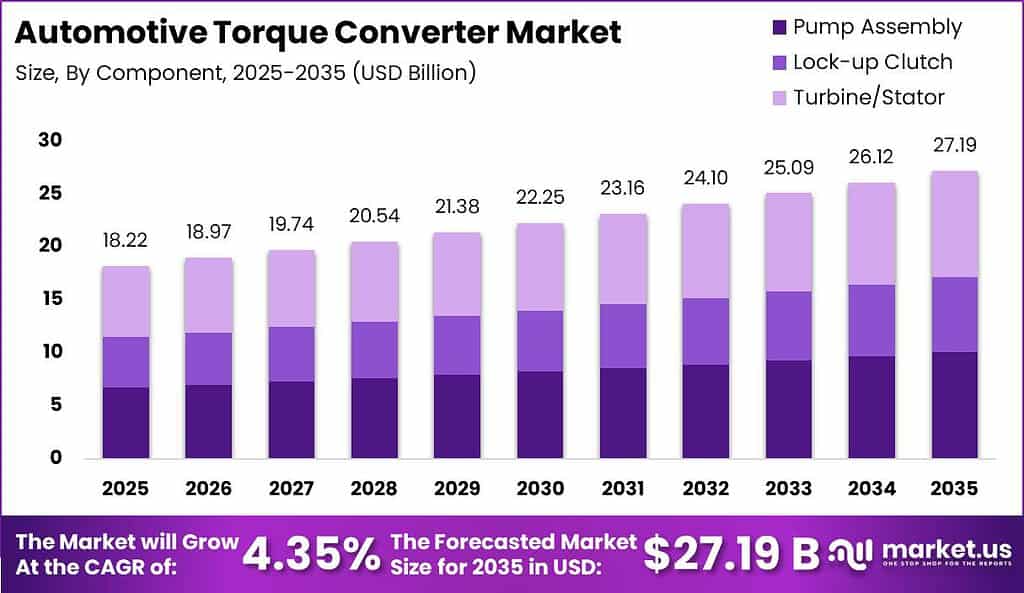
Global Automotive Torque Converter Market size is expected to be worth around USD 27.19 Billion by 2035 from USD 18.22 Billion in 2025, growing at a CAGR of 4.35% during the forecast period 2026 to 2035. This expansion reflects steady OEM fitment of converter-based automatics across passenger and commercial platforms. Investors who track multi-speed and hybrid-ready converter content capture durable volume before pure electric platforms fully displace geared drivetrains.
Therefore, the torque converter market covers hydrodynamic coupling devices that transfer engine torque into the Automotive Transmission system through pump, turbine, stator, and lock-up clutch assemblies. Product structure spans transmission type, component, vehicle type, sales channel, converter stage design, and drivetrain layout. Buyers who map content per vehicle type can prioritize high-attach programs and protect margin against pure battery-electric substitution.
Key Takeaways
- The market is valued at USD 18.22 Billion in 2025 and is set to reach USD 27.19 Billion by 2035 at a CAGR of 4.35%.
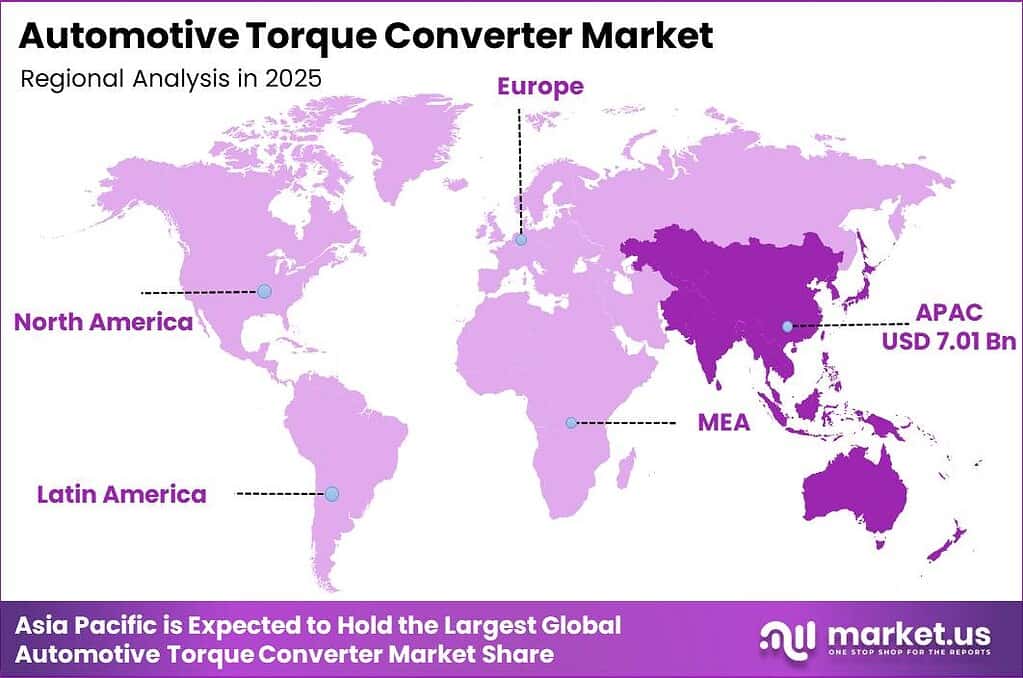
- Asia Pacific leads with a 38.50% share, valued at USD 7.02 Billion.
- Automatic Transmission holds 39.55% within transmission type segmentation.
- Turbine/Stator leads components with a 63.00% share.
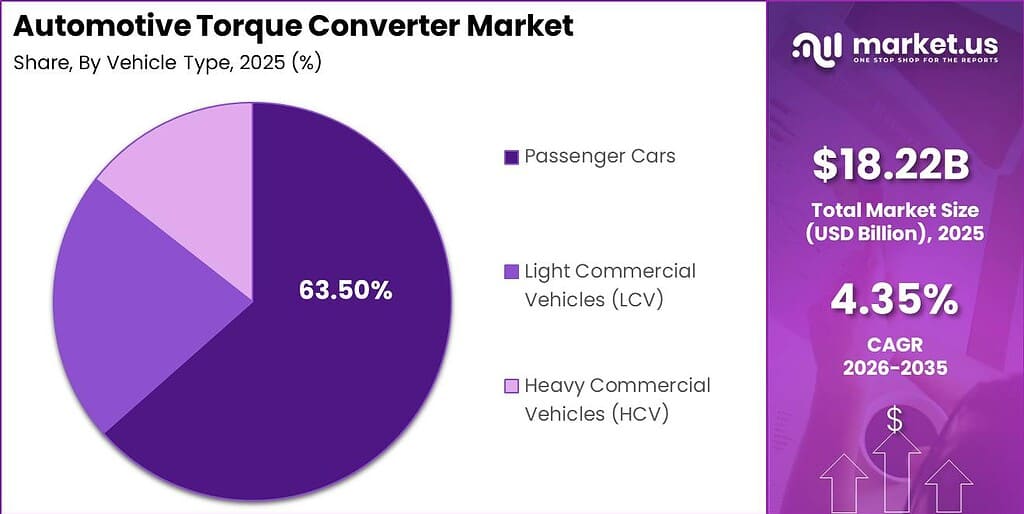
- Passenger Cars dominate vehicle type with a 63.50% share.
- OEM channels control 84.00% of sales channel revenue.
- Single-Stage converters hold 75.00% of torque converter type demand.
- Front-Wheel Drive leads drivetrain with a 52.00% share.
As per our research, emission and safety rules keep multi-speed torque-converter automatics central to light-duty powertrains even as hybrids scale. This means OEMs still specify converter clutches for launch feel and durability under trailer and stop-start duty. Suppliers who co-develop damper and controller packages with regional assembly plants lock multi-year platform wins before sourcing freezes.
Consequently, end-use growth in pickups and crossovers raises converter torque capacity requirements on every new architecture. As reported by Hyundai Motor specifications, the 2025 Santa Cruz pairs its 8-speed torque-converter automatic with a 2.5-liter engine rated at 191 hp and 181 lb-ft. This engine-load envelope forces higher clutch thermal capacity and rewards suppliers who qualify early on mid-torque truck platforms.
In May 2025, Sonnax flagged torque-converter service relevance in GM Safety Recall N242480630 covering 10L1000 and second-generation 10L60, 10L80, and 10L90 families. This creates aftermarket and reman demand for precision clutch and damper kits. In 2026, Schaeffler expanded LuK 6R80 TorCon production on newly manufactured original components rather than remanufactured cores, lifting replacement reliability and pulling fleet buyers toward factory-spec units.
Transmission Type Analysis
Automatic Transmission (AT) dominates with 39.55% due to high multi-speed OEM attach rates.
In 2025, Automatic Transmission (AT) held a dominant market position in the By Transmission Type segment of Automotive Torque Converter Market, with a 39.55% share. Data from OICA shows Asia-Pacific vehicle output rose 7.6% to about 59.2 million units and over 61% of global assembly. This volume pulls converter AT content into mass programs. Suppliers who localize pump and clutch modules near Asian plants secure scale before price pressure peaks.
Continuously Variable Transmission platforms still require dedicated start devices on many ICE and mild-hybrid layouts. Figures from the IEA show electric and plug-in models reached about 25% of global new car sales in 2025. This share leaves a large residual ICE and hybrid base that still needs hydrodynamic launch hardware. Vendors who offer CVT-compatible converters protect volume as pure AT mix slowly shifts.
Automated Manual Transmission applications use converters mainly where launch comfort outweighs cost in commercial and entry passenger fleets. OICA regional sales data show Asia, Oceania and the Middle East sales near 55.02 million units after a 7.1% rise. This fleet expansion favors simple automated solutions in cost-sensitive markets. Makers who price AMT converters aggressively win tenders in India and ASEAN fleets.
Dual-Clutch Transmission is the fastest growing transmission path for sport and efficiency-focused models, yet many hybrids still retain torque-converter AT for smoothness. This signals selective DCT growth rather than full converter displacement. CVT, AMT, and remaining niche layouts hold the balance of transmission-type demand collectively. Investors should track hybrid AT content, not DCT headlines alone, when sizing converter capacity.
Component Analysis
Turbine/Stator dominates with 63.00% due to core hydrodynamic torque multiplication role.
In 2025, Turbine/Stator held a dominant market position in the By Component segment of Automotive Torque Converter Market, with a 63.00% share. Corporate filings on ZF hybrid systems cite electric-drive output up to 160 kW and 450 Nm through converter-based AT interfaces. This torque path keeps turbine and stator metallurgy critical. Foundries that hold tight blade geometry win multi-year OEM casting contracts.
Pump assembly drives fluid circulation and sets converter efficiency under stop-start duty. As per our research, pump hardware still represents a 37.00% component share in 2025 structures. This share anchors high-volume machining cells at Tier-1 plants. Suppliers who cut pump drag while holding durability gain fuel-economy credits with OEM powertrain teams.
Lock-up clutch is the fastest growing component as OEMs demand earlier lock and lower slip for efficiency and NVH targets. NHTSA-linked GM service guidance assesses TCC slip below 150 rpm during controlled acceleration tests. This diagnostic bar raises clutch friction material quality needs. Aftermarket and OEM clutch specialists who meet slip targets capture both production and service revenue.
Vehicle Type Analysis
Passenger Cars dominate with 63.50% due to high global light-duty production scale.
In 2025, Passenger Cars held a dominant market position in the By Vehicle Type segment of Automotive Torque Converter Market, with a 63.50% share. OICA tracking shows China production near 34.53 million units after about 3.25 million added volume. This car-heavy base multiplies converter unit demand. Tier-1s who dual-source passenger AT converters across China and India plants reduce logistics risk.
Light Commercial Vehicles form the fastest growing vehicle class as urban delivery fleets automate transmissions for driver comfort. India production climbed to about 6.49 million units in fiscal 2025-26 per industry association tallies referenced with OICA flows. This commercial build supports converter content on vans and pickups. Suppliers who harden clutches for stop-start delivery cycles win LCV platform awards.
Heavy Commercial Vehicles require high-capacity converters for launch on grade and loaded starts. Voith-class industrial ratings illustrate why HCV hardware differs from passenger units in thermal mass and torque path. This creates separate tooling and validation cost. Makers who specialize HCV converters avoid passenger price wars and hold longer replacement cycles.
Sales Channel Analysis
OEM dominates with 84.00% due to factory-fit transmission integration contracts.
In 2025, OEM held a dominant market position in the By Sales Channel segment of Automotive Torque Converter Market, with a 84.00% share. Asia-Pacific assembly above 61% of world output concentrates purchasing inside OEM powertrain bill-of-materials. This concentration rewards long-term design-in over spot sales. Converter makers who co-locate with AT plants secure take-or-pay volume and stabilize utilization.
Aftermarket is the fastest growing channel as multi-speed fleets age and clutch shudder repairs rise. GM procedures require at least 322 km of driving after fluid service to confirm degraded TCC repairs. This service depth expands parts and fluid kit demand. Distributors who stock OE-spec lock-up and damper kits capture repair-shop loyalty before low-cost rebuilds erode trust.
Independent rebuilders and specialty performance channels fill remaining sales alongside mainstream aftermarket kits. This structure keeps OEM design authority intact while service revenue grows with vehicle age. Investors should model aftermarket as a margin hedge when new-vehicle cycles soften.
Torque Converter Type Analysis
Single-Stage dominates with 75.00% due to cost-efficient passenger automatic packaging.
In 2025, Single-Stage held a dominant market position in the By Torque Converter Type segment of Automotive Torque Converter Market, with a 75.00% share. Stellantis specifications for the 2025 Jeep Gladiator pair an 850RE eight-speed torque-converter automatic with 353 Nm at 4,400 rpm. This mid-torque band fits single-stage hardware on high-volume trucks. Suppliers who standardize single-stage cores across brand families cut tooling cost per unit.
Multi-Stage designs are the fastest growing type where higher stall control and heavy launch duty justify extra complexity. Combined hybrid system outputs cited near 550 kW and 1,000 Nm on advanced AT architectures push interface loads upward. This load path favors multi-stage or heavily reinforced single-stage units. Engineering teams that qualify multi-stage early win hybrid truck and performance programs.
Performance and off-road niches still specify reinforced single-stage units with upgraded clutches rather than full multi-stage stacks. This keeps single-stage relevant even as multi-stage grows. Portfolio managers should fund multi-stage R&D without abandoning single-stage cost leadership.
Drivetrain Analysis
Front-Wheel Drive dominates with 52.00% due to compact transverse powertrain packaging.
In 2025, Front-Wheel Drive held a dominant market position in the By Drivetrain segment of Automotive Torque Converter Market, with a 52.00% share. Hyundai 2025 Tucson torque-converter variants offer FWD packaging with 7.1 inches minimum ground clearance on two-wheel-drive models. This compact layout multiplies FWD converter unit counts globally. Suppliers who optimize axial length for transverse AT win volume car programs.
Rear-Wheel Drive applications favor longitudinal converters on trucks, performance cars, and body-on-frame SUVs. Toyota Sequoia hybrid systems rate 437 hp and 583 lb-ft through a 10-speed automatic path. This torque level stresses converter clutch capacity on RWD trucks. Clutch and damper upgrades become the competitive edge on full-size platforms.
All-Wheel Drive is the fastest growing drivetrain as crossovers add on-demand rear torque. Tucson AWD models list 8.3 inches ground clearance with the same converter automatic family. This AWD attach raises thermal and durability requirements. Vendors who validate AWD duty cycles early capture crossover mix enrichment in North America and the Middle East.
Key Market Segments
By Transmission Type
- Automatic Transmission (AT)
- Continuously Variable Transmission (CVT)
- Automated Manual Transmission (AMT)
- Dual-Clutch Transmission (DCT)
By Component
- Pump Assembly
- Lock-up Clutch
- Turbine/Stator
By Vehicle Type
- Passenger Cars
- Light Commercial Vehicles (LCV)
- Heavy Commercial Vehicles (HCV)
By Sales Channel
- OEM
- Aftermarket
By Torque Converter Type
- Single-Stage
- Multi-Stage
By Drivetrain
- Front-Wheel Drive
- Rear-Wheel Drive
- All-Wheel Drive
Regional Analysis
Asia Pacific Dominates the Automotive Torque Converter Market with a Market Share of 38.50%, Valued at USD 7.02 Billion
As per our research, Asia Pacific holds 38.50% share at USD 7.02 Billion on the back of dense vehicle assembly and rising automatic mix. OICA data place regional production near 59.2 million vehicles and over 61% of world output. This scale concentrates converter purchasing in China, India, Japan, and Korea. Local content rules push global Tier-1s to expand casting and machining inside the region.
Consequently, Asia Pacific also sets the pace for unit growth as automatic penetration climbs in former manual-heavy markets. National industry figures show India near 6.49 million units and China near 34.53 million units in the latest tracked year. This production depth multiplies OEM converter contracts. Investors should weight greenfield capacity toward Pune, Chennai, and Chongqing corridors first.
North America and Europe retain high content per vehicle through 8- to 10-speed AT and hybrid programs even where unit growth is slower. Middle East and Latin America add pickup and commercial mix that favors durable converters. This regional split supports premium R&D in the West and volume manufacturing in Asia. Balanced portfolios hedge tariff and BEV-mix risk across both zones.
Key Regions and Countries
North America
- US
- Canada
Europe
- Germany
- France
- The UK
- Spain
- Italy
- Rest of Europe
Asia Pacific
- China
- Japan
- South Korea
- India
- Australia
- Rest of APAC
Latin America
- Brazil
- Mexico
- Rest of Latin America
Middle East and Africa
- GCC
- South Africa
- Rest of MEA
Market Dynamics
Market Opportunity Analysis - Hybrid modules, LCV growth, aftermarket kits, and multi-stage designs open white space
Light Commercial Vehicles remain underexploited relative to passenger-car converter scale even though LCV is the fastest growing vehicle class. High passenger share near 63.50% has pulled most engineering budgets toward car AT programs. This leaves delivery van and pickup converter durability packages under-served in India and Latin America. Entrants who certify stop-start clutch packs for LCV duty can win fleets before global majors retool.
Aftermarket channels still trail OEM’s 84.00% grip, yet replacement growth is the fastest sales-channel trend. Aging 8- and 10-speed fleets need OE-spec lock-up and damper kits rather than generic rebuilds. This gap favors specialists with validated friction materials and diagnostic support. Investors funding distribution in North America and Latin America capture recurring margin outside OEM price cycles.
Multi-Stage converters hold a minority position against Single-Stage’s 75.00% share, leaving hybrid and heavy-launch niches open. Platform torque levels on advanced hybrids already stress conventional single-stage thermal limits. This creates room for multi-stage or heavily reinforced designs on premium trucks. Early tooling investment before 2028 hybrid locks can secure price premiums competitors will miss.
All-Wheel Drive is the fastest growing drivetrain while Front-Wheel Drive still holds 52.00%. Crossover mix enrichment raises AWD converter validation needs that many FWD-centric lines have not fully funded. This means niche capacity for AWD thermal and NVH packages remains scarce. New players who partner with crossover OEMs in North America and the Middle East can enter without fighting pure FWD price wars.
Technology and Innovation Landscape - Hybrid AT interfaces, multi-speed ratios, and clutch diagnostics redefine converter value
ZF fourth-generation 8HP hybrid technology integrates torque-converter AT with electric-drive output up to 160 kW and 450 Nm. Combined-system capability reaches up to 550 kW and 1,000 Nm on the same architecture family. This torque interface standard forces converter suppliers to raise clutch energy capacity. Manufacturers who co-develop hybrid dampers with AT makers win content as hybrids scale.
Multi-speed ratio spreads on light trucks raise converter operating envelopes beyond older 6-speed norms. Hyundai Santa Cruz 8-speed listings show a first-gear ratio of 4.487, top gear of 0.635, reverse of 3.081, and final drive of 4.081. Jeep Gladiator applications limit engine speed near 6,600 rpm with 353 Nm peaks. Suppliers must validate stall and lock-up maps across wider ratio bands or lose truck programs.
Clutch diagnostic science is becoming a product differentiator in both OEM and service channels. GM guidance targets TCC slip below 150 rpm on launch tests and steady-state checks between 89 and 113 km/h. Post-repair confirmation needs at least 322 km of driving. Firms that embed sensors and publish calibrated slip thresholds reduce warranty cost and win fleet service contracts.
High-capacity converters on performance and full-size hybrid trucks extend material and clutch-pack innovation. Toyota GR86 automatic models use high-capacity converters with extra clutch discs for a 2.4-liter boxer rated 228 hp and 184 lb-ft. Sequoia hybrid systems deliver 437 hp and 583 lb-ft through 10-speed automatics. This performance tier rewards advanced friction and cooling designs over commodity stampings.
Drivers
Asia-Pacific automatic penetration is the primary growth engine for torque converter unit demand. OICA tracking shows regional output up 7.6% to roughly 59.2 million vehicles, over 61% of global assembly. China reached about 34.53 million units and India about 6.49 million units. Automatic mix near 58% lifts converter attach and shifts suppliers toward high-volume localized programs.
As a result, converter makers move from premium-only supply to integrated lock-up and controller sub-assemblies. Per-unit prices may compress 6% to 9%, yet volume and 200 to 400 basis points of extra margin on smarter modules lift returns. This dynamic supports a path above the 4.35% baseline for firms that win Pune, Chennai, and Chongqing fitments.
| Driver | (~) % Impact on CAGR Forecast | Geographic Relevance | Impact Timeline |
|---|---|---|---|
| Rising automatic transmission penetration in Asia-Pacific | +1.6% | China, India, ASEAN | Short term (2 years or less) |
| Hybrid electric vehicle (HEV) production ramp | +1.2% | Global (US, Japan, EU) | Medium term (2 to 4 years) |
| Emission-driven shift to 8- to 10-speed gearboxes | +0.9% | EU, North America | Medium term (2 to 4 years) |
| SUV and pickup mix enrichment | +0.7% | North America, Middle East | Short term (2 years or less) |
| Lock-up clutch & low-slip refinement demand | +0.5% | Global | Long term (4 years or more) |
| Aftermarket replacement cycle expansion | +0.4% | North America, Latin America | Long term (4 years or more) |
Restraints
Section 232 metals duties form the sharpest near-term cost shock for converter bill-of-materials. U.S. Department of Commerce actions lifted steel and aluminum duties from 25% to 50% ad valorem effective June 4, 2025. Industry filings cite about USD 400 average metals cost increase per vehicle. General Motors absorbed about USD 1.1 billion tariff expense in one 2025 quarter.
This means ferrous impellers, turbines, and stator housings face stacked landed-cost risk on non-USMCA modules. Tier-1 margin compression of roughly 150 to 300 basis points and deferred tooling CapEx slow North American volume. Realized growth in the region can fall below the 4.35% global baseline until sourcing and melt origin adjust.
| Restraint | (~) % Impact on CAGR Forecast | Geographic Relevance | Impact Timeline |
|---|---|---|---|
| Steel & aluminum input tariffs raising bill-of-materials | -1.3% | North America | Short term (2 years or less) |
| Battery-electric substitution of geared drivetrains | -1.1% | China, EU | Medium term (2 to 4 years) |
| Elevated interest rates suppressing vehicle financing | -0.8% | Global | Short term (2 years or less) |
| European assembly stagnation | -0.6% | EU (UK, Italy) | Medium term (2 to 4 years) |
| Section 232 component tariff cascade | -0.5% | North America | Short term (2 years or less) |
Challenges
NVH control at higher rotational speeds is the deepest engineering friction for multi-speed and hybrid converters. ICE multi-speed architectures still represented about 71.73% of the 2025 transmission installed base yet face tighter acoustic limits beside electrified units. Lock-up damper and pendulum tuning can add 6 to 12 months to validation. UNECE and EU type-approval thresholds tightened through 2024 and 2025.
This creates a paid engineering market for torsional-damping design and simulation services. OEMs may divert 8% to 12% of converter R&D from pure cost-down into compliance work. Firms that sell validated damper modules and NVH software tools open a new revenue stream while competitors absorb delay cost alone.
| Challenge | (~) % CAGR Friction Drag | Geographic Relevance | Mitigation Horizon |
|---|---|---|---|
| NVH engineering at higher speeds | -0.7% | EU, Japan | Long term (4 years or more) |
| Skilled powertrain talent deficit | -0.6% | Global | Medium term (2 to 4 years) |
| Specialty casting supply concentration | -0.5% | Asia-Pacific | Medium term (2 to 4 years) |
| Software-defined shift calibration complexity | -0.4% | Global | Long term (4 years or more) |
| Hybrid packaging & e-axle integration | -0.4% | North America, EU | Medium term (2 to 4 years) |
Opportunities
Dedicated hybrid-transmission converter modules are the highest-upside white space for early design wins. Hybrid powertrain volumes expand near 7% annually per IEA tracking, while U.S. hybrid, BEV, and PHEV share reached about 22% of light-duty sales in early 2026 from 18% a year earlier. Most supply still adapts legacy ICE converters. Clean-sheet hybrid modules remain under-penetrated before 2028 platform locks.
Therefore, integrated damper-plus-controller hybrid units can command 15% to 25% price premiums and 300 to 500 basis points of gross-margin expansion. First movers who secure medium-term design wins add upside above the 4.35% baseline. Delayed entrants face locked sourcing and commodity pricing on residual ICE-only hardware.
| Opportunity | (~) % Potential CAGR Upside | Geographic Relevance | Execution Window |
|---|---|---|---|
| Dedicated hybrid-transmission converter modules | +1.5% | Global (US, Japan, EU) | Medium term (2 to 4 years) |
| Off-highway & commercial vehicle white space | +0.9% | India, Latin America, Africa | Long term (4 years or more) |
| Predictive-maintenance digital aftermarket | +0.7% | North America, EU | Long term (4 years or more) |
| Localized casting M&A roll-ups | +0.6% | Asia-Pacific, Mexico | Medium term (2 to 4 years) |
| Lightweight composite & additive-manufactured housings | +0.5% | Global | Long term (4 years or more) |
Key Company Insights
Aisin Corporation anchors high-volume automatic converter supply through deep OEM transmission integration in Asia and global car platforms. This positioning aligns with passenger-car and FWD-heavy demand where unit counts are highest. Scale purchasing of castings and clutch packs protects cost when metals tariffs rise. Rivals without captive AT relationships struggle to match Aisin program access on mass platforms.
ZF Friedrichshafen AG differentiates through hybrid-ready multi-speed systems such as fourth-generation 8HP technology supporting electric-drive output up to 160 kW and 450 Nm. In 2026, ZF TraXon Torque 2 targeted heavy-duty vehicles with wear-free hydrodynamic starting under high input torque. This dual light-duty and commercial stack widens addressable content. Competitors limited to passenger-only converters face share loss on truck and hybrid bids.
Key Players
- Aisin Corporation
- ZF Friedrichshafen AG
- BorgWarner Inc.
- JATCO Ltd.
- Schaeffler AG
- Valeo SA
- Exedy Corporation
- Precision Industries
- Sonnax Transmission Company
- Continental AG
- Delphi Technologies
- Isuzu Motors Ltd.
- Subaru Corporation
- Transtar Industries
- Voith GmbH & Co. KG
- Allison Transmission
- Hyundai Transys
- Punch Powertrain
Recent Developments
- February 2026: Schaeffler launched the LuK 6R80 TorCon torque converter, engineered to outperform rebuilt alternatives by up to 5 times longer service performance.
- 2026: Voith hydrodynamic torque converter systems were specified for power transmission applications up to 100 MW, with output torque up to 110,000 Nm and input speeds up to 3,600 rpm.
Geopolitical Impact Analysis
According to U.S. trade measures tracked across 2025 policy updates, Section 232 duties on steel and aluminum rose from 25% to 50% ad valorem. This tariff shock hits cast and stamped impeller, turbine, and stator housings that dominate converter metal content. As a result, North American converter modules face higher bill-of-materials and cross-border cascade risk when USMCA origin rules fail. Tier-1s must requalify melt sources or absorb margin loss on every ferrous-intensive unit.
Data from UNCTAD maritime outlook work shows seaborne trade growth slowing near 0.5% in 2025 with only about 2% average annual growth expected from 2026 to 2030. Longer and costlier ocean legs raise inventory buffers for Asian castings bound for Western AT plants. This creates dual pressure with metals tariffs on converter logistics. Buyers who dual-source regionally cut transit exposure and stabilize OEM delivery scores.
Report Scope
| Report Features | Description |
|---|---|
| Market Value (2025) | USD 18.22 Billion |
| Forecast Revenue (2035) | USD 27.19 Billion |
| CAGR (2026-2035) | 4.35% |
| Base Year for Estimation | 2025 |
| Historic Period | 2020-2024 |
| Forecast Period | 2026-2035 |
| Report Coverage | Revenue Forecast, Market Dynamics, Market Opportunity Analysis, Technology and Innovation Landscape, Competitive Landscape, Recent Developments |
| Segments Covered | By Transmission Type (Automatic Transmission (AT), Continuously Variable Transmission (CVT), Automated Manual Transmission (AMT), Dual-Clutch Transmission (DCT)), By Component (Pump Assembly, Lock-up Clutch, Turbine/Stator), By Vehicle Type (Passenger Cars, Light Commercial Vehicles (LCV), Heavy Commercial Vehicles (HCV)), By Sales Channel (OEM, Aftermarket), By Torque Converter Type (Single-Stage, Multi-Stage), By Drivetrain (Front-Wheel Drive, Rear-Wheel Drive, All-Wheel Drive) |
| Regional Analysis | North America (US and Canada), Europe (Germany, France, The UK, Spain, Italy, and Rest of Europe), Asia Pacific (China, Japan, South Korea, India, Australia, and Rest of APAC), Latin America (Brazil, Mexico, and Rest of Latin America), Middle East and Africa (GCC, South Africa, and Rest of MEA) |
| Competitive Landscape | Aisin Corporation, ZF Friedrichshafen AG, BorgWarner Inc., JATCO Ltd., Schaeffler AG, Valeo SA, Exedy Corporation, Precision Industries, Sonnax Transmission Company, Continental AG, Delphi Technologies, Isuzu Motors Ltd., Subaru Corporation, Transtar Industries, Voith GmbH & Co. KG, Allison Transmission, Hyundai Transys, Punch Powertrain |
| Customization Scope | Customization for segments, region / country-level will be provided. Additional customization can be done based on requirements. |
| Purchase Options | We have three licenses to opt for: Single User License | Multi-User License (Up to 5 Users) | Corporate Use License (Unlimited User and Printable PDF) |





































