Report Overview
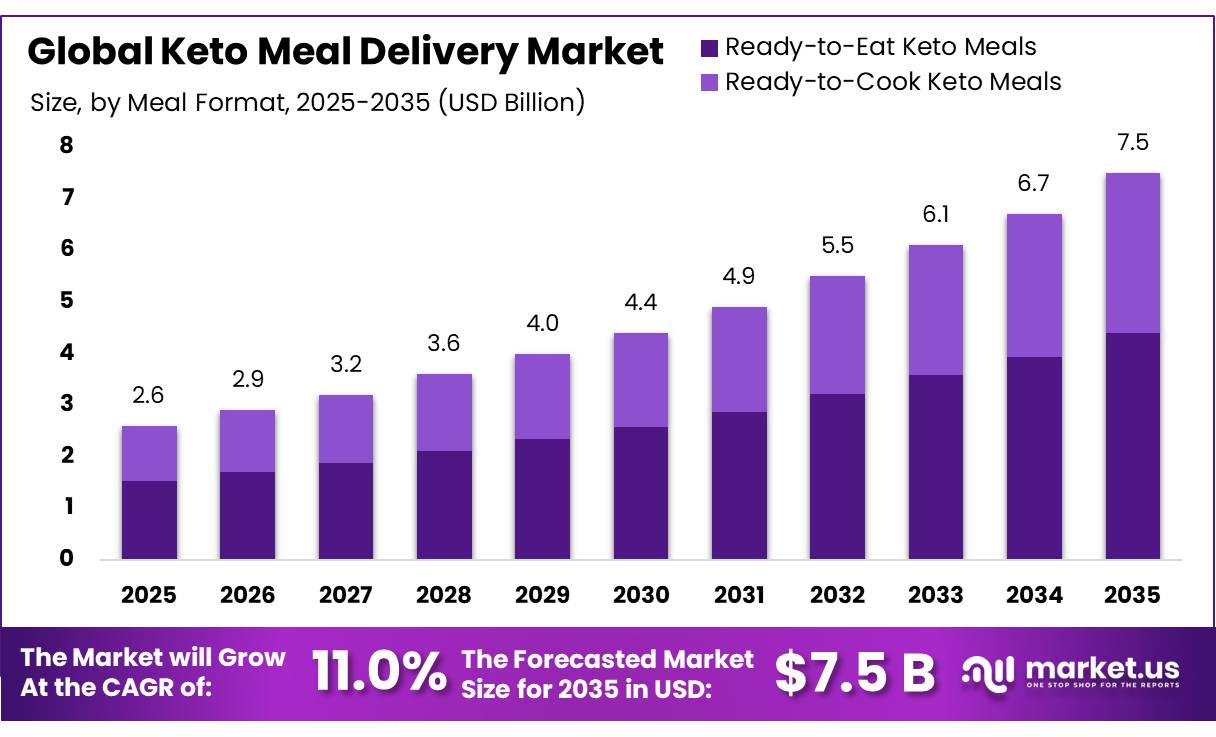
The Global Keto Meal Delivery Market size is expected to be worth around USD 7.5 Billion by 2035, from USD 2.6 Billion in 2025, growing at a CAGR of 11.0% during the forecast period from 2026 to 2035. In 2025, North America held a dominant market position, capturing more than a 58.90% share, holding USD 1.5 Billion revenue.
The Keto Meal Delivery industry is developing as consumers increasingly seek convenient, low-carbohydrate meals that support weight management, dietary control, and lifestyle preferences. The industry combines prepared-food manufacturing, meal planning, cold-chain logistics, nutritional formulation, and digital ordering platforms. Keto meal delivery providers generally offer meals with high fat, moderate protein, and very low carbohydrate content. Their product portfolios include ready-to-eat meals, meal kits, breakfast options, snacks, and customized weekly food plans.
- According to the United States Centers for Disease Control and Prevention, 40.3% of adults aged 20 years and older had obesity during August 2021 to August 2023. This highlights the importance of accessible food choices and nutritional planning, although ketogenic diets are not suitable for every consumer and should not be presented as a universal medical solution.
The wider foodservice environment also provides a supportive commercial base. The United States Department of Agriculture’s Economic Research Service reported that inflation-adjusted food-away-from-home spending reached USD 1.41 trillion in 2025, representing 56.3% of total food expenditure. This reflects the significant role of restaurants, prepared meals, and other foodservice channels in consumer spending. Keto meal delivery companies can benefit by offering convenient alternatives to conventional restaurant meals, particularly through subscription packages, office meal plans, and direct-to-consumer ordering.
- Government food-labeling requirements also influence industry operations. The United States Food and Drug Administration requires qualifying restaurant chains with 20 or more locations to display calorie information and make additional nutritional details available, including total carbohydrates, fat, protein, sodium, and sugars.
Maintaining freshness and controlling portion sizes across multiple delivery locations can increase operating expenses. Food safety is another important consideration. The United States Department of Agriculture recommends maintaining cold foods at or below 40°F (4.4°C) and hot foods at or above 140°F (60°C). These requirements highlight the importance of reliable packaging, temperature monitoring, and efficient delivery networks.
Key Takeaways
- Keto Meal Delivery Market size is expected to be worth around USD 7.5 Billion by 2035, from USD 2.6 Billion in 2025, growing at a CAGR of 11.0%.
- Ready-to-Eat Keto Meals held a dominant market position, capturing more than a 58.67% share.
- Subscription-Based Delivery held a dominant market position, capturing more than a 76.34% share.
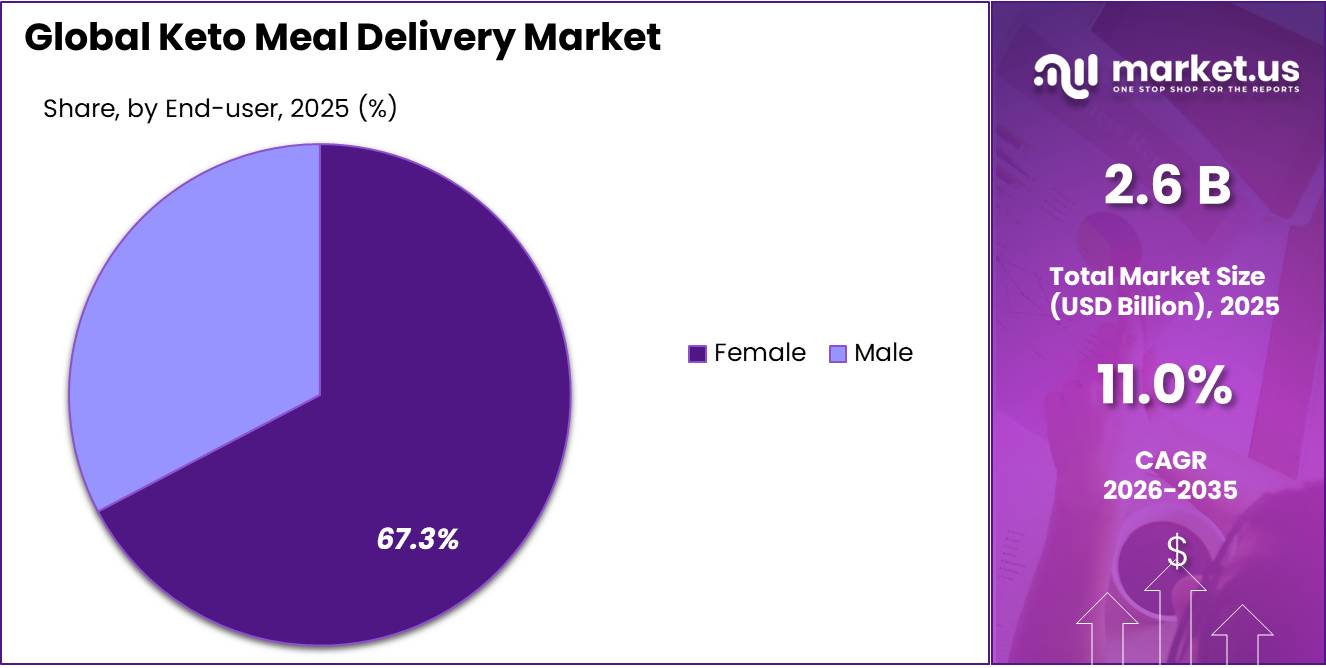
- Female held a dominant market position, capturing more than a 67.34% share.
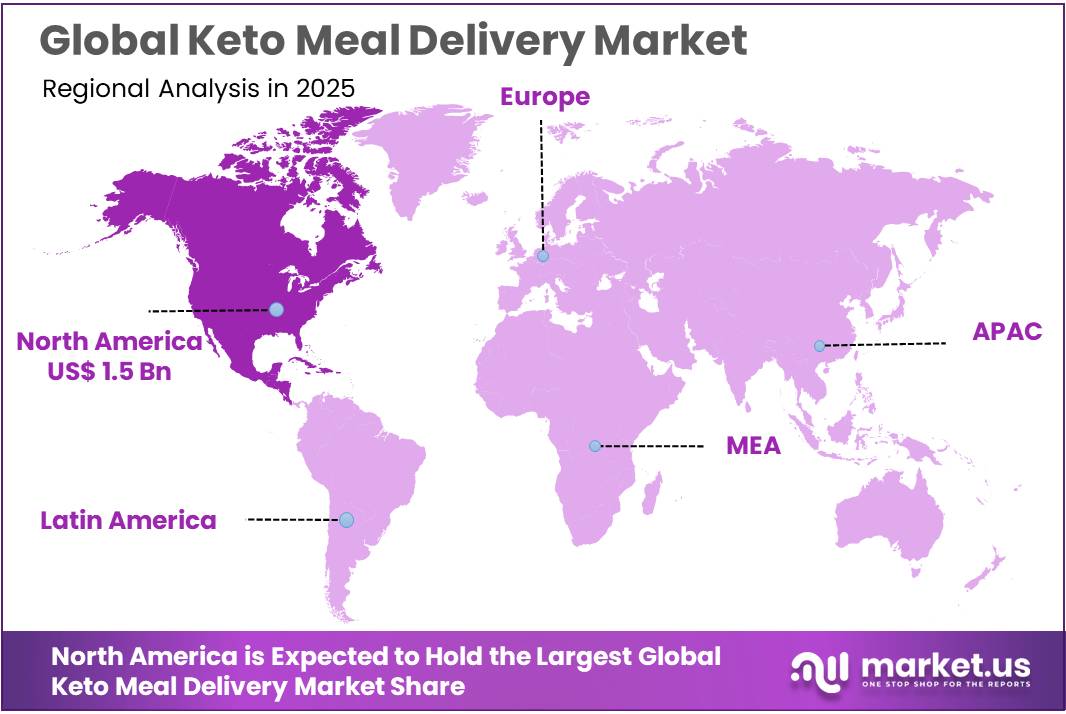
- North America dominated the Keto Meal Delivery Market in 2025, accounting for 58.90% of the global market, with a market value of USD 1.5 billion.
By Meal Format Analysis
Ready-to-Eat Keto Meals dominate due to convenience, portion control, and easy consumption without additional cooking.
In 2025, “Ready-to-Eat Keto Meals” held a dominant market position, capturing more than a 58.67% share. This segment benefits from increasing demand for convenient meal solutions among working professionals, fitness-conscious consumers, and individuals following structured low-carbohydrate diets. These meals are prepared in advance and require minimal effort before consumption, making them suitable for customers with limited cooking time.
“Ready-to-Cook Keto Meals” represent an important segment of the market, serving consumers who prefer preparing meals at home while avoiding the effort of ingredient selection, measurement, and meal planning. These packages generally include pre-portioned ingredients, recipe instructions, and low-carbohydrate food combinations. Demand is supported by consumers seeking greater control over cooking methods, ingredient quality, serving sizes, and meal customization.
In 2025, the broader United States foodservice sector recorded USD 1.41 trillion in inflation-adjusted spending, accounting for 56.3% of total food expenditure, according to the USDA Economic Research Service. Although this figure covers the wider foodservice industry rather than ready-to-cook keto meals specifically, it indicates the substantial consumer spending base for prepared food and meal services.
By Delivery Model Analysis
Subscription-Based Delivery dominates through recurring meal plans, predictable ordering, and convenient weekly food services.
In 2025, “Subscription-Based Delivery” held a dominant market position, capturing more than a 76.34% share. This segment leads because it provides customers with a regular supply of keto-friendly meals without requiring repeated orders. Subscription plans allow consumers to select daily or weekly meal packages based on their dietary preferences, calorie requirements, and consumption habits. The model is particularly useful for working professionals and individuals following consistent low-carbohydrate eating routines.
“One-Time or On-Demand Delivery” serves consumers who prefer purchasing keto meals whenever required rather than committing to a regular subscription. This model is suitable for first-time customers, occasional keto diet followers, and individuals who need convenient meals during busy workdays or travel. Customers can select individual meals, choose specific delivery dates, and adjust their orders according to their daily requirements.
Government data supporting the subscription-based segment: According to the USDA Economic Research Service, total United States food expenditure reached USD 2.51 trillion in 2025, with food-away-from-home spending accounting for 56.3% of total food expenditure. This provides evidence of the substantial spending base for convenient foodservice solutions. Although the figures do not measure meal subscriptions directly, they support the broader demand environment in which subscription-based keto meal providers operate.
By End User Analysis
Female consumers dominate the market due to growing interest in weight management, personalized nutrition, and convenient healthy meal options.
In 2025, “Female” held a dominant market position, capturing more than a 67.34% share. The segment benefits from increasing interest in structured dietary plans, portion-controlled meals, and convenient food options that support individual nutrition preferences. Female consumers represent an important customer group for keto meal delivery providers because subscription packages offer easier meal planning and reduce the time required for grocery shopping and food preparation.
“Male” represents an important end-user segment in the Keto Meal Delivery Market, supported by growing interest in fitness-oriented diets, weight management, and convenient meal preparation. Male consumers often seek keto meal options that combine protein-rich ingredients, controlled carbohydrate content, and suitable portion sizes. Ready-to-eat meals and flexible delivery packages provide convenient choices for individuals with demanding work schedules and regular fitness routines.
According to the United States Department of Agriculture (USDA), its July 2026 report on food and health found that 43.4% of women were fully responsible for meal preparation in their households, compared with 22.3% of men. The report also found that online grocery shopping was more common among women. These findings indicate women’s greater involvement in household meal preparation and food purchasing, providing useful supporting evidence for the female consumer segment.
Key Market Segments
By Meal Format
- Ready-to-Eat Keto Meals
- Ready-to-Cook Keto Meals
By Delivery Model
- Subscription-Based Delivery
- One-Time or On-Demand Delivery
By End User
- Male
- Female
Driver Analysis
Preparation-Free Keto Execution
Ready-to-eat delivery removes ingredient shopping, recipe assembly and cooking from the customer’s ketogenic meal occasion, allowing operators to monetize execution convenience rather than merely provide dietary information. Factor currently advertises more than ten weekly keto options, meals containing no more than approximately 15 g net carbohydrate, heating times of roughly two to three minutes and refrigerated storage of up to seven days; these are supplier specifications, not independent evidence that every meal produces ketosis or that all customers follow a medically appropriate ketogenic diet.
CookUnity likewise offers ready-to-heat keto meals through plans of four to 16 meals weekly, demonstrating that prepared keto is an established commercial service rather than a future white space.
In an illustrative customer model, replacing five home-prepared meals requiring an assumed 30 minutes each with five meals requiring three minutes each saves 135 minutes weekly, excluding shopping and cleanup. At an assumed service premium of USD 4 per meal, the customer pays USD 20 for that convenience, equivalent to approximately USD 8.89 per hour saved; this is a willingness-to-pay illustration, not a measured household time valuation.
For an operator serving 10,000 incremental customers ordering five qualifying meals weekly over 40 weeks, annual volume reaches two million meals and USD 22 million of product revenue at an assumed USD 11 net realization. If 30% replaces purchases from other keto delivery services, net category expansion is USD 15.4 million. The +0.9 pp contribution assumes 30% revenue exposure grows 3.0 percentage points faster through conversion from self-preparation and other out-of-scope meal occasions, excluding purchase-frequency improvements allocated to subscription retention.
Drivers Impact Analysis
| Driver | (~) % Impact on CAGR Forecast | Geographic Relevance | Impact Timeline |
|---|---|---|---|
| Preparation-free keto execution | +0.9 pp | US, Canada, UK, Australia | Short term (≤ 2 years) |
| Transparent carbohydrate control | +0.8 pp | US, Canada; UK, EU specialists | Short term (≤ 2 years) |
| Flexible subscription retention | +0.7 pp | US, Canada, UK, Australia | Short term (≤ 2 years) |
| Broader keto menu rotation | +0.6 pp | US; established European delivery zones | Short term (≤ 2 years) |
| Shared-platform delivery access | +0.5 pp | Canada, Germany, Denmark, Sweden | Medium term (2–4 years) |
Restraint Analysis
Delivered-Price Purchase Rejection
Keto meal delivery asks customers to pay for prepared food, diet-specific selection, packaging and doorstep distribution, creating a purchase barrier when the total bill exceeds their perceived convenience value. Current provider pricing illustrates the ticket size without establishing an industry average: CookUnity advertises meals starting at USD 10.49 on a 16-meal plan and states that smaller plans have higher per-meal prices; its terms also provide for service fees, applicable taxes and other charges.
In an illustrative six-meal order priced at USD 12 per meal plus USD 10 delivery, the customer pays USD 82, equivalent to USD 13.67 per meal before tax. Against an assumed USD 7 home-prepared alternative, the incremental outlay is USD 40 weekly, or USD 1,600 across 40 purchasing weeks. The alternative cost is a modeling assumption, and the comparison excludes the customer’s time. Discounting can temporarily bridge that gap but compresses acquisition economics: a 25% introductory reduction on the USD 72 food component costs USD 18 per box, consuming three-quarters of an assumed USD 24 pre-promotion contribution before delivery and acquisition expenditure.
The restraint is actual non-purchase or fewer paid meals—not higher operating costs alone—and suppliers must assess conversion at the recurring checkout price rather than the advertised introductory offer. The −0.5 pp deduction assumes 25% revenue exposure grows 2.0 percentage points more slowly through price-related rejection, excluding customers who reject a minimum quantity despite accepting the per-meal price.
Restraint Impact Analysis
| Restraint | (~) % Impact on CAGR Forecast | Geographic Relevance | Impact Timeline |
|---|---|---|---|
| Delivered-price purchase rejection | −0.5 pp | US, Canada, UK, Australia | Short term (≤ 2 years) |
| Keto-diet discontinuation | −0.4 pp | US, Canada, UK, Western Europe | Medium term (2–4 years) |
| Clinical suitability exclusions | −0.3 pp | US, Canada, UK, EU, Australia | Short term (≤ 2 years) |
| Unserved delivery locations | −0.3 pp | US ZIP codes; Canadian postal zones | Medium term (2–4 years) |
| Minimum-basket conversion losses | −0.2 pp | US, Canada; subscription-led markets | Short term (≤ 2 years) |
Opportunity Analysis
Employer-Funded Keto Allocations
Employer-funded meal programs could convert employees who are interested in keto but unwilling to fund its full delivered price into incremental purchasers, while shifting acquisition from individual advertising toward contracted organizational access. Factor already offers workplace meals on a recurring weekly cadence and employee vouchers redeemable against home deliveries, with employers paying for redeemed offers; its business platform advertises more than 35 rotating weekly meals across dietary preferences.
The opportunity is a separately negotiated, employee-opt-in keto allocation within new benefits accounts—not counting existing office lunches or ordinary business-channel growth again. In an illustrative portfolio of 100 employers with 500 eligible employees each, 5% participation creates 2,500 users; three qualifying meals weekly over 40 paid weeks generates 300,000 meals and USD 3.0 million of product revenue at an assumed USD 10 net realization.
A USD 4 employer subsidy per meal costs participating organizations USD 1.2 million annually and leaves USD 6 per meal for employees before applicable charges; the subsidy is part of the same transaction, not additional market revenue. If 40% replaces existing keto-delivery purchases, net category expansion is USD 1.8 million. The +0.35 pp contribution assumes 7% revenue exposure grows 5.0 percentage points faster through newly activated employer-funded demand, excluding pooled pickup purchases allocated separately.
Opportunity Impact Analysis
| Opportunity | (~) % Potential CAGR Upside | Geographic Relevance | Execution Window |
|---|---|---|---|
| Employer-funded keto allocations | +0.35 pp | US, Canada, UK corporate hubs | Short term (≤ 2 years) |
| Aggregated small-basket delivery | +0.30 pp | US, UK, Canadian urban clusters | Medium term (2–4 years) |
| Dietitian-directed meal programs | +0.25 pp | US, Canada, UK, Australia | Medium term (2–4 years) |
| Keto breakfast subscriptions | +0.25 pp | US, Canada, UK | Short term (≤ 2 years) |
| Dual-specification keto ranges | +0.25 pp | US, Canada, UK, Germany | Medium term (2–4 years) |
Challenges Analysis
End-to-End Chilled Temperature Control
Prepared keto meals depend on coordinated cooling, packing, transport and household receipt, making temperature control a continuous operating obligation rather than a one-time investment in insulated packaging. FDA’s February 2025 consumer guidance recommends refrigerator temperatures of 40°F or below, approximately 4°C, and limits unrefrigerated exposure of perishables to two hours, or one hour when ambient temperature exceeds 90°F; these consumer benchmarks do not replace a manufacturer’s product-specific process validation or applicable commercial requirements.
A 2022 university study covering 72 deliveries from 12 meal-delivery companies found that transit duration influenced arrival temperature, with deliveries taking at least 40 hours recording higher average temperatures than those taking 20 hours or less; this historical sample is not a current keto-sector failure rate.
In an illustrative network shipping one million six-meal boxes annually, an assumed 1.0% temperature-related credit or replacement rate affects 10,000 boxes and 60,000 meals. At USD 5 production cost per meal plus USD 12 replacement freight per box, one complete replacement cycle exposes USD 420,000 before investigation and customer-service costs; this is cost exposure, not automatically lost market revenue. Reducing the affected-box rate to 0.6% would avoid USD 168,000 under identical assumptions, against which seasonal packaging and monitoring expenditure must be assessed.
Operators need route-qualified thermal packaging, calibrated monitoring, carrier performance controls and clear receiving instructions. The −0.35 pp contribution assumes 17.5% revenue exposure grows 2.0 percentage points more slowly through residual spoilage, replacement burdens and service recovery, excluding addresses that cannot be served at all.
Challenges Impact Analysis
| Challenge | (~) % CAGR Friction Drag | Geographic Relevance | Mitigation Horizon |
|---|---|---|---|
| End-to-end chilled temperature control | −0.35 pp | US, Canada, UK, Australia | Medium term (2–4 years) |
| Recipe-level carbohydrate consistency | −0.30 pp | US, Canada, UK, EU processors | Medium term (2–4 years) |
| Mixed-menu manufacturing bottlenecks | −0.30 pp | US; German, Nordic production hubs | Medium term (2–4 years) |
| Ingredient yield and substitution | −0.25 pp | North America, UK, Western Europe | Long term (≥ 4 years) |
| Short-life demand forecasting | −0.20 pp | US, Canada, UK, Australia | Medium term (2–4 years) |
Geopolitical Impact Analysis
Geopolitical Impact of Ongoing Wars on the Keto Meal Delivery Market
Ongoing geopolitical conflicts, particularly the Russia-Ukraine war and instability in the Middle East, are creating cost and supply-chain pressures for the Keto Meal Delivery Market. Disruptions to international shipping routes, higher fuel costs, and uncertainty in agricultural trade can increase the cost of meat, dairy products, cooking oils, nuts, and packaged food ingredients. These pressures affect meal preparation, refrigerated transportation, packaging, and last-mile delivery. Companies operating subscription-based services may face additional challenges in maintaining fixed meal prices and regular delivery schedules.
The World Bank reported in its October 28, 2026 Commodity Markets Outlook that global energy prices are projected to increase by 32% in 2026, while food commodity prices are expected to rise by 10% in 2026 and a further 7% in 2027. These increases may place pressure on keto meal delivery companies through higher ingredient procurement, refrigeration, fuel, and transportation expenses. Smaller providers may face greater difficulty maintaining affordable subscription packages. To manage these challenges, companies are likely to diversify suppliers, source ingredients locally, improve inventory planning, and optimize delivery routes.
Regional Insights
North America – Dominating Region
North America dominated the Keto Meal Delivery Market in 2025, accounting for 58.90% of the global market, with a market value of USD 1.5 billion. The region benefits from established meal subscription services, strong online food ordering infrastructure, and growing consumer interest in low-carbohydrate diets.
The United States represents a major contributor due to the availability of specialized meal providers, ready-to-eat keto products, and customized nutrition plans. Canada also supports regional demand through expanding online food purchasing and convenient prepared-meal services. A 2022 International Food Policy Study found that 62.13% of surveyed United States participants used online food retail or delivery platforms. This established digital purchasing environment supports customer acquisition and recurring meal subscriptions.
Asia-Pacific is expected to offer strong future growth opportunities for keto meal delivery providers as online food purchasing, urban lifestyles, and interest in convenient nutrition continue to expand. The International Telecommunication Union reported that 77% of the Asia-Pacific population used the internet in 2025, creating a wider digital base for online meal ordering and subscription services.
Urban consumers are increasingly accessible through mobile applications and digital payment platforms, supporting the expansion of specialized food delivery businesses. Companies can target major metropolitan markets through ready-to-eat keto meals, customized weekly packages, and affordable subscription options. However, local food preferences, ingredient availability, and pricing differences will remain important considerations.
Key Regions and Countries Insights
- North America
- US
- Canada
- Europe
- Germany
- France
- The UK
- Spain
- Italy
- Rest of Europe
- Asia Pacific
- China
- Japan
- South Korea
- India
- Australia
- Rest of APAC
- Latin America
- Brazil
- Mexico
- Rest of Latin America
- Middle East & Africa
- GCC
- South Africa
- Rest of MEA
Key Players Analysis
Trifecta Nutrition is an established participant in the Keto Meal Delivery Market, offering fully prepared meals designed around fitness, weight management, and nutritional goals. Founded in 2015, the company provides specialized keto meal plans featuring whole-food ingredients, high-quality proteins, and controlled carbohydrates. Its keto meals contain an average of 470 calories, 36 grams of protein, 10 grams of carbohydrates, and 30 grams of fat. Weekly delivery, customizable meal selections, and nutrition-focused menus support its competitive position.
Territory Foods competes through chef-prepared meals, locally sourced ingredients, and dietitian-led nutritional planning. Established in 2011, the company works with independent chefs across 27 US states, providing ready-to-eat meals for different dietary preferences. Its keto meal program follows a net carbohydrate limit of 15 grams per meal, with an emphasis on quality fats, protein, and nutrient-rich vegetables. Its rotating weekly menus and locally prepared food model help the company serve consumers seeking convenient and customized keto meal options.
Fresh n’ Lean was a prepared-meal delivery provider founded in 2010, offering organic meals across keto, paleo, vegan, and other dietary categories. The company focused on ready-to-eat meals prepared with organic ingredients and delivered through weekly meal plans. Its business model targeted consumers seeking convenient, nutrition-focused food without daily cooking. However, Fresh n’ Lean ceased operations in July 2024, according to CB Insights.
Top Key Players Outlook
- Trifecta Nutrition
- Territory Foods
- Fresh n’ Lean
- CookUnity
- Diet-to-Go
- Pete’s Real Food
- The Good Kitchen
- BistroMD
- Snap Kitchen
- HelloFresh
- Sunbasket
- Home Chef
- Other Key Players
Recent Developments
- In January 2026, CookUnity partnered with Airbnb to offer prepared meals through Airbnb Services, with meal bundles of 3–6 meals starting at USD 15 per meal. In March 2026, the company reported that it had closed 2025 with more than USD 750 million in annual recurring revenue, delivered over 43 million meals, served more than 200,000 customers, and recorded annual meal delivery growth of over 80%.
- In August 2025, Pete’s Real Food continued its digital content and customer engagement activities through nutrition articles and recipe guides covering anti-inflammatory meals, protein intake, and meal preparation. Its website also featured 679 journal entries in its historical content archive.
Report Scope
| Report Features | Description |
|---|---|
| Market Value (2025) | USD 2.6 Bn |
| Forecast Revenue (2035) | USD 7.5 Bn |
| CAGR (2026-2035) | 11.0% |
| Base Year for Estimation | 2025 |
| Historic Period | 2020-2024 |
| Forecast Period | 2026-2035 |
| Report Coverage | Revenue Forecast, Market Dynamics, Competitive Landscape, Recent Developments |
| Segments Covered | By Meal Format (Ready-to-Eat Keto Meals, Ready-to-Cook Keto Meals), By Delivery Model (Subscription-Based Delivery, One-Time or On-Demand Delivery), By End User (Male, Female) |
| Regional Analysis | North America – US, Canada; Europe – Germany, France, The UK, Spain, Italy, Rest of Europe; Asia Pacific – China, Japan, South Korea, India, Australia, Singapore, Rest of APAC; Latin America – Brazil, Mexico, Rest of Latin America; Middle East & Africa – GCC, South Africa, Rest of MEA |
| Competitive Landscape | Trifecta Nutrition, Territory Foods, Fresh n’ Lean, CookUnity, Diet-to-Go, Pete’s Real Food, The Good Kitchen, BistroMD, Snap Kitchen, HelloFresh, Sunbasket, Home Chef, Other Key Players |
| Customization Scope | Customization for segments, region/country-level will be provided. Moreover, additional customization can be done based on the requirements. |
| Purchase Options | We have three licenses to opt for: Single User License, Multi-User License (Up to 5 Users), Corporate Use License (Unlimited User and Printable PDF) |