


Global Kenaf Seed Oil Market Size, Share, And Industry Analysis Report By Form (Liquid, Powder/Capsule), By Application (Nutraceuticals, Food, Cosmetics), By Distribution (B2B, Retail/Online), By Region and Companies - Industry Segment Outlook, Market Assessment, Competition Scenario, Statistics, Trends and Forecast 2026-2035
- Published date: March 2026
- Report ID: 182839
- Number of Pages: 397
- Format:
-
keyboard_arrow_up
Quick Navigation
Report Overview
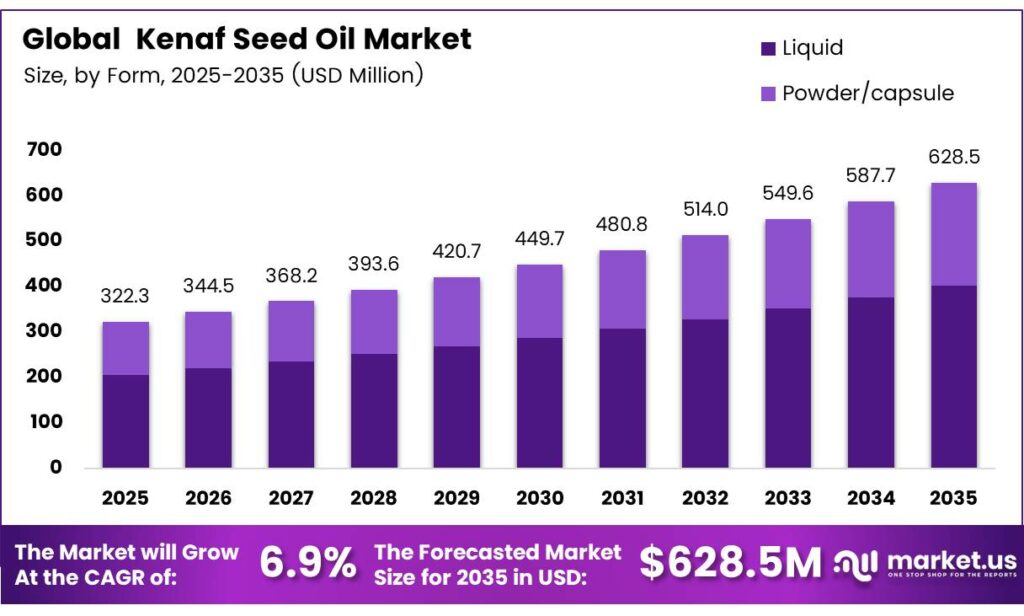
The Global Kenaf Seed Oil Market size is expected to be worth around USD 628.5 Million by 2035 from USD 322.3 Million in 2025, growing at a CAGR of 6.9% during the forecast period 2026 to 2035.
Kenaf seed oil is a plant-derived oil extracted from the seeds of Hibiscus cannabinus, a fast-growing industrial crop. It contains high concentrations of omega fatty acids, antioxidants, and natural emollients. Consequently, it serves multiple industries, including nutraceuticals, food processing, cosmetics, and bio-based lubricants.
The market benefits from rising global demand for plant-based, chemical-free ingredients. Manufacturers across the food and personal care sectors are increasingly replacing synthetic compounds with natural oil alternatives. Moreover, kenaf seed oil’s versatility makes it suitable for both consumer products and industrial applications, widening its commercial appeal.
Kenaf seed oil production reached 3,200 metric tons, supported by 12,500 hectares of cultivated land, reflecting strong government-backed agricultural expansion. This steady increase in cultivation is helping strengthen the global supply chain, with the Asia Pacific region continuing to lead through its well-established infrastructure and export networks.
Brazil exported $5.1 million in kenaf oilseed trade in 2024, mainly to European cosmetic manufacturers, reinforcing Latin America’s role as a key bridge between emerging producers and premium end-users. Meanwhile, Africa’s production rose to 7,800 metric tons, led by Nigeria and Sudan, highlighting growing competition from emerging supply markets.
Clean-label and organic product trends accelerate kenaf seed oil adoption in premium consumer markets. Cosmetic brands actively reformulate products using natural emollient oils to meet regulatory and consumer expectations. Therefore, kenaf seed oil positions itself as a commercially attractive ingredient across multiple high-growth product categories.
Key Takeaways
- The Global Kenaf Seed Oil Market is valued at USD 322.3 Million in 2025 and is projected to reach USD 628.5 Million by 2035 at a CAGR of 6.9% during the forecast period 2026 to 2035.
- Liquid holds the dominant share at 73.6% in 2025.
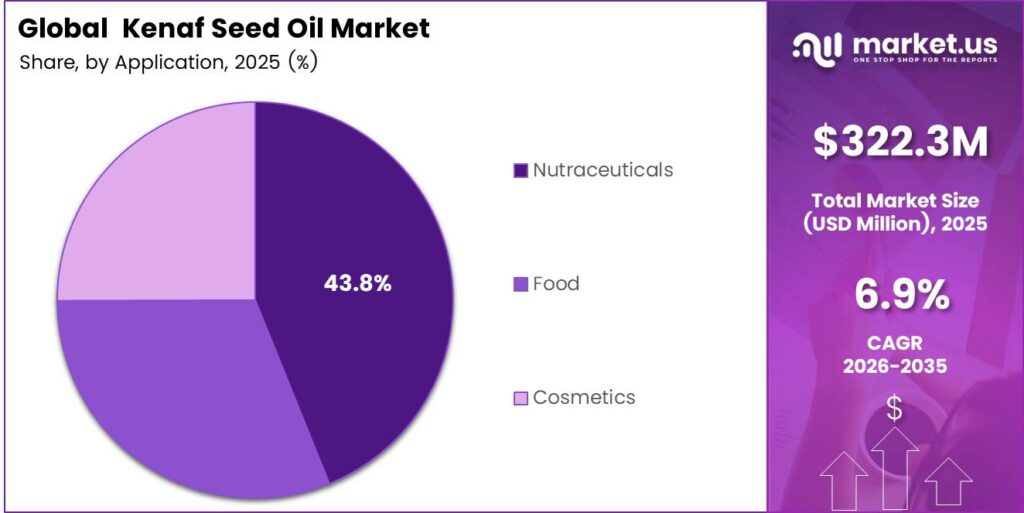
- Nutraceuticals lead the market with a 43.8% share in 2025.
- B2B channels account for 67.2% of the total market share in 2025.
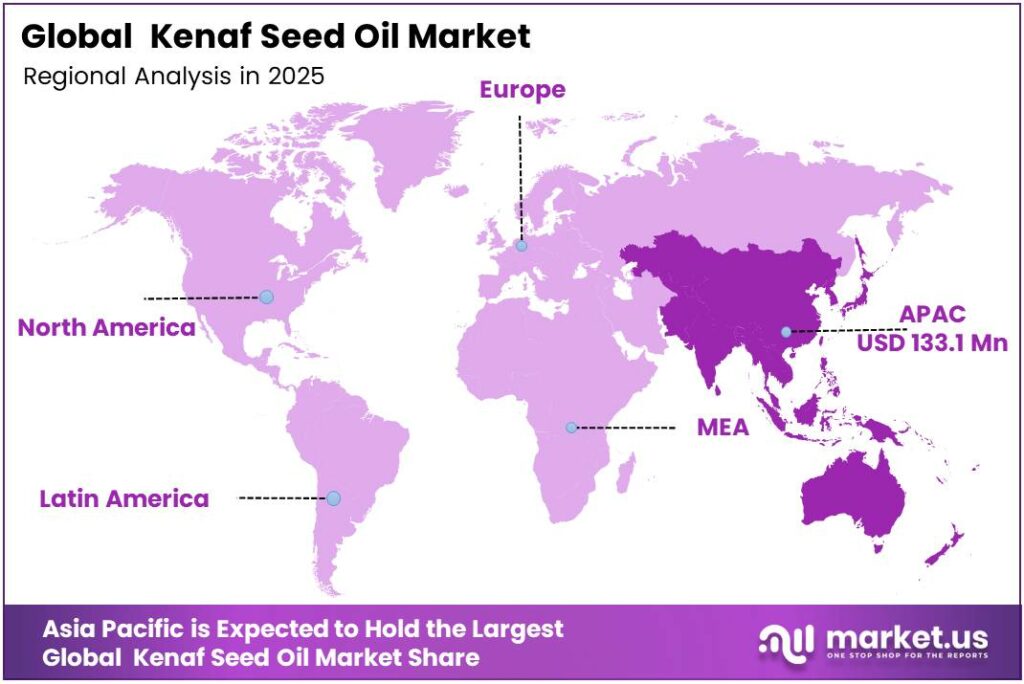
- Asia Pacific dominates the regional landscape with a 41.3% market share, valued at USD 133.1 Million in 2025.
By Form Analysis
Liquid dominates with 73.6% due to superior versatility and ease of integration across industrial and consumer applications.
In 2025, Liquid kenaf seed oil held a dominant market position in the By Form segment of the Kenaf Seed Oil Market, with a 73.6% share. Liquid form offers superior bioavailability, easy blending, and seamless incorporation into food, cosmetic, and industrial formulations. Moreover, manufacturers prefer liquid variants for their processing efficiency and scalability in large-batch production environments.
The Powder/Capsule segment represents the remaining share of the By Form segment, attracting demand from nutraceutical and dietary supplement brands. Powder and capsule formats provide convenience, extended shelf life, and precise dosing capabilities. Additionally, health-conscious consumers prefer encapsulated kenaf seed oil for daily supplementation, supporting steady growth in this form category.
By Application Analysis
Nutraceuticals dominate with 43.8% due to growing consumer demand for antioxidant-rich, plant-based health supplements.
In 2025, Nutraceuticals held a dominant market position in the By Application segment of the Kenaf Seed Oil Market, with a 43.8% share. Rising health awareness drives consumers toward functional supplements featuring omega fatty acids and natural antioxidants. Consequently, nutraceutical producers actively incorporate kenaf seed oil into capsules, soft gels, and wellness formulations targeting cardiovascular and immune health.
The Food application segment captures meaningful market share as clean-label food brands integrate kenaf seed oil into cooking oils, dressings, and fortified food products. Its favorable fatty acid profile and neutral taste profile make it a practical functional ingredient. Moreover, food manufacturers leverage their health positioning to attract premium and health-oriented consumer segments.
The Cosmetics segment expands rapidly as skincare and haircare brands seek natural emollient ingredients with proven efficacy. Kenaf seed oil delivers moisturizing, anti-aging, and skin-barrier benefits that align with premium formulation standards. Therefore, cosmetic manufacturers increasingly feature it in serums, creams, and conditioning products targeting organic and clean-beauty consumers.
By Distribution Analysis
B2B dominates with 67.2% due to large-volume procurement by industrial manufacturers and nutraceutical producers.
In 2025, B2B held a dominant market position in the By Distribution segment of the Kenaf Seed Oil Market, with a 67.2% share. Industrial buyers, including cosmetic manufacturers, food processors, and bio-lubricant producers, source kenaf seed oil in bulk through direct supplier contracts. Additionally, B2B channels support customized formulations and volume pricing that large manufacturers require for consistent production operations.
The Retail/Online segment captures the remaining distribution share, driven by e-commerce growth and rising direct-to-consumer health product sales. Online platforms enable smaller brands and individual consumers to access kenaf seed oil products conveniently. Moreover, digital retail channels allow specialty suppliers to reach global health-conscious audiences without traditional distribution intermediaries.
Key Market Segments
By Form
- Liquid
- Powder/Capsule
By Application
- Nutraceuticals
- Food
- Cosmetics
By Distribution
- B2B
- Retail/Online
Emerging Trends
Organic Variant Demand Surges Amid Clean-Label Consumer Movements
Organic kenaf seed oil demand accelerates as consumers actively reject synthetic ingredients in food, cosmetics, and wellness products. Clean-label movements across North America and Europe push brands toward certified natural sourcing. Europe’s kenaf oil imports, with Germany and France leading in industrial oil applications. This growth confirms a strong European preference for bio-based, sustainably sourced specialty oils.
Regulatory Frameworks Favor Bio-Based Oils Across Energy and Cosmetic Sectors
Evolving biofuel regulations in North America, Europe, and Asia-Pacific create structured demand for bio-based oils, including kenaf seed variants. Regulatory frameworks now prioritize sustainable sourcing, directly benefiting kenaf oil producers. Global kenaf oil trade flows between Asia-Pacific and Europe reached $27.5 million in 2024, with 68% consisting of refined industrial-grade oil. This confirms regulatory-driven trade expansion.
Drivers
Health Consciousness and Nutraceutical Demand Propel Kenaf Seed Oil Growth
Rising consumer health awareness drives strong demand for antioxidant-rich, plant-based oils in nutraceutical and functional food sectors. Manufacturers reformulate supplements using omega-rich kenaf seed oil to meet evolving dietary preferences. China’s kenaf oilseed production, with Guangxi province contributing of national output. This production growth directly supports expanding nutraceutical supply chains.
Renewable Biofuel Adoption and Clean Cosmetics Expand Market Reach
Global biofuel transitions accelerate kenaf seed oil adoption as a renewable energy feedstock across multiple industrial sectors. Simultaneously, cosmetic brands expand clean-label formulations using kenaf oil’s proven emollient properties. Japan’s export strength reflects diversified end-market demand growth.
Restraints
Limited Commercial Cultivation Scale Keeps Kenaf Seed Oil Prices Elevated
Kenaf seed oil commands premium pricing because commercial cultivation remains concentrated in a limited number of producing countries. Small cultivation footprints restrict output volumes and prevent economies of scale. India’s kenaf seed oil output covers only 8,200 hectares. This limited scale constrains global supply, keeping prices above mass-market thresholds and slowing broader consumer adoption.
Insufficient Refining Infrastructure Creates Supply Chain Inconsistencies
Inadequate kenaf seed oil processing and refining facilities prevent consistent, high-quality product supply across global markets. Many producing regions lack investment in modern extraction and purification technologies. Consequently, quality variability discourages large-scale procurement from food, pharmaceutical, and industrial buyers. Without optimized refining infrastructure, kenaf seed oil struggles to meet the strict quality standards demanded by premium international markets.
Growth Factors
Automated Extraction Technologies Unlock Higher Yield and Purity Potential
Advancements in automated cold-press and solvent-free extraction systems significantly improve kenaf seed oil yield rates and product purity. These technologies reduce processing costs and improve commercial scalability for producers. North America’s kenaf oil processing capacity, with Texas-based facilities contributing of total capacity. This infrastructure expansion reflects growing confidence in kenaf oil’s commercial scalability.
Premium Skincare Expansion and Strategic B2B Partnerships Drive Market Development
Kenaf seed oil’s integration into premium anti-aging and organic skincare product lines creates high-value market opportunities for producers. Strategic B2B partnerships localize production near North American and European nutraceutical manufacturing hubs. United States kenaf seed oil imports totaled $18.4 million in 2024, with 61% sourced from Southeast Asia. This import demand signals strong downstream industry growth across cosmetic and nutraceutical applications.
Regional Analysis
Asia Pacific Dominates the Kenaf Seed Oil Market with a Market Share of 41.3%, Valued at USD 133.1 Million
Asia Pacific leads the global kenaf seed oil market with a 41.3% share, valued at USD 133.1 Million in 2025. China, India, and Malaysia drive regional dominance through extensive cultivation programs and integrated processing facilities. Nevertheless, the Asia Pacific maintains its leadership through established infrastructure and export networks.
North America represents a significant import-driven market for kenaf seed oil, supported by growing nutraceutical and bio-lubricant industries. Large processing facilities, primarily in Texas, handle substantial refining volumes. Moreover, sustainability regulations and biofuel incentives encourage manufacturers to integrate kenaf-derived oils into eco-compliant product formulations across multiple industrial sectors.
Europe actively imports kenaf seed oil to support its expanding organic cosmetics, functional food, and bio-based industrial sectors. Germany and France lead import volumes for industrial oil applications. Additionally, stringent EU regulations favoring bio-based materials create a favorable regulatory environment that directly stimulates kenaf seed oil procurement from Asia-Pacific and Latin American suppliers.
The Middle East and Africa region shows emerging market potential for kenaf seed oil in specialty chemical and industrial applications. UAE leads Middle Eastern imports through specialty chemical trade channels. Furthermore, African nations, including Nigeria and Sudan, are strengthening their domestic kenaf oilseed production capacity, positioning the continent as a future supplier to global markets.
Key Regions and Countries
North America
- US
- Canada
Europe
- Germany
- France
- The UK
- Spain
- Italy
- Rest of Europe
Asia Pacific
- China
- Japan
- South Korea
- India
- Australia
- Rest of APAC
Latin America
- Brazil
- Mexico
- Rest of Latin America
Middle East & Africa
- GCC
- South Africa
- Rest of MEA
Key Players Analysis
Parchem operates as a specialty chemical and natural ingredient distributor with a strong global supply network for kenaf seed oil. The company serves nutraceutical, cosmetic, and industrial clients across North America and Europe. Parchem’s established sourcing relationships with Asian producers allow consistent delivery of high-purity kenaf seed oil to demanding B2B customers across multiple end-use sectors.
AOS Products focuses on natural plant oils and botanical ingredients, positioning kenaf seed oil prominently within its product portfolio for food and cosmetic applications. The company emphasizes quality-certified, traceable supply chains that meet clean-label requirements. Moreover, AOS Products actively expands its distribution partnerships to reach growing organic skincare and functional nutrition markets across international territories.
Hallstar specializes in performance-driven cosmetic ingredients and bio-based industrial lubricants, making kenaf seed oil a strategic fit within its renewable ingredient offerings. The company leverages strong formulation expertise to market kenaf oil’s emollient and anti-aging properties to premium skincare brands. Additionally, Hallstar invests in technical support services that help cosmetic formulators integrate kenaf seed oil effectively into finished products.
Connoils provides custom oil blending and private-label manufacturing services, with kenaf seed oil featuring in its natural oil ingredient catalog for nutraceutical and food clients. The company serves both large-scale manufacturers and emerging health brands seeking plant-based oil solutions. Furthermore, Connoils supports its clients through formulation consultation, ensuring kenaf seed oil is optimally incorporated into diverse product applications.
Top Key Players in the Market
- Parchem
- AOS Products
- Hallstar
- Connoils
- NutriScience
- BioOrganic
- Sanmik
- JMC Oil
- EcoGreen
- Pioneer Herb
Recent Developments
- In 2025, AOS Products is an Indian manufacturer/exporter of essential oils, carrier oils, menthol/mint oils, and herbal extracts (food/cosmetic/pharma grades). Carrier oils are offered, but no kenaf seed oil or Hibiscus cannabinus references appear in product categories, blog, or about sections.
- In 2025, NutriScience will be a supplier of nutraceutical/functional ingredients (including fats/oils category with items like chia). The news/events section covers acquisitions and general ingredients—suppliers of natural/organic ingredients for cosmetics/personal care.
Report Scope
Report Features Description Market Value (2025) USD 322.3 Million Forecast Revenue (2035) USD 628.5 Million CAGR (2026-2035) 6.9% Base Year for Estimation 2025 Historic Period 2020-2024 Forecast Period 2026-2035 Report Coverage Revenue Forecast, Market Dynamics, Competitive Landscape, Recent Developments Segments Covered By Form (Liquid, Powder/Capsule), By Application (Nutraceuticals, Food, Cosmetics), By Distribution (B2B, Retail/Online) Regional Analysis North America (US and Canada), Europe (Germany, France, The UK, Spain, Italy, and Rest of Europe), Asia Pacific (China, Japan, South Korea, India, Australia, and Rest of APAC), Latin America (Brazil, Mexico, and Rest of Latin America), Middle East & Africa (GCC, South Africa, and Rest of MEA) Competitive Landscape Parchem, AOS Products, Hallstar, Connoils, NutriScience, BioOrganic, Sanmik, JMC Oil, EcoGreen, Pioneer Herb Customization Scope Customization for segments, region/country-level will be provided. Moreover, additional customization can be done based on the requirements. Purchase Options We have three licenses to opt for: Single User License, Multi-User License (Up to 5 Users), Corporate Use License (Unlimited Users and Printable PDF) 
-
-
- Parchem
- AOS Products
- Hallstar
- Connoils
- NutriScience
- BioOrganic
- Sanmik
- JMC Oil
- EcoGreen
- Pioneer Herb
Our Clients

- 182839
- March 2026






