


Global Rice Bran Oil Market Size, Share, And Industry Analysis Report By Type (Organic, Non-Organic), By Application (Food and Beverage, Nutraceutical, Animal Feed, Others), By Distribution Channel (Offline, Online), By Region and Companies - Industry Segment Outlook, Market Assessment, Competition Scenario, Statistics, Trends and Forecast 2026-2035
- Published date: April 2026
- Report ID: 184285
- Number of Pages: 201
- Format:
-
keyboard_arrow_up
Quick Navigation
Report Overview
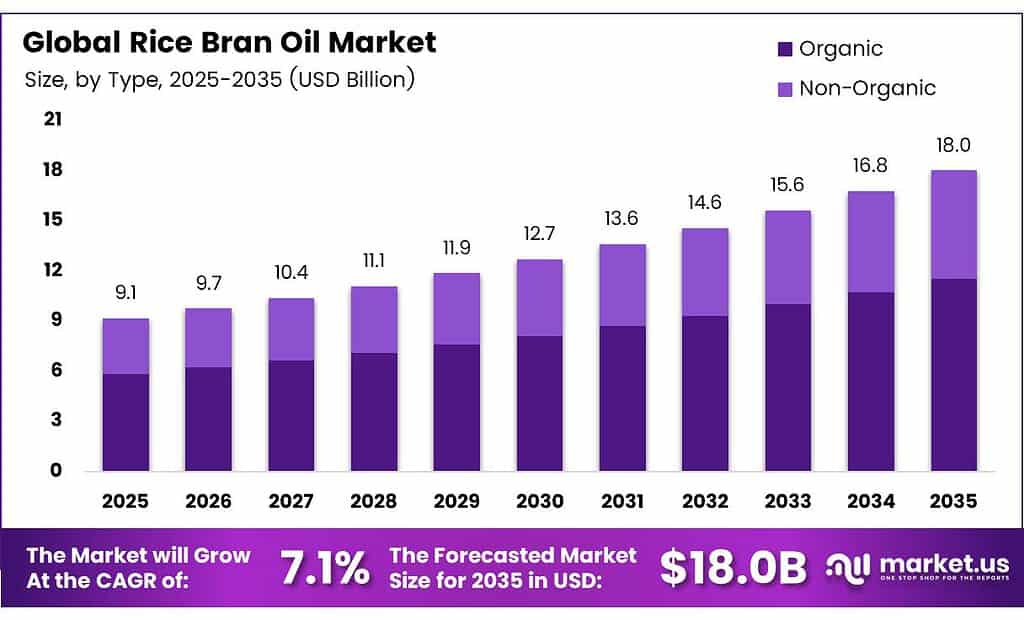
The Global Rice Bran Oil Market size is expected to be worth around USD 18.0 billion by 2035 from USD 9.1 billion in 2025, growing at a CAGR of 7.1% during the forecast period 2026 to 2035.
Rice bran oil is a vegetable oil extracted from the outer husk of rice grains. It contains a unique blend of fatty acids, natural antioxidants, and bioactive compounds, including gamma-oryzanol and tocotrienols. Consequently, it serves both culinary and health-focused applications across global markets.
The oil’s high smoke point makes it ideal for commercial frying and food processing. Moreover, its mild flavor appeals to health-conscious consumers seeking a light, neutral cooking oil. Food manufacturers increasingly prefer it as a functional ingredient in packaged and processed foods.
Life-cycle assessment studies support the adoption of cleaner extraction methods. Energy-efficient supercritical CO₂ (SC-CO₂) extraction achieved 10 g of oil in 1.5 hours, versus 3.6 g in 3 hours by the Soxhlet method — indicating over 2.7× higher yield per unit time. This efficiency gain signals a major shift in production economics toward sustainable extraction.
Industrial advancements further reinforce production reliability. Advanced industrial solvent-extraction systems can recover 98–99% of total available oil from pretreated rice bran, compared to just 60–70% through mechanical pressing alone. This recovery advantage supports consistent supply volumes and reduces raw material waste significantly.
Growth opportunities in cosmetics, nutraceuticals, and animal feed are expanding the market’s revenue base. Producers are investing in refining technologies to generate both culinary-grade and pharmaceutical-grade oil from the same feedstock. This dual-use capability improves margins and opens new premium product lines.
Key Takeaways
- The Global Rice Bran Oil Market is valued at USD 9.1 billion in 2025 and is projected to reach USD 18.0 billion by 2035 at a CAGR of 7.1% during the forecast period 2026–2035.
- The Non-Organic segment dominates with a market share of 74.8% in 2025.
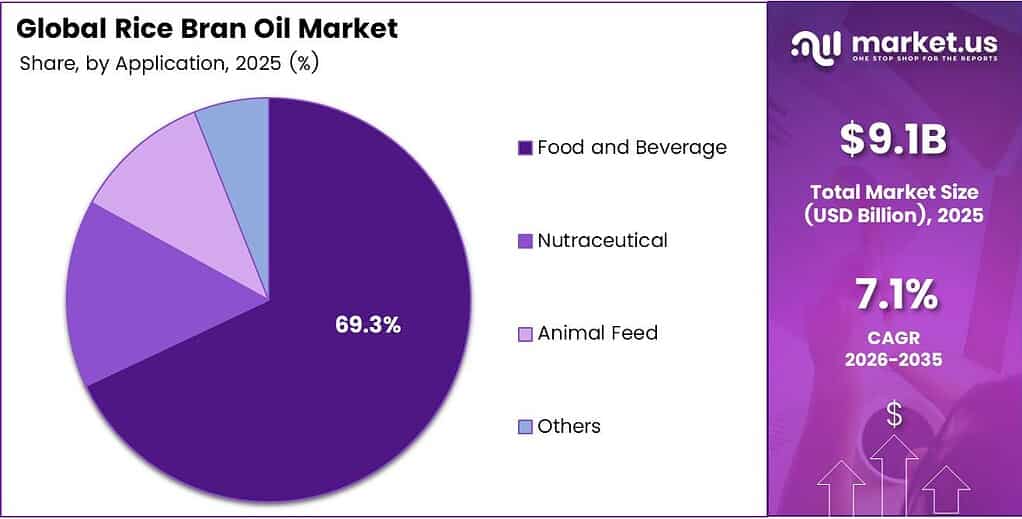
- The Food and Beverage segment leads with a share of 69.3% in 2025.
- The Offline segment holds a dominant share of 77.6% in 2025.
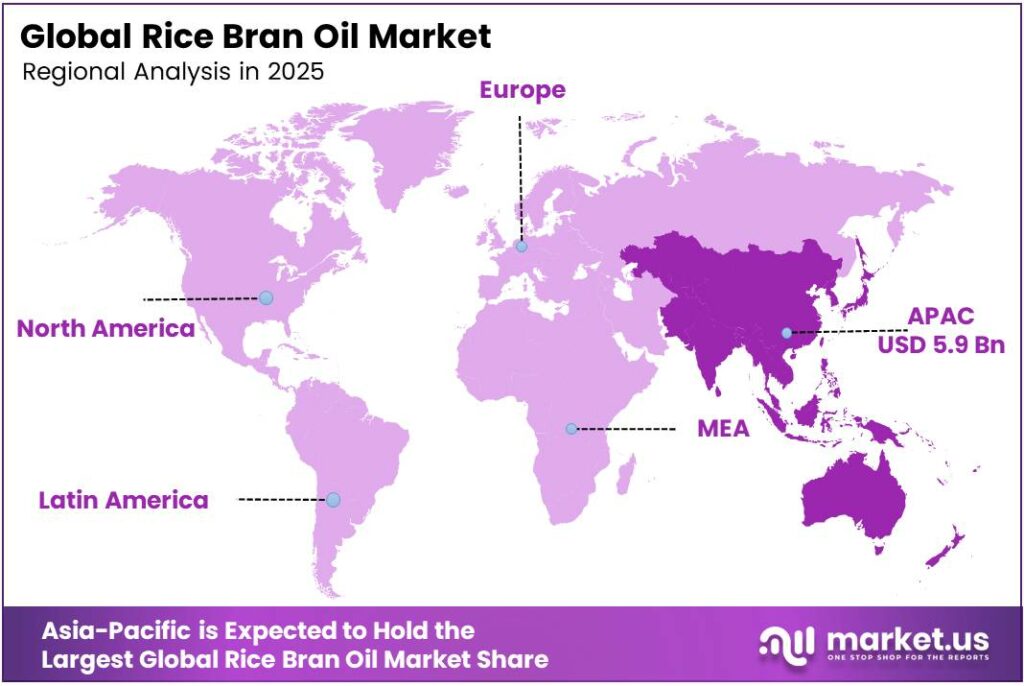
- Asia-Pacific dominates the regional landscape with a 65.9% market share, valued at USD 5.9 billion in 2025.
By Type Analysis
Non-Organic dominates with 74.8% due to its affordability and wide commercial availability.
In 2025, Non-Organic rice bran oil held a dominant market position in the By Type segment of the Rice Bran Oil Market, with a 74.8% share. Its lower production cost and mass-market availability make it the preferred choice for food manufacturers and commercial kitchens. Additionally, well-established extraction and refining infrastructure support consistent large-scale output.
The Organic segment, while smaller, is gaining traction among premium health-conscious consumers. Organic certification commands higher price points and appeals to buyers seeking clean-label, pesticide-free cooking oils. Moreover, growing e-commerce penetration helps organic brands reach niche global audiences more efficiently than traditional retail channels.
By Application Analysis
Food and beverage dominate with 69.3% due to the oil’s high smoke point and neutral flavor profile.
In 2025, Food and Beverage held a dominant market position in the By Application segment of the Rice Bran Oil Market, with a 69.3% share. Manufacturers prefer it for frying, baking, and salad dressing due to its oxidative stability. Consequently, large food processing companies continue sourcing it as a functional cooking medium.
The Nutraceutical segment attracts pharmaceutical and health supplement producers seeking gamma-oryzanol and tocotrienols. These bioactive compounds support cardiovascular and immunity benefits, creating strong demand in functional food formulations. Therefore, producers are investing in refining processes that preserve these high-value compounds during oil processing.
The Animal Feed segment uses rice bran oil as an energy-dense additive in livestock nutrition programs. It improves feed palatability and supports healthy fat ratios in animal diets. Additionally, the Others segment covers cosmetic and personal care applications, where the oil’s vitamin E content drives adoption in moisturizers and skin treatments.
By Distribution Channel Analysis
Offline dominates with 77.6% due to established retail networks and consumer purchasing habits.
In 2025, Offline distribution held a dominant market position in the By Distribution Channel segment of the Rice Bran Oil Market, with a 77.6% share. Supermarkets, grocery stores, and wholesale distributors remain the primary points of purchase for both household and industrial buyers. Moreover, strong retailer relationships and physical product availability continue to support offline channel dominance.
The Online channel is expanding rapidly, driven by direct-to-consumer brand growth and specialty health food platforms. E-commerce enables smaller organic and premium brands to access global audiences without heavy retail infrastructure investment. Additionally, subscription-based purchasing models and digital marketing are reshaping how consumers discover and reorder edible oils.
Key Market Segments
By Type
- Organic
- Non-Organic
By Application
- Food and Beverage
- Nutraceutical
- Animal Feed
- Others
By Distribution Channel
- Offline
- Online
Emerging Trends
Clean-Label and Plant-Based Oils Reshape Consumer Preferences
Consumers increasingly demand clean-label, plant-based cooking oils with transparent ingredient sourcing. Rice bran oil benefits directly from this trend due to its natural antioxidant profile and minimal processing. Moreover, deploying advanced refining allows concentration of nutraceutical fractions from crude oil, improving product differentiation without additional raw material input.
Sustainable Packaging and Functional Nutrition Drive Market Innovation
Brands across the rice bran oil value chain are adopting eco-friendly packaging and traceable sourcing practices to meet sustainability expectations. Additionally, the convergence of functional nutrition trends with the oil’s bioactive compounds is driving innovation in packaged snacks and fortified food products. Consequently, producers that align with both sustainability and health narratives gain stronger premium market positioning.
Drivers
Health Consciousness and Cholesterol-Management Benefits Fuel Demand
Rising global health awareness drives consumers toward oils with proven nutritional benefits. Rice bran oil’s balanced fatty acid profile, gamma-oryzanol content, and cholesterol-management properties make it a preferred choice for health-focused households. Additionally, modern solvent-extraction units recapture up to 99.5% of hexane for reuse, reducing operating costs and enabling producers to pass savings to consumers.
Asia-Pacific Middle-Class Growth and Commercial Adoption Accelerate Market Expansion
Rapid middle-class expansion across the Asia-Pacific fuels everyday cooking oil consumption at the household level. Simultaneously, rice bran oil’s superior high smoke point and oxidative stability drive strong adoption in commercial frying and food processing operations. Furthermore, advanced plants processing pretreated bran can recover 98–99% of available oil, reinforcing supply reliability for large-scale industrial buyers.
Restraints
Raw Material Perishability Creates Supply Chain Instability
Rice bran undergoes rapid lipase-induced degradation after milling, which shortens shelf life and demands immediate stabilization. Seasonal production cycles and regional rice harvest variations further restrict consistent raw material availability. Industrial pre-treatment steps, including stabilization, particle size reduction, and moisture adjustment, are essential to limit degradation losses and maintain oil quality during processing.
Substitute Edible Oils Limit Broader Market Penetration
Sunflower, canola, and palm oils compete aggressively with rice bran oil on price in mass consumer markets. Their wider availability and established consumer familiarity create significant switching barriers for new rice bran oil users. Consequently, producers must invest in consumer education and brand differentiation to justify rice bran oil’s premium positioning against lower-cost substitutes.
Growth Factors
Premium Cosmetics and Nutraceutical Applications Open High-Value Revenue Streams
Cosmetics and skincare brands increasingly incorporate rice bran oil for its natural vitamins E and B content, which supports hydration and skin nourishment. Simultaneously, nutraceutical producers target their gamma-oryzanol fraction for cardiovascular and immunity formulations. A two-stage industrial process combining mechanical pressing with solvent extraction achieves over 95% oil recovery while maintaining higher levels of gamma-oryzanol and tocotrienols than conventional methods.
Organic Certification and E-Commerce Expansion Unlock New Market Segments
Organic certification programs are expanding access to premium health-conscious consumer segments globally. Producers that secure these certifications can command significantly higher price premiums in specialty and natural food retail. Moreover, direct-to-consumer e-commerce platforms enable brands to bypass traditional distribution intermediaries, improving margin structures and accelerating entry into previously unreachable regional markets.
Regional Analysis
Asia-Pacific Dominates the Rice Bran Oil Market with a Market Share of 65.9%, Valued at USD 5.9 Billion
Asia-Pacific leads the global rice bran oil market with a dominant 65.9% share, valued at USD 5.9 billion in 2025. The region benefits from abundant rice production across India, China, Thailand, and Vietnam, creating a steady raw material base. Additionally, rising health awareness and government support for rice by-product utilization accelerate domestic extraction and refining capacity expansion.
North America represents a growing market driven by health-conscious consumer demand for functional cooking oils. Retail chains and e-commerce platforms actively expand rice bran oil availability across the US and Canada. Moreover, rising interest in clean-label and allergen-free edible oils among premium grocery shoppers supports sustained demand growth in this region.
European markets show increasing demand for specialty and premium edible oils with verified health benefits. Regulatory support for natural food ingredients and organic certification drives adoption in Germany, France, and the UK. Additionally, food processing companies in Europe incorporate rice bran oil into functional food and snack formulations targeting cardiovascular health and clean nutrition.
The Middle East and Africa represent an emerging opportunity for rice bran oil driven by urbanization and shifting dietary habits. Growing foodservice industry activity in GCC countries supports demand for high-smoke-point cooking oils suitable for commercial frying. Therefore, international suppliers are targeting these markets through established edible oil distribution networks.
Key Regions and Countries
North America
- US
- Canada
Europe
- Germany
- France
- The UK
- Spain
- Italy
- Rest of Europe
Asia Pacific
- China
- Japan
- South Korea
- India
- Australia
- Rest of APAC
Latin America
- Brazil
- Mexico
- Rest of Latin America
Middle East & Africa
- GCC
- South Africa
- Rest of MEA
Key Players Analysis
Adani Group is one of India’s largest agribusiness conglomerates, with a significant presence in edible oil processing and distribution. The group leverages its extensive logistics infrastructure and port operations to source and refine rice bran oil at scale. Its broad retail and industrial distribution network enables a wide product reach across domestic and international markets.
Modi Naturals specializes in health-focused edible oils with a strong emphasis on rice bran oil as a core product category. The company markets its oil under established consumer brands and focuses on cholesterol management and heart-health positioning. Additionally, Modi Naturals invests in refining quality to produce premium-grade oil targeted at health-conscious urban consumers across India and export markets.
Marico is a leading consumer goods company that has built strong brand equity in the edible oil segment across Asian markets. The company integrates rice bran oil into its product portfolio alongside other functional cooking oil variants. Marico’s deep distribution reach across modern trade, general trade, and digital channels enables effective penetration into diverse consumer demographics.
CONAGRA BRANDS, INC. represents a major North American food company with diversified operations spanning branded food products and cooking oils. The company applies advanced food science capabilities to develop and refine edible oil products for both retail and foodservice channels. Its established relationships with large-scale grocery chains and restaurant groups provide consistent volume demand across competitive market segments.
Top Key Players in the Market
- Adani Group
- Modi Naturals
- Marico
- CONAGRA BRANDS, INC.
- King Rice Oil Group
- Ricela Health Foods Ltd.
- 3F Industries LTD
- Sethia Oils Ltd
Recent Developments
- In 2025, the Adani Group made significant progress on its integrated food complex at Gohana, Haryana. As of the Q3 FY26 press release, the complex is fully operational. It includes integrated capacities for paddy-to-rice and rice-to-rice processing, a rice bran/mustard solvent extraction plant (SEP) refinery, and an edible oil refinery specifically for rice bran oil.
- In 2025, Modi Naturals remains one of India’s largest rice bran oil producers with fully integrated operations (solvent extraction, refining, and value addition into de-oiled cakes and wax). The company is expanding its grain-based ethanol division (using surplus/broken rice, with rice husk as boiler fuel).
Report Scope
Report Features Description Market Value (2025) USD 9.1 Billion Forecast Revenue (2035) USD 18.0 Billion CAGR (2026-2035) 7.1% Base Year for Estimation 2025 Historic Period 2020-2024 Forecast Period 2026-2035 Report Coverage Revenue Forecast, Market Dynamics, Competitive Landscape, Recent Developments Segments Covered By Type (Organic, Non-Organic), By Application (Food and Beverage, Nutraceutical, Animal Feed, Others), By Distribution Channel (Offline, Online) Regional Analysis North America (US and Canada), Europe (Germany, France, The UK, Spain, Italy, and Rest of Europe), Asia Pacific (China, Japan, South Korea, India, Australia, and Rest of APAC), Latin America (Brazil, Mexico, and Rest of Latin America), Middle East & Africa (GCC, South Africa, and Rest of MEA) Competitive Landscape Adani Group, Modi Naturals, Marico, CONAGRA BRANDS, INC., King Rice Oil Group, Ricela Health Foods Ltd., 3F Industries LTD, Sethia Oils Ltd Customization Scope Customization for segments, region/country-level will be provided. Moreover, additional customization can be done based on the requirements. Purchase Options We have three licenses to opt for: Single User License, Multi-User License (Up to 5 Users), Corporate Use License (Unlimited Users and Printable PDF) 
-
-
- Adani Group
- Modi Naturals
- Marico
- CONAGRA BRANDS, INC.
- King Rice Oil Group
- Ricela Health Foods Ltd.
- 3F Industries LTD
- Sethia Oils Ltd
Our Clients

- 184285
- April 2026






