


Report Overview
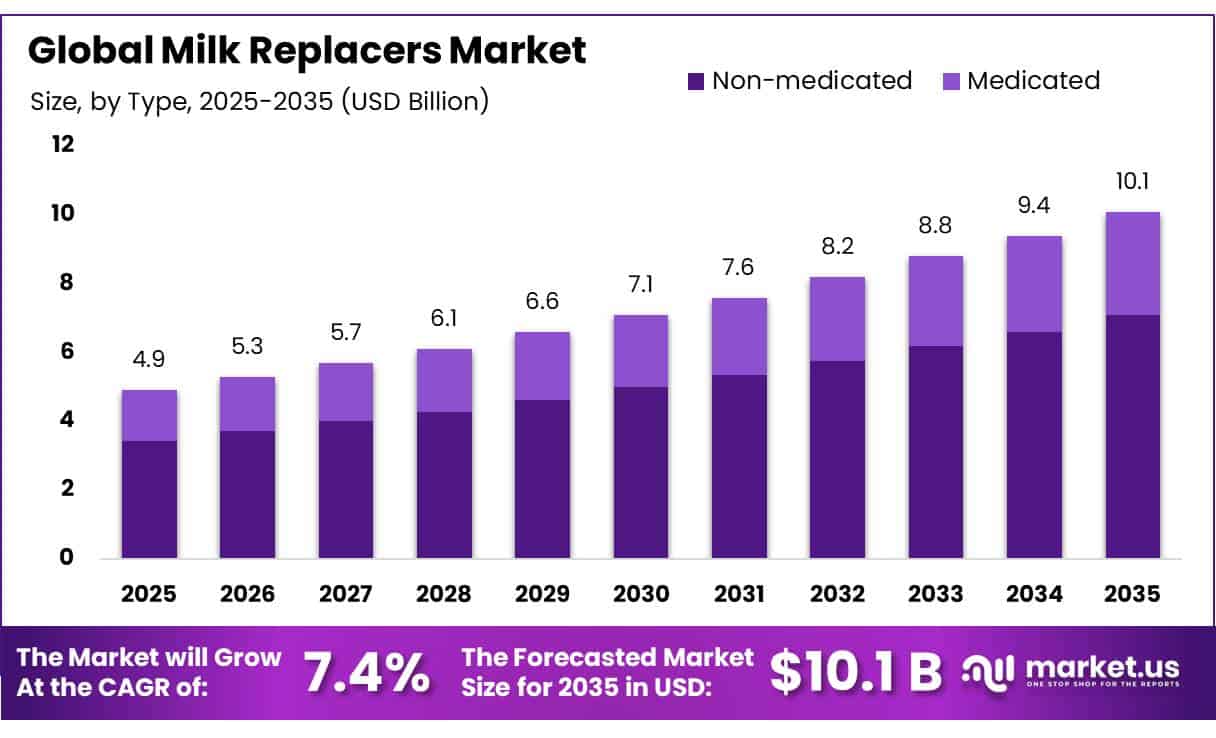
The Global Milk Replacers Market size is expected to be worth around USD 10.1 Billion by 2035, from USD 4.9 Billion in 2025, growing at a CAGR of 7.4% during the forecast period from 2026 to 2035. In 2025, North America held a dominant market position, capturing more than a 40.00% share, holding USD 0.4 Billion revenue.
Milk replacers are becoming an important part of modern livestock nutrition because they give young animals a controlled supply of protein, fat, vitamins and minerals when whole milk is unavailable, costly or operationally inefficient.
- FAO reported global milk production of 985 million tonnes in 2024, with cattle milk contributing 797 million tonnes, or 81% of the total. This large dairy base supports the supply of whey, skim-milk powder, fats and other ingredients commonly used in calf milk replacers.
Key Takeaways
- Milk Replacers Market size is expected to be worth around USD 10.1 Billion by 2035, from USD 4.9 Billion in 2025, growing at a CAGR of 7.4%.
- Non-medicated held a dominant market position, capturing more than a 70.00% share.
- Ruminants held a dominant market position, capturing more than a 79.00% share.
- Milk-based held a dominant market position, capturing more than a 65.00% share.
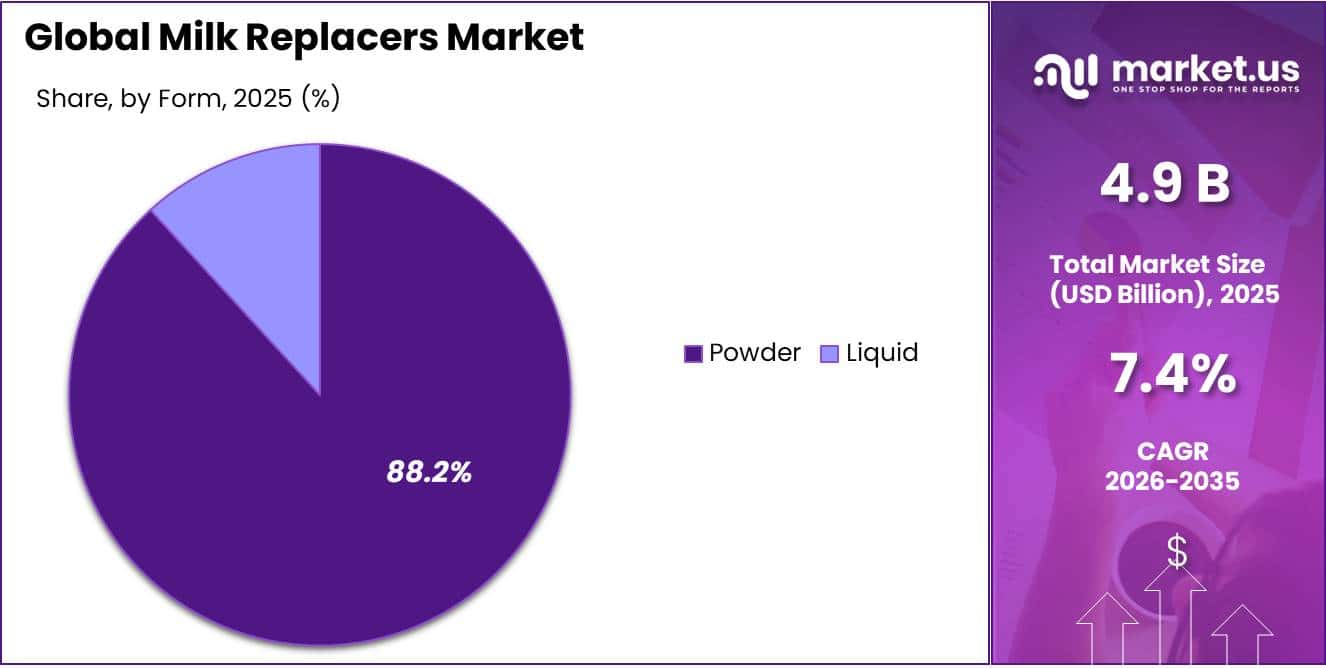
- Powder held a dominant market position, capturing more than a 88.00% share.
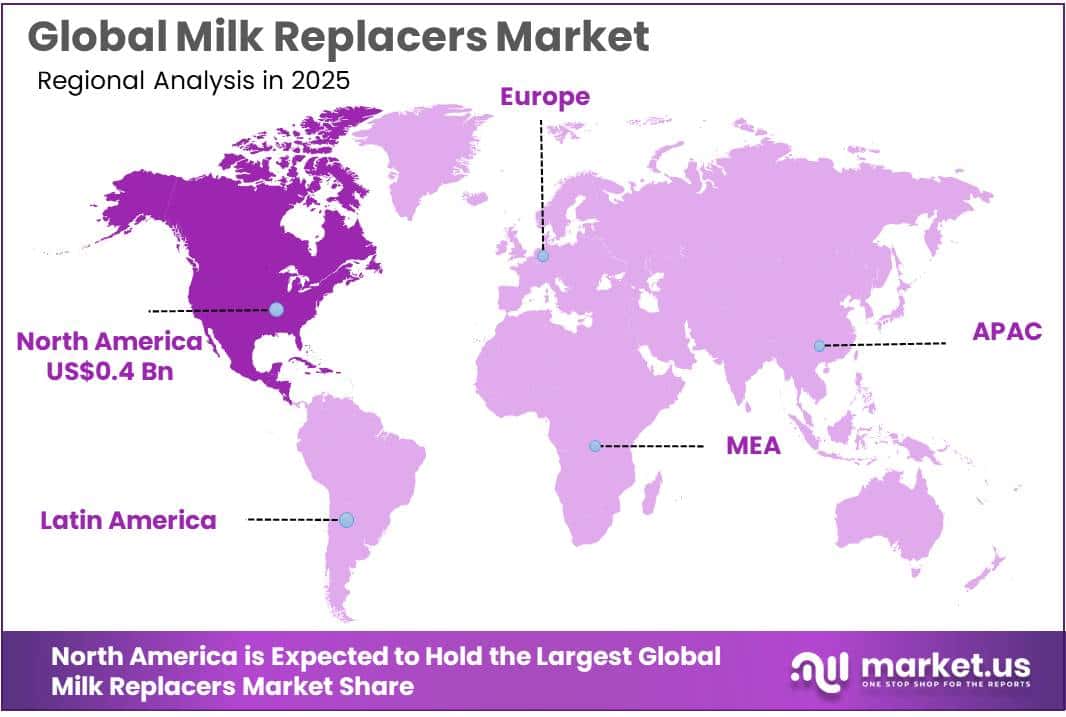
- North America held a dominant position in the Milk Replacers Market, capturing more than a 40.00% share and reaching approximately USD 0.40 billion.
The industrial scenario is particularly strong in developed dairy systems. USDA reported 86.2 million cattle and calves on U.S. farms as of January 1, 2026, including 9.57 million milk cows, while the 2025 calf crop reached 32.9 million head. USDA NASS Cattle Inventory USDA’s Economic Research Service also reported that U.S. milk output now exceeds 231 billion pounds annually. USDA ERS Dairy Production Data These figures indicate a large recurring population of newborn and replacement calves requiring structured early-life feeding.
- Eurostat counted 71.6 million bovine animals in the EU in 2025, despite a 0.4% year-on-year decline. Eurostat EU Livestock Statistics In 2024, EU farms produced 161.8 million tonnes of raw milk, of which 150.8 million tonnes were delivered to dairies and 11.0 million tonnes remained on farms for uses including direct consumption, processing and animal feed. Eurostat European Food Chain Statistics This encourages producers to compare whole-milk feeding with standardized replacers on cost, hygiene and nutrient consistency.
Feed economics remain a major driving factor. ADM states that feed can represent 60–70% of total dairy production expenses, making nutrient efficiency important for profitability. ADM Dairy Nutrition Development In FY2025, ADM’s Animal Nutrition operating profit increased 66% to USD 98 million, while its Nutrition segment generated USD 417 million in operating profit. ADM Full-Year 2025 Results The figures reflect continued industry attention toward higher-value animal nutrition products and efficiency-led feeding solutions.
Calf-performance targets are also supporting more precise feeding programs. Teagasc recommends around 6 litres of milk replacer per calf per day at a 12.5% concentration, equal to about 0.75 kg of milk solids daily, to support a pre-weaning growth target of roughly 0.7 kg per day. Teagasc Calf-Rearing Guidance Such feeding standards create opportunities for premium replacers with improved digestibility, optimized protein-to-fat ratios, probiotics and formulations compatible with automatic feeding systems.
Future growth is expected from precision nutrition, automated calf feeders, medicated and non-medicated specialty formulas, improved gut-health products and better ingredient consistency. The EU’s Common Agricultural Policy for 2023–2027 provides EUR 307 billion in total public expenditure, including EUR 264 billion from EU funds and EUR 43 billion from national funding, across about 2,500 planned interventions.
By Type Analysis
Non-medicated Milk Replacers dominate with more than 70.00% share, supported by routine calf feeding and fewer medication controls
In 2025, “Non-medicated” held a dominant market position, capturing more than a 70.00% share. Non-medicated milk replacers remain the standard choice for routine calf nutrition because they provide protein, fat, vitamins and minerals without adding therapeutic drugs to everyday feeding programs. The large commercial calf population supports regular consumption of these products.
- In July 2026, the USDA reported 94.2 million cattle and calves on U.S. farms, including 9.65 million milk cows, while the U.S. calf crop was estimated at 32.5 million head. These numbers show the broad feeding base available for conventional milk replacers. The regulatory environment also favors clear separation between routine nutrition and therapeutic feeding.
Medicated milk replacers continue to serve a specialized role where young calves require nutritional support together with approved disease-control treatment. According to the U.S. FDA, medicated calf milk replacers can contain approved drugs such as chlortetracycline, decoquinate, lasalocid, neomycin sulfate and oxytetracycline. FDA-approved levels include approximately 400 g/ton for chlortetracycline, 12.9–90.8 g/ton for decoquinate and 400–2,000 g/ton for neomycin sulfate, depending on the approved treatment and feeding conditions.
A 2026 FDA-approved lasalocid calf milk-replacer label specifies a dosage of 1 mg per 2.2 lb of body weight per day for controlling coccidiosis caused by Eimeria bovis and Eimeria zuernii. However, tighter veterinary supervision limits routine use.
By Livestock Analysis
Ruminants dominate the Milk Replacers Market with more than 79.00% share, supported by the large commercial cattle and calf population
In 2025, “Ruminants” held a dominant market position, capturing more than a 79.00% share. The segment maintains a strong position because milk replacers are widely used in calf-rearing programs to provide consistent nutrition when whole milk feeding is limited or less economical. The size of the ruminant population provides a broad consumption base.
- According to USDA data released in July 2026, the United States had 94.2 million cattle and calves, including 9.65 million milk cows, while the 2026 calf crop was estimated at 32.5 million head. In Europe, Eurostat reported that the EU had 71.6 million bovine animals, 55.3 million sheep, and 10.2 million goats in 2025. These large livestock populations support continuous demand for calf, lamb, and kid milk replacers, particularly across organized dairy and commercial livestock farms.
Swine milk replacers represent a specialized livestock segment, mainly used for orphaned piglets, large litters, weak piglets, and situations where sow milk supply does not fully meet nutritional requirements. Demand is supported by the scale and productivity of commercial pig production.
According to USDA data released in June 2026, U.S. farms held 73.7 million hogs and pigs, including 5.88 million breeding animals. Between March and May 2026, producers weaned 33.5 million pigs, while the average number of pigs weaned reached 11.87 per litter. Europe also represents a substantial production base, with Eurostat reporting 131.5 million pigs across the EU in 2025.
By Source Analysis
Milk-based milk replacers dominate with more than 65.00% share, supported by established dairy ingredient availability
In 2025, “Milk-based” held a dominant market position, capturing more than a 65.00% share. Milk-based products remain widely preferred because ingredients such as skim milk powder, whey, lactose and whey protein provide highly digestible nutrition suited to young calves and other livestock. The established dairy-processing industry also gives manufacturers a reliable ingredient base.
- According to the USDA’s Dairy Products 2025 Summary, U.S. production reached 1.66 billion pounds of nonfat dry milk, 504 million pounds of skim milk powder, 845 million pounds of dry whey, and 502 million pounds of whey protein concentrate in 2025. Lactose production for human and animal applications also reached 1.14 billion pounds, increasing 2.6% from the previous year.
Non-milk-based milk replacers serve as an alternative where producers seek lower dependence on dairy ingredients or require formulations using vegetable proteins and oils. Soy protein is particularly important because it offers a large and established feed ingredient base for specialized livestock nutrition.
USDA data published in August 2026 forecast U.S. soybean production at 4.52 billion bushels for the 2026/27 marketing year, while soybean crush was projected at 2.78 billion bushels. The same USDA outlook placed global soybean crush at 384.8 million metric tons, showing the large processing base available for soybean meal, protein ingredients and vegetable oils. USDA also estimated that U.S. farmers planted 85.4 million acres of soybeans in 2026, up 5% from the previous year.
By Form Analysis
Powder dominates the Milk Replacers Market with more than 88.00% share, supported by easy storage, transport, and consistent mixing
In 2025, “Powder” held a dominant market position, capturing more than a 88.00% share. Powder milk replacers remain the preferred form because they are easier to store, transport, measure, and prepare according to the nutritional needs of young animals.
- Their position is also supported by the large dairy-powder processing base. USDA reported in April 2026 that U.S. production during 2025 reached 1.66 billion pounds of nonfat dry milk, 504 million pounds of skim milk powder, and 845 million pounds of dry whey. Whey protein concentrate production also reached 502 million pounds, while lactose production for human and animal applications stood at 1.14 billion pounds.
Liquid milk replacers serve farms that value ready-to-feed nutrition, consistent preparation, and simplified feeding of young calves. Their use is particularly relevant in organized calf-rearing operations where controlled liquid feeding is maintained during the pre-weaning period.
In 2026, Ireland’s public Agriculture and Food Development Authority, Teagasc, recommended feeding calves about 6 litres of milk replacer per day at a 12.5% concentration, equal to approximately 0.75 kg of milk solids daily, during the early rearing period. Teagasc also reported a 2026 demonstration farm where 444 calves were fed 3 litres per head twice daily during the first stage of rearing before moving to once-a-day feeding.
Key Market Segments
By Type
- Medicated
- Non-medicated
By Livestock
- Ruminants
- Swine
- Equine
- Pets
- Other livestock
By Source
- Milk-based
- Non-milk-based
- Blended
By Form
- Powder
- Liquid
Driver Analysis
Whey Protein Supply Squeeze Redirecting Ingredient Economics
US whey protein inventories have contracted by an estimated 50% since 2023, with whey protein isolate spot prices climbing as high as $14 per pound in mid-2026 as human-nutrition and sports-supplement demand competes directly with animal-feed applications for the same dairy-processing byproduct stream, according to USDA market reporting from June 2026 describing conditions where “product [is] largely unavailable”.
This scarcity is compounding a multi-year price base: CME spot dry whey, which traded near $0.36-0.48 per pound in 2024, has continued firming into 2026, with the US Whey Protein Price Index rising quarter-over-quarter in Q1 2026 on tightening domestic inventories and elevated production expenses, even as Germany’s index eased slightly on stabilized raw milk costs creating a regional arbitrage dynamic that reshapes sourcing strategy for milk replacer formulators.
Structurally, this input volatility is forcing manufacturers to reformulate away from 100% whey-protein-concentrate bases toward blended formulations incorporating skim milk powder, hydrolyzed soy protein, and plasma protein fractions, a shift that changes the underlying bill-of-materials cost curve and pushes premium all-milk-protein products into a higher price tier reserved for early-life calf nutrition where digestibility cannot be compromised.
Drivers Impact Analysis
| Driver | (~) % Impact on CAGR Forecast | Geographic Relevance | Impact Timeline |
|---|---|---|---|
| Whey protein supply squeeze redirecting ingredient economics | +1.4% | North America core, EU dairy-ingredient hubs | Short term (≤2 years) |
| EU/US antibiotic-reduction mandates accelerating non-medicated replacer adoption | +1.2% | EU regulatory core, North America spill-over | Medium term (2-4 years) |
| Precision calf-feeding automation reshaping farm purchasing | +1.1% | North America core, EU advanced-dairy regions | Medium term (2-4 years) |
| Dairy herd consolidation into large-scale commercial operations | +0.9% | North America core, EU, APAC emerging dairy belts | Long term (≥4 years) |
| Rising dairy demand and herd expansion in APAC emerging economies | +1.3% | APAC (India, China, Southeast Asia), South America spill-over | Long term (≥4 years) |
| Veal and specialty-calf nutrition premiumization | +0.6% | EU core, North America niche segments | Medium term (2-4 years) |
Restraint Analysis
H5N1 Dairy-Herd Disease Burden Disrupting Raw-Milk Supply Base
Since the first confirmed US dairy-cattle H5N1 detection on March 25, 2024, the virus has spread across at least 14 states including Texas, Idaho, Michigan, and Iowa, with infected lactating cows experiencing atypical mammary-tropic infection causing necrotizing mastitis rather than respiratory illness, a mechanism only scientifically explained in a June 2026 Science Advances study identifying N-linked sialic acid receptor concentration in udder tissue as the root biological cause; clinically affected herds have shown milk-production losses of 10-20% per cow over 7-10 days in mild cases, but a documented Ohio outbreak of roughly 3,900 cows recorded sustained production drops lasting 60 days with average losses of 900 kg of milk per clinically affected cow
Translating to an estimated $950 economic loss per animal and a total herd-level cost of $737,500 for that single outbreak, with industry-wide per-cow cost estimates from the American Association of Bovine Practitioners ranging $100-200 per infected animal; because milk replacer formulators depend on stable dairy-byproduct streams sourced from the same processing infrastructure feeding fluid-milk and cheese production, herd-level output volatility of this magnitude periodically tightens byproduct availability and raises procurement costs during outbreak windows, forcing formulators to hold larger raw-material safety-stock buffers and accept intermittent short-term price spikes that compress gross margin until outbreak containment and eventual vaccine development stabilize herd health outcomes.
Restraint Impact Analysis
| Restraint | (~) % Impact on CAGR Forecast | Geographic Relevance | Impact Timeline |
|---|---|---|---|
| H5N1 dairy-herd disease burden disrupting raw-milk supply base | -1.2% | North America core (US dairy states) | Short term (≤2 years) |
| US-Canada dairy tariff escalation raising cross-border input costs | -0.9% | North America core (US-Canada corridor) | Short term (≤2 years) |
| Whey and skim milk powder price inflation squeezing formulation cost | -1.3% | North America core, EU, APAC importers | Short term (≤2 years) |
| Calf welfare and early-weaning regulatory tightening | -0.6% | EU regulatory core, UK | Medium term (2-4 years) |
| Raw milk feeding substitution reducing replacer conversion | -0.5% | North America core, EU smallholder segments | Long term (≥4 years) |
Opportunity Analysis
Precision-Fermentation Dairy Protein as an Alternative Input Platform
Precision-fermentation-derived casein and whey-equivalent proteins represent an emergent, currently uncaptured supply-side opportunity rather than a present driver, since the segment remains a nascent $700-925 million market in 2025-2026 against a broader dairy protein ingredient base exceeding $14.5 billion meaning current commercial volumes are still too small to influence baseline milk replacer formulation economics, but the technology trajectory is accelerating rapidly, with Standing Ovation and Bel Group validating the first industrial-scale production of precision-fermented casein from cheesemaking whey in October 2025 and Standing Ovation subsequently raising $34.2 million in Series B funding in April 2026 to scale commercialization
The strategic white space for milk replacer manufacturers lies in securing early offtake or co-development agreements with fermentation-protein producers now, before the segment’s projected 20-38% CAGR trajectory through the early 2030s pushes unit costs low enough to become mainstream, since a formulator that locks in fermentation-protein supply ahead of competitors could insulate itself from the whey-market volatility currently compressing category margins, effectively converting an R&D bet today into a structural cost-and-supply-security advantage of an estimated 10-15% versus whey-dependent competitors once fermentation capacity scales beyond pilot batch sizes into continuous bioreactor production exceeding 100,000-liter volumes.
Opportunity Impact Analysis
| Opportunity | (~) % Potential CAGR Upside | Geographic Relevance | Execution Window |
|---|---|---|---|
| Precision-fermentation dairy protein as an alternative input platform | +1.3% | North America core, EU, India (emerging biotech hubs) | Long term (≥4 years) |
| Pet milk replacer vertical expansion beyond livestock | +1.0% | North America core, APAC (India, China) | Medium term (2-4 years) |
| Insect-protein feed substitution monetization | +0.7% | EU core, North America (post-FDA approval) | Medium term (2-4 years) |
| Direct-to-farm digital commerce and subscription replenishment | +0.8% | North America core, EU | Short term (≤2 years) |
| Whey-permeate valorization circular-economy partnerships | +0.6% | EU core, North America | Medium term (2-4 years) |
| Colostrum-replacer and neonatal-immunity premium tier | +0.5% | North America core, EU, APAC emerging dairy operations | Long term (≥4 years) |
Challenges Analysis
Dairy Labor Scarcity
A chronic shortage of trained dairy labor creates an indirect but persistent adoption and performance challenge for milk replacer suppliers because correct feeding requires repeatable powder weighing, hygiene, water-temperature control, feeder cleaning, disease observation, and weaning management every day of the year; dairy farms facing labor shortages are estimated to be 30% more likely to reduce milk production, 21% more likely to raise wages, and 6% more likely to adopt labor-saving technologies, while immigrants account for more than one-half of the US dairy workforce and year-round dairies cannot use the seasonal H-2A program, creating a structural staffing mismatch rather than a short-term hiring issue.
For milk replacer manufacturers, the commercial consequence is that a technically sound formula may still underperform if farms use inexperienced or high-turnover labor, increasing scours, inconsistent nutrient intake, and customer churn; a 10-15 minute daily increase in preparation, washing, and recordkeeping per 50-calf group can translate into 60-90 additional labor hours annually per feeding unit, making ease of mixing, simplified dosage instructions, pre-measured sachets, closed-loop automated feeders, and multilingual digital training essential retention tools.
The strategic response requires suppliers to shift from selling powder alone to delivering labor-offset systems—automated feeding compatibility, standard operating procedures, QR-linked training, remote troubleshooting, and dealer-led calf-health support—because the farm-level labor deficit is likely to remain unresolved beyond 2030.
Challenges Impact Analysis
| Challenge | (~) % CAGR Friction Drag | Geographic Relevance | Mitigation Horizon |
|---|---|---|---|
| Dairy labor scarcity | -0.9% | North America core, EU dairy hubs | Long term (≥4 years) |
| Mixing consistency failures | -0.8% | North America, EU, APAC farms | Medium term (2-4 years) |
| Freight-route volatility | -0.7% | EU–APAC, Middle East, Africa | Medium term (2-4 years) |
| Ingredient quality variance | -0.8% | North America, EU, APAC importers | Medium term (2-4 years) |
| Herd-health volatility | -0.7% | North America core, EU, APAC | Long term (≥4 years) |
| Emerging-market service gaps | -0.6% | India, China, Southeast Asia, LATAM | Long term (≥4 years) |
Geopolitical Impact Analysis
Ongoing Wars Raise Feed, Energy and Supply-Chain Risks for Milk Replacers
The ongoing Russia–Ukraine war and conflict-related disruption around the Strait of Hormuz are keeping cost and supply risks elevated across the Milk Replacers market. Milk-replacer producers depend on dairy powders, whey proteins, vegetable oils, grains, energy and freight, making geopolitical shocks important for manufacturing and farm-level purchasing.
- The European Commission reported that, in July 2026, about 80% of Ukrainian grain, oilseed and related-product exports moved through Black Sea ports, while 20% used EU–Ukraine Solidarity Lanes. Around 2.4 million tonnes moved through Ukraine’s Black Sea corridor during that month. Continued military risk around export routes can therefore influence feed ingredient availability and freight premiums.
Cost pressure is also visible in commodity markets. FAO reported that its Cereal Price Index increased 3.4% month-on-month in July 2026 and stood 6.9% above July 2025. Meanwhile, the European Commission said Middle East conflict and energy uncertainty were raising agricultural input costs in 2026, with EU inflation forecast at 3.1%.
Regional Insights
North America Leads the Milk Replacers Market with 40.00% Share
In 2025, North America held a dominant position in the Milk Replacers Market, capturing more than a 40.00% share and reaching approximately USD 0.40 billion. The region benefits from a well-developed dairy industry, large calf population, advanced livestock management, and widespread use of formulated nutrition.
- In July 2026, the USDA reported 94.2 million cattle and calves on U.S. farms, including 9.65 million milk cows, while the calf crop was estimated at 32.5 million head. These large numbers create steady requirements for milk replacers in calf-rearing and weaning programs.
Asia Pacific is expected to emerge as the fastest-growing regional market as commercial dairy farming, livestock productivity, and structured young-animal feeding continue to expand. OECD-FAO projects Asia Pacific to contribute 54% of additional global agricultural output through 2034, while livestock production globally is projected to increase by 16% during the outlook period.
China provides a major dairy base, with USDA projecting cow-milk production at 40.6 million metric tons in 2026 from around 6.32 million cows in milk. OECD-FAO further expects global milk production to grow by 1.8% annually and reach 1,146 million tonnes by 2034. Increasing farm modernization, greater attention to calf survival, and wider adoption of whey-based nutrition and automated feeding systems should create stronger opportunities for standardized milk replacers across commercial livestock operations in the region.
Key Regions and Countries Insights
- North America
- US
- Canada
- Europe
- Germany
- France
- The UK
- Spain
- Italy
- Rest of Europe
- Asia Pacific
- China
- Japan
- South Korea
- India
- Australia
- Rest of APAC
- Latin America
- Brazil
- Mexico
- Rest of Latin America
- Middle East & Africa
- GCC
- South Africa
- Rest of MEA
Key Players Analysis
Land O’Lakes maintains a strong position in milk replacers through Land O’Lakes Animal Milk Solutions and Purina Animal Nutrition. The company feeds around 100 million animals every day and manages nearly 13 billion pounds of milk annually. Its Herd Maker calf milk replacer provides 20% protein and 20% fat, while Cow’s Match ColdFront offers 26% protein and 20% fat for cold-weather feeding.
Trouw Nutrition strengthens its milk replacer business through its Sprayfo calf nutrition range and LifeStart feeding program. Nutreco employs more than 11,000 people across over 40 countries, while Sprayfo products are used by farmers in more than 50 countries. In a LifeStart study involving 86 calves, animals receiving 8 litres of milk replacer daily achieved 150 grams higher daily weight gain than calves receiving 4 litres, with later production improving by around 400 kg of fat-corrected milk.
Cargill participates in the milk replacer market through HerdFirst milk replacers, calf feeds, additives, and specialized dairy nutrition programs. Its animal nutrition business employs around 20,000 people across 280 locations in 40 countries and produces nearly 18 million metric tons of feed annually. Cargill’s calf and heifer program covers 7 rearing phases and targets first calving at around 24 months, compared with the typical 27–28 months.
Top Key Players Outlook
- Land O’Lakes, Inc.
- Trouw Nutrition (Nutreco N.V.)
- Cargill, Incorporated
- Archer-Daniels-Midland Company
- Denkavit Nederland B.V.
- Lactalis Ingredients
- Actus Nutrition
- CHS Inc.
- Milk Specialties Global
- Liprovit B.V.
- Calva Products, LLC
- PetAg, Inc.
- Glanbia plc
- ForFarmers N.V.
- Royal FrieslandCampina N.V.
Recent Developments
- In February 2026, ADM reported FY2025 Animal Nutrition operating profit of USD 98 million, up 66%, while total Nutrition operating profit reached USD 417 million.
- In August 2026, Lactalis Ingredients further expanded its animal-nutrition engagement by confirming participation in the 40th SPACE exhibition, which brings together more than 1,200 exhibitors, across 11 halls and 16 hectares, where the company planned to present its full dairy-ingredient and nutritional-solutions range.
Report Scope
| Report Features | Description |
|---|---|
| Market Value (2025) | USD 4.9 Bn |
| Forecast Revenue (2035) | USD 10.1 Bn |
| CAGR (2026-2035) | 7.4% |
| Base Year for Estimation | 2025 |
| Historic Period | 2020-2024 |
| Forecast Period | 2026-2035 |
| Report Coverage | Revenue Forecast, Market Dynamics, Competitive Landscape, Recent Developments |
| Segments Covered | By Type (Medicated, Non-medicated), By Livestock (Ruminants, Swine, Equine, Pets, Other livestock), By Source ( Milk-based, Non-milk-based, Blended), By Form (Powder, Liquid) |
| Regional Analysis | North America – US, Canada; Europe – Germany, France, The UK, Spain, Italy, Rest of Europe; Asia Pacific – China, Japan, South Korea, India, Australia, Singapore, Rest of APAC; Latin America – Brazil, Mexico, Rest of Latin America; Middle East & Africa – GCC, South Africa, Rest of MEA |
| Competitive Landscape | Land O’Lakes, Inc., Trouw Nutrition (Nutreco N.V.), Cargill, Incorporated, Archer-Daniels-Midland Company, Denkavit Nederland B.V., Lactalis Ingredients, Actus Nutrition, CHS Inc., Milk Specialties Global, Liprovit B.V., Calva Products, LLC, PetAg, Inc., Glanbia plc, ForFarmers N.V., Royal FrieslandCampina N.V. |
| Customization Scope | Customization for segments, region/country-level will be provided. Moreover, additional customization can be done based on the requirements. |
| Purchase Options | We have three licenses to opt for: Single User License, Multi-User License (Up to 5 Users), Corporate Use License (Unlimited User and Printable PDF) |





































