Report Overview
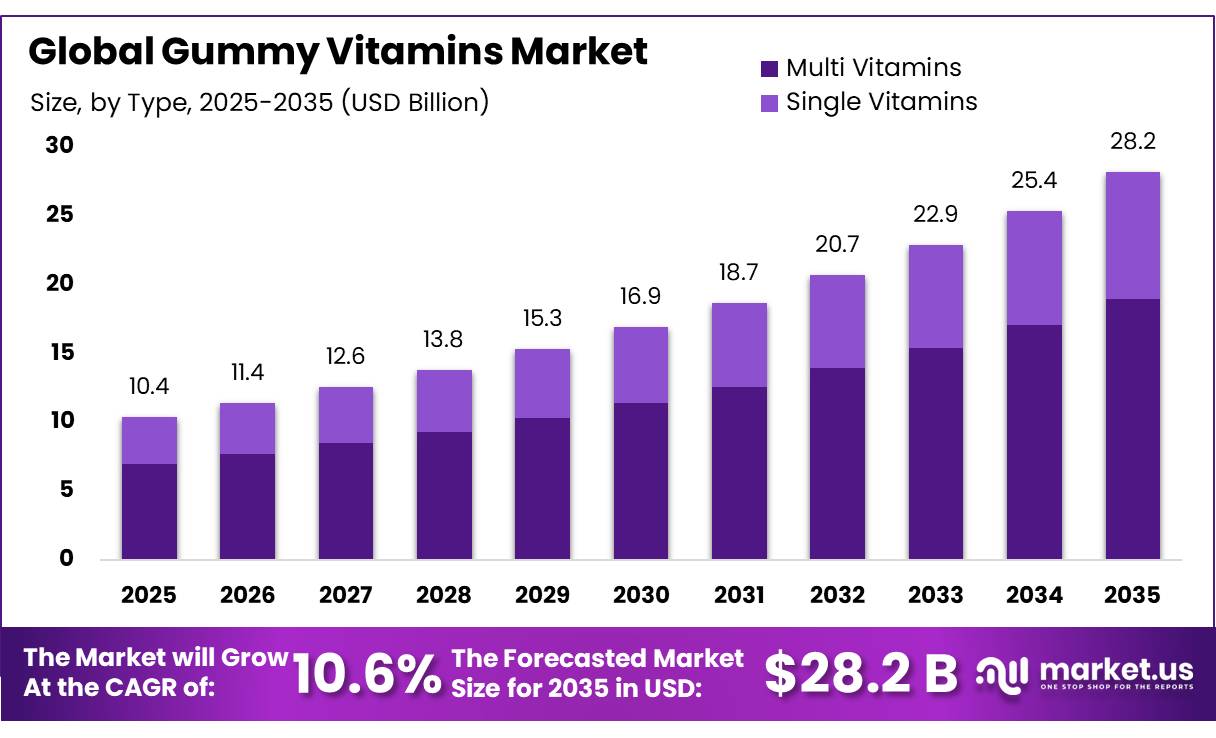
The Global Gummy Vitamins Market size is expected to be worth around USD 28.2 Billion by 2035, from USD 10.4 Billion in 2025, growing at a CAGR of 10.6% during the forecast period from 2026 to 2035. In 2025, Asia-Pacific held a dominant market position, capturing more than a 37.67% share, holding USD 3.9 Billion revenue.
Gummy vitamins have emerged as an innovative segment of the dietary supplement industry, offering an alternative to conventional tablets, capsules, and softgels. These products combine essential vitamins and minerals with appealing flavors, chewable textures, and convenient consumption. According to the U.S. Food and Drug Administration (FDA), dietary supplements are available in several forms, including gummies, powders, liquids, and capsules.
- The industrial scenario of gummy vitamins is shaped by developments in food chemistry, pharmaceutical formulation, confectionery processing, and nutritional ingredient manufacturing. Producers increasingly use gelatin, pectin, starch, sweeteners, flavoring agents, and stabilizers to develop gummies with consistent texture and product quality. Gelatin (CAS No. 9000-70-8) is recognized by the FDA for technical functions such as stabilizing, thickening, and texturizing food products.
Product innovation is another important industry driver. Manufacturers are investing in sugar-free, vegan, plant-based, allergen-conscious, and naturally flavored formulations. A technical industry publication by Bartek Chemicals reported that new vitamin, mineral, and supplement gummy launches containing pectin increased approximately 3 times between 2016 and 2020. In 2020, pectin accounted for 60% of newly launched vitamin, mineral, and supplement gummies tracked in the publication, highlighting the movement toward alternative gelling systems.
Regulatory compliance and product quality remain central to industrial operations. Under the FDA’s 21 CFR Part 111, dietary supplement manufacturers must follow current Good Manufacturing Practices (CGMP) covering production, packaging, labeling, quality control, and documentation. These requirements create opportunities for ingredient testing laboratories, contract manufacturers, quality assurance providers, and specialized formulation companies.
Future growth opportunities are expected to arise from advanced formulation technologies, personalized nutrition, clean-label ingredients, and expansion into specialized nutritional categories. Manufacturers can strengthen their competitive position through improved shelf-life management, stability testing, precise nutrient dosing, and automated production systems. The FDA’s September 2026 scientific perspective on gummy dietary supplements also highlighted formulation, manufacturing, and analytical testing challenges, emphasizing the importance of product consistency, safety, and stability.
Key Takeaways
- Gummy Vitamins Market size is expected to be worth around USD 28.2 Billion by 2035, from USD 10.4 Billion in 2025, growing at a CAGR of 10.6%.
- Multi Vitamins held a dominant market position, capturing more than a 67.34% share of the Gummy Vitamins Market.
- Plants held a dominant market position, capturing more than a 72.34% share of the Gummy Vitamins Market.
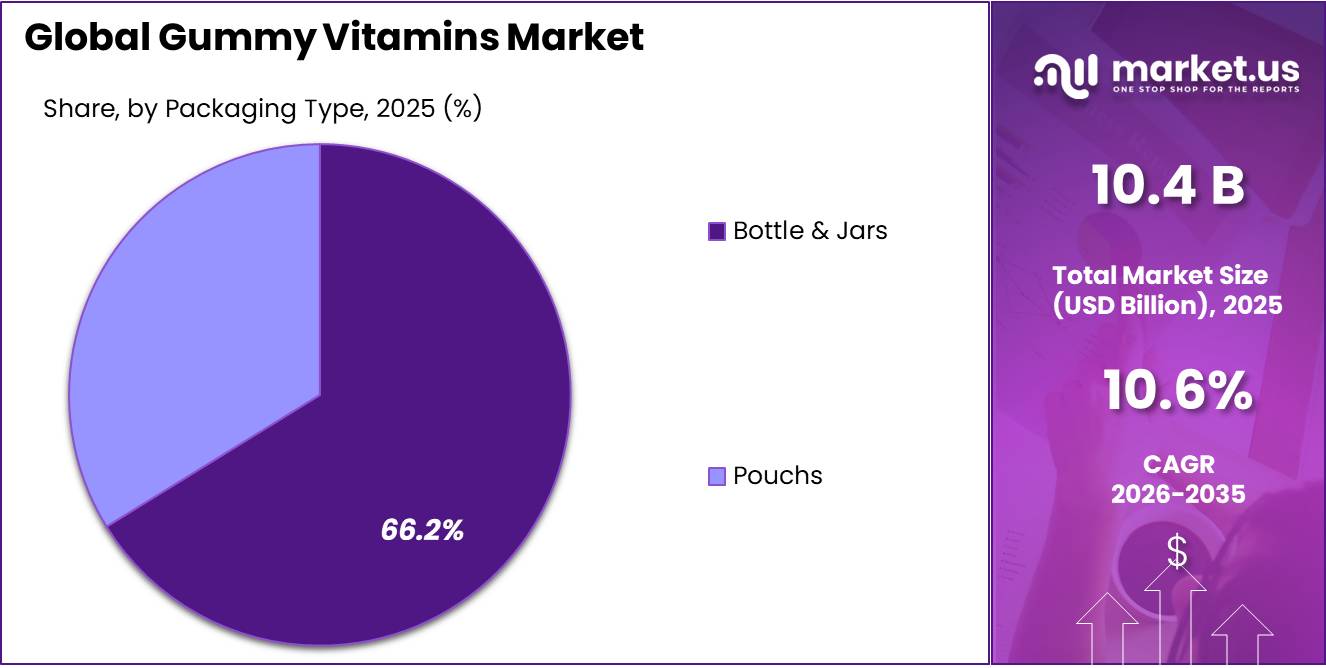
- Bottle & Jars held a dominant market position, capturing more than a 66.23% share of the Gummy Vitamins Market.
- Supermarkets/Hypermarkets held a dominant market position, capturing more than a 38.78% share.
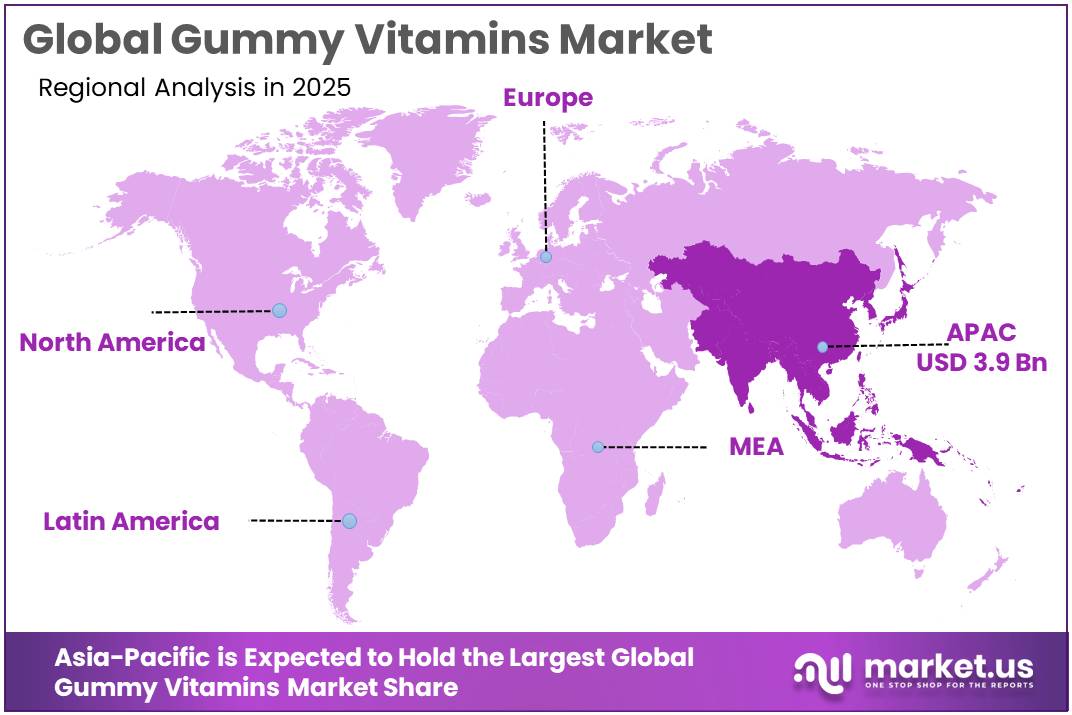
- Asia-Pacific dominated the Gummy Vitamins Market, accounting for a 37.67% share and reaching USD 3.9 billion.
By Type Analysis
Multivitamins dominate with a 67.34% share due to their broad nutritional benefits and everyday wellness applications.
In 2025, “Multi Vitamins” held a dominant market position, capturing more than a 67.34% share of the Gummy Vitamins Market. This dominance is supported by growing consumer preference for convenient nutritional supplements that combine multiple essential vitamins in a single formulation. Multivitamin gummies offer an appealing consumption format and support daily nutritional requirements, making them suitable for adults and children. Their availability in different flavors and formulations further strengthens their acceptance.
Single Vitamins represent an important segment of the Gummy Vitamins Market, driven by consumer demand for targeted nutritional supplementation. In 2025, single-vitamin gummies attracted attention among consumers seeking specific nutrients, including vitamin C, vitamin D, vitamin B12, and vitamin E, based on their individual nutritional requirements. These formulations provide a convenient option for consumers who prefer supplementing particular vitamins instead of consuming a combined multivitamin product. Growing interest in personalized nutrition, specialized wellness routines, and easy-to-consume supplement formats is supporting product development in this segment.
By Source Analysis
Plant-based gummy vitamins dominate with a 72.34% share, driven by consumer preference for natural and vegetarian nutritional ingredients.
In 2025, “Plants” held a dominant market position, capturing more than a 72.34% share of the Gummy Vitamins Market. This dominance reflects increasing consumer preference for plant-derived ingredients and vegetarian-friendly nutritional supplements. Plant-based gummy vitamins are commonly formulated using pectin, fruit extracts, and plant-derived colors and flavors, making them attractive to consumers seeking alternatives to animal-based ingredients. Growing interest in clean-label products, vegan lifestyles, and naturally sourced nutritional supplements is encouraging manufacturers to expand their plant-based product portfolios.
Animals represent an alternative source in the Gummy Vitamins Market, particularly through the use of gelatin derived from animal collagen. Animal-based ingredients are widely used in gummy formulations because of their gelling properties, chewable texture, and ability to maintain product structure. Gelatin-based gummy vitamins offer manufacturers established processing methods and formulation flexibility. The segment continues to serve consumers who prioritize traditional gummy texture and consistency.
By Packaging Type Analysis
Bottles & Jars dominate with a 66.23% share due to convenient storage, product protection, and easy everyday use.
In 2025, “Bottle & Jars” held a dominant market position, capturing more than a 66.23% share of the Gummy Vitamins Market. This dominance is supported by their practical design, ease of handling, and suitability for storing gummy supplements. Bottles and jars help protect gummies from moisture and external contamination while offering convenient access for regular consumption. Their availability in different sizes and materials also allows manufacturers to serve diverse consumer requirements.
Pouches represent an alternative packaging format in the Gummy Vitamins Market, supported by their lightweight structure, flexibility, and convenient handling. Pouch packaging offers manufacturers opportunities to reduce packaging material usage and develop compact product formats for consumers. Resealable pouches can provide practical storage and portability, making them suitable for travel and daily nutritional routines. Growing interest in innovative packaging designs and flexible packaging solutions is encouraging manufacturers to explore pouches for different gummy vitamin formulations.
By Distribution Channel Analysis
Supermarkets/Hypermarkets dominate with a 38.78% share due to broad product availability, convenient shopping, and strong consumer reach.
In 2025, “Supermarkets/Hypermarkets” held a dominant market position, capturing more than a 38.78% share of the Gummy Vitamins Market. Their leading position is supported by extensive product selection, convenient purchasing experiences, and easy access to different nutritional supplement brands. Consumers can compare flavors, ingredients, formulations, and prices while purchasing other household essentials. The availability of dedicated health and wellness sections further improves product visibility.
Convenience Stores represent an accessible distribution channel for gummy vitamins, supported by their convenient locations and quick purchasing experience. These stores serve consumers looking for nutritional supplements during routine shopping and on-the-go purchases. Their smaller retail format and easy accessibility make them suitable for offering selected popular gummy vitamin products, including multivitamins and targeted nutritional formulations.
Key Market Segments
By Type
- Single Vitamins
- Multi Vitamins
By Source
- Plants
- Animals
By Packaging Type
- Bottle & Jars
- Pouchs
By Distribution Channel
- Supermarkets/Hypermarkets
- Convenience Stores
- Pharmacy Stores
- Online Retail
Driver Analysis
Adult Chewable-Format Adoption
Vitafusion’s current portfolio includes adult multivitamins and vitamin-containing products such as vitamin C and calcium-plus-D3 gummies, while Nature Made identifies gummies as a delivery format for vitamins and other nutrients; neither source establishes superior clinical effectiveness or higher adherence versus conventional tablets.
Historical CDC data provide context for the underlying supplement customer pool: 57.6% of US adults reported supplement use in 2017–2018, rising to 74.3% among those aged sixty and older, but these figures are neither 2026 estimates nor gummy-specific penetration rates.
In a constructed brand cohort with 200,000 existing tablet customers, converting 8% to gummies produces 16,000 gummy buyers; at six bottles annually and USD 10 net brand revenue per bottle, gummy revenue reaches USD 960,000. For the gummy market this is format migration, while for the wider supplement market it is largely substitution rather than new demand.
Acquiring another 10,000 previously nonparticipating customers adds USD 600,000 under the same purchasing assumptions. The +0.9-point sensitivity assumes 35% terminal exposure and approximately 12.7% cumulative outperformance, producing 4.4% terminal market upside.
Drivers Impact Analysis
| Driver | (~) % Impact on CAGR Forecast | Geographic Relevance | Impact Timeline |
|---|---|---|---|
| Adult chewable-format adoption | +0.9 pp | US, Canada, UK, Australia | Short term (≤ 2 years) |
| Sugar-free portfolio expansion | +0.7 pp | US, Canada, EU, Australia | Short term (≤ 2 years) |
| Targeted vitamin formulations | +0.7 pp | US, EU, Japan, South Korea | Medium term (2–4 years) |
| Digital replenishment expansion | +0.6 pp | US, UK, China, India | Short term (≤ 2 years) |
| Plant-based formulation access | +0.5 pp | EU, UK, India, Gulf states | Medium term (2–4 years) |
| Localized distribution expansion | +0.6 pp | India, ASEAN, Brazil, Gulf states | Medium term (2–4 years) |
Restraint Analysis
Tablet Price Competition
Gummy vitamins compete with tablets and capsules for the same supplementation budget, making cost per labeled daily serving a direct constraint on format adoption and repeat purchasing. Nature Made’s portfolio includes multivitamins in tablets, softgels and gummies, establishing that consumers can choose alternative delivery formats within the same brand rather than abandon supplementation altogether.
In a constructed comparison, a ninety-gummy bottle priced at USD 15 with a two-gummy serving supplies forty-five days at approximately USD 0.33/day, while a ninety-tablet bottle priced at USD 12 with a one-tablet serving supplies ninety days at approximately USD 0.13/day. The gummy option therefore costs 2.5 times as much per day, or approximately USD 122 annually versus USD 49, although nutrient composition must be compared before treating the products as equivalent.
A 20% gummy discount reduces the daily cost to approximately USD 0.27 but still leaves a twofold premium. For a brand selling 500,000 bottles at USD 10 net revenue, matching that discount on 30% of volume reduces annual revenue by USD 300,000 before any volume recovery. The −0.6-point sensitivity assumes 25% terminal exposure and an 11.2% net spending shortfall, producing approximately 2.8% terminal market erosion.
This restraint concerns customers selecting cheaper formats or buying fewer gummies, not generalized inflation alone; manufacturers can respond through pack design and lower-cost formulations, but discounting without sufficient incremental volume compresses revenue and contribution.
Restraint Impact Analysis
| Restraint | (~) % Impact on CAGR Forecast | Geographic Relevance | Impact Timeline |
|---|---|---|---|
| Tablet price competition | −0.6 pp | US, EU, India, Latin America | Short term (≤ 2 years) |
| Nutrient payload limits | −0.5 pp | US, EU, Japan, Australia | Medium term (2–4 years) |
| Sugar-related purchase rejection | −0.4 pp | US, Canada, EU, Australia | Short term (≤ 2 years) |
| Claims and ingredient restrictions | −0.4 pp | US, EU; export-linked brands | Medium term (2–4 years) |
| Dose-safety purchasing limits | −0.4 pp | US, EU, UK, Australia | Medium term (2–4 years) |
| Preventive-benefit evidence limits | −0.3 pp | US, Canada, EU, Australia | Long term (≥ 4 years) |
Opportunity Analysis
Assessment-Linked Pharmacy Programs
Haleon’s 2025 pharmacy presentation reported 85,000 UAE consumers participating in its Centrum vitamin-deficiency testing initiative and described expansion across the Middle East; the disclosure establishes an operating engagement model, but does not identify gummy-specific conversion, test methodology or clinical outcomes.
A future gummy program would need an independently appropriate assessment, a suitable formulation and professional referral where treatment rather than routine supplementation is required. In a constructed 500-pharmacy network, twenty eligible consultations per outlet monthly create 120,000 annual consultations. A 15% incremental gummy conversion produces 18,000 buyers; four bottles per buyer at USD 9 net brand revenue generates USD 648,000 annually.
At USD 4 direct product cost and USD 1 incremental program-support cost per bottle, contribution is USD 288,000 before fixed training, clinical oversight and overhead. If half the buyers merely switch from existing gummies, incremental revenue falls to USD 324,000 before any additional benefit from retention. The +0.5-point sensitivity requires approximately 2.4% additional terminal market revenue.
This is a conditional customer-acquisition model, not a recommendation for universal screening: assessment fees, diagnostic services and prescribed treatment remain outside the gummy market, and the commercial process must not create incentives to overstate deficiency or recommend unnecessary supplementation.
Opportunity Impact Analysis
| Opportunity | (~) % Potential CAGR Upside | Geographic Relevance | Execution Window |
|---|---|---|---|
| Assessment-linked pharmacy programs | +0.5 pp | Gulf states, India, UK, US | Medium term (2–4 years) |
| Protected multi-active formulations | +0.5 pp | US, EU, Japan, South Korea | Medium term (2–4 years) |
| Climate-qualified product platforms | +0.4 pp | India, ASEAN, Brazil, Gulf states | Medium term (2–4 years) |
| Verified retailer-exclusive portfolios | +0.4 pp | US, Canada, UK, EU | Short term (≤ 2 years) |
| Finished-product evidence platforms | +0.4 pp | US, EU, Japan, Australia | Long term (≥ 4 years) |
| Capability-led acquisition platforms | +0.3 pp | US, UK, Germany, India | Short term (≤ 2 years) |
Challenges Analysis
Shelf-Life Potency Variability
Vitamins can lose potency through heat, oxygen, light and interactions within the formulation, making release-day compliance insufficient to demonstrate performance throughout the labeled shelf life.
FDA’s dietary-supplement guidance states that expiration dating is not mandatory under US supplement CGMP rules, but manufacturers should possess supporting data for any date they place on the label. In a constructed product labeled to deliver 50 mg of a vitamin, assumed 15% degradation requires approximately 58.8 mg at release to retain 50 mg at expiry; 25% degradation requires approximately 66.7 mg. Across one million two-gummy servings, the difference adds approximately 7.8 kg of active-equivalent input before processing losses.
At an assumed USD 200/kg, that incremental material costs only about USD 1,570, whereas a failed 100,000-bottle lot costing USD 3.50 per bottle exposes USD 350,000 of inventory, showing why failure prevention matters more than overage cost alone. Overages cannot substitute for stability data and must remain compatible with safety and product specifications.
The −0.4-point sensitivity assumes 20% terminal revenue exposure and a 9.4% realization shortfall, yielding approximately 1.9% terminal erosion. Manufacturers need real-time stability programs, appropriate accelerated studies, validated packaging and controlled ingredient substitutions; this is ongoing performance management, not proof that all gummy vitamins deteriorate excessively.
Challenges Impact Analysis
| Challenge | (~) % CAGR Friction Drag | Geographic Relevance | Mitigation Horizon |
|---|---|---|---|
| Shelf-life potency variability | −0.4 pp | US, EU, India, ASEAN | Long term (≥ 4 years) |
| Piece-level dosage consistency | −0.4 pp | US, EU, China, India | Medium term (2–4 years) |
| Texture and process variability | −0.3 pp | US, EU, India, China | Medium term (2–4 years) |
| Ingredient qualification and traceability | −0.3 pp | US, EU, India, China | Medium term (2–4 years) |
| Climate-sensitive distribution integrity | −0.3 pp | Gulf states, India, ASEAN, Brazil | Long term (≥ 4 years) |
| Portfolio testing and changeovers | −0.3 pp | US, EU, UK, Australia | Medium term (2–4 years) |
Geopolitical Impact Analysis
Geopolitical Impact of Ongoing Wars on the Gummy Vitamins Market
The ongoing war in the Middle East and geopolitical tensions are creating challenges for the global Gummy Vitamins Market by increasing raw material costs, disrupting transportation, and affecting international supply chains. Gummy vitamin manufacturing depends on vitamins, minerals, gelatin, pectin, sweeteners, flavors, and packaging materials.
According to the United Nations (May 2026), oil production in the Middle East declined by at least 9 million barrels per day in March 2026 compared with February. These disruptions have increased energy, freight, and industrial input costs, affecting manufacturing and distribution activities.
The conflict is also affecting the availability and pricing of chemical ingredients, plastic packaging, and other essential manufacturing materials. Higher transportation and insurance expenses may increase the cost of bottles, jars, and flexible pouches used for gummy vitamin packaging. Small and medium-sized manufacturers may face additional pressure on operating margins and production planning.
According to UN Trade and Development (UNCTAD), global merchandise trade growth is projected to decline from 4.7% in 2025 to 1.5%–2.5% in 2026, reflecting growing geopolitical uncertainty and supply chain disruptions.
Regional Insights
Dominating Region: Asia-Pacific (37.67% | USD 3.9 Billion)
In 2025, Asia-Pacific dominated the Gummy Vitamins Market, accounting for a 37.67% share and reaching USD 3.9 billion. The region’s leading position is supported by rising health awareness, increasing interest in preventive healthcare, and growing demand for convenient nutritional supplements. Japan, China, South Korea, and Australia are important markets, supported by established consumer healthcare industries and growing acceptance of dietary supplements.
According to Glanbia Nutrition, 89% of Asian consumers reported taking actions to live more healthily, reflecting strong interest in wellness and preventive nutrition. The regional supplement industry was valued at USD 66.2 billion in 2025 and is projected to reach USD 84.4 billion by 2029. Growing demand for child-friendly supplements, adult multivitamins, and innovative plant-based formulations is further supporting regional expansion.
Key Regions and Countries Insights
- North America
- US
- Canada
- Europe
- Germany
- France
- The UK
- Spain
- Italy
- Rest of Europe
- Asia Pacific
- China
- Japan
- South Korea
- India
- Australia
- Rest of APAC
- Latin America
- Brazil
- Mexico
- Rest of Latin America
- Middle East & Africa
- GCC
- South Africa
- Rest of MEA
Key Players Analysis
Pfizer is a leading global pharmaceutical company with extensive experience in healthcare, research, and product development. The company operates across several therapeutic categories and maintains a broad portfolio of pharmaceutical products. Its global presence across multiple countries and established research capabilities support its competitive position in the healthcare industry.
Nature’s Bounty is a well-established nutritional supplement brand under Nestlé Health Science, offering vitamins, minerals, and wellness products. The brand emphasizes ingredient quality, scientific research, and manufacturing standards. Its products undergo multiple quality tests to verify purity, potency, and microbiological safety. In 2021, Nestlé Health Science acquired The Bountiful Company’s core brands, including Nature’s Bounty, strengthening its consumer nutrition portfolio.
Makers Nutrition is a contract manufacturer specializing in dietary supplements, including gummy vitamins, capsules, tablets, powders, and softgels. The company provides integrated services covering formulation, manufacturing, packaging, labeling, and fulfillment. Its manufacturing facilities are registered with the U.S. Food and Drug Administration and operate under Good Manufacturing Practice requirements. The company offers gelatin-based, pectin-based, vegetarian-friendly, and vegan gummy formulations.
Top Key Players Outlook
- Pfizer
- Nature’s Bounty
- Makers Nutrition
- Gummi World
- SMP Nutra
- Willings Nutraceutical
- Almighty Nutrition
- GWGummies
- Well Aliments
- Somafina
- Zanon Vitamec
- SmartyPants Vitamins
- Vitapur Labs
- Superior Supplement Manufacturing
- Pharmavite
- Church & Dwight Co. Inc.
- Reckitt Benckiser Group PLC
- Unilever PLC
- Other Key Players
Recent Developments
- July 2025 SMP Nutra officially inaugurated its new headquarters in Largo, Florida, following its relocation from Long Island, New York. The new facility covers more than 100,000 square feet and was developed to increase manufacturing capacity, improve operational efficiency, and support future business expansion.
- May 2026 Almighty Nutrition continued promoting its white-label gummy supplement program, enabling customers to introduce ready-developed formulations under their own brand names. The program offers different order volumes, including 2,500–5,000 bottles, 5,000–7,500 bottles, and 7,500+ bottles, providing flexibility for businesses entering or expanding in the gummy supplement sector.
Report Scope
| Report Features | Description |
|---|---|
| Market Value (2025) | USD 10.4 Bn |
| Forecast Revenue (2035) | USD 28.2 Bn |
| CAGR (2026-2035) | 10.6% |
| Base Year for Estimation | 2025 |
| Historic Period | 2020-2024 |
| Forecast Period | 2026-2035 |
| Report Coverage | Revenue Forecast, Market Dynamics, Competitive Landscape, Recent Developments |
| Segments Covered | By Type (Single Vitamins, Multi Vitamins), By Source (Plants, Animals), By Packaging Type (Bottle & Jars, Pouchs), By Distribution Channel ( Supermarkets/Hypermarkets, Convenience Stores, Pharmacy Stores, Online Retail) |
| Regional Analysis | North America – US, Canada; Europe – Germany, France, The UK, Spain, Italy, Rest of Europe; Asia Pacific – China, Japan, South Korea, India, Australia, Singapore, Rest of APAC; Latin America – Brazil, Mexico, Rest of Latin America; Middle East & Africa – GCC, South Africa, Rest of MEA |
| Competitive Landscape | Pfizer, Nature’s Bounty, Makers Nutrition, Gummi World, SMP Nutra, Willings Nutraceutical, Almighty Nutrition, GWGummies, Well Aliments, Somafina, Zanon Vitamec, SmartyPants Vitamins, Vitapur Labs, Superior Supplement Manufacturing, Pharmavite, Church & Dwight Co. Inc., Reckitt Benckiser Group PLC, Unilever PLC, Other Key Players |
| Customization Scope | Customization for segments, region/country-level will be provided. Moreover, additional customization can be done based on the requirements. |
| Purchase Options | We have three licenses to opt for: Single User License, Multi-User License (Up to 5 Users), Corporate Use License (Unlimited User and Printable PDF) |