


Report Overview
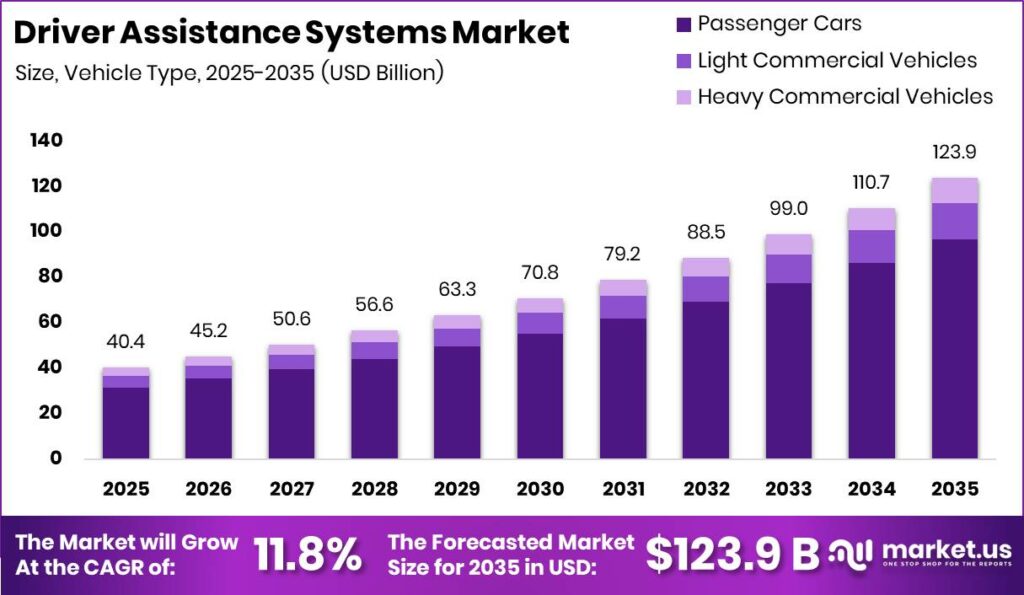
Global Driver Assistance Systems Market size is expected to be worth around USD 123.90 Billion by 2035 from USD 40.40 Billion in 2025, growing at a CAGR of 11.8% during the forecast period 2026 to 2035. Capital now favors suppliers that can scale certified perception stacks across high volume platforms. Buyers who lock multi year capacity early gain pricing power before mandate driven demand peaks.
Therefore the market covers electronic systems that sense road conditions and support braking, steering, and speed control. System type, component type, vehicle type, autonomy level, and propulsion type structure purchasing decisions. This structure channels investment toward radar heavy architectures and partial automation packages that OEMs can certify at scale.
Key Takeaways
- The market reaches USD 40.40 Billion in 2025 and USD 123.90 Billion by 2035 at a CAGR of 11.8%.
- Adaptive Cruise Control leads system type with a 24.40% share.
- Radar Sensors lead component type with a 45.50% share.
- Passenger Cars lead vehicle type with a 78.20% share.
- Level 2 (Partial Automation) leads autonomy level with a 47.10% share.
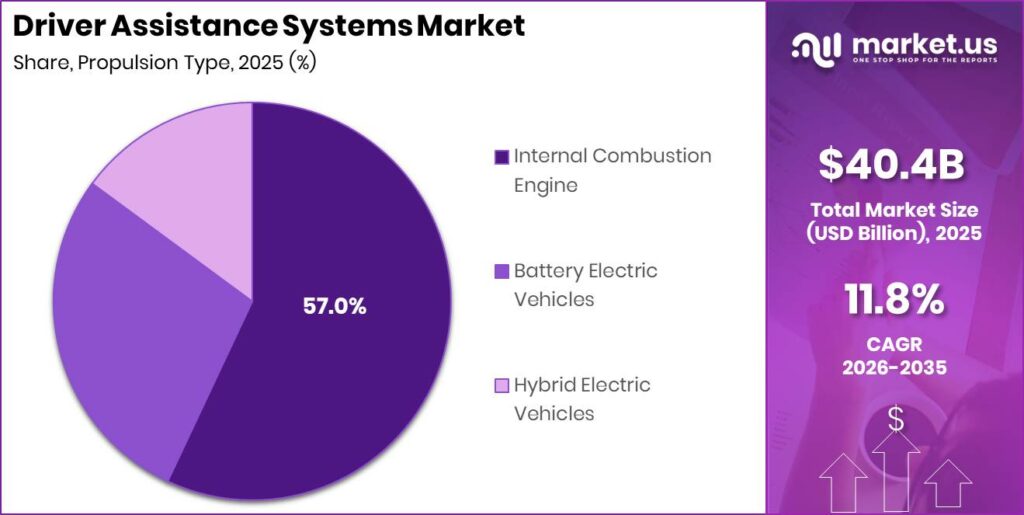
- Internal Combustion Engine leads propulsion type with a 57.00% share.
Government rules now convert driver assistance from optional content into base vehicle engineering. Federal fitment timelines for automatic emergency braking and forward collision warning pull perception hardware into mass production budgets. Consequently end use growth in regulated light vehicle fleets raises unit demand for cameras, radars, and control software on every new platform.
According to JATO Dynamics, ADAS equipped passenger vehicles in India reached 8.3% of wholesale volume in H1 2025, up from 6.2% in H1 2024, a 33% rise in penetration. This climb shows mid market buyers accept paid assist packages when crash avoidance is visible. Vendors that localize low cost sensor kits can convert that acceptance into sustained volume before price floors harden.
JATO Dynamics found that overtaking sensors appeared in 9% of Indian passenger vehicle models in H1 2025, while collision warning, autonomous lane control, pedestrian avoidance, and adaptive cruise control reached 8%, 8%, 7%, and 6%. Feature mix this uneven steers bill of materials toward warning and lane functions first. In July 2026 Qualcomm signed a long term agreement with BMW to supply chips for future digital cockpit and advanced driver assistance platforms, which signals premium OEMs will keep raising compute content per vehicle.
System Type Analysis
Adaptive Cruise Control dominates with 24.40% due to highway comfort at scale.
In 2025, Adaptive Cruise Control held a dominant market position in the By System Type segment of Driver Assistance Systems Market, with a 24.40% share. ACEA data show global car sales reached 74.6 million units in 2024, giving ACC a vast highway fleet to penetrate. Suppliers that cut false braking events win repeat OEM nominations on high mileage trims.
Automatic Emergency Braking sits at the center of regulated safety content on light vehicles. NHTSA requires AEB and forward collision warning on new light vehicles by 1 September 2029 under FMVSS No. 127. This means braking stack vendors with proven pedestrian detection secure multi year platform awards ahead of rivals still tuning night performance.
Blind Spot Detection supports lane change confidence in dense urban and highway traffic. IIHS notes most automakers now offer partial Level 2 automation across vehicles that represent 99% of US light vehicle sales, and blind spot sensing often anchors those packages. Fleets that specify blind spot alerts reduce sideswipe claims and favor suppliers with stable radar camera fusion.
Lane Departure Warning, Forward Collision Warning, Driver Monitoring Systems, and Park Assist Systems together hold the remaining system demand and serve distinct driver workloads. Park assist raises urban attach rates, while driver monitoring protects sustained assist compliance. Investors should track monitoring software attach as regulators tighten attention rules. Lane and collision warning remain the volume bridge into fuller automation stacks.
Component Type Analysis
Radar Sensors dominate with 45.50% due to all weather ranging performance.
In 2025, Radar Sensors held a dominant market position in the By Component Type segment of Driver Assistance Systems Market, with a 45.50% share. OICA linked tallies place world motor vehicle production near 92.5 million units in 2024, so radar content multiplies across a huge build base. Component makers that lower module cost without losing range capture the largest share of that build.
Camera Units supply lane, object, and sign interpretation that radar alone cannot resolve. China built about 34.53 million motor vehicles in 2025, concentrating camera module demand in Asia Pacific assembly hubs. This creates scale advantages for vision suppliers colocated with those plants and pressures import heavy vendors on lead time.
LiDAR Sensors add high resolution depth for higher autonomy prototypes and premium trims. UNCTAD reports semiconductor trade rose 25% in the first quarter of 2026 as digital and mobility demand expanded. LiDAR vendors tied to secure compute supply avoid launch slips when perception chips tighten.
Ultrasonic Sensors, Electronic Control Units, and Sensor Fusion Software share the balance of component spend for near field detection and decision logic. Fusion software turns mixed sensor feeds into certified vehicle actions. Buyers should favor ECU vendors that pre validate fusion stacks, because integration risk now decides award speed more than raw sensor count.
Vehicle Type Analysis
Passenger Cars dominate with 78.20% due to highest global build volume.
In 2025, Passenger Cars held a dominant market position in the By Vehicle Type segment of Driver Assistance Systems Market, with a 78.20% share. ACEA reports global car manufacturing totalled 75.5 million units in 2024, so car platforms absorb most assist content. Tier ones that standardize a car first architecture spread engineering cost across the widest order book.
Light Commercial Vehicles need assist features that cut urban delivery incidents and insurance severity. Global van production declined 4.6% in 2024 per ACEA, which tightens OEM willingness to fund optional packages. Suppliers that prove fleet fuel and claim savings keep LCV assist on the order sheet despite softer van output.
Heavy Commercial Vehicles prioritize forward collision and lane support on long haul routes where downtime is costly. ACEA recorded an 8.3% drop in global truck production in 2024, so truck makers ration electronics spend toward features with clear safety payback. Vendors offering ruggedized radar suites with simple calibration win scarce heavy duty slots.
Autonomy Level Analysis
Level 2 (Partial Automation) dominates with 47.10% due to certifiable mass market readiness.
In 2025, Level 2 (Partial Automation) held a dominant market position in the By Autonomy Level segment of Driver Assistance Systems Market, with a 47.10% share. NHTSA states no vehicle sold to US consumers is fully automated, so Level 2 remains the practical ceiling for retail volume. This keeps budgets on supervised highway assist rather than unmanned robotaxi hardware.
Level 1 (Driver Assistance) delivers single function support such as adaptive speed or steering aid for cost sensitive trims. India produced about 6.49 million motor vehicles in 2025, expanding the pool of entry trims that still start on Level 1 content. OEMs that package Level 1 cleanly create an upsell path into Level 2 without redesigning the vehicle electrical architecture.
Level 3 (Conditional Automation) allows conditional eyes off driving only where law and mapping permit. In September 2025 Qualcomm and BMW launched the Snapdragon Ride Pilot system with hands free highway driving, automatic lane changes, and intelligent parking on the next generation iX3. Premium brands that sequence Level 3 behind proven Level 2 reduce liability while still marketing step up autonomy.
Level 4 and 5 (High/Full Automation) remain confined to controlled ride hail and goods pilots rather than open retail sales. IIHS notes vehicles that drive themselves at these levels are not available for consumer purchase today. Capital should treat Level 4 programs as option value, not as the near term volume engine of this market.
Propulsion Type Analysis
Internal Combustion Engine dominates with 57.00% due to largest powertrain parc base.
In 2025, Internal Combustion Engine held a dominant market position in the By Propulsion Type segment of Driver Assistance Systems Market, with a 57.00% share. IEA data show electric cars still accounted for about one quarter of global car sales in 2025, so ICE platforms remain the default fitment base. Assist suppliers must keep ICE validated stacks current or lose the majority of near term units.
Battery Electric Vehicles integrate driver assistance with high voltage architectures and dense domain compute. The IEA reports global electric car sales reached about 20.7 million in 2025, up roughly 20% year on year. BEV growth rewards vendors whose perception software shares processors with cockpit and battery controllers.
Hybrid Electric Vehicles blend engine and electric drive and often carry assist content aligned with mid to upper trims. IEA figures show global electric car sales rose 35% year on year in the first quarter of 2025, lifting hybrid and battery demand together. Hybrid programs give suppliers a bridge volume stream while pure battery share keeps climbing.
Key Market Segments
By System Type
- Adaptive Cruise Control
- Automatic Emergency Braking
- Blind Spot Detection
- Lane Departure Warning
- Forward Collision Warning
- Driver Monitoring Systems
- Park Assist Systems
By Component Type
- Radar Sensors
- Camera Units
- LiDAR Sensors
- Ultrasonic Sensors
- Electronic Control Units
- Sensor Fusion Software
By Vehicle Type
- Passenger Cars
- Light Commercial Vehicles
- Heavy Commercial Vehicles
By Autonomy Level
- Level 1 (Driver Assistance)
- Level 2 (Partial Automation)
- Level 3 (Conditional Automation)
- Level 4 & 5 (High/Full Automation)
By Propulsion Type
- Internal Combustion Engine
- Battery Electric Vehicles
- Hybrid Electric Vehicles
Regional Analysis
Asia Pacific concentrates the fastest unit expansion as local OEMs move assist features into higher volume passenger cars. Data from JATO Dynamics shows Level 2 ADAS penetration in India reached 5.6% in H1 2025 after growing 70.8%, while Level 1 penetration eased from 2.5% to 2.1%. This shift tells suppliers to prioritize Level 2 bundles over basic single function kits in urban India.
Europe already shows mature fitment even where driver trust still varies by function. Based on FIA Region I analysis, new vehicle penetration of lane keeping assistance exceeded 80% in Germany for LKA alongside high ACC and parking assist fitment. High fitment with uneven use favors vendors that improve driver trust and reduce nuisance alerts rather than only chasing hardware share.
Price band gaps inside India still decide where regional volume stalls. JATO Dynamics indicates that in the Rs 1.0 million to Rs 2.0 million band ADAS penetration reached 55% in ICE vehicles versus 11.8% in EVs, while above Rs 2.0 million the rates were 43.6% in ICE and 88.2% in EVs. Suppliers that close the mid band EV cost gap unlock the next wave of Asia Pacific units.
Key Regions and Countries
North America
- US
- Canada
Europe
- Germany
- France
- The UK
- Spain
- Italy
- Rest of Europe
Asia Pacific
- China
- Japan
- South Korea
- India
- Australia
- Rest of APAC
Latin America
- Brazil
- Mexico
- Rest of Latin America
Middle East and Africa
- GCC
- South Africa
- Rest of MEA
Market Dynamics
Market Opportunity Analysis - Commercial fleets, higher autonomy steps, and mid band EV platforms still leave open white space
Heavy Commercial Vehicles remain underexploited relative to passenger cars even though long haul operators pay for downtime and crash losses. Fleet buyers need rugged forward sensing with simple service routines rather than passenger style luxury packages. New entrants that certify truck specific braking and lane stacks can win share without fighting overcrowded car platform bids.
Level 3 and Level 4 and 5 programs stay thin in retail channels while Level 2 absorbs most volume. Mapped highway corridors and depot bound goods routes still need suppliers willing to fund local validation. This creates room for specialist software firms that sell geofenced stacks instead of chasing every mass market car nomination.
Battery Electric Vehicles in mid price bands still trail richer trims on assist content in key growth markets. Cost optimized camera radar bundles designed for electric architectures can close that gap. Investors should back module sets that share compute with battery and cockpit controllers to protect margin at lower sticker prices.
LiDAR and advanced fusion layers remain concentrated on premium pilots rather than high volume trims. As radar and camera baselines saturate, depth sensing becomes the differentiation lever for safer urban assist. Early suppliers that industrialize lower cost LiDAR for robotaxi and premium SUV lines secure design wins before prices compress.
Technology and Innovation Landscape - Domain compute, edge inference, and unlockable software redefine supplier economics
Centralized domain controllers consolidate perception workloads that once sat on scattered electronic control units. Fewer boxes cut wiring weight and simplify OEM electrical designs on premium platforms in Europe, North America, and China. Suppliers that ship pre integrated controller software shorten OEM validation cycles and raise switching costs.
On board edge inference replaces cloud only scenario processing when rules demand low latency braking decisions. Local inference keeps automatic emergency braking inside strict false positive envelopes without constant connectivity. This shifts value toward chip and software vendors that certify deterministic on vehicle models.
Sensor fusion software turns radar, camera, ultrasonic, and optional LiDAR feeds into a single driving plan. Fusion quality now decides whether an OEM can market supervised highway assist with acceptable driver trust. Vendors that own fusion IP capture recurring software fees after the initial hardware award.
Feature on demand activation and self calibrating sensor designs change aftersales economics. Dormant hardware can be unlocked over telematics channels while dynamic calibration cuts static target board dependence in body shops. Companies that pair unlock commerce with easier serviceability defend both OEM margin and insurer acceptance.
Drivers
Persistent frontal crash risk pushed NHTSA to mandate automatic emergency braking, pedestrian AEB, and forward collision warning on light vehicles under 10,000 pounds. The final rule took effect on 20 March 2025, and volume makers must comply by 1 September 2029. As a result, fitment moves into base trim budgets and supports near 100% take rates across the US light vehicle build. Suppliers reprice stacks as multi year software and validation contracts rather than one time licenses.
Regulatory impact work projects roughly 360 lives saved and more than 24,000 injuries avoided each year once systems are standard. On board edge inference replaces cloud scenario processing to meet latency rules, and software content per vehicle rises by an estimated 18% to 25%. This means tier one suppliers lock multi year capacity against the mandate window instead of treating orders as a short cycle spike.
| Driver | (~) % Impact on CAGR Forecast | Geographic Relevance | Impact Timeline |
|---|---|---|---|
| Federal AEB/FCW Fitment Standard | +2.6% | North America; United States enforcement core, Canada following | Short term (2 years or less) |
| Consumer Rating Scheme Scoring of Assisted Driving | +2.1% | Western and Central Europe; spillover to Australia, Japan, Korea | Short term (2 years or less) |
| Radar and Camera Module BOM Deflation | +1.9% | Global; sourcing concentrated in Asia Pacific manufacturing hubs | Short term (2 years or less) |
| Centralized Domain Controller Consolidation | +1.5% | Global; premium platforms in Europe, North America, China | Medium term (2 to 4 years) |
| Standardized L2 Assist in Mid-Segment Vehicles | +1.3% | Asia Pacific; China, Korea, Japan, urban India | Short term (2 years or less) |
| Insurance Telematics-Linked Fitment Incentives | +0.9% | North America and Western Europe; fleet channels first | Medium term (2 to 4 years) |
Restraints
Entry segment ticket price still blocks full assist fitment even when the technology is ready. A front radar, forward camera, and extra compute can add roughly 2.5% to 3.5% of build cost on an entry hatchback and a showroom premium of 4% to 7% after margin and tax. Price elastic buyers then exit the addressable pool entirely. OEMs desccope assist from base trims to protect entry price points.
Margin pressure deepens the volume loss across emerging markets. Suppliers on entry platforms face single sensor designs with gross margins compressed by about 80 to 140 basis points versus mid segment fitments. Line retooling and calibration CapEx slip by 12 to 24 months until local sensor supply or a domestic mandate appears. This freezes a large share of global units despite mature hardware elsewhere.
| Restraint | (~) % Impact on CAGR Forecast | Geographic Relevance | Impact Timeline |
|---|---|---|---|
| Sensor Suite Price Premium in Entry Segments | -1.6% | India, ASEAN, South America, Africa; price-elastic A and B segments | Short term (2 years or less) |
| Marketing and OTA Update Restrictions on Assist Features | -1.2% | China; national scope across all passenger OEMs | Short term (2 years or less) |
| Elevated Policy Rates Suppressing Vehicle Financing | -1.0% | Global; acute in emerging-market credit channels | Short term (2 years or less) |
| Type-Approval Homologation Queue for Sustained Assist | -0.8% | Europe and UNECE contracting parties | Medium term (2 to 4 years) |
| Deferred OEM CapEx on Higher-Autonomy Programs | -0.7% | North America; select European legacy OEMs | Medium term (2 to 4 years) |
| Non-Compliant Lane Marking and Signage Infrastructure | -0.5% | South Asia, Sub-Saharan Africa, rural Latin America | Long term (4 years or more) |
Challenges
Assist hardware is entering vehicles faster than shops can restore it after collision or glass work. Industry surveys show post repair calibration demand near 65% of repair orders by the second quarter of 2025 and approaching 70% by year end. In a sample of 304 shops, only 81 hired calibration staff easily and 118 sublet the work. Subletting adds about 1.5 to 3 days per repair and raises insurer severity.
Technician turnover of 30% to 40% each year shortens the payback on certification spend and cuts shop margin by roughly 150 to 250 basis points on ADAS jobs. Service employment grows only in the low single digits while calibration eligible vehicles grow much faster. This creates a paid opening for calibration networks, self calibrating sensors, and clearer liability contracts among OEMs, insurers, and repairers.
| Challenge | (~) % CAGR Friction Drag | Geographic Relevance | Mitigation Horizon |
|---|---|---|---|
| Calibration Technician Capacity Deficit | -1.4% | North America and Western Europe; aftermarket and collision channel | Medium term (2 to 4 years) |
| Automotive Compute Node Supply Concentration | -1.1% | Global; fabrication concentrated in Taiwan, Korea, Japan | Medium term (2 to 4 years) |
| Adverse Weather Perception Degradation | -0.9% | Nordics, Canada, Alpine Europe, monsoon Asia Pacific | Long term (4 years or more) |
| Cybersecurity Management System Overhead | -0.8% | Global; UNECE contracting parties strictest | Medium term (2 to 4 years) |
| Escalating Validation Mileage Burden | -0.7% | Global; multi-market homologation programs | Long term (4 years or more) |
| Annotation and Ground-Truth Cost Inflation | -0.5% | Global; engineering centers in India, Eastern Europe, China | Medium term (2 to 4 years) |
Opportunities
Many connected vehicles already ship with sensors and spare compute that higher functions never unlock. Registration authorities show the connected sensor equipped parc rising at double digit rates, yet software activation attach often stays in the low to mid teens. An activation sold after delivery can carry incremental gross margin of 70% to 85% against 15% to 22% on the hardware itself. Early movers build the consent, pricing, and connectivity stack before hardware ages out.
Converting even 10 percentage points of eligible vehicles can lift blended program margin by about 200 to 400 basis points without new plant CapEx. Delivery over existing telematics channels can cut marginal activation cost by roughly 60% to 80% versus dealer installed options. This signals a software first revenue pool for OEMs and tier ones that already won the hardware nomination.
| Opportunity | (~) % Potential CAGR Upside | Geographic Relevance | Execution Window |
|---|---|---|---|
| Feature-on-Demand Activation of Dormant Hardware | +2.2% | North America, Western Europe, China; connected fleets first | Medium term (2 to 4 years) |
| Retrofit Kits for Commercial and Fleet Vehicles | +1.7% | India, ASEAN, Middle East, Latin America | Medium term (2 to 4 years) |
| Radar-Based Powered Two-Wheeler Rider Assist | +1.4% | India, Indonesia, Vietnam, Southern Europe | Long term (4 years or more) |
| Calibration Network Roll-Up and Consolidation | +1.1% | North America and Western Europe | Short term (2 years or less) |
| Off-Highway, Agricultural and Mining Adjacency | +0.9% | Global; North America, Brazil, Australia lead | Long term (4 years or more) |
| Anonymized Driving Data Licensing to Insurers | +0.8% | Global; regulated first in Europe under data statutes | Long term (4 years or more) |
Key Company Insights
Robert Bosch GmbH anchors the market as a full stack perception and control supplier across braking, radar, and vehicle compute. As reported by JATO Dynamics, ADAS penetration in Indian EVs reached 36.4% in H1 2025, far above the broader passenger vehicle mix. This EV skew rewards Bosch scale in integrated powertrain and assist electronics where software dense platforms need fewer but smarter control units.
Continental AG / Aumovio SE competes through broad ADAS portfolio depth spanning sensors, brakes, and assisted driving software for global OEMs. Figures from the 2025 PARTS study cover 98 million US sold vehicles from 168 models across 10 segments, giving large tier ones a hard effectiveness evidence base. Continental can use that evidence in OEM bids to defend share where insurers and regulators demand proven crash reduction.
Key Players
- Robert Bosch GmbH
- Continental AG / Aumovio SE
- DENSO Corporation
- ZF Friedrichshafen AG
- Aptiv PLC
- Magna International Inc.
- Valeo SA
- Mobileye Global Inc.
- Hyundai Mobis Co., Ltd.
- Autoliv, Inc.
- NVIDIA Corporation
- NXP Semiconductors N.V.
- FORVIA HELLA
- Hitachi Astemo, Ltd.
- Gentex Corporation
Recent Developments
- March 2025: Volkswagen Group selected Valeo and Mobileye to jointly supply its next generation Level 2 plus ADAS platform for upcoming MQB based vehicles, integrating cameras, radars, electronic control units, and Mobileye Surround ADAS software.
- January 2026: Mobileye secured a production award from a major US automaker for its EyeQ6H based Surround ADAS platform, expanding its projected production pipeline to more than 19 million ADAS systems.
- July 2026: Mobileye signed an agreement with Stellantis to supply its cloud based Road Experience Management technology, enabling continuously updated road intelligence for future lane keeping and hands free driving systems.
Geopolitical Impact Analysis
According to USTR linked trade measures, Section 301 tariffs on Chinese semiconductors stand near 50% while electric vehicles face rates up to 100%, and Section 232 style duties on automobiles and auto parts run about 25%. These layers raise landed cost for electronic control units, radar chipsets, and camera modules that feed driver assistance builds. Therefore North American and European OEMs accelerate dual sourcing outside single country fabs even when unit prices rise.
UNCTAD estimates global goods trade reached about USD 13.7 trillion in the first half of 2026, up 12.5%, while semiconductor trade jumped 25% in the first quarter on AI and electric mobility demand. UNCTAD maritime analysis also noted container freight rates more than doubled by mid 2024 versus late 2023 during Red Sea disruption. As a result, perception component lead times and logistics budgets stay volatile for just in time vehicle plants.
Report Scope
| Report Features | Description |
|---|---|
| Market Value (2025) | USD 40.40 Billion |
| Forecast Revenue (2035) | USD 123.90 Billion |
| CAGR (2026-2035) | 11.8% |
| Base Year for Estimation | 2025 |
| Historic Period | 2020-2024 |
| Forecast Period | 2026-2035 |
| Report Coverage | Revenue Forecast, Market Dynamics, Market Opportunity Analysis, Technology and Innovation Landscape, Competitive Landscape, Recent Developments |
| Segments Covered | By System Type (Adaptive Cruise Control, Automatic Emergency Braking, Blind Spot Detection, Lane Departure Warning, Forward Collision Warning, Driver Monitoring Systems, Park Assist Systems), By Component Type (Radar Sensors, Camera Units, LiDAR Sensors, Ultrasonic Sensors, Electronic Control Units, Sensor Fusion Software), By Vehicle Type (Passenger Cars, Light Commercial Vehicles, Heavy Commercial Vehicles), By Autonomy Level (Level 1 (Driver Assistance), Level 2 (Partial Automation), Level 3 (Conditional Automation), Level 4 & 5 (High/Full Automation)), By Propulsion Type (Internal Combustion Engine, Battery Electric Vehicles, Hybrid Electric Vehicles) |
| Regional Analysis | North America (US and Canada), Europe (Germany, France, The UK, Spain, Italy, and Rest of Europe), Asia Pacific (China, Japan, South Korea, India, Australia, and Rest of APAC), Latin America (Brazil, Mexico, and Rest of Latin America), Middle East and Africa (GCC, South Africa, and Rest of MEA) |
| Competitive Landscape | Robert Bosch GmbH, Continental AG / Aumovio SE, DENSO Corporation, ZF Friedrichshafen AG, Aptiv PLC, Magna International Inc., Valeo SA, Mobileye Global Inc., Hyundai Mobis Co., Ltd., Autoliv, Inc., NVIDIA Corporation, NXP Semiconductors N.V., FORVIA HELLA, Hitachi Astemo, Ltd., Gentex Corporation |
| Customization Scope | Customization for segments, region / country-level will be provided. Additional customization can be done based on requirements. |
| Purchase Options | We have three licenses to opt for: Single User License | Multi-User License (Up to 5 Users) | Corporate Use License (Unlimited User and Printable PDF) |





































