Report Overview
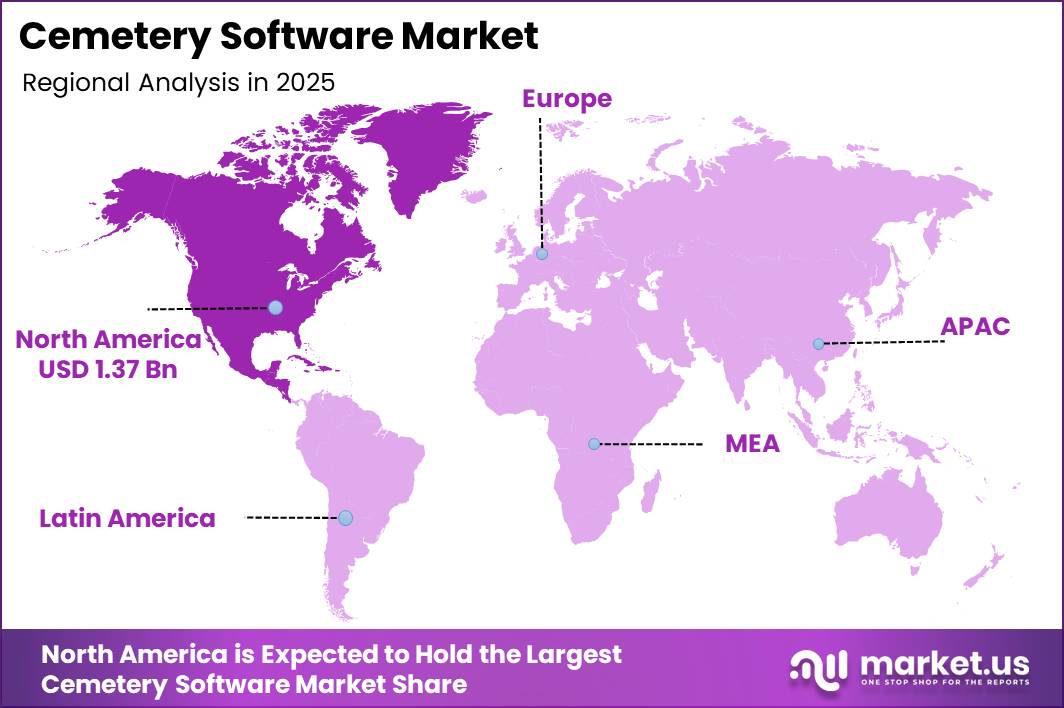
In 2025, the Global Cemetery Software Market was valued at USD 4.0 billion. The market is projected to grow at a CAGR of 8.2% during 2026–2035, reaching approximately USD 8.8 billion by 2035. North America dominated the global market in 2025, accounting for more than 34.3% of the total market share and generating approximately USD 1.3 billion in revenue.
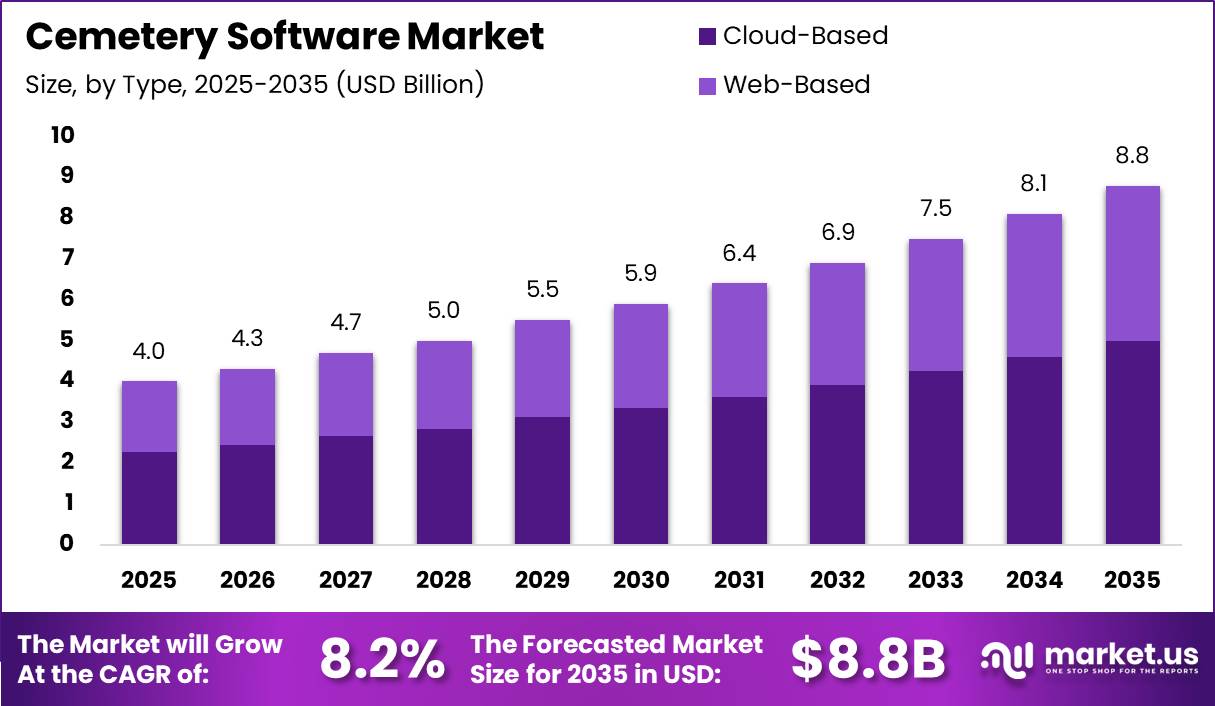
Growth is supported by the large and continuing volume of deaths that cemetery operators must process. According to the U.S. Centers for Disease Control and Prevention, 3,072,666 deaths were registered in the United States in 2024. Statistics Canada reported another 326,779 deaths during the same year.
Together, these countries recorded nearly 3.4 million deaths, creating substantial annual demand for burial scheduling, grave mapping, ownership records, payment processing, document storage, and family communication systems. Digital platforms reduce dependence on paper registers and allow operators to manage records from one central database.
North America’s leading position is supported by an ageing population and strong adoption of digital death-record systems. The U.S. Census Bureau reported that the population aged 65 and above reached 61.2 million in 2024, rising 3.1% in one year and representing 18.0% of the population. The CDC also reported that digital data exchange reduced Idaho’s death-record processing time from eight days to 2.7 days and saved four to five staff hours each week. In Michigan, average processing time declined from 17 days to five days.
Key Takeaway
- The Global Cemetery Software Market was valued at USD 4.0 billion in 2025 and is projected to reach USD 8.8 billion by 2035, growing at a CAGR of 8.2%.
- The cloud-based segment was dominated by type, with a 56.7% share in 2025.
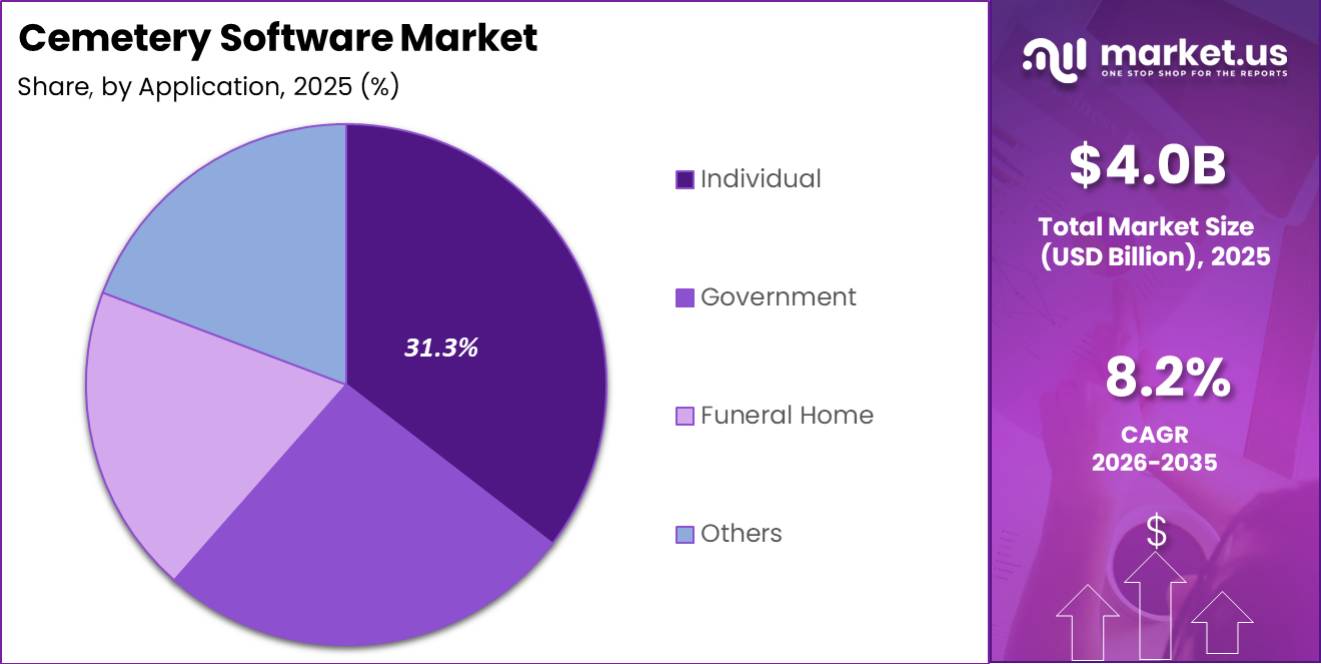
- The individual segment was led by application, with a 31.3% share in 2025.
- North America led the market in 2025 with a 34.3% share, generating approximately USD 1.3 billion in revenue.
Market Statistics and Data Insights
- In 2025, 52.7% of European Union enterprises used paid cloud computing services, increasing by 7.4 percentage points compared with 2023. Cloud usage includes services such as software access, storage capacity, and database hosting, which directly support cemetery software deployment models.
- Among EU enterprises using cloud services in 2025, 71.5% used cloud-based file storage, 65.5% used security software applications, and 45.5% used cloud hosting for enterprise databases. These capabilities align with cemetery software requirements for burial records, ownership documents, and secure backups.
- Eurostat reported that in 2025, 85% of large EU enterprises used cloud services compared with 52% of small and medium enterprises, showing that digital infrastructure adoption is becoming mainstream across organisational sizes.
- The U.S. National Archives manages more than 13.5 billion pages of federal records, highlighting the scale of historical document preservation challenges faced by institutions managing large archives.
- The National Archives planned to digitise 500 million pages by September 30, 2026, demonstrating continued investment in large-scale document conversion technologies.
- CemSites reported that its cemetery data migration services have transferred more than 27 million records into its platform, covering historical burial records, ownership documentation, financial data and related cemetery information.
- Cemify lists cemetery software subscription pricing between USD 799 and USD 1,899 annually, with mapping setup costs ranging from USD 1,000 to USD 1,500 per acre for implementation services.
- The City of Barre approved a CemSites cemetery software project in 2025 valued at USD 39,500, including USD 34,500 for implementation and USD 5,000 annually for licensing. The project covered digitisation of more than 100,000 paper records related to approximately 17,600 burials across 3 cemeteries.
- PlotBox supports more than 2,000 facilities globally, including cemeteries, crematories, funeral homes, municipalities and memorial organisations.
- A 2026 peer-reviewed cemetery GIS study used UAV photogrammetry, GNSS surveying and GIS databases to digitise 1,112 graves linked with 1,594 burial records. The highest-resolution mapping output achieved 1.4 cm Ground Sampling Distance (GSD).
By Type
In 2025, the Cloud-based segment led the Cemetery Software Market with a 56.7% share. This strong position is supported by the growing use of hosted software that lowers the need for costly on-site servers and makes cemetery records easier to manage. Cloud platforms allow staff to access burial schedules, grave maps, ownership details, payment records, and customer information from different locations through one connected system.
According to Eurostat, 52.7% of enterprises in the European Union used paid cloud services in 2025, representing an increase of 7.4 percentage points compared with 2023. Among these cloud users, 71.5% used online file-storage services, 65.5% purchased cloud-based security software and 45.5% hosted business databases in the cloud.
These functions closely match the needs of cemetery operators, which must securely store permanent records, update plot availability, process payments and maintain reliable backups. As more organisations shift toward digital record systems, cloud-based cemetery software is expected to remain the preferred type due to its lower infrastructure costs, easy access, scalability and stronger data protection.
By Application
In 2025, the Individual segment dominated the Cemetery Software Market with a 31.3% share. This leadership is supported by the growing need for families to access burial and memorial information through simple digital platforms. Individual users rely on cemetery software to locate graves, check burial records, view plot details, request documents, and manage memorial information without making repeated visits to cemetery offices.
The scale of these services shows why individual demand remains strong. In fiscal 2025, the U.S. Department of Veterans Affairs reported that the National Cemetery Administration managed records for more than 5.7 million burials. During the same period, it issued 495,951 Presidential Memorial Certificates and supplied 286,863 headstones and markers. Each request requires accurate personal records, family communication, and long-term document storage.
Cemetery software helps manage this large volume of individual enquiries by providing searchable grave maps, digital records, application updates, and secure access to memorial details. As families increasingly expect faster and easier access to information, cemetery operators are adopting digital systems to improve service quality, reduce manual work, and maintain reliable records.
Key Market Segments
By Type
- Cloud-Based
- Web-Based
By Application
- Individual
- Government
- Funeral Home
- Others
Geopolitical Impact Analysis
Although cemetery software is delivered digitally, it relies on semiconductors, servers, storage systems, routers, and data-centre power. The U.S. Trade Representative raised the Section 301 tariff on Chinese semiconductors to 50% in 2025, increasing cost exposure for processors and electronic parts used by cloud hosts and cemetery offices.
Conflict-related route changes add further pressure. UNCTAD reported that Suez Canal tonnage was still 70% below its 2023 level in May 2025, while vessel rerouting increased global ton-miles by 5.9% in 2024. Between December 2023 and March 2024, average port waiting time increased 23% to 6.4 hours in developed economies.
Energy volatility directly affects subscription pricing because cloud hosting, database replication, security monitoring, and cooling operate continuously. The World Bank projected energy prices to rise 24% in 2026 and Brent crude to average USD 86 per barrel, compared with USD 69 in 2025, following Middle East supply and shipping disruption. The IEA estimated that data-centre electricity consumption reached 485 TWh in 2025 and could approach 950 TWh by 2030.
Higher electricity and hardware costs may be passed into cloud fees, support contracts and municipal procurement budgets. The WTO also estimated that prolonged high energy prices could reduce 2026 merchandise-trade growth from 1.9% to 1.4%. Cemetery software vendors are therefore moving toward multi-region hosting, energy-efficient infrastructure, longer hardware inventories, and diversified suppliers to protect service continuity.
Regional Analysis
In 2025, North America led the Cemetery Software Market, accounting for 34.3% of global revenue, worth USD 1.3 billion. The region benefits from established cloud infrastructure, high software use among service organisations, and strong demand for digital records. In the second quarter of 2025, Statistics Canada found that 45.0% of businesses had made significant, moderate, or minor digital-infrastructure investments over the previous three years.
Asia Pacific is expected to be the fastest-growing regional market as demographic pressure combines with expanding internet access and wider public-service digitisation. The International Telecommunication Union estimated that 77.1% of the region’s population used the internet in 2025, improving the reach of cloud portals, mobile grave-location tools, and online memorial services.
The United Nations Economic and Social Commission for Asia and the Pacific reported 721 million people aged 60 years or older in the region in 2024, with the total projected to approach 1.3 billion by 2050. This increase will expand the number of burial, cremation, memorial, and long-term record-management transactions.
Key Regions and Countries
North America
- US
- Canada
Europe
- Germany
- France
- The UK
- Spain
- Italy
- Rest of Europe
Asia Pacific
- China
- Japan
- South Korea
- India
- Australia
- Rest of APAC
Latin America
- Brazil
- Mexico
- Rest of Latin America
Middle East & Africa
- GCC
- South Africa
- Rest of MEA
Market Dynamics
Drivers
| Driver | (~) % CAGR | Geographic Relevance | Impact Timeline |
|---|---|---|---|
| Cloud-First Public-Service Digitisation | +1.5% | Global, led by North America and Europe | Short term (2 years or less) |
| Online Booking and Payment Adoption | +0.8% | North America, Europe and developed Asia | Short term (2 years or less) |
| GIS Plot Inventory Control | +0.7% | Urban markets worldwide | Medium term (2 to 4 years) |
| Remote Family Self-Service | +0.5% | North America, Europe and Asia Pacific | Short term (2 years or less) |
| Multi-Site Administrative Consolidation | +0.4% | North America and Western Europe | Medium term (2 to 4 years) |
Cloud-First Public-Service Digitisation
Cloud-first public-service digitisation is the strongest active driver because it changes cemetery software from one-time desktop licences into recurring subscriptions covering hosting, updates, backups and remote access. Eurostat reported that paid cloud use reached 52.7% of EU enterprises in 2025, increasing by 7.4 percentage points from 2023; among cloud users, 71.5% purchased file storage and 45.5% hosted databases.
The OECD found that data-sharing systems were available in 28 of 33 surveyed countries, equal to 85%, while digital identities were available in 24, or 73%. The World Bank further reported that the global GovTech Maturity Index increased from 0.552 in 2022 to 0.589 in 2025 across 197 economies.
Restraints
| Restraint | (~) % CAGR | Geographic Relevance | Impact Timeline |
|---|---|---|---|
| Municipal Fiscal and Procurement Pressure | -1.3% | Global public-sector market | Short term (2 years or less) |
| Data-Privacy Liability Thresholds | -0.8% | Europe and regulated economies | Short term (2 years or less) |
| Rural Connectivity Gaps | -0.5% | Emerging markets and remote communities | Medium term (2 to 4 years) |
| Long Public-Contract Lock-Ins | -0.4% | North America and Europe | Medium term (2 to 4 years) |
| Small-Site Affordability Ceiling | -0.3% | Global small cemetery segment | Long term (4 years or more) |
Municipal Fiscal and Procurement Pressure
Municipal fiscal and procurement pressure is the largest immediate restraint because cemetery software is commonly purchased from discretionary local-authority budgets and can be delayed when essential-service spending takes priority.
The IMF estimated global government debt at 93.9% of GDP in 2025 and projected it to reach 100% by 2029, increasing pressure on public investment choices. The OECD reported that procurement represented 12.7% of GDP and 29.9% of total government expenditure across member economies, meaning technology projects must compete within heavily controlled tender budgets.
The World Bank’s 2025 GovTech assessment covered 197 economies and found that progress remained uneven, with lower-maturity economies falling further behind digitally advanced administrations. For cemetery software suppliers, this creates postponed tenders, restricted implementation budgets, and longer approval chains.
Challenges
| Challenge | (~) % CAGR | Geographic Relevance | Mitigation Horizon |
|---|---|---|---|
| Legacy Record Conversion | -1.1% | Global, especially older cemetery systems | Medium term (2 to 4 years) |
| Cybersecurity Continuity Exposure | -0.9% | Global cloud-based deployments | Long term (4 years or more) |
| System Interoperability Complexity | -0.7% | North America and Europe | Medium term (2 to 4 years) |
| Geospatial Accuracy Gaps | -0.5% | Older and high-density cemeteries | Medium term (2 to 4 years) |
| Specialist Implementation Shortages | -0.4% | Global specialist-vendor ecosystem | Long term (4 years or more) |
Legacy Record Conversion
Legacy record conversion creates the greatest operational friction because many cemeteries still depend on handwritten registers, paper deeds and historical plot maps that cannot be transferred automatically into structured databases.
The U.S. National Archives reported holdings of more than 13.5 billion pages, with fewer than 300 million digitised when its new centre opened, illustrating the scale gap between physical records and searchable data; its target is 500 million pages by 30 September 2026.
The National Archives also warns that optical character recognition and artificial intelligence are often less accurate than manual transcription for handwritten or damaged documents. In 2025, Heckington Parish Council approved burial-record digitisation at 5 pence per record, confirming that even basic conversion carries a measurable unit cost. Blackpool Council states that its burial records have been electronic only since 2000, while earlier paper files remain under digitisation.
Opportunities
| Opportunity | (~) % CAGR | Geographic Relevance | Execution Window |
|---|---|---|---|
| Emerging-Market Municipal SaaS | +1.4% | Asia Pacific, Africa and Latin America | Medium term (2 to 4 years) |
| Consumer Memorial-Commerce Platforms | +0.8% | Global digitally connected markets | Medium term (2 to 4 years) |
| Crematorium Workflow Convergence | +0.6% | Europe, North America and developed Asia | Short term (2 years or less) |
| Green-Burial Compliance Modules | +0.5% | Europe, North America and Oceania | Long term (4 years or more) |
| Vendor Roll-Up and Managed Services | +0.4% | North America and Europe | Medium term (2 to 4 years) |
Emerging-Market Municipal SaaS
Emerging-market municipal SaaS represents future white space rather than the current cloud driver, which remains concentrated in digitally mature economies. The World Bank reported that its 2025 GovTech index covered 197 economies and reached an average score of 0.58, but the gap between high-maturity and low-maturity groups widened.
The ITU estimated that 73.6% of the world was online in 2025, compared with only 23.4% in low-income economies and 62.9% in lower-middle-income economies, showing both unmet digital demand and infrastructure limits.
UN DESA reported that cities contained 45% of the global population of 8.2 billion in 2025, while approximately two-thirds of population growth through 2050 is expected in cities. Vendors can target this gap with mobile-first interfaces, offline synchronisation, regional hosting and local-language support.
An analyst scenario calibrated to these World Bank, ITU and UN indicators suggests that shared multi-tenant deployment could reduce incremental servicing costs by approximately 20–30% per additional site and improve gross margins by 5–8 percentage points after regional scale is achieved.
Key Players Analysis
The Cemetery Software Market remains fragmented, with competition led by private specialist vendors rather than large public software companies. Ramaker and Associates and Pontem Software represent the Tier-1 group because of their larger installation bases and longer operating histories. Ramaker’s Cemetery Information Management System has been used by more than 1,000 cemeteries over 20 years.
Pontem Software has completed more than 850 implementations and has over 35 years of industry experience. These figures indicate strong positions in municipal, religious and multi-location cemetery operations. However, neither company publishes audited revenue or confirmed market-share data, making exact percentage comparisons unreliable.
Memorial Business Systems, CemSites, and Legacy Mark form the Tier-2 challenger group. Memorial Business Systems serves several hundred customers across the United States, Canada, and Central America. CemSites has established operations in more than 45 U.S. states and 4 Canadian provinces. Legacy Mark expanded its offering in 2024 through an updated platform covering cemetery mapping, database migration, and online hosting.
Cemify, NewCom Technologies, Grave Discover Software, OVS-Genealogy, and TechniServe operate as smaller or niche providers. Cemify offers annual subscriptions ranging from USD 799 to USD 1,899, with mapping setup fees of USD 1,000 to USD 1,500 per acre. Grave Discover Software reports 99.99% cloud availability, while NewCom Technologies focuses on Esri-based geographic information systems.
Top Key Players in the Market
- Cemify
- CemSites
- Ovs-Genealogy
- Legacy Mark
- NewCom Technologies
- Ramaker and Associates
- Grave Discover Software
- Memorial Business Systems
- Pontem Software
- TechniServe
Recent Developments
- In May 2025, PlotBox secured a £337,035 contract from the City of London to supply an integrated cemetery and crematorium administration system. The agreement covers 5 years, with an option for a further 2 years. The platform will support a facility receiving around 250,000 visitors and managing approximately 900 burials and 2,600 cremations annually.
- In August 2025, CemSites was selected by the Barre City Council for a US$39,500 cemetery management software project. The approved expenditure included US$34,500 for one-time implementation and a recurring US$5,000 annual licence.
- The software rollout is linked to a wider digitisation programme covering more than 100,000 paper records and approximately 17,600 burials across 3 municipal cemeteries. The system is expected to improve burial-data storage, cemetery mapping and long-term record access, with full implementation scheduled for 2026.
- In February 2026, PlotBox received a £147,218 contract, excluding VAT, from South Ayrshire Council for cemetery and crematorium software. The contract was awarded through the G-Cloud 14, Lot 2 cloud-software framework after the council received 1 tender. This award strengthens PlotBox’s position in cloud-based public cemetery administration.
Report Scope
| Report Features | Description |
|---|---|
| Market Value (2025) | USD 4.0 Billion |
| Forecast Revenue (2035) | USD 8.8 Billion |
| CAGR (2026-2035) | 8.2% |
| Base Year for Estimation | 2025 |
| Historic Period | 2020-2024 |
| Forecast Period | 2026-2035 |
| Report Coverage | Revenue Forecast, Market Dynamics, Competitive Landscape, Recent Developments |
| Segments Covered | By Type (Cloud-Based, Web-Based); By Application (Individual, Government, Funeral Home, Others). |
| Regional Analysis | North America – US, Canada; Europe – Germany, France, The UK, Spain, Italy, Rest of Europe; Asia Pacific – China, Japan, South Korea, India, Australia, Singapore, Rest of APAC; Latin America – Brazil, Mexico, Rest of Latin America; Middle East & Africa – GCC, South Africa, Rest of MEA |
| Competitive Landscape | Cemify, CemSites, Ovs-Genealogy, Legacy Mark, NewCom Technologies, Ramaker and Associates, Grave Discover Software, Memorial Business Systems, Pontem Software, TechniServe |
| Customization Scope | Customization for segments and region/country-level will be provided. Moreover, additional customization can be done based on the requirements. |
| Purchase Options | We have three licenses to opt for: Single User License, Multi-User License (Up to 5 Users), Corporate Use License (Unlimited Users and Printable PDF) |