


Report Overview
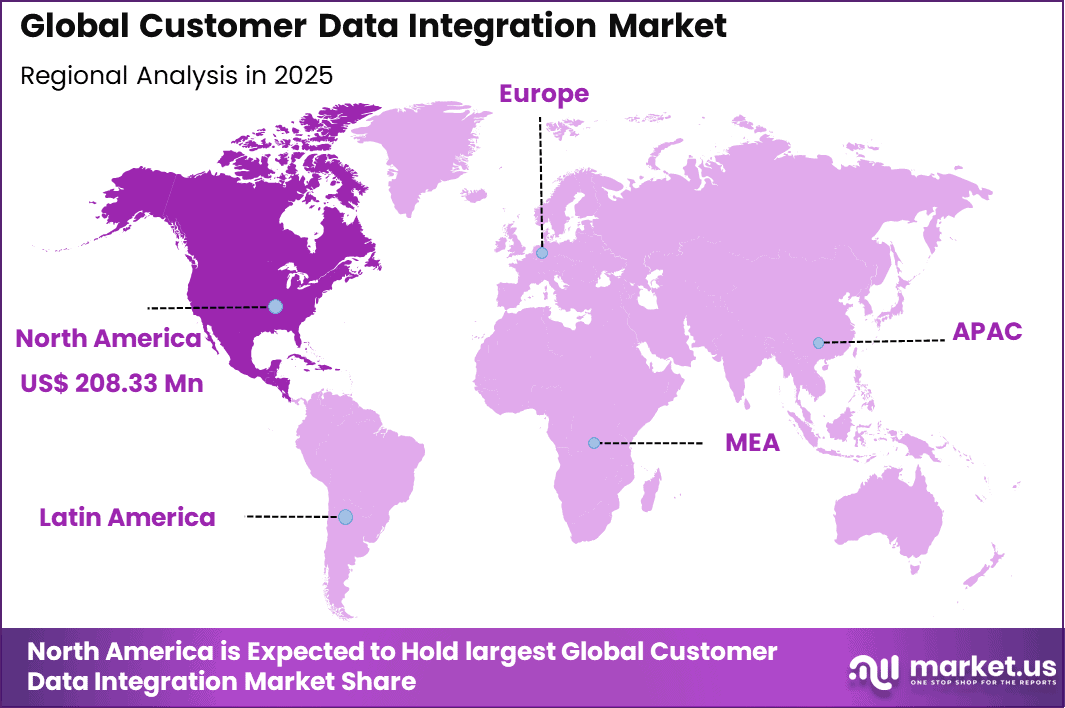
The Global Customer Data Integration Market generated USD 637.1 million in 2025 and is projected to grow from USD 786.2 million in 2026 to about USD 5,216.3 million by 2035, recording a CAGR of 23.4% over the forecast period. In 2025, North America held a dominant market position, capturing more than a 32.7% share, with USD 208.33 million in revenue.
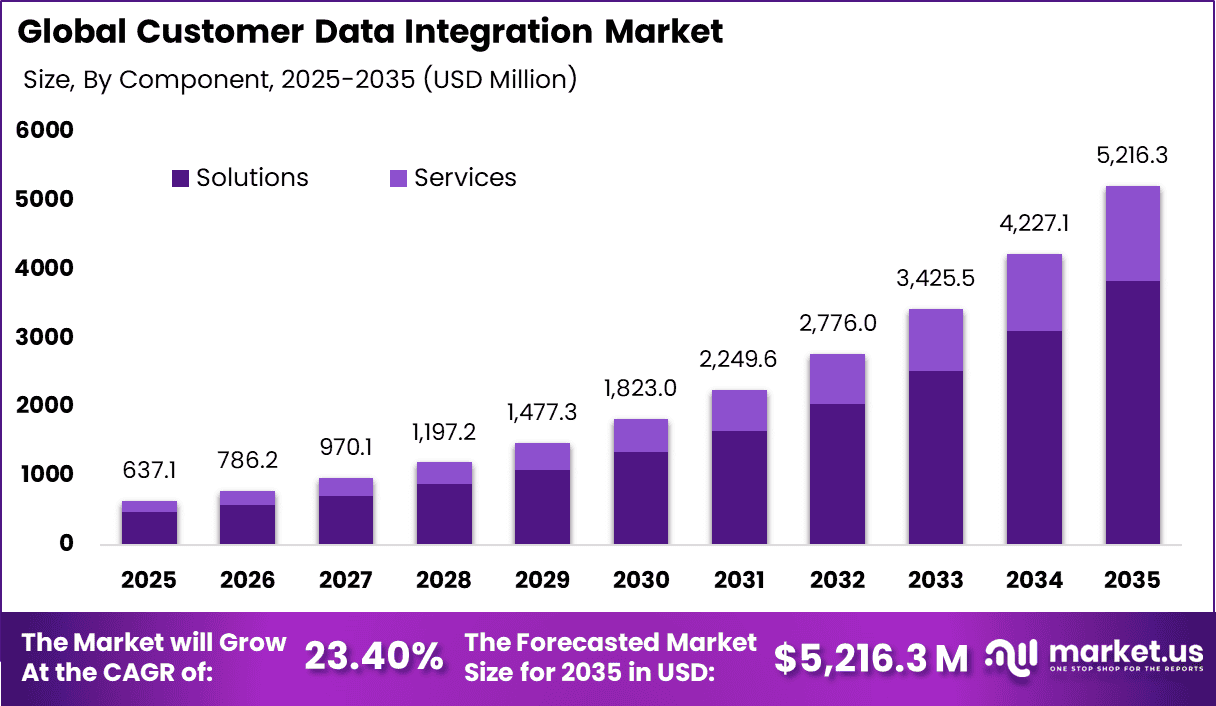
The customer data integration market focuses on combining customer information from multiple systems into a unified and consistent view. Organizations often store data across sales platforms, service channels, digital applications, and legacy databases, which creates fragmentation and duplication.
Customer data integration solutions are designed to consolidate, cleanse, and synchronize this information to support accurate analytics and personalized engagement. The market is shaped by enterprises seeking a reliable foundation for data-driven decision-making.
Growth in the customer data integration market is supported by the increasing use of advanced analytics and artificial intelligence in customer strategy. Reliable and unified data improves segmentation, targeting, and service personalization. Organizations are also prioritizing real-time data access to enhance responsiveness across channels.
Top Market Takeaways
- By component, software/tools account for 73.6% of the market, facilitating ETL processes, identity resolution, and master data management across siloed sources.
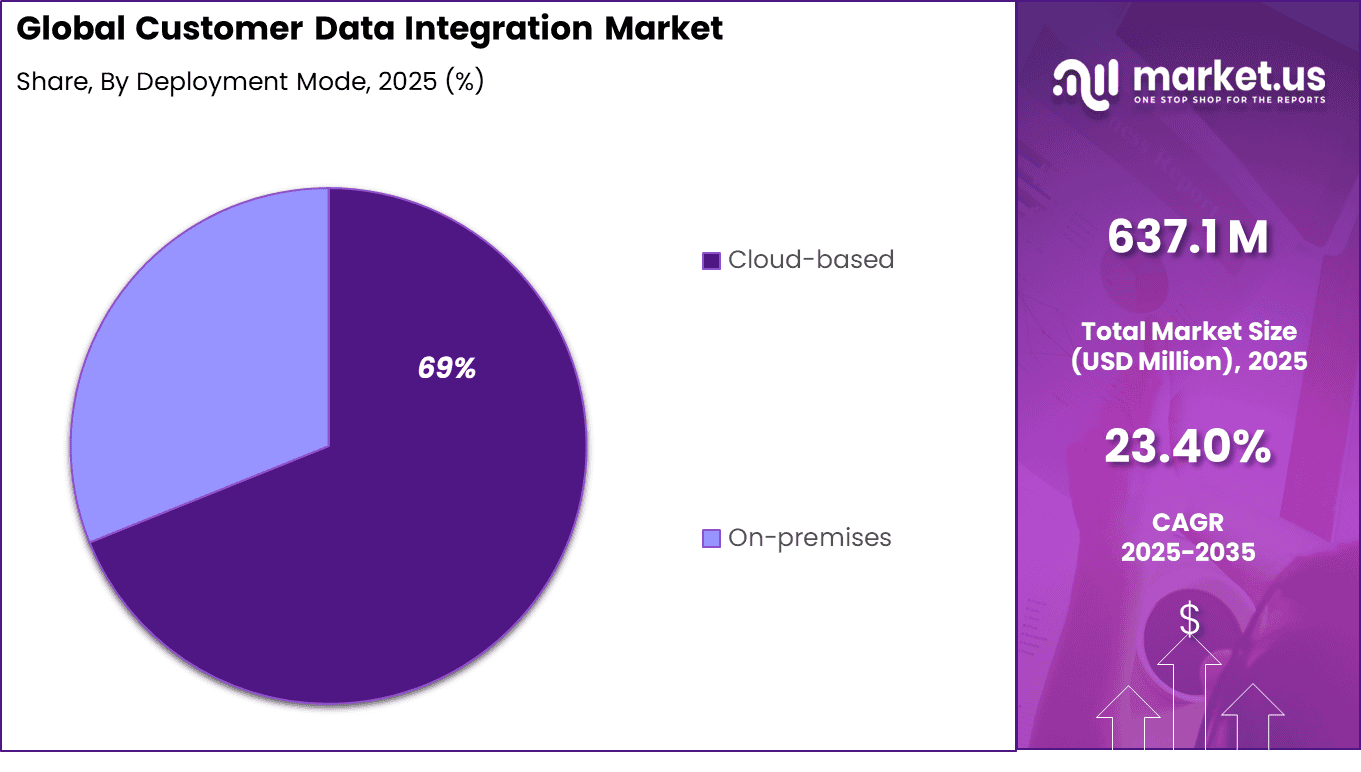
- By deployment mode, cloud-based platforms represent 68.9%, offering auto-scaling, real-time synchronization, and pre-built connectors for CRM/CDP ecosystems.
- By organization size, large enterprises hold a 71.4% share, tackling complex multi-channel data for 360-degree customer views and personalization.
- By application, marketing data unification captures 41.3%, enabling unified profiles for targeted campaigns, journey orchestration, and attribution modeling.
- By end-user industry, retail & e-commerce commands 34.7%, integrating online/offline behaviors to boost loyalty, recommendations, and omnichannel experiences.
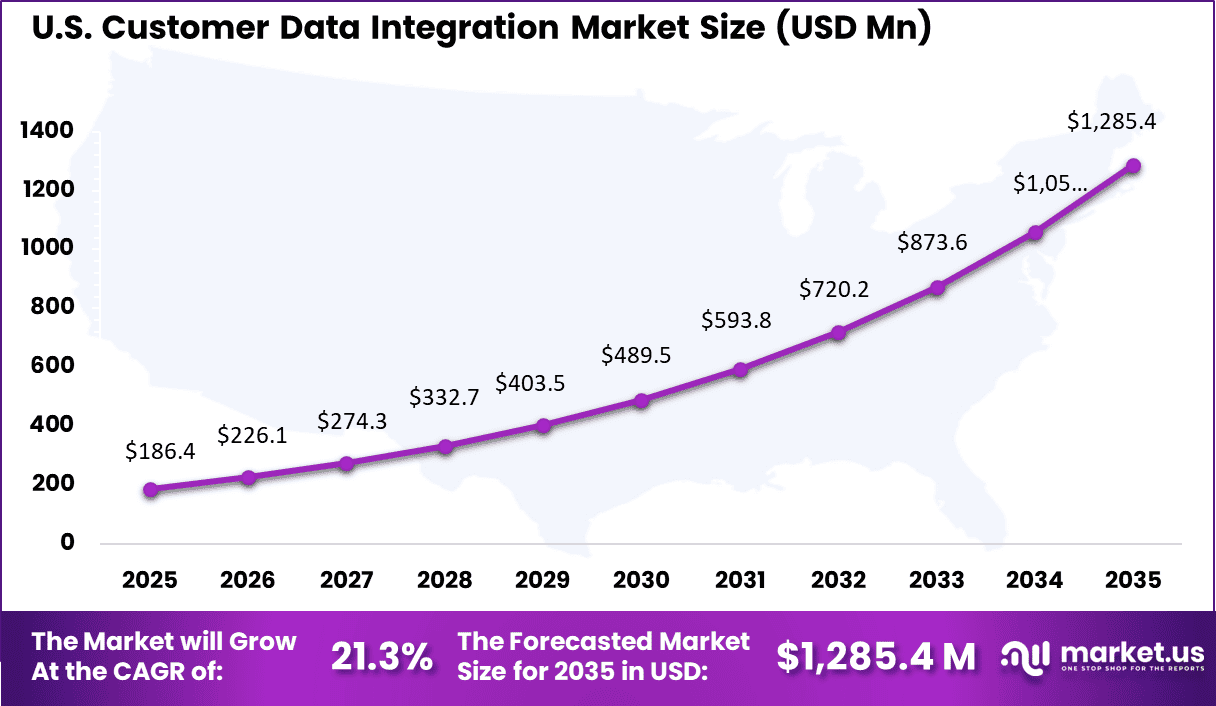
- By region, North America leads with 32.7% of the global market, where the U.S. is valued at USD 186.4 million with a projected CAGR of 21.3%, propelled by privacy regulations and CDP investments.
By Component
Software and tool-based solutions account for 73.6% of adoption in the customer data integration market, as organizations prioritize centralized platforms to unify fragmented customer information. These tools collect and standardize data from multiple touchpoints such as websites, mobile apps, CRM systems, and transaction platforms. This consolidation improves data accuracy and consistency across departments.
Advanced integration software also supports real-time data synchronization and identity resolution. By eliminating duplicate and inconsistent records, businesses enhance decision-making and operational efficiency. This functional value continues to position software tools as the dominant component.
By Deployment Mode
Cloud-based deployment holds 69%, reflecting the need for scalability and flexible data management. Cloud environments allow organizations to process large volumes of structured and unstructured data without heavy infrastructure investment. This is critical as digital engagement channels expand.
Cloud platforms also enable easier integration with analytics and marketing automation systems. Continuous updates improve system reliability and compliance with data governance requirements. These advantages sustain strong cloud adoption in customer data integration.
By Organization Size
Large enterprises represent 71.4% of adoption due to their complex and multi-channel customer ecosystems. These organizations manage vast data sets across business units and regions. Integrated data platforms are essential to maintain a unified customer view.
Regulatory compliance and data governance obligations are also more demanding for large firms. Centralized integration systems improve oversight and reporting. This reinforces strong uptake among large-scale enterprises.
By Application
Marketing data unification accounts for 41.3% of application usage, as businesses seek to improve campaign effectiveness. Integrated customer profiles allow targeted communication and personalized engagement. This enhances conversion rates and customer retention.
Unified marketing data also supports accurate performance measurement across channels. Organizations gain clearer insights into customer journeys and spending patterns. This makes marketing unification a leading application area.
By End User Industry
Retail and e-commerce hold 34.7% of end user adoption, driven by high customer interaction volumes. These sectors rely heavily on personalized experiences and cross-channel engagement. Data integration platforms support consistent messaging and offer management.
Retailers also benefit from improved inventory planning and demand forecasting through unified customer insights. Strong competition in digital commerce further accelerates investment in integration tools. This continues to support adoption in retail environments.
Key Market Segments
By Component
- Software/Tools
- Services
By Deployment Mode
- Cloud-based
- On-premises
By Organization Size
- Large Enterprises
- Small and Medium-sized Enterprises (SMEs)
By Application
- Marketing Data Unification
- Customer Service & Support
- Sales & Account Management
- Others
By End-User Industry
- Banking, Financial Services, and Insurance (BFSI)
- Retail & E-commerce
- Healthcare
- Telecommunications
- Media & Entertainment
- Others
Regional Analysis
North America accounts for 32.7% of the customer data integration market, supported by advanced digital ecosystems and high adoption of analytics-driven customer engagement strategies. Enterprises across banking, retail, telecommunications, and healthcare are consolidating fragmented customer data from multiple touchpoints to create unified profiles. Demand is driven by the need for accurate customer insights, regulatory compliance in data handling, and improved personalization across digital and physical channels.
The United States market is valued at USD 186.4 Mn and is expanding at a CAGR of 21.3%, reflecting strong investment in real-time data integration platforms. Adoption is influenced by rising volumes of structured and unstructured customer data generated through mobile apps, online transactions, and connected devices. Growth is further supported by increasing focus on data quality, advanced analytics integration, and the need to enable seamless omnichannel customer experiences.
Key Regions and Countries
- North America
- US
- Canada
- Europe
- Germany
- France
- The UK
- Spain
- Italy
- Russia
- Netherlands
- Rest of Europe
- Asia Pacific
- China
- Japan
- South Korea
- India
- Australia
- Singapore
- Thailand
- Vietnam
- Rest of APAC
- Latin America
- Brazil
- Mexico
- Rest of Latin America
- Middle East & Africa
- South Africa
- Saudi Arabia
- UAE
- Rest of MEA
Driver Impact Analysis
| Key Driver | Impact on CAGR Forecast (~%) | Geographic Relevance | Impact Timeline |
|---|---|---|---|
| Rising demand for unified customer profiles across channels | +5.8% | North America, Europe | Short to medium term |
| Growth of omnichannel marketing and personalization strategies | +4.9% | Global | Medium term |
| Increasing regulatory requirements for data governance and consent management | +4.2% | Europe, North America | Medium term |
| Expansion of cloud-based CRM and marketing automation platforms | +3.7% | Global | Medium term |
| Adoption of AI-driven analytics for customer insights | +3.4% | North America, Asia Pacific | Medium to long term |
Restraints Impact Analysis
| Key Restraint | Impact on CAGR Forecast (~%) | Geographic Relevance | Impact Timeline |
|---|---|---|---|
| High complexity of integrating legacy data silos | −4.1% | Global | Short to medium term |
| Data privacy and cross-border compliance challenges | −3.6% | Europe, North America | Medium term |
| Limited data standardization across enterprises | −3.0% | Global | Medium term |
| High implementation and customization costs | −2.6% | Emerging Markets | Medium term |
| Organizational resistance to centralized data governance | −2.1% | Global | Medium to long term |
Investor Type Impact Matrix
| Investor Type | Growth Sensitivity | Risk Exposure | Geographic Focus | Investment Outlook |
|---|---|---|---|---|
| Customer data platform and integration vendors | Very High | Medium | North America, Europe | Strong SaaS scalability |
| CRM and marketing automation providers | High | Medium | Global | Platform extension opportunity |
| Cloud infrastructure providers | Medium | Low to Medium | Global | Data-driven service growth |
| Private equity firms | Medium | Medium | North America, Europe | Consolidation of data platforms |
| Venture capital investors | High | High | North America | Innovation in AI-powered data orchestration |
Technology Enablement Analysis
| Technology Enabler | Impact on CAGR Forecast (~%) | Primary Function | Geographic Relevance | Adoption Timeline |
|---|---|---|---|---|
| Cloud-native customer data platforms (CDPs) | +6.0% | Centralized data unification | Global | Short to medium term |
| API-based real-time data ingestion frameworks | +5.1% | Cross-channel integration | Global | Medium term |
| AI and machine learning for identity resolution | +4.4% | Accurate customer matching | North America, Europe | Medium term |
| Data governance and consent management tools | +3.8% | Regulatory compliance | Europe, North America | Medium to long term |
| Real-time analytics and customer journey orchestration | +3.1% | Personalized engagement | Global | Long term |
Key Challenges
Emerging Trends
In the Customer Data Integration market, a significant trend is the shift toward real-time unification of customer information across all touchpoints. Organisations are moving away from batch-oriented processes that update data once or twice a day and are instead adopting continuous synchronization where interactions from web portals, mobile apps, call centers, and in-store systems are merged instantly.
This trend enables a more accurate and current view of each customer, supporting personalized experiences and informed decision-making. Another emerging pattern is the integration of contextual tagging, where customer behavior, preferences, and sentiment signals are linked directly to profiles, helping teams understand not just who the customer is but how they are engaging over time.
Growth Factors
A key growth driver is the increasing demand for consistent and trusted customer data to support personalisation efforts. As customers interact with brands through multiple channels, inconsistencies in records can lead to confusing or redundant experiences, weakening satisfaction and loyalty.
Integration solutions that consolidate and cleanse data help organisations address these gaps and deliver coherent, tailored engagements. Another important factor is the imperative to improve operational efficiency and reduce redundant data workflows.
Manually stitching data from disparate systems not only consumes time but also introduces error and compliance risk. By automating data integration and establishing a unified source of truth, businesses strengthen governance, enhance analytical accuracy, and enable teams to focus on strategic tasks rather than data reconciliation.
Competitive Analysis
The Customer Data Integration market is led by large enterprise software providers such as Salesforce, Adobe, Oracle, SAP, Microsoft, IBM, Informatica, Talend, and SAS Institute. These companies compete on platform scalability, deep CRM and ERP integration, and strong data governance capabilities.
Digital experience and customer engagement-focused vendors including Twilio, Tealium, Amplitude, Bloomreach, and others compete through real-time data activation and marketing personalization features. Competition in this segment is driven by ease of integration, cloud native deployment, and the ability to connect data from multiple channels such as web, mobile, and in-store systems.
Top Key Players in the Market
- Salesforce, Inc.
- Adobe, Inc.
- Oracle Corporation
- SAP SE
- Microsoft Corporation
- IBM Corporation
- Informatica, Inc.
- Talend, Inc.
- SAS Institute, Inc.
- Twilio, Inc.
- Tealium, Inc.
- Amplitude, Inc.
- Bloomreach, Inc.
- Others
Future Outlook
The future outlook for the Customer Data Integration Market is positive as businesses increasingly need unified and accurate customer information across systems. Demand for data integration solutions is expected to grow because these platforms help combine data from multiple sources, improve data quality, and support better decision-making.
Adoption of cloud technologies, real-time processing, and analytics will enhance insights and operational efficiency. Growth can be attributed to rising focus on personalized customer experiences, regulatory compliance for data governance, and the need for consistent information across channels. Overall, the market is expected to expand as organizations prioritize reliable and integrated customer data.
Recent Developments
- In October 2025, Microsoft Corporation launched a native Graph service in Fabric for connected data visualization. Scales horizontally for relationship queries in customer graphs. Integrates AI analytics for enterprise insights.
- In February 2025, Adobe Inc. announced general availability of Real-Time CDP Collaboration for U.S. advertisers. Enables first-party data sharing with publishers like NBCUniversal. Measures ad effectiveness with Snowflake and AWS integrations.
Report Scope
| Report Features | Description |
|---|---|
| Market Value (2025) | USD 637.1 Million |
| Forecast Revenue (2035) | USD 5,216.3 Million |
| CAGR(2025-2035) | 23.40% |
| Base Year for Estimation | 2024 |
| Historic Period | 2020-2024 |
| Forecast Period | 2025-2035 |
| Report Coverage | Revenue forecast, AI impact on Market trends, Share Insights, Company ranking, competitive landscape, Recent Developments, Market Dynamics and Emerging Trends |
| Segments Covered | By Component (Software/Tools, Services), By Deployment Mode (Cloud-based, On-premises), By Organization Size (Large Enterprises, Small and Medium-sized Enterprises (SMEs)), By Application (Marketing Data Unification, Customer Service & Support, Others), By End-User Industry (Banking, Financial Services, and Insurance (BFSI), Retail & E-commerce, Others) |
| Regional Analysis | North America – US, Canada; Europe – Germany, France, The UK, Spain, Italy, Russia, Netherlands, Rest of Europe; Asia Pacific – China, Japan, South Korea, India, New Zealand, Singapore, Thailand, Vietnam, Rest of Latin America; Latin America – Brazil, Mexico, Rest of Latin America; Middle East & Africa – South Africa, Saudi Arabia, UAE, Rest of MEA |
| Competitive Landscape | Salesforce, Inc., Adobe, Inc., Oracle Corporation, SAP SE, Microsoft Corporation, IBM Corporation, Informatica, Inc., Talend, Inc., SAS Institute, Inc., Twilio, Inc., Tealium, Inc., Amplitude, Inc., Bloomreach, Inc., Others |
| Customization Scope | Customization for segments, region/country-level will be provided. Moreover, additional customization can be done based on the requirements. |
| Purchase Options | We have three licenses to opt for: Single User License, Multi-User License (Up to 5 Users), Corporate Use License (Unlimited Users and Printable PDF) |





























