


Report Overview
Global Automotive Over The Air Updates Market size is expected to be worth around USD 29.0 Billion by 2035 from USD 5.8 Billion in 2025, growing at a CAGR of 17.5% during the forecast period 2026 to 2035. This trajectory reflects a structural shift in how automakers manage software across vehicle lifecycles at scale.
The automotive over-the-air updates market covers wireless software and firmware delivery systems that allow vehicle manufacturers to push updates, patches, and new features directly to connected vehicles without requiring a dealership visit. The market spans two core technology types, multiple application domains, and a broad range of vehicle propulsion systems and classes. As a result, its growth touches every layer of the automotive value chain.
Key Takeaways
- The global Automotive Over The Air Updates Market was valued at USD 5.8 Billion in 2025 and is forecast to reach USD 29.0 Billion by 2035.
- The market is growing at a CAGR of 17.5% from 2026 to 2035.
- By Technology, Software Over-The-Air Technology (SOTA) dominates with a 63.21% share.
- By Application, Telematics Control Unit (TCU) holds the largest share at 36.23%.
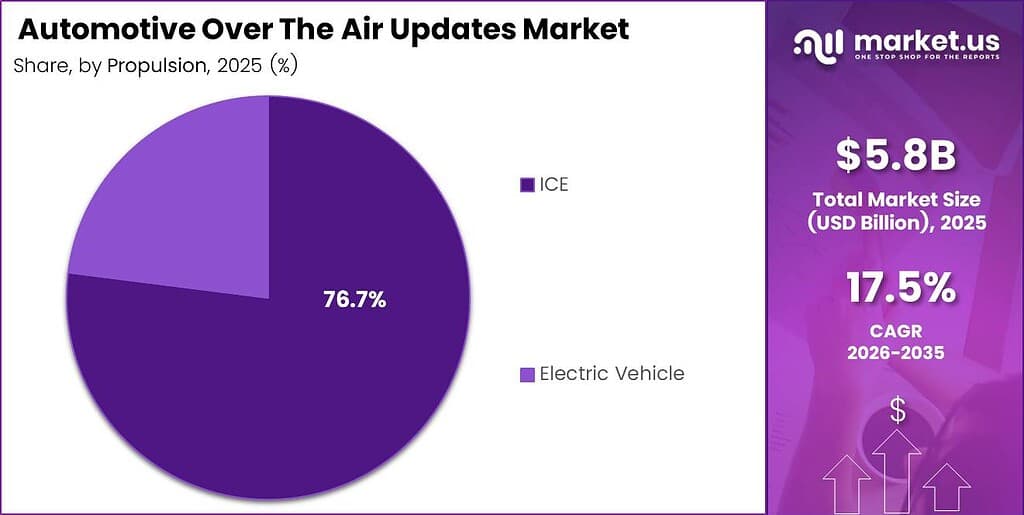
- By Propulsion, ICE vehicles lead with a 76.78% share.
- By Vehicle Type, Passenger Cars hold a 61.21% share and are also the fastest-growing segment.
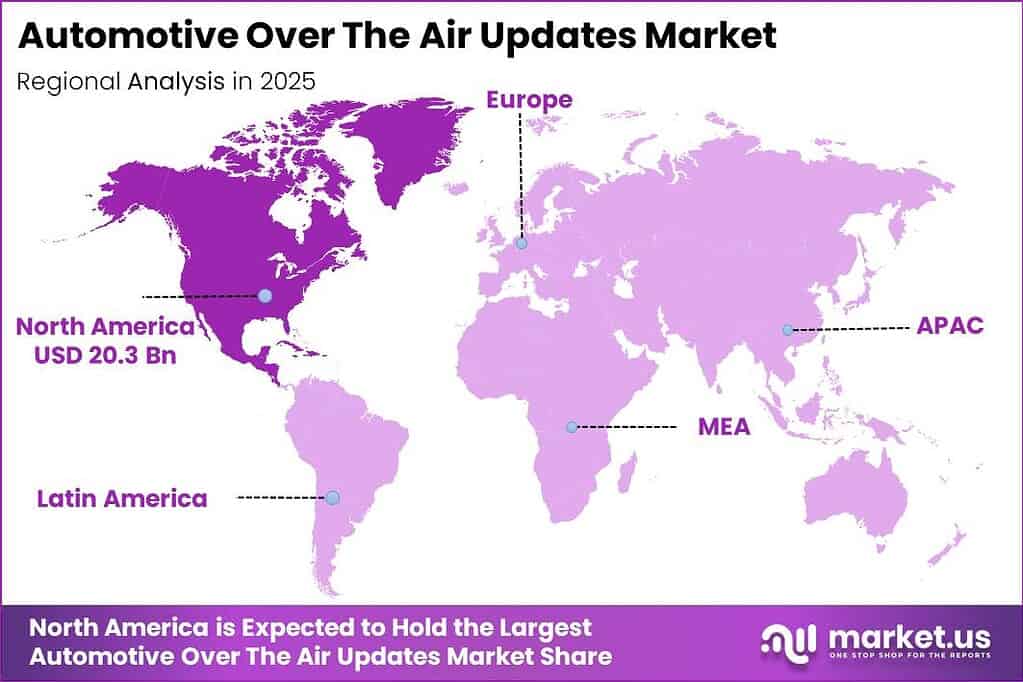
- North America is the dominant region with a 35.21% share, valued at USD 2.03 Billion.
- Asia-Pacific is the fastest-growing regional market.
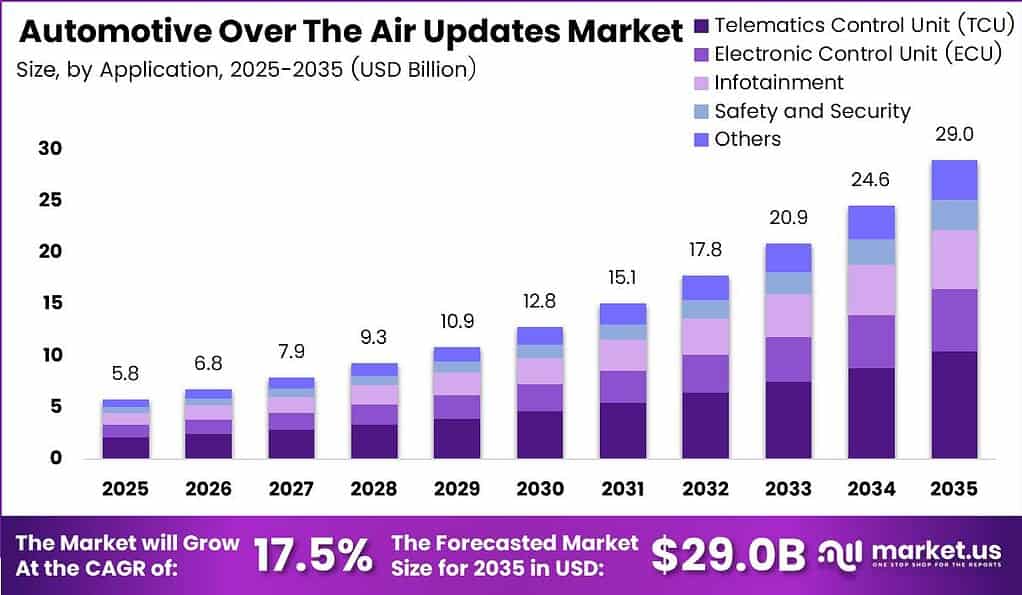
As per our research, more than 500 million connected cars were projected to be on roads by 2025, while connected-vehicle services were projected to reach USD 81 billion by 2030. This scale of connectivity creates a permanent addressable base for OTA platforms. Vendors who secure platform agreements now will benefit from recurring service revenue across multi-year vehicle lifecycles.
The United States recorded 950 vehicle recalls affecting 29,346,478 vehicles in 2024, according to the National Highway Traffic Safety Administration. This recall volume demonstrates the direct business case for OTA infrastructure. Manufacturers with remote update capability can resolve safety issues faster, reduce physical workshop costs, and limit reputational damage from extended recall timelines.
In January 2026, Tesla disclosed expected 2026 capital expenditure exceeding USD 20 billion, signaling continued investment in its software-defined vehicle ecosystem. General Motors announced approximately USD 4 billion of investment over two years in US manufacturing plants in June 2025. These commitments confirm that leading OEMs are treating software infrastructure and manufacturing upgrades as parallel priorities rather than competing budget lines.
Technology Analysis
Software Over-The-Air Technology (SOTA) dominates with 63.21% due to broader application scope across vehicle software layers.
In 2025, Software Over-The-Air Technology (SOTA) held a dominant market position in the By Technology segment of the Automotive Over The Air Updates Market, with a 63.21% share. SOTA enables updates to application-level software, infotainment systems, and telematics platforms without requiring physical access. This flexibility drives adoption across both passenger and commercial vehicle programs, giving manufacturers a scalable tool for continuous feature delivery and compliance management.
Firmware Over-The-Air Technology (FOTA) is the fastest-growing segment within this category. FOTA addresses low-level embedded software governing powertrain, braking, and safety systems, areas where update precision and validation overhead are highest. As centralized vehicle architectures replace distributed ECU networks, FOTA becomes the critical delivery mechanism for safety-relevant software changes. This positions FOTA vendors for accelerating demand as software-defined vehicles reach scale production.
Application Analysis
Telematics Control Unit (TCU) dominates with 36.23% due to its role as the primary vehicle connectivity gateway.
In 2025, Telematics Control Unit (TCU) held a dominant market position in the By Application segment of the Automotive Over The Air Updates Market, with a 36.23% share. The TCU functions as the vehicle’s primary connection point to cloud infrastructure, enabling OTA platforms to route updates, collect diagnostics, and manage session integrity. Manufacturers that invest in TCU architecture control the data pipeline, creating a structural advantage over software-only competitors.
Electronic Control Unit (ECU) updates represent the most technically complex application domain. A modern vehicle contains dozens of ECUs governing everything from engine management to door controls, and each requires validated, dependency-aware update packages. As ISO 24089:2023 tightens software update engineering standards at both the organizational and project level, ECU update platforms that demonstrate compliance will command premium positioning in OEM procurement cycles.
Infotainment systems represent a commercially visible OTA application layer. Manufacturers use infotainment updates to deliver new features, navigation map refreshes, and third-party app integrations, creating recurring engagement touchpoints with vehicle owners. This application layer also supports post-sale monetization, as feature unlocks and subscription-based content can be delivered without hardware changes, improving margin per vehicle over the ownership cycle.
Safety and Security is the fastest-growing application segment. Twenty-four US OTA recalls affected 6,769,773 vehicles in 2024, according to the National Highway Traffic Safety Administration, demonstrating the regulatory pressure that makes remote safety updates a compliance necessity rather than an optional capability. Stellantis announced USD 13 billion of US investment over four years in October 2025, supporting five new vehicles and product actions that will expand the safety-capable connected fleet. The remaining application categories, including Others, hold the balance of market share collectively.
Propulsion Analysis
ICE dominates with 76.78% due to the sheer size of the existing combustion-engine vehicle parc.
In 2025, ICE held a dominant market position in the By Propulsion segment of the Automotive Over The Air Updates Market, with a 76.78% share. Global motor-vehicle production reached 96.4 million units and global sales reached 99.8 million units in 2025, according to the International Organization of Motor Vehicle Manufacturers. Petrol and diesel vehicles still represented a combined 37% of EU new-car registrations through September 2025, down from 46.8% a year earlier. This declining but still-substantial base keeps ICE the largest OTA addressable segment for the near term.
Electric Vehicles are the fastest-growing propulsion segment for OTA updates. Nearly 22 million electric cars were produced worldwide in 2025, more than 25% above 2024, according to the International Energy Agency. EVs carry higher ECU counts, more complex battery management software, and mandatory regulatory compliance requirements, all of which increase update frequency. Rivian’s 2024 OTA-related recall covered 5,128 R1T and R1S vehicles, with 100% remedied remotely, illustrating the cost efficiency of wireless recall resolution compared to dealership-based campaigns.
Vehicle Type Analysis
Passenger Cars dominate with 61.21% due to higher connectivity penetration rates relative to commercial vehicles.
In 2025, Passenger Cars held a dominant market position in the By Vehicle Type segment of the Automotive Over The Air Updates Market, with a 61.21% share. Passenger Cars are also the fastest-growing vehicle type segment. Toyota established Toyota Invention Partners with JPY 100 billion in investment capacity and launched Woven Capital Fund II with USD 800 million in September 2025, directing capital toward software and mobility innovation that will directly support connected passenger-car platforms.
Commercial Vehicles hold the remaining market share in this segment. The EU registered 1,168,561 diesel vans, 307,460 new trucks, and 38,238 new buses in 2025, according to the European Automobile Manufacturers Association. Fleet operators managing large commercial vehicle populations face mounting pressure to reduce workshop downtime, making remote update capability a direct operational cost lever. This creates a clear business case for OTA platform providers targeting fleet procurement in European and North American markets.
Key Market Segments
By Technology
- Software Over-The-Air Technology (SOTA)
- Firmware Over-The-Air Technology (FOTA)
By Application
- Telematics Control Unit (TCU)
- Electronic Control Unit (ECU)
- Infotainment
- Safety and Security
- Others
By Propulsion
- ICE
- Electric Vehicle
By Vehicle Type
- Passenger Cars
- Commercial Vehicles
Regional Analysis
North America Dominates the Automotive Over The Air Updates Market with a Market Share of 35.21%, Valued at USD 2.03 Billion
North America holds the largest regional share at 35.21%, valued at USD 2.03 Billion in 2025. The region benefits from a high density of software-defined vehicle programs, established regulatory recall infrastructure, and deep OEM investment in connected platforms. Hyundai Motor India reported more than 0.8 million connected cars on Indian roads in August 2026 and targeted 1 million cumulative connected-car sales by 2027, reflecting the global OEM push into connected vehicle programs that North American platforms are already leading.
Asia-Pacific is the fastest-growing regional market for automotive OTA updates. The region produced approximately 59.2 million vehicles in 2025, an increase of 7.6%, and accounted for more than 61% of global production, according to the International Organization of Motor Vehicle Manufacturers. Indian passenger-vehicle sales reached 1.04 million units in the July–September quarter of fiscal 2025–26.
Hyundai Motor Group announced KRW 125.2 trillion of South Korean investment for 2026–2030 in November 2025, reinforcing Asia-Pacific as a primary growth engine for connected vehicle infrastructure. Volvo Cars raised EUR 500 million through its fifth green-bond issuance in June 2025, providing capital to support electrification and connected-vehicle programs that include Asia-Pacific expansion.
Key Regions and Countries
North America
- US
- Canada
Europe
- Germany
- France
- The UK
- Spain
- Italy
- Rest of Europe
Asia Pacific
- China
- Japan
- South Korea
- India
- Australia
- Rest of APAC
Latin America
- Brazil
- Mexico
- Rest of Latin America
Middle East and Africa
- GCC
- South Africa
- Rest of MEA
Market Dynamics
Market Opportunity Analysis - Underserved propulsion segments and emerging regional markets offer entry points for OTA platform providers
The Electric Vehicle propulsion segment is the fastest-growing OTA opportunity but remains underserved at the platform infrastructure level. Most current OTA investments target passenger car infotainment and telematics, leaving battery management software and FOTA for EV powertrains as a less-contested space. Providers that build EV-specific update orchestration will face fewer established incumbents and higher switching costs once design wins are secured.
Commercial Vehicles represent a structurally underexploited segment despite the EU registering 1,168,561 diesel vans, 307,460 new trucks, and 38,238 new buses in 2025. Fleet-scale deployments across logistics and long-haul transport create predictable, high-volume update cycles that justify dedicated platform investment. This segment rewards providers with uptime-linked service models and compliance documentation capabilities over those offering generic OTA toolkits.
Asia-Pacific, despite producing more than 61% of global vehicles in 2025, remains underserved by OTA platform providers headquartered outside the region. Local OEM software programs, regulatory timelines, and language-specific consent frameworks create barriers that global platforms have not yet fully addressed. This regional gap is an entry point for specialized middleware and compliance layer vendors willing to localize for Chinese, Indian, and Southeast Asian OEM requirements.
The Safety and Security application segment, while the fastest-growing, lacks mature platform standardization. The volume of OTA-resolved recalls, including 24 US OTA recalls affecting 6,769,773 vehicles in 2024, confirms regulatory appetite for wireless remediation. However, few providers offer end-to-end platforms covering compliance documentation, staged rollout, and post-deployment verification in a single integrated offering. This gap creates acquisition and partnership opportunities for platform consolidators.
Technology and Innovation Landscape - Centralized architectures, AI-driven development, and validated multi-ECU toolchains define the next competitive tier
GM’s centralized vehicle architecture is designed to deliver 10 times more OTA-update capacity, 1,000 times more bandwidth, and up to 35 times more AI-computing performance compared to its prior distributed systems, according to General Motors. This architectural shift moves OTA from a peripheral feature to a core vehicle operating system capability. Suppliers building platform software for centralized architectures will displace legacy ECU-level vendors that cannot scale across consolidated compute domains.
During 2020–2024, 3,514 US recalls affecting approximately 78 million vehicles had final remedies available in less than two months, according to the National Highway Traffic Safety Administration. This recall resolution speed reflects maturing OTA toolchain maturity among leading OEMs. Vendors that can demonstrate sub-two-month remedy delivery at fleet scale will gain credibility in regulatory conversations and OEM procurement evaluations as safety recall timelines become a public performance metric.
Digital twins and configuration-aware release orchestration are emerging as the primary tools for managing multi-ECU validation complexity. ISO 24089:2023 requires software-update engineering controls at both organizational and project levels, making validation toolchains a compliance necessity rather than an internal quality choice. Manufacturers that deploy digital twin environments for pre-release testing will reduce hardware-in-the-loop testing cycles, lower per-update validation costs, and accelerate time-to-deployment across complex multi-model vehicle portfolios.
Volkswagen Group announced plans to invest up to EUR 1 billion in AI-driven vehicle development, industrial applications, and high-performance IT by 2030. BMW i Ventures launched a USD 300 million fund in April 2026 targeting AI, industrial software, manufacturing, supply chains, and advanced materials. These investment signals confirm that AI integration into OTA release management, anomaly detection, and predictive update scheduling is moving from experimental to capital-backed priority status across tier-one OEMs.
Drivers
UN Regulation No. 156 became mandatory for all newly produced vehicles in the European Union from July 2024, requiring audited update-management systems, protected delivery, compatibility verification, owner notification, and recovery after failed installations. This regulatory shift converts OTA capability from a competitive feature into a type-approval requirement, expanding the addressable platform market and moving OEM procurement from project-based licensing toward recurring enterprise service agreements.
Electric-car sales exceeded 17 million in 2024 and 20 million in 2025, when electric models represented approximately 25% of worldwide new-car sales. This expanding EV installed base directly enlarges the fleet requiring compliant software-update infrastructure. Manufacturers replacing campaign-based licensing with cloud hosting and fleet-lifecycle software services are positioned to capture an estimated +2.2% contribution to the baseline CAGR through this transition.
| Driver | (~) % Impact on CAGR Forecast | Geographic Relevance | Impact Timeline |
|---|---|---|---|
| Mandatory Software Update Management | +2.2% | Europe, Japan, South Korea | Short term (≤ 2 years) |
| Software-Defined Electric Vehicles | +1.8% | Global, led by China | Short term (≤ 2 years) |
| Remote Recall Remediation | +1.2% | North America, Europe | Short term (≤ 2 years) |
| Lifecycle Feature Monetization | +0.9% | North America, Europe, China | Medium term (2–4 years) |
| ADAS Software Release Cadence | +0.8% | Global developed markets | Medium term (2–4 years) |
| Centralized Vehicle Architectures | +0.6% | China, North America, Europe | Medium term (2–4 years) |
Restraints
Global 5G coverage reached only 51% of the population in 2024, falling to 4% in low-income countries, while rural coverage stood at 29% compared with 67% in urban areas. Although 4G covered approximately 92% of the world population, coverage in low-income countries was about 52%. These gaps force manufacturers to maintain parallel dealership flashing and multi-fallback delivery systems, inflating per-vehicle support expenditure and limiting OTA platform scalability in high-growth emerging markets.
The duplication of physical and digital service infrastructure can defer regional platform launches and elevate per-vehicle support costs by an estimated 15–25%. This restraint is expected to deduct approximately 1.3% from the baseline CAGR until network reliability becomes commercially consistent across rural and low-income markets. Vendors building compressed, resumable delivery protocols for low-bandwidth environments will reduce this drag and gain early share in markets where broadband coverage improves.
| Restraint | (~) % Impact on CAGR Forecast | Geographic Relevance | Impact Timeline |
|---|---|---|---|
| Uneven Mobile Broadband Coverage | -1.3% | Africa, South Asia, rural markets | Short term (≤ 2 years) |
| Legacy ECU Incompatibility | -1.1% | Global legacy vehicle fleets | Long term (≥ 4 years) |
| Consumer Data Consent Barriers | -0.8% | Europe, North America | Short term (≤ 2 years) |
| Software Intellectual Property Restrictions | -0.7% | Global supplier ecosystems | Medium term (2–4 years) |
| Warranty Liability Restrictions | -0.6% | North America, Europe, Japan | Medium term (2–4 years) |
| Constrained Automotive Software CapEx | -0.5% | Price-sensitive global manufacturers | Short term (≤ 2 years) |
Challenges
ISO 24089:2023 applies software-update engineering requirements at both organizational and project levels, including package assembly and deployment after initial development. An update must remain safe across ECUs, gateways, software dependencies, and vehicle-specific configurations simultaneously. This multi-layer validation requirement forces manufacturers to allocate an estimated 10–20% of OTA release capacity to hardware-in-the-loop testing, dependency mapping, staged deployment, and rollback verification.
This validation burden creates approximately 1.2% of friction against maximum CAGR potential. However, it also drives long-term investment in digital twins and configuration-aware release orchestration, creating a specialist software market segment that did not exist at meaningful scale before widespread OTA deployment. Vendors delivering certified multi-ECU validation toolchains will capture disproportionate margin as compliance complexity increases.
| Challenge | (~) % CAGR Friction Drag | Geographic Relevance | Mitigation Horizon |
|---|---|---|---|
| Multi-ECU Validation Complexity | -1.2% | Global | Long term (≥ 4 years) |
| Expanding Cyberattack Surface | -1.0% | Global connected fleets | Long term (≥ 4 years) |
| Vehicle Configuration Fragmentation | -0.8% | Global multi-model portfolios | Medium term (2–4 years) |
| Fleet Telemetry Observability Gaps | -0.6% | Emerging and mature markets | Medium term (2–4 years) |
| Automotive Software Talent Shortage | -0.5% | Europe, Japan, North America | Long term (≥ 4 years) |
| Rollback and Power-State Failures | -0.4% | Global | Medium term (2–4 years) |
Opportunities
Most OTA deployments remain organized around vehicle maintenance, recalls, and manufacturer-controlled feature delivery rather than contractually guaranteed commercial-fleet uptime. Capturing the Fleet Uptime as a Service opportunity requires deliberate integration of OTA orchestration with telematics, predictive diagnostics, and fleet-management workflows. This enables providers to price around availability and avoided workshop visits rather than software seat licenses.
Reducing software-related workshop events by 30–50% and lowering intervention cost per vehicle by 20–40% could expand service gross margins by approximately 8–12 percentage points. Under a scaled execution scenario, this opportunity could add up to 1.1% above the 17.5% baseline CAGR. Providers that build uptime-linked service contracts into fleet procurement agreements will lock in recurring revenue streams before broader market standardization compresses pricing.
| Opportunity | (~) % Potential CAGR Upside | Geographic Relevance | Execution Window |
|---|---|---|---|
| Fleet Uptime as a Service | +1.1% | North America, Europe, China | Medium term (2–4 years) |
| Battery Health Optimization Services | +0.9% | Global electric vehicle markets | Medium term (2–4 years) |
| Third-Party Automotive App Ecosystems | +0.8% | Europe, followed by global markets | Medium term (2–4 years) |
| OTA Platform Consolidation | +0.7% | Fragmented global vendor markets | Medium term (2–4 years) |
| Connected Two-Wheeler Expansion | +0.6% | India, Southeast Asia, Latin America | Long term (≥ 4 years) |
| Insurance-Linked Risk Updates | +0.5% | North America, Europe | Long term (≥ 4 years) |
Key Company Insights
Tesla, Inc. recognized USD 94.83 billion in total revenue during 2025, down USD 2.86 billion from 2024, according to its SEC filing. Despite this revenue decline, Tesla’s vertically integrated OTA infrastructure remains its deepest competitive moat. The company’s ability to push software updates to its entire global fleet without third-party middleware gives it a speed and cost advantage that legacy OEMs cannot replicate without fundamental architecture changes.
Volkswagen AG delivered 8,983,900 vehicles worldwide in 2025, down 0.5% from 9,026,681 vehicles in 2024. In September 2025, Volkswagen Group announced plans to invest up to EUR 1 billion in AI-driven vehicle development, industrial applications, and high-performance IT by 2030. General Motors announced USD 275 million for its Spring Hill complex in June 2026 and USD 830 million for three US propulsion sites in April 2026, taking domestic manufacturing investment above USD 6 billion over 12 months. These capital commitments signal that platform-scale software infrastructure investment is becoming a baseline competitive requirement across top-tier OEMs.
Key Players
- Tesla, Inc.
- Volkswagen AG
- General Motors Co.
- Hyundai Motor Company
- Toyota Motor Corp.
- BMW AG
- Mercedes-Benz Group AG
- Ford Motor Co.
- Stellantis N.V.
- Volvo Car Corp.
- Renault Group
- Nissan Motor Co., Ltd.
- Other Key Players
Recent Developments
- 30 June 2026 – BMW Group completed a USD 1.7 billion investment in its South Carolina operations, supporting US production of fully electric vehicles beginning in late 2026.
- 21 May 2026 – Stellantis unveiled the EUR 60 billion, five-year FaSTLAne 2030 strategic plan.
- 29 April 2026 – BMW i Ventures launched a USD 300 million fund focused on AI, industrial software, manufacturing, supply chains, and advanced materials.
- 3 March 2026 – Volvo Cars launched its largest OTA software update for approximately 2.5 million vehicles across 85 countries.
- 26 February 2026 – Ford announced an OTA-capable Integrated Trailer Module software update covering approximately 4,380,609 US vehicles.
- 18 November 2025 – Toyota announced USD 912 million of investment in five US hybrid-vehicle manufacturing plants.
- 13 November 2025 – Toyota announced up to USD 10 billion of additional US investment over five years.
- 9 September 2025 – Volkswagen Group announced plans to invest up to EUR 1 billion in AI-driven vehicle development, industrial applications, and high-performance IT by 2030.
- 26 August 2025 – Hyundai Motor Group increased its planned US investment for 2025–2028 to USD 26 billion.
- 13 November 2024 – Rivian and Volkswagen Group Technologies commenced operations, with Volkswagen planning investments of up to USD 5.8 billion by January 2028.
Report Scope
| Report Features | Description |
|---|---|
| Market Value (2025) | USD 5.8 Billion |
| Forecast Revenue (2035) | USD 29.0 Billion |
| CAGR (2026-2035) | 17.5% |
| Base Year for Estimation | 2025 |
| Historic Period | 2020-2024 |
| Forecast Period | 2026-2035 |
| Report Coverage | Revenue Forecast, Market Dynamics, Market Opportunity Analysis, Technology and Innovation Landscape, Competitive Landscape, Recent Developments |
| Segments Covered | By Technology (Software Over-The-Air Technology (SOTA), Firmware Over-The-Air Technology (FOTA)), By Application (Telematics Control Unit (TCU), Electronic Control Unit (ECU), Infotainment, Safety and Security, Others), By Propulsion (ICE, Electric Vehicle), By Vehicle Type (Passenger Cars, Commercial Vehicles) |
| Regional Analysis | North America (US and Canada), Europe (Germany, France, The UK, Spain, Italy, and Rest of Europe), Asia Pacific (China, Japan, South Korea, India, Australia, and Rest of APAC), Latin America (Brazil, Mexico, and Rest of Latin America), Middle East and Africa (GCC, South Africa, and Rest of MEA) |
| Competitive Landscape | Tesla, Inc., Volkswagen AG, General Motors Co., Hyundai Motor Company, Toyota Motor Corp., BMW AG, Mercedes-Benz Group AG, Ford Motor Co., Stellantis N.V., Volvo Car Corp., Renault Group, Nissan Motor Co., Ltd., Other Key Players |
| Customization Scope | Customization for segments, region/country-level will be provided. Additional customization can be done based on requirements. |
| Purchase Options | We have three licenses to opt for: Single User License, Multi-User License (Up to 5 Users), Corporate Use License (Unlimited User and Printable PDF) |





































