


Report Overview
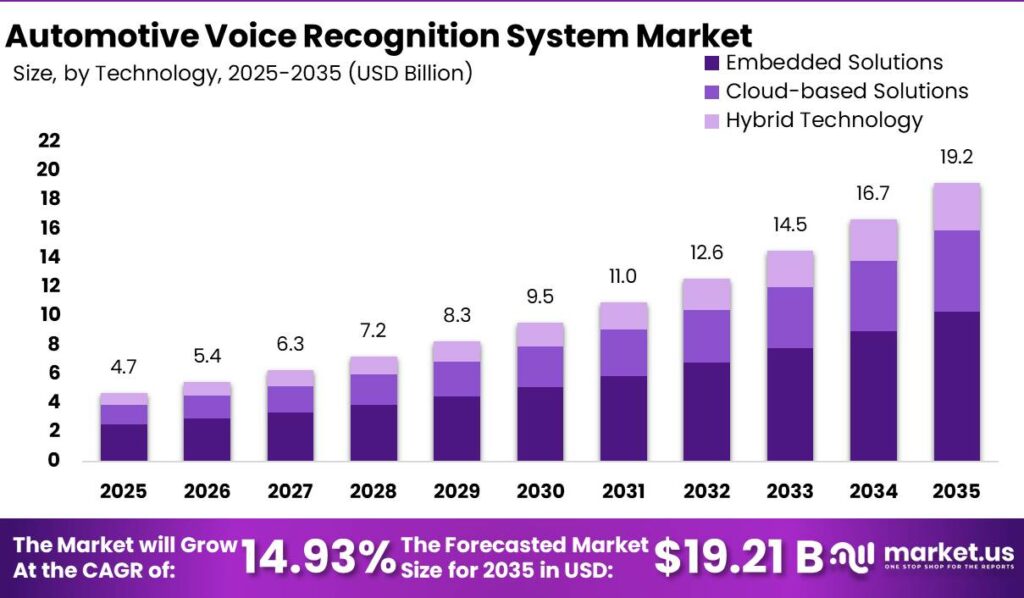
Global Automotive Voice Recognition System Market size is expected to be worth around USD 19.21 Billion by 2035 from USD 4.74 Billion in 2025, growing at a CAGR of 14.93% during the forecast period 2026 to 2035. Voice recognition now anchors the driver interface layer inside connected vehicle cockpits. Suppliers who control the speech stack control cockpit software revenue for a full decade.
This market covers embedded, cloud and hybrid speech engines that convert spoken commands into vehicle actions. The structure spans three tiers. Chipset and microphone hardware vendors sit at the base, natural language software specialists occupy the middle, and automakers integrate the finished stack. Therefore value concentrates in the software tier, where licensing and subscription models scale faster than hardware margins allow.
Key Takeaways
- Market value reached USD 4.74 Billion in 2025 and will hit USD 19.21 Billion by 2035.
- The market grows at a CAGR of 14.93% across 2026 to 2035.
- Embedded Solutions led the technology segment with a 53.80% share.
- Passenger Cars dominated vehicle type demand with a 72.60% share.
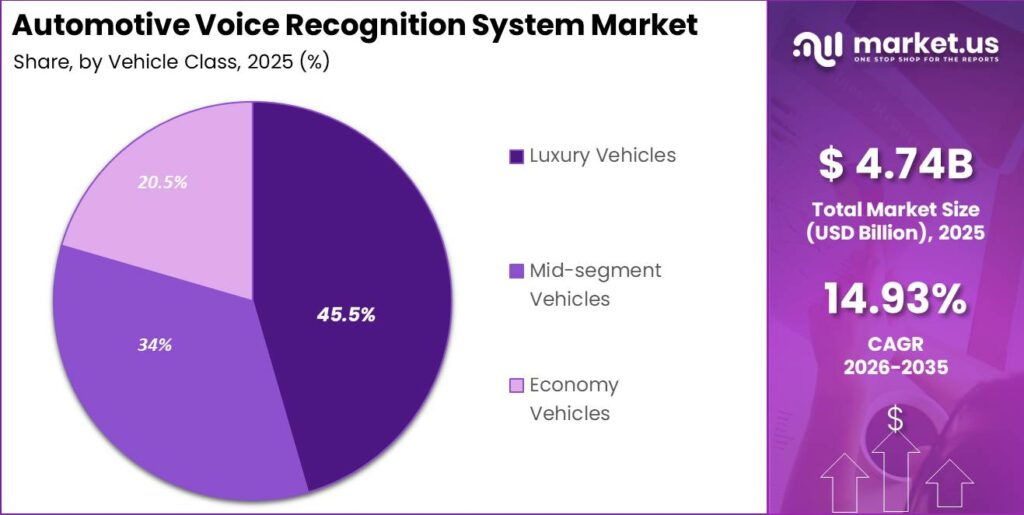
- Luxury Vehicles held 45.50% of the vehicle class segment.
- Single-Microphone designs captured 31.70% of microphone array demand.
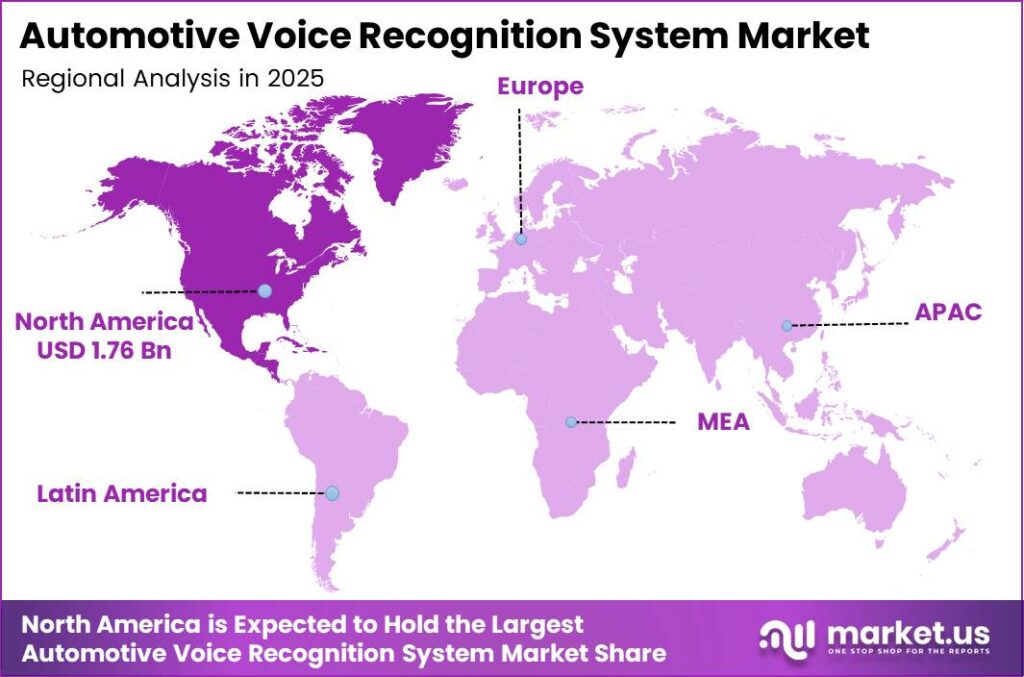
- North America led all regions with 37.10% share, valued at USD 1.76 Billion.
Regulators shape adoption speed as much as engineering budgets do. Hands-free operation rules and distracted driving statutes in North America and Europe push automakers to standardize voice control rather than sell it as an option. This means compliance spending converts directly into installed base. Suppliers with certified, low latency engines win platform contracts that lock in revenue across entire model cycles.
As reported by SoundHound, 73% of regular United States drivers want voice AI to order food while driving. This appetite moves voice beyond navigation into paid transactions. Automakers who add payment tokenization capture commission revenue on every spoken order, turning a fixed cost interface into a margin generating channel.
Data from Master of Code shows 77% of consumers already use voice assistants on smartphones. This familiarity removes the training barrier that slowed earlier cockpit systems. Consequently, Cerence AI launched Cerence xUI in March 2025 as a hybrid edge and cloud platform for agentic interaction, signaling that suppliers now compete on reasoning quality rather than command counts.
Technology Analysis
Embedded Solutions dominates with 53.80% due to offline reliability inside moving vehicles.
In 2025, Embedded Solutions held a dominant market position in the By Technology segment of Automotive Voice Recognition System Market, with a 53.80% share. OICA production data records 92.5 million motor vehicles built worldwide in 2024, and every unit needs a control interface that works without network access. This means embedded engines remain the default safety baseline, protecting incumbent licensors from pure cloud challengers.
Cloud-based Solutions serve automakers that need continuous model updates after vehicles leave the factory. ITU figures show 5.5 billion people used the internet in 2024, yet coverage gaps persist across rural corridors. Therefore cloud engines deliver richer answers but carry connectivity risk. Suppliers must price cloud tiers as premium subscriptions rather than standard equipment to protect customer satisfaction scores.
Hybrid Technology routes simple commands on device and complex reasoning to servers. Cerence AI partnered with SiMa.ai in September 2025 to run CaLLM Edge on the Modalix MLSoC for low power embedded conversational AI. This split architecture cuts inference bills while preserving response speed. Automakers gain negotiating leverage because they can shift workloads between silicon vendors and cloud providers.
Vehicle Type Analysis
Passenger Cars dominates with 72.60% due to highest consumer cockpit feature expectations.
In 2025, Passenger Cars held a dominant market position in the By Vehicle Type segment of Automotive Voice Recognition System Market, with a 72.60% share. According to OICA registration data, passenger car sales exceeded 65 million units globally in 2024. This volume spreads software development cost across huge platforms. As a result, voice suppliers price aggressively for car programs and recover margin through connected service renewals.
Light Commercial Vehicles carry drivers who spend full shifts inside the cab handling deliveries. Eurostat road freight statistics confirm that light goods vehicles handle a rising share of urban last mile trips across the European Union. Voice control keeps hands on the wheel during constant stop and start routes. Fleet buyers therefore judge systems on accident reduction rather than entertainment features.
Heavy Commercial Vehicles rank as the fastest growing type because cabin noise and long shifts make manual screens impractical. UNIDO industrial statistics track sustained growth in transport equipment manufacturing output, which expands the addressable truck fleet. Suppliers who tune noise robust models for truck cabins can charge premium licences, since few vendors validate performance at diesel engine sound levels.
Vehicle Class Analysis
Luxury Vehicles dominates with 45.50% due to standard fitment of advanced cockpits.
In 2025, Luxury Vehicles held a dominant market position in the By Vehicle Class segment of Automotive Voice Recognition System Market, with a 45.50% share. Mercedes-Benz Group annual report figures show the company sold roughly 2.4 million vehicles in 2024 across premium lines that ship voice assistants as standard. This means premium platforms fund first generation development before features cascade downward.
Mid-segment Vehicles adopt voice once component costs fall below option pricing thresholds. Corporate filings from Volkswagen Group report deliveries near 9 million vehicles in 2024, mostly in mid tier badges. This scale makes the segment the true profit pool for licensors. Suppliers who deliver trimmed feature sets at lower memory footprints capture the largest unit volumes.
Economy Vehicles grow fastest as regional automakers add basic speech control to compete on features. National statistical office data from India records passenger vehicle production above 4.5 million units in recent fiscal reporting, concentrated in affordable models. Consequently, low cost offline engines with regional language support open a volume driven revenue path in price sensitive markets.
Microphone Array Design Analysis
Single-Microphone dominates with 31.70% due to lowest bill of material cost.
In 2025, Single-Microphone held a dominant market position in the By Microphone Array Design segment of Automotive Voice Recognition System Market, with a 31.70% share. UN Comtrade trade records show global microphone and headphone imports under HS code 8518 run into billions of dollars annually. This means single element designs benefit from mature, high volume supply chains that keep unit prices predictable.
Dual-Microphone layouts separate driver speech from passenger conversation using two capture points. Patent database records from the World Intellectual Property Organization show sustained filing activity in acoustic beamforming and noise suppression classifications. This innovation pipeline signals that dual designs will become the mid tier standard. Suppliers should expect tighter validation demands from automakers on speaker separation accuracy.
Beam-Forming Arrays grow fastest because zone based control lets each seat issue separate commands. IEC and SAE standards work on in cabin audio measurement gives automakers common test benchmarks for array performance. Therefore array vendors that publish certified test results shorten OEM qualification cycles and win design slots ahead of unverified competitors.
Key Market Segments
By Technology
- Embedded Solutions
- Cloud-based Solutions
- Hybrid Technology
By Vehicle Type
- Passenger Cars
- Light Commercial Vehicles
- Heavy Commercial Vehicles
By Vehicle Class
- Luxury Vehicles
- Mid-segment Vehicles
- Economy Vehicles
By Microphone Array Design
- Single-Microphone
- Dual-Microphone
- Beam-Forming Arrays
Regional Analysis
North America Dominates the Automotive Voice Recognition System Market with a Market Share of 37.10%, Valued at USD 1.76 Billion
North America holds 37.10% of global revenue, worth USD 1.76 Billion in 2025. Early connected service adoption and high premium vehicle mix drive this lead. In November 2025, Alphabet began the global rollout of Gemini on Android Auto in 45 languages, replacing Google Assistant. This means platform giants now set interface expectations, forcing tier one suppliers to differentiate on vehicle integration depth.
Asia Pacific grows fastest as regional automakers scale digital cockpits into affordable models. Local language coverage decides who wins these programs. Suppliers that build dialect capable models early gain multi year platform positions. By contrast, vendors relying only on English and Mandarin models will lose bids across South and Southeast Asian markets where linguistic diversity shapes purchase decisions.
Europe, Latin America and the Middle East and Africa hold the remaining share collectively. European demand tracks premium exports and strict driver distraction rules. Latin American and Middle Eastern uptake follows imported vehicle mix. This creates an entry route for suppliers offering compliance ready packages, since regional automakers rarely build in house speech teams.
Key Regions and Countries
North America
- US
- Canada
Europe
- Germany
- France
- The UK
- Spain
- Italy
- Rest of Europe
Asia Pacific
- China
- Japan
- South Korea
- India
- Australia
- Rest of APAC
Latin America
- Brazil
- Mexico
- Rest of Latin America
Middle East and Africa
- GCC
- South Africa
- Rest of MEA
Market Dynamics
Market Opportunity Analysis - Underserved vehicle classes, commercial fleets and emerging regions offer the clearest entry points
Economy Vehicles remain underexploited because automakers historically treated voice as a premium option. Luxury Vehicles still hold 45.50% of the class segment, which shows how little penetration exists below the premium tier. This creates room for suppliers offering stripped down offline engines. New entrants can win volume contracts without competing against incumbent premium licence pricing.
Heavy Commercial Vehicles sit outside the passenger car mainstream that controls 72.60% of demand. Fleet operators buy on safety and uptime, not cabin luxury. This means the segment rewards vendors that prove noise robust performance in field trials. Early movers gain multi year fleet contracts that renew automatically with vehicle replacement cycles.
Beam-Forming Arrays trail Single-Microphone designs, which hold 31.70% of the array segment. This gap reflects cost caution rather than weak demand for zone based control. Consequently, array vendors that hit automotive cost targets can leapfrog into new cockpit programs. Investors should watch component suppliers rather than only software licensors here.
Asia Pacific ranks as the fastest growing region while North America still holds 37.10% of revenue. This imbalance signals unclaimed share across high volume production bases. Instead of chasing saturated premium accounts, entrants should target regional automakers needing local language coverage. That path builds installed base before global platform rivals localize their own assistants.
Technology and Innovation Landscape - Offline accuracy, low latency inference and multilingual coverage now decide platform wins
A 2025 SAE technical paper reported at least 97% wake word and intent recognition accuracy for an embedded offline voice assistant tested under typical commercial truck cabin noise. This proves offline engines can match cloud quality in harsh acoustics. Therefore automakers can commit to voice control in trucks without network dependency, which expands the addressable fleet market immediately.
The same 2025 commercial truck prototype achieved response latency of 400 to 700 milliseconds under typical cabin noise. Sub second response protects driver trust and reduces repeat commands. Suppliers who publish verified latency figures shorten qualification cycles. Automakers can then price voice as a safety feature rather than an infotainment extra.
In a 2025 BMW and TUM study, GPT-4 with input output prompting reached 90.2% factual relevance accuracy and 92.2% factual consistency accuracy when evaluating in car conversational responses. Testing also processed each evaluation in an average of 4.5 seconds using 689 tokens. This means automated evaluation can replace costly manual review, cutting validation spend per software release.
SoundHound’s 2025 automotive wake word system supported more than 25 languages, needed only 2 to 6 MB of memory and offered development cycles up to 14 weeks. Alphabet’s Gemini for Android Auto added conversational interaction in 45 languages during 2025. As a result, language breadth now functions as the primary competitive moat in emerging markets.
Drivers
Generative AI and large language model integration inside OEM cockpits now reshapes how voice earns money. Automakers moved from fixed command grammars to context aware assistants. Volkswagen shipped an automotive grade ChatGPT integration through Cerence Chat Pro as standard equipment on the ID.7, Passat and Tiguan from the second quarter of 2024. Audi followed across its lineup in July 2024. This converts a one time embedded licence into recurring cloud linked service revenue.
Mercedes-Benz confirmed integration across more than 900,000 vehicles under a beta program. Market.us data shows fixed licence contract revenue roughly doubled to about $21.5 Million in a single quarter year over year, with core technology guided to near 8% growth into FY26. This means suppliers cut per vehicle acquisition cost while raising connected service attach rates. However, cloud inference cost decides whether the 14.93% trajectory becomes durable revenue per user.
| Driver | (~) % Impact on CAGR Forecast | Geographic Relevance | Impact Timeline |
|---|---|---|---|
| Generative AI & LLM voice integration in OEM cockpits | +3.4% | North America, Europe, China | Short term (2 years or less) |
| Software-defined vehicle architecture adoption | +2.6% | Global | Medium term (2 to 4 years) |
| BEV production scale-up with digital-native cockpits | +2.1% | Asia Pacific, Europe | Medium term (2 to 4 years) |
| Hands-free safety mandates & distracted-driving regulation | +1.5% | North America, Europe | Short term (2 years or less) |
| Multilingual & regional-dialect NLU expansion | +1.2% | Asia Pacific, Middle East | Medium term (2 to 4 years) |
| Connected-services subscription monetization by OEMs | +1.0% | Global | Short term (2 years or less) |
Restraints
Connected vehicle privacy law now gates cloud voice rollouts. Always listening capture counts as biometric and behavioral personal data under the EU GDPR. The European Commission sets a penalty ceiling of 20 Million euros or 4% of global annual turnover. This makes non compliant launches commercially impossible. Automakers geo fence or delay features until consent and data residency duties are proven, freezing revenue that would otherwise book on delivery.
India’s Digital Personal Data Protection Act, 2023 and the draft DPDP Rules 2025 add explicit consent, purpose limitation and telematics data mapping duties per Ministry of Electronics and Information Technology notifications. Automakers must split safety critical processing from commercial analytics before activation. As a result, validation timelines stretch by several quarters and engineering budgets shift toward consent management. This compresses margins on premium voice packages and delays cloud infrastructure recognition.
| Restraint | (~) % Impact on CAGR Forecast | Geographic Relevance | Impact Timeline |
|---|---|---|---|
| Data-privacy consent regimes freezing feature rollouts | -2.3% | Europe, India | Short term (2 years or less) |
| High interest rates suppressing new-vehicle demand | -1.9% | Global | Short term (2 years or less) |
| Automotive-grade semiconductor allocation scarcity | -1.6% | Global | Short term (2 years or less) |
| Cross-border tariffs on electronic sub-assemblies | -1.3% | North America, China | Short term (2 years or less) |
| Entry-segment cost sensitivity blocking premium voice | -1.0% | Asia Pacific, Latin America | Medium term (2 to 4 years) |
Challenges
Edge and cloud architecture tension creates constant operational friction. Hybrid stacks must answer in under a second to keep driver trust, yet the highest value conversational features fail when cellular coverage drops. Central compute and quasi zonal software defined vehicle platforms will anchor most hardware value uplift by 2029 per IDTechEx forecasts. However, ITU records show uneven network deployment across rural and emerging market corridors, which limits where premium features can launch.
Round trip inference forces automakers to duplicate models on device and in the cloud. This raises per vehicle compute bill of materials and pressures automotive grade semiconductor supply, which industry association shipment data shows recovering only gradually through late 2025 with continuing MCU constraints. Therefore automakers invest in small language model distillation, caching and multi carrier contracts. That spending protects the 14.93% baseline from latency driven churn.
| Challenge | (~) % CAGR Friction Drag | Geographic Relevance | Mitigation Horizon |
|---|---|---|---|
| Edge-cloud latency & connectivity gaps | -1.8% | Global | Medium term (2 to 4 years) |
| Conversational-AI talent deficit | -1.4% | North America, Europe, India | Long term (4 years or more) |
| Recurring cloud inference cost inflation | -1.2% | Global | Medium term (2 to 4 years) |
| Multi-tier supplier integration complexity | -1.0% | Global | Medium term (2 to 4 years) |
| Voice accuracy in noisy & accented conditions | -0.9% | Asia Pacific, Middle East | Long term (4 years or more) |
Opportunities
Voice initiated in car commerce remains the largest open white space. Current deployments monetize voice as a control interface and subscription, not as a transaction rail for fuel, charging, parking, food and toll payments. Embedded payment tokenization and agentic intent execution only just matured. Mapping partners such as HERE signed roughly $1 Billion ten year cloud commitments with AWS, which signals infrastructure readiness ahead of monetization.
The unit economics shift decisively. Moving voice from a fixed licence to a per transaction take rate adds high margin revenue on installed hardware at almost no incremental cost per unit. Even a low single digit commission on connected vehicle payment flows would lift voice module gross margin by several hundred basis points. This means early movers on merchant onboarding and PSD2 aligned consent capture upside above the 14.93% baseline.
| Opportunity | (~) % Potential CAGR Upside | Geographic Relevance | Execution Window |
|---|---|---|---|
| In-car voice commerce & transaction monetization | +2.8% | North America, China | Medium term (2 to 4 years) |
| Agentic AI upsell across aftermarket & OTA fleet | +2.2% | Global | Medium term (2 to 4 years) |
| Commercial & fleet-vehicle voice telematics adjacency | +1.7% | North America, Europe | Long term (4 years or more) |
| Emerging-market localized-language white space | +1.4% | India, Southeast Asia, Africa | Long term (4 years or more) |
| Supplier M&A roll-up of niche NLU specialists | +1.1% | Global | Medium term (2 to 4 years) |
Key Company Insights
Sensory competes on embedded efficiency rather than cloud scale. Its 2025 TrulyHandsfree and TrulyNatural speech SDK version 7.6.0 supported 4 operating system families covering Windows, macOS, Android and iOS. This breadth lets automakers reuse one wake word engine across mixed cockpit platforms. However, its narrow cloud footprint leaves the reasoning layer open to larger platform rivals.
Nuance Communications built its position on deep automotive natural language libraries and long standing OEM relationships. Platform level assistants now ship with more than 100 knowledge domains spanning vehicle controls, navigation, weather, entertainment and messaging. This depth raises switching costs for automakers mid program. By contrast, rising generative competition pressures legacy licence pricing and pushes value toward subscription based service tiers.
Key Players
- Sensory
- Nuance Communications
- Harman International
- Alphabet Inc.
- Amazon.com, Inc.
- Cerence Inc.
Recent Developments
- January 2025: HARMAN launched the Luna in-vehicle avatar, powered by its Ready Engage emotionally intelligent AI system.
- January 2025: Cerence AI expanded its NVIDIA collaboration to advance its cloud-based CaLLM and embedded CaLLM Edge automotive language models.
- April 2025: Cerence AI partnered with MediaTek and expanded its NVIDIA collaboration to develop the next generation of CaLLM Edge for automotive experiences.
- June 2026: Amazon Alexa and ThunderSoft partnered to integrate Alexa Custom Assistant into automakers’ vehicle architectures and accelerate production deployment of branded in-vehicle voice assistants.
Geopolitical Impact Analysis
According to the WTO, average applied tariffs on electronic components remain a direct cost input for cockpit modules, while merchandise trade growth held near 2.7% in recent estimates. Voice systems depend on imported microcontrollers, microphones and audio codecs. Consequently, tariff layers on electronic sub assemblies raise landed module cost and push suppliers to dual source silicon across regions rather than concentrate on single country plants.
Data from UNCTAD shows container shipping rates spiked well above 100% on key routes during Red Sea rerouting, adding roughly 10 extra transit days around the Cape of Good Hope. As reported by the IEA, energy price volatility further lifts manufacturing costs for semiconductor fabrication. This means automakers hold larger buffer inventories of voice hardware, tying up working capital and delaying program launches.
Report Scope
| Report Features | Description |
|---|---|
| Market Value (2025) | USD 4.74 Billion |
| Forecast Revenue (2035) | USD 19.21 Billion |
| CAGR (2026-2035) | 14.93% |
| Base Year for Estimation | 2025 |
| Historic Period | 2020-2024 |
| Forecast Period | 2026-2035 |
| Report Coverage | Revenue Forecast, Market Dynamics, Market Opportunity Analysis, Technology and Innovation Landscape, Competitive Landscape, Recent Developments |
| Segments Covered | By Technology (Embedded Solutions, Cloud-based Solutions, Hybrid Technology), By Vehicle Type (Passenger Cars, Light Commercial Vehicles, Heavy Commercial Vehicles), By Vehicle Class (Luxury Vehicles, Mid-segment Vehicles, Economy Vehicles), By Microphone Array Design (Single-Microphone, Dual-Microphone, Beam-Forming Arrays) |
| Regional Analysis | North America (US and Canada), Europe (Germany, France, The UK, Spain, Italy, and Rest of Europe), Asia Pacific (China, Japan, South Korea, India, Australia, and Rest of APAC), Latin America (Brazil, Mexico, and Rest of Latin America), Middle East and Africa (GCC, South Africa, and Rest of MEA) |
| Competitive Landscape | Sensory, Nuance Communications, Harman International, Alphabet Inc., Amazon.com, Inc., Cerence Inc. |
| Customization Scope | Customization for segments, region / country-level will be provided. Additional customization can be done based on requirements. |
| Purchase Options | We have three licenses to opt for: Single User License | Multi-User License (Up to 5 Users) | Corporate Use License (Unlimited User and Printable PDF) |





































