


Report Overview
Global Remote Vehicle Diagnostic Market size is expected to be worth around USD 83.18 Billion by 2035 from USD 19.68 Billion in 2025, growing at a CAGR of 15.56% during the forecast period 2026 to 2035. This expansion reflects a structural shift from workshop-only fault finding to always-on, cloud-linked vehicle health systems. Investors who price connectivity attach rates into OEM and fleet models capture recurring software revenue instead of one-time hardware sales.
Therefore, the Remote Vehicle Diagnostic Market covers hardware probes, cloud software, and managed services that read vehicle controllers, stream fault data, and guide repair decisions at distance. The structure spans product type, vehicle type, connectivity path, application use case, and sales channel. Each layer decides who owns the data loop and who bills the end customer for uptime protection.
Key Takeaways
- The market is valued at USD 19.68 Billion in 2025 and is projected to reach USD 83.18 Billion by 2035.
- The market is expected to grow at a CAGR of 15.56% from 2026 to 2035.
- Diagnostic Equipment leads the By Product Type segment with a 49.00% share.
- Passenger Cars lead the By Vehicle Type segment with a 58.50% share.
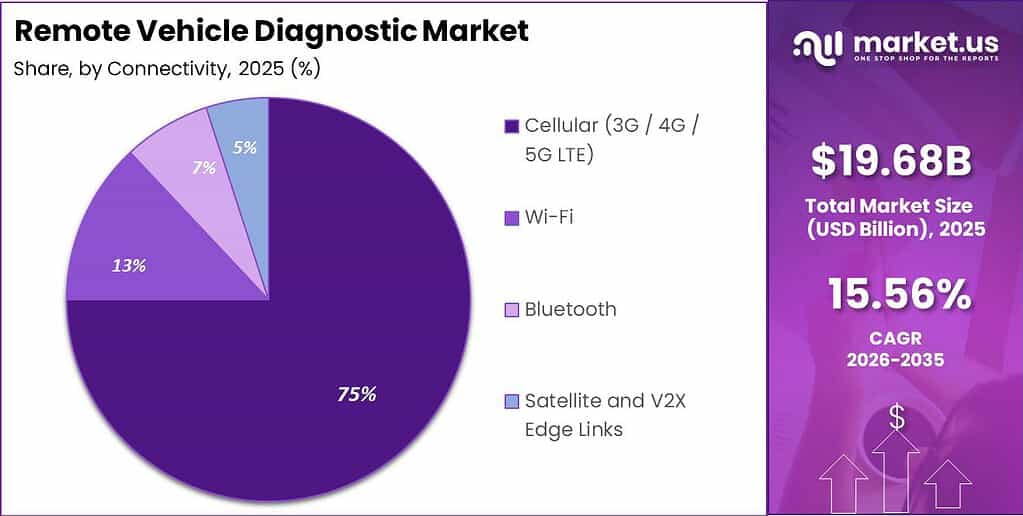
- Cellular (3G / 4G / 5G LTE) leads the By Connectivity segment with a 75.00% share.
- Vehicle Health Tracking and Prognostics leads the By Application segment with a 51.35% share.
- OEM-installed leads the By Sales Channel segment with a 86.85% share.
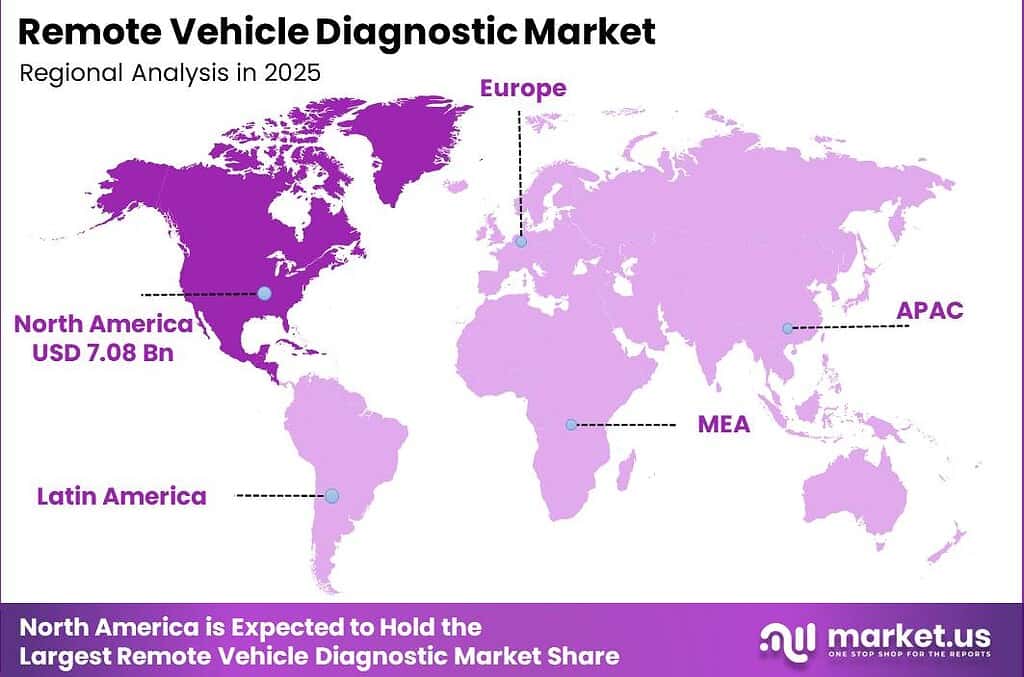
- North America is the leading region with a 36.00% share, valued at USD 7.08 Billion.
As per our research, predictive maintenance backed by remote fault monitoring can lift vehicle uptime by up to 25% versus reactive repair. This uptime gain cuts unplanned downtime risk for fleet buyers. Consequently, platforms that prove measurable availability gains win multi-year subscription renewals ahead of pure hardware vendors. 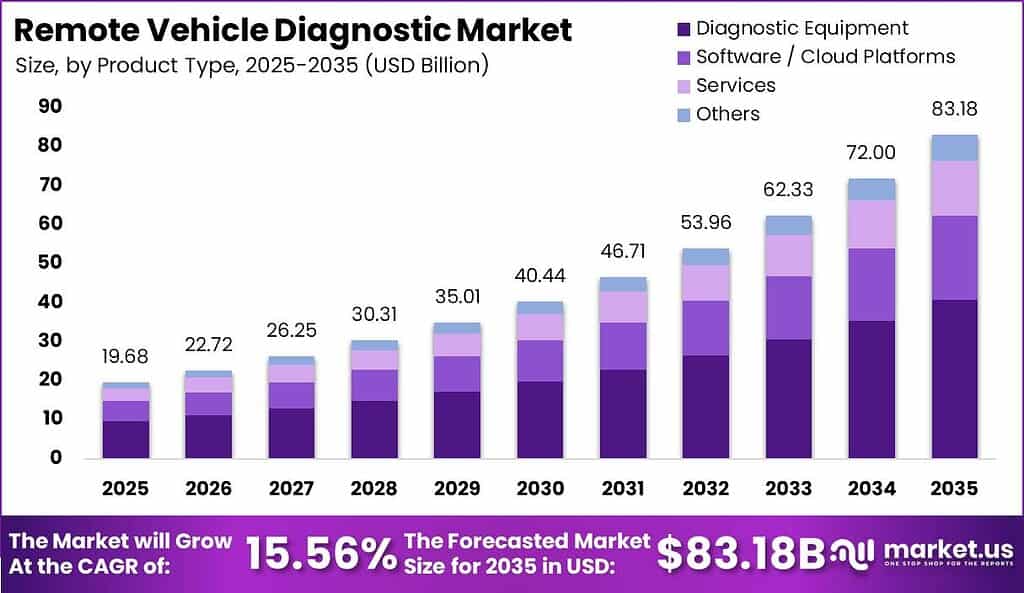
Data from Geotab shows 75% of surveyed service leaders said remote diagnostic tools improved first-time-fix rates by at least 11%. Higher first-time-fix rates lower return visits and labor waste. This creates a clear path for service chains to price diagnostic access as a productivity product rather than a free add-on.
As a result, integrated factory telematics deals, such as the June 2025 Geotab and Mercedes-Benz USA link of factory vehicle data into MyGeotab, pull fleet buyers toward OEM-grade data streams. End-use growth in commercial and passenger fleets then lifts demand for continuous health feeds. Sellers who own the factory data pipe lock out pure aftermarket dongles on new vehicle cohorts.
Product Type Analysis
Diagnostic Equipment dominates with 49.00% due to direct controller access needs.
In 2025, Diagnostic Equipment held a dominant market position in the By Product Type segment of Remote Vehicle Diagnostic Market, with a 49.00% share. Physical readers and scan tools still open the vehicle bus when cloud links fail. Mack systems can surface detailed fault codes in less than 1 minute, which speeds bay throughput. Buyers who standardize on fast readers cut idle technician time and protect shop margin.
Software and Cloud Platforms turn raw fault streams into ranked work orders and health scores for multi-site fleets. Fleet managers pay recurring seats because cloud rules scale across mixed brands without new handheld stock. Vendors who ship open APIs lock in long contracts as fleets refuse to retrain staff on siloed tools.
Services form the fastest growing product layer as operators outsource interpretation, triage, and remote expert support. Managed diagnostic desks convert alerts into booked repairs without adding headcount at every depot. This signals a shift of spend from capital tools toward operating expense that scales with fleet size. Others hold the remaining share through niche adapters and specialty interfaces.
Vehicle Type Analysis
Passenger Cars dominates with 58.50% due to high connected car volumes.
In 2025, Passenger Cars held a dominant market position in the By Vehicle Type segment of Remote Vehicle Diagnostic Market, with a 58.50% share. Hatchbacks, sedans, sports utility vehicles, and multi-purpose utility vehicles ship with factory modems that feed continuous health data. High unit volume spreads platform cost across millions of cars. OEMs who bundle diagnostics into ownership apps raise residual values and cut warranty surprise claims.
Commercial Vehicles represent the fastest growing vehicle class as uptime economics dominate buyer math. Vans, pickup trucks, buses, coaches, and medium and heavy-duty trucks lose revenue every hour off road. Volvo Trucks reported more than 1 million connected trucks worldwide in September 2025, expanding the base for remote uptime services. Fleets that adopt predictive packs protect delivery SLAs and insurance scores.
Medium and heavy-duty trucks concentrate the highest per-unit diagnostic spend because component failures cascade into cargo delays. Buses and coaches add passenger-safety reporting duties that favor always-on remote packs. Vans and pickup trucks bridge last-mile and mixed fleets that need simple, low-friction apps. Sellers who price by asset class rather than one flat seat fee win complex mixed fleets.
Connectivity Analysis
Cellular (3G / 4G / 5G LTE) dominates with 75.00% due to wide geographic coverage reach.
In 2025, Cellular (3G / 4G / 5G LTE) held a dominant market position in the By Connectivity segment of Remote Vehicle Diagnostic Market, with a 75.00% share. Cellular modules keep diagnostic streams alive across highways and depots without local hotspots. Carriers and OEMs co-design eSIM profiles that survive vehicle resale. This means vendors who certify multi-carrier SIMs avoid coverage black holes that kill subscription trust.
Wi-Fi supports high-bandwidth log downloads when vehicles sit in workshops or depots with fixed access points. Shops use Wi-Fi to pull full ECU dumps without burning cellular data caps. Depot-centric fleets that schedule overnight pulls cut airtime cost while keeping deep diagnostics. Integrators who auto-switch cellular and Wi-Fi reduce both bill shock and incomplete tickets.
Bluetooth is the fastest growing link for short-range technician tools and owner smartphone apps. Techs pair handhelds to controllers in seconds without climbing under dashboards for ports. Satellite and V2X edge links serve remote corridors and cooperative safety use cases. Remaining share sits with hybrid stacks that fail over when primary radios drop. Early movers who certify Bluetooth secure pairing win independent shop loyalty.
Application Analysis
Vehicle Health Tracking and Prognostics dominates with 51.35% due to continuous fault trend scoring.
In 2025, Vehicle Health Tracking and Prognostics held a dominant market position in the By Application segment of Remote Vehicle Diagnostic Market, with a 51.35% share. Continuous scoring turns intermittent codes into planned work before roadside failure. Fleets book parts and bays on the platform calendar instead of reacting after breakdown. Suppliers who publish transparent health scores win preferred-vendor status on large RFPs.
Automatic Crash Notification and Roadside Assistance close the safety loop when sensors detect impact or immobility. Insurers and PSAPs value verified location and severity data within seconds. Vendors who certify eCall-grade pipelines meet regulated markets without custom builds per country.
Over-the-Air (OTA) Updates and Re-flashing is the fastest growing application as software fixes replace workshop visits. Daimler Buses offered 3 years of free remote-diagnosis digital services on new diesel buses and 6 years on eligible battery-electric models in June 2025. Longer free terms on electric fleets pull buyers into permanent paid tiers after the window. Vehicle Tracking, Vehicle Health Alert, and Warranty and Recall Management hold remaining share and bind OEMs to compliance clocks.
Sales Channel Analysis
OEM-installed dominates with 86.85% due to factory telematics integration depth.
In 2025, OEM-installed held a dominant market position in the By Sales Channel segment of Remote Vehicle Diagnostic Market, with a 86.85% share. Factory modules share deep controller access that aftermarket dongles cannot match without gateway limits. OEMs monetize diagnostics inside connected-service packages from first delivery. This creates a moat against pure aftermarket tools on new vehicle cohorts.
Aftermarket Repair Chains form the fastest growing channel as independent shops demand equal data access under right-to-repair rules. Chains buy multi-brand platforms that cover aged fleets still on the road. Vendors who open secure APIs to independents capture volume OEMs leave on older stock.
Fleet and Leasing Operators buy direct seats when they manage mixed brands across regions. They demand brand-neutral dashboards and exportable fault histories for residual pricing. Lessors who embed diagnostics into lease contracts reduce end-of-term disputes. Channel partners who serve both OEM programs and independent chains hedge against single-route regulation shifts.
Key Market Segments
By Product Type
- Diagnostic Equipment
- Software / Cloud Platforms
- Services
- Others
By Vehicle Type
- Passenger Cars
- Hatchbacks
- Sedans
- Sports Utility Vehicles
- Multi-Purpose Utility Vehicles
- Commercial Vehicles
- Vans and Pickup Trucks
- Buses and Coaches
- Medium and Heavy-Duty Trucks
By Connectivity
- Cellular (3G / 4G / 5G LTE)
- Wi-Fi
- Bluetooth
- Satellite and V2X Edge Links
By Application
- Vehicle Health Tracking and Prognostics
- Automatic Crash Notification
- Roadside Assistance
- Over-the-Air (OTA) Updates and Re-flashing
- Vehicle Tracking
- Vehicle Health Alert
- Warranty and Recall Management
By Sales Channel
- OEM-installed
- Aftermarket Repair Chains
- Fleet and Leasing Operators
Regional Analysis
North America Dominates the Remote Vehicle Diagnostic Market with a Market Share of 36.00%, Valued at USD 7.08 Billion
North America leads because dense commercial fleets and early cellular telematics attach rates pull diagnostic seats at scale. Of Volvo Trucks global connected base in 2025, more than 218,000 connected trucks operated in North America. That installed base is ready for uptime and remote diagnostic packages. Regional buyers who standardize one platform across states cut multi-vendor integration cost.
Asia Pacific and Europe deliver the next growth wave as OTA rules and EV fault monitoring expand factory attach rates. Embedded telematics mandates and eCall-style baselines pull connectivity into new vehicle lines. Vendors who certify once for UNECE-aligned markets scale faster than single-country tool makers.
Figures from Verizon Connect show fleets using connected monitoring cut accident costs by 22% and labor costs by 16%. Those savings justify premium seats in mature North American and European fleets. Latin America and Middle East and Africa follow as fleet digitization budgets open. Regional partners who prove fuel and labor ROI win tender shortlists first.
Key Regions and Countries
North America
- US
- Canada
Europe
- Germany
- France
- The UK
- Spain
- Italy
- Rest of Europe
Asia Pacific
- China
- Japan
- South Korea
- India
- Australia
- Rest of APAC
Latin America
- Brazil
- Mexico
- Rest of Latin America
Middle East and Africa
- GCC
- South Africa
- Rest of MEA
Market Dynamics
Market Opportunity Analysis - Aftermarket data access, commercial fleets, and OTA services open white space for new entrants
Aftermarket Repair Chains remain underexploited relative to OEM-installed dominance at 86.85%. Independents need multi-brand tools as right-to-repair windows open in the EU and North America. New entrants who license secure APIs capture aged fleets OEMs ignore. This creates recurring transaction fees with lower customer acquisition cost once mandates pull shops online.
Commercial Vehicles grow fastest yet still trail Passenger Cars at 58.50% share. Uptime economics on trucks and buses support higher per-asset ARPU than mass-market cars. Investors who fund brand-neutral heavy-duty diagnostics win fleet RFPs that reject single-OEM lock-in. Early coverage of buses and heavy trucks locks reference accounts for regional expansion.
Services and OTA update applications expand faster than core Diagnostic Equipment at 49.00% share. Buyers shift spend from handheld capital outlays to subscription interpretation and re-flash packs. Platforms that price by resolved ticket rather than device count align with fleet CFO metrics. This signals durable software margins as hardware commoditizes.
Bluetooth and short-range technician links grow quickly under Cellular leadership at 75.00%. Shops want phone-paired workflows without new cellular SIMs on every tool. Vendors who ship secure Bluetooth diagnostic stacks win independent bay share. Regional white space in Latin America and MEA favors partners who bundle low-cost connectivity with simple apps.
Technology and Innovation Landscape - OTA pipelines, predictive analytics, and multi-brand scan ecosystems redefine advantage
OTA update and re-flashing pipelines turn remote diagnostics into a compliance and feature-delivery backbone. UN R156-style rules force certified software update management on new production vehicles. Manufacturers who own the validation loop convert each release into paid connected service revenue. Buyers gain fewer workshop visits and faster defect closure.
Predictive maintenance analytics score component risk before roadside failure. Geotab-class models show material uptime and cost gains when fault streams feed work orders automatically. Fleets that adopt ranked alerts cut emergency towing and overtime labor. Investors reward vendors who publish audited ROI rather than raw sensor counts.
Multi-brand scan ecosystems such as ZF [pro]Diagnostics extend coverage across commercial vehicles, buses, trailers, and off-highway assets. Proprietary plus multi-brand modes reduce tool sprawl in mixed depots. Service chains standardize training on one interface and raise first-time-fix rates. This creates switching costs that pure single-brand tools cannot match.
Fault code enrichment and work order automation close the loop from alert to booked bay. Platforms that interpret codes and stage parts reduce technician guesswork under labor shortages. Edge processing and cyber-secure gateways protect controller access as attack surfaces grow. Suppliers who certify secure remote sessions win OEM and insurer approval gates.
Drivers
UNECE R156 software update rules made certified OTA pipelines a type-approval need for new vehicles from July 2024. That rule turned remote diagnostics into a required backbone that validates each update before release. OEMs now sell recurring connected services instead of one-off workshop visits. This shift supports roughly +3.2% incremental CAGR impact in the EU, Japan, and South Korea within two years.
Embedded telematics in new vehicle lines and EV high-voltage fault monitoring add further pull in North America, the EU, and China. Fleet predictive maintenance economics and mandatory eCall-style safety telematics lock baseline demand. Insurer usage-based diagnostic ties extend the case in the UK and EU. Buyers who budget software ARPU early protect margin when hardware cycles slow.
| Driver | (~) % Impact on CAGR Forecast | Geographic Relevance | Impact Timeline |
|---|---|---|---|
| Mandated OTA & software update frameworks (UN R156) | +3.2% | EU, Japan, South Korea | Short term (2 years or less) |
| Embedded telematics penetration in new vehicle lines | +2.8% | North America, EU, China | Short term (2 years or less) |
| EV & high-voltage powertrain fault monitoring demand | +2.4% | China, EU, North America | Medium term (2 to 4 years) |
| Fleet predictive maintenance & uptime economics | +2.1% | North America, EU, Middle East | Medium term (2 to 4 years) |
| Mandatory eCall & connected safety telematics baseline | +1.6% | EU, EFTA, Russia | Short term (2 years or less) |
| Insurer-driven usage-based diagnostics integration | +1.3% | North America, UK, EU | Medium term (2 to 4 years) |
Restraints
Legacy 2G and 3G telematics hardware stranding forces full device swaps after carrier sunsets. U.S. major carriers completed 3G shutdowns in 2022, and Canadian retirements hit December 31, 2025. Mexican carrier shutdowns completed December 31, 2024. Fleets divert budgets to replacement units instead of new diagnostic seats, justifying about -2.6% CAGR drag across North America.
Elevated interest rates freeze fleet CapEx and delay multi-year platform deals in North America, the EU, and emerging markets. OEM data-access gatekeeping limits independent tool makers and slows aftermarket expansion. Cross-border data-localization rules raise compliance cost in China, the EU, and India. Consumer privacy consent friction further slows attach rates. Sellers who fund migration kits and clear consent UX protect renewal rates during the hardware refresh wave.
| Restraint | (~) % Impact on CAGR Forecast | Geographic Relevance | Impact Timeline |
|---|---|---|---|
| Legacy 2G/3G telematics hardware stranding | -2.6% | North America, Canada, Mexico | Short term (2 years or less) |
| Elevated interest rates freezing fleet CapEx | -2.2% | North America, EU, Emerging markets | Short term (2 years or less) |
| OEM data-access gatekeeping vs. independents | -1.8% | North America, EU | Medium term (2 to 4 years) |
| Cross-border data-localization compliance cost | -1.5% | China, EU, India | Medium term (2 to 4 years) |
| Consumer data-privacy consent friction | -1.2% | EU, North America | Short term (2 years or less) |
Challenges
Skilled diagnostic technician shortages cap how fast remote alerts become paid repairs. U.S. projections point toward roughly 642,000 unfilled technician roles against about 39,000 new graduates each year. High telemetry volume without enough humans to close the loop extends downtime. This friction supports a lasting -2.3% drag on maximum growth in North America and the EU.
Fragmented ECU protocols, rising cyberattack surfaces, cloud latency tradeoffs, and false-positive alert fatigue add global friction. Platforms that ship AI-guided diagnostics and remote-expert tools convert more alerts into billable work. Investors who fund apprenticeship and guided-repair stacks open a services revenue stream. That stream grows even when hardware attach rates flatten.
| Challenge | (~) % CAGR Friction Drag | Geographic Relevance | Mitigation Horizon |
|---|---|---|---|
| Skilled diagnostic technician deficit | -2.3% | North America, EU | Long term (4 years or more) |
| Fragmented ECU & protocol interoperability | -1.9% | Global | Medium term (2 to 4 years) |
| Escalating cyberattack surface management | -1.6% | Global | Long term (4 years or more) |
| Cloud latency & edge processing tradeoffs | -1.3% | Global | Medium term (2 to 4 years) |
| False-positive diagnostic alert fatigue | -1.0% | North America, EU | Medium term (2 to 4 years) |
Opportunities
Right-to-repair rules open independent aftermarket data monetization in the EU and North America. The EU Repair Directive must be transposed by July 31, 2026, with a common repair platform by July 31, 2027. Oregon parts-pairing limits and pending U.S. federal bills expand workshop access. OEMs who license diagnostic APIs to roughly 39,000 U.S. independent outlets gain recurring fees and about +2.7% upside potential.
Diagnostics-as-a-Service subscriptions, emerging-market fleet electrification, predictive parts and warranty analytics, autonomous remote fault attestation, and commercial-vehicle M&A platforms add further upside. Early movers who productize open data access before 2026 to 2027 deadlines set price and protocol standards. This creates durable ARPU as independents and fleets standardize on one licensed feed.
| Opportunity | (~) % Potential CAGR Upside | Geographic Relevance | Execution Window |
|---|---|---|---|
| Right-to-repair independent aftermarket data monetization | +2.7% | EU, North America | Medium term (2 to 4 years) |
| Diagnostics-as-a-Service (DaaS) subscription layer | +2.3% | North America, EU, China | Medium term (2 to 4 years) |
| Emerging-market fleet electrification whitespace | +1.9% | India, Southeast Asia, LatAm | Long term (4 years or more) |
| Predictive parts-supply & warranty analytics tie-in | +1.6% | Global | Medium term (2 to 4 years) |
| Autonomous & L3+ remote fault attestation | +1.4% | North America, EU, China | Long term (4 years or more) |
| Commercial-vehicle roll-up & M&A platform consolidation | +1.1% | North America, EU | Medium term (2 to 4 years) |
Key Company Insights
Robert Bosch GmbH launched the Bosch Vehicle Health Certificate in 2025 for selected European customers. The offer scores used-vehicle health from stored vehicle data without brand lock-in. Independent assessment builds trust in residual pricing and dealer intake. This positions Bosch to monetize data across mixed fleets rather than only Bosch-equipped lines.
Continental AG holds deep ECU and chassis electronics reach that feeds remote diagnostic quality at the sensor layer. Strong OEM design-win density supports factory-installed pipelines at scale. However, pure software fleet platforms can undercut on brand-neutral dashboards. Continental must pair hardware wins with open cloud APIs to defend aftermarket and leasing seats.
As per our research, predictive fleet systems can save about US$2,000 per vehicle each year by catching failures early. Verizon Connect reported average 16% fuel cost cuts among fleets using connected monitoring. Those benchmarks set the ROI bar every major supplier must meet in tenders.
Key Players
- Robert Bosch GmbH
- Continental AG
- ZF Friedrichshafen AG
- Verizon Connect
- Trimble Inc.
- Denso Corporation
- Geotab
- General Motors (OnStar)
- Harman International
- Omnitracs, LLC
- Valeo
- MiX Telematics
- Octo Group S.p.A.
- Zonar Systems, Inc.
- Marelli Corporation
- Siemens AG
- HELLA GmbH & Co. KGaA
- Mercedes-Benz
- Toyota Motor Corporation
- BMW Group
- Aptiv PLC
- Autel Intelligent Technology Corp., Ltd.
- Teletrac Navman
- Snap-on Incorporated
Recent Developments
- February 2025: Geotab launched Work Order Management and Fault Code Enrichment within Geotab Maintenance Center to interpret vehicle fault codes, predict maintenance needs, streamline repairs, and reduce fleet downtime.
- June 2025: ZF Friedrichshafen AG introduced ZF Scan and ZF MultiScan inside the ZF [pro]Diagnostics ecosystem for proprietary and multi-brand diagnostics across commercial vehicles, buses, trailers, and off-highway equipment.
- November 2025: Mercedes-Benz Group Daimler Truck introduced Short Test, a next-generation remote diagnostic solution that replaced its previous Remote Diagnostics system.
Geopolitical Impact Analysis
According to the WTO, higher tariffs dampen merchandise trade into the second half of 2025 and through 2026 after front-loading earlier in the cycle. Automotive electronics and telematics modules face cost pressure when cross-border parts move under new duty stacks. This raises bill-of-materials cost for diagnostic control units and cellular modems. OEMs who dual-source radios and ECUs across regions protect launch schedules and subscription attach rates.
Data from WTO trade outlook materials show world trade growth slowing from stronger 2025 levels toward about 1.9% in 2026 before a later rebound near 2.6%. Energy and shipping volatility from regional conflicts lifts logistics cost for hardware dongles and replacement TCUs. Consequently, fleets delay non-critical hardware swaps and favor software seats on already-connected assets. Vendors who price cloud diagnostics without forced hardware refresh keep revenue through CapEx freezes.
Report Scope
| Report Features | Description |
|---|---|
| Market Value (2025) | USD 19.68 Billion |
| Forecast Revenue (2035) | USD 83.18 Billion |
| CAGR (2026-2035) | 15.56% |
| Base Year for Estimation | 2025 |
| Historic Period | 2020-2024 |
| Forecast Period | 2026-2035 |
| Report Coverage | Revenue Forecast, Market Dynamics, Market Opportunity Analysis, Technology and Innovation Landscape, Competitive Landscape, Recent Developments |
| Segments Covered | By Product Type (Diagnostic Equipment, Software / Cloud Platforms, Services, Others), By Vehicle Type (Passenger Cars (Hatchbacks, Sedans, Sports Utility Vehicles, Multi-Purpose Utility Vehicles), Commercial Vehicles (Vans and Pickup Trucks, Buses and Coaches, Medium and Heavy-Duty Trucks)), By Connectivity (Cellular (3G / 4G / 5G LTE), Wi-Fi, Bluetooth, Satellite and V2X Edge Links), By Application (Vehicle Health Tracking and Prognostics, Automatic Crash Notification, Roadside Assistance, Over-the-Air (OTA) Updates and Re-flashing, Vehicle Tracking, Vehicle Health Alert, Warranty and Recall Management), By Sales Channel (OEM-installed, Aftermarket Repair Chains, Fleet and Leasing Operators) |
| Regional Analysis | North America (US and Canada), Europe (Germany, France, The UK, Spain, Italy, and Rest of Europe), Asia Pacific (China, Japan, South Korea, India, Australia, and Rest of APAC), Latin America (Brazil, Mexico, and Rest of Latin America), Middle East and Africa (GCC, South Africa, and Rest of MEA) |
| Competitive Landscape | Robert Bosch GmbH, Continental AG, ZF Friedrichshafen AG, Verizon Connect, Trimble Inc., Denso Corporation, Geotab, General Motors (OnStar), Harman International, Omnitracs, LLC, Valeo, MiX Telematics, Octo Group S.p.A., Zonar Systems, Inc., Marelli Corporation, Siemens AG, HELLA GmbH & Co. KGaA, Mercedes-Benz, Toyota Motor Corporation, BMW Group, Aptiv PLC, Autel Intelligent Technology Corp., Ltd., Teletrac Navman, Snap-on Incorporated |
| Customization Scope | Customization for segments, region / country-level will be provided. Additional customization can be done based on requirements. |
| Purchase Options | We have three licenses to opt for: Single User License | Multi-User License (Up to 5 Users) | Corporate Use License (Unlimited User and Printable PDF) |





































