


Report Overview
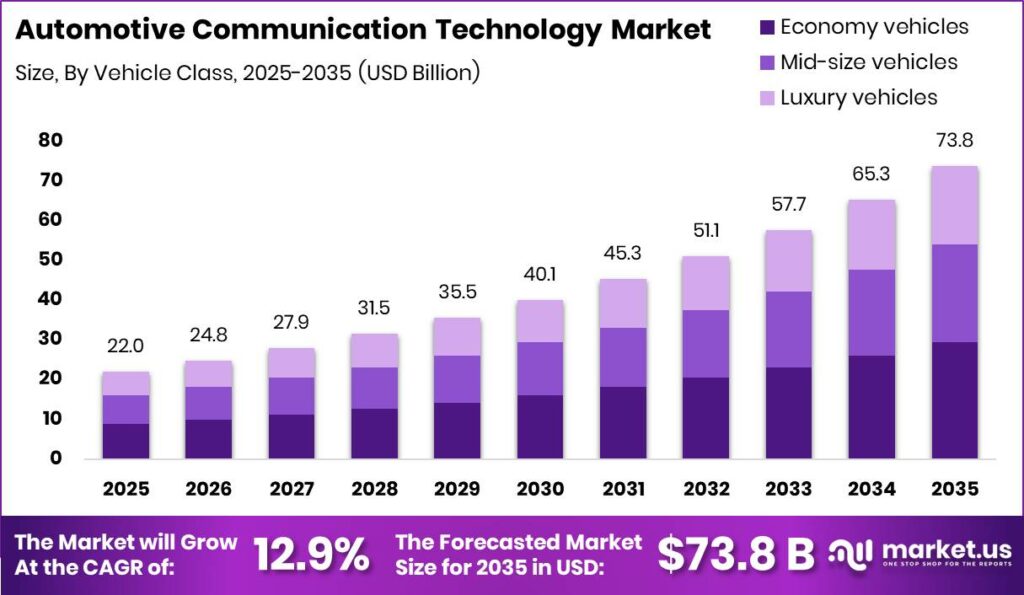
Global Automotive Communication Technology Market size is expected to be worth around USD 73.80 Billion by 2035 from USD 22.00 Billion in 2025, growing at a CAGR of 12.9% during the forecast period 2026 to 2035. This expansion reflects rising in-vehicle data loads from cameras, radar, and zonal controllers. Therefore, suppliers who scale multi-gig physical layers early will lock long-term platform design wins.
Automotive communication technology covers the wired and wireless links that move sensor, control, and entertainment data inside and around the vehicle. Core bus modules include Ethernet, CAN, LIN, FlexRay, and MOST. Applications span safety and ADAS, infotainment, powertrain, and body control. Vehicle classes and propulsion types further shape bandwidth and latency needs across OEM platforms.
Key Takeaways
- The market is valued at USD 22.00 Billion in 2025 and is projected to reach USD 73.80 Billion by 2035 at a CAGR of 12.9%.
- Ethernet leads the By Bus Module segment with a 58.2% share.
- Safety and ADAS leads the By Application segment with a 35.1% share.
- Economy vehicles lead the By Vehicle Class segment with a 40.0% share.
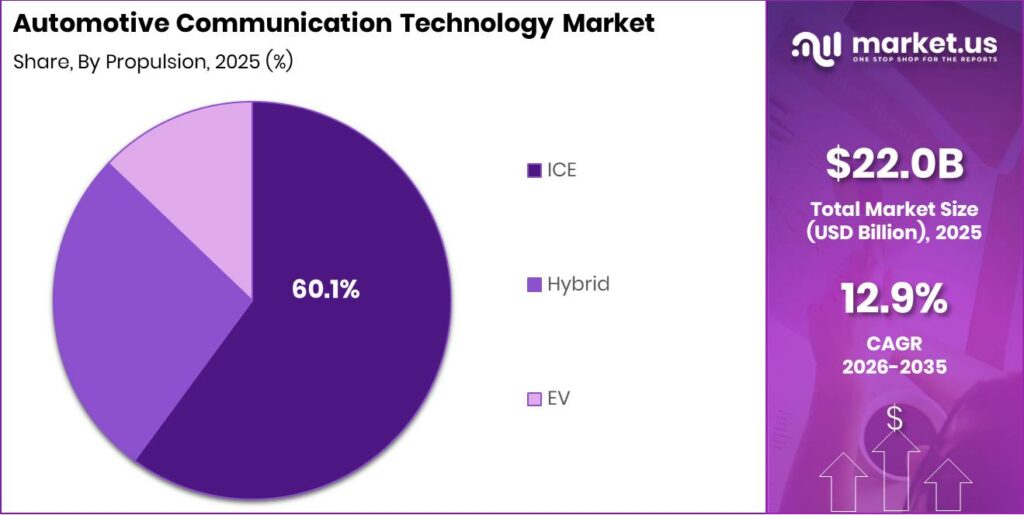
- ICE leads the By Propulsion segment with a 60.1% share.
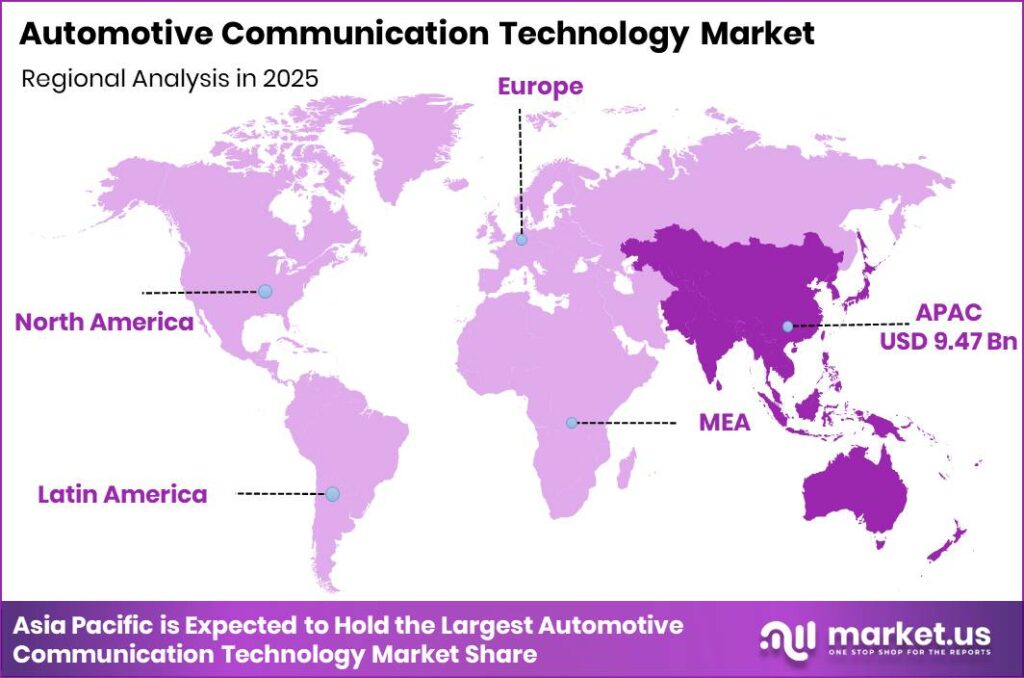
- Asia Pacific dominates with a 43.1% share, valued at USD 9.47 Billion.
IEEE’s 2026 technical overview lists six automotive Ethernet physical-layer rates from 10 Mb/s to 10 Gb/s. This ladder lets OEMs match bandwidth to ADAS camera and zonal traffic without full harness redesigns. Consequently, platform teams can stage multi-gig upgrades while protecting existing CAN and LIN domains. Buyers who standardize early cut requalification cost on future model years.
In March 2025, the University of New Hampshire InterOperability Laboratory added MultiGBASE-T1 testing at 2.5 Gbps, 5 Gbps, and 10 Gbps. This creates three compliance tiers for high-speed links. As a result, tier-1s gain clearer interoperability proof before SOP. A U.S. DOT cost assessment puts roadside-unit hardware at USD 3,000 to 5,000 and onboard units at USD 2,000 to 3,000 per vehicle, shaping V2X budget cases for fleets.
Bus Module Analysis
Ethernet dominates with 58.2% due to multi-gig ADAS backbone demand.
In 2025, Ethernet held a dominant market position in the By Bus Module segment of Automotive Communication Technology Market, with a 58.2% share. IEA data shows more than one in four cars sold in 2025 was electric, raising per-vehicle data demand. This share signals OEM migration from low-bandwidth buses toward multi-gig backbones. Vendors with qualified 1000BASE-T1 and MultiGBASE-T1 PHYs will capture zonal architecture sockets first.
CAN remains the workhorse for powertrain and body control where deterministic low-cost messaging still fits. Global light-vehicle production still exceeds 90 million units annually across major assemblies tracked by industry bodies. This volume keeps CAN silicon and tooling in high run rates. Suppliers who pair CAN FD gateways with Ethernet switches protect dual-network designs during multi-year transitions.
LIN serves simple actuator and switch networks where cost per node must stay minimal. Typical door, seat, and climate modules still rely on LIN for sub-20 kbps class loads in mass-market trims. This role keeps LIN viable inside economy platforms. Chipmakers who bundle LIN transceivers with domain controllers reduce BOM count for high-volume OEMs.
FlexRay and MOST and others hold the remaining share collectively for niche high-reliability and legacy multimedia links. FlexRay still appears in selected chassis domains needing time-triggered redundancy. MOST persists in older infotainment rings. This residual demand favors dual-sourcing strategies rather than new greenfield designs.
Application Analysis
Safety and ADAS dominates with 35.1% due to multi-sensor fusion bandwidth needs.
In 2025, Safety and ADAS held a dominant market position in the By Application segment of Automotive Communication Technology Market, with a 35.1% share. NHTSA-linked industry commitments pushed AEB toward near-universal fitment on new U.S. light vehicles. This share reflects camera, radar, and lidar traffic that legacy buses cannot carry. Ethernet-centric ADAS stacks therefore win design-ins on next platforms.
Infotainment and communication systems move high-rate audio, video, and connectivity traffic across the cabin network. MITRE PARTS data for model year 2023 shows many ADAS features already above 50% U.S. penetration, lifting related display and telematics loads. This pattern raises demand for deterministic AVB and TSN paths. Tier-1s that unify cabin and ADAS Ethernet cut wiring mass and gateway count.
Powertrain communication links engine, transmission, and hybrid control units with hard real-time frames. Hybrid and EV power electronics still require low-latency status and torque messages. This keeps CAN FD and selective Ethernet side-by-side. Suppliers offering certified powertrain gateways secure multi-cycle OEM contracts.
Body control and comfort networks manage doors, lighting, HVAC, and seats across many low-cost nodes. High vehicle volumes in Asia keep node counts large even when bit rates stay modest. This structure favors LIN and CAN mixes. Vendors who simplify body domain controllers improve margin on economy trims. Bosch unveiled an AI-enabled cockpit platform at CES 2026, tying comfort HMI closer to high-bandwidth cabin links.
Vehicle Class Analysis
Economy vehicles dominate with 40.0% due to high global unit volume.
In 2025, Economy vehicles held a dominant market position in the By Vehicle Class segment of Automotive Communication Technology Market, with a 40.0% share. High unit throughput in China, India, and other volume markets multiplies even simple bus content. This share means cost-optimized CAN and LIN still set the volume baseline. Chipmakers who hit aggressive ASP targets win the largest wafer allocations.
Mid-size vehicles add richer ADAS packs and dual-display cabins without full luxury harness cost. Many mid-size lines now ship Level 2 combinations of lane keep and adaptive cruise as standard or option. This mix lifts Ethernet port counts per vehicle. Platform leaders who reuse one zonal design across mid-size nameplates lower validation spend.
Luxury vehicles grow fastest as multi-gig Ethernet, premium audio, and dense sensor suites become default. Sub-microsecond class timing and multi-display video push higher PHY grades. This trend rewards early MultiGBASE-T1 readiness. Semiconductor vendors locked into luxury E/E architectures gain multi-year content uplift per car.
Propulsion Analysis
ICE dominates with 60.1% due to large installed production base.
In 2025, ICE held a dominant market position in the By Propulsion segment of Automotive Communication Technology Market, with a 60.1% share. Most global assemblies still ship combustion powertrains despite EV growth. This share anchors steady demand for CAN-based engine and transmission networks. Suppliers must support ICE programs through the full decade even as EV ramps continue.
Hybrid vehicles blend engine, motor, and battery controllers and therefore raise gateway complexity. Coordinated torque and energy messages need reliable cross-domain links. This architecture expands mixed CAN and Ethernet content per hybrid. Vendors with proven hybrid gateway stacks gain share as OEMs stretch hybrid lineups.
EVs grow fastest because high-voltage control, battery management, and dense ADAS raise network load. IEA figures put global electric car sales above 20 million in 2025, with more than one in four cars sold electric. This growth multiplies multi-gig backbone demand. Early EV platform wins lock long software-defined vehicle revenue after SOP.
Key Market Segments
By Bus Module
- Ethernet
- CAN
- LIN
- FlexRay
- MOST & others
By Application
- Safety & ADAS
- Infotainment & communication
- Powertrain
- Body control & comfort
By Vehicle Class
- Economy vehicles
- Mid-size vehicles
- Luxury vehicles
By Propulsion
- ICE
- Hybrid
- EV
Regional Analysis
Asia Pacific Dominates the Automotive Communication Technology Market with a Market Share of 43.1%, Valued at USD 9.47 Billion
Asia Pacific leads on the back of high vehicle output in China, Japan, South Korea, and India. Japan alone had more than 500,000 V2X-equipped vehicles and 115 roadside units, with Lexus and Toyota offering V2X across many models. This scale multiplies bus-module and V2X silicon demand. Local fabs and tier-1 clusters also shorten design cycles for regional OEM platforms.
Europe and North America advance fastest on safety mandates and C-ITS corridors. Vector’s 2025 review counted about 1.5 million C-ITS-equipped vehicles across 21 European countries plus 8 associated countries. This installed base pulls roadside and onboard communication content. Suppliers aligned with UNECE and NHTSA rules gain preferential RFQ access.
Latin America and Middle East and Africa add smaller but rising telematics and fleet connectivity volumes. Fleet operators adopt basic V2X and cellular backhaul where urban congestion is high. This pattern favors cost-optimized modules over multi-gig luxury stacks. Global vendors who offer modular SKUs can serve these regions without full platform redesigns.
Key Regions and Countries
North America
- US
- Canada
Europe
- Germany
- France
- The UK
- Spain
- Italy
- Rest of Europe
Asia Pacific
- China
- Japan
- South Korea
- India
- Australia
- Rest of APAC
Latin America
- Brazil
- Mexico
- Rest of Latin America
Middle East and Africa
- GCC
- South Africa
- Rest of MEA
Market Dynamics
Market Opportunity Analysis - Signal control, V2X retrofit, and EV networking still leave open white space for new entrants
Connected-vehicle signal control cut critical-phase intersection delay by 53 seconds and 19 seconds per vehicle at two evaluated phases. Split failures fell 30% and 9%, while arrivals on green rose 15% and 8%. Cities still under-deploy these stacks. Solution vendors who package roadside software with certified onboard units can win municipal RFPs before incumbents standardize.
Cooperative traffic-control simulation at 100% CAV penetration cut travel time by 18.85%, 27.15%, and 29.61% across three scenarios. Average stops fell 15.77% versus baseline. Few metros have funded full CAV corridors. Early infrastructure partners lock multi-year service contracts once pilots convert to citywide rollouts.
Green Light Optimal Speed Advisory simulation reduced travel time by about 5% and stop time by about 13%. These gains need only partial fleet penetration. Mid-tier OEMs and fleet operators remain under-served versus premium brands. Aftermarket and fleet-focused GLOSA suppliers can enter without full OEM platform wins.
EV propulsion is the fastest-growing class yet still trails ICE at 60.1% share. High-voltage and battery networks remain uneven across economy EVs in India and Southeast Asia. Regional specialists who ship cost-optimized EV gateways can capture volume the global leaders overlook.
Technology and Innovation Landscape - Multi-gig Ethernet, TSN timing, and C-V2X reliability redefine in-vehicle networks
IEEE lists automotive Ethernet rates of 10 Mb/s, 100 Mb/s, 1 Gb/s, 2.5 Gb/s, 5 Gb/s, and 10 Gb/s. Time synchronization via IEEE 1588 and IEEE 802.1AS reaches sub-microsecond accuracy below 1 microsecond. Manufacturers who certify full rate ladders win zonal backbone sockets. Investors should track MultiGBASE-T1 design-in counts as a leading indicator.
Vector’s 2025 review shows remaining U.S. V2X spectrum as one 10 MHz and one 20 MHz channel, or 30 MHz total near 5.9 GHz. About 1.5 million C-ITS vehicles already run in the European C-Roads ecosystem. Spectrum clarity lowers deployment risk for chipset vendors. Regional stack differences still force dual-mode hardware strategies.
A 2025 peer-reviewed study found C-V2X cut communication latency by more than 99% versus DSRC and reduced traffic conflicts 38% at 60% AV penetration. Proposed CAM methods held more than 95% reliability at a 10-millisecond threshold and more than 90% at 20 milliseconds. These figures favor C-V2X silicon over legacy DSRC paths. Safety-case teams can use the latency math in regulatory filings.
JAE’s 2026 automotive-Ethernet connector supports 1 Gbps over a single twisted pair under 1000BASE-T1. Header size is 10.3 by 11.35 millimeters and socket size is 9.5 by 12.5 millimeters. Compact connectors ease dense zonal packaging. Harness suppliers who qualify early become default on multi-gig programs. An Oakland County test still showed vulnerable-road-user alert latency at 1.8 seconds versus a 300-millisecond target, so edge perception stacks need further work.
Drivers
Sensor fusion from cameras, radar, and lidar is forcing OEMs to replace legacy CAN and LIN with automotive Ethernet backbones. Industry association tracking put 100BASE-T1 and multi-gig links near 44.4% of Ethernet deployments in 2025. Port counts are climbing toward a 400-million-port installed base. Harness BOM can fall 8% to 12% per vehicle even as PHY content rises, lifting software-attach margins by 150 to 250 basis points.
This bandwidth shift turns connectivity from one-time hardware into recurring OTA and data revenue. Zonal E/E programs and V2X mandates in North America, Europe, and China reinforce the same backbone choice. Buyers who lock multi-gig PHYs now reduce later redesign cost. Investors should track Ethernet content per vehicle as the clearest near-term growth proxy.
| Driver | (~) % Impact on CAGR Forecast | Geographic Relevance | Impact Timeline |
|---|---|---|---|
| ADAS-driven Ethernet backbone adoption | +3.1% | Global, led by North America and Europe | Short term (2 years or less) |
| Zonal E/E architecture migration | +2.4% | Global OEM platforms | Medium term (2 to 4 years) |
| Mandatory V2X safety mandates | +1.9% | North America, EU, China | Short term (2 years or less) |
| SDV software monetization pull | +1.6% | Global, concentrated in premium OEMs | Medium term (2 to 4 years) |
| EV powertrain telematics growth | +1.2% | China, Europe | Short term (2 years or less) |
| MIPI A-PHY SerDes standardization | +1.0% | Global tier-1 supply base | Medium term (2 to 4 years) |
Restraints
AI data-center demand is competing with automotive-grade packaging and assembly capacity. Automotive semiconductor lead times averaged 16.8 weeks in Q1 2026, the highest since Q3 2023. Memory and power-discrete leads stretched another six to eight weeks. Global semiconductor revenue grew about 22% in 2025 with a projected 26% in 2026, yet AI absorbs a disproportionate share of wafers.
Tier-1s must buffer power discretes and absorb margin hits of roughly 100 to 180 basis points. OEMs delay zonal-controller CapEx by two to three quarters when parts, not designs, gate ramps. High rates, fragmented cyber rules, EV soft patches, and tariffs add further drag. Procurement teams should dual-source critical PHYs and power devices now.
| Restraint | (~) % Impact on CAGR Forecast | Geographic Relevance | Impact Timeline |
|---|---|---|---|
| Automotive semiconductor allocation squeeze | -2.6% | Global, acute in Asia-Pacific fabs | Short term (2 years or less) |
| High interest rate CapEx freeze | -1.5% | North America, Europe | Short term (2 years or less) |
| Fragmented regional cybersecurity mandates | -1.1% | EU, UNECE-aligned markets | Short term (2 years or less) |
| EV demand slowdown in key markets | -0.9% | Europe, North America | Short term (2 years or less) |
| Tariff-driven component cost shock | -0.8% | United States, China | Short term (2 years or less) |
Challenges
Demand for engineers skilled in TSN, SOME/IP, and automotive SerDes outpaces supply. Tier-1 open requisitions take 20% to 30% longer to fill than in 2023. Validation cycles stretch 4 to 6 weeks per ECU domain when senior sign-off is scarce. This friction does not stop shipments but caps how fast zonal programs scale.
Protocol fragmentation, legacy retrofit cost, data-sovereignty rules, and longer EMI thermal loops add further drag. OEMs that fund university pipelines and internal certification protect ramp speed. This gap also creates service revenue for tools and training vendors. Early movers who productize compliance toolchains can monetize the shortage itself.
| Challenge | (~) % CAGR Friction Drag | Geographic Relevance | Mitigation Horizon |
|---|---|---|---|
| Embedded systems talent shortage | -1.4% | Global, acute in Europe and North America | Medium term (2 to 4 years) |
| Protocol interoperability fragmentation | -1.0% | Global multi-OEM supply base | Medium term (2 to 4 years) |
| Legacy fleet retrofit complexity | -0.7% | North America, Europe | Long term (4 years or more) |
| Cross-border data sovereignty rules | -0.6% | China, EU | Medium term (2 to 4 years) |
| Rising EMI and thermal validation cycles | -0.5% | Global tier-1 test labs | Medium term (2 to 4 years) |
Opportunities
Most Ethernet and TSN capability still ships as embedded hardware rather than recurring software. Only a low double-digit share of connected fleets monetize post-sale connectivity features today. Software-layered services can expand gross margins by 300 to 400 basis points versus hardware-only sales. Near-zero marginal cost for OTA features makes this upside real beyond the 12.9% baseline CAGR.
Capturing this white space needs billing systems, OTA reliability, and data governance under ISO/SAE cyber rules. Aftermarket V2X retrofit, smart-infrastructure roll-ups, emerging-market telematics, and edge-AI cabin data add further upside. Early movers who package feature-on-demand tiers will set reference pricing. Investors should favor firms with both silicon and subscription hooks.
| Opportunity | (~) % Potential CAGR Upside | Geographic Relevance | Execution Window |
|---|---|---|---|
| Software-defined connectivity monetization | +2.2% | Global, premium and mid-tier OEMs | Medium term (2 to 4 years) |
| Aftermarket V2X retrofit white space | +1.5% | North America, Southeast Asia | Long term (4 years or more) |
| Cross-industry smart-infrastructure roll-ups | +1.1% | Global, urban mobility hubs | Long term (4 years or more) |
| Emerging market fleet telematics expansion | +0.9% | India, Southeast Asia, Latin America | Medium term (2 to 4 years) |
| Edge-AI in-cabin data monetization | +0.7% | Global, concentrated in EV OEMs | Long term (4 years or more) |
Key Company Insights
NXP Semiconductors N.V. strengthens zonal networking with the S32N7 in-vehicle network processor introduced in January 2026. Bosch adoption of the platform validates high-bandwidth domain designs. This positioning ties NXP silicon to multi-year OEM architecture cycles. Competitors without comparable network processors risk exclusion from next zonal RFQs.
Texas Instruments Inc. holds breadth across analog, interface, and embedded processing used in automotive links. Wide catalog coverage lets tier-1s source PHYs, power, and MCUs from one vendor. This reduces qualification overhead on mixed CAN and Ethernet boards. The risk is slower pure-play multi-gig storytelling versus focused Ethernet rivals.
Key Players
- NXP Semiconductors N.V.
- Texas Instruments Inc.
- Infineon Technologies AG.
- STMicroelectronics N.V.
- Renesas Electronics Corporation.
- Broadcom Inc.
- Analog Devices, Inc.
- Microchip Technology Inc.
- Robert Bosch GmbH
- Continental AG.
- Denso Corporation.
- Aptiv PLC.
- Harman International Industries.
- Valeo S.A.
- ZF Friedrichshafen AG.
Recent Developments
- June 2025: Qualcomm Technologies completed the acquisition of Autotalks, adding dedicated Vehicle-to-Everything communication technology to its Snapdragon Digital Chassis portfolio.
- September 2025: Sonatus launched the AI Director platform, enabling deployment of edge AI across software-defined vehicles to improve in-vehicle communication, data orchestration, and network management.
- January 2026: Sonatus demonstrated AI-powered software-defined vehicle technologies at CES 2026, including edge AI, diagnostics, and fleet communication solutions developed with Bosch, NXP, Renesas, Michelin, and Nissan Technical Centre Europe.
Geopolitical Impact Analysis
According to UNCTAD and World Bank trade monitors, tariff escalation between major auto-component hubs has lifted landed costs on semiconductors and connectors used in vehicle networks. Figures from industry logistics reviews show fiber-backhaul upgrades for connected-vehicle sites above USD 20,000 per location. Cellular backhaul runs about USD 1,000 to 1,500 per site plus monthly data fees. These costs slow roadside V2X builds when capital budgets tighten under trade uncertainty.
Data from IEA energy and shipping analyses show energy-price swings and Red Sea style reroutes lengthen lead times for automotive electronics. Average automotive semiconductor waits near 16.8 weeks already strain zonal controller ramps. Therefore, OEMs dual-source PHYs across Asia and Europe and raise safety stocks. This raises working capital but protects SOP dates when geopolitical shocks hit a single corridor.
Report Scope
| Report Features | Description |
|---|---|
| Market Value (2025) | USD 22.00 Billion |
| Forecast Revenue (2035) | USD 73.80 Billion |
| CAGR (2026-2035) | 12.9% |
| Base Year for Estimation | 2025 |
| Historic Period | 2020-2024 |
| Forecast Period | 2026-2035 |
| Report Coverage | Revenue Forecast, Market Dynamics, Market Opportunity Analysis, Technology and Innovation Landscape, Competitive Landscape, Recent Developments |
| Segments Covered | By Bus Module (Ethernet, CAN, LIN, FlexRay, MOST & others), By Application (Safety & ADAS, Infotainment & communication, Powertrain, Body control & comfort), By Vehicle Class (Economy vehicles, Mid-size vehicles, Luxury vehicles), By Propulsion (ICE, Hybrid, EV) |
| Regional Analysis | North America (US and Canada), Europe (Germany, France, The UK, Spain, Italy, and Rest of Europe), Asia Pacific (China, Japan, South Korea, India, Australia, and Rest of APAC), Latin America (Brazil, Mexico, and Rest of Latin America), Middle East and Africa (GCC, South Africa, and Rest of MEA) |
| Competitive Landscape | NXP Semiconductors N.V., Texas Instruments Inc., Infineon Technologies AG., STMicroelectronics N.V., Renesas Electronics Corporation., Broadcom Inc., Analog Devices, Inc., Microchip Technology Inc., Robert Bosch GmbH, Continental AG., Denso Corporation., Aptiv PLC., Harman International Industries., Valeo S.A., ZF Friedrichshafen AG. |
| Customization Scope | Customization for segments, region / country-level will be provided. Additional customization can be done based on requirements. |
| Purchase Options | We have three licenses to opt for: Single User License | Multi-User License (Up to 5 Users) | Corporate Use License (Unlimited User and Printable PDF) |





































