


Report Overview
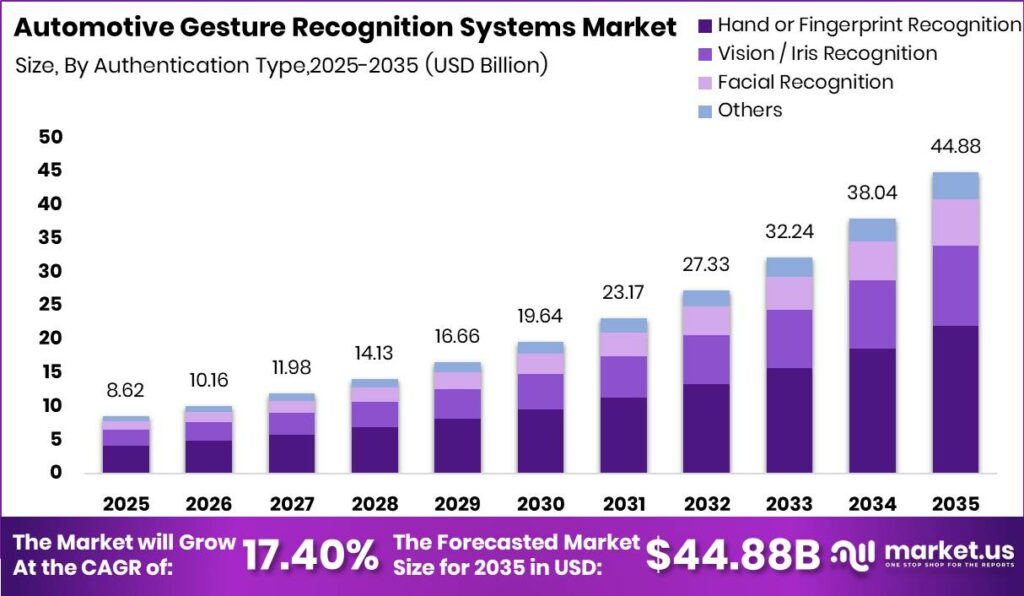
Global Automotive Gesture Recognition Systems Market size is expected to be worth around USD 44.88 Billion by 2035 from USD 8.62 Billion in 2025, growing at a CAGR of 17.40% during the forecast period 2026 to 2035. This trajectory reflects accelerating OEM investment in touch-free In-Car Infotainment cockpit interfaces across premium and upper-mid vehicle segments globally.
The automotive gesture recognition systems market covers hardware, software, and integrated sensor platforms that enable drivers and passengers to control vehicle functions through deliberate hand or body movements. This market spans touchless and touch-based input systems used across infotainment, lighting, door and window controls, and driver-monitoring applications. System components include camera arrays, ultrasonic and radar sensors, capacitive proximity sensors, and AI software platforms that interpret movement data in real time.
Key Takeaways
- Global Automotive Gesture Recognition Systems Market size reached USD 8.62 Billion in 2025 and is forecast to reach USD 44.88 Billion by 2035, at a CAGR of 17.40%.
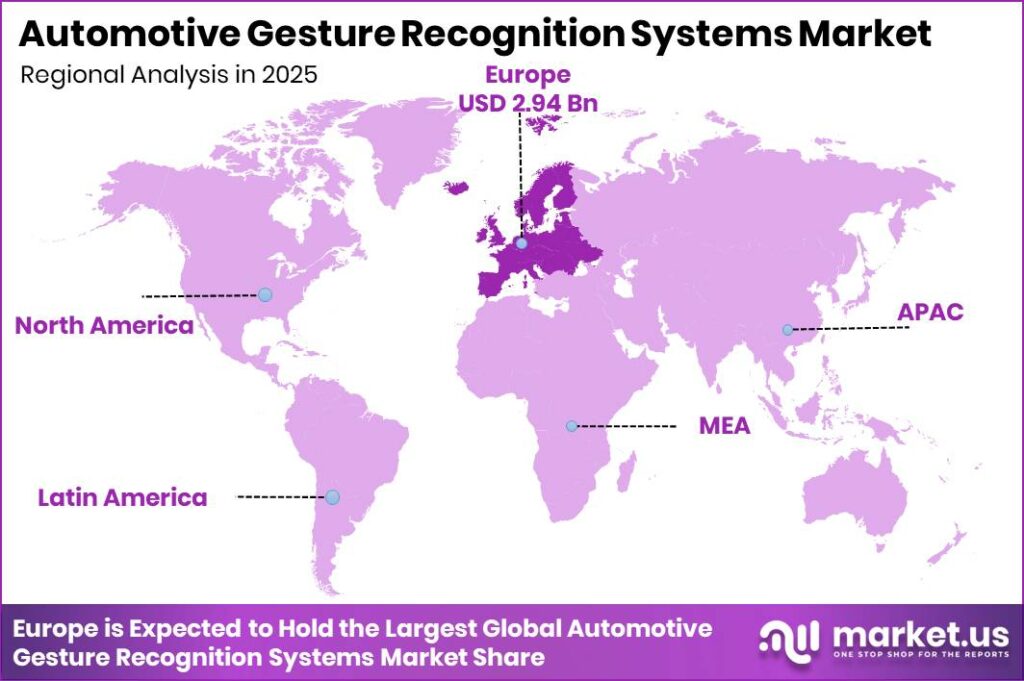
- Europe dominates the market with a 34.18% share, valued at USD 2.95 Billion in 2025.
- By Component, Touchless Systems holds the largest share at 62.01%, with Touch-Based Systems identified as the fastest-growing sub-segment.
- By Authentication Type, Hand or Fingerprint Recognition leads with a 49.00% share, while Vision / Iris Recognition is the fastest-growing sub-segment.
- By Application, Multimedia / Infotainment / Navigation commands the largest share at 72.00%, with Lighting Systems identified as the fastest-growing application.
- By Vehicle Type, Passenger Cars hold the dominant share at 62.55%, while Commercial Vehicles represent the fastest-growing vehicle type.
- By Technology, Camera-Based Systems lead with a 55% share, while AI Software Platforms are the fastest-growing technology sub-segment.
Regulatory frameworks across Europe and North America are directly expanding the addressable opportunity for gesture recognition suppliers. The European Commission’s General Safety Regulation, applied to all new vehicles sold in the EU from July 2024, mandates driver monitoring, intelligent speed assistance, and reversing sensors. This creates a shared sensor and compute architecture that gesture-recognition layers can attach to, reducing incremental hardware cost per vehicle and raising attachment potential across broader trim levels.
In January 2025, BMW showcased its Neue Klasse cockpit at CES 2025, transitioning away from traditional hand gesture controls toward AI-powered multimodal interaction using BMW Operating System X. This signals an industry-wide shift where gesture control merges with voice, eye-tracking, and AI assistant logic to form unified human-machine interfaces. Suppliers that offer modular, software-configurable gesture platforms will capture a larger share of this cockpit integration budget as automotive multimodal interaction development accelerates across premium OEMs.
As reported by a 2025 infotainment gesture study, 85% of participants found the gesture-recognition system comfortable and easy to learn without disrupting infotainment control. This acceptance rate indicates that consumer readiness is not a barrier to deployment. Vendors who prioritize onboarding design and low-latency response will convert trial users into loyal adopters faster, giving early system suppliers a durable advantage as connected vehicles platforms expand gesture capability across more vehicle lines.
Component Analysis
Touchless Systems dominates with 62.01% due to hygiene-driven contactless cabin interaction demand.
In 2025, Touchless Systems held a dominant market position in the By Component segment of the Automotive Gesture Recognition Systems Market, with a 62.01% share. Camera-based and radar-based contactless sensing eliminates physical surface wear, supports hands-free operation, and aligns with driver-monitoring sensor architectures that OEMs already install for safety compliance. According to the International Federation of Robotics, sensor-integrated automation adoption in vehicle manufacturing exceeded 3.5 million industrial robot units globally in 2023, signaling a hardware ecosystem that supports complex in-cabin sensing at scale. Suppliers offering touchless platforms with edge-AI inference will capture OEM preference as cabin architectures standardize around non-contact interaction.
Touch-Based Systems represent the fastest-growing sub-segment within the Component category, driven by cost-effective integration into existing capacitive display and steering-wheel surfaces. These systems require no additional sensor housing, allowing Tier 1 suppliers to embed gesture-command layers directly into existing human-machine interface hardware. The European Automobile Manufacturers’ Association reported that new passenger car registrations in Europe reached 10.5 million units in 2023, providing a large annual fitment base where touch-based gesture overlays can be added at low incremental cost. This affordability advantage positions touch-based systems as the near-term adoption path for mid-range vehicles in price-sensitive markets.
Authentication Type Analysis
Hand or Fingerprint Recognition dominates with 49.00% due to mature biometric sensor supply chains.
In 2025, Hand or Fingerprint Recognition held a dominant market position in the By Authentication Type segment of the Automotive Gesture Recognition Systems Market, with a 49.00% share. This sub-segment benefits from established capacitive fingerprint sensor supply chains that automotive Tier 1 suppliers have integrated into steering wheels and door handles across premium trims. According to the International Trade Centre Trade Map, global trade in fingerprint recognition and biometric sensor modules exceeded USD 2.1 Billion in 2023, confirming deep supply infrastructure. OEMs sourcing hand-recognition modules can leverage this supply base to shorten lead times and reduce per-unit sensor cost.
Vision and Iris Recognition is the fastest-growing authentication sub-segment, supported by the deployment of cabin-facing cameras already mandated for driver-monitoring systems in Europe. These cameras enable iris-based authentication without adding hardware, converting a compliance investment into a biometric identity layer. The European Union Agency for Cybersecurity notes that connected-vehicle deployments involve multiple processing nodes, and iris recognition executed locally reduces data-exfiltration risk. Industry body SAE International reports that Level 2 and Level 2+ vehicle production exceeded 8 million units globally in 2023, all requiring cabin-facing sensors that Vision and Iris Recognition can leverage for authentication at minimal incremental cost.
Facial Recognition operates as a secondary authentication layer that links driver identity to personalized seat, mirror, climate, and infotainment presets. This sub-segment adds commercial value through seamless vehicle personalization without requiring physical key or card interaction. Other authentication approaches, including voice-based gesture confirmation and multi-factor combinations, hold the remaining share and serve niche accessibility and fleet-management use cases where identity verification must comply with employer or insurance requirements.
Application Analysis
Multimedia / Infotainment / Navigation dominates with 72.00% due to highest driver-interaction frequency per trip.
In 2025, Multimedia / Infotainment / Navigation held a dominant market position in the By Application segment of the Automotive Gesture Recognition Systems Market, with a 72.00% share. Drivers interact with infotainment and navigation controls more frequently than any other in-cabin function during a typical trip, making this the highest-value gesture deployment surface. According to the ITU, global connected-device installations exceeded 15 billion units by 2023, a hardware proliferation that normalizes touchless interaction across consumer electronics and raises driver expectations for equivalent capability in vehicles. Vendors that certify gesture workflows for map zoom, media skip, and call answer will secure preferred supplier status with OEMs building next-generation digital cockpit platforms.
Lighting Systems represent the fastest-growing application segment, driven by the integration of adaptive interior and exterior lighting controls into gesture-command menus across premium EVs and software-defined vehicle platforms. Ambient lighting personalization, puddle-lamp activation, and adaptive headlight adjustment are increasingly mapped to swipe and point gestures in high-specification trims. The European Automobile Manufacturers’ Association confirms that battery electric vehicle registrations in Europe reached 1.5 million units in 2023, and EV cabins are being redesigned without traditional switch panels, creating a direct need for gesture-controlled lighting interfaces.
Door, Window, and Sunroof control via gesture represents a growing mid-tier application where proximity detection and directional swipe commands replace physical switches. This application reduces mechanical switch count, lowers interior panel cost, and enables contactless operation for passengers with limited mobility. Other applications, including HVAC gesture adjustment, seat positioning, and autonomous parking gesture commands, hold the remaining share and are expanding as software-defined vehicle architectures enable broader function mapping to gesture inputs.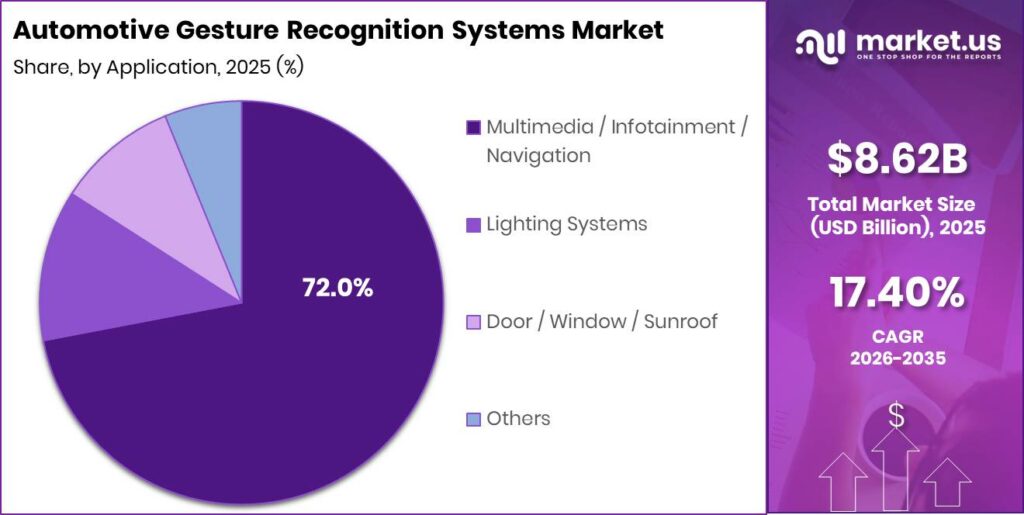
Vehicle Type Analysis
Passenger Cars dominates with 62.55% due to highest annual production volume globally.
In 2025, Passenger Cars held a dominant market position in the By Vehicle Type segment of the Automotive Gesture Recognition Systems Market, with a 62.55% share. The sub-segment covers Compact Cars, Midsize Cars, SUVs, and Luxury vehicles, with luxury and SUV trims accounting for the largest share of gesture-system fitment given their higher average selling price and broader optional-equipment budgets. According to the International Organization of Motor Vehicle Manufacturers (OICA), global passenger car production reached 69.6 million units in 2023, representing the primary addressable volume for gesture-recognition hardware and software suppliers. Tier 1 suppliers that secure platform-level contracts in SUV and luxury programs gain disproportionate revenue exposure relative to the passenger-car category’s unit share.
Commercial Vehicles represent the fastest-growing vehicle-type sub-segment, driven by logistics fleet operators adopting contactless cabin controls to reduce driver fatigue and improve operational safety in long-haul and last-mile applications. Fleet operators in Europe and North America are under regulatory pressure to reduce driver distraction events, and gesture-controlled navigation and communication interfaces reduce eyes-off-road time during delivery cycles. UNECE vehicle regulations for heavy-duty vehicles increasingly require advanced driver-assistance integration, creating infrastructure that gesture modules can attach to. The World Shipping Council and UNCTAD both report global freight volumes recovering toward 11 billion metric tons annually, signaling sustained demand for fleet cabin technology investment.
Technology Analysis
Camera-Based Systems dominates with 55% due to dual-use driver-monitoring regulatory installation base.
In 2025, Camera-Based Systems held a dominant market position in the By Technology segment of the Automotive Gesture Recognition Systems Market, with a 55% share. These systems leverage cabin-facing cameras already installed for driver-monitoring system compliance under EU General Safety Regulation mandates, allowing gesture-recognition functionality to run on existing hardware with software updates rather than new sensors. This dual-use architecture lowers per-vehicle system cost and raises attachment rates. According to UNIDO industrial output statistics, global imaging sensor production exceeded 5 billion units in 2023, ensuring adequate supply for automotive-grade camera procurement across major assembly regions.
Ultrasonic and Radar Gesture Sensors serve applications where lighting conditions, tinted glass, or privacy requirements limit camera-based recognition. These sensors detect hand proximity and directional movement without capturing identifiable visual data, reducing data-governance complexity under UNECE R155 and GDPR. Radar-based systems operating at 60 GHz and 79 GHz support millimeter-level spatial resolution suitable for fine finger-gesture recognition in center-stack and door-panel interaction zones. National telecommunications regulatory filings in Europe and the US confirm dedicated short-range radar spectrum allocations that support automotive-grade deployment without interference from other in-vehicle radio systems.
Capacitive and Infrared Proximity Sensors offer a cost-effective gesture layer for steering wheel and door-panel surfaces in mid-range vehicles. These sensors detect approach and directional movement across defined zones without requiring compute-intensive inference. AI Software Platforms represent the fastest-growing technology sub-segment, driven by OEM investment in centralized domain controllers and software-defined vehicle architectures. Suppliers providing over-the-air-updatable gesture-recognition models capture recurring software licensing revenue in addition to initial hardware margin, improving long-term unit economics across vehicle programs.
Key Market Segments
By Component
- Touchless Systems
- Touch-Based Systems
By Authentication Type
- Hand or Fingerprint Recognition
- Vision / Iris Recognition
- Facial Recognition
- Others
By Application
- Multimedia / Infotainment / Navigation
- Lighting Systems
- Door / Window / Sunroof
- Others
By Vehicle Type
- Passenger Cars
- Compact Car
- Midsize Car
- SUVs
- Luxury
- Commercial Vehicles
By Technology
- Ultrasonic / Radar Gesture Sensors
- Camera-Based Systems
- Capacitive / Infrared Proximity Sensors
- AI Software Platforms
Regional Analysis
Europe Dominates the Automotive Gesture Recognition Systems Market with a Market Share of 34.18%, Valued at USD 2.95 Billion
Europe holds the largest regional share at 34.18%, equivalent to USD 2.95 Billion in 2025. This leadership position reflects mandatory EU General Safety Regulation compliance, UNECE R155 cybersecurity requirements, and strong OEM production bases in Germany, France, and the United Kingdom. European automakers invest heavily in premium cockpit differentiation, and regulatory-mandated cabin sensors create a shared hardware foundation for gesture-system deployment at limited incremental cost across new vehicle lines.
In September 2025, Qualcomm and BMW launched the Snapdragon Ride Pilot platform, integrating advanced automotive computing that supports next-generation vehicle interaction systems and software-defined cockpit architectures. This partnership signals that Asia Pacific is accelerating rapidly in platform-level cockpit technology investment. China’s software-defined vehicle expansion and South Korea’s Tier 1 semiconductor and sensor supply chains position Asia Pacific as the fastest-growing region, where OEM volume, EV adoption, and Automotive Operating System development converge to drive above-average gesture-system attachment rates.
North America benefits from strong NHTSA distraction-reduction guidelines that favor gesture-based interaction over manual touchscreen operation, supporting adoption across both premium and commercial vehicle segments. Latin America, the Middle East, and Africa hold smaller shares as affordability constraints limit gesture-system fitment to imported premium vehicles, though Gulf state luxury fleet demand and Brazil’s growing automotive production base represent near-term entry points for regional expansion.
Key Regions and Countries
North America
- US
- Canada
Europe
- Germany
- France
- The UK
- Spain
- Italy
- Rest of Europe
Asia Pacific
- China
- Japan
- South Korea
- India
- Australia
- Rest of APAC
Latin America
- Brazil
- Mexico
- Rest of Latin America
Middle East and Africa
- GCC
- South Africa
- Rest of MEA
Market Dynamics
Market Opportunity Analysis - Underexploited segments and geographies offer high-return entry points for focused suppliers
The Commercial Vehicles sub-segment remains underpenetrated relative to its fastest-growing status within the Vehicle Type category. Fleet operators in logistics and long-haul transport face regulatory pressure to reduce driver distraction, yet gesture-system fitment rates in commercial cabins remain low compared to passenger car premium trims. Suppliers that develop ruggedized, low-latency gesture modules certified for heavy-duty cabin environments and priced to fleet-procurement budgets will enter a segment with minimal direct competition and high per-unit volume potential.
AI Software Platforms represent the fastest-growing technology sub-segment but currently lack a dominant incumbent in the over-the-air-updatable gesture model licensing space. This creates an entry window for software-first vendors who can package edge-native inference models, consent management tools, and regulatory compliance documentation as a single deployable stack for OEMs completing software-defined vehicle transitions. Vendors entering this sub-segment avoid the capital intensity of sensor manufacturing while capturing recurring software revenue across each vehicle’s operational life.
The Lighting Systems application sub-segment is the fastest-growing application category yet holds a small share compared to Multimedia / Infotainment / Navigation’s dominant 72.00%. This gap indicates that gesture-controlled ambient and adaptive lighting has not yet reached standard fitment in mid-range EV platforms, where switch-panel elimination is already advancing. Suppliers that certify lighting-gesture command sets for Compact Car and Midsize Car platforms within the Passenger Cars category will address an uncontested fitment opportunity before larger Tier 1 players redirect capacity from infotainment to lighting applications.
Vision and Iris Recognition is the fastest-growing authentication sub-segment and benefits from cabin-facing cameras already mandated across European markets. However, software solutions that convert these compliance cameras into authenticated identity layers remain nascent outside luxury trims. Developers that build privacy-preserving, in-vehicle iris-authentication stacks compatible with existing driver-monitoring hardware can address a broad installed base of Automotive Electronics without requiring new camera procurement, reducing customer adoption friction and accelerating revenue ramp.
Technology and Innovation Landscape - Radar, edge AI, and compact neural architectures define the next performance frontier
Radar-based gesture sensing is emerging as the highest-accuracy contactless input method for automotive cabins. A 2026 fine-grained radar hand-gesture study published in Electronics reported 99.75% recognition accuracy, demonstrating radar’s technical ceiling for contactless interfaces. A separate 2025 mmWave radar system reached 97% peak classification accuracy across an interaction range of 0.5 to 1.5 metres, directly matching the center-stack and door-panel interaction zones in passenger vehicles. Suppliers integrating production-grade radar gesture stacks gain a performance argument over camera-only competitors, particularly in low-light and privacy-sensitive cabin environments.
Edge-efficient neural architectures are reducing the compute and memory requirements that previously limited gesture deployment to high-specification hardware. A 2025 edge-efficient CNN achieved 95.1% binary-classification accuracy, 96.6% precision, and a 2.17% false-positive rate for real-time recognition. A separate infotainment gesture-recognition CNN used approximately 50 MB of memory, confirming deployment feasibility on resource-constrained in-vehicle hardware. These benchmarks mean OEMs no longer require dedicated high-performance processors to run gesture inference, opening fitment to mid-range and compact vehicle platforms.
Latency reduction is a direct commercial differentiator because driver confidence in gesture control depends on near-instantaneous system response. A 2025 gesture-controlled vehicle study reported an average gesture-processing time of 0.19 seconds, while a separate gesture-and-voice system achieved a gesture-command response time of approximately 50 milliseconds, which was 50 milliseconds faster than the same system’s voice-control response. End-to-end processing latency in a vision-based vehicle system ranged from 150 to 300 milliseconds during live operation, with the system running at a stable 12 to 18 frames per second. Suppliers that bring system latency below 100 milliseconds consistently will set a new UX benchmark that raises the barrier for new entrants.
MediaPipe and Transformer Encoder architectures achieved 95% to 100% recognition accuracy for dynamic hand gestures in a 2025 study, while a 2026 IoT-device gesture framework reached 99.87% accuracy using the Morlet wavelet for known users, though accuracy for previously unseen users reached 82% to 84%. A 2025 online recognition method delivered 95% real-time accuracy for continuously operating interactive systems. The gap between known-user and new-user performance signals that personalization and onboarding design remain active engineering priorities. Suppliers that close this gap through adaptive model fine-tuning will improve first-drive acceptance rates and reduce post-sale customer support costs for gesture-enabled vehicle programs. This connects directly to the Center Stack Display integration roadmaps of leading OEMs.
Drivers
In-cabin safety mandates are widening the sensor and compute architecture that gesture-recognition suppliers can attach to, converting the technology from a standalone feature into an integrated element of the cockpit safety platform. The European Commission applied its General Safety Regulation to all new vehicles sold in the EU from July 2024, requiring driver-drowsiness warnings, intelligent speed assistance, reversing cameras, and emergency stop signals. This regulation is expected to save more than 25,000 lives and prevent at least 140,000 serious injuries by 2038, accelerating OEM investment in certified cabin-perception hardware.
NHTSA guidelines recommend limiting individual eyes-off-road glances to 2 seconds and total task-related off-road glance time to 12 seconds, creating a direct commercial argument for short, glance-minimizing gesture commands in navigation, media, and comfort control. This installed-base effect reduces the incremental hardware cost of adding gesture layers and raises attachment potential across safety-equipped trims. In-cabin safety platform expansion contributes an estimated +2.8% to the market’s baseline CAGR of 17.40%, making it the single largest identified demand driver in the forecast period.
| Driver | (~) % Impact on CAGR Forecast | Geographic Relevance | Impact Timeline |
|---|---|---|---|
| In-cabin safety platform expansion | +2.8% | Europe, North America, China | Short term (2 years or less) |
| Premium cockpit differentiation | +2.2% | North America, Europe, China, Gulf states | Short term (2 years or less) |
| Touchscreen distraction reduction | +1.8% | North America, Europe, Japan, South Korea | Medium term (2 to 4 years) |
| Software-defined vehicle migration | +1.6% | China, Europe, North America | Medium term (2 to 4 years) |
| Electric-vehicle cockpit redesign | +1.3% | China, Europe, South Korea | Medium term (2 to 4 years) |
| Multimodal HMI convergence | +1.1% | Global premium and upper-mid segments | Long term (4 years or more) |
Restraints
Automotive gesture-recognition suppliers face a direct commercial drag from the validation and homologation requirements that govern production deployment. UNECE R155 cybersecurity compliance became mandatory for all new EU vehicle types from July 2022 and extended to all new vehicles sold in the EU from July 2024. The European Data Protection Board requires heightened safeguards for biometric data in connected vehicles, adding privacy-by-design and consent-management obligations where gesture platforms combine hand tracking with occupant identity data.
NHTSA benchmarks of no more than 2 seconds per off-road glance and no more than 12 seconds total task time raise functional safety test requirements for every gesture workflow intended to replace touchscreen interaction. These non-recurring engineering and certification costs compress supplier margins, raise program break-even volumes, and cause OEMs to defer factory-fit deployment in lower-priced vehicle lines. High validation burden contributes an estimated -2.5% deduction from the market’s baseline CAGR, making it the single largest restraint in the forecast period.
| Restraint | (~) % Impact on CAGR Forecast | Geographic Relevance | Impact Timeline |
|---|---|---|---|
| High validation and homologation burden | -2.5% | Europe, Japan, South Korea, United Kingdom | Short term (2 years or less) |
| Mass-market affordability constraints | -2.0% | India, Southeast Asia, Latin America, Africa | Short term (2 years or less) |
| Vehicle architecture fragmentation | -1.6% | Global | Medium term (2 to 4 years) |
| Low feature-use consumer confidence | -1.4% | Global mass-market segments | Medium term (2 to 4 years) |
| Trim-content cost prioritization | -1.2% | North America, Europe, India | Short term (2 years or less) |
| Limited retrofit integration economics | -0.9% | Global vehicle parc | Long term (4 years or more) |
Challenges
Edge-AI recognition robustness remains a persistent scaling barrier because a deployed gesture engine must reliably distinguish deliberate commands from incidental arm movements, passenger actions, and cabin reflections across darkness, direct sunlight, vibration, and partial camera occlusion. NHTSA’s recommendation of no more than 2 seconds per eyes-off-road glance means unreliable gesture detection negates its safety value when drivers repeat commands or revert to touchscreens. The European Data Protection Board also advises that connected-vehicle data processing remain in-vehicle wherever possible, increasing pressure for efficient local inference over cloud-dependent recognition.
UNECE R155 requires cybersecurity management across a vehicle’s entire lifecycle rather than at launch only. This forces suppliers to invest continuously in optimized neural models, diverse training datasets, sensor-fusion logic, over-the-air regression testing, and cyber-secure update pipelines. This ongoing engineering burden does not halt shipments but limits recognition consistency, raises warranty exposure, and creates an estimated -2.3% drag on the market’s maximum achievable CAGR. Suppliers that build modular, updateable AI inference stacks will reduce long-run maintenance cost and close this performance gap faster than those using static models.
| Challenge | (~) % CAGR Friction Drag | Geographic Relevance | Mitigation Horizon |
|---|---|---|---|
| Edge AI recognition robustness | -2.3% | Global | Medium term (2 to 4 years) |
| Automotive chip supply volatility | -1.9% | North America, Europe, China, Japan | Medium term (2 to 4 years) |
| Gesture-language standardization | -1.6% | Global | Long term (4 years or more) |
| Cabin-data governance complexity | -1.4% | Europe, North America, Japan, South Korea | Medium term (2 to 4 years) |
| Lifecycle software maintenance | -1.2% | Global connected-vehicle markets | Long term (4 years or more) |
| Cross-cultural usability variance | -1.0% | Global | Long term (4 years or more) |
Opportunities
Post-sale feature activation represents the clearest near-term revenue opportunity because millions of vehicles already carry cameras, displays, and cockpit controllers installed for safety, parking, or driver-monitoring compliance, yet gesture-command packs remain absent from recurring post-delivery software catalogues. UNECE R156 establishes the framework for authenticated, traceable software-update delivery, and R155 provides the cybersecurity governance model. Together these regulations create the operational foundation for OEMs to launch opt-in gesture packages without shipping new hardware.
The EU Artificial Intelligence Act entered into force on 1 August 2024 and becomes broadly applicable from 2 August 2026. This regulatory timeline gives suppliers a defined window to build privacy-preserving, edge-processed gesture activation models that comply before the Act’s full obligations apply. Activation converts a fixed factory hardware investment into higher-margin software revenue, avoids retrofit logistics cost, and could add an estimated +2.7% upside above the baseline CAGR of 17.40%. Early movers who ship compliant, edge-native gesture packs before 2026 will establish preferred-supplier status ahead of broad market entry.
| Opportunity | (~) % Potential CAGR Upside | Geographic Relevance | Execution Window |
|---|---|---|---|
| Post-sale feature activation | +2.7% | China, Europe, North America | Medium term (2 to 4 years) |
| Rear-cabin passenger interfaces | +2.1% | China, Middle East, North America, Europe | Medium term (2 to 4 years) |
| Accessible mobility interfaces | +1.9% | Global | Long term (4 years or more) |
| Fleet cabin-control applications | +1.7% | North America, Europe, Gulf states | Medium term (2 to 4 years) |
| Cross-platform software licensing | +1.5% | Global | Long term (4 years or more) |
| Gesture-led advertising commerce | +1.1% | China, North America, Europe | Long term (4 years or more) |
Key Company Insights
Continental AG holds a structural advantage through its integrated sensor and domain-controller portfolio, which combines camera modules, radar units, and cockpit software under a single Tier 1 supply relationship. This full-stack positioning allows Continental to offer OEMs a certified, co-validated gesture platform rather than a point component, reducing OEM integration risk. A 2025 YOLOv5s gesture-controlled vehicle study demonstrated 94.2% classification accuracy across 5 command classes, benchmarking the performance level Continental’s industrial-scale AI inference stacks must meet or exceed in production.
In 2025, Valeo S.A. expanded its interior sensing portfolio with AI-based cabin monitoring and gesture recognition solutions, integrating machine-learning algorithms and 3D camera modules directly into vehicle interior systems. This move positions Valeo as a direct competitor to camera-only gesture suppliers by embedding gesture capability inside existing driver-monitoring and occupant-sensing hardware already fitted for safety compliance. Valeo’s ability to share sensor cost across safety and gesture functions gives it a per-vehicle economics advantage that pure-play gesture vendors cannot replicate without equivalent hardware scale. This dual-function approach is central to its Vehicle Personalization strategy.
Key Players
- Continental AG
- Sony Corporation
- Synaptics Incorporated
- Visteon Corporation
- NXP Semiconductors N.V.
- Robert Bosch GmbH
- Delphi Technologies
- Denso Corporation
- Renesas Electronics Corporation
- Harman International
- Eyesight Technology
- Cognitec Systems GmbH
- Valeo S.A.
Recent Developments
- May 2025: Huf announced the first series-production order for its 79 GHz radar-based kick sensor, enabling gesture-controlled vehicle access including hands-free trunk opening for a European premium vehicle manufacturer.
- June 2025: embedUR Systems developed an automotive UWB Edge AI gesture-control solution using NXP’s Trimension NCJ29D6 platform, enabling contactless vehicle functions including gesture-based trunk opening and parking assistance control.
Geopolitical Impact Analysis
Semiconductor trade restrictions are directly raising component costs and extending lead times for the imaging sensors, radar modules, and AI inference chips that automotive gesture-recognition systems require. According to the World Trade Organization, global goods trade growth slowed to 2.6% in 2023 partly due to export control escalation in advanced semiconductors, with restrictions covering chips manufactured at geometries below 14 nanometres that are central to edge-AI inference in vehicle cockpits. Suppliers reliant on single-geography chip sourcing face procurement risk that extends program timelines and compresses margin on fixed-price OEM contracts.
Freight volatility compounds component sourcing risk for gesture-recognition hardware assembled across multi-region supply chains. As reported by UNCTAD, container shipping rates rose by more than 300% from pre-disruption baselines during peak supply-chain stress, and transit delays through contested maritime corridors add 10 to 14 days to Asia-to-Europe automotive component shipments. This timeline extension forces suppliers to carry higher safety stock of radar and camera modules, increasing working-capital requirements. Suppliers that dual-source critical sensors across European and Asian manufacturing nodes will reduce geopolitical exposure and maintain delivery commitments to OEM just-in-time production schedules.
Report Scope
| Report Features | Description |
|---|---|
| Market Value (2025) | USD 8.62 Billion |
| Forecast Revenue (2035) | USD 44.88 Billion |
| CAGR (2026-2035) | 17.40% |
| Base Year for Estimation | 2025 |
| Historic Period | 2020-2024 |
| Forecast Period | 2026-2035 |
| Report Coverage | Revenue Forecast, Market Dynamics, Market Opportunity Analysis, Technology and Innovation Landscape, Competitive Landscape, Recent Developments |
| Segments Covered | By Component (Touchless Systems, Touch-Based Systems), By Authentication Type (Hand or Fingerprint Recognition, Vision / Iris Recognition, Facial Recognition, Others), By Application (Multimedia / Infotainment / Navigation, Lighting Systems, Door / Window / Sunroof, Others), By Vehicle Type (Passenger Cars including Compact Car, Midsize Car, SUVs, Luxury; Commercial Vehicles), By Technology (Ultrasonic / Radar Gesture Sensors, Camera-Based Systems, Capacitive / Infrared Proximity Sensors, AI Software Platforms) |
| Regional Analysis | North America (US and Canada), Europe (Germany, France, The UK, Spain, Italy, and Rest of Europe), Asia Pacific (China, Japan, South Korea, India, Australia, and Rest of APAC), Latin America (Brazil, Mexico, and Rest of Latin America), Middle East and Africa (GCC, South Africa, and Rest of MEA) |
| Competitive Landscape | Continental AG, Sony Corporation, Synaptics Incorporated, Visteon Corporation, NXP Semiconductors N.V., Robert Bosch GmbH, Delphi Technologies, Denso Corporation, Renesas Electronics Corporation, Harman International, Eyesight Technology, Cognitec Systems GmbH, Valeo S.A. |
| Customization Scope | Customization for segments, region / country-level will be provided. Additional customization can be done based on requirements. |
| Purchase Options | We have three licenses to opt for: Single User License | Multi-User License (Up to 5 Users) | Corporate Use License (Unlimited User and Printable PDF) |





































