


Report Overview
Global Car Care Product Market size is expected to be worth around USD 14.1 Billion by 2035 from USD 9.9 Billion in 2025, growing at a CAGR of 3.6% during the forecast period 2026 to 2035. Category spend tracks the installed vehicle base more than one-time showroom purchases. Owners keep cars longer and repurchase cleaners, polishes, and protectants on a steady cycle. This pattern rewards brands that secure repeat buys through pack formats and broad channel reach.
Therefore, the market covers chemical and physical treatments that clean, polish, protect, and finish vehicle surfaces inside and outside the cabin. Lines include wash chemistries, waxes, glass care, and wheel treatments sold in retail and service formats. Buyers range from household DIY users to professional wash and detailing operators. Channel mix and vehicle class shape volume more than isolated premium launches.
Key Takeaways
- The market reaches USD 9.9 Billion in 2025 and USD 14.1 Billion by 2035 at a 3.6% CAGR.
- Car cleaning products lead By Type with a 45.6% share in 2025.
- Interior leads By Application with a 50.5% share in 2025.
- DIY / retail stores lead By Distribution with a 68.9% share in 2025.
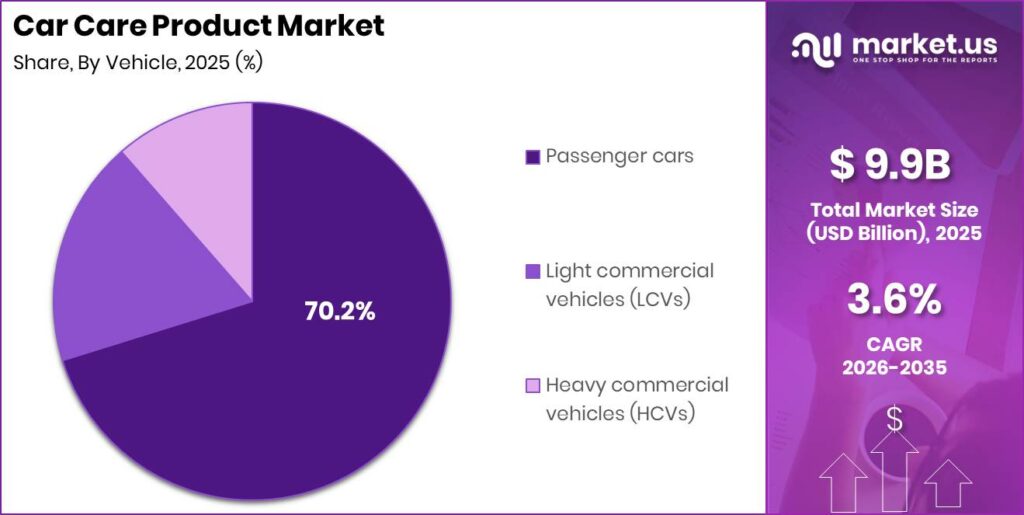
- Passenger cars lead By Vehicle with a 70.2% share in 2025.
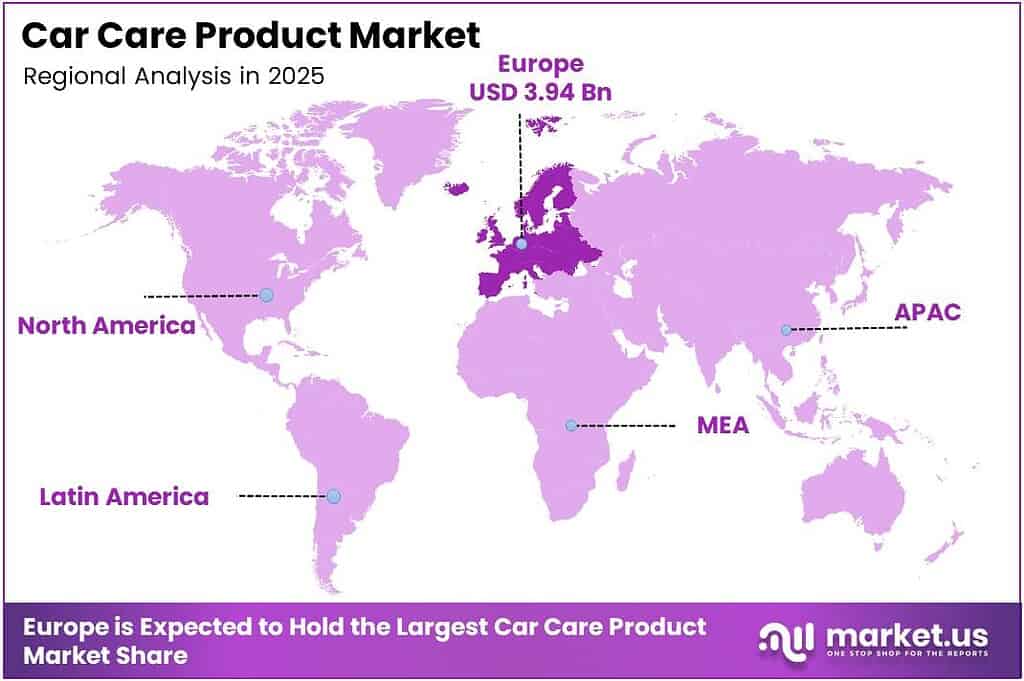
- Europe leads regionally with a 39.8% share, valued at USD 3.94 Billion.
- Car polish, exterior care, and online / e-commerce rank as the fastest growing lanes in their groups.
As per our research, professional conveyor systems used an average of 30 gallons of fresh water per vehicle in a cited 2018 study, down from 34 gallons in 2002. EPA guidance caps freshwater near 35 to 40 gallons for conveyor and in-bay systems. Operators that hit these bands lower utility cost per bay and free capital for chemistry upgrades. This means wash chains become steadier bulk buyers of efficient cleaners and protectants.
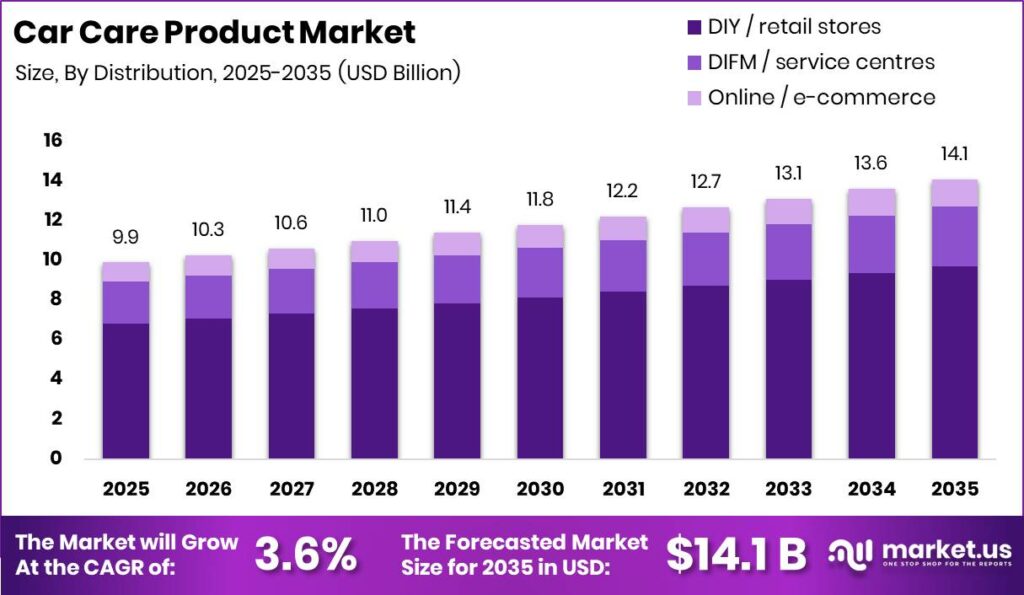
Consequently, standard hoses that release 10 gallons per minute can push a traditional session toward 100 gallons in 10 minutes without controls. High water intensity raises site cost and sharpens buyer preference for concentrated formulas. In March 2025, Autoglym launched high capacity 2.5 liter bulk packs for four core products with the Easy Sprayer. Bulk formats cut cost per use and lock professional accounts into repeat fill cycles.
Type Analysis
Car cleaning products dominates with 45.6% due to high frequency wash replenishment cycles.
In 2025, Car cleaning products held a dominant market position in the By Type segment of Car Care Product Market, with a 45.6% share. As reported by the International Carwash Association water conservation brief, professional washes introduce only 9 to 15 gallons of fresh water per vehicle on average. That path cuts freshwater need by 65% or more versus home washing. Brands that sell concentrated cleaners into pro bays capture high-turn volume with lower acquisition cost.
Car polish ranks as the fastest growing type as buyers shift from short-lived shine to longer film life. In a controlled year-long test on identical vehicles, ceramic systems kept full protective performance after 12 months. Wax lost measurable hydrophobicity within 3 months, and sealant held only about 30% comparable protection by month six versus roughly 90% for ceramic. Suppliers that prove durability win premium shelf space and higher ticket mixes.
Car wax still anchors classic DIY protection routines despite shorter wear windows. In a separate 12 month Mumbai field test, ceramic-coated panels retained 85% of hydrophobic properties after one year. Waxed panels lost all measurable hydrophobicity within 6 weeks. Retailers that pair wax entry kits with clear reapplication guidance defend basket size against full ceramic migration.
Wheel and tire care products, glass cleaners, and other product types hold the remaining share collectively. In 2025, SOFT99 introduced Glaco QAD, a quick-adhesion windshield treatment applied during active washes. Glass SKUs that fit wash-lane timing raise attach rates without adding bay labor. Formulators that align wheel and glass chemistries with automated cycles secure service-channel contracts faster than pure retail SKUs.
Application Analysis
Interior dominates with 50.5% due to frequent cabin soil and fabric care.
In 2025, Interior held a dominant market position in the By Application segment of Car Care Product Market, with a 50.5% share. Traditional at-home or non-optimized washing still consumes between 15 and 85 gallons per vehicle. Systems with reclamation cut that band to 8 to 70 gallons depending on wash type. Interior cleaners sold beside water-efficient service menus gain from higher visit frequency and add-on detailing tickets.
In 2025, SOFT99 formally rolled out Roompia Interior Shampoo for high-foaming, residue-free fabric and carpet deep cleaning. Cabin soils return faster than exterior films in daily urban use. Products that clean without sticky residue reduce rework time for detailers. This creates a clear path for premium interior lines to lift average ticket inside organized service chains.
Exterior stands as the fastest growing application as owners chase longer paint protection and showroom finish. A fully automated tunnel can use up to 450 liters of water per car. One efficiency case showed that saving 3 cents per wash across 300,000 cars produced 9,000 euros in annual savings. Chemistry vendors that cut rinse demand while holding gloss help operators bank those savings and expand exterior packages.
Distribution Analysis
DIY / retail stores dominates with 68.9% due to broad household purchase access points.
In 2025, DIY / retail stores held a dominant market position in the By Distribution segment of Car Care Product Market, with a 68.9% share. EPA WaterSense guidance caps self-service nozzles at no more than 3.0 gallons (11.4 liters) per minute. Flow limits push DIY buyers toward stronger concentrates that finish jobs with less rinse time. Retail packs that advertise dose control convert water-aware shoppers at the shelf.
DIFM / service centres supply professional bays where throughput and water cost set the buying brief. Water recycling and reclamation systems can recycle or conserve up to 80% of water used per vehicle. That saving improves site margins and funds higher-grade chemical contracts. Suppliers with bulk closed-loop compatible formulas win multi-site chain awards over single-bottle brands.
Online / e-commerce is the fastest growing distribution lane as buyers refill known SKUs without store trips. Digital shelves favor clear claim labels on protection life and pack size. Brands that publish dose charts and kit bundles raise repeat order rates. This signals marketplace sellers can cut reliance on dealer-linked launches and build direct replenishment revenue.
Vehicle Analysis
Passenger cars dominates with 70.2% due to largest active parc and retail access.
In 2025, Passenger cars held a dominant market position in the By Vehicle segment of Car Care Product Market, with a 70.2% share. An 8 week academic campaign covering 3,667 vehicles measured average wash use at 158 liters for sedans and 197 liters for SUVs, with an overall mean near 207 liters. Higher surface area on popular passenger bodies lifts chemical dose per visit. Formulas tuned for sedan and SUV panels capture the densest retail demand pool.
Light commercial vehicles need durable cleaners that handle fleet soil, brake dust, and frequent urban stops. ACEA fleet data place EU vans at an average age near 12.5 years, which extends maintenance spend beyond the first owner cycle. Older LCVs raise demand for strong degreasers and tire care in workshop channels. Fleet buyers prioritize cost per wash and uptime over lifestyle branding.
Heavy commercial vehicles round out demand with large exterior areas and depot-based wash routines. OICA figures show global motor vehicle production near 92.7 million units in 2024 and about 96.4 million in 2025, sustaining a wide commercial parc. Depot operators buy in drums and require consistent dilution control. Vendors with HCV-ready pack sizes lock longer service contracts than retail-only rivals.
Key Market Segments
By Type
- Car cleaning products
- Car polish
- Car wax
- Wheel & tire care products
- Glass cleaners
- Other product types
By Application
- Interior
- Exterior
By Distribution
- DIY / retail stores
- DIFM / service centres
- Online / e-commerce
By Vehicle
- Passenger cars
- Light commercial vehicles (LCVs)
- Heavy commercial vehicles (HCVs)
Regional Analysis
Europe Dominates the Car Care Product Market with a Market Share of 39.8%, Valued at USD 3.94 Billion
Europe leads on the back of a large aged parc and dense professional wash and detailing networks. ACEA data show EU passenger cars average about 12.3 years, which extends spend on cleaning and protection after warranty exit. Mature retail chains and quick-service bays keep replenishment volumes high. Investors should treat Europe as the cash-flow core while pricing VOC-compliant formulas for regulated shelves.
North America deepens demand through specialty retail and show-driven product discovery. In November 2024, Griot’s Garage expanded detailing and maintenance lines with new core tool systems presented live at SEMA 2024. Event-led launches speed sell-in across independent detailers and e-commerce kits. Asia Pacific, Latin America, and Middle East and Africa add volume as organized retail and service formats widen household access.
Key Regions and Countries
North America
- US
- Canada
Europe
- Germany
- France
- The UK
- Spain
- Italy
- Rest of Europe
Asia Pacific
- China
- Japan
- South Korea
- India
- Australia
- Rest of APAC
Latin America
- Brazil
- Mexico
- Rest of Latin America
Middle East and Africa
- GCC
- South Africa
- Rest of MEA
Market Dynamics
Market Opportunity Analysis - Online kits, exterior protectants, and EV-safe lines open whitespace beyond core retail cleaning
Online / e-commerce remains the fastest growing distribution lane while DIY retail still holds 68.9%. Many legacy brands under-invest in refill bundles and dose education on digital shelves. New entrants can win repeat orders with subscription kits priced below pro-detail visits. This creates a lower-capex path into the category without buying store planograms first.
Exterior care is the fastest growing application while Interior still leads at 50.5%. Paint protection and wash-lane gloss packages remain less saturated in mid-tier service chains. Operators that add simple exterior upsells raise ticket size without new real estate. Investors should back formulas built for tunnel timing rather than long hand-detail cycles only.
Car polish is the fastest growing type beside cleaning products at 45.6%. Durability claims separate premium polish and ceramic hybrids from commodity wax. Challengers that publish wear-test proof can take share from short-cycle wax without matching full ceramic price points. This signals a mid-tier protection lane still open between economy shine and multi-year coatings.
Passenger cars dominate at 70.2%, yet LCV and HCV care stays thinner in branded retail. Fleet and depot buyers need drum formats and dilution control more than lifestyle packs. Suppliers that build commercial-only SKUs avoid pure price wars on consumer shelves. Early movers can lock multi-year wash contracts before global brands localize fleet lines.
Technology and Innovation Landscape - Water thrift, long-life coatings, and wash-lane automation redefine product design
Water reclamation and recycling now sit at the center of pro wash economics. Systems that conserve large shares of process water cut utility spend and support municipal permits. Chemical makers that keep foam and rinse performance in reclaim loops win chain specifications. Sites that ignore thrift face rising operating cost and weaker expansion cases.
Long-life ceramic and nano protectants change repurchase timing versus classic wax. Multi-year film life shifts messaging from weekly shine to measured durability. Brands that certify real outdoor wear reduce refund risk and support premium ASP. Retail kits that include prep cleaners capture full system revenue, not only top-coat bottles.
Wash-lane automation favors chemistries that dose cleanly through arches and foamers. Labor shortages push operators toward shorter cycles and simpler steps. Products that fail in automated spray patterns lose bay contracts even if they win on store shelves. Formulators should validate viscosity and dwell time inside conveyor hardware before scale-up.
EV-safe dielectric cleaning and battery-bay protocols are the next specification layer. IEA tracking shows electric cars already holding about one quarter of new global sales in 2025. Low-conductivity cleaners and coated-tool guidance will become purchase gates for OEM-linked service networks. Early certification spend buys preferred-vendor status before standards fully harden.
Drivers
The global vehicle parc underwrites category growth, with OICA-linked tracking near 1.6 billion operating units by 2024. U.S. and European fleet surveys place average age above 12 years, adding roughly +1.3% to baseline growth as older cars need more cleaning and protection. SEMA shipment patterns show post-warranty owners spend more to defend resale value. This shifts economics toward recurring replenishment and cuts acquisition cost for direct and marketplace sellers by about 15% to 20%.
As a result, manufacturers redirect capital from one-off SKUs toward modular families and multi-pack bundles. NADA used-vehicle data through 2025 and Manheim value signals support this as a durable pattern into 2026. Professional detailing growth, digital DIY reach, ceramic premiumization, and early OEM care bundles add further lift. Buyers who stock refill formats capture parc-driven demand before rivals retool assortments.
| Driver | (~) % Impact on CAGR Forecast | Geographic Relevance | Impact Timeline |
|---|---|---|---|
| Vehicle parc expansion & aging used-car fleet | +1.3% | Global, led by APAC, North America, Latin America | Medium term (2 to 4 years) |
| Proliferation of professional detailing & quick-service wash centers | +0.8% | North America, Europe, urban China and India | Medium term (2 to 4 years) |
| E-commerce/digital distribution penetration for DIY products | +0.6% | Global, led by APAC and North America | Short term (2 years or less) |
| Premiumization via ceramic and nano-coating adoption | +0.5% | North America, Europe, urban APAC | Long term (4 years or more) |
| Rising preventive-maintenance awareness | +0.4% | Global | Long term (4 years or more) |
| Early-stage OEM subscription/bundled-care programs | +0.3% | North America, Western Europe | Short term (2 years or less) |
Restraints
CARB consumer product rules and EU REACH updates tighten VOC ceilings on aerosols, solvent cleaners, waxes, and tire dressings. Non-compliant SKUs leave California and EU shelves, removing an estimated -0.5% from baseline growth. Company filings show reformulation and recertification take 9 to 14 months per SKU. Gross margin can compress about 200 to 350 basis points as low-VOC inputs cost more than legacy solvents.
This means producers delay new solvent-line capacity and spend first on compliance chemistry. OECD chemical investment tracking shows budgets freeze on current-generation solvent sales until substitutes clear tests. Higher policy rates, intermediate tariffs, weaker discretionary spend, and plastic pack limits add further drag in the near term. Sellers without compliant reformulations lose two of the largest regulated demand pools.
| Restraint | (~) % Impact on CAGR Forecast | Geographic Relevance | Impact Timeline |
|---|---|---|---|
| VOC and solvent-content regulatory bans | -0.5% | North America (California), European Union | Short term (2 years or less) |
| Elevated policy interest rates constraining capex | -0.4% | North America, Europe | Short term (2 years or less) |
| Import tariffs on chemical intermediates and surfactant feedstocks | -0.3% | North America, select APAC importers | Short term (2 years or less) |
| Inflation-driven discretionary-spend contraction | -0.2% | Emerging markets, select OECD economies | Short term (2 years or less) |
| Single-use plastic packaging restrictions | -0.1% | European Union, select APAC markets | Medium term (2 to 4 years) |
Challenges
Certified detailing labor remains scarce across North America and Western Europe. U.S. BLS and Eurostat training data imply new entrants trail replacement need by about 18,000 to 22,000 technicians a year. That gap drags roughly -0.3% off achievable growth. SEMA workforce surveys show vacancies lasting 45 to 60 days and overtime lifting bay labor cost by about 8% to 12%.
By contrast, operators that fund semi-automated bays and shorter training certificates open a new equipment-linked revenue stream. Faster bays still need simple, high-foaming chemistries that unskilled staff can apply safely. Counterfeits, fragmented chemical supply, EV formula retooling, and private-label price pressure add further friction. Vendors that sell automation-ready kits convert labor pain into contracted product pull-through.
| Challenge | (~) % CAGR Friction Drag | Geographic Relevance | Mitigation Horizon |
|---|---|---|---|
| Skilled labor deficit in detailing | -0.3% | North America, Europe | Medium term (2 to 4 years) |
| Counterfeit and grey-market proliferation | -0.2% | APAC (China, Southeast Asia), Middle East | Medium term (2 to 4 years) |
| Fragmented specialty-chemical supply chains | -0.2% | Global, concentrated in APAC sourcing | Medium term (2 to 4 years) |
| EV-compatible formulation retooling burden | -0.2% | China, Europe, North America | Medium term (2 to 4 years) |
| Private-label and marketplace price competition | -0.1% | Global, e-commerce-heavy markets | Long term (4 years or more) |
Opportunities
Dedicated EV-safe care remains open white space because battery-electric and plug-in fleets are still a minority of the operating parc per IEA tracking. Capturing this lane could add about +0.5% upside as EV sales share keeps rising through 2026 and beyond. Specialty producer decks show EV-safe lines earning 20% to 30% price premiums. Margin expansion near 300 to 450 basis points favors formulators that requalify dielectric-safe cleaners rather than rebuild every SKU.
This signals early movers who certify to emerging OEM bay standards can own a distinct maintenance need. DTC subscription replenishment, organized retail in emerging markets, detailing chain roll-ups, telematics prompts, and bio-based waterless systems extend the upside map. Execution needs deliberate R&D, not passive category drift. Investors should fund certification pipelines now while standards committees still finalize battery-bay rules.
| Opportunity | (~) % Potential CAGR Upside | Geographic Relevance | Execution Window |
|---|---|---|---|
| Dedicated EV-safe care product formulations | +0.5% | Global, led by China, Europe, North America | Medium term (2 to 4 years) |
| Scaled DTC/AI-personalized replenishment subscriptions | +0.4% | North America, Western Europe | Medium term (2 to 4 years) |
| Organized-retail penetration in underserved emerging markets | +0.4% | Latin America, Southeast Asia, Sub-Saharan Africa | Long term (4 years or more) |
| Consolidation/M&A roll-up of regional detailing chains | +0.3% | North America, Europe | Medium term (2 to 4 years) |
| Telematics-triggered predictive-maintenance recommendations | +0.2% | North America, Europe, China | Long term (4 years or more) |
| Bio-based waterless nanotech for regulatory-arbitrage white space | +0.2% | Middle East, Africa, Southeast Asia | Long term (4 years or more) |
Key Company Insights
3M Company positions across abrasives, tapes, and surface-care chemistries that feed both DIY shelves and professional bays. Multi-category reach lets fleets and retailers source prep and finish products from one vendor stack. Ceramic systems often rate 2 to 5 years of durability, while natural carnauba wax lasts only 4 to 8 weeks and synthetic sealants last 3 to 6 months. That gap favors 3M lines that sell proven long-life protection into premium kits.
Adolf Würth GmbH & Co. KG (Würth Group) anchors the trade channel through dense workshop distribution and private professional brands. Direct access to service bays shortens refill cycles versus pure consumer labels. Workshop loyalty raises switching costs for smaller chemical specialists. However, heavy trade focus can slow lifestyle brand storytelling where e-commerce kits set discovery trends.
Key Players
- 3M Company
- Adolf Würth GmbH & Co. KG (Würth Group)
- Autoglym
- Bullsone Co., Ltd.
- ITW Global Brands
- Jopasu Systems Pvt. Ltd.
- Liqui Moly GmbH
- Simoniz USA
- SOFT99 Corporation
- Sonax GmbH
- Tetrosyl Ltd.
- Turtle Wax, Inc.
- Armored Auto Group
- Northern Labs, Inc.
- Auto Magic
Recent Developments
- January 2024: MPE Partners and Appearance Technology Group acquired P&S Detail Products and folded the chemical maker into their premium enthusiast portfolio.
- November 2024: Meguiar’s announced global 2025 consumer kit configurations and new surface pads during early November automotive previews.
- June 2025: Turtle Wax launched its surreal global brand campaign “You Are How You Car” to link vehicle pride with personal lifestyle.
- February 2026: Chemical Guys released high frequency specialty products, including Decon Pro Iron and Fallout Remover and ClingShot Bug and Tar chemistry.
- April 2026: Holley launched a dedicated High Performance Car Care line through a chemistry manufacturing partnership with Malco Automotive.
Geopolitical Impact Analysis
According to UNCTAD Review of Maritime Transport 2025, seaborne trade growth slows toward about 0.5% in 2025 after 2.2% growth in 2024. Ton-miles still rose near 6% as ships rerouted around conflict zones. Longer hauls lift landed cost for surfactants, solvents, and packaging resins used in car care formulas. This means importers face sticky freight and delayed drum replenishment into wash chains.
Data from WTO-linked tariff profiles show many chemical MFN rates clustered from 0% to 6.5% under older harmonization deals. Newer reciprocal measures have pushed effective duties far higher on selected lanes, with reported chemical cost lifts near 8% to 15% in stressed corridors. Higher intermediate tariffs compress blender margins on waxes and cleaners. As a result, regional compounding and dual sourcing become core risk controls for category leaders.
Report Scope
| Report Features | Description |
|---|---|
| Market Value (2025) | USD 9.90 Billion |
| Forecast Revenue (2035) | USD 14.10 Billion |
| CAGR (2026-2035) | 3.6% |
| Base Year for Estimation | 2025 |
| Historic Period | 2020-2024 |
| Forecast Period | 2026-2035 |
| Report Coverage | Revenue Forecast, Market Dynamics, Market Opportunity Analysis, Technology and Innovation Landscape, Competitive Landscape, Recent Developments |
| Segments Covered | By Type (Car cleaning products, Car polish, Car wax, Wheel & tire care products, Glass cleaners, Other product types), By Application (Interior, Exterior), By Distribution (DIY / retail stores, DIFM / service centres, Online / e-commerce), By Vehicle (Passenger cars, Light commercial vehicles (LCVs), Heavy commercial vehicles (HCVs)) |
| Regional Analysis | North America (US and Canada), Europe (Germany, France, The UK, Spain, Italy, and Rest of Europe), Asia Pacific (China, Japan, South Korea, India, Australia, and Rest of APAC), Latin America (Brazil, Mexico, and Rest of Latin America), Middle East and Africa (GCC, South Africa, and Rest of MEA) |
| Competitive Landscape | 3M Company, Adolf Würth GmbH & Co. KG (Würth Group), Autoglym, Bullsone Co., Ltd., ITW Global Brands, Jopasu Systems Pvt. Ltd., Liqui Moly GmbH, Simoniz USA, SOFT99 Corporation, Sonax GmbH, Tetrosyl Ltd., Turtle Wax, Inc., Armored Auto Group, Northern Labs, Inc., Auto Magic |
| Customization Scope | Customization for segments, region / country-level will be provided. Additional customization can be done based on requirements. |
| Purchase Options | We have three licenses to opt for: Single User License | Multi-User License (Up to 5 Users) | Corporate Use License (Unlimited User and Printable PDF) |





































