


Report Overview
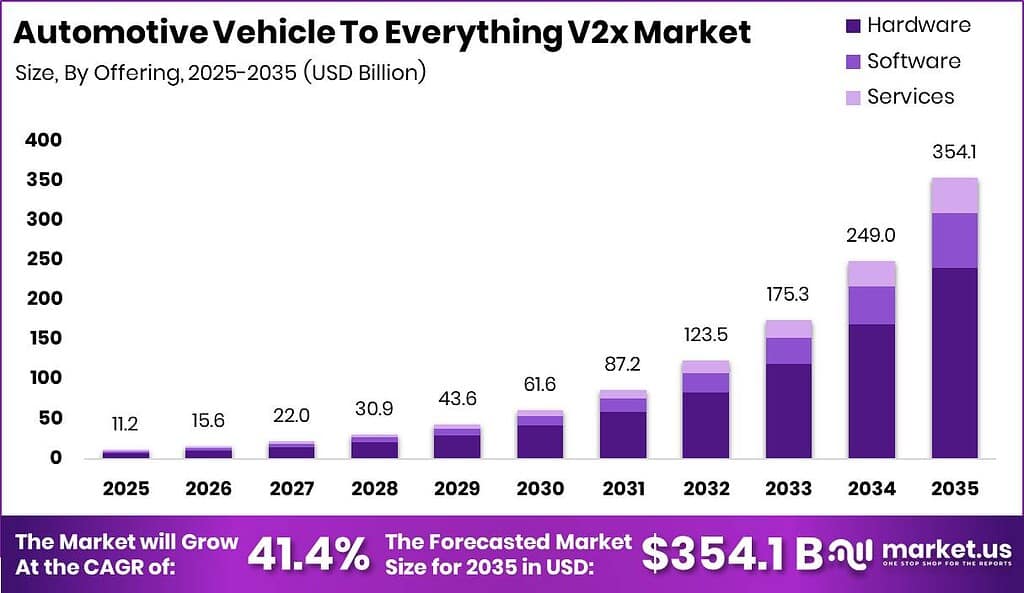
Global Automotive Vehicle to Everything (V2X) Market size is expected to be worth around USD 354.1 Billion by 2035 from USD 11.2 Billion in 2025, growing at a CAGR of 41.4% during the forecast period 2026 to 2035. This trajectory places V2X among the fastest-scaling segments in automotive technology. Investors and OEMs entering between 2026 and 2028 stand to capture platform-level positions before market consolidation narrows competitive entry points.
The Automotive V2X Market encompasses the hardware, software, and services that enable vehicles to communicate with surrounding infrastructure, other vehicles, pedestrians, networks, grids, clouds, and connected devices. This ecosystem spans onboard units, roadside units, chipsets, communication stacks, and managed connectivity services. The market operates across two primary communication protocols, DSRC and C-V2X, and serves applications from collision avoidance to intelligent traffic management.
Key Takeaways
- Market Value (2025): USD 11.2 Billion
- Market Value (2035): USD 354.1 Billion
- CAGR (2026–2035): 41.4%
- Dominant Segment (By Offering): Hardware with 68.0% share
- Dominant Segment (By Communication Type): Vehicle-to-Vehicle (V2V) with 34.6% share
- Dominant Segment (By Connectivity): Cellular V2X (C-V2X) with 72.0% share
- Dominant Segment (By Technology): LTE/4G with 47.0% share
- Dominant Segment (By Application): Collision Avoidance and Safety with 31.0% share
- Dominant Region: Asia Pacific with 42.0% market share, valued at USD 4.69 Billion in 2025
According to the U.S. Department of Transportation field-test data, V2X traffic-signal priority cut travel time by approximately 10 seconds per intersection on each qualifying pass. This translates directly into measurable fuel savings and reduced urban emissions. Municipalities that deploy V2X signal systems early can use these efficiency gains to justify deployment costs to local councils and federal grant bodies.
The first U.S. C-V2X “Day One Deployment District” launched in Atlanta in September 2025, backed by an industry association reporting more than 110 automotive, telecommunications, semiconductor, and equipment members. This coalition structure signals that V2X is transitioning from pilot-phase fragmentation to coordinated commercial rollout in North America. Vendors who align with these deployment districts now secure preferred-supplier positioning before federal procurement cycles open at scale.
Offering Analysis
Hardware dominates with 68.0% due to mandatory onboard unit integration requirements.
In 2025, Hardware held a dominant market position in the By Offering segment of the Automotive V2X Market, with a 68.0% share. V2X hardware includes onboard units, roadside units, and chipsets that form the physical communication layer between vehicles and their environment. India’s ARAI regulatory submission specifies an automotive operating-temperature range of −40°C to +85°C for V2X equipment certification, confirming that ruggedized hardware must meet strict environmental standards before market entry. Vendors who invest in certified, temperature-qualified hardware architectures now lock in design-win advantages before competing platforms qualify.
Software represents the fastest-growing sub-segment within the Offering category, driven by OEM demand for firmware-over-the-air update capability and protocol-agnostic communication management. The ITU’s work program on intelligent transport systems identifies software-defined communication layers as a priority for spectrum-harmonized V2X deployment across member states. As C-V2X network density increases, software platforms that abstract hardware complexity and support multi-protocol operation will command higher per-vehicle licensing fees, shifting supplier revenue models from one-time hardware sales toward recurring software subscriptions.
Services complete the offering hierarchy, covering managed connectivity, V2X-as-a-service platforms, and cybersecurity certificate authority operations for vehicle public-key infrastructure. Industry trade associations, including SAE International and the Car Connectivity Consortium, define minimum cybersecurity service requirements tied to certificate lifecycle management for V2X-enabled vehicles. Fleet operators and municipalities that outsource certificate authority management to third-party service providers reduce internal PKI staffing costs, making managed services a structurally recurring revenue stream for V2X platform vendors.
Communication Type Analysis
Vehicle-to-Vehicle (V2V) dominates with 34.6% due to direct safety-critical peer communication priority.
In 2025, Vehicle-to-Vehicle (V2V) held a dominant market position in the By Communication Type segment of the Automotive V2X Market, with a 34.6% share. V2V enables direct peer-to-peer collision warnings, emergency braking alerts, and cooperative adaptive cruise control without relying on network infrastructure. A real-world C-V2X expressway visibility-warning system achieved a communication coverage radius of more than 500 metres between roadside and onboard equipment, while end-to-end transmission delays measured 30 to 35 milliseconds. These figures confirm that direct V2V links deliver the latency and range profiles required for pre-crash safety applications at highway speeds.
Vehicle-to-Infrastructure (V2I) connects onboard units to roadside units at traffic signals, toll plazas, and smart intersections, enabling signal-phase-and-timing data exchange that reduces stop-and-go driving. The U.S. Federal Highway Administration’s Every Day Counts initiative tracks V2I deployment volumes at signalized intersections as a benchmark for connected-infrastructure investment. Municipalities that commit V2I infrastructure budgets ahead of federal mandate cycles lock in grant eligibility windows and RSU procurement pricing before broader rollout compresses vendor capacity.
Vehicle-to-Pedestrian (V2P) addresses vulnerable road user detection by broadcasting proximity alerts to smartphones and wearables in the ITS spectrum. Vehicle-to-Network (V2N) routes vehicle telemetry through cellular networks for cloud-based traffic management and OTA updates. Vehicle-to-Grid (V2G), Vehicle-to-Cloud (V2C), and Vehicle-to-Device (V2D) complete the communication type architecture, collectively expanding V2X beyond safety into energy management and device interoperability, and together they represent the remaining market share outside V2V, V2I, and V2P.
Connectivity Analysis
Cellular V2X (C-V2X) dominates with 72.0% due to cellular network reuse lowering deployment costs.
In 2025, Cellular V2X (C-V2X) held a dominant market position in the By Connectivity segment of the Automotive V2X Market, with a 72.0% share. C-V2X operates across both direct PC5 sidelink communication and wide-area Uu network interfaces, enabling vehicle-to-vehicle and vehicle-to-network modes on a single chipset. A real-world LTE-V2X PC5 test placed 2 C-V2X modules 50 metres apart and measured full-stack end-to-end communication latency. At a transmission rate of 10 packets per second, measured latency ranged from 13.5 to 28.3 milliseconds with an average of 19.1 milliseconds, confirming sub-30ms performance across standard payload sizes. Chipset vendors who certify C-V2X modules to these latency benchmarks secure design-win priority at OEM procurement reviews.
Dedicated Short-Range Communication (DSRC), built on the IEEE 802.11p standard, operates across a 20 MHz bandwidth channel in the 5.9 GHz ITS spectrum and provides proven low-latency direct communication without cellular network dependency. The U.S. Department of Transportation’s Vehicle-to-Infrastructure program historically qualified DSRC equipment through its connected vehicle pilot programs in New York City, Tampa, and Wyoming. DSRC deployments already embedded in North American and European infrastructure represent a stranded-asset risk for municipalities, but also an upgrade revenue opportunity for vendors offering dual-mode DSRC and C-V2X transition hardware.
Technology Analysis
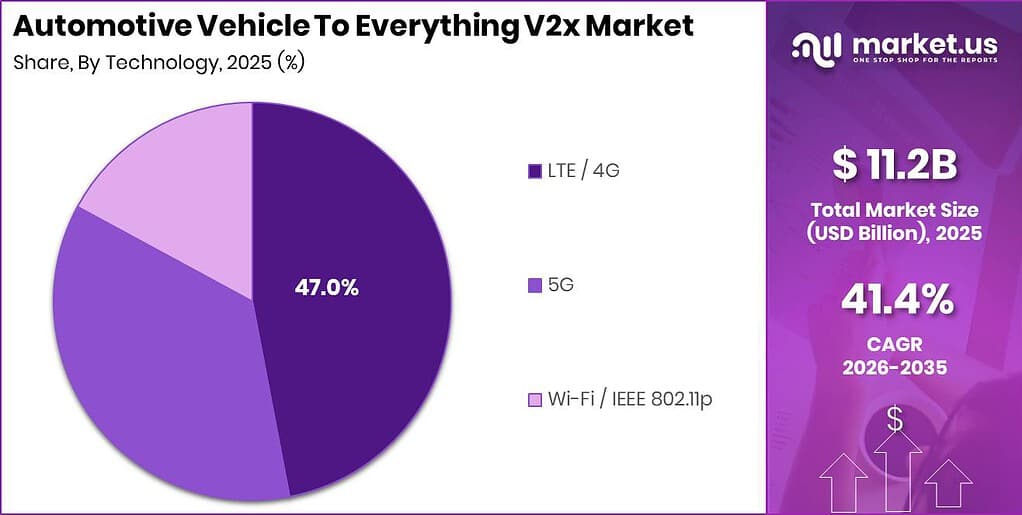
LTE/4G dominates with 47.0% due to existing cellular infrastructure enabling immediate V2X deployment.
In 2025, LTE/4G held a dominant market position in the By Technology segment of the Automotive V2X Market, with a 47.0% share. LTE-V2X, standardized under 3GPP Release 14, provides the baseline communication protocol for current production-vehicle V2X deployments across China, Europe, and North America. India’s ARAI regulatory submission to TRAI specified 3GPP Release 14 as the minimum acceptable LTE-V2X baseline, with Release 15 preferred, for on-board and roadside unit certification. For LTE-V2X systems managing large-packet message queues, measured latency for a 1,000-byte payload at 100 packets per second ranged from 13.4 to 27.8 milliseconds with an average of 19.6 milliseconds, and route-guidance algorithms require a convergence target of 0.0001 (a 0.01% relative gap) for stable traffic-assignment outputs. Vendors who meet these precision thresholds in certified LTE deployments gain a qualification advantage as regulators tighten performance benchmarks.
5G represents the fastest-growing technology sub-segment, driven by its sub-millisecond latency potential and network slicing capability that enables dedicated low-latency channels for safety-critical V2X messages. The 3GPP Release 16 standard introduced the first 5G NR-V2X specification, formally defining sidelink communication for direct vehicle-to-vehicle 5G messaging outside network coverage. OEMs that begin chipset qualification for 5G NR-V2X now shorten their time-to-production relative to competitors who defer 5G integration until regulatory deadlines force action. Wi-Fi/IEEE 802.11p completes the technology segment, primarily relevant for legacy DSRC infrastructure serving existing corridor deployments.
Application Analysis
Collision Avoidance and Safety dominates with 31.0% due to regulatory safety mandates prioritizing crash prevention.
In 2025, Collision Avoidance and Safety held a dominant market position in the By Application segment of the Automotive V2X Market, with a 31.0% share. V2X collision-avoidance systems broadcast critical obstacle data across connected vehicles, with a peer-reviewed 2025 cooperative-perception study reporting an average broadcast latency of 9.24 milliseconds for safety-critical obstacle information. That same system was configured to detect and classify 2 safety-relevant object classes, pedestrians and cars, providing a deployable baseline for urban intersection safety. Systems that meet sub-10ms broadcast thresholds qualify for the highest-priority safety message classes under SAE J2945 standards, giving certified vendors a regulatory compliance advantage over slower architectures.
Autonomous Driving Support relies on V2X cooperative-perception data to extend a vehicle’s effective sensor range beyond line-of-sight limits. A 2025 USDOT evaluation found that trajectory-based connected-vehicle traffic-control methods reduced total intersection delay by 15.8% to 23.7% compared with conventional coordinated control, demonstrating that V2X data integration meaningfully improves autonomous routing decisions. This performance gap creates a commercial incentive for autonomous vehicle developers to embed V2X receivers as standard hardware rather than optional sensors.
Traffic Management and Efficiency benefits directly from V2X route-guidance integration. A 2025 peer-reviewed review found that integrated route-guidance and V2X communication techniques improved packet-delivery ratio by 14.5% and 44% across evaluated deployment scenarios. Emergency Vehicle Notification, Intelligent Parking and Navigation, and Fleet and Asset Management complete the application segment. These sub-segments collectively hold the remaining share below Collision Avoidance, Autonomous Driving Support, and Traffic Management, and each depends on the same C-V2X communication infrastructure already being deployed for safety applications.
Key Market Segments
By Offering
- Hardware
- Software
- Services
By Communication Type
- Vehicle-to-Vehicle (V2V)
- Vehicle-to-Infrastructure (V2I)
- Vehicle-to-Pedestrian (V2P)
- Vehicle-to-Network (V2N)
- Vehicle-to-Grid (V2G)
- Vehicle-to-Cloud (V2C)
- Vehicle-to-Device (V2D)
By Connectivity
- Dedicated Short-Range Communication (DSRC)
- Cellular V2X (C-V2X)
By Technology
- LTE/4G
- 5G
- Wi-Fi/IEEE 802.11p
By Application
- Collision Avoidance and Safety
- Autonomous Driving Support
- Traffic Management and Efficiency
- Emergency Vehicle Notification
- Intelligent Parking and Navigation
- Fleet and Asset Management
Regional Analysis
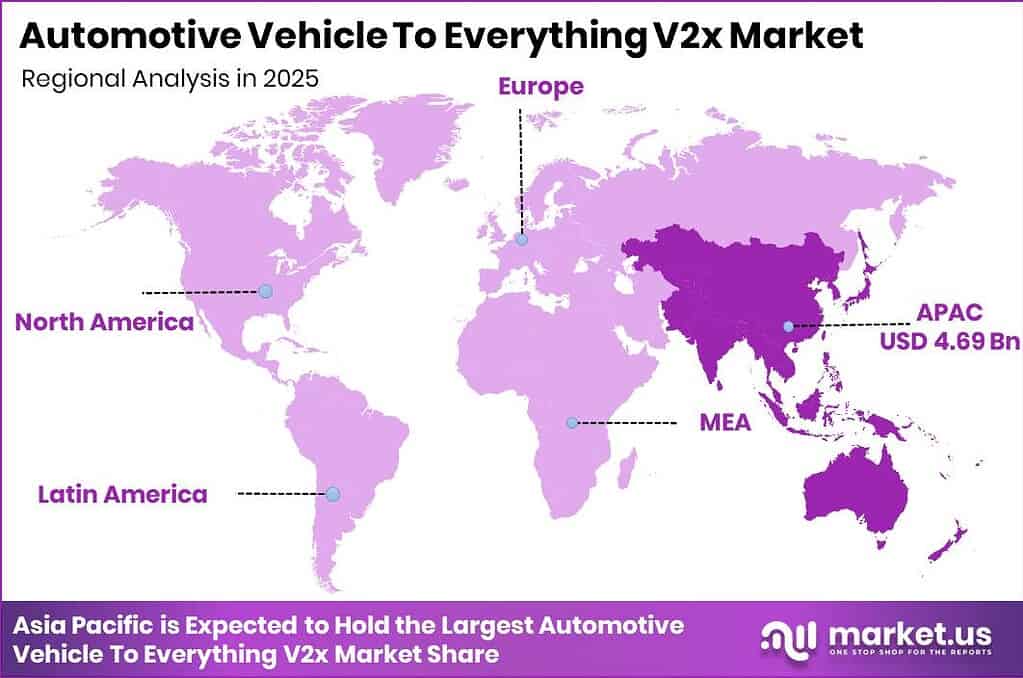
Asia Pacific Dominates the Automotive V2X Market with a Market Share of 42.0%, Valued at USD 4.69 Billion
Asia Pacific commands the largest regional share at 42.0%, valued at USD 4.69 Billion in 2025, anchored by China’s mandatory LTE-V2X standard for new energy vehicles that has already pushed V2X-equipped unit penetration in domestic NEV output past 30%. This regulatory enforcement mechanism converts policy into immediate hardware procurement volume. OEMs supplying the China market must now treat V2X as a standard-fit embedded architecture rather than an optional trim feature, accelerating platform-model transitions across the entire Asia Pacific supply chain.
North America represents the fastest-growing regional market, driven by the FCC’s reallocation of the 5.9 GHz band to C-V2X and the launch of the first U.S. C-V2X Day One Deployment District in Atlanta in September 2025. India’s 2026 ARAI regulatory submission to TRAI proposed a 10-year licence validity for V2X equipment authorization, with a mandatory performance audit required at renewal. This licensing framework signals that India is building the regulatory foundation for large-scale V2X rollout, creating a medium-term procurement pipeline for vendors who certify equipment under the proposed ARAI standard before competitors enter.
Europe advances through the EU C-Roads Platform and ITS-G5 corridor rollout, which creates coordinated cross-border RSU procurement across member states. Latin America and the Middle East and Africa regions represent early-stage markets where smart-city infrastructure investment is beginning to create selective V2X deployment opportunities. These regions collectively hold the share outside Asia Pacific and North America, and their growth will depend on concessional financing from multilateral development banks and alignment with global V2X certification frameworks.
Key Regions and Countries
North America
- US
- Canada
Europe
- Germany
- France
- The UK
- Spain
- Italy
- Rest of Europe
Asia Pacific
- China
- Japan
- South Korea
- India
- Australia
- Rest of APAC
Latin America
- Brazil
- Mexico
- Rest of Latin America
Middle East and Africa
- GCC
- South Africa
- Rest of MEA
Market Dynamics
Market Opportunity Analysis - Underserved connectivity segments and emerging regional corridors offer high-return entry points for platform vendors.
The Services sub-segment within the Offering category remains the least-penetrated layer of the V2X value chain despite its highest recurring-revenue potential. Hardware captures 68.0% of current market share, meaning the software and services tiers collectively hold the remaining 32.0% of a market valued at USD 11.2 Billion in 2025. New entrants who position around managed PKI certificate services and V2X-as-a-service connectivity platforms can capture this undermonetized layer without competing directly against established chipset vendors on hardware margin.
Vehicle-to-Grid and Vehicle-to-Device communication types hold the lowest share positions within the By Communication Type segment, yet both sit at the intersection of V2X and the EV charging infrastructure buildout. This overlap creates a white-space entry point where V2X platform vendors can bundle V2G communication capability into existing C-V2X hardware at minimal incremental cost. Vendors who file V2G interoperability certifications now position ahead of utility-sector procurement cycles that will formalize V2G communication standards within the next two to four years.
The LTE/4G technology segment holds 47.0% share today, but its dominance masks a transition risk as 5G NR-V2X qualifications accelerate. This creates an immediate opportunity for vendors offering seamless firmware-upgrade paths from LTE to 5G NR-V2X on the same hardware platform. OEMs who source upgradeable chipsets now avoid a costly mid-cycle hardware replacement when 5G V2X mandates arrive. Vendors who productize this upgrade path as a paid feature capture a near-term premium from OEMs unwilling to absorb a full hardware replacement cycle.
India and ASEAN markets represent the largest geographically concentrated white space in the current V2X deployment map. The Collision Avoidance and Safety application, which holds 31.0% of global application share, is currently concentrated in China, North America, and Western Europe. Replicating this application mix across Indian national highway corridors under the ARAI certification framework gives infrastructure integrators a first-mover procurement advantage in a market where no incumbent deployment currently anchors buyer relationships or shapes specification standards.
Technology and Innovation Landscape - Low-latency communication architectures and software-defined protocol flexibility define the next competitive frontier
A 2025 peer-reviewed cooperative-perception study reported that its V2X collision-avoidance system broadcast critical obstacle information with an average end-to-end latency of 9.24 milliseconds, using roadside and onboard units operating on a 20 MHz bandwidth channel in the 5.9 GHz ITS spectrum. This sub-10ms threshold sets a de facto performance benchmark for safety-critical message delivery. Chipset vendors whose hardware architectures certifiably meet or beat this figure gain a specification-compliance advantage as safety rating bodies begin weighting V2X communication latency in their scoring models.
A real-world LTE-V2X PC5 interface test measured latency averaging 18.6 milliseconds at 100 packets per second across 200-byte and 800-byte payloads, with instrument timestamping precision of 0.1 microseconds. This measurement precision establishes a reproducible test methodology that regulators and OEM procurement teams can use to evaluate chipset bids on objective latency benchmarks rather than vendor-claimed specifications. Test labs that adopt this methodology as a standard qualification protocol gain influence over the procurement criteria that shape future V2X hardware contract awards.
Parallel processing reduced traffic-assignment computation time by as much as 77% using 12 processing threads in a 2025 route-guidance study, while replacing a library power function with an iterative implementation alone reduced route-assignment computation time by approximately 70%. These algorithmic efficiency gains translate directly into lower onboard compute requirements for V2X route-guidance applications. Platform vendors who integrate these optimizations into their V2X software stacks can reduce required processor core counts per vehicle, cutting per-unit bill-of-materials cost and improving competitive positioning on price-sensitive OEM platform bids.
5G NR-V2X introduces network slicing capability that assigns dedicated low-latency channels to safety-critical V2X message classes, separating them from general cellular traffic. The 2026 safety-critical communications standard applied in a peer-reviewed study used a packet-delivery reliability target of 99.999% for V2X safety messages, a threshold that LTE networks cannot guarantee under congested urban conditions. Vendors who qualify their 5G NR-V2X implementations against this reliability target now hold a differentiation claim that LTE-only competitors cannot match, giving them a structural advantage as 5G network density increases across China, North America, and Europe between 2026 and 2030.
Drivers
China’s Ministry of Industry and Information Technology finalized its mandatory LTE-V2X standard for new energy vehicle production in 2024, with enforced compliance phased through 2025. Per China Association of Automobile Manufacturers data, V2X-equipped unit penetration in domestic NEV output has already surpassed 30% ahead of the 2026 baseline year. Per-unit onboard-unit costs have fallen roughly 18% since volume production began. This cost compression expands the addressable market by making V2X integration economically viable for mid-tier NEV platforms, not just premium models.
A 2025 USDOT field-test report from Oakland County calculated that a 0.4% crash reduction, equivalent to approximately 187 avoided crashes over three years, would fully offset the project’s USD 15 million V2X deployment cost. This cost-benefit threshold gives municipal budget officers a replicable financial model for V2X procurement approval. Cities that adopt this safety-return framework can unlock infrastructure grant funding ahead of competitors who lack a quantified cost-justification case.
| Driver | (~) % Impact on CAGR Forecast | Geographic Relevance | Impact Timeline |
|---|---|---|---|
| China MIIT/CAAM LTE-V2X Mandate for NEVs | +7.2% | Asia Pacific (China) | Short term (2 years or less) |
| FCC 5.9GHz Band Reallocation to C-V2X Standard | +6.5% | North America | Short term (2 years or less) |
| OEM Series Production of C-V2X Chipsets | +5.5% | Global | Short term (2 years or less) |
| EU C-Roads Platform & ITS-G5 Corridor Rollout | +4.8% | Europe | Medium term (2 to 4 years) |
| Safety Rating Weighting for Connected Features | +3.9% | Global | Medium term (2 to 4 years) |
| 5G-Advanced Network Slicing for Low-Latency V2X | +3.0% | Global | Medium term (2 to 4 years) |
Restraints
U.S. Bureau of Industry and Security export-control rules, expanded in 2024, restrict the fabrication and cross-border shipment of sub-7nm secure-element and V2X system-on-chip designs used in onboard and roadside units. Semiconductor Industry Association supply-chain tracking shows lead-time extensions of 16 to 22 weeks for qualified automotive-grade V2X silicon. A peer-reviewed 2025 field test found that the V2X vulnerable-road-user detection system recorded an average end-to-end latency of approximately 1.8 seconds against an acceptable threshold of 300 milliseconds. This gap signals that hardware supply delays are compounding performance qualification backlogs across the V2X chipset pipeline.
Dual-sourcing procurement costs have risen an estimated 12% per tier-one supplier earnings disclosures, while supplier gross margins face compression of an estimated 3 to 5 percentage points from export-driven cost increases. Municipal budget constraints simultaneously freeze roadside-unit procurement in North America and Europe, removing a key demand catalyst at the infrastructure deployment layer. The absence of a U.S. federal safety mandate for V2X removes the regulatory certainty that would otherwise unlock OEM CapEx commitments, leaving the North American pipeline dependent on voluntary deployment initiatives rather than enforceable purchase obligations.
| Restraint | (~) % Impact on CAGR Forecast | Geographic Relevance | Impact Timeline |
|---|---|---|---|
| Semiconductor Export Control Restrictions | -4.2% | China / Global | Short term (2 years or less) |
| Municipal Budget Constraints Freezing RSU Procurement | -3.3% | North America / Europe | Short term (2 years or less) |
| US Federal Safety Mandate Absence | -3.0% | North America | Short term (2 years or less) |
| High Interest Rate Environment Delaying OEM CapEx | -2.8% | Global | Short term (2 years or less) |
| Legacy DSRC Sunset Litigation & Write-offs | -2.5% | North America | Short term (2 years or less) |
Challenges
DSRC and C-V2X protocols continue to coexist across regulatory jurisdictions, creating a structural interoperability burden for OEM hardware teams. The FCC confined DSRC to a narrow 30 MHz slice of the 5.9 GHz band while reallocating the remainder to C-V2X, entrenching a dual-protocol market. Dual-mode chipset qualification cycles run 9 to 14 months longer than single-protocol designs per 5G Automotive Association interoperability benchmarks. This qualification lag delays time-to-market for OEMs shipping into both European ITS-G5 and North American C-V2X corridors simultaneously, compressing launch windows and R&D capital efficiency.
Nationwide U.S. C-V2X deployment carries an estimated cost of USD 6.5 Billion per 5GAA’s September 2025 analysis, a capital commitment that no single public or private entity can absorb without coordinated federal funding mechanisms. Dual-mode bill-of-materials costs carry an estimated 7% incremental premium for OEMs shipping into multi-protocol markets. Cross-border data localization rules and cybersecurity PKI talent deficits add compliance overhead that further stretches vendor resources. Spectrum harmonization gaps across regions create long-horizon uncertainty for OEMs planning multi-generational hardware investment cycles, making it structurally harder to justify full platform commits without guaranteed regulatory alignment.
| Challenge | (~) % CAGR Friction Drag | Geographic Relevance | Mitigation Horizon |
|---|---|---|---|
| DSRC-C-V2X Interoperability Fragmentation | -2.0% | Global | Medium term (2 to 4 years) |
| Cybersecurity PKI Talent Deficit | -1.8% | Global | Medium term (2 to 4 years) |
| Cross-Border Data Localization Rules | -1.6% | Global | Medium term (2 to 4 years) |
| Spectrum Harmonization Gaps | -1.5% | Global | Long term (4 years or more) |
| Legacy Vehicle Parc Retrofit Complexity | -1.2% | Global | Long term (4 years or more) |
| Roadside Unit Power & Maintenance Burden | -1.0% | Emerging Markets | Medium term (2 to 4 years) |
Opportunities
Indian and ASEAN highway networks remain deliberate white space in current V2X deployment programming. World Bank transport-lending indices show concessional financing rising for digital-infrastructure buildout in these corridors. India’s production-linked incentive framework is estimated to lower per-unit roadside-unit hardware costs by 20 to 25% relative to imported equivalents, expanding supplier gross margins by an estimated 4 to 6 percentage points once localized supply chains mature. Vendors who commit manufacturing capacity in India before ARAI regulatory deadlines are formalized capture this cost advantage before global competitors establish local footholds.
A 2025 technical industry report identified a Fort Bend County, Texas, C-V2X school-zone initiative that planned to equip approximately 120 schools with connected beacons and crosswalk notifications. This school-safety use case demonstrates that V2X monetization extends beyond highway corridors into municipal public-safety contracts. V2X-as-a-service data monetization, vehicle-to-grid EV charging integration, autonomous trucking platooning corridors, aftermarket retrofit kits, and insurance telematics data licensing collectively represent a diversified opportunity pipeline that early-moving platform vendors can layer onto existing hardware deployments to generate recurring revenue beyond initial unit sales.
| Opportunity | (~) % Potential CAGR Upside | Geographic Relevance | Execution Window |
|---|---|---|---|
| Emerging Market Smart Corridor Retrofits | +2.6% | Asia Pacific (India / ASEAN) | Long term (4 years or more) |
| V2X-as-a-Service Data Monetization | +2.2% | Global | Medium term (2 to 4 years) |
| Vehicle-to-Grid Integration with EV Charging | +1.8% | Global | Medium term (2 to 4 years) |
| Autonomous Trucking Platooning Corridors | +1.6% | North America / Europe | Long term (4 years or more) |
| Aftermarket V2X Retrofit Kits | +1.5% | Global | Long term (4 years or more) |
| Insurance Telematics Data Licensing | +1.4% | North America / Europe | Medium term (2 to 4 years) |
Key Company Insights
Qualcomm Technologies, Inc. anchors its V2X position through the Snapdragon Digital Chassis platform, which integrates C-V2X and DSRC communication stacks into a unified automotive-grade chipset architecture. The company’s June 2025 acquisition of Autotalks added production-ready direct V2X chipset capability to this portfolio. This vertical integration gives Qualcomm a design-to-deployment advantage, as it now controls both the application processor and the V2X communication silicon that OEMs require on a single hardware bill.
Autotalks Ltd. built its market position on dual-mode DSRC and C-V2X chipset designs that support simultaneous protocol operation on a single device. In January 2025, Autotalks introduced its next-generation V2X chipset supporting both DSRC and C-V2X standards with improved communication range, reliability, and easier integration into vehicle electronic architectures. This product launch, completed before the Qualcomm acquisition closed, validated Autotalks as a technology differentiator and demonstrated the strategic value that made it an acquisition target for a tier-one semiconductor platform company.
Key Players
- Qualcomm Technologies, Inc.
- Autotalks Ltd.
- HARMAN International Industries
- Continental AG
- Robert Bosch GmbH
- NXP Semiconductors N.V.
- Infineon Technologies AG
- DENSO Corporation
- Aptiv PLC (incl. Delphi)
- Cohda Wireless Pty Ltd.
- Commsignia Ltd.
- STMicroelectronics N.V.
- Huawei Technologies Co., Ltd.
- Ficosa International S.A.
- Mobileye Global Inc.
Recent Developments
- June 2025: Qualcomm Technologies completed the acquisition of Autotalks, a provider of direct V2X communication chipsets, integrating production-ready DSRC and C-V2X technologies into its Snapdragon Digital Chassis portfolio for connected and automated vehicles.
Geopolitical Impact Analysis
Data from the World Trade Organization shows that U.S. Bureau of Industry and Security export-control expansions in 2023 and 2024 directly restrict cross-border shipment of advanced V2X system-on-chip designs, extending qualified automotive-grade silicon lead times by 16 to 22 weeks and raising dual-sourcing procurement costs by an estimated 12% per tier-one supplier disclosures. This supply-chain dislocation forces OEM CapEx delays of two to three fiscal quarters, compressing the capital deployment timelines that roadside-unit infrastructure programs in North America and Europe depend on for coordinated rollout.
As reported by IEA energy market data, energy price volatility driven by geopolitical instability in key oil-producing regions is raising operational costs for cellular base station infrastructure that C-V2X networks depend on for wide-area coverage. A 2025 cooperative-perception study found that LTE-V2X latency in major European cities averaged approximately 50 milliseconds under normal conditions but rose to 150 to 350 milliseconds under unfavorable network conditions, a range that exceeds acceptable thresholds for safety-critical applications. This performance variability, compounded by energy-driven network maintenance budget pressures, exposes C-V2X deployments in high-energy-cost regions to reliability risks that vendors must address through edge-computing fallback architectures to maintain safety compliance.
Report Scope
| Report Features | Description |
|---|---|
| Market Value (2025) | USD 11.2 Billion |
| Forecast Revenue (2035) | USD 354.1 Billion |
| CAGR (2026-2035) | 41.4% |
| Base Year for Estimation | 2025 |
| Historic Period | 2020-2024 |
| Forecast Period | 2026-2035 |
| Report Coverage | Revenue Forecast, Market Dynamics, Market Opportunity Analysis, Technology and Innovation Landscape, Competitive Landscape, Recent Developments |
| Segments Covered | By Offering (Hardware, Software, Services), By Communication Type (Vehicle-to-Vehicle, Vehicle-to-Infrastructure, Vehicle-to-Pedestrian, Vehicle-to-Network, Vehicle-to-Grid, Vehicle-to-Cloud, Vehicle-to-Device), By Connectivity (DSRC, Cellular V2X), By Technology (LTE/4G, 5G, Wi-Fi/IEEE 802.11p), By Application (Collision Avoidance and Safety, Autonomous Driving Support, Traffic Management and Efficiency, Emergency Vehicle Notification, Intelligent Parking and Navigation, Fleet and Asset Management) |
| Regional Analysis | North America (US and Canada), Europe (Germany, France, The UK, Spain, Italy, and Rest of Europe), Asia Pacific (China, Japan, South Korea, India, Australia, and Rest of APAC), Latin America (Brazil, Mexico, and Rest of Latin America), Middle East and Africa (GCC, South Africa, and Rest of MEA) |
| Competitive Landscape | Qualcomm Technologies, Inc., Autotalks Ltd., HARMAN International Industries, Continental AG, Robert Bosch GmbH, NXP Semiconductors N.V., Infineon Technologies AG, DENSO Corporation, Aptiv PLC (incl. Delphi), Cohda Wireless Pty Ltd., Commsignia Ltd., STMicroelectronics N.V., Huawei Technologies Co., Ltd., Ficosa International S.A., Mobileye Global Inc. |
| Customization Scope | Customization for segments, region / country-level will be provided. Additional customization can be done based on requirements. |
| Purchase Options | We have three licenses to opt for: Single User License | Multi-User License (Up to 5 Users) | Corporate Use License (Unlimited User and Printable PDF) |





































