


Report Overview
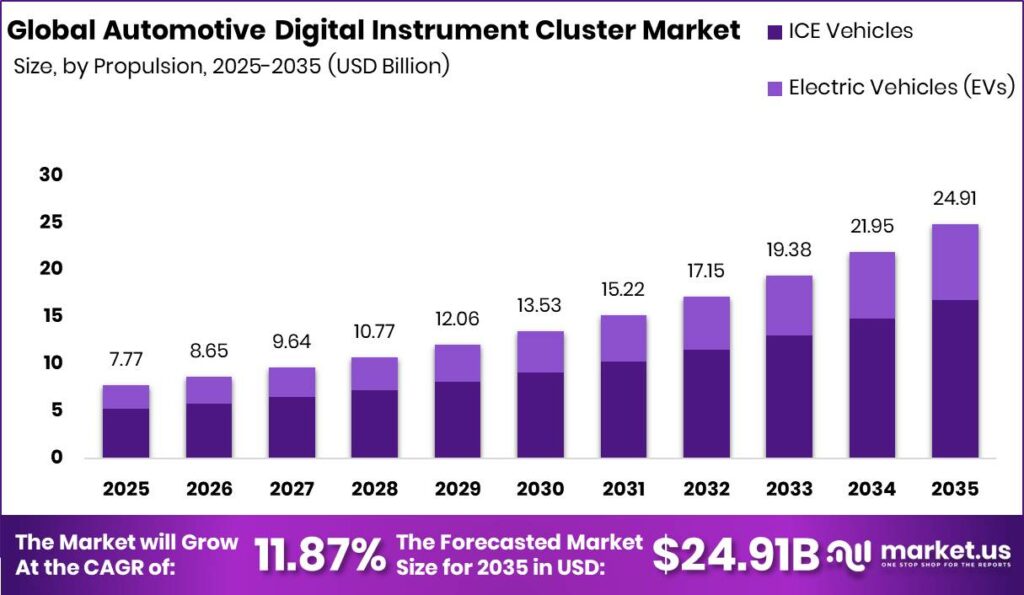
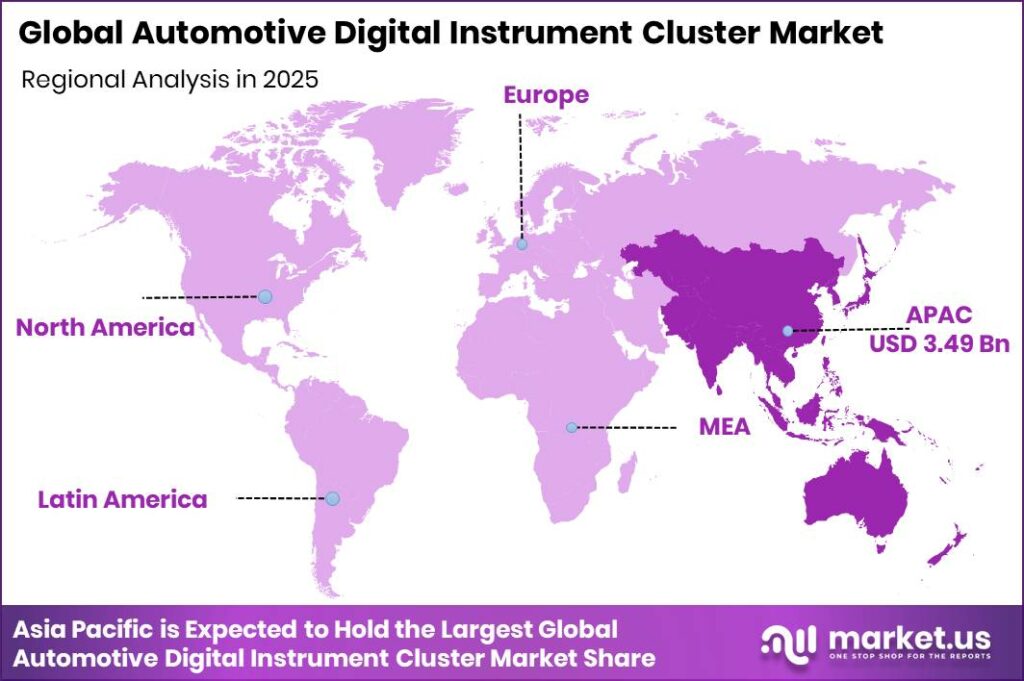
Global Automotive Digital Instrument Cluster Market size is expected to be worth around USD 24.91 Billion by 2035 from USD 7.77 Billion in 2025, growing at a CAGR of 11.87% during the forecast period 2026 to 2035. Asia Pacific holds the dominant regional position, with a 45.00% share valued at USD 3.50 Billion, making it the most commercially consequential geography for cluster suppliers and platform investors through the forecast period.
The automotive digital instrument cluster market covers display systems that replace or supplement traditional analog gauges inside a vehicle’s driver-facing cockpit. These clusters render speed, range, warning alerts, ADAS outputs, navigation cues, and powertrain data on screen-based panels. The market spans three core technology formats: hybrid dashboards that blend digital and analog elements, fully digital dashboards, and residual analog clusters. Display technologies include LED, OLED, LCD, and projection formats. Segments extend across vehicle types from passenger cars to commercial trucks, across propulsion types from ICE to electric, and across sales channels covering OEM supply and aftermarket fitment.
Key Takeaways
- Global Automotive Digital Instrument Cluster Market was valued at USD 7.77 Billion in 2025 and is forecast to reach USD 24.91 Billion by 2035.
- The market is projected to expand at a CAGR of 11.87% from 2026 to 2035.
- By Technology, Hybrid Dashboard holds the dominant segment position with a 62.95% share, with Digital Dashboard identified as the fastest-growing sub-segment.
- By Display Technology, LED Display leads with a 65.00% share, with OLED Display identified as the fastest-growing sub-segment.
- By Display Size, 7 to 11 inches holds the largest share at 45.00%, with More than 12 inches identified as the fastest-growing sub-segment.
- By Vehicle Type, Passenger Cars leads with a 73.00% share, with Heavy Commercial Vehicles identified as the fastest-growing sub-segment.
- By Propulsion, ICE Vehicles dominate with a 67.50% share, with Electric Vehicles identified as the fastest-growing sub-segment.
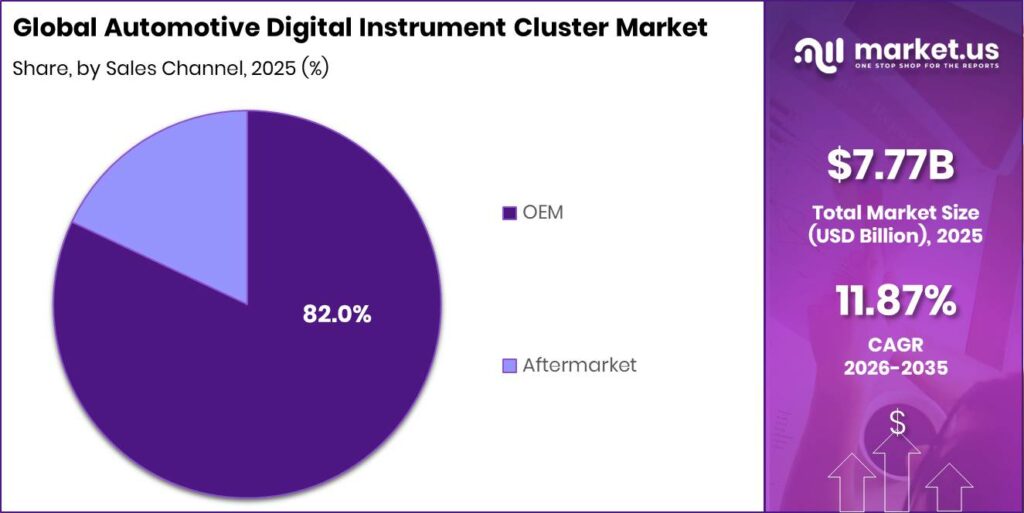
- By Sales Channel, OEM dominates with an 82.00% share, with Aftermarket identified as the fastest-growing sub-segment.
- Asia Pacific is the leading region, holding a 45.00% market share valued at USD 3.50 Billion.
As per our research, instrument-cluster display shipments reached 43.3 million units globally in the first half of 2025, a year-over-year increase of 16.8%. This growth rate outpaced total automotive display shipments, which rose 5.1% to 120.96 million units across the same period. The instrument-cluster segment expanding at a rate 11.7 percentage points faster than the broader display market confirms that cluster adoption is a distinct and structurally accelerating demand layer within automotive electronics.
Government safety and cybersecurity mandates are directly reshaping cluster content requirements. UNECE regulations UN R155 and UN R156 became mandatory for all newly produced EU vehicles from July 2024, requiring manufacturers to manage cybersecurity risk, validate over-the-air software updates, and maintain post-incident reporting. These regulations increase the engineering content per cluster and raise the minimum qualification bar, which effectively concentrates supply toward Tier 1 vendors with established functional safety certification infrastructure. In June 2026, Visteon expanded its premium cockpit portfolio with new narrow-border display solutions designed for integrated digital cockpit architectures, directly responding to OEM demand for unified instrument and infotainment display formats.
Technology Analysis
Hybrid Dashboard dominates with 62.95% due to flexible analog-digital integration appeal.
In 2025, Hybrid Dashboard held a dominant market position in the By Technology segment of the Automotive Digital Instrument Cluster Market, with a 62.95% share. Hybrid clusters embed at least one configurable digital display zone alongside retained physical gauges, allowing OEMs to upgrade cockpit visual quality without a full analog-to-digital transition. According to the International Trade Administration, the majority of global vehicle programs still use shared platform architectures that support hybrid configurations at lower incremental cost. This cost-efficiency makes hybrid formats the default choice for mid-volume, mid-price programs where full digital conversion cannot be justified on bill-of-material grounds.
Digital Dashboard is the fastest-growing sub-segment within the By Technology segment. Fully digital clusters eliminate mechanical gauge assemblies and render all driver information through a single software-managed display surface. This architecture supports configurable screen layouts, multi-language rendering, ADAS overlay integration, and over-the-air content updates without hardware replacement. Corporate annual reports from display suppliers show increasing model-year nominations for full-digital clusters in premium and near-premium vehicle programs. OEMs targeting software-defined vehicle strategies depend on full-digital clusters as the primary interface layer, which makes this sub-segment the structural growth engine for the broader technology category.
Analog Dashboard retains a presence in the market primarily in entry-level and commercial segments where cost pressure limits digital investment. Analog clusters carry no screen, no graphics processor, and no software maintenance obligation, which makes them the lowest total-cost option for base trims in price-sensitive markets. Trade association data from national automotive manufacturing bodies in markets such as India and Southeast Asia confirms that analog clusters remain standard across a significant proportion of two-wheeler and light commercial vehicle builds. However, their share is declining as OEM platform investment shifts display budgets toward digital formats even in budget segments.
Display Technology Analysis
LED Display dominates with 65.00% due to low cost and proven mass-market reliability.
In 2025, LED Display held a dominant market position in the By Display Technology segment of the Automotive Digital Instrument Cluster Market, with a 65.00% share. LED-backlit TFT-LCD panels underpin the overwhelming majority of cluster shipments because they offer established brightness uniformity, wide temperature operating ranges, and a mature supply chain. The Lexus IS 2026 specification standardizes a 12.3-inch full-LCD instrument cluster across all model variants, paired with a separate 12.3-inch center touchscreen, confirming that even premium brands rely on LED-backlit LCD for high-visibility driver displays. This standardization across a volume-producing OEM program signals that LED-based clusters remain commercially competitive against emerging display alternatives.
OLED Display is the fastest-growing sub-segment in the By Display Technology segment. OLED panels deliver per-pixel light control, enabling true black rendering, higher contrast ratios, and thinner form factors that support curved or flexible cluster designs. The Porsche Cayenne Electric pairs a 14.25-inch OLED cluster with an augmented-reality head-up display producing an effective 87-inch image at a 10-metre projection distance, demonstrating that OLED is becoming the display of choice for flagship cockpit architectures. As manufacturing scale increases and panel costs reduce, OLED adoption will expand from premium to near-premium programs, increasing average cluster content value per vehicle.
LCD Display as a standalone sub-segment captures residual share in programs where display controllers, optical bonding specs, and thermal validation are already completed and re-sourcing is not commercially justified. As per our research, LCD represented approximately 98% of automotive display volume in 2025 when measured across all display applications in a vehicle. This concentration reflects the technology’s entrenched position in active programs, and suppliers holding LCD positions in long-cycle OEM contracts retain predictable revenue even as new nominations shift toward OLED and advanced LED formats.
Projection Display holds the smallest share within the segment but serves a functionally distinct role through head-up display integration. Projection clusters project speed and navigation data onto the windshield or a combiner screen, reducing driver gaze-off-road time. Regulatory filing data from road safety authorities in the EU and Japan supports windshield-projected display systems as compliant with minimum visibility and distraction standards. Remaining share in the segment is distributed across projection-based formats and specialty display types used in niche commercial applications.
Display Size Analysis
7 to 11 inches dominates with 45.00% due to standard fit across mainstream vehicle programs.
In 2025, 7 to 11 inches held a dominant market position in the By Display Size segment of the Automotive Digital Instrument Cluster Market, with a 45.00% share. This size range matches the physical packaging constraints of the majority of passenger car and light commercial vehicle dashboards produced globally, making it the default specification for mid-volume platform programs. The cockpit system fitted to the 2025 Car of the Year uses a 10.25-inch high-definition digital instrument cluster, confirming that this size delivers sufficient resolution and readability for a prize-winning vehicle program. OEMs sourcing clusters within this range benefit from the deepest supplier competition and the most mature validation datasets, keeping procurement costs controlled.
The more-than-12-inches sub-segment is the fastest-growing display size category. Larger clusters support simultaneous rendering of multiple data domains including navigation maps, ADAS camera feeds, and digital gauge arrays without visual crowding. The 2026 Nissan Leaf provides two standard 12.3-inch screens on its S and S+ variants, with higher model lines upgrading both displays to 14.3 inches, illustrating that screen size escalation is now embedded in production-grade platform decisions. The Nissan 2025-2026 Murano uses two 12.3-inch displays as standard across its cockpit, reinforcing that large-format dual-screen architectures are entering mainstream production volumes.
Less than 7 inches serves entry trims, two-wheelers, and commercial vehicles where dashboard space is constrained and display budget is lowest. The Nissan Navara unveiled in 2025 uses a 7-inch colour TFT instrument-cluster display paired with a 9-inch infotainment screen, confirming that even newly launched commercial pickup platforms target cost-efficient smaller cluster sizes. This sub-segment offers volume but limited content value per unit, and suppliers competing here face margin pressure from low-cost regional panel producers. Niche applications in motorcycles and agricultural vehicles account for additional demand in this size bracket.
Vehicle Type Analysis
Passenger Cars dominates with 73.00% due to highest global new-vehicle production volume.
In 2025, Passenger Cars held a dominant market position in the By Vehicle Type segment of the Automotive Digital Instrument Cluster Market, with a 73.00% share. Passenger cars represent the largest individual segment of global vehicle production and consequently the largest addressable volume for digital cluster suppliers. OICA production statistics confirm that passenger cars account for the majority of global four-wheeled vehicle output annually. OEM platform programs targeting passenger cars carry the highest cluster nomination values and the longest supply lifespans, making this segment the primary revenue base for every Tier 1 cluster supplier in this market.
Light Commercial Vehicles represent the next significant segment by volume. Fleet operators purchasing LCVs for last-mile delivery, service, and urban logistics increasingly request digital clusters as a standard feature tied to telematics integration, driver behavior monitoring, and regulatory compliance reporting. The Nissan Frontier Pro plug-in hybrid unveiled in 2025 uses a standard 10-inch LCD instrument panel alongside a 14.6-inch infotainment screen, demonstrating that electrified LCV platforms are adopting mid-large cluster formats. Suppliers who secure LCV platform nominations benefit from consistent fleet replacement cycles and multi-year production commitments.
Heavy Commercial Vehicles are the fastest-growing sub-segment in the By Vehicle Type segment. HCV operators face increasing regulatory pressure to equip trucks and buses with telematics-integrated displays for speed logging, driver hours recording, lane departure alerts, and fuel efficiency feedback. National highway safety agencies in the EU and North America mandate specific cluster display capabilities for vehicles above defined gross vehicle weight thresholds. The Nissan Navara’s 7-inch TFT cluster and the wider commercial vehicle production data from UNIDO confirm active hardware investment across new commercial platform introductions. HCV cluster adoption creates a durable incremental demand stream outside the traditional passenger vehicle market.
Propulsion Analysis
ICE Vehicles dominates with 67.50% due to overwhelmingly larger global production base.
In 2025, ICE Vehicles held a dominant market position in the By Propulsion segment of the Automotive Digital Instrument Cluster Market, with a 67.50% share. Internal combustion engine vehicles remain the largest portion of global vehicle production and the installed vehicle parc, sustaining ICE cluster demand through both new vehicle programs and aftermarket replacement. OICA production records confirm that ICE vehicles and mild hybrids collectively account for the substantial majority of units built globally in each model year. Platform longevity for ICE programs means existing cluster contracts in this segment run for multi-year production cycles, providing revenue predictability for incumbent suppliers.
Electric Vehicles are the fastest-growing propulsion sub-segment and the primary driver of premium cluster content escalation. EVs require the cluster to display battery state-of-charge, regenerative braking feedback, thermal management status, charging location data, and range-remaining calculations simultaneously, which mandates higher-resolution displays and more capable graphics processors than equivalent ICE clusters. IEA transport electrification tracking recorded global electric-car sales exceeding 17 million units in 2024, an increase of more than 25% from 2023. This production base growth converts each additional EV program into a cluster content opportunity with a materially higher average selling price than a comparable ICE fitment.
Sales Channel Analysis
OEM dominates with 82.00% due to cluster integration at vehicle manufacture stage.
In 2025, OEM held a dominant market position in the By Sales Channel segment of the Automotive Digital Instrument Cluster Market, with an 82.00% share. Digital instrument clusters are designed, validated, and integrated into the vehicle electrical architecture at the OEM stage, making aftermarket fitment technically complex and commercially limited for most cluster formats. Corporate annual reports from Tier 1 suppliers including Visteon and Continental confirm that revenue is generated primarily through OEM production contracts spanning multi-year vehicle programs. The OEM channel also determines which display technology, software stack, and safety certification standard is applied, giving cluster content value its floor price and its ceiling.
Aftermarket is the fastest-growing sales channel sub-segment as fleet operators and individual owners seek display upgrades for vehicles that left the factory with analog or small-format digital clusters. Certified retrofit clusters for trucks, vans, and older passenger cars represent a growing demand layer in markets where vehicle replacement cycles are long and fleet operators must meet new telematics reporting mandates without replacing entire vehicles. Regulatory filing data from road traffic authorities in Europe and North America confirm that certified aftermarket display systems must meet minimum electromagnetic compatibility and functional safety standards, which creates a compliance-qualified product niche that smaller manufacturers can address. This channel expansion adds incremental volume outside the OEM contract cycle.
Key Market Segments
By Technology
- Hybrid Dashboard
- Digital Dashboard
- Analog Dashboard
By Display Technology
- LED Display
- OLED Display
- LCD Display
- Projection Display
By Display Size
- 7 to 11 inches
- Less than 7 inches
- More than 12 inches
By Vehicle Type
- Passenger Cars
- Light Commercial Vehicles (LCV)
- Heavy Commercial Vehicles (HCV)
By Propulsion
- ICE Vehicles
- Electric Vehicles (EVs)
By Sales Channel
- OEM
- Aftermarket
Regional Analysis
Asia Pacific Dominates the Automotive Digital Instrument Cluster Market with a Market Share of 45.00%, Valued at USD 3.50 Billion
Asia Pacific holds the leading regional position with a 45.00% share valued at USD 3.50 Billion, driven by the concentration of global vehicle production in China, Japan, South Korea, and India. China alone represents the world’s largest single-country automotive market by annual unit sales, and its OEM platforms drive the majority of cluster nominations across both passenger and commercial vehicle segments. In June 2025, Visteon started production of next-generation display backlight units and high-resolution camera systems at its Chennai manufacturing facility, directly reinforcing the region’s role as both a manufacturing base and a demand center for advanced display modules. Suppliers who establish local production and engineering presence in Asia Pacific reduce currency risk and shorten the supply lead time required by regional OEM programs.
Europe and North America represent the fastest-growing and second-largest regions respectively, with premium and upper-mid vehicle programs driving cluster content escalation beyond the global average. The 2026 Nissan Armada, released for the North American market, provides dual 12.3-inch displays on SV and SL trim levels while higher trims increase both screens to 14.3 inches, confirming that North American consumer preference for large-format cockpit displays is embedded in production specifications. The 2026 Infiniti QX65 cockpit uses two 12.3-inch displays including one reconfigurable digital instrument cluster, further confirming the pattern. European demand is shaped by UNECE regulatory requirements, which have made cybersecurity-validated cluster software a compliance requirement rather than an optional feature.
Latin America, the Middle East, and Africa represent developing regional markets where analog cluster retention and vehicle affordability constraints slow digital adoption rates relative to Asia Pacific and Europe. These regions contain high volumes of entry-level and commercial vehicle production where digital cluster penetration remains low. However, growing commercial fleet telematics mandates in Brazil, the Gulf Cooperation Council states, and South Africa are beginning to create OEM demand for basic digital display fitment. Investors targeting these regions should prioritize commercial vehicle platform nominations over passenger car programs, as fleet compliance spending provides a more predictable demand signal than consumer electronics premiumization.
Key Regions and Countries
North America
- US
- Canada
Europe
- Germany
- France
- The UK
- Spain
- Italy
- Rest of Europe
Asia Pacific
- China
- Japan
- South Korea
- India
- Australia
- Rest of APAC
Latin America
- Brazil
- Mexico
- Rest of Latin America
Middle East and Africa
- GCC
- South Africa
- Rest of MEA
Market Dynamics
Market Opportunity Analysis - Underserved vehicle categories and emerging regions offer entry points beyond the passenger car mainstream
The Heavy Commercial Vehicle sub-segment holds the fastest-growing position within By Vehicle Type yet remains underserved by most Tier 1 cluster suppliers whose product roadmaps prioritize passenger car OEM programs. Fleet telematics mandates in the EU and North America require trucks and buses to log speed, driver hours, and safety alerts through driver-facing displays, but certified HCV-grade cluster offerings remain limited. Suppliers who develop validated commercial-grade cluster platforms address a compliance-driven demand that does not require consumer premiumization, making HCV a lower-risk entry point with multi-year fleet contract potential.
The Aftermarket sales channel holds an 18.00% residual share that established Tier 1 suppliers largely ignore because their business models are built around OEM contract revenue. This creates a structural gap for mid-tier manufacturers who can produce certified retrofit cluster systems for fleet operators with aging vehicles subject to new telematics reporting requirements. Regulatory filing data from EU type-approval authorities confirms that compliant aftermarket display systems can qualify for installation approval without full OEM program nomination, reducing the market entry barrier for focused challengers.
Latin America, the Middle East, and Africa collectively represent the lowest current cluster penetration rate among all regions tracked. Vehicle affordability constraints limit digital cluster adoption, but commercial fleet telematics mandates in Brazil, the GCC states, and South Africa are beginning to generate OEM-level demand for basic digital fitment. Investors who target commercial vehicle platform nominations in these regions face less competitive supplier intensity than in Asia Pacific or Europe, and fleet replacement timelines provide revenue visibility over multi-year horizons rather than single model-year program cycles.
The Cayenne Electric’s combined display area is 50% larger than in the equivalent combustion-engine Cayenne, confirming that EV platform transitions create immediate display upsell opportunities within existing model lines. This dynamic applies across the industry: OEM EV platforms require larger, more capable clusters regardless of brand positioning, giving display suppliers a built-in content escalation mechanism tied to each EV program launch. Suppliers who position cluster solutions specifically for EV platform architects capture incremental average selling price without competing solely on cost against ICE-program incumbents.
Technology and Innovation Landscape - Display density, OLED brightness, and domain controller architectures redefine cluster performance benchmarks
Bosch’s automotive TFT Connect platform specifies a display density above 200 pixels per inch, establishing a quantitative readability benchmark for connected digital-cluster implementations. This density level supports anti-aliased text rendering, high-resolution map graphics, and ADAS camera overlays within a single display surface. Suppliers who meet or exceed this pixel-density threshold gain a measurable product specification advantage in premium OEM program sourcing decisions, where readability at arm’s length is a customer-visible differentiator that can be tested and scored during vehicle evaluation programs.
OLED panel brightness performance has advanced to levels that directly address automotive thermal and visibility requirements. The EverDisplay automotive AMOLED panel introduced at CES operates at 120 Hz with a typical brightness of 3,000 nits and a peak brightness of 12,000 nits, a 4-fold intensity swing that enables both sunlight-readable daytime performance and low-glare nighttime operation from a single panel specification. This performance range reduces the need for dual-mode display engineering workarounds, simplifying cluster validation and reducing the bill-of-material complexity for OLED-equipped vehicle programs.
The Porsche Macan’s cockpit supports up to 3 displays including a 12.6-inch curved digital instrument cluster, a 10.9-inch center display, and an optional 10.9-inch passenger display. The Macan’s augmented-reality head-up system projects information at an effective distance of 10 metres, corresponding to an 87-inch display image extending cluster data into the driver’s forward field of view. This multi-display domain architecture signals that the premium cockpit of 2026 is not a single cluster but a spatially distributed display network, and suppliers who engineer for multi-domain controller integration rather than single-display supply capture larger program content values per vehicle nomination.
The Lexus IS 2025 increased its driver display to a 12.3-inch TFT-LCD instrument cluster as part of a mid-cycle model update, confirming that display size escalation is occurring even within existing platform refresh cycles rather than exclusively at new model launches. This pattern means cluster display investment decisions are being made more frequently and with shorter lead times than traditional full-model changeovers, giving agile display engineering teams the opportunity to compete for incremental program upgrades outside the standard seven-to-ten-year OEM development cycle. Suppliers with rapid qualification capabilities gain a structural sourcing advantage over slower-moving incumbents.
Drivers
Battery-electric vehicle production is converting the instrument cluster from a regulatory display into the real-time energy-management interface for range prediction, battery state-of-charge, regenerative-braking feedback, and route-energy forecasting. IEA transport electrification tracking recorded global electric-car sales exceeding 17 million units in 2024, a rise of more than 25% from 2023. ACEA registration statistics recorded 1,880,370 battery-electric registrations in the EU during 2025, equivalent to a 17.4% market share. This installed-base growth raises the probability that vehicle programs specify configurable digital instrumentation as standard rather than as a premium option.
Each additional EV program increases the number of software-rendered functions a cluster must support, which directly raises the content value per unit and improves platform amortization for display suppliers. This structural shift adds an estimated +2.4% incremental contribution to the stated 11.87% baseline CAGR. Buyers who secure EV-grade cluster nominations early benefit from longer program lifespans and a higher average selling price than equivalent ICE fitments, making EV-oriented cluster capability a commercially critical product investment for every Tier 1 supplier in this market.
| Driver | (~) % Impact on CAGR Forecast | Geographic Relevance | Impact Timeline |
|---|---|---|---|
| EV Energy-Management Displays | +2.4% | Global; strongest in China, Europe, North America | Short term (2 years or less) |
| ADAS Warning Visualization | +1.7% | North America, Europe, China, Japan | Short term (2 years or less) |
| Premium Cockpit Differentiation | +1.5% | Global premium and upper-mid segments | Short term (2 years or less) |
| Larger Display Architectures | +1.2% | China, North America, Gulf markets | Medium term (2 to 4 years) |
| Software-Defined Vehicle Rollout | +1.1% | Global high-volume OEM programs | Medium term (2 to 4 years) |
| Digital Premiumization in SUVs | +0.9% | North America, China, India, Europe | Medium term (2 to 4 years) |
Restraints
Instrument-cluster adoption is structurally constrained when vehicle manufacturers must protect entry-level transaction prices. A larger display, higher-performance system-on-chip, optical bonding, safety validation, and software integration costs cannot be passed through proportionately in price-sensitive segments. ACEA reported that EU new-car registrations fell by 1.9% in the first half of 2025. Battery-electric vehicles represented only 15.6% of EU registrations during that period, despite rising from 12.5% in the first half of 2024.
Under this demand environment, OEM purchasing organizations protect gross margin by retaining small-format displays or conventional gauge clusters, and delaying optional cockpit upgrades until a platform refresh. This creates a direct constraint on unit penetration in high-volume price bands and reduces supplier pricing power. The combined effect of affordability pressure, entry-trim decontenting, and restricted OEM capital allocation plausibly subtracts approximately -1.9% from the 11.87% baseline CAGR, with additional drag from analog cluster retention in India, Africa, and Latin America.
| Restraint | (~) % Impact on CAGR Forecast | Geographic Relevance | Impact Timeline |
|---|---|---|---|
| Vehicle Affordability Constraints | -1.9% | Europe, North America, emerging markets | Short term (2 years or less) |
| Entry-Trim Feature Decontenting | -1.5% | India, ASEAN, Latin America, Africa | Short term (2 years or less) |
| OEM Investment Prioritization | -1.2% | Europe and North America | Short term (2 years or less) |
| Display Cost Pass-Through Limits | -1.0% | Global mass-market vehicle programs | Medium term (2 to 4 years) |
| Analogue Cluster Retention | -0.8% | India, Africa, Latin America | Medium term (2 to 4 years) |
| Long Replacement Cycles | -0.7% | Emerging markets and commercial fleets | Long term (4 years or more) |
Challenges
Functional safety and cybersecurity assurance represent a persistent scaling challenge because the digital cluster now communicates critical speed, warning, ADAS, and powertrain information through software stacks spanning display electronics, graphics rendering, operating systems, gateways, and over-the-air update functions. UNECE states that UN Regulation No. 155 requires manufacturers to identify and manage cybersecurity risks, demonstrate mitigation through testing, monitor cyberattacks, and provide post-incident analytical capabilities. UNECE further specifies that UN Regulation No. 156 requires a controlled software-update management system with protected software identifiers and recovery provisions for failed over-the-air updates.
These requirements became mandatory in the European Union for all newly produced vehicles from July 2024. Each change in warning logic, screen layout, or hardware revision can initiate renewed verification, traceability, and homologation work, extending engineering release gates and raising lifecycle support obligations. Suppliers must invest in reusable safety cases, standardized middleware, and automated regression testing. Recurring validation load, slower design freezes, and post-launch update liability can impose approximately -1.8% friction on the market’s maximum achievable CAGR, with semiconductor supply volatility adding a further -1.5% friction drag.
| Challenge | (~) % CAGR Friction Drag | Geographic Relevance | Mitigation Horizon |
|---|---|---|---|
| Functional Safety Validation Complexity | -1.8% | Global | Medium term (2 to 4 years) |
| Semiconductor Supply Volatility | -1.5% | Global | Medium term (2 to 4 years) |
| Automotive Software Talent Gap | -1.3% | North America, Europe, Japan, South Korea | Long term (4 years or more) |
| Display Thermal Durability | -1.1% | India, ASEAN, Middle East, North America | Medium term (2 to 4 years) |
| Cross-Domain Integration Complexity | -1.0% | Global | Medium term (2 to 4 years) |
| Long Vehicle Qualification Cycles | -0.8% | Global | Long term (4 years or more) |
Opportunities
Cluster feature subscriptions represent an unexploited future revenue layer because most instrument-cluster contracts still monetize hardware and embedded software at vehicle build. Recurring revenues from personalization, advanced trip-energy analytics, adaptive driver profiles, and feature-on-demand interfaces remain limited by entitlement architecture and OEM revenue-sharing models. UNECE identifies UN Regulation No. 156 as a legal framework for safe and secure software updates, including verification of software identity and vehicle-function recovery after an unsuccessful update.
IEA recorded more than 17 million electric-car sales globally in 2024, creating a large and expanding installed base whose drivers require energy-management interface updates across the vehicle lifecycle. A disciplined subscription model that achieves even modest digital-feature uptake can raise lifecycle gross-margin potential by approximately 10% to 20% relative to a hardware-only supply model. This recurring software layer creates an estimated +2.1% CAGR upside above the 11.87% baseline, making cluster subscription architecture the highest-potential commercial innovation available to Tier 1 suppliers in the near to medium term.
| Opportunity | (~) % Potential CAGR Upside | Geographic Relevance | Execution Window |
|---|---|---|---|
| Cluster Feature Subscriptions | +2.1% | North America, Europe, China, Japan | Medium term (2 to 4 years) |
| Commercial Fleet Cockpits | +1.7% | North America, Europe, China, India | Medium term (2 to 4 years) |
| Two-Wheeler Cluster Conversion | +1.5% | India, ASEAN, Latin America | Medium term (2 to 4 years) |
| Insurance-Linked Driver Insights | +1.3% | North America, Europe, China | Long term (4 years or more) |
| Augmented Navigation Overlays | +1.1% | China, Europe, North America | Long term (4 years or more) |
| Certified Retrofit Clusters | +0.9% | Europe, North America, Japan | Long term (4 years or more) |
Key Company Insights
Visteon Corporation positions itself as the digital cockpit specialist among Tier 1 cluster suppliers, with a product strategy centered on domain controller architectures and multi-display integration. Its cockpit domain controller can support as many as 8 high-resolution displays from a single controller platform, covering the digital instrument cluster and all additional cockpit screens simultaneously. In May 2026, Smart Eye and Visteon introduced an LCD instrument cluster with an integrated Driver Monitoring System placing the monitoring camera behind the display, creating a product that addresses both display quality and active safety requirements within one assembly.
Bosch competes through hardware density and display performance specifications embedded in its automotive TFT Connect platform. The platform specifies a display density above 200 pixels per inch, a measurable readability specification that directly addresses OEM demands for high-clarity text and graphics in connected digital-cluster implementations. This density specification positions Bosch as a supplier for programs where pixel fidelity is a customer-visible differentiator, particularly in premium and near-premium passenger vehicle segments where instrument cluster clarity is a stated product attribute. Bosch’s breadth across powertrain, safety, and cockpit electronics gives it cross-domain integration leverage that specialist cluster vendors cannot match.
Key Players
- Bosch
- Continental AG
- Denso Corporation
- Marelli
- Aptiv PLC
- Panasonic Automotive
- Harman International
- LG Electronics Vehicle Solutions
- Hyundai Mobis
- JP Minda Group
- Nippon Seiki Co., Ltd.
- Pricol Limited
- Simco Ltd.
- Valid Manufacturing Ltd.
- Visteon Corporation
Recent Developments
- January 2025: Continental unveiled its Emotional Cockpit concept featuring an E Ink Prism display integrated across the vehicle dashboard, combining multiple digital display functions into a customizable cockpit interface for future vehicle interiors.
- January 2025: NXP Semiconductors agreed to acquire TTTech Auto for approximately USD 625 Million to strengthen its automotive software and safety platform capabilities, supporting centralized vehicle computing architectures used for digital cockpit and instrument cluster systems.
- May 2025: Visteon launched digital instrument clusters across multiple vehicle programs including the Volkswagen Jetta, Dacia Bigster, Mitsubishi Xforce, and Ford Transit EV, expanding its production portfolio of digital cockpit display systems.
Geopolitical Impact Analysis
Trade tariff escalations between the United States and its principal automotive supply partners are directly raising the landed cost of display panels, semiconductor chips, and finished cluster assemblies that transit Pacific and Atlantic shipping routes. According to WTO trade monitoring data, average applied tariff rates on electronics and automotive components between major trading blocs increased materially through 2024 and 2025, adding cost pressure to cluster programs whose bill-of-material structures assumed pre-tariff logistics economics. World Shipping Council vessel congestion data recorded average container transit delays of 5 to 7 days above baseline on key transpacific lanes during peak disruption periods in 2024, extending OEM supplier lead times and forcing buffer inventory investments that reduce cluster supplier cash efficiency.
As reported by the World Bank Commodity Markets Outlook, rare earth and specialty metal prices relevant to OLED emitter materials, LED phosphors, and semiconductor substrates rose by double-digit percentages across 2024 and into 2025 under the combined effect of export restrictions and production concentration risk. IMF trade flow analysis identifies that approximately 60% of critical display material processing capacity remains concentrated in a small number of jurisdictions subject to ongoing geopolitical tension, exposing automotive display supply chains to single-source disruption risk. This concentration creates a commercial incentive for cluster suppliers to qualify secondary supply sources and redesign panel specifications around materials with more geographically diversified production, adding engineering cost but reducing long-term supply chain vulnerability for both suppliers and OEM customers.
Report Scope
| Report Features | Description |
|---|---|
| Market Value (2025) | USD 7.77 Billion |
| Forecast Revenue (2035) | USD 24.91 Billion |
| CAGR (2026-2035) | 11.87% |
| Base Year for Estimation | 2025 |
| Historic Period | 2020-2024 |
| Forecast Period | 2026-2035 |
| Report Coverage | Revenue Forecast, Market Dynamics, Market Opportunity Analysis, Technology and Innovation Landscape, Competitive Landscape, Recent Developments |
| Segments Covered | By Technology (Hybrid Dashboard, Digital Dashboard, Analog Dashboard); By Display Technology (LED Display, OLED Display, LCD Display, Projection Display); By Display Size (7 to 11 inches, Less than 7 inches, More than 12 inches); By Vehicle Type (Passenger Cars, Light Commercial Vehicles, Heavy Commercial Vehicles); By Propulsion (ICE Vehicles, Electric Vehicles); By Sales Channel (OEM, Aftermarket) |
| Regional Analysis | North America (US and Canada), Europe (Germany, France, The UK, Spain, Italy, and Rest of Europe), Asia Pacific (China, Japan, South Korea, India, Australia, and Rest of APAC), Latin America (Brazil, Mexico, and Rest of Latin America), Middle East and Africa (GCC, South Africa, and Rest of MEA) |
| Competitive Landscape | Bosch, Continental AG, Denso Corporation, Marelli, Aptiv PLC, Panasonic Automotive, Harman International, LG Electronics Vehicle Solutions, Hyundai Mobis, JP Minda Group, Nippon Seiki Co., Ltd., Pricol Limited, Simco Ltd., Valid Manufacturing Ltd., Visteon Corporation |
| Customization Scope | Customization for segments, region / country-level will be provided. Additional customization can be done based on requirements. |
| Purchase Options | We have three licenses to opt for: Single User License | Multi-User License (Up to 5 Users) | Corporate Use License (Unlimited User and Printable PDF) |





































