


Report Overview
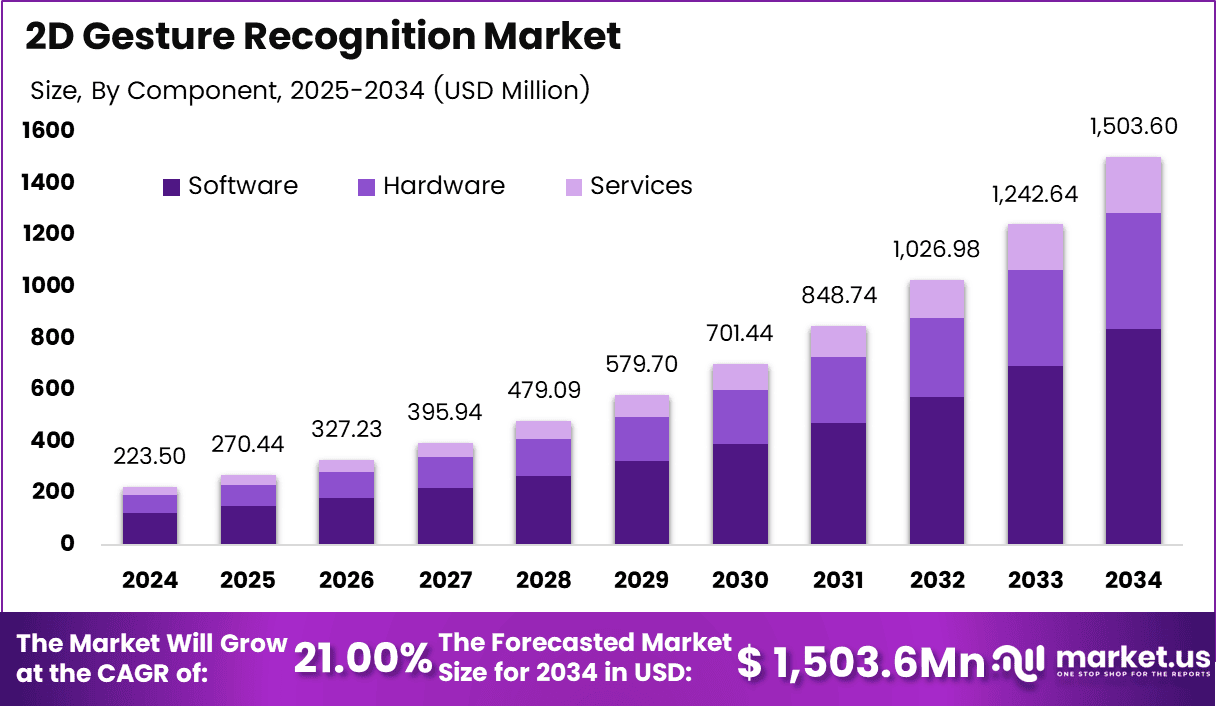
In 2024, the Global 2D Gesture Recognition Market was valued at USD 223.5 million. The market is projected to grow at a CAGR of 21.0% during 2025–2034, reaching approximately USD 1,503.6 million by 2034. North America dominated the global market in 2024, accounting for more than 45.0% of the total market share and generating approximately USD 100.5 million in revenue.
Automotive applications are becoming increasingly important. Global car production reached 75.5 million units in 2024, creating a large installation base for camera-based driver monitoring, infotainment control, and cabin sensing. In Europe, new vehicle safety rules became applicable to all newly manufactured vehicles from 7 July 2024, supporting broader use of in-cabin cameras and sensing systems.
North America accounted for more than 45.0% of the market, supported by high technology spending, a large connected-device base, and early adoption of AI-enabled interfaces. U.S. consumer technology retail revenue was projected at USD 512 billion in 2024, representing growth of 2.8% from 2023, which supports demand for gesture-enabled televisions, laptops, tablets, gaming systems, kiosks, and smart-home displays.
Key Takeaways
- The Global 2D Gesture Recognition Market was valued at USD 223.5 million in 2024 and is projected to reach USD 1,503.6 million by 2034, growing at a 21.0% CAGR.
- Software dominated the component segment with a 55.7% share, driven by advances in ML, AI algorithms, SDKs, and middleware solutions.
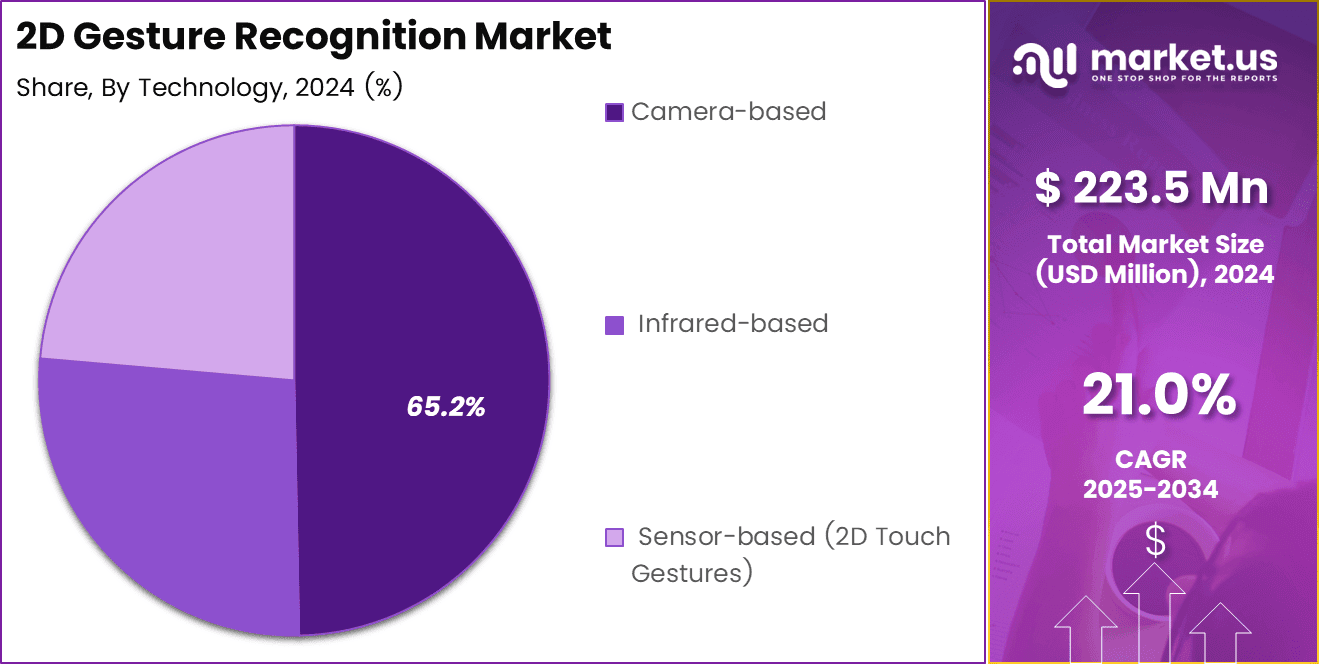
- Camera-based technology held the largest technology share at 65.2%, supported by high accuracy and widespread camera integration.
- Consumer Electronics led the product segment with a 74.4% share, supported by smartphones, tablets, smart TVs, remotes, and gaming consoles.
- Touchless Control dominated the application segment with a 45.8% share, driven by growing demand for contactless interaction across multiple industries.
- North America led the market in 2024 with more than 45.0% share, generating approximately USD 100.5 million in revenue.
Role of Generative AI
Generative AI plays a crucial role in enhancing the capabilities of 2D gesture recognition systems by enabling more accurate and responsive interactions. Through machine learning and deep learning models, generative AI helps improve the recognition of complex gestures, making the technology more intuitive and adaptable to varying user inputs.
This AI-driven approach allows systems to continuously learn and refine their performance, ensuring a more seamless user experience. In addition, generative AI can enable the creation of synthetic data to train gesture recognition models, which is particularly beneficial when real-world datasets are limited or difficult to obtain.
This data augmentation helps improve the system’s accuracy, making it more reliable across different environments and scenarios. As gesture recognition systems become smarter, businesses can leverage these AI-powered solutions to offer more personalized and engaging user interfaces, enhancing customer satisfaction and expanding the potential applications in fields such as gaming, automotive, and healthcare.
By Component
The Software Component of the 2D Gesture Recognition market holds a dominant share of 55.7%, largely due to rapid advancements in machine learning (ML) and artificial intelligence (AI) algorithms, as well as the growing adoption of software development kits (SDKs) and middleware solutions.
As industries such as automotive, healthcare, and entertainment increasingly integrate gesture recognition technologies, the demand for sophisticated software tools continues to rise. This segment is expected to grow at a robust CAGR of 24.5%, driven by the ongoing evolution of AI/ML algorithms and the growing need for customized software solutions that enable seamless, intuitive user experiences across various applications.
By Technology
The Camera-based Technology segment holds a substantial share of 65.2% in the 2D Gesture Recognition market. This dominance is attributed to the widespread use of cameras in gesture recognition systems, offering high accuracy and flexibility for detecting and interpreting user gestures.
With advancements in camera technologies and their integration into devices like smartphones, automotive systems, and gaming consoles, the camera-based segment is expected to grow at a CAGR of 21.8%, driven by the increasing demand for intuitive, contactless interaction methods in consumer and industrial applications.
By Product
The Consumer Electronics segment leads the 2D Gesture Recognition market with a share of 74.4%. This dominance is driven by the widespread integration of gesture recognition technologies in smartphones, tablets, smart TVs, remote controls, gaming consoles, and other consumer devices.
The segment benefits from the increasing consumer demand for enhanced, intuitive, and touchless interfaces in everyday gadgets. With continuous innovations and improvements in device capabilities, the consumer electronics segment is expected to grow at a CAGR of 22.3%, as more products adopt gesture-based controls to offer a seamless user experience.
By Application
The Touchless Control application holds a leading share of 45.8% in the 2D Gesture Recognition market. This growth is fueled by the increasing demand for contactless interaction methods in various industries, such as automotive, healthcare, and consumer electronics.
Touchless control offers a more hygienic and intuitive user experience, driving its widespread adoption in products like smartphones, smart home devices, and automotive infotainment systems. This segment is expected to grow at a CAGR of 20.7%, as businesses continue to integrate gesture recognition technologies to enhance user interactions while prioritizing safety and convenience.
Key Market Segment
By Component
- Hardware
- Sensors
- Controllers
- SoCs
- Others
- Software
- ML/AL Algorithms
- SDKs
- Middleware
- Others
- Services
- Integration Services
- Custom Model Training Services
- Maintenance Services
By Technology
- Camera-based
- Infrared-based
- Sensor-based (2D Touch Gestures)
By Product
- Consumer Electronics
- Smartphones & Tablets
- Laptops & Desktops
- Smart TVs & Remote Controls
- Gaming Consoles
- Others
- Automotive Infotainment Systems
- Kiosks & Vending Machines
- Smart Home Devices
- Others
By Application
- Touchless Control
- Gaming & Entertainment
- Automotive HMI
- Sign Language Recognition
- Accessibility
- Industrial Automation
Regional Analysis
The Asia Pacific (APAC) region is expected to hold the largest share of the 2D Gesture Recognition market in 2024, with a projected value of USD 100.5 million. This growth is driven by the increasing adoption of advanced technologies, particularly in countries like China, Japan, and South Korea, fostering innovation in gesture recognition applications across various industries.
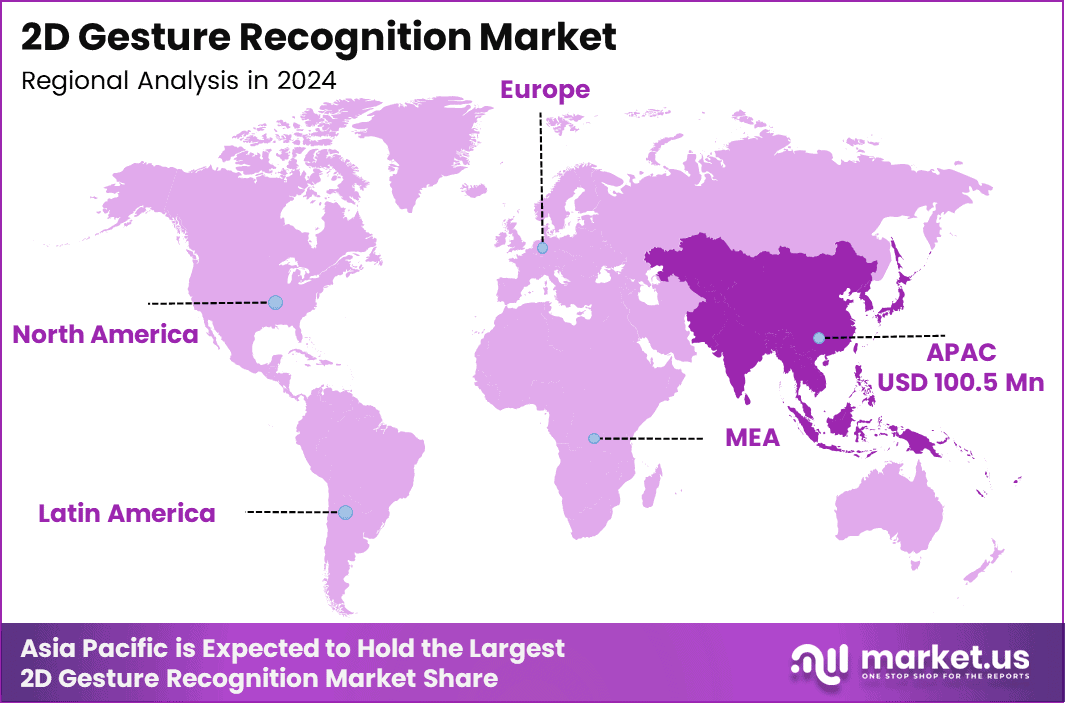
The APAC region’s dominance in the 2D Gesture Recognition market can be attributed to rapid technological advancements and significant investments in research and development. With a large consumer base, especially in tech-savvy countries, APAC is a hub for industries like automotive, healthcare, and entertainment, all of which are leveraging gesture recognition technologies for enhanced user experiences and operational efficiency.
China Market Size
The China 2D Gesture Recognition market, valued at USD 41.2 million in 2024, is expected to grow steadily, reaching USD 226.9 million by 2034. This represents an 18.6% CAGR, driven by advancements in sensor technology, machine learning, and increasing adoption across consumer electronics, automotive, and healthcare sectors, highlighting rising demand for touchless, intuitive interaction solutions.
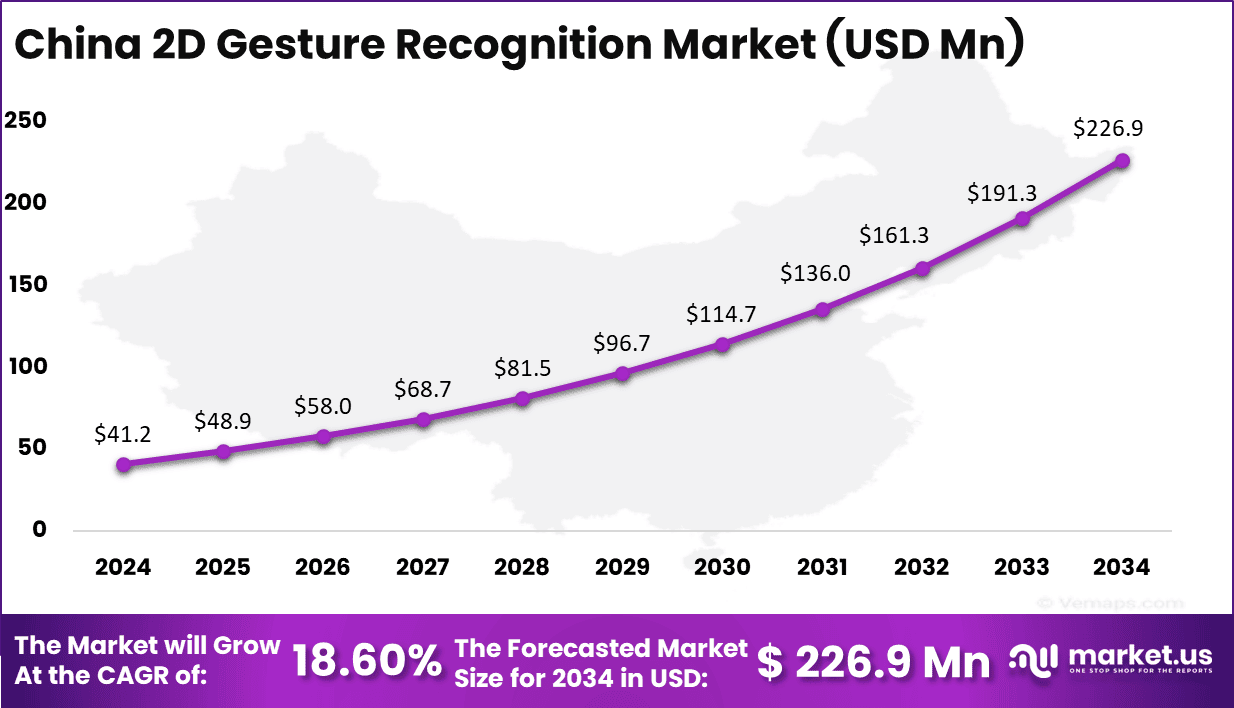
The 2D gesture recognition market is experiencing robust growth, driven by rising demand for touchless interaction and human-computer interfaces across consumer electronics, automotive, and healthcare sectors.
Advancements in sensor technology and machine learning are enhancing system accuracy and responsiveness. Increasing digitalization and automation are fueling adoption, while integration in smart devices, gaming, and AR applications is expanding market potential. Asia-Pacific and North America are expected to lead regional growth in the coming years.
Key Regions and Countries
- North America
- US
- Canada
- Europe
- Germany
- France
- The UK
- Spain
- Italy
- Rest of Europe
- Asia Pacific
- China
- Japan
- South Korea
- India
- Australia
- Rest of APAC
- Latin America
- Brazil
- Mexico
- Rest of Latin America
- Middle East & Africa
- GCC
- South Africa
- Rest of MEA
Market Dynamics
Drivers
| Driver | (~) % Impact on CAGR Forecast | Geographic Relevance | Impact Timeline |
|---|---|---|---|
| Automotive in-cabin safety integration | +3.4% | European Union, China, North America | Short term (2 years or less) |
| Edge-AI camera proliferation | +2.8% | Global | Short term (2 years or less) |
| Touchless enterprise workflow adoption | +2.1% | North America, Europe, East Asia | Medium term (2 to 4 years) |
| Smart-display interface deployment | +1.7% | East Asia, North America | Medium term (2 to 4 years) |
| Retail self-service modernization | +1.3% | Global urban markets | Medium term (2 to 4 years) |
Automotive in-cabin safety integration
The immediate growth catalyst is the integration of camera-based occupant and driver-interaction functions into vehicle electronics. The European Commission’s General Safety Regulation applies to all new vehicle types from 7 July 2024, expanding the installation base for advanced safety systems, including driver-drowsiness and attention-warning functions.
This creates an opportunity for gesture-recognition suppliers to move from stand-alone licenses toward multi-year automotive design wins covering image processing, embedded inference, and validation. By sharing existing in-cabin cameras and compute systems, gesture features can reduce incremental hardware costs and contribute an estimated +3.4% to the stated 21% baseline CAGR.
Restraints
| Restraint | (~) % Impact on CAGR Forecast | Geographic Relevance | Impact Timeline |
|---|---|---|---|
| Biometric-use compliance restrictions | -2.6% | European Union, United Kingdom, North America | Short term (2 years or less) |
| Automotive validation cost burden | -1.9% | Global automotive markets | Medium term (2 to 4 years) |
| Low-cost touch interface substitution | -1.5% | Global consumer electronics | Short term (2 years or less) |
| Camera privacy procurement barriers | -1.2% | Europe, public-sector buyers | Medium term (2 to 4 years) |
| Fragmented device certification | -0.9% | Global | Medium term (2 to 4 years) |
Biometric-use compliance restrictions
Compliance restrictions are a near-term restraint because camera-based gesture systems can process personal data beyond basic gesture classification. The EU AI Act entered into force on 1 August 2024, with prohibited practices and AI-literacy obligations applying from 2 February 2025, while the broader framework became applicable on 2 August 2026.
These rules can delay deployments that combine gesture recognition with facial, attention, or emotion analysis, particularly in regulated environments. The estimated -2.6% CAGR impact reflects reduced addressability and higher compliance costs, making privacy-by-design, local processing, and data minimization increasingly important for market adoption.
Challenges
| Challenge | (~) % CAGR Friction Drag | Geographic Relevance | Mitigation Horizon |
|---|---|---|---|
| Real-World Vision Robustness | -2.3% | Global | Medium term (2 to 4 years) |
| Cross-Device Model Portability | -1.7% | Global | Medium term (2 to 4 years) |
| Embedded Compute Constraints | -1.4% | Global | Short term (2 years or less) |
| Training-Data Representation Gaps | -1.2% | Global | Long term (4 years or more) |
| Software Security Maintenance | -0.8% | Global connected-device markets | Long term (4 years or more) |
Real-World Vision Robustness
Robustness remains a key challenge because a 2D vision model must accurately recognize gestures across changes in lighting, camera angle, occlusion, skin tone, motion blur, and background clutter without the depth information available in 3D sensing methods.
WIPO’s PATENTSCOPE database contains around 2 million international patent applications, highlighting both strong innovation and freedom-to-operate complexity in vision technologies. The estimated -2.3% growth friction reflects higher engineering costs, larger dataset requirements, camera-specific model optimization, and repeated validation that can extend OEM qualification cycles.
Opportunities
| Opportunity | (~) % Potential CAGR Upside | Geographic Relevance | Execution Window |
|---|---|---|---|
| Privacy-preserving edge gesture software | +3.0% | Europe, North America, developed Asia | Medium term (2 to 4 years) |
| Accessibility-focused interface platforms | +2.2% | Global | Medium term (2 to 4 years) |
| Industrial digital twin controls | +1.9% | Europe, North America, East Asia | Long term (4 years or more) |
| Healthcare sterile-workflow interfaces | +1.6% | North America, Europe, Gulf states | Long term (4 years or more) |
| Usage-based software licensing | +1.3% | Global | Medium term (2 to 4 years) |
Privacy-preserving edge gesture software
Privacy-preserving, on-device gesture recognition represents a future growth opportunity as regulatory requirements increase demand for local processing and reduced video retention. The EU AI Act’s prohibitions became applicable from 2 February 2025, while the principal framework applied from 2 August 2026, supporting demand for gesture software that avoids prohibited emotion-recognition functions.
This opportunity could add an estimated +3.0% to the 21% baseline CAGR if vendors offer privacy-focused software as a premium tier. Reusable on-device privacy controls could improve software gross-margin potential by around 5% to 10%, while WIPO’s searchable patent infrastructure includes approximately 2 million published applications that may support further licensing and local-inference innovation.
Key Player Analysis
The 2D gesture-recognition market is led by major consumer-platform companies and edge-AI semiconductor suppliers. Tier 1 players, including Apple, Google, Microsoft, Sony, Qualcomm, and Intel, account for an estimated 55–65% of the addressable market through operating systems, devices, processors, sensors, and AI platforms.
Apple invested USD 34.55 billion in R&D in FY2025, supporting on-device computer vision and gesture interfaces. Microsoft generated USD 281.7 billion in FY2025 revenue, while Azure exceeded USD 75 billion, and R&D spending increased by USD 3.0 billion year over year. Qualcomm recorded FY2025 revenue of USD 44.3 billion, QCT revenue of USD 38.37 billion, and R&D spending of USD 9.04 billion, with QCT revenue rising 16%.
Tier 2 players account for an estimated 25–35% combined share and are stronger in automotive, industrial HMI, and sensing applications. Sony’s Imaging & Sensing Solutions segment generated JPY 1,712.5 billion in FY2024 sales. NXP reported USD 12.27 billion in 2025 revenue and USD 2.36 billion in R&D, equal to roughly 19% of revenue, while Infineon posted EUR 14.662 billion in FY2025 revenue and a EUR 2.56 billion segment result.
Specialists such as GestureTek, Crunchfish, and Ultraleap collectively represent an estimated share below 10%. These companies compete through patents, low-latency algorithms, touchless interfaces, and customized deployments, but face strong competition from larger platform providers that can integrate hardware, software, AI models, and distribution within a single ecosystem.
Top Key Players
- Google LLC
- Apple Inc.
- Microsoft Corporation
- Intel Corporation
- GestureTek
- Qualcomm Technologies, Inc.
- NXP
- Infineon
- Sony Corp.
- Crunchfish
- Microchip Technology
- Ultraleap
- Others
Recent Development
- In January 2025, Microsoft acquired GestureTek for USD 250 million, enhancing its Kinect and HoloLens platforms with advanced gesture recognition technologies. This acquisition strengthens Microsoft’s position in gaming, education, and workplace solutions by integrating GestureTek’s expertise in gesture recognition.
- In March 2025, OMNIVISION launched the OV50K40 smartphone image sensor, featuring enhanced gesture recognition capabilities. This development supports the growing demand for touchless interfaces in consumer electronics, contributing to the expansion of the gesture recognition market.
Report Scope
| Report Features | Description |
|---|---|
| Market Value (2024) | USD 223.5 Mn |
| Forecast Revenue (2034) | USD 1,503.6 Mn |
| CAGR(2025-2034) | 21.0% |
| Base Year for Estimation | 2024 |
| Historic Period | 2020-2023 |
| Forecast Period | 2025-2034 |
| Report Coverage | Revenue forecast, AI impact on Market trends, Share Insights, Company ranking, competitive landscape, Recent Developments, Market Dynamics, nd Emerging Trends |
| Segments Covered | By Component (Hardware, Sensors, Controllers, SoCs, Others, Software, [ML/AL Algorithms, SDKs, Middleware, Others], Services, Integration Services, Custom Model Training Services, Maintenance Services]), By Technology (Camerabased, Infraredbased, Sensorbased (2D Touch Gestures)), By Product (Consumer Electronics, [Smartphones & Tablets, Laptops & Desktops, Smart TVs & Remote Controls, Gaming Consoles, Others], Automotive Infotainment Systems, Kiosks & Vending Machines, Smart Home Devices, Others), By Application (Touchless Control, Gaming & Entertainment, Automotive HMI, Sign Language Recognition, Accessibility, Industrial Automation) |
| Regional Analysis | North America – US, Canada; Europe – Germany, France, The UK, Spain, Italy, Russia, Netherlands, Rest of Europe; Asia Pacific – China, Japan, South Korea, India, New Zealand, Singapore, Thailand, Vietnam, Rest of Latin America; Latin America – Brazil, Mexico, Rest of Latin America; Middle East & Africa – South Africa, Saudi Arabia, UAE, Rest of MEA |
| Competitive Landscape | Google LLC, Apple Inc., Microsoft Corporation, Intel Corporation, GestureTek, Qualcomm Technologies, Inc., NXP, Infineon, Sony Corp., Crunchfish, Microchip Technology, Ultraleap, Others |
| Customization Scope | Customization for segments, region/country-level will be provided. Moreover, additional customization can be done based on the requirements. |
| Purchase Options | We have three licenses to choose from: Single User License, Multi-User License (Up to 5 Users), Corporate Use License (Unlimited Users, Printable PDF) |





































