


Report Overview
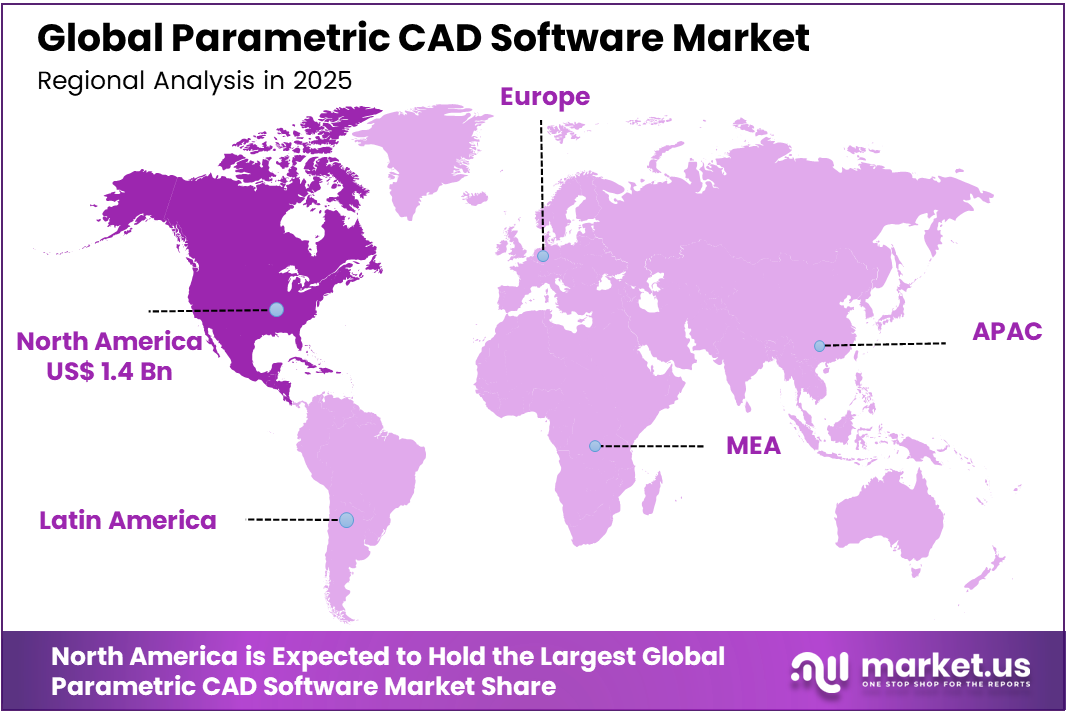
The Global Parametric CAD Software Market size is expected to be worth around USD 10.8 billion by 2035, from USD 4.2 billion in 2025, growing at a CAGR of 10.0% during the forecast period from 2026 to 2035. North America held a dominant market position, capturing more than a 34.3% share, holding USD 1.4 billion in revenue.
Parametric CAD Software refers to design tools that allow engineers and designers to create 2D and 3D models using defined parameters, dimensions, and constraints. When one value is changed, related parts update automatically. It helps improve design accuracy, reduce rework, and support faster product development across engineering and manufacturing workflows.
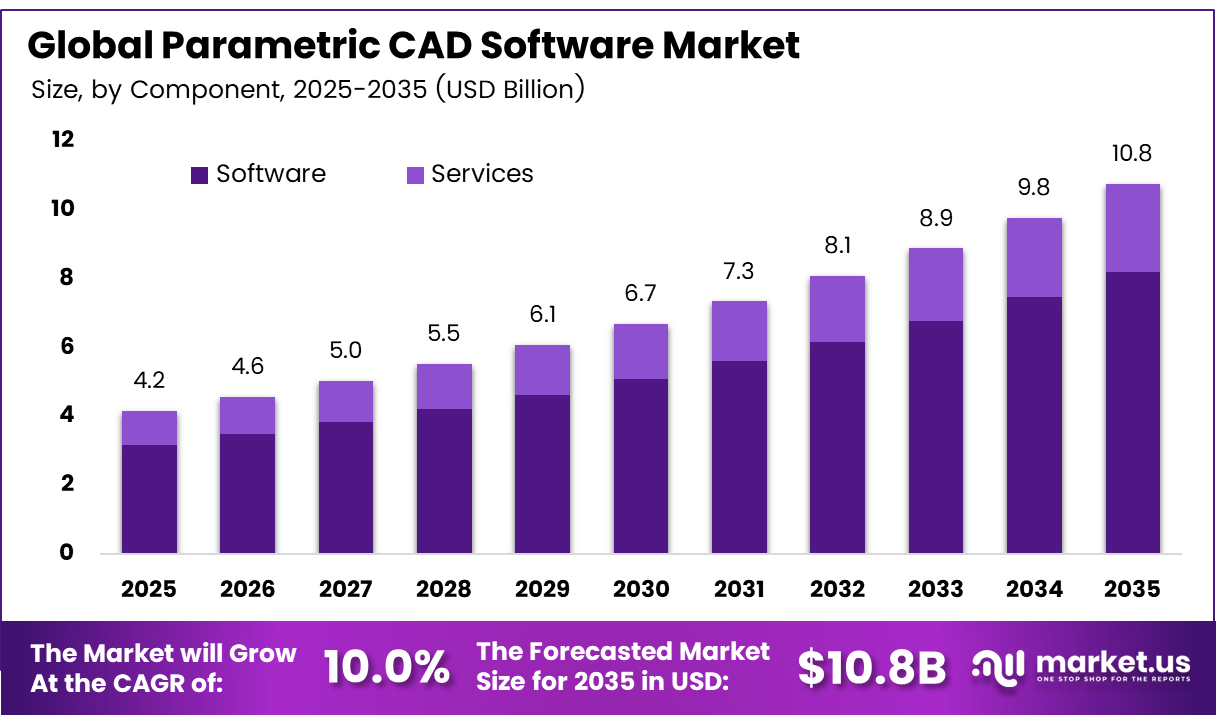
Top driving factors include faster product development, rising use of virtual prototypes, and growing pressure to cut physical test iterations by nearly 30%. Manufacturers in automotive, aerospace and industrial machinery are moving toward digital workflows to reduce design delays, test products earlier, and improve engineering accuracy before physical production begins.
The market for Parametric CAD Software is driven by rising demand for faster product development, accurate 3D modelling, and flexible design changes. Manufacturers are using these tools to reduce rework, improve design quality, and support virtual prototyping. Growing adoption across automotive, aerospace, industrial machinery, and healthcare is further strengthening market demand.
Demand is rising as more than 70% of design teams now work in 3D environments. These teams need accurate manufacturing data and associative models that connect parts, assemblies, and drawings. This helps reduce errors when designs change late in the project and supports smoother coordination between engineering and production teams.
For instance, in December 2025, Hexagon reinforced its smart-manufacturing story by tightening the link between its CAD tools and metrology solutions, helping users close the loop between parametric design intent and shop-floor inspection. This move positions Hexagon as a key player for customers who want tolerance-driven design and in-process quality feedback tied directly to the CAD model.
Key Takeaways
- In 2025, the Software segment held a dominant market position, capturing a 76.3% share of the Global Parametric CAD Software Market.
- In 2025, the On-premises segment held a dominant market position, capturing a 61.3% share of the Global Parametric CAD Software Market.
- In 2025, the Large Enterprises segment held a dominant market position, capturing a 68.7% share of the Global Parametric CAD Software Market.
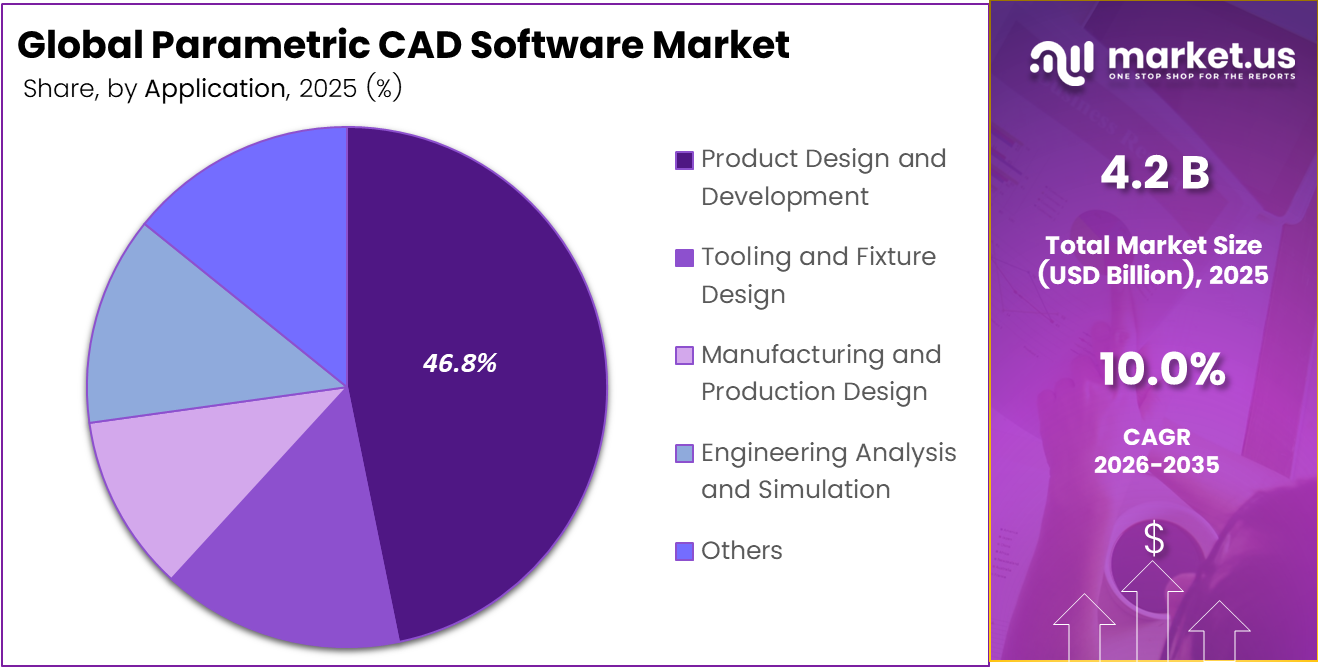
- In 2025, the Product Design and Development segment held a dominant market position, capturing a 46.8% share of the Global Parametric CAD Software Market.
- In 2025, the Automotive segment held a dominant market position, capturing a 33.5% share of the Global Parametric CAD Software Market.
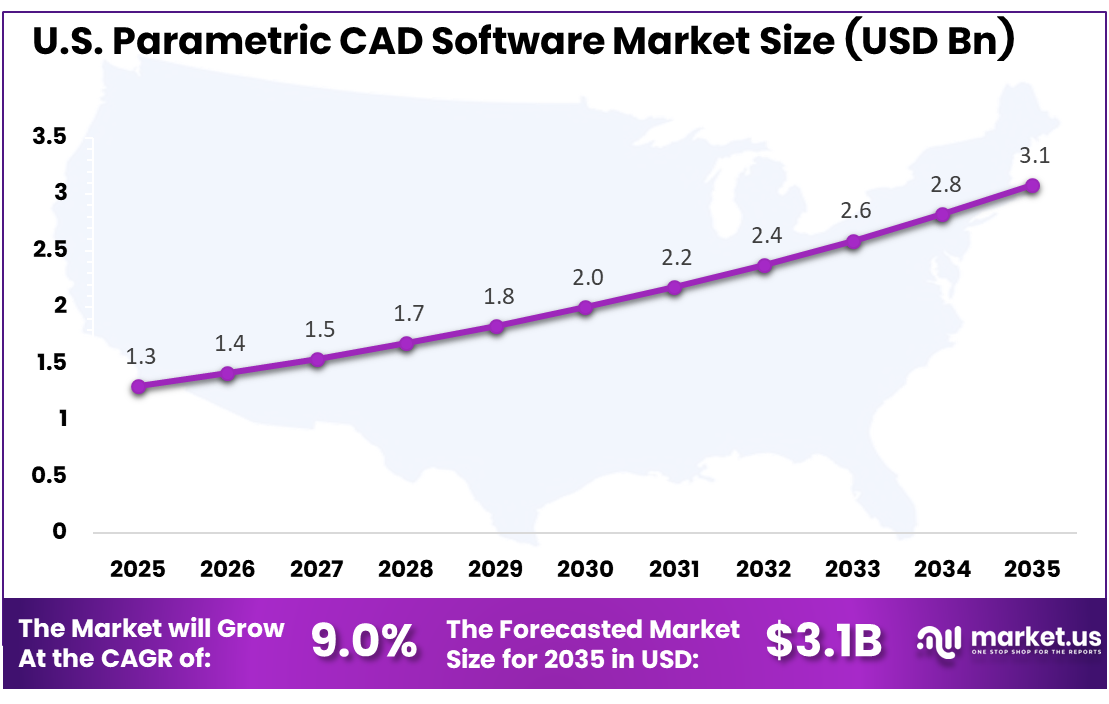
- The U.S. Parametric CAD Software Market was valued at USD 1.3 billion in 2025, with a robust CAGR of 9.0%.
- In 2025, North America held a dominant market position in the Global Parametric CAD Software Market, capturing more than a 34.3% share.
Role of Generative AI
Generative AI is becoming a useful layer over parametric design tools. It helps engineers reduce manual work in feature creation, sizing, design variation, and dimensioning. In selected engineering use cases, AI-based automation can reduce repetitive parametric modelling efforts by nearly 20–30%, mainly for standard part variants.
AI-supported generative design is also improving how optimised shapes are created. These tools can suggest designs based on load, material, and manufacturing rules, then connect them back to editable parametric histories. More than 40% of organisations testing AI-driven design tools are linking them directly with parametric CAD systems.
Investment and Business Benefits
Investment opportunities are growing around cloud-native parametric platforms, CAD integration with PLM and MES, and services that convert legacy 2D data into feature-rich 3D models. Strong scope is also seen in vertical parametric configurators, where even a 10% gain in engineer productivity can support better margins.
Business benefits include lower prototyping costs, faster design iterations, and stronger collaboration across engineering, sales, manufacturing, and procurement teams. Many firms report double-digit percentage reductions in design cycle time after structured parametric rollouts. Automatic bill of materials generation and better visualisation also help reduce scrap, rework, and production misalignment.
Market Dynamics
In 2025, North America held a dominant market position in the Global Parametric CAD Software Market, capturing more than a 34.3% share, holding USD 1.4 billion in revenue. This dominance is due to North America’s strong base of advanced manufacturing, automotive, aerospace, and industrial design companies. The region has high adoption of digital engineering tools, skilled design professionals, and strong use of 3D modelling in product development. Companies are also investing in faster design workflows, virtual prototyping, and connected engineering systems to improve accuracy, reduce rework, and support complex product innovation.
For instance, in February 2026, ANSYS introduced deeper bidirectional links between its simulation suite and leading parametric CAD systems, enabling U.S. engineers to iterate on complex geometry with high-fidelity virtual testing. This tight CAD–CAE integration, orchestrated from its Pennsylvania base, underlines North America’s dominance in high-end engineering platforms used across global aerospace and energy projects.
U.S. Parametric CAD Software Market Size
The market for Parametric CAD Software within the U.S. is growing tremendously and is currently valued at USD 1.3 billion, with a projected CAGR of 9.0%. The market is growing due to the strong shift toward digital engineering, virtual product development, and advanced manufacturing workflows. Companies are using parametric tools to speed up design changes, reduce physical prototyping, and improve product accuracy. Rising adoption across automotive, aerospace, industrial equipment, and healthcare sectors is also supporting demand, as firms need flexible design systems to manage complex products efficiently.
For instance, in January 2026, Siemens Digital Industries Software pushed new NX and Solid Edge enhancements that blend parametric modelling with digital twin and CAD–CAM integration, aimed at U.S. discrete manufacturers. By anchoring key product decisions out of its Plano, Texas hub, Siemens helps cement North America as a centre for next-generation parametric CAD and smart manufacturing platforms.
Key Regions and Countries
North America
- US
- Canada
Europe
- Germany
- France
- The UK
- Spain
- Italy
- Russia
- Netherlands
- Rest of Europe
Asia Pacific
- China
- Japan
- South Korea
- India
- Australia
- Singapore
- Thailand
- Vietnam
- Rest of APAC
- Brazil
- Mexico
- Rest of Latin America
Middle East & Africa
- South Africa
- Saudi Arabia
- UAE
- Rest of MEA
Component Analysis
In 2025, the Software segment held a dominant market position, capturing a 76.3% share of the Global Parametric CAD Software Market. This dominance is due to the central role of software in parametric CAD workflows. Design teams use software tools to build editable models, manage dimensions, update features, and prepare accurate engineering drawings. It supports faster design correction and helps teams reduce manual work during product development.
Software demand is also supported by the growing use of virtual prototyping, simulation, and connected design workflows. Engineers prefer software-led systems because they improve design control, reduce errors, and allow repeated changes without starting from zero. This makes software the core component of parametric CAD adoption.
For instance, in September 2025, Autodesk outlined its Neural CAD roadmap, bringing AI-assisted constraint and feature creation into Fusion to speed up everyday modelling tasks. This move shows how software-centric innovation is raising productivity directly inside parametric environments, encouraging design teams to lean even more on core tools for complex projects.
Deployment Mode Analysis
In 2025, the On-premises segment held a dominant market position, capturing a 61.3% share of the Global Parametric CAD Software Market. This dominance is due to the preference for stronger data control among engineering-heavy organisations. Many firms manage confidential design files, product geometry, and internal manufacturing data. On-premises systems allow these companies to keep critical CAD information within their own infrastructure and security environment.
On-premises deployment is also preferred where customisation, compliance, and internal system integration are important. Large manufacturers often connect CAD platforms with local PLM, PDM, and production systems. This setup gives better control over access, storage, and workflow management across complex engineering operations.
For instance, in November 2025, Siemens announced new AI features in its Solid Edge release that run inside customer-controlled environments, including automated constraint handling and drawing creation. Many firms prefer to deploy such advanced tools on-premises so they can secure models locally and connect them with existing internal systems.
End User Analysis
In 2025, the Large Enterprises segment held a dominant market position, capturing a 68.7% share of the Global Parametric CAD Software Market. This dominance is due to the high use of parametric CAD across large engineering and manufacturing organisations. Large enterprises manage complex products, multiple design teams, and long approval processes. Parametric tools help them maintain design consistency, improve collaboration, and reduce rework across large assemblies.
Large enterprises also invest more in advanced CAD capabilities because they need strong integration with simulation, production planning, and product lifecycle systems. These firms use parametric models to improve design accuracy, support standardisation, and manage frequent product changes across different departments and locations.
For instance, in October 2025, at a major event, Dassault Systèmes highlighted its next-generation 3DExperience vision that links AI-driven assistants, virtual twins, and manufacturing workflows for large manufacturers. Global enterprises adopt these capabilities to manage complex programmes, reinforcing their role as primary users of advanced parametric platforms.
Application Analysis
In 2025, the Product Design and Development segment held a dominant market position, capturing a 46.8% share of the Global Parametric CAD Software Market. This dominance is due to the strong use of parametric CAD in core product design activities. Engineers use these tools to create accurate 3D models, test design variations, and refine parts before manufacturing. This makes product design and development the main application area for parametric CAD software.
The segment is also supported by the need for faster design cycles and better product visualisation. Parametric CAD allows teams to change dimensions, features, and assemblies quickly while keeping the model structure intact. This improves coordination between design, engineering, testing, and manufacturing teams.
For instance, in April 2026, Autodesk introduced Wonder 3D in Flow Studio to turn text and images into 3D assets, feeding early concept work that can later be refined in parametric tools. Faster creation of starting geometry encourages more experimentation in product design before teams lock into detailed models.
Industry Analysis
In 2025, the Automotive segment held a dominant market position, capturing a 33.5% share of the Global Parametric CAD Software Market. This dominance is due to the automotive industry’s need for precision, repeatable design, and frequent product updates. Automakers and suppliers use parametric CAD to design vehicle parts, assemblies, body structures, and mechanical systems. It helps engineers manage complex designs with better accuracy and control.
Automotive companies also depend on parametric CAD to improve collaboration between styling, engineering, simulation, and production teams. The software supports faster design changes, better component validation, and smoother handoff to manufacturing. This makes it highly valuable in modern vehicle development workflows.
For instance, in November 2024, Siemens released a next-generation electronic systems design suite with AI support and unified workflows. Automotive engineers can use such tools alongside mechanical CAD to manage dense electronics in vehicles, deepening reliance on integrated parametric environments.
Key Market Segments
By Component
- Software
- Services
By Deployment Mode
- On-premises
- Cloud-based
By End User
- Large Enterprises
- Small and Medium-sized Enterprises (SMEs)
By Application
- Product Design and Development
- Tooling and Fixture Design
- Manufacturing and Production Design
- Engineering Analysis and Simulation
- Others
By Industry
- Automotive
- Aerospace and Defense
- Industrial Machinery
- Consumer Goods
- Electronics and Semiconductor
- Medical Devices
- Construction and Architecture
- Others
Emerging Trends
A key trend is the growing move toward cloud-delivered parametric CAD. In this model, design parameters, feature trees, and collaboration tools are managed through browser-based platforms and connected with PLM and PDM systems. Cloud or hybrid deployment now represents about 35–40% of new 3D CAD deployments.
Another trend is stronger integration between parametric CAD, simulation, generative design, and 3D printing. Parameter changes can now update meshes, toolpaths, and performance results more quickly. More than 50% of advanced users run simulation studies from parametric models, while nearly 30% connect CAD files with additive manufacturing workflows.
Growth Factors
The adoption of parametric design tools is being supported by digitalisation in manufacturing, automotive, aerospace, and healthcare. These models are used as a base for model-based definition and downstream automation. Manufacturing use cases account for over 40% of 3D CAD and parametric design deployments.
Growth is also supported by the need to manage complex products while shortening design cycles. Teams are moving away from static 2D tools and adopting constraint-driven workflows. Parametric and 3D CAD solutions are recording mid-to-high single-digit annual growth, while legacy 2D-only tools are growing slowly or declining.
Market Dynamics
Drivers - Faster Product Development
Faster product development is a major driver for the Parametric CAD Software Market. The software allows engineers to change dimensions, features, and assemblies without rebuilding the full model. This helps design teams test more options, correct errors quickly, and move products from concept to production with better control.
The demand is also rising as manufacturers face shorter launch cycles and higher pressure to reduce physical prototypes. Parametric CAD supports design reuse, automated updates, and better coordination between engineering and production teams. These benefits make it a practical tool for companies working on complex and frequently updated products.
For instance, in April 2025, Autodesk highlighted new AI-assisted features in AutoCAD 2026 that speed file opening and automate repetitive drafting edits, helping designers move from concept to detailed models faster in day-to-day work. These improvements support shorter iteration cycles and more responsive design changes in parametric workflows, especially on large, complex engineering drawings.
Restraints - Complex Learning and Model Management
Complex learning and model management act as key restraints in the market. Parametric CAD requires users to understand constraints, feature history, design intent, and assembly relationships. New users may take time to build accurate models, especially when shifting from basic drafting or direct modelling tools.
Model management also becomes difficult when large files, linked parts, and design changes are not handled properly. A poorly structured model can create errors during updates and increase rework. This limits adoption among smaller firms that may lack trained staff, clear design standards, and strong internal CAD practices.
For instance, in July 2025, as Ansys tools became integrated into Synopsys’ broader platform, engineering teams faced the task of learning combined design and simulation workflows. The increased system breadth can make it harder for new users to master model setup and manage parameter linkages across tools, reinforcing the perception that high-fidelity parametric simulation environments are complex to learn.
Opportunities - Cloud and AI-Enabled Design
Cloud and AI-enabled design create a strong opportunity for the Parametric CAD Software Market. Cloud platforms allow teams to access models, review changes, and work together from different locations. This is useful for companies that depend on distributed engineering teams, suppliers, and faster design approval cycles.
AI is also creating new value by helping engineers generate design options, automate repetitive modelling tasks, and improve early design decisions. When AI tools are connected with parametric CAD, teams can explore more alternatives while keeping models editable. This can improve productivity and support smarter product development workflows.
For instance, in September 2025, Dassault’s cloud 3DEXPERIENCE platform was promoted as a way to connect teams, processes, and data in a single environment. By using cloud infrastructure and AI-assisted services such as virtual companions and generative experiences, the company creates opportunities for customers to centralise parametric models and share them widely across supply chains with consistent data.
Challenges - Shortage of Skilled Users
The shortage of skilled users remains a major challenge for the market. Parametric CAD needs trained engineers who can build clean models, manage design intent, and apply constraints correctly. Many companies struggle to find users who understand both the software and the engineering logic behind complex product design.
This skills gap can slow implementation and reduce the value of CAD investments. Without proper training, teams may create unstable models, face repeated errors, and depend heavily on senior designers. Companies need structured training, design guidelines, and continuous skill development to use parametric CAD effectively.
For instance, in December 2024, the inclusion of an AI chatbot and usability improvements in IronCAD 2025 suggests the company is trying to lower the expertise barrier for users. Many smaller manufacturers cannot easily recruit experienced CAD professionals, so tools that guide less seasoned designers help, but the underlying shortage of skilled users remains a constraint on more advanced usage.
Key Players Analysis
One of the leading players, in October 2025, Autodesk expanded Inventor and Fusion enhancements for mechanical design, improving constraint solvers and parametric sketch performance as part of a broader 3D CAD roadmap. The company continues to push cloud-connected workflows, ensuring that parametric models created in desktop tools feed seamlessly into simulation and manufacturing workflows.
Top Key Players in the Market
- Autodesk, Inc.
- Dassault Systèmes SE
- PTC, Inc.
- Siemens Digital Industries Software
- Hexagon AB
- Altair Engineering Inc.
- ANSYS, Inc.
- Zuken Inc.
- Bentley Systems, Incorporated
- IronCAD LLC
- Onshape Inc.
- Alibre, LLC
- Others
Recent Developments
- In February 2026, Siemens strengthened its position in parametric CAD by deepening integration between NX and its Xcelerator portfolio, adding AI-assisted feature modelling and constraint handling for complex assemblies. The update targets automotive and aerospace users who need faster design cycles and tighter links between CAD, simulation, and manufacturing execution.
- In January 2026, PTC rolled out enhancements to Creo within its SaaS-based Windchill+ environment, focusing on model-based definition and parametric feature automation. The release helps design teams standardise 3D annotations, reduce 2D drawing work, and connect parametric models more directly with downstream PLM and digital thread initiatives.
Report Scope
| Report Features | Description |
|---|---|
| Market Value (2025) | USD 4.2 Billion |
| Forecast Revenue (2035) | USD 10.8 Billion |
| CAGR (2026-2035) | 10.0% |
| Base Year for Estimation | 2025 |
| Historic Period | 2020-2024 |
| Forecast Period | 2026-2035 |
| Report Coverage | Revenue Forecast, Market Dynamics, Competitive Landscape, Recent Developments |
| Segments Covered | By Component (Software, Services), By Deployment Mode (On-premises, Cloud-based), By End User (Large Enterprises, Small and Medium-sized Enterprises (SMEs)), By Application (Product Design and Development, Tooling and Fixture Design, Manufacturing and Production Design, Engineering Analysis and Simulation, Others), By Industry (Automotive, Aerospace and Defense, Industrial Machinery, Consumer Goods, Electronics and Semiconductor, Medical Devices, Construction and Architecture, Others) |
| Regional Analysis | North America (US and Canada), Europe (Germany, France, The UK, Spain, Italy, and Rest of Europe), Asia Pacific (China, Japan, South Korea, India, Australia, and Rest of APAC), Latin America (Brazil, Mexico, and Rest of Latin America), Middle East & Africa (GCC, South Africa, and Rest of MEA) |
| Competitive Landscape | Autodesk, Inc., Dassault Systèmes SE, PTC, Inc., Siemens Digital Industries Software, Hexagon AB, Altair Engineering Inc., ANSYS, Inc., Zuken Inc., Bentley Systems, Incorporated, IronCAD LLC, Onshape Inc., Alibre, LLC, Others |
| Customization Scope | Customisation at the segment and region/country levels will be provided. Moreover, customisation can be tailored to the requirements. |
| Purchase Options | We have three licenses to opt for: Single User License, Multi-User License (Up to 5 Users), Corporate Use License (Unlimited Users and Printable PDF) |





































