


Report Overview
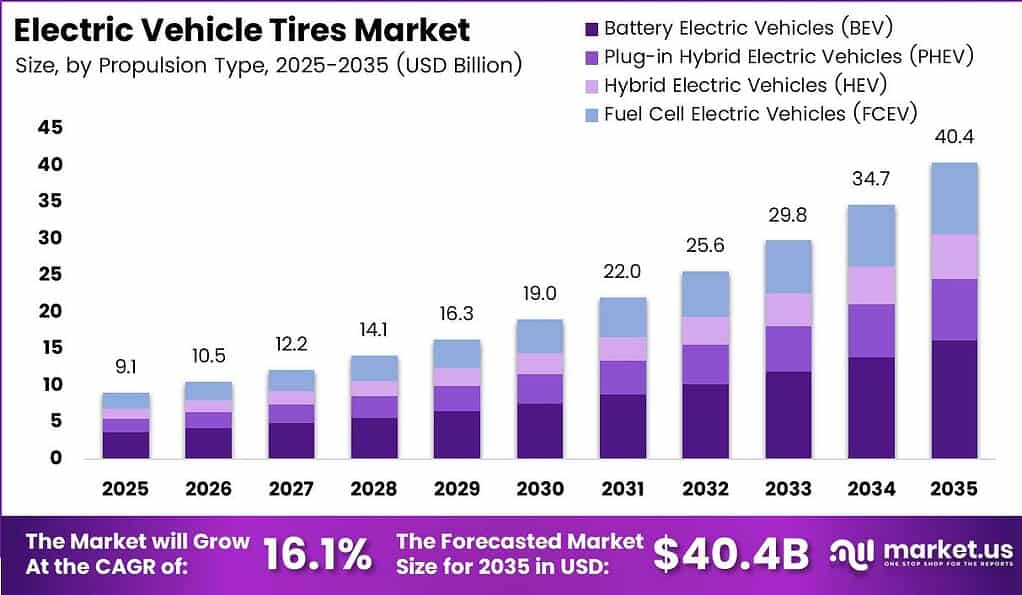
Global Electric Vehicle Tires Market size is expected to be worth around USD 40.4 Billion by 2035 from USD 9.1 Billion in 2025, growing at a CAGR of 16.1% during the forecast period 2026 to 2035.
The electric vehicle tires market covers purpose-engineered tires designed to meet the specific performance demands of battery-electric, plug-in hybrid, hybrid, and fuel-cell electric vehicles. These tires address higher curb weight, instant torque delivery, regenerative braking, cabin acoustics, and range-efficiency requirements that standard passenger-car tires cannot consistently satisfy. The market spans original-equipment supply to automakers and aftermarket replacement sales across all major global regions.
Key Takeaways
- The global Electric Vehicle Tires Market is valued at USD 9.1 Billion in 2025 and is forecast to reach USD 40.4 Billion by 2035, at a CAGR of 16.1%.
- By Propulsion Type, Battery Electric Vehicles (BEV) dominate with a 32.2% share and represent the fastest-growing sub-segment.
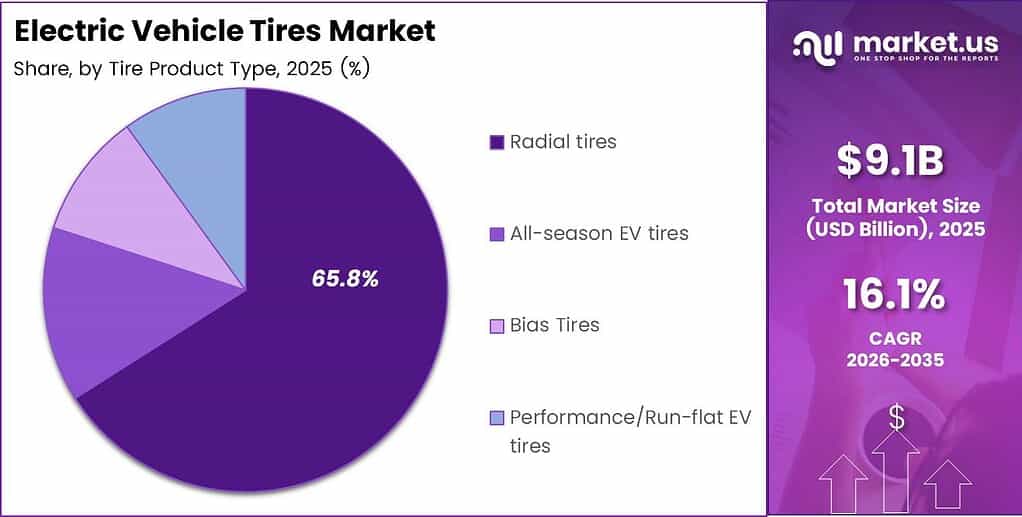
- By Tire Product Type, Radial Tires hold the leading share at 65.8% and are the fastest-growing sub-segment.
- By Rim Size, tires sized ≥ 19 inch dominate with a 42.1% share, while the 16–18 inch range is the fastest-growing.
- By Sales Channel, Aftermarket leads with a 65.3% share and is the fastest-growing channel.
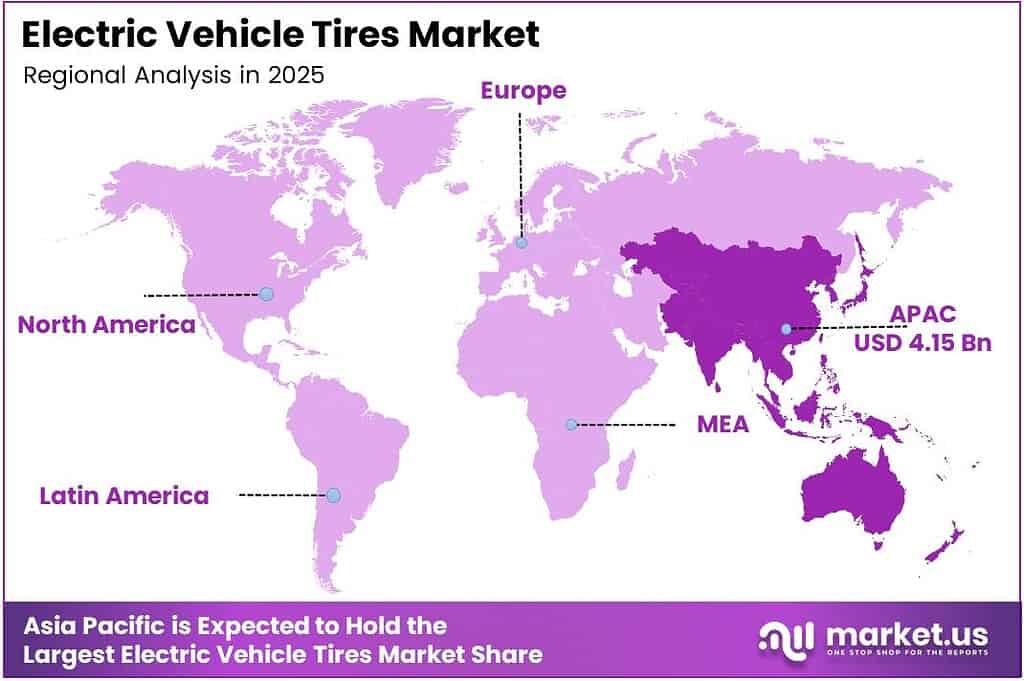
- Asia Pacific dominates regional demand with a 45.6% share, valued at USD 4.15 Billion in 2025.
Electrically chargeable cars represented 3.7% of the EU passenger-car fleet in 2024, rising from 3.0% in 2023, signaling that EV fleet penetration is compounding year-on-year across one of the world’s most regulated automotive markets. This fleet expansion directly enlarges the addressable replacement-tire pool in Europe. Investors targeting aftermarket channels in Europe can expect structurally expanding volumes as older EV cohorts begin their first replacement cycles.
Global electric-car sales exceeded 17 million units in 2024, representing more than 20% of all new cars sold worldwide. This volume converts into a growing installed base that feeds replacement demand within two to four years. As per our research, world merchandise-trade volume also grew 4.6% in 2025, supporting cross-border tire supply chains and enabling manufacturers to serve high-growth markets through existing export infrastructure.
In April 2025, Hankook introduced the iON evo AS SUV, an EV-specific all-season tire developed for large electric SUVs through its collaboration with Lucid Motors. This product launch reflects the commercial logic now driving the market: OEM-exclusive fitment agreements lock in volume, reduce substitution risk, and generate premium pricing. Tire makers that secure platform-level homologation contracts early will hold structural cost and margin advantages through the forecast period.
Propulsion Type Analysis
Battery Electric Vehicles (BEV) dominate with 32.2% due to highest EV volume and fastest adoption rate.
In 2025, Battery Electric Vehicles (BEV) held a dominant market position in the By Propulsion Type segment of the Electric Vehicle Tires Market, with a 32.2% share. Global electric-car sales exceeded 20 million units in 2025, growing 20% from 2024, with BEVs generating the majority of purpose-engineered tire demand through OEM homologation requirements and accelerating replacement cycles. Tire suppliers that secure BEV platform contracts hold multi-year volume visibility that hybrid or PHEV programs cannot match.
Plug-in Hybrid Electric Vehicles (PHEV) represent the second-largest sub-segment by propulsion type. Around 800,000 plug-in hybrid electric cars were registered in the European Union in 2024, equal to 7.3% of new-car registrations. PHEV buyers typically demand tires that balance electric-mode efficiency with combustion-mode performance, requiring dual-optimized compounds and creating a differentiated product niche for tire developers. In February 2025, Yokohama Rubber announced that its ADVAN Sport EV tires would be factory-equipped on the ONVO L60 electric SUV from NIO, demonstrating how OEM supply agreements are extending into platform-specific fitment programs across propulsion types.
Hybrid Electric Vehicles (HEV) occupy a structurally distinct tier, as their partial electrification generates moderate torque loads and lower curb-weight penalties than full BEVs. Electric-car sales in China exceeded 11 million in 2024, with electric cars accounting for almost half of Chinese car sales, underscoring that the largest HEV and BEV market is now a volume base that forces tire makers to maintain localized compounding and fitment capabilities. Fuel Cell Electric Vehicles (FCEV) currently represent a smaller share, with commercialization concentrated in commercial and heavy-duty applications rather than mass passenger-vehicle segments.
Tire Product Type Analysis
Radial Tires dominate with 65.8% due to superior load management and rolling-resistance performance.
In 2025, Radial Tires held a dominant market position in the By Tire Product Type segment of the Electric Vehicle Tires Market, with a 65.8% share. Radial construction distributes the higher axle loads from battery-pack mass more evenly across the contact patch, reducing localized wear and sustaining rolling-resistance targets over the tire’s service life. Pirelli operated 18 production plants across 12 countries with annual capacity of approximately 74 million car tires at the end of 2025, illustrating how scale in radial production directly translates to cost-per-unit advantages in high-volume EV programs. In May 2024, Bridgestone supplied the Chevrolet Blazer EV with a bespoke Alenza A/S 02 tire incorporating B-SEAL S technology, demonstrating how radial platforms support model-specific engineering without full compound redesign.
All-season EV tires represent the fastest-expanding product sub-type within the radial family, driven by consumer preference for single-tire solutions across mixed climatic conditions. This sub-segment reduces the per-vehicle total-cost-of-ownership calculation for EV buyers and simultaneously simplifies aftermarket stocking for tire retailers. Suppliers that develop all-season EV compounds with certified rolling-resistance ratings gain shelf-presence advantages in markets where seasonal switching is impractical or costly.
Bias Tires retain a limited but persistent presence in commercial EV and specialty-vehicle applications where sidewall stiffness and load-floor resilience outweigh rolling-resistance optimization. Performance and Run-flat EV tires address premium and high-rim-diameter fitments where range anxiety from a disabled tire creates unacceptable stranding risk. These sub-segments collectively serve lower-volume but higher-margin niches that reward technical differentiation over commodity pricing.
Rim Size Analysis
≥ 19 inch Rim Sizes dominate with 42.1% due to premium EV platform design and performance tire demand.
In 2025, ≥ 19 inch Rim Sizes held a dominant market position in the By Rim Size segment of the Electric Vehicle Tires Market, with a 42.1% share. Premium and performance EV platforms from major automakers are designed around large-diameter wheels that enhance aerodynamic profiles and accommodate wider tires with lower-profile sidewalls. This structural design preference locks in large-rim tire demand at the OEM stage and sustains it through replacement cycles, providing suppliers with predictable long-duration volume. In February 2025, Continental announced that Volkswagen’s all-electric ID.7 received exclusive worldwide original-equipment approval for its 21-inch EcoContact 7 S, confirming how OEM specifications drive large-rim fitment share.
The 16–18 inch rim size range is the fastest-growing tier, driven by the electrification of mass-market passenger vehicles and compact SUVs in China, Europe, and emerging markets. This segment connects the performance-demand gap between entry-level EVs and premium large-rim platforms, producing the broadest replacement addressable market over the medium term. Suppliers with strong mid-rim product ranges and competitive aftermarket pricing are best positioned to capture share as mid-size EV volume scales globally.
Tires sized ≤ 15 inch serve urban EVs, entry-level microcars, and light commercial electrification in emerging markets. This rim category carries the lowest revenue-per-unit but compensates through volume consistency and the potential to anchor consumers into brand loyalty ahead of vehicle upgrades. Goodyear reported 2025 net sales of USD 18.3 Billion and tire unit volume of 158.7 million units, demonstrating that scale across rim categories remains a critical competitive lever for full-line suppliers managing mixed portfolio profitability.
Sales Channel Analysis
Aftermarket dominates with 65.3% due to replacement cycle volume and installed EV base expansion.
In 2025, Aftermarket held a dominant market position in the By Sales Channel segment of the Electric Vehicle Tires Market, with a 65.3% share. The aftermarket channel captures replacement demand generated by the accumulated global EV installed base, which continues to grow as first-generation EVs enter their initial tire replacement windows. Natural-rubber TSR20 prices were projected at USD 1.80 per kilogram in 2025 versus USD 1.77 per kilogram in 2024, signaling marginal but sustained raw-material cost pressure that aftermarket pricing strategies must absorb without losing volume to lower-grade alternatives. In September 2024, Yokohama Rubber announced factory-equipment supply of its ADVAN Sport EV tire for a Chinese electric vehicle, reflecting the OEM-to-aftermarket supply chain continuity that brand-authorized fitment programs reinforce.
The OEM channel supplies tires directly to vehicle assembly lines under platform-specific homologation agreements, giving approved tire brands first-mover presence in every new EV sold. OEM contracts provide revenue certainty, but require significant engineering investment, certification spend, and pricing concessions relative to aftermarket replacement margins. Suppliers that combine OEM homologation footprints with strong branded aftermarket networks capture value at both ends of the vehicle lifecycle, reducing channel concentration risk across the forecast period.
Key Market Segments
By Propulsion Type
- Battery Electric Vehicles (BEV)
- Plug-in Hybrid Electric Vehicles (PHEV)
- Hybrid Electric Vehicles (HEV)
- Fuel Cell Electric Vehicles (FCEV)
By Tire Product Type
- Radial Tires
- All-Season EV Tires
- Bias Tires
- Performance/Run-flat EV Tires
By Rim Size
- ≤ 15 inch
- 16–18 inch
- ≥ 19 inch
By Sales Channel
- OEM
- Aftermarket
Regional Analysis
Asia Pacific Dominates the Electric Vehicle Tires Market with a Market Share of 45.6%, Valued at USD 4.15 Billion
Asia Pacific accounts for 45.6% of global electric vehicle tire demand, valued at USD 4.15 Billion in 2025. China produced nearly 16 million electric cars in 2025, equivalent to nearly 75% of global EV production, making it the single largest source of OEM tire fitment volume worldwide. This concentration gives tire manufacturers with established Chinese supply chains a structural volume advantage that competitors without local production capacity cannot easily replicate.
Europe represents the fastest-growing major regional market, supported by policy-driven EV adoption targets and fleet electrification mandates across Germany, France, the UK, and the Nordics. In 2025, 1,880,370 battery-electric cars were registered in the European Union, capturing 17.4% of the new-car market, up from 13.6% and 1.4 million BEV registrations in 2024. The EU passenger-car fleet reached 256 million vehicles in 2024, growing 1.4%, with electrically chargeable cars representing 3.7% of that fleet. In September 2024, Bridgestone announced that Audi selected its Potenza Sport A tire as original equipment for the all-electric Audi e-tron GT, illustrating how premium European OEM programs drive branded fitment growth across the region. In August 2026, Hankook announced plans to showcase its EV-exclusive iON tire lineup at Demo Days Bay Area in California, signaling active brand-building investment in the North American aftermarket.
North America is a high-value market where premium EV platforms generate above-average revenue-per-tire, and where aftermarket channel development is accelerating as first-generation EVs enter replacement cycles. Maritime trade grew 2.2% in 2024, with growth forecast to slow to 0.5% in 2025, indicating tightening cross-border logistics conditions that favor locally manufactured tire supply over import-dependent sourcing strategies. Latin America, the Middle East, and Africa represent earlier-stage EV adoption markets where low-cost EV fitments and localized manufacturing investments will determine which global suppliers capture share in the next decade.
Key Regions and Countries
North America
- US
- Canada
Europe
- Germany
- France
- The UK
- Spain
- Italy
- Rest of Europe
Asia Pacific
- China
- Japan
- South Korea
- India
- Australia
- Rest of APAC
Latin America
- Brazil
- Mexico
- Rest of Latin America
Middle East and Africa
- GCC
- South Africa
- Rest of MEA
Drivers
Battery-electric vehicle production scale-up is the primary force expanding original-equipment tire fitment volumes. Rising BEV output requires purpose-engineered tires with reinforced carcasses, lower rolling-resistance compounds, and tighter noise and load-bearing specifications than conventional passenger-car tires. This technical differentiation lifts the average revenue content per vehicle and supports long-duration OEM homologation contracts, favoring suppliers with dedicated EV product development infrastructure.
Higher vehicle mass and faster tread wear from instant torque delivery create compounding replacement demand that sustains aftermarket volumes above levels generated by combustion-vehicle fleets. Range-efficiency tire specifications are now a baseline OEM procurement criterion in Europe, China, Japan, and South Korea. OEM platform-specific homologation and the electrification of premium SUV segments add further layers of differentiation that reward technical capability over commodity pricing across global passenger-vehicle markets.
| Driver | (~) % Impact on CAGR Forecast | Geographic Relevance | Impact Timeline |
|---|---|---|---|
| Battery-Electric Vehicle Production Scale-Up | +3.0% | China, Europe, North America, India | Short term (≤ 2 years) |
| Higher Vehicle Mass Requirements | +2.2% | Global passenger-vehicle markets | Short term (≤ 2 years) |
| Replacement Demand From Faster Wear | +1.8% | China, Europe, North America | Medium term (2–4 years) |
| Range-Efficiency Tire Specification | +1.5% | Europe, China, Japan, South Korea | Short term (≤ 2 years) |
| OEM Platform-Specific Homologation | +1.2% | China, Europe, North America | Medium term (2–4 years) |
| Premium SUV Electrification Mix | +0.9% | North America, Europe, China, Gulf markets | Medium term (2–4 years) |
Restraints
Natural rubber, synthetic rubber, carbon black, silica, and steel cord costs represent approximately 60% of tire production expense, with natural rubber alone accounting for roughly 35% of raw-material cost in exposed product mixes. EV-specific silica-rich compounds and reinforced structures carry higher technical content costs, while OEM sourcing agreements typically require annualized price reductions. Sharp commodity moves compress gross margin before contractual price-reset mechanisms take effect.
Trade barriers on tire imports, consumer EV purchase deferrals in Europe and North America, and OEM price-down procurement pressure collectively limit revenue recovery from cost inflation. Low-cost conventional tire substitution in India, Southeast Asia, Latin America, and Africa redirects budget buyers away from purpose-engineered EV products. Fragmented aftermarket fitment awareness in emerging EV markets further suppresses replacement revenue and slows branded product penetration.
| Restraint | (~) % Impact on CAGR Forecast | Geographic Relevance | Impact Timeline |
|---|---|---|---|
| Natural Rubber And Petrochemical Cost Volatility | -2.4% | Global manufacturing hubs | Short term (≤ 2 years) |
| Trade Barriers On Tire Imports | -1.7% | North America and selected import markets | Short term (≤ 2 years) |
| Consumer EV Purchase Deferrals | -1.3% | Europe, North America, emerging markets | Short term (≤ 2 years) |
| Low-Cost Conventional Tire Substitution | -1.0% | India, Southeast Asia, Latin America, Africa | Medium term (2–4 years) |
| OEM Price-Down Procurement Pressure | -0.8% | China, Europe, North America | Medium term (2–4 years) |
| Fragmented Aftermarket Fitment Awareness | -0.6% | Emerging EV markets | Medium term (2–4 years) |
Challenges
Electric vehicles combine battery-driven mass with immediate motor torque and regenerative-braking load reversals, creating a persistent engineering conflict between rolling resistance, wet braking, acoustic comfort, durability, and abrasion control. A tire moving from an energy-efficiency rating of A to C can reduce battery-electric driving range by more than 8%. Each new vehicle platform requires iterative compound, belt, sidewall, and tread-pattern validation before OEM approval, extending development timelines and increasing certification costs.
Abrasion testing standardization gaps in Europe create regulatory uncertainty that raises compliance costs across global OEM supply chains and delays product launches. Regional SKU complexity, charging-route climate variability across North America, Europe, India, and China, and constrained specialist test capacity in key development markets compound development friction. These structural barriers favor well-capitalized incumbents with established simulation, material science, and global testing infrastructure over new entrants and smaller regional suppliers.
| Challenge | (~) % CAGR Friction Drag | Geographic Relevance | Mitigation Horizon |
|---|---|---|---|
| Weight Torque Wear Trade-Off | -2.0% | Global passenger EV markets | Medium term (2–4 years) |
| Abrasion Testing Standardization Gap | -1.6% | Europe with global spillover | Medium term (2–4 years) |
| Regional SKU Complexity | -1.2% | Global OEM supply chains | Medium term (2–4 years) |
| Charging-Route Climate Variability | -0.9% | North America, Europe, India, China | Long term (≥ 4 years) |
| Specialist Test Capacity Constraints | -0.8% | Europe, China, Japan, North America | Medium term (2–4 years) |
| Data-Poor Aftermarket Servicing | -0.6% | India, Southeast Asia, Latin America | Long term (≥ 4 years) |
Opportunities
Predictive tire-service subscriptions represent a revenue model shift from one-time product sales to contracted performance management. Embedding pressure, temperature, tread-depth, and load-monitoring capabilities into fleet service agreements converts periodic replacement margin into recurring revenue streams. A 5% to 10% improvement in usable tire life through proactive service scheduling can materially reduce fleet operating costs, creating measurable justification for subscription-based commercial contracts.
Electric commercial fleet fitments, low-abrasion compliance portfolios for European regulatory markets, and retreadable electric bus casings in China, India, and Latin America represent addressable volume pools that OEM passenger-car programs cannot serve. Smart-tire sensor monetization through connected-vehicle platforms opens a recurring revenue channel in premium fleet and mobility markets. Localized emerging-market EV fitments in India, Southeast Asia, Latin America, and Africa represent the longest-horizon upside, rewarding suppliers that invest in affordable product lines and local manufacturing capacity before competitive density rises.
| Opportunity | (~) % Potential CAGR Upside | Geographic Relevance | Execution Window |
|---|---|---|---|
| Predictive Tire-Service Subscriptions | +2.1% | North America, Europe, China, fleet corridors | Medium term (2–4 years) |
| Electric Commercial Fleet Fitments | +1.9% | China, Europe, North America, India | Medium term (2–4 years) |
| Low-Abrasion Compliance Portfolios | +1.6% | Europe and export-oriented suppliers | Medium term (2–4 years) |
| Retreadable Electric Bus Casings | +1.3% | Europe, China, India, Latin America | Long term (≥ 4 years) |
| Smart-Tire Sensor Monetization | +1.1% | Premium fleets and connected-vehicle markets | Long term (≥ 4 years) |
| Localized Emerging-Market EV Fitments | +0.9% | India, Southeast Asia, Latin America, Africa | Medium term (2–4 years) |
Key Company Insights
Michelin reported €26.0 Billion in sales in 2025 with €2.9 Billion in segment operating income, reflecting a margin structure that allows sustained investment in EV-specific compound development and OEM homologation programs. In August 2025, Michelin introduced the Pilot Sport 5 energy tire for the Mercedes-AMG CONCEPT GT XX, combining high-performance capability with RFID-enabled tire monitoring. This positions Michelin at the premium end of the connected-tire segment where per-unit revenue and switching costs are highest.
Bridgestone reported FY2025 revenue of ¥4,429.5 Billion and adjusted operating profit of ¥493.7 Billion, while authorizing share buybacks of up to ¥150 Billion covering up to 60 million shares. In May 2024, Bridgestone developed bespoke 20-inch Potenza Sport ENLITEN tires for Maserati’s first all-electric SUV, the Grecale Folgore. This dual focus on capital returns and platform-specific EV engineering signals a strategy of concentrating investment in high-margin homologation programs while returning excess cash to shareholders. In May 2025, Hankook reported that EV-dedicated products accounted for 23% of its passenger-car and light-truck tire sales in Q1 2025, an increase of 6 percentage points year over year, confirming rapid EV portfolio penetration across leading global suppliers.
Key Players
- Michelin
- Bridgestone Corporation
- The Goodyear Tire & Rubber Company
- Continental AG
- Hankook Tire & Technology Co., Ltd.
- Yokohama Rubber Co., Ltd.
- Pirelli & C. S.p.A.
- Sumitomo Rubber Industries, Ltd.
- ZC Rubber
- Sailun Jinyu Group
- Cooper Tire & Rubber Company
- Double Coin Holdings Ltd.
- Giti Tire
- Toyo Tire Corporation
- Apollo Tyres Ltd.
Recent Developments
- January 2024 – Goodyear introduced the ElectricDrive 2, an all-season tire designed for electric vehicles in 17 sizes and incorporating at least 50% sustainable materials by weight.
- April 2024 – Michelin introduced three customized tire ranges (summer, winter, and all-season) for the all-electric Porsche Macan, comprising 14 tire references developed specifically for the EV.
- June 2024 – ENSO announced plans to invest USD 500 Million in a US carbon-neutral tire factory designed to produce up to 20 million EV tires annually at full operation, with initial production targeted for 2027.
- November 2024 – Bridgestone announced a ¥27 Billion strategic investment to expand premium passenger-car tire production capacity at 3 Japanese plants, targeting high-rim-diameter premium tires.
- February 2025 – Continental launched the EcoContact 7 and EcoContact 7 S summer tires designed to improve driving efficiency, reduce rolling noise, and provide dynamic handling, with both products suited to electric vehicles.
- April 2025 – Continental announced it had supplied original-equipment tires to 18 of the world’s 20 highest-volume fully electric-vehicle manufacturers during 2024, including BYD, Geely, Volkswagen, NIO, Mercedes-Benz, and Renault.
- June 2025 – Hankook launched the iON HT tire for electric light-duty trucks, expanding its dedicated iON EV tire portfolio beyond passenger cars and SUVs.
- March 2026 – Michelin unveiled the Primacy 5 energy and Pilot Sport 5 energy summer tire ranges, combining energy efficiency, longevity, wet-grip performance, and driving performance across different vehicle powertrains.
- April 2026 – Pirelli acquired a 30% stake in Swedish technology company Univrses and established a strategic partnership to integrate Univrses’ AI-based 3DAI computer-vision technology into Pirelli’s sensor-equipped Cyber Tyre system.
- May 2026 – Pirelli announced it would begin producing its sensor-integrated Cyber Tyres at its Rome, Georgia, United States facility, strengthening its connected-tire manufacturing presence in North America.
Report Scope
| Report Features | Description |
|---|---|
| Market Value (2025) | USD 9.1 Billion |
| Forecast Revenue (2035) | USD 40.4 Billion |
| CAGR (2026-2035) | 16.1% |
| Base Year for Estimation | 2025 |
| Historic Period | 2020-2024 |
| Forecast Period | 2026-2035 |
| Report Coverage | Revenue Forecast, Market Dynamics, Market Opportunity Analysis, Technology and Innovation Landscape, Competitive Landscape, Recent Developments |
| Segments Covered | By Propulsion Type (Battery Electric Vehicles (BEV), Plug-in Hybrid Electric Vehicles (PHEV), Hybrid Electric Vehicles (HEV), Fuel Cell Electric Vehicles (FCEV)), By Tire Product Type (Radial Tires, All-Season EV Tires, Bias Tires, Performance/Run-flat EV Tires), By Rim Size (≤ 15 inch, 16–18 inch, ≥ 19 inch), By Sales Channel (OEM, Aftermarket) |
| Regional Analysis | North America (US and Canada), Europe (Germany, France, The UK, Spain, Italy, and Rest of Europe), Asia Pacific (China, Japan, South Korea, India, Australia, and Rest of APAC), Latin America (Brazil, Mexico, and Rest of Latin America), Middle East and Africa (GCC, South Africa, and Rest of MEA) |
| Competitive Landscape | Michelin, Bridgestone Corporation, The Goodyear Tire & Rubber Company, Continental AG, Hankook Tire & Technology Co. Ltd., Yokohama Rubber Co. Ltd., Pirelli & C. S.p.A., Sumitomo Rubber Industries Ltd., ZC Rubber, Sailun Jinyu Group, Cooper Tire & Rubber Company, Double Coin Holdings Ltd., Giti Tire, Toyo Tire Corporation, Apollo Tyres Ltd. |
| Customization Scope | Customization for segments, region/country-level will be provided. Additional customization can be done based on requirements. |
| Purchase Options | We have three licenses to opt for: Single User License, Multi-User License (Up to 5 Users), Corporate Use License (Unlimited User and Printable PDF) |





































