


Report Overview
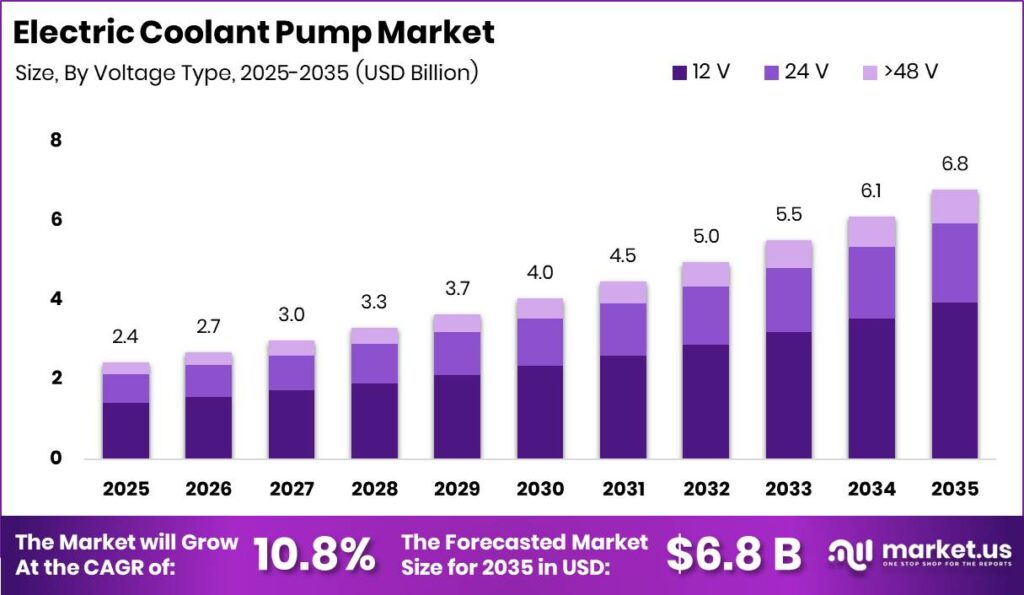
Global Electric Coolant Pump Market size is expected to be worth around USD 6.8 Billion by 2035 from USD 2.4 Billion in 2025, growing at a CAGR of 10.8% during the forecast period 2026 to 2035.
This means automakers are moving from belt driven mechanical pumps toward electrically controlled units for thermal management. An electric coolant pump uses an internal motor to circulate coolant independent of engine speed. Manufacturers place these pumps near engines, batteries, and cabin systems to control flow electronically. The market spans passenger cars, commercial vehicles, and industrial platforms that require precise temperature regulation.
Key Takeaways
- Global Electric Coolant Pump Market size is projected to reach USD 6.8 Billion by 2035, up from USD 2.4 Billion in 2025, at a CAGR of 10.8%.
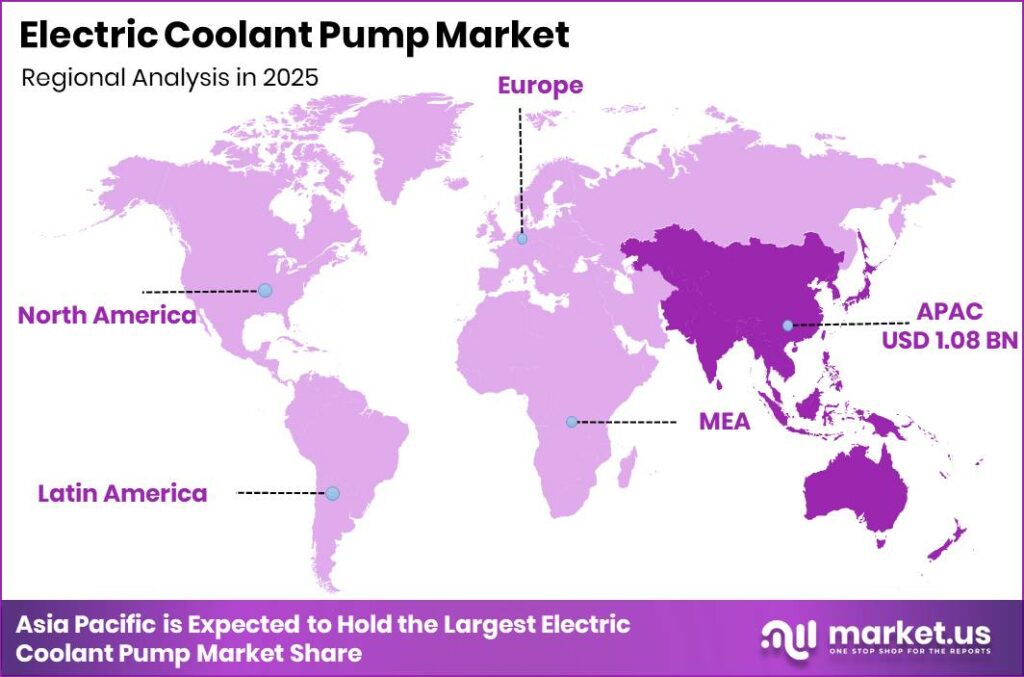
- Asia Pacific dominates the market with a 44.0% share, valued at USD 1.08 Billion in 2025.
- By Voltage Type, 12 V systems lead with a 58.0% share.
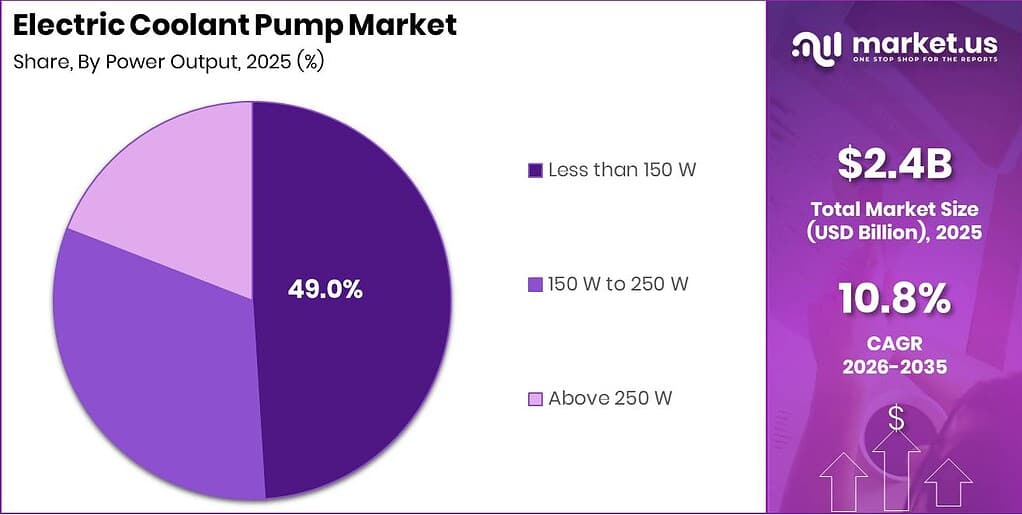
- By Power Output, pumps under 150 W hold the largest share at 49.0%.
- By Propulsion Type, ICE vehicles account for 44.0% of demand.
- By Application, engine cooling leads with a 38.0% share.
- By Sales Channel, OEM demand dominates with an 81.0% share.
Governments worldwide are tightening vehicle emissions and fuel economy rules, pushing automakers toward electrified thermal architectures. Regulatory bodies in the European Union, China, and North America require lower tailpipe emissions, which forces engineers to replace mechanical pumps with electronically controlled units. This shift ties directly to end use demand. As passenger and commercial vehicle production expands, suppliers scale pump output to match new platform requirements.
Consequently, suppliers are consolidating to meet this regulatory pressure at scale. In August 2025, CIRCOR International announced the acquisition of Swelore Engineering and Hiro Nisha Systems, expanding its industrial pump portfolio and strengthening manufacturing capacity in India through Allweiler India. This move signals broader consolidation among fluid management suppliers positioning for higher volume electric pump programs. Buyers gain a wider domestic supply base as global platforms localize production.
According to MAHLE, its integrated cooling module combines three coolant pumps with a compressor, heat exchanger, sensors, and valves. This design increases electric vehicle range by up to 20% versus resistance heater systems, cutting total cost of ownership for fleet buyers. Rheinmetall indicates its 800 V architecture delivers 2x the charging power of a 400 V system. This gives OEMs a stronger case to adopt higher voltage platforms.
Voltage Type Analysis
12 V dominates with 58.0% due to its low cost standard architecture.
In 2025, 12 V held a dominant market position in the By Voltage Type segment of Electric Coolant Pump Market, with a 58.0% share. Corporate annual filings from major tier-1 suppliers confirm 12 V remains the baseline automotive electrical standard across the majority of global light vehicle platforms. As per World Bank industrial indicators, over 80 million light vehicles are produced annually worldwide, most on 12 V architecture. This scale keeps unit costs low and secures 12 V as the default sourcing choice for volume OEM programs.
24 V systems serve buyers in heavy duty and specialty vehicle segments that need higher electrical load capacity. Regulatory filings tracked by national transport authorities in Europe show 24 V remains standard on trucks and buses under UNECE commercial vehicle wiring rules. This structural role keeps 24 V demand steady but narrow. Suppliers targeting this tier compete on durability rather than volume pricing.
Systems above 48 V serve mild hybrid and high voltage electrified platforms. ISO 21780 defines the 48 V road vehicle electrical system standard now referenced across European and Asian OEM specifications. This standardization lowers integration risk for suppliers entering the segment. As 48 V and higher hybrid architectures expand, pump makers gain a defined technical pathway to scale beyond the 12 V base.
Power Output Analysis
Less than 150 W dominates with 49.0% due to compact low load engine cooling use.
In 2025, Less than 150 W held a dominant market position in the By Power Output segment of Electric Coolant Pump Market, with a 49.0% share. This tier serves small displacement engine cooling and low load auxiliary circuits across mainstream passenger platforms. UNIDO manufacturing output data shows small electric motor production, the core input for this pump class, has expanded across Asian manufacturing hubs. Suppliers in this tier compete primarily on unit price and manufacturing throughput.
Pumps rated 150 W to 250 W handle higher thermal loads found in turbocharged engines and hybrid auxiliary circuits. Patent filings tracked across major automotive innovation databases show rising activity in mid power brushless pump design over the past several years. This growth reflects OEM demand for pumps that balance flow rate against energy draw. Suppliers investing in this tier position for turbocharged and hybrid platform contracts.
Pumps above 250 W support battery and power electronics cooling on higher voltage platforms. Corporate annual reports from tier-1 suppliers cite growing capital allocation toward high output pump lines for electrified vehicle programs. This shift signals rising unit value per pump sold. Vendors that scale above 250 W capacity capture higher margin contracts as battery cooling demand builds.
Propulsion Type Analysis
ICE Vehicles dominates with 44.0% due to large installed global vehicle base.
In 2025, ICE Vehicles held a dominant market position in the By Propulsion Type segment of Electric Coolant Pump Market, with a 44.0% share. Data from the International Organization of Motor Vehicle Manufacturers shows global vehicle production reached 92.7 million units in 2024, the majority still internal combustion platforms. This installed base keeps demand for engine cooling pumps steady. Suppliers serving this segment benefit from stable aftermarket replacement cycles even as new platform mix shifts.
Battery Electric Vehicles rely on electric coolant pumps for battery pack and power electronics thermal management rather than engine cooling. According to the IEA, electric car sales topped 17 million units worldwide in 2024, rising by more than 25% year on year. This surge pulls pump demand toward higher voltage, multi circuit designs. Suppliers positioned in BEV platforms capture rising per vehicle pump content.
Plug-in Hybrid Electric Vehicles and Hybrid Electric Vehicles require pumps that manage both combustion and electric drive heat loads. IEA figures show China’s electric car sales share crossed 50% in the second half of 2024, with plug-in hybrids contributing a growing portion of that mix. This dual demand path pushes suppliers to design pumps compatible with mixed powertrain architectures. Vendors serving both categories reduce platform specific tooling costs.
Application Analysis
Engine Cooling dominates with 38.0% due to universal combustion platform requirement.
In 2025, Engine Cooling held a dominant market position in the By Application segment of Electric Coolant Pump Market, with a 38.0% share. Every internal combustion and hybrid platform requires an engine cooling circuit, and OICA reports global vehicle sales reached 95.3 million units in 2024. This near universal requirement anchors baseline pump demand. Suppliers serving engine cooling maintain the broadest customer base across vehicle types.
HVAC and Cabin Thermal Management pumps circulate coolant for passenger comfort systems independent of engine operation. This function grows in importance on electric platforms that lack waste engine heat for cabin warming. National statistical offices tracking vehicle climate system attach rates report rising HVAC pump content per vehicle on electrified platforms. Suppliers gain incremental unit volume as electrified platform share increases.
Battery and Power Electronics Cooling, along with Turbocharger and EGR Cooling, address specialized thermal loads unique to electrified and turbocharged platforms. Regulatory filings on turbocharger adoption rates show downsizing trends have expanded turbocharged engine penetration across Europe and Asia Pacific. This trend adds a dedicated pump circuit per vehicle. Suppliers covering these two applications collectively capture the remaining share tied to platform specific thermal engineering.
Sales Channel Analysis
OEM dominates with 81.0% due to factory fitted first equipment demand.
In 2025, OEM held a dominant market position in the By Sales Channel segment of Electric Coolant Pump Market, with an 81.0% share. OICA data shows global vehicle production climbed to 96.4 million units in 2025, each requiring at least one factory fitted coolant pump. This direct tie between vehicle output and pump installation secures OEM channel dominance. Suppliers with OEM contracts gain predictable, platform linked order volume.
The Aftermarket channel serves replacement demand once vehicles leave factory warranty coverage. Corporate filings from parts distributors show replacement part cycles for electric pumps extend as vehicle fleets age past initial ownership terms. This creates a secondary, recurring revenue stream distinct from OEM contracts. Suppliers building aftermarket distribution networks capture margin from an installed base that grows every year.
Key Market Segments
By Voltage Type
- 12 V
- 24 V
- Above 48 V
By Power Output
- Less than 150 W
- 150 W to 250 W
- Above 250 W
By Propulsion Type
- ICE Vehicles
- Battery Electric Vehicles (BEVs)
- Plug-in Hybrid Electric Vehicles (PHEVs)
- Hybrid Electric Vehicles (HEVs)
By Application
- Engine Cooling
- HVAC / Cabin Thermal Management
- Battery & Power Electronics Cooling
- Turbocharger & EGR Cooling
By Sales Channel
- OEM
- Aftermarket
Regional Analysis
Asia Pacific Dominates the Electric Coolant Pump Market with a Market Share of 44.0%, Valued at USD 1.08 Billion
Asia Pacific leads the global market with a 44.0% share, valued at USD 1.08 Billion in 2025. This dominance reflects the region’s position as the largest vehicle production hub, anchored by dense OEM and tier-1 supplier clusters across China, Japan, and South Korea. Buyers sourcing from this region gain proximity to both component manufacturing and final vehicle assembly. This concentration lowers logistics cost and shortens supplier qualification timelines for new pump programs.
Therefore, other regions are positioning around faster growth rather than existing scale. North America and Europe continue expanding electric pump adoption as regulatory emissions targets tighten platform requirements. This regulatory pressure accelerates conversion from mechanical to electric pump architecture on new vehicle programs. Suppliers with regional manufacturing footprints in these markets capture share as OEMs localize sourcing to meet compliance deadlines.
Key Regions and Countries
North America
- US
- Canada
Europe
- Germany
- France
- The UK
- Spain
- Italy
- Rest of Europe
Asia Pacific
- China
- Japan
- South Korea
- India
- Australia
- Rest of APAC
Latin America
- Brazil
- Mexico
- Rest of Latin America
Middle East and Africa
- GCC
- South Africa
- Rest of MEA
Market Dynamics
Market Opportunity Analysis - Underserved voltage tiers and commercial platforms offer entry points for new suppliers.
The 24 V voltage tier remains underexploited relative to its structural role in commercial and specialty vehicles. This segment lacks the volume pricing pressure seen in 12 V programs, leaving room for suppliers to compete on durability specifications instead. This creates space for smaller manufacturers to enter through heavy duty fleet contracts. New entrants gain a foothold without competing directly against dominant 12 V incumbents.
Pumps above 250 W remain a smaller but structurally important segment tied to battery and power electronics cooling. This tier carries higher unit value per pump sold. Instead of competing on volume, suppliers here compete on thermal performance and integration expertise. Investors backing this tier position for margin growth as electrified platform share expands across all regions.
Latin America and the Middle East and Africa remain underdeveloped relative to Asia Pacific’s established production base. This gap reflects lower current vehicle electrification rates rather than lack of demand potential. As a result, suppliers establishing early distribution or assembly partnerships in these regions face less competitive density. This creates a longer runway for first mover advantage before larger incumbents expand regional footprints.
Technology and Innovation Landscape - Scalable pump architecture and high voltage integration redefine competitive edges.
TI Fluid Systems introduced its next generation eCP electric coolant pump in February 2025, built on a 12 V electrical architecture for battery electric vehicles. The pump offers a scalable power range of 60 to 230 W, letting one product family cover multiple cooling requirements. This flexibility lets suppliers standardize a single platform across several vehicle programs, cutting engineering cost per application and shortening OEM qualification timelines.
Rheinmetall’s CWA 2000 high voltage coolant pump supports operating voltage up to 850 V, confirmed in a June 2025 order covering electric trucks. A separate February 2025 order applies the pump within an 800 V fuel cell architecture across vans, trucks, and stationary power plants. This dual application shows high voltage pump platforms extending beyond passenger vehicles into commercial and stationary energy systems, widening the addressable market for suppliers with validated high voltage designs.
MAHLE’s charging cooling module, announced in February 2025, integrates pumps with heat exchangers and fans to manage charging station waste heat of up to 8 kW. The module supports commercial vehicle charging capacities up to 3.75 MW per station and passenger or light commercial charging up to 500 kW. This positions pump suppliers as critical partners in charging infrastructure, not just vehicle assembly, opening a new commercial channel beyond traditional OEM contracts.
FORVIA HELLA’s MPx electric coolant pump operates across an 8 to 16 V range with a specified working point of 3,000 liters per hour, equal to 50 liters per minute. FORVIA HELLA specifies an operating lifetime beyond 30,000 hours depending on duty profile. This durability figure gives OEMs a concrete basis for warranty planning, and suppliers citing verified lifetime data gain an edge in long term fleet and commercial vehicle contracts.
Drivers
Vehicle electrification stands out as the strongest force behind this market. Battery electric and plug-in hybrid registrations already account for roughly 18% of new global light vehicle sales, and each electrified platform needs an estimated 2 to 4 separate electric coolant pumps for the battery pack, power electronics, and cabin circuits, compared with one mechanical pump on a conventional engine. This shift moves OEM sourcing from single supplier mechanical contracts toward multi unit electronic packages.
As a result, tier-1 suppliers including Hanon Systems and Rheinmetall report strong order backlog growth tied to electrified platforms. Electric pumps also command an estimated 25% to 40% price premium over their mechanical predecessors. This margin accretive shift accelerates ahead of Euro 7 and CARB compliance deadlines, giving early moving suppliers a revenue mix advantage over competitors still weighted toward legacy mechanical pump lines.
| Driver | (~) % Impact on CAGR Forecast | Geographic Relevance | Impact Timeline |
|---|---|---|---|
| EV/HEV powertrain electrification driving multi-pump battery and power-electronics cooling | +2.8% | Global | Short term (2 years or less) |
| Tightening CO2 and fuel-economy regulatory mandates | +2.1% | European Union, China, North America | Short term (2 years or less) |
| Structural shift from mechanical to electronically-controlled pump architecture | +1.6% | Global | Medium term (2 to 4 years) |
| Migration to 48V and 800V vehicle electrical architectures | +1.3% | Global | Medium term (2 to 4 years) |
| Rising turbocharged and downsized engine penetration | +1.0% | Asia-Pacific, Europe | Short term (2 years or less) |
| OEM integration of smart, variable-speed flow-control electronics | +0.8% | North America, Europe | Medium term (2 to 4 years) |
Restraints
Cost remains the biggest obstacle to faster adoption. Brushless electric coolant pumps require rare earth magnet rotors and dedicated control electronics, pushing bill of materials cost 30% to 45% above a conventional belt driven equivalent. Magnet input costs climbed over the past 2 years as China tightened export licensing on rare earth materials. This cost pressure hits suppliers in price sensitive markets hardest.
Consequently, OEM platform teams in these markets are delaying electronic pump adoption on entry level and mild hybrid trims by an estimated 12 to 18 months. This delay freezes near term unit conversion in cost sensitive segments. Suppliers face compressed gross margins on cost down program commitments while waiting for input costs to stabilize before scaling further.
| Restraint | (~) % Impact on CAGR Forecast | Geographic Relevance | Impact Timeline |
|---|---|---|---|
| High bill-of-materials cost of brushless, sensorless pump systems | -1.8% | India, Southeast Asia, Latin America | Short term (2 years or less) |
| Rare-earth magnet supply concentration and export-licensing controls | -1.3% | Global, concentrated in China | Short term (2 years or less) |
| Semiconductor and control-chip supply shortages | -1.2% | Global | Short term (2 years or less) |
| Recall and warranty liability from early-generation pump failures | -1.1% | Global | Short term (2 years or less) |
| Elevated interest rates constraining OEM platform CapEx financing | -0.9% | North America, Europe | Short term (2 years or less) |
Challenges
Talent scarcity slows program execution. Brushless coolant pump programs need engineers skilled in sensorless motor control, power electronics, and embedded thermal software, a combination the supplier base struggles to staff. Over 40% of tier-1 suppliers report unfilled requisitions for combined motor control and thermal systems engineers. This gap extends validation and ISO 26262 safety qualification cycles by 4 to 6 months per platform.
Instead of waiting out the shortage, suppliers are expanding university partnerships and shifting embedded validation work to engineering hubs in India and Eastern Europe. Several suppliers now direct an estimated 6% to 9% of segment revenue toward research and development. This spending builds internal motor control competency rather than leaving suppliers dependent on third party semiconductor reference designs.
| Challenge | (~) % CAGR Friction Drag | Geographic Relevance | Mitigation Horizon |
|---|---|---|---|
| Motor-control engineering talent shortage | -1.0% | Global | Medium term (2 to 4 years) |
| Legacy architecture integration complexity | -0.9% | Global | Medium term (2 to 4 years) |
| Functional-safety qualification cycle extension | -0.7% | Global | Medium term (2 to 4 years) |
| Aftermarket technician retraining burden | -0.6% | Global | Medium term (2 to 4 years) |
| Communication-protocol standardization fragmentation | -0.5% | Europe, North America | Long term (4 years or more) |
Opportunities
Commercial vehicle electrification remains largely untapped. Current electric pump programs concentrate on passenger battery electric and hybrid platforms, while medium and heavy duty commercial EVs still rely on legacy mechanical or lower specification pumps. Commercial vehicle electrification lags passenger fleet adoption by several years, leaving e-axle and multi motor architectures without dedicated pump designs built for their continuous duty thermal loads.
This means capturing this space requires new qualification programs rather than extending existing supply contracts. Suppliers that build commercial grade pumps can charge an estimated 20% to 30% price premium given higher flow rate and durability specifications. This premium, combined with R&D amortized across a broader platform base, gives early movers a path to growth above the 10.8% baseline CAGR.
| Opportunity | (~) % Potential CAGR Upside | Geographic Relevance | Execution Window |
|---|---|---|---|
| Commercial EV and e-axle thermal-management expansion | +1.7% | Asia-Pacific, Global | Medium term (2 to 4 years) |
| Aftermarket replacement demand from aging first-generation EV fleets | +1.4% | Global | Medium term (2 to 4 years) |
| Magnet-free localized manufacturing bypassing rare-earth exposure | +1.2% | India, Southeast Asia | Long term (4 years or more) |
| AI-based predictive thermal management and software monetization | +1.1% | North America, Europe | Long term (4 years or more) |
| Stationary and industrial battery storage adjacent thermal-management TAM | +1.0% | Global | Long term (4 years or more) |
| M&A roll-up of fragmented regional pump manufacturers | +0.9% | Global | Medium term (2 to 4 years) |
Key Company Insights
Robert Bosch GmbH operates as a diversified global engineering group with thermal and powertrain systems spanning combustion, hybrid, and electric platforms. This breadth lets Bosch bundle coolant pump programs with adjacent electronics and sensor contracts. However, this scale also means coolant pumps compete internally for capital against larger mobility divisions, creating execution risk if resources shift toward other business lines.
Continental AG supplies powertrain and mobility systems across a wide OEM customer base spanning Europe, Asia, and North America. This global footprint gives Continental proximity to major vehicle assembly hubs and shorter qualification cycles with existing customers. Instead of competing purely on price, Continental leans on integrated systems engineering, though this positioning leaves smaller, pump focused rivals room to compete on speed and cost.
Key Players
- Robert Bosch GmbH
- Continental AG
- DENSO Corporation
- Aisin Corporation
- MAHLE GmbH
- Rheinmetall AG (Pierburg GmbH)
- Hanon Systems
- Valeo SA
- Schaeffler AG
- Johnson Electric Holdings Ltd.
- Gates Corporation
- HELLA GmbH & Co. KGaA
- Concentric AB
- GMB Corporation
- Bühler Motor GmbH
Recent Developments
- September 2025: CIRCOR International completed the acquisition of Swelore Engineering and Hiro Nisha Systems, adding advanced metering and reciprocating pump technologies to its portfolio and supporting broader thermal and fluid management applications.
Geopolitical Impact Analysis
Trade tensions are reshaping component sourcing for electric coolant pump makers. According to the WTO, global merchandise trade growth has slowed as tariff actions between major economies raise input costs across automotive supply chains. Rare earth magnet exports from China, a core input for brushless pump rotors, remain subject to licensing controls that the IEA links to price volatility exceeding 10% within single quarters. This raises landed cost for suppliers without regional magnet sourcing.
Consequently, logistics disruption compounds this pressure. As reported by the World Shipping Council, container freight rates on major trade lanes have shown swings of more than 20% tied to rerouting around conflict zones and canal restrictions. This means pump makers face longer, less predictable lead times for semiconductor control chips and magnet materials. Suppliers building regional manufacturing hubs closer to end markets reduce exposure to these shipping and tariff swings.
Report Scope
| Report Features | Description |
|---|---|
| Market Value (2025) | USD 2.4 Billion |
| Forecast Revenue (2035) | USD 6.8 Billion |
| CAGR (2026-2035) | 10.8% |
| Base Year for Estimation | 2025 |
| Historic Period | 2020-2024 |
| Forecast Period | 2026-2035 |
| Report Coverage | Revenue Forecast, Market Dynamics, Market Opportunity Analysis, Technology and Innovation Landscape, Competitive Landscape, Recent Developments |
| Segments Covered | By Voltage Type (12 V, 24 V, Above 48 V), By Power Output (Less than 150 W, 150 W to 250 W, Above 250 W), By Propulsion Type (ICE Vehicles, Battery Electric Vehicles, Plug-in Hybrid Electric Vehicles, Hybrid Electric Vehicles), By Application (Engine Cooling, HVAC/Cabin Thermal Management, Battery & Power Electronics Cooling, Turbocharger & EGR Cooling), By Sales Channel (OEM, Aftermarket) |
| Regional Analysis | North America (US and Canada), Europe (Germany, France, The UK, Spain, Italy, and Rest of Europe), Asia Pacific (China, Japan, South Korea, India, Australia, and Rest of APAC), Latin America (Brazil, Mexico, and Rest of Latin America), Middle East and Africa (GCC, South Africa, and Rest of MEA) |
| Competitive Landscape | Robert Bosch GmbH, Continental AG, DENSO Corporation, Aisin Corporation, MAHLE GmbH, Rheinmetall AG (Pierburg GmbH), Hanon Systems, Valeo SA, Schaeffler AG, Johnson Electric Holdings Ltd., Gates Corporation, HELLA GmbH & Co. KGaA, Concentric AB, GMB Corporation, Bühler Motor GmbH |
| Customization Scope | Customization for segments, region / country-level will be provided. Additional customization can be done based on requirements. |
| Purchase Options | We have three licenses to opt for: Single User License | Multi-User License (Up to 5 Users) | Corporate Use License (Unlimited User and Printable PDF) |





































