


Report Overview
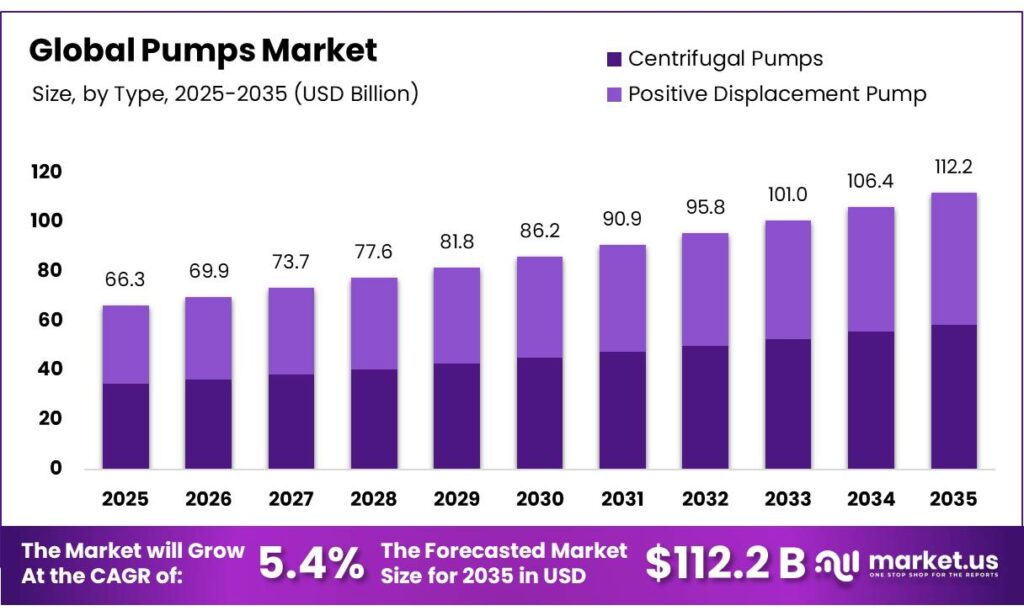
The Global Pumps Market is projected to grow from USD 66.3 Billion in 2025 to USD 112.2 Billion by 2035, at a steady CAGR of 5.4% over the forecast period. This expansion is not incidental; it is structurally driven by rising pressure on global water systems, accelerating industrial output, and massive public investment in infrastructure.
According to the UN Food and Agriculture Organization (FAO)’s 2025 AQUASTAT Water Data Snapshot, global freshwater withdrawals have been increasing across multiple regions, while renewable water availability per person has declined by 7% over the past decade. This growing scarcity gap is forcing governments and industries worldwide to invest heavily in water management systems, fluid handling infrastructure, and treatment facilities, all of which depend directly on pumps as a core operating component.
Adding to this pressure, the United Nations World Water Development Report 2026 confirms that 2.1 billion people still lack access to safely managed drinking water, signaling decades of sustained infrastructure build-out ahead. Pumps are the foundational equipment in every water supply, irrigation, and wastewater treatment system, making their demand growth a near-certain outcome of these macro-level water challenges.
According to the Asian Development Bank (ADB), Asia and the Pacific require investments of USD 1.7 trillion per year through 2030 to meet its infrastructure needs, with urban water supply, wastewater management, and drainage as priority focus areas. In India alone, the ADB has committed a USD 10 billion five-year urban infrastructure plan, targeting water, sanitation, and city-level services.
On the financing side, the World Bank’s 2024 Water Security Financing Report shows that Multilateral Development Banks (MDBs) collectively approved USD 19.6 billion in water-related financing in 2024, with USD 14.4 billion directed specifically to low- and middle-income countries, the majority of which are in Asia.
The World Bank reports that developing countries currently spend USD 164.6 billion annually on water but need to nearly triple spending on water supply and sanitation to meet global targets. Every new water treatment plant, irrigation network, desalination unit, or industrial processing facility built under this wave of investment requires pumps for fluid movement, directly translating infrastructure expenditure into pump market demand.
Key Takeaways
- The global pumps market was valued at USD 66.3 billion in 2025.
- The global pumps market is projected to grow at a CAGR of 5.4% and is estimated to reach USD 112.2 billion by 2035.
- On the basis of type, centrifugal pumps dominated the market, constituting 52.3% of the total market share.
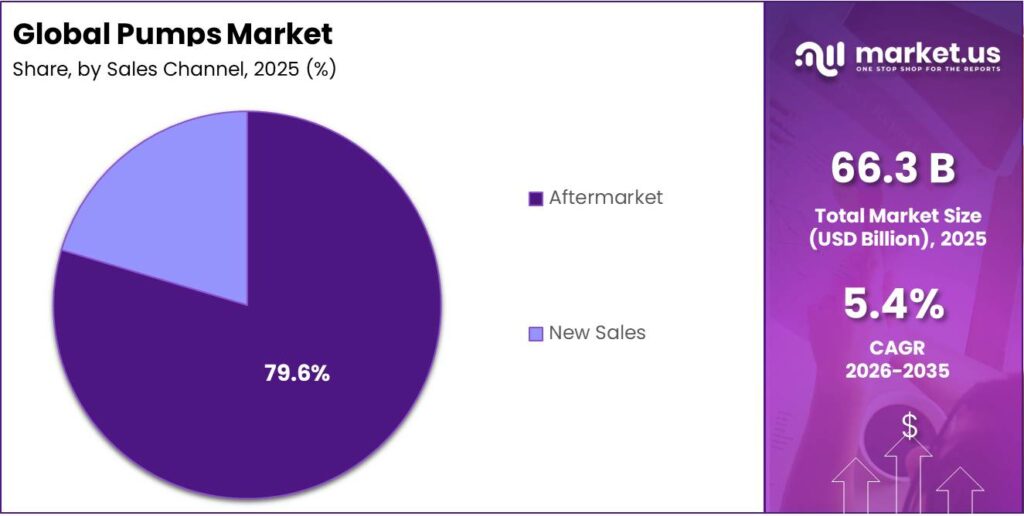
- Based on the sales channel, aftermarket sales led the pumps market, comprising 79.6% of the total market.
- Among the end-uses of the pumps, the industrial sector is the most considerable end-use of the product, accounting for around 82.9% of the revenue.
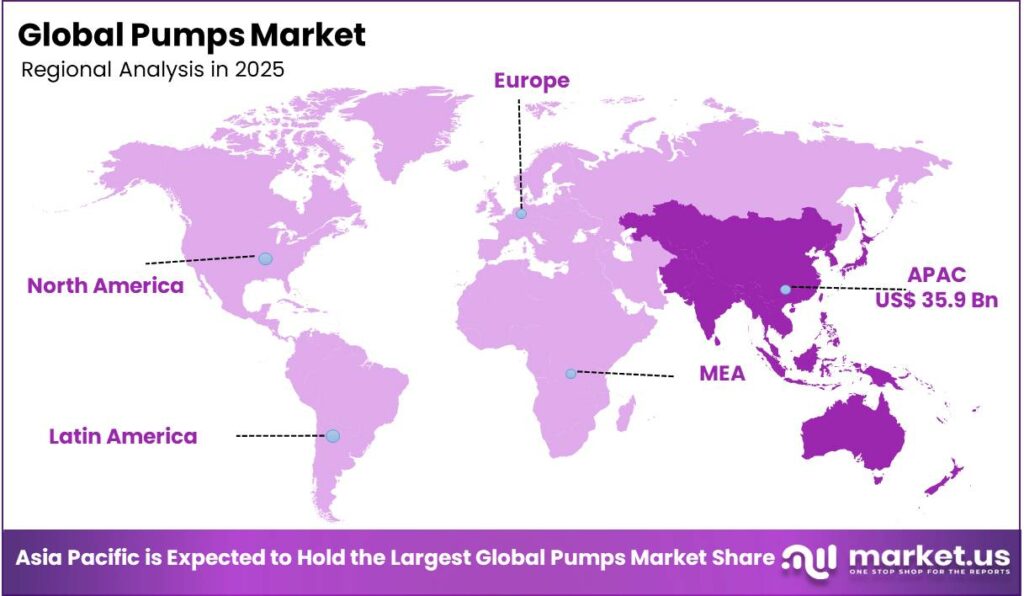
- In 2025, the Asia Pacific was the most dominant region in the pumps market, accounting for 54.1% of the total global consumption.
Type Analysis
Centrifugal Pumps are a Prominent Segment in the Market.
The market is segmented based on the type of pumps into centrifugal and positive displacement pumps. The centrifugal pumps led the market, comprising 52.3% of the market share, primarily due to their simplicity, versatility, and efficiency in handling large volumes of liquids.
They operate by converting rotational energy from a motor into kinetic energy, which is ideal for low-viscosity fluids such as water, chemicals, and oil. Their design is less complex, making them easier and cheaper to maintain and operate compared to positive displacement pumps.
Additionally, centrifugal pumps can handle a wide range of flow rates and pressures, making them suitable for diverse applications, from water supply systems to industrial processes. In addition, their ability to operate with variable flow conditions and low pulsation makes them more efficient in large-scale systems, contributing to their widespread adoption.
Sales Channel Analysis
Aftermarket Sales Dominated the Pumps Market.
On the basis of sales channels, the pumps market is segmented into aftermarket and new sales. The aftermarket sales dominated the pumps market, comprising 79.6% of the market share, due to the critical role they play in maintenance and replacement within existing infrastructure.
Many industrial systems, water treatment plants, and irrigation systems have long lifecycles, requiring pumps to be replaced or repaired as they wear out over time. Additionally, pumps in established systems often need to be upgraded or replaced to meet new regulatory standards, improve energy efficiency, or adapt to changing operational needs.
The aftermarket further sees a demand for customized solutions, such as pump modifications or specialized parts, to ensure compatibility with specific applications. Moreover, industries prefer to buy pumps as replacements when the need arises, rather than investing in entirely new systems, thus driving sustained aftermarket demand.
End-Uses Analysis
Pumps Are Mostly Utilized in Industrial Sectors.
Among the end-uses of the pumps, 82.9% of the total global consumption of pumps is in the industrial sector, outperforming agriculture and residential & commercial sectors, due to the high demand for fluid handling in complex and large-scale processes.
Industries such as manufacturing, chemicals, oil and gas, and power generation require pumps to move fluids for critical operations such as cooling, heating, chemical processing, and wastewater management. These sectors need pumps capable of handling large volumes, high pressures, and various fluid types, which makes industrial applications the primary focus.
Additionally, the industrial sector often operates under more rigorous standards, driving the adoption of specialized pumps for efficiency, durability, and compliance. While agriculture and residential sectors do require pumps, their usage is generally less complex and demands lower capacities compared to industrial processes, thus making the industrial sector the dominant consumer.
Key Market Segments:
By Type
- Centrifugal Pumps
- Overhung Impeller
- Between Bearing
- Vertically Suspended
- Positive Displacement Pump
- Rotary Pump
- Vane
- Gear
- Lobe
- Others
- Reciprocating Pump
- Piston
- Diaphragm
- Rotary Pump
By Sales Channel
- Aftermarket
- New Sales
By End-Use
- Industrial
- Oil & Gas
- Water & Wastewater
- Mining
- Chemical and Petrochemical
- Food and Beverage
- Power Generation
- Pharmaceuticals
- Others
- Agriculture
- Residential & Commercial
Market Dynamics
Challenge
The pump industry faces a growing shortage of skilled engineering and technical talent as retirements outpace the supply of new workers. By 2033, the manufacturing sector is expected to require 3
Industry surveys show 56 percent of industrial companies identify labor and skills shortages as their biggest workforce challenge, while field engineering roles face annual replacement gaps of 40 to 50 percent of retiring skilled workers. As a result, industrial pump mean time to repair has increased by 15 to 25 percent, and commissioning timelines for major pump installations have lengthened by 8 to 14 weeks compared with pre 2020 levels.
These workforce shortages increase maintenance costs, delay infrastructure projects, and reduce operational efficiency, with project delays costing USD 15,000 to 80,000 per day in sectors such as oil and gas, water treatment, and chemicals. The industry is increasingly relying on digital maintenance tools, apprenticeship programs, and predictive maintenance technologies to help offset the shortage of experienced technicians.
| Challenge | (~) % CAGR Friction Drag | Geographic Relevance | Mitigation Horizon |
|---|---|---|---|
| Metallurgical Input Cost Volatility | -1.2% | Global; highest in APAC export corridors, North America fabrication hubs | Medium term (2–4 years) |
| Skilled Workforce & Engineering Talent Deficit | -0.9% | EU industrial belts, North America, APAC manufacturing clusters | Long term (≥ 4 years) |
| Geopolitical Trade Fragmentation & Tariff Restructuring | -0.8% | North America import nodes, EU regulatory hubs, China-exposed OEM supply chains | Medium term (2–4 years) |
| Smart Pump Digitalization & Legacy Integration Gap | -0.7% | APAC legacy industrial estates, Middle East, Latin America utility sectors | Long term (≥ 4 years) |
| Escalating Energy Efficiency & Ecodesign Compliance | -0.6% | EU ecodesign regulatory hubs, North America DOE compliance zones | Medium term (2–4 years) |
| APAC Multimodal Logistics Congestion & Freight Volatility | -0.5% | APAC logistics corridors; Asia–Europe sea lanes; India inland freight nodes | Short term (≤ 2 years) |
Opportunity
The pumps industry remains highly fragmented beyond the largest OEMs, with thousands of regional manufacturers specializing in engineered-to-order applications such as chemical dosing, bioprocessing, and high-rise booster pumps. This fragmentation creates a strong opportunity to consolidate niche players, particularly as price competition from standardized pump manufacturers continues to pressure margins.
Acquiring 6 to 10 specialized manufacturers across India, Southeast Asia, and the Middle East could generate procurement and operational synergies while expanding product portfolios across multiple industrial applications. Such consolidation has the potential to improve EBITDA margins by 400 to 700 basis points, allowing companies to offer integrated pump systems with greater pricing power and stronger aftermarket relationships.
With global M&A activity expected to reach about USD 4 trillion in 2026, and no single pump manufacturer controlling more than 8 to 10 percent of the addressable market, the industry remains well suited for platform-based consolidation. Over a 4 to 7-year period, this strategy could transform a mid-sized manufacturer into a leading global engineered-to-order pump supplier through scale, diversification, and recurring service revenue.
| Opportunity | (~) % Potential CAGR Upside | Geographic Relevance | Execution Window |
|---|---|---|---|
| Pump-as-a-Service (PaaS) Monetization Model | +1.8% | North America, EU, Japan | Short term (≤ 2 years) |
| Green Hydrogen Infrastructure Pump Vertical | +2.2% | EU, APAC, Middle East | Medium term (2–4 years) |
| Hyper-Scale Data Center Liquid Cooling Pumps | +1.5% | North America, APAC | Short term (≤ 2 years) |
| Solar Pump + Secondary-Use Platform in Agri-Emerging Markets | +2.0% | India, Sub-Saharan Africa | Medium term (2–4 years) |
| Aftermarket MRO Digital Services Roll-Out | +1.4% | Global (North America core) | Short term (≤ 2 years) |
| Fragmented Market M&A Roll-Up to Capture Engineered-to-Order Niche TAM | +1.6% | South & Southeast Asia, MENA | Long term (≥ 4 years) |
Driver
Mandatory energy efficiency regulations are accelerating replacement demand for pumps by requiring older, inefficient models to be upgraded across major markets. In the EU, Regulation (EU) 547
In India, the Perform, Achieve and Trade (PAT) scheme sets energy reduction targets for major pump-intensive industries such as cement, steel, fertilizers, and aluminium, while allowing high-performing facilities to earn tradable Energy Saving Certificates (ESCerts). The government also provides up to 80 percent accelerated depreciation in the first year for certified energy-efficient pumps, improving investment returns and encouraging faster equipment replacement.
Since pumping systems account for about 20 to 25 percent of industrial motor-driven electricity consumption, upgrading from MEI 0
| Driver | (~) % Impact on CAGR Forecast | Geographic Relevance | Impact Timeline |
|---|---|---|---|
| Water & Wastewater Infrastructure Expansion — accelerating municipal and industrial investments driven by water stress mandates | +1.4% | APAC (India, China), MENA, South America spill-over | Short–Medium term (1–4 years) |
| Industrial Digitalization & IoT-Enabled Smart Pumps — predictive maintenance, digital twins, and Industry 4.0 integration shifting pump OEM revenue models | +1.1% | North America core, EU, APAC corridors (China, Japan, South Korea) | Medium term (2–4 years) |
| Energy Efficiency Mandates & Regulatory Compliance — EU Ecodesign MEI ≥ 0.40 rules, India BEE/PAT scheme, and global MEPS driving mandatory product replacement | +0.8% | EU core, North America, India, China | Short term (≤ 2 years) |
| Agricultural Irrigation Modernization & Solar Pump Adoption — PM-KUSUM India, APAC groundwater extraction growth, and solar-to-diesel pump substitution | +0.7% | India, China, Southeast Asia, Sub-Saharan Africa | Short–Medium term (1–3 years) |
| Oil, Gas & Chemical Processing Capex — sustained upstream hydrocarbon spending across GCC, Permian, and deepwater; chemical processing expansion in Asia | +0.6% | GCC/Middle East core, North America (Permian), APAC chemical corridors | Medium term (2–4 years) |
| Pumped Hydro Storage & Clean Energy Integration — rapid deployment of reversible pump-turbines as grid balancing assets in renewable-heavy power systems | +0.5% | APAC (India, China), EU, South America | Long term (≥ 4 years) |
Restraint
The US tariff regime introduced under the Trump 2.0 administration has significantly increased costs across pump supply chains by raising duties on metal-intensive goods. During January to April 2025, the average effective US tariff rate reached about 27 percent, while Section 232 tariffs on steel and aluminum increased from 25 percent to 50 percent in June 2025. A 50 percent tariff on copper imports also took effect on August 1, 2025, with many metal-intensive industrial products subject to tariffs of 15 to 25 percent.
Because pumps rely heavily on steel, aluminum, and copper for housings, impellers, shafts, and motor windings, imported components from several manufacturing regions experienced landed cost increases of 15 to 50 percent. These higher costs have raised equipment prices, slowed procurement, and extended project approval timelines, particularly for industrial, oil and gas, chemical, and water infrastructure applications.
For US buyers, the tariffs have resulted in project cost increases of approximately USD 50,000 to 250,000 for mid-sized industrial installations, while procurement lead times for specialty pumps have stretched to 26 to 40 weeks. The resulting shift toward nearshoring, dual sourcing, and domestic manufacturing requires substantial capital investment, creating a continued drag on pump market growth over the medium term.
| Restraint | (~) % Impact on CAGR Forecast | Geographic Relevance | Impact Timeline |
|---|---|---|---|
| Raw Material Cost Inflation (Steel, Copper, Aluminum) | -1.4% | North America core, EU, APAC corridors, India | Short term (≤ 2 years) |
| US Section 232 / Reciprocal Tariff Regime on Metal-Intensive Goods | -1.2% | North America core; APAC export corridors; India, China | Short–Medium term (1–4 years) |
| Escalating Motor Efficiency Compliance Mandates (IE3/IE4/DOE 2027) | -0.9% | EU, North America, India (BIS IS 12615), China | Medium term (2–4 years) |
| Skilled Manufacturing Labor Shortage & Workforce Attrition | -0.8% | North America core, EU industrials, APAC (selective) | Medium–Long term (3–6 years) |
| Low-Cost Commodity Competition & Margin Compression | -0.5% | Global; highest pressure in APAC, Middle East, Latin America | Medium term (2–4 years) |
| Underfunded Water Infrastructure CapEx in Emerging Markets | -0.3% | Sub-Saharan Africa, South Asia, Latin America | Long term (≥ 4 years) |
Geopolitical Impact Analysis
Geopolitical Tensions Have Led to Severe Disruptions of the Supply Chains of Pumps.
The geopolitical tensions, including trade disputes and regional conflicts, are influencing the global pumps market, primarily through disruptions in supply chains, increased raw material costs, and altered trade flows. For instance, the ongoing trade tensions between the United States and China have led to tariffs on pump components, impacting manufacturers’ costs and delivery timelines.
The U.S. has imposed tariffs on Chinese-made goods, including certain pump components, which has resulted in a shift in procurement strategies and a reassessment of manufacturing footprints. In Europe, the European Commission has raised concerns about the impact of the Russia-Ukraine conflict on energy supplies, which affects industries reliant on pumps for fluid transport and processing. The disruptions in energy imports, particularly natural gas, have led to reduced industrial output in some regions, impacting pump demand.
Furthermore, in the Middle East, geopolitical instability has affected infrastructure development projects, such as desalination plants and water management systems. Conflicts in regions such as Yemen and Syria have slowed construction, limiting growth in pump demand within those sectors. These geopolitical factors contribute to uncertainty in the market, prompting companies to diversify sourcing and adapt to changing global conditions.
Regional Analysis
Asia Pacific Held the Largest Share of the Global Pumps Market.
In 2025, the Asia Pacific dominated the global pumps market, holding about 54.1% of the total global consumption, driven by rapid industrialization, urbanization, and infrastructure development. According to UN-Habitat, APAC’s urban population is projected to increase to over a billion people by 2030, highlighting the demand for water, wastewater, and irrigation systems, all of which heavily rely on pumps.
In countries such as India and China, government initiatives such as the Smart Cities Mission in India and the 13th Five-Year Plan in China focus on improving water management and wastewater treatment infrastructure, directly driving pump demand.
The region’s growing industrial base further intensifies the need for pumps. Sectors such as chemical manufacturing, power generation, and mining in APAC increasingly rely on pumps for fluid handling and circulation. Additionally, there is increased use of pumps for flood prevention and water supply systems in Japan due to the region’s vulnerability to natural disasters. This expansion in both industrial and infrastructural applications reinforces APAC’s position as the largest market for pumps.
Key Regions and Countries
- North America
- The US
- Canada
- Europe
- Germany
- France
- The UK
- Spain
- Italy
- Russia & CIS
- Rest of Europe
- APAC
- China
- Japan
- South Korea
- India
- ASEAN
- Rest of APAC
- Latin America
- Brazil
- Mexico
- Rest of Latin America
- Middle East & Africa
- GCC
- South Africa
- Rest of MEA
Key Players Analysis
Manufacturers of pumps focus on product innovation, especially in developing energy-efficient and high-performance pumps to meet evolving industry standards, such as those outlined in environmental regulations. Companies invest in R&D to create smarter, IoT-enabled pumps with remote monitoring capabilities for predictive maintenance and operational optimization.
Another strategy is expanding after-sales services, including installation, maintenance, and technical support, to ensure long-term customer relationships and enhance brand loyalty. Furthermore, manufacturers focus on regional diversification, establishing localized production facilities or partnerships in emerging markets, such as the Asia-Pacific, to capitalize on the growing infrastructure and industrial demand.
The Major Players in The Industry
- Grundfos Holding A/S
- Xylem
- KSB
- Ebara Corporation
- Flowserve Corporation
- Sulzer Ltd.
- SLB
- Dover Corporation
- Weatherford International plc
- Wilo SE
- Baker Hughes
- Alfa Laval
- ITT Inc.
- Pentair plc
- Danfoss
- Other Key Players
Key Developments
- In May 2025, Grundfos, a global leader in advanced water technology and pump solutions, revealed the expansion of its facilities in Brookshire, Texas, representing a substantial enlargement of the existing facility.
- In December 2025, Ebara Corporation announced the launch of its dry vacuum pump, MODEL EV-H, and plasma abatement system, MODEL ELF, which were set to commence mass production at the beginning of 2026.
Report Scope
| Report Features | Description |
|---|---|
| Market Value (2025) | USD 66.3 Billion |
| Forecast Revenue (2035) | USD 112.2 Billion |
| CAGR (2026-2035) | 5.4% |
| Base Year for Estimation | 2025 |
| Historic Period | 2020-2024 |
| Forecast Period | 2026-2035 |
| Report Coverage | Revenue Forecast, Market Dynamics, Competitive Landscape, Recent Developments |
| Segments Covered | By Type (Centrifugal Pumps and Positive Displacement Pumps), By Sales Channel (Aftermarket and New Sales), By End-Use (Industrial, Agriculture, and Residential & Commercial) |
| Regional Analysis | North America – The US & Canada; Europe – Germany, France, The UK, Spain, Italy, Russia & CIS, Rest of Europe; APAC- China, Japan, South Korea, India, ASEAN & Rest of APAC; Latin America- Brazil, Mexico & Rest of Latin America; Middle East & Africa- GCC, South Africa, & Rest of MEA |
| Competitive Landscape | Grundfos Holding A/S, Xylem, KSB, Ebara Corporation, Flowserve Corporation, Sulzer Ltd., SLB, Dover Corporation, Weatherford International plc, Wilo SE, Baker Hughes, Alfa Laval, ITT Inc., Pentair plc, Danfoss, and Other Players. |
| Customization Scope | Customization for segments and region/country-level will be provided. Moreover, additional customization can be done based on the requirements. |
| Purchase Options | We have three licenses to opt for: Single User License, Multi-User License (Up to 5 Users), Corporate Use License (Unlimited Users and Printable PDF) |





































