


Report Overview
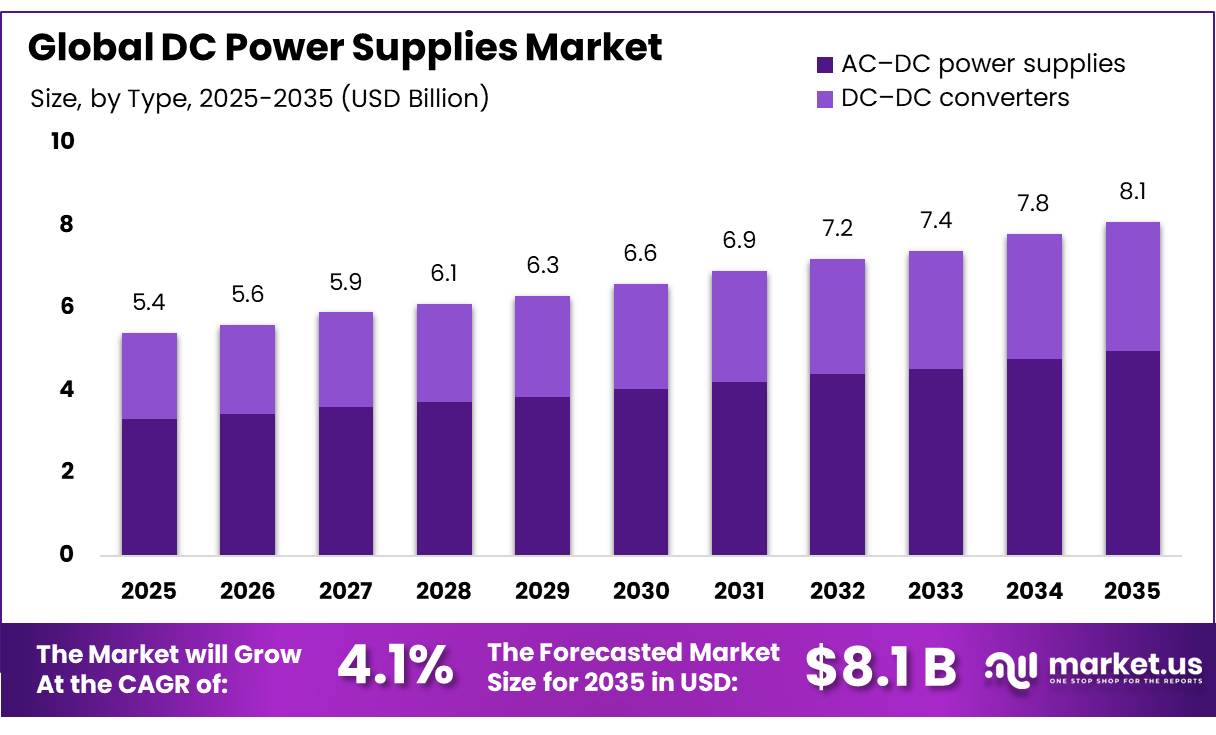
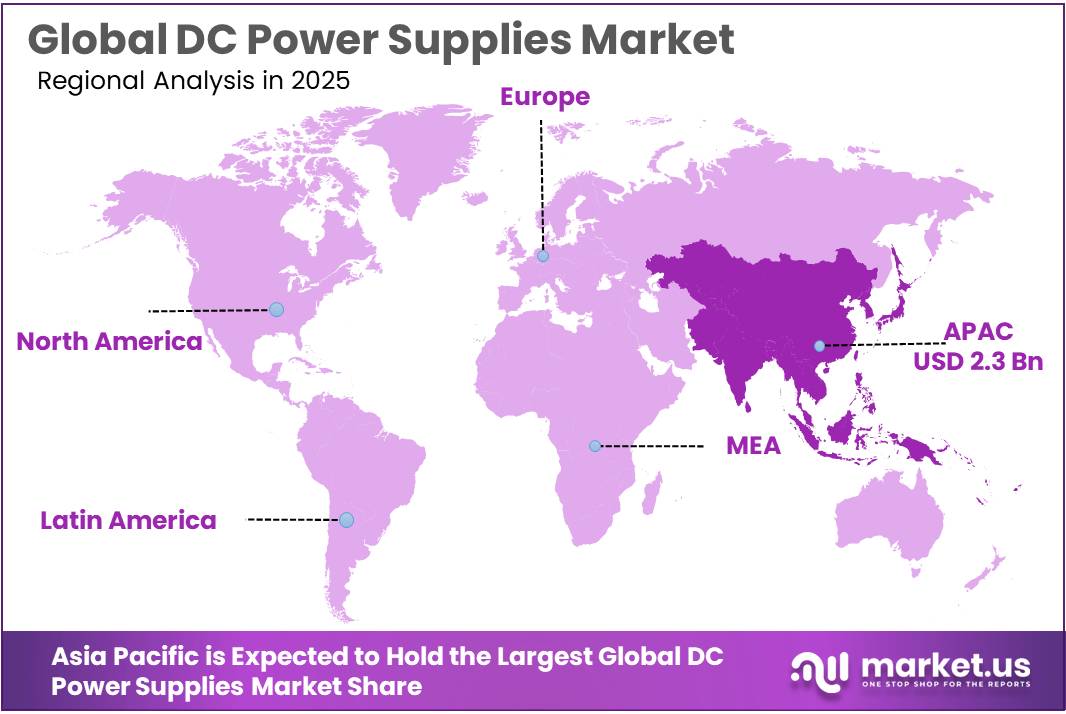
The Global DC Power Supplies Market size is expected to be worth around USD 8.1 Billion by 2035, from USD 5.4 Billion in 2025, growing at a CAGR of 4.1% during the forecast period from 2026 to 2035. In 2025, Asia Pacific held a dominant market position, capturing more than a 42.65% share, holding USD 2.3 Billion revenue.
DC power supplies form a critical part of modern electronic and industrial infrastructure, converting incoming electrical power into stable direct current for semiconductors, telecommunications equipment, industrial automation, laboratories, medical electronics, electric vehicles, and data centers. The industry is moving toward programmable, modular, high-density, and digitally controlled power systems as equipment manufacturers require tighter voltage regulation, lower electrical noise, better efficiency, and continuous monitoring.
- According to the Semiconductor Industry Association, global semiconductor sales reached USD 791.7 billion in 2025, increasing 25.6% from the previous year. Logic semiconductor sales reached USD 301.9 billion, while memory products generated USD 223.1 billion. Semiconductor fabrication, burn-in testing, component validation, wafer inspection, and automated test equipment require accurate and highly stable DC power sources, creating a large application base for programmable power-supply manufacturers.
Data-center and artificial-intelligence infrastructure is becoming another major demand driver. The International Energy Agency estimates that global data-center electricity consumption stood at approximately 485 TWh in 2025 and could increase to around 950 TWh by 2030. Data centers could represent nearly 3% of worldwide electricity demand by that stage, while electricity consumption from AI-focused facilities is expected to triple between 2025 and 2030.
Telecommunication investment also provides a strong industrial base. The International Telecommunication Union reported that 5G networks covered 55% of the global population in 2025. Around 3 billion 5G subscriptions represented approximately one-third of global mobile broadband subscriptions. Continued deployment of base stations, network equipment, edge-computing systems, and telecom backup infrastructure supports the use of reliable DC power supplies designed for continuous operation and changing electrical loads.
Government-backed semiconductor investment is further strengthening the supply chain. The U.S. Department of Commerce reported that the CHIPS Program Office was investing USD 39 billion in semiconductor manufacturing incentives. By January 2025, approximately USD 34 billion had been awarded, while planned U.S. electronics-manufacturing investment was approaching USD 450 billion. New semiconductor fabrication and advanced-packaging facilities create additional opportunities for precision DC sources, power analyzers, and electronic test systems.
Key Takeaways
- DC Power Supplies Market size is expected to be worth around USD 8.1 Billion by 2035, from USD 5.4 Billion in 2025, growing at a CAGR of 4.1%.
- AC–DC power supplies held a dominant market position, capturing more than a 61.00% share.
- Switching power supplies held a dominant market position, capturing more than a 74.00% share of the DC Power Supplies Market.
- Multiple-output held a dominant market position, capturing more than a 55.20% share.
- Low Output (Up to 10 kW / Under 100W–1kW) held a dominant market position, capturing more than a 42.00% share.
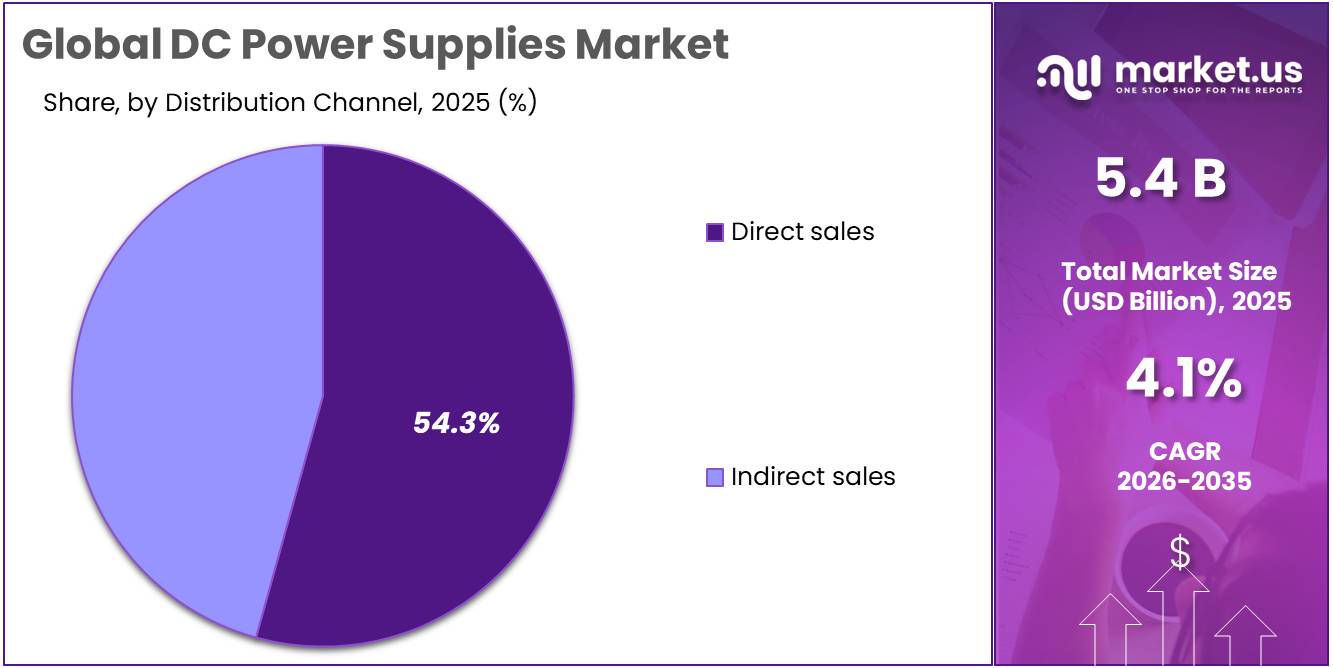
- Direct sales held a dominant market position, capturing more than a 54.00% share.
- Asia Pacific held a dominant market position, capturing more than a 42.65% share and reaching approximately USD 2.30 billion.
By Type Analysis
AC–DC power supplies dominate with more than a 61.00% share, supported by widespread use across electronic, industrial, telecom, and computing systems.
In 2025, “AC–DC power supplies” held a dominant market position, capturing more than a 61.00% share of the DC Power Supplies Market by type. These systems remain widely used because most electronic equipment requires controlled DC power while electricity is commonly supplied through AC networks. Demand is particularly strong across semiconductor plants, data centers, telecommunications equipment, industrial automation, and electronic testing.
- In 2025, the U.S. Department of Commerce reported USD 39 billion in CHIPS manufacturing incentives, with approximately USD 34 billion already awarded. Planned U.S. electronics manufacturing investments were also approaching USD 450 billion, creating a sizeable installed base for AC–DC conversion, testing, control, and manufacturing equipment.
DC–DC converters hold an important position in the DC Power Supplies Market because they convert one DC voltage level into another within batteries, electric vehicles, telecom equipment, servers, industrial controls, and electronic devices. Their role is growing as more equipment operates through battery-based and distributed DC architectures.
- According to the IEA, global electric-car sales exceeded 20 million units in 2025, increasing 20% and representing 25% of new car sales. Nearly 22 million electric cars were also produced during the year, increasing more than 25%. In telecommunications, ITU reported around 3 billion 5G subscriptions in 2025, while 5G networks covered 55% of the global population.
By Design Architecture Analysis
Switching power supplies dominate with more than a 74.00% share
In 2025, “Switching power supplies” held a dominant market position, capturing more than a 74.00% share of the DC Power Supplies Market by design architecture. Switching designs are widely used in data centers, telecom equipment, industrial electronics, servers, and semiconductor systems because they provide compact size, high power density, and efficient voltage conversion.
In 2025, global data-center electricity demand increased by 17%, while the power density of AI servers became around 11 times higher than in 2020. The ITU also reported that 5G networks covered 55% of the world’s population in 2025, supporting continued deployment of power-efficient telecom equipment. These trends favor switching architectures where energy efficiency, thermal management, and compact equipment design are important.
Linear power supplies continue to hold an important position in the DC Power Supplies Market where stable output, low electrical noise, and precise voltage control are more important than high conversion efficiency. They are commonly used in laboratories, semiconductor testing, measurement equipment, medical electronics, research facilities, and sensitive analog circuits.
In 2025, the U.S. Department of Commerce reported that the CHIPS Program Office was investing USD 39 billion in semiconductor manufacturing incentives, with approximately USD 34 billion already awarded. Planned semiconductor and electronics manufacturing investment was approaching USD 450 billion. In addition, the government finalized USD 1.4 billion in advanced semiconductor-packaging awards during January 2025. Expansion of semiconductor development, validation, and testing facilities supports continued demand for clean and highly regulated linear DC power sources.
By Output Configuration Analysis
Multiple-output power supplies dominate with more than a 55.20% share, driven by equipment requiring several controlled voltage rails.
In 2025, “Multiple-output” held a dominant market position, capturing more than a 55.20% share of the DC Power Supplies Market by output configuration. Multiple-output units are widely used in servers, telecom systems, semiconductor equipment, industrial controls, and automated testing because a single power supply can provide several regulated voltage levels. Growing digital infrastructure is strengthening this requirement.
Global data centers consumed around 485 TWh of electricity in 2025, with consumption projected to reach 950 TWh by 2030. Meanwhile, approximately 3 billion 5G subscriptions were active worldwide in 2025, and 5G networks covered 55% of the global population. These expanding multi-component electronic systems support demand for flexible multiple-output DC architectures.
Single-output power supplies maintain an important position in the DC Power Supplies Market where equipment requires one stable and accurately controlled DC voltage. They are commonly used in laboratories, semiconductor testing, component validation, production lines, medical electronics, and dedicated industrial systems because their simpler architecture supports precise voltage and current control.
In 2025, the U.S. Department of Commerce reported nearly USD 450 billion in planned semiconductor and electronics manufacturing investment, while the CHIPS Program Office was investing USD 39 billion in manufacturing incentives and had awarded approximately USD 34 billion. The government also finalized USD 1.4 billion in advanced semiconductor packaging awards during 2025, supporting additional testing and validation infrastructure where dedicated single-output DC sources remain widely applicable.
By End-Use Industry Analysis
Industrial and manufacturing dominates with more than a 25.10% share
In 2025, “Industrial and manufacturing” held a dominant market position, capturing more than a 25.10% share of the DC Power Supplies Market by end-use industry. DC power supplies are widely used in automated production lines, robotics, semiconductor fabrication, testing systems, sensors, and industrial control equipment.
In 2025, the U.S. Department of Commerce reported nearly USD 450 billion in planned semiconductor and electronics manufacturing investments. The CHIPS Program Office was investing USD 39 billion in manufacturing incentives and had awarded approximately USD 34 billion through 34 negotiated deals across 22 states. This manufacturing expansion supports demand for reliable and programmable DC power systems used in production and testing environments.
IT and telecommunications remains an important segment of the DC Power Supplies Market because telecom base stations, routers, servers, switches, network equipment, and backup systems depend on stable DC power.
In 2025, the International Telecommunication Union reported around 9.2 billion mobile-cellular subscriptions worldwide, while mobile broadband represented 89% of all mobile subscriptions. Around 3 billion 5G subscriptions were active globally, and 5G networks covered 55% of the world’s population. Mobile broadband networks also reached more than 96% of the global population.
By Output Power Rating Analysis
Low Output power supplies dominate with more than a 42.00% share
In 2025, “Low Output (Up to 10 kW / Under 100W–1kW)” held a dominant market position, capturing more than a 42.00% share of the DC Power Supplies Market by output power rating. Low-output units are widely used in electronic testing, sensors, control boards, communication devices, laboratory equipment, and semiconductor production systems because these applications require stable power in compact formats.
In 2025, the U.S. Department of Commerce reported nearly USD 450 billion in planned semiconductor and electronics manufacturing investment. Its CHIPS Program Office was investing USD 39 billion in manufacturing incentives and had awarded approximately USD 34 billion across 22 states. These investments support a growing base of electronic production and testing equipment that relies on lower-power DC sources.
Medium Output (10–100 kW / 101W–500W) remains an important output power category in the DC Power Supplies Market, particularly across telecom systems, networking equipment, industrial automation, server infrastructure, and electronic test platforms. Demand is supported by continued expansion of communication networks that require reliable power conversion and distribution.
In 2025, the International Telecommunication Union reported 9.2 billion mobile-cellular subscriptions worldwide, while 5G accounted for around 3 billion subscriptions. Mobile broadband represented 89% of all mobile subscriptions, and 5G networks covered 55% of the global population. These expanding digital systems create continued requirements for medium-power DC supplies used across telecom racks, network equipment, testing systems, and supporting electronics.
By Distribution Channel Analysis
Direct sales dominates with more than a 54.00% share, supported by large industrial projects and customized power requirements.
In 2025, “Direct sales” held a dominant market position, capturing more than a 54.00% share of the DC Power Supplies Market by distribution channel. Direct purchasing is widely preferred by semiconductor manufacturers, data centers, telecom operators, industrial plants, and equipment makers that require customized voltage, power ratings, technical support, and bulk orders.
In 2025, the U.S. Department of Commerce reported nearly USD 450 billion in announced semiconductor and electronics manufacturing investment. The CHIPS Program Office was investing USD 39 billion, with approximately USD 34 billion already awarded through 34 negotiated deals across 22 states. Large projects of this scale favor direct supplier relationships for specialized DC power equipment.
Indirect sales remains an important distribution channel in the DC Power Supplies Market, particularly for smaller manufacturers, laboratories, system integrators, repair businesses, and regional industrial customers. Distributors help buyers access standard power supplies, converters, modules, connectors, and related electronic components without purchasing directly from manufacturers.
The scale of the wider distribution network remains substantial. U.S. Census Bureau data released in February 2026 show that merchant-wholesaler sales reached USD 722.1 billion in December 2025, increasing 5.2% from a year earlier. Wholesale inventories stood at USD 918.0 billion, while the inventories-to-sales ratio was 1.27. This broad wholesale infrastructure supports continued availability of DC power products through indirect channels.
Key Market Segments
By Type
- AC–DC power supplies
- DC–DC converters
By Design Architecture
- Linear power supplies
- Switching power supplies
By Output Configuration
- Single-output
- Dual-output
- Multiple-output
By End-Use Industry
- IT and telecommunications
- Healthcare and medical devices
- Automotive and transportation
- Aerospace and defense
- Industrial and manufacturing
- Other industries
By Output Power Rating
- Low Output (Up to 10 kW / Under 100W–1kW)
- Medium Output (10–100 kW / 101W–500W)
- High Output (100–250 kW and above)
By Distribution Channel
- Direct sales
- Indirect sales
Driver Analysis
Semiconductor Test Expansion
Semiconductor capacity growth directly lifts demand for precision, low-noise, programmable and multi-channel DC sources used in wafer probing, device characterization, burn-in, automated test equipment, advanced packaging, silicon-carbide and gallium-nitride qualification, and high-bandwidth-memory validation; SEMI reported USD 117 billion of global equipment billings in 2024, previously projected USD 139 billion for 2026, and now indicates USD 165.9 billion for 2026, while cumulative 300 mm fab-equipment spending is expected to reach USD 374 billion during 2026–2028.
The modeled +1.8 percentage-point CAGR uplift assumes that 0.6–1.1% of relevant wafer-fab, packaging and test-equipment expenditure converts into programmable DC source, source-measure, switching and rack-integration content; this implies roughly USD 6,000–25,000 of DC sourcing in a component-characterization bench, USD 25,000–100,000 in multi-site automated-test cells, and USD 100,000–400,000 in high-current burn-in or power-device laboratories.
AI accelerators and advanced power semiconductors raise value per channel because voltage tolerances tighten, current steps accelerate, rail counts multiply and validation expands from static output to transient response, sequencing, fault injection and energy recovery, allowing premium platforms to command 20–45% more revenue than general-purpose supplies.
The business model correspondingly moves from one-time instrument sales toward modular chassis, software APIs, calibration, application engineering and five- to seven-year support contracts; recurring calibration and channel expansion can add 10–20% to lifetime account value, while suppliers with applications teams near Taiwan, South Korea, Japan, China, the United States and European semiconductor clusters gain disproportionate design-in access during 6–18-month equipment qualification cycles.
Drivers Impact Analysis
| Driver(~) | % Impact on CAGR Forecast | Geographic Relevance | Impact Timeline |
|---|---|---|---|
| Semiconductor test expansion | +1.8% | East Asia, US, EU | Short term (≤ 2 years) |
| AI power-density escalation | +1.6% | US core, China, EU, GCC | Short term (≤ 2 years) |
| EV validation buildout | +1.3% | China, EU, India, US | Medium term (2-4 years) |
| Factory automation scaling | +1.1% | China, Korea, Japan, EU, US | Medium term (2-4 years) |
| Renewable-electronics deployment | +0.9% | APAC, EU, India, US | Long term (≥ 4 years) |
| High-power DC standardization | +0.7% | EU, North America, APAC | Medium term (2-4 years) |
Restraint Analysis
Component Supply Concentration
DC power-supply output remains structurally exposed to concentrated sources of power MOSFETs, IGBTs, silicon-carbide and gallium-nitride switches, PWM and power-management ICs, microcontrollers, magnetics, capacitors and cooling components, meaning one unavailable approved part can prevent shipment of a unit whose remaining bill of materials is complete; current planning ranges place power-semiconductor and analog-IC lead times at 26–40 weeks, microcontrollers at 30–55-plus weeks and programmable logic at 40–52 weeks, versus a routine 8–16-week cycle.
The modeled -1.5 percentage-point CAGR deduction assumes 12–20% of a typical power-supply bill of materials is tied to long-lead or single-region parts, requiring an additional 60–150 inventory days, creating 5–15% spot-procurement premiums on constrained lines and delaying 2–4% of annual shipments; because purchased electronics, magnetics, enclosures and cooling hardware can represent 50–65% of manufacturing cost, even a 6% increase across the exposed basket can remove roughly 180–300 basis points of gross margin when customer repricing trails procurement by one or two quarters.
Dual sourcing is not immediate relief because a replacement controller, switching device or capacitor can require layout changes, firmware retuning, thermal validation, electromagnetic-compatibility retesting and 8–20 weeks of customer requalification. The commercial result is higher working-capital borrowing, selective allocation to premium customers, reduced availability of low-volume SKUs, delayed product introductions and lost tenders where delivery exceeds 12–16 weeks, while smaller suppliers lacking lifecycle-buy capital or multi-vendor engineering teams face disproportionate share erosion.
Restraint Impact Analysis
| Restraint(~) | % Impact on CAGR Forecast | Geographic Relevance | Impact Timeline |
|---|---|---|---|
| Component supply concentration | -1.5% | Global; US–Asia corridors | Short term (≤ 2 years) |
| Commodity cost inflation | -1.2% | Global; APAC manufacturing | Short term (≤ 2 years) |
| Price commoditization | -1.1% | APAC core; global low-power | Long term (≥ 4 years) |
| Tariff-driven cost escalation | -1.0% | US, China, North America | Medium term (2-4 years) |
| Compliance redesign burden | -0.8% | EU, India, North America | Medium term (2-4 years) |
| Industrial CapEx weakness | -0.7% | EU, LATAM, emerging APAC | Short term (≤ 2 years) |
Opportunity Analysis
HVDC AI Rack Platforms
High-voltage DC architecture for AI infrastructure is an opportunity rather than a current baseline driver because today’s data-centre growth mainly buys conventional AC front ends and established 48 V rack systems, whereas the uncommitted white space lies in supplying future 400–800 V DC distribution, 800 V-to-48 V conversion, battery-buffer interfaces, protection and commissioning as an integrated platform before architecture standards and approved-vendor lists harden.
The Open Compute Project states that AI racks may soon exceed 500 kW and that such density is likely to require high-voltage DC systems with components disaggregated from the IT rack; its published architecture work already describes an isolated 16:1 converter stepping 800 V down to 48 V, while 2026 demonstrations target 800 V/48 V server conversion at 97.5% efficiency.
At 500 kW, a 48 V trunk would carry about 10,417 A versus 625 A at 800 V, an approximately 94% current reduction that materially lowers conductor cross-section, resistive loss and connector count but creates new needs for arc management, insulation coordination, hot-swap protection and bidirectional battery integration. The modeled +1.8 percentage-point upside assumes that HVDC becomes addressable in 10–15% of incremental high-density AI halls by 2030 and that specialist suppliers capture USD 20,000–75,000 per rack-equivalent through converter shelves, bus protection, controls and service—well above a commodity supply sale—while engineering, commissioning and firmware contribute 20–30% of contract value.
Entry requires roughly USD 8–20 million of multi-year R&D, 12–24 months of hyperscaler qualification and demonstrated 99.999% class availability, but early winners can secure design control, license reference architectures to ODMs and earn recurring telemetry and lifecycle revenue; failure to invest before 2028 risks ceding the value layer to semiconductor vendors and vertically integrated cloud operators.
Opportunity Impact Analysis
| Opportunity(~) | % Potential CAGR Upside | Geographic Relevance | Execution Window |
|---|---|---|---|
| HVDC AI rack platforms | +1.8% | North America, China, EU, GCC | Short term (≤ 2 years) |
| Regenerative power-as-service | +1.5% | North America, EU, East Asia | Short term (≤ 2 years) |
| Secure power software | +1.2% | EU core, North America, Japan | Medium term (2-4 years) |
| Battery passport test-data | +1.0% | EU core, China, Korea, Japan | Short term (≤ 2 years) |
| Certified vertical platforms | +0.9% | North America, EU, APAC | Medium term (2-4 years) |
| Circular retrofit networks | +0.7% | EU, North America, Japan | Long term (≥ 4 years) |
Challenges Analysis
Power-Engineering Talent Gap
The principal talent challenge is not a short-term hiring freeze but a persistent shortage of engineers who can simultaneously design high-frequency magnetics, analog feedback loops, digital control, thermal systems, electromagnetic compatibility, functional safety and embedded cybersecurity; IEEE estimates that global energy systems will need 450,000–1.5 million additional power engineers by 2030, indicating that DC-supply manufacturers are competing with utilities, EV makers, renewable developers and data-centre operators for the same scarce capability.
The modeled -1.3 percentage-point CAGR friction assumes senior power-electronics vacancies remain open for 6–12 months, compensation for critical roles rises 8–15% above general electrical-engineering bands, and a 100-engineer product organization operates with 8–12 unfilled positions; if each cross-functional team supports two major platforms, that shortfall can defer 3–6 launches annually and shift revenue recognition by 6–18 months without stopping sales of existing units.
The productivity penalty compounds because experienced engineers must spend 15–25% of their time reviewing junior work, supplier deviations and certification failures, while retirement removes tacit knowledge about magnetics, stability margins, creepage, component derating and field failure signatures. Outsourcing can fill narrow simulation or layout tasks at USD 100–250 per hour, but fragmenting design ownership raises iteration counts and intellectual-property exposure.
Challenges Impact Analysis
| Challenge(~) | % CAGR Friction Drag | Geographic Relevance | Mitigation Horizon |
|---|---|---|---|
| Power-engineering talent gap | -1.3% | North America, EU, Japan | Long term (≥ 4 years) |
| Extreme-density thermal design | -1.2% | US, China, EU, GCC | Medium term (2-4 years) |
| Cross-region certification churn | -1.0% | EU, India, North America | Medium term (2-4 years) |
| Connected-product cyber exposure | -0.9% | EU core, North America, APAC | Long term (≥ 4 years) |
| Variant-complexity yield control | -0.8% | APAC manufacturing, global | Medium term (2-4 years) |
| Lifecycle service fragmentation | -0.7% | Emerging APAC, LATAM, MEA | Long term (≥ 4 years) |
Geopolitical Impact Analysis
Ongoing Wars Raise Supply Costs and Defense-Electronics Demand
Ongoing conflicts in the Middle East and the Russia–Ukraine war are increasing uncertainty across the DC Power Supplies Market by affecting energy prices, semiconductor logistics, metals, freight, and industrial procurement. Manufacturers depend on globally sourced semiconductors, transformers, copper, aluminum, control devices, and electronic assemblies, making production sensitive to transport disruption and higher input costs.
In 2026, military escalation around the Strait of Hormuz created a major logistics shock. UN Trade and Development reported that vessel transits fell about 95%, from around 130 ships per day in February to only 6 in March. The Strait normally carries about one-quarter of global seaborne oil trade. Higher fuel, insurance, and freight costs can therefore raise manufacturing and distribution expenses for power-supply producers.
The Russia–Ukraine war is also supporting demand for defense electronics and resilient power systems. In August 2026, the European Commission approved EUR 6.1 billion for Ukrainian air and missile defense, ammunition, missiles, and radars after 376 missile strikes were recorded in July. Such spending increases requirements for reliable DC power conversion in radar, communications, surveillance, and electronic-defense equipment, partly offsetting weaker demand from cost-sensitive commercial applications, across affected markets.
Regional Insights
Asia Pacific Dominates with 42.65% Share and USD 2.30 Billion
In 2025, Asia Pacific held a dominant market position, capturing more than a 42.65% share and reaching approximately USD 2.30 billion. The region benefits from its large electronics manufacturing and telecom base. China produced 484.3 billion integrated circuits in 2025, up 10.9%, while its computer, communications, and other electronic-equipment manufacturing output increased 10.6%.
The International Telecommunication Union reported that 5G networks covered 70% of the Asia-Pacific population in 2025, and active mobile-broadband subscriptions reached 101 per 100 people. These production and connectivity levels support strong demand for DC power supplies used in factories, network equipment, testing systems, servers, and industrial electronics.
North America is positioned as a fast-growing regional opportunity, supported by semiconductor reshoring, AI infrastructure, and data-center expansion. In 2025, the U.S. Department of Commerce reported nearly USD 450 billion in announced semiconductor and electronics manufacturing investment, while the CHIPS Program Office was investing USD 39 billion and had awarded about USD 34 billion. U.S. data centers are also becoming a major power-demand driver.
Berkeley Lab’s 2026 update estimates that data centers could account for 11.8% of total U.S. electricity use by 2030, with a range of 9.5% to 15.3%. This expansion supports higher demand for efficient, programmable, and high-density DC power systems.
Key Regions and Countries Insights
- North America
- US
- Canada
- Europe
- Germany
- France
- The UK
- Spain
- Italy
- Rest of Europe
- Asia Pacific
- China
- Japan
- South Korea
- India
- Australia
- Rest of APAC
- Latin America
- Brazil
- Mexico
- Rest of Latin America
- Middle East & Africa
- GCC
- South Africa
- Rest of MEA
Key Players Analysis
Keysight Technologies maintains a strong position in programmable DC power supplies for semiconductor testing, electronics R&D, automotive systems, and automated test equipment. In fiscal 2025, Keysight generated USD 5.37 billion in revenue, up from USD 4.98 billion in the previous year. Its N8900 DC power supply family provides 5 kW, 10 kW, and 15 kW models, with output reaching 1,500 V and 510 A. Multiple units can also be connected to deliver more than 100 kW.
TDK-Lambda operates as a major TDK brand supplying AC-DC, DC-DC, and programmable power solutions for industrial, medical, semiconductor, automotive, and test applications. TDK recorded net sales of JPY 2,504.8 billion in fiscal 2026, increasing 13.6%, while operating profit reached JPY 272.4 billion. TDK-Lambda’s GENESYS+ platform includes programmable DC systems ranging from 750 W to 90 kW. In 2025, a 7,500 W, 20 V, 375 A model was selected for automotive control-unit production testing.
AMETEK Programmable Power supplies precision programmable AC and DC power systems under brands including Sorensen, Elgar, and California Instruments. AMETEK generated approximately USD 9.0 billion in annual sales entering 2026. Its XG Series DC supplies offer power ratings from 670 W to 1,710 W and voltages up to 600 V. During 2025, the systems supported Wayne Taylor Racing, where more than 40 hours of track operation were completed with zero low-voltage issues during a major endurance-racing program.
Top Key Players Outlook
- Keysight Technologies
- TDK-Lambda
- AMETEK Programmable Power
- Chroma ATE
- Rohde & Schwarz
- Tektronix
- MEAN WELL Enterprises
- Delta Electronics
- Good Will Instrument
- B&K Precision
- EA Elektro-Automatik
- Kikusui Electronics
- ITECH Electronic
- Magna-Power Electronics
- XP Power
Recent Developments
- In January 2026, Chroma partnered with National Taiwan University of Science and Technology to strengthen EV testing capabilities, deploying systems supporting up to 20,000 rpm, 500 Nm, and 300 kW. Financially, Chroma generated NT$28.31 billion in consolidated revenue in 2025, increasing 31.05%, showing a strong funding base for further DC power, semiconductor, EV, and AI infrastructure development.
- In April 2026, Rohde & Schwarz opened a new technology and manufacturing center in Memmingen after investing around EUR 70 million, adding approximately 20,000 square meters of usable space. also reported fiscal 2024/25 revenue of EUR 3.16 billion, up 7.8%, with more than 15,000 employees and an order backlog above EUR 5 billion, providing a strong base for further expansion in programmable power supplies, semiconductor testing, EV electronics, and industrial power systems.
Report Scope
| Report Features | Description |
|---|---|
| Market Value (2025) | USD 5.4 Bn |
| Forecast Revenue (2035) | USD 8.1 Bn |
| CAGR (2026-2035) | 4.1% |
| Base Year for Estimation | 2025 |
| Historic Period | 2020-2024 |
| Forecast Period | 2026-2035 |
| Report Coverage | Revenue Forecast, Market Dynamics, Competitive Landscape, Recent Developments |
| Segments Covered | By Type (AC–DC power supplies, DC–DC converters), By Design Architecture (Linear power supplies, Switching power supplies), By Output Configuration (Single-output, Dual-output, Multiple-output), By End-Use Industry (IT and telecommunications, Healthcare and medical devices, Automotive and transportation, Aerospace and defense, Industrial and manufacturing, Other industries), By Output Power Rating (Low Output (Up to 10 kW / Under 100W–1kW), Medium Output (10–100 kW / 101W–500W), High Output (100–250 kW and above)), By Distribution Channel, (Direct sales, Indirect sales) |
| Regional Analysis | North America – US, Canada; Europe – Germany, France, The UK, Spain, Italy, Rest of Europe; Asia Pacific – China, Japan, South Korea, India, Australia, Singapore, Rest of APAC; Latin America – Brazil, Mexico, Rest of Latin America; Middle East & Africa – GCC, South Africa, Rest of MEA |
| Competitive Landscape | Keysight Technologies, TDK-Lambda, AMETEK Programmable Power, Chroma ATE, Rohde & Schwarz, Tektronix, MEAN WELL Enterprises, Delta Electronics, Good Will Instrument, B&K Precision, EA Elektro-Automatik, Kikusui Electronics, ITECH Electronic, Magna-Power Electronics, XP Power |
| Customization Scope | Customization for segments, region/country-level will be provided. Moreover, additional customization can be done based on the requirements. |
| Purchase Options | We have three licenses to opt for: Single User License, Multi-User License (Up to 5 Users), Corporate Use License (Unlimited User and Printable PDF) |





































