Report Overview
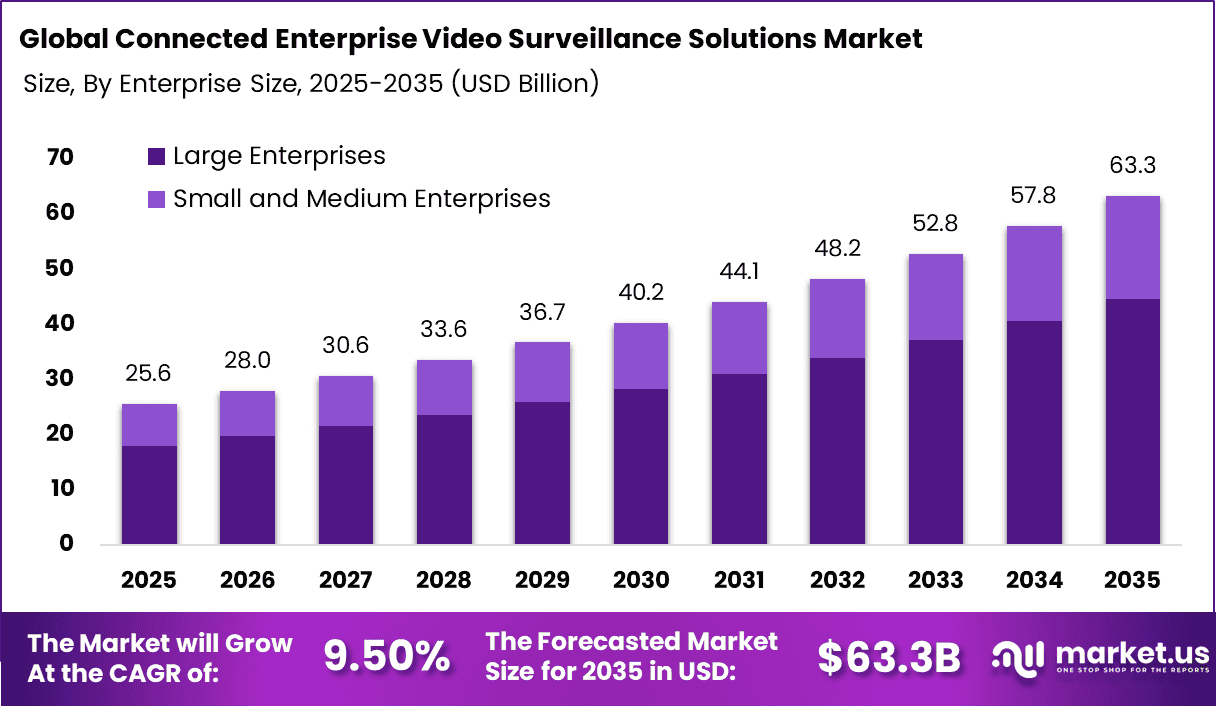
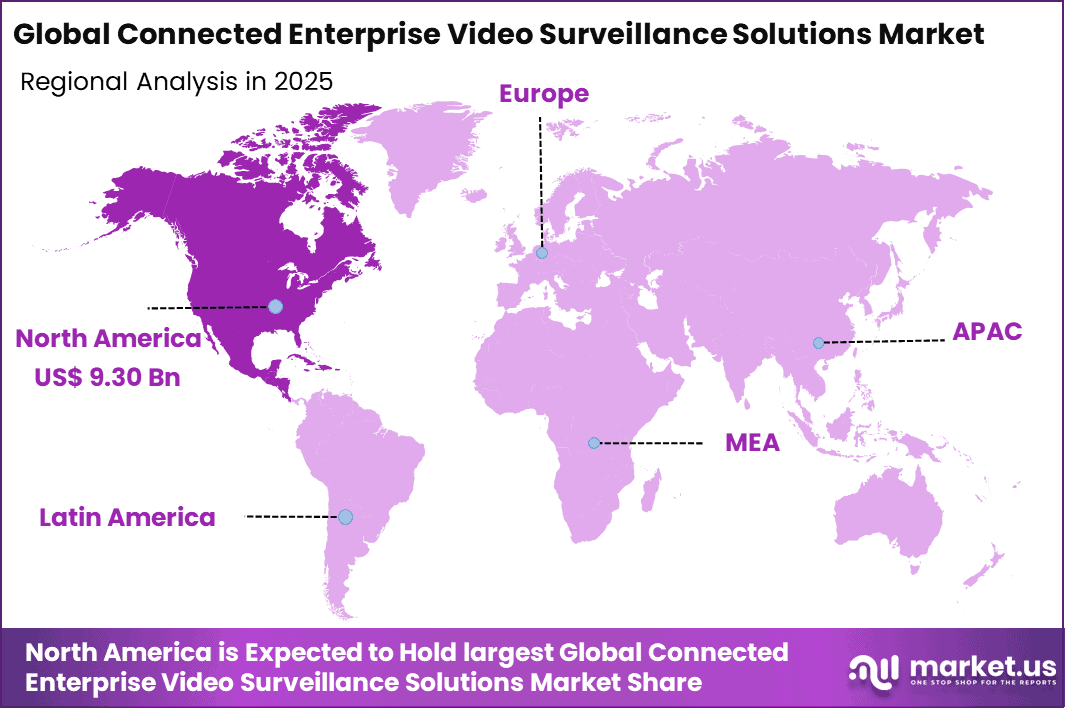
The Global Connected Enterprise Video Surveillance Solutions Market generated USD 25.6 billion in 2025 and is predicted to register growth from USD 28.0 billion in 2026 to about USD 63.3 billion by 2035, recording a CAGR of 9.5% throughout the forecast span. In 2025, North America held a dominant market position, capturing more than a 36.4% share, holding USD 9.3 billion in revenue.
Connected Enterprise Video Surveillance Solutions market refers to integrated surveillance systems that connect cameras, video management software, analytics tools, storage platforms, and network infrastructure across an enterprise environment. These solutions help organizations monitor multiple sites from a central platform, improve incident response, and support better visibility across offices, factories, warehouses, retail stores, transport hubs, and public facilities.
One of the main factors driving this market is the increasing need for centralized security management across large and multi-location enterprises. Companies want connected surveillance systems that can reduce blind spots, improve response time, and support faster investigation of security events. The shift toward smart buildings, industrial automation, and digital infrastructure is also supporting growth, as businesses look for surveillance systems that can work with access control, alarms, and other enterprise security tools.
Top Market Takeaways
- By Component, hardware dominates with a 52.6% share, delivering IP cameras, NVRs, and edge analytics appliances for unified video infrastructure.
- By Application, banking and financial services capture 40.8%, securing branches, ATMs, and transaction areas with facial recognition and behavioral anomaly detection.
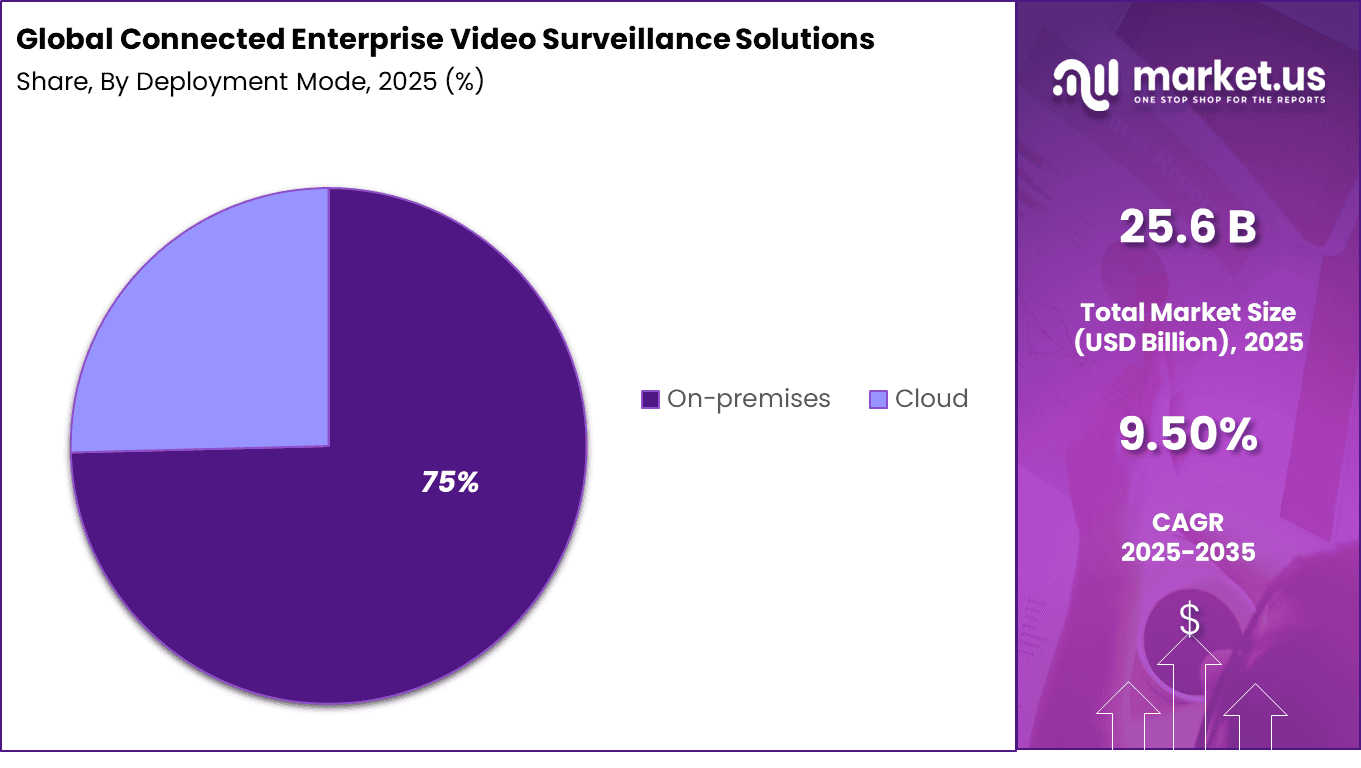
- By Deployment Mode, on-premises claims 74.6%, ensuring data sovereignty, low-latency forensics, and integration with legacy alarm systems.
- By Enterprise Size, large enterprises hold 70.4%, orchestrating campus-wide surveillance with centralized VMS and compliance recording.
- By End-User, commercial sectors lead at 43.7%, protecting retail chains, office complexes, and hospitality venues.
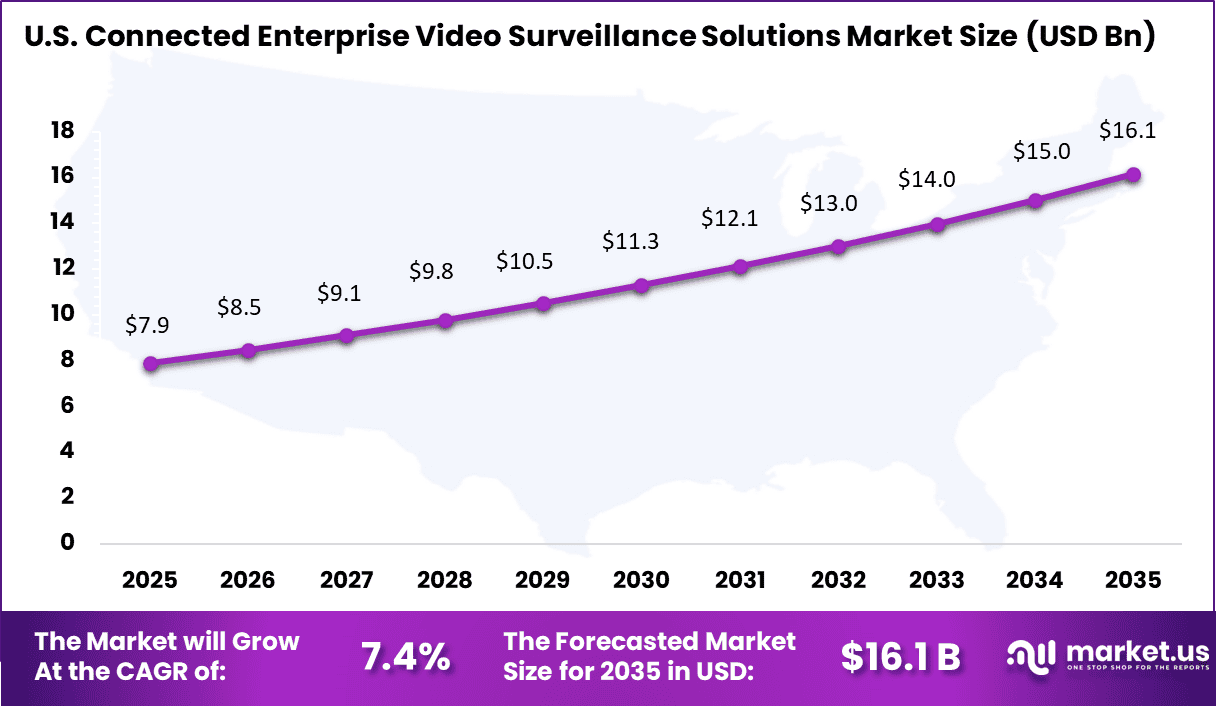
- North America accounts for 36.4% global share, with the U.S. market valued at USD 7.9 billion and a CAGR of 7.4%, driven by FISMA compliance and active shooter mitigation requirements.
By Component Analysis
Hardware accounted for 52.6% of the Connected Enterprise Video Surveillance Solutions Market. This segment leads because cameras, sensors, storage devices, and edge recording systems form the base of every surveillance setup. Enterprises continue to invest in reliable physical infrastructure to support real-time monitoring, high image clarity, and secure video capture across facilities.
The hardware segment also benefits from rising demand for smart surveillance environments in offices, branches, campuses, and industrial sites. As organizations modernize security systems, they increasingly upgrade to connected devices that support remote visibility, better coverage, and stronger control over daily security operations.
By Application Analysis
Banking and financial services held 40.8% of the market. This segment remains dominant because banks and financial institutions require continuous monitoring of branches, ATMs, cash handling zones, and customer service areas. Video surveillance plays an important role in improving physical security, reducing fraud risk, and supporting incident review.
The segment also grows due to the need for stronger compliance and better operational oversight in financial environments. Connected surveillance solutions help institutions monitor multiple locations from centralized platforms, which improves response time and strengthens security management across distributed networks.
By Deployment Mode Analysis
On-premises deployment captured 75% of the market. Many enterprises prefer this model because it gives them greater control over video data, storage systems, and network security. This is especially important in surveillance environments where footage is sensitive and must remain within the organization’s own infrastructure.
On-premises systems are also widely used in facilities that require uninterrupted monitoring and fast local access to recorded video. Organizations with established security infrastructure often choose this model to maintain tighter control over performance, compliance, and data handling procedures.
By Enterprise Size Analysis
Large enterprises represented 70.4% of the Connected Enterprise Video Surveillance Solutions Market. These organizations operate across large sites and multiple locations, which creates strong demand for connected surveillance systems that can monitor people, assets, and operations at scale. Their security requirements are broader and more complex than those of smaller businesses.
Large enterprises also have stronger budgets for integrated security investments and long-term infrastructure upgrades. They often need centralized monitoring, analytics support, and broad camera coverage, which keeps adoption levels high in this segment.
By End User Analysis
Commercial end users accounted for 43.7% of the market. This segment leads because shopping centers, office buildings, hotels, retail outlets, and business complexes require constant monitoring to protect visitors, staff, and property. Surveillance systems help these facilities improve security visibility and support smoother day-to-day management.
The growth of this segment is also linked to the expansion of connected buildings and smart commercial spaces. Businesses increasingly use video surveillance not only for protection but also for access monitoring, crowd observation, and incident tracking across busy commercial environments.
Key Market Segments
By Component
- Hardware
- Software
- Services
By Application
- Banking and Financial Services
- Government
- Transportation
- Retail
- Healthcare
- Others
By Deployment Mode
- On-Premises
- Cloud
By Enterprise Size
- Small and Medium Enterprises
- Large Enterprises
By End-User
- Commercial
- Industrial
- Residential
- Others
Regional Analysis
North America accounted for 36.4% of the Connected Enterprise Video Surveillance Solutions Market, reflecting strong deployment of integrated surveillance infrastructure across commercial and industrial environments. Enterprises across sectors such as retail, transportation, logistics, and public infrastructure increasingly install connected camera networks linked with centralized monitoring systems.
Organizations across the region continue to upgrade traditional CCTV setups with network-enabled surveillance platforms that support remote monitoring, real-time alerts, and data-driven security management, which strengthens demand for connected enterprise surveillance solutions.
The U.S. generated about USD 7.9 Bn within the regional market and is projected to expand at a CAGR of 7.4%. Businesses across the country continue to strengthen physical security and operational visibility across offices, warehouses, and large facilities. Enterprises increasingly integrate video surveillance with access control, analytics software, and cloud storage to improve monitoring efficiency.
As companies focus on protecting assets, managing large facilities, and improving workplace safety, demand for connected enterprise video surveillance platforms continues to grow steadily across the US market.
Key Regions and Countries
- North America
- US
- Canada
- Europe
- Germany
- France
- The UK
- Spain
- Italy
- Russia
- Netherlands
- Rest of Europe
- Asia Pacific
- China
- Japan
- South Korea
- India
- Australia
- Singapore
- Thailand
- Vietnam
- Rest of APAC
- Latin America
- Brazil
- Mexico
- Rest of Latin America
- Middle East & Africa
- South Africa
- Saudi Arabia
- UAE
- Rest of MEA
Drivers Impact Analysis
| Key Driver | Impact on CAGR Forecast (~%) | Geographic Relevance | Impact Timeline | Strategic Effect |
|---|---|---|---|---|
| Rising demand for enterprise security and facility monitoring | +1.9% | North America, Europe, Asia Pacific | Short to Mid Term (2025–2031) | Strengthens workplace and infrastructure security |
| Increasing adoption of AI-powered video analytics | +1.7% | US, China, Japan, Europe | Mid Term (2026–2032) | Improves automated threat detection |
| Expansion of smart city and critical infrastructure projects | +1.6% | Asia Pacific, Middle East, Europe | Mid to Long Term (2026–2035) | Drives large-scale surveillance deployment |
| Growth of remote monitoring and centralized security operations | +1.5% | Global | Mid Term (2026–2032) | Enables multi-site surveillance management |
| Integration with enterprise IoT and building management systems | +1.4% | North America, Europe, Asia Pacific | Mid to Long Term (2026–2035) | Enhances operational intelligence |
Restraints Impact Analysis
| Key Restraint | Impact on CAGR Forecast (~%) | Geographic Relevance | Impact Timeline | Strategic Effect |
|---|---|---|---|---|
| Privacy concerns related to surveillance systems | -1.8% | Europe, North America | Short to Mid Term (2025–2031) | Limits deployment in sensitive areas |
| High installation and infrastructure costs | -1.6% | Global | Mid Term (2026–2032) | Slows adoption among smaller enterprises |
| Data storage and bandwidth challenges | -1.4% | Global | Mid Term (2026–2032) | Increases operational complexity |
| Regulatory restrictions on video monitoring | -1.3% | Europe, North America | Mid to Long Term (2026–2035) | Creates compliance barriers |
| Cybersecurity risks in connected surveillance systems | -1.2% | Global | Mid to Long Term (2026–2035) | Raises concerns over system vulnerabilities |
Investor Type Impact Analysis
| Investor Type | Growth Sensitivity | Risk Exposure | Geographic Focus | Investment Outlook |
|---|---|---|---|---|
| Venture Capital Firms | Medium to High | Medium | US, China, Israel | Strong AI surveillance innovation |
| Private Equity Firms | High | Medium | North America, Europe | Infrastructure security expansion |
| Strategic Technology Investors | High | Medium | US, China, Japan | Supports AI video ecosystem |
| Corporate Venture Arms | Medium to High | Medium | Global | Strengthens enterprise security platforms |
| Government and Public Infrastructure Funds | Medium | Low | Asia Pacific, Middle East, Europe | Investment in smart city security |
Technology Enablement Analysis
| Technology Enabler | Impact on CAGR Forecast (~%) | Geographic Relevance | Impact Timeline | Implementation Significance |
|---|---|---|---|---|
| AI-based video analytics and object recognition | +1.8% | North America, China, Europe | Mid Term (2026–2032) | Improves automated monitoring |
| Cloud-based video surveillance platforms | +1.7% | Global | Short to Mid Term (2025–2031) | Enables remote access |
| Edge computing for real-time video processing | +1.5% | US, Europe, Japan | Mid to Long Term (2026–2035) | Reduces latency in surveillance |
| Integration with IoT security ecosystems | +1.4% | Global | Mid Term (2026–2032) | Improves connected security infrastructure |
| Advanced video compression and storage solutions | +1.2% | Global | Mid Term (2026–2032) | Optimizes data management |
Key Challenges
- Integrating connected video surveillance solutions with old security systems, access control tools, and IT networks remains a major challenge for many organizations.
- Managing large volumes of video data is difficult because enterprises need strong storage capacity, fast retrieval, and continuous monitoring across many sites.
- Data privacy and cybersecurity risks are a serious concern, as connected cameras and cloud based platforms may become targets for hacking or unauthorized access.
- High installation and maintenance costs create adoption barriers, especially for businesses that need advanced cameras, network upgrades, analytics software, and skilled support teams.
- False alerts and system accuracy issues remain a challenge because poor image quality, lighting changes, and crowded environments can reduce the reliability of surveillance monitoring.
Emerging Trends
A noticeable trend in the Connected Enterprise Video Surveillance Solutions market is the integration of surveillance systems with broader enterprise networks and operational platforms. Organizations increasingly connect cameras with centralized monitoring software, access control systems, and data analytics tools to create a unified security environment.
This connected approach allows security teams to monitor facilities in real time while also gaining operational insights from video data. As enterprises move toward smarter infrastructure, surveillance solutions are evolving from simple recording systems into intelligent platforms that support safety management and situational awareness across multiple locations.
Growth Factors
The growing need for stronger workplace security and operational visibility is supporting the expansion of connected enterprise video surveillance solutions. Businesses operate across large campuses, warehouses, offices, and production facilities where continuous monitoring helps maintain safety and protect valuable assets.
Connected surveillance systems allow organizations to manage multiple sites through centralized platforms, making monitoring more efficient. At the same time, enterprises seek technologies that help security teams respond quickly to unusual activity, which increases the importance of advanced surveillance solutions that provide reliable and coordinated monitoring capabilities.
Competitive Analysis
The competitive landscape of the Connected Enterprise Video Surveillance Solutions market includes global security technology companies, network solution providers, and video surveillance hardware manufacturers.
Cisco Systems, Inc., Honeywell International Inc., Bosch Security Systems GmbH, Axis Communications AB, Panasonic Corporation, Hikvision Digital Technology Co., Ltd., and NEC Corporation hold strong positions through their wide product portfolios in cameras, network video systems, storage, and monitoring software. These companies compete by offering scalable surveillance solutions for commercial buildings, industrial sites, transport hubs, and smart enterprise environments.
Other players such as Avigilon Corporation, FLIR Systems, Inc., Pelco, Inc., Genetec Inc., Hanwha Techwin Co., Ltd., Johnson Controls International plc, Milestone Systems A/S, Verint Systems Inc., VIVOTEK Inc., and Honeywell Security Group strengthen the market with advanced analytics, thermal imaging, access control integration, and centralized video management platforms.
Their focus remains on improving real-time monitoring, remote access, data security, and system interoperability. Together, these companies create a competitive market shaped by connected security infrastructure, intelligent analytics, and enterprise-level surveillance management.
Top Key Players in the Market
- Cisco Systems, Inc.
- Honeywell International Inc.
- Bosch Security Systems GmbH
- Axis Communications AB
- Panasonic Corporation
- Hikvision Digital Technology Co., Ltd.
- Dahua Technology Co., Ltd.
- Avigilon Corporation
- FLIR Systems, Inc.
- Pelco, Inc.
- Genetec Inc.
- Hanwha Techwin Co., Ltd.
- Johnson Controls International plc
- Sony Corporation
- Samsung Electronics Co., Ltd.
- Milestone Systems A/S
- Verint Systems Inc.
- VIVOTEK Inc.
- NEC Corporation
- Honeywell Security Group
- Others
Future Outlook
The future outlook for the Connected Enterprise Video Surveillance Solutions Market looks strong as businesses increasingly adopt smart security systems that connect cameras, software, and analytics on a single platform. Organizations are expected to invest more in these solutions to improve real-time monitoring, remote access, and faster incident response across offices, factories, retail stores, and public spaces. Growing interest in cloud-based management, AI-enabled video analysis, and stronger security compliance is likely to support steady market growth in the coming years.
Recent Developments
- In January 2026, Cisco SecureX Video Integration unified Meraki cameras with SIEM, EDR, and network analytics, providing correlated physical-cyber threat intelligence across global corporate networks.
- In February 2026, Honeywell Forge Security Operations Center integrated MAXPRO VMS with building management systems, enabling unified incident response across 5,000+ commercial properties.
Report Scope
| Report Features | Description |
|---|---|
| Market Value (2025) | USD 25.6 Billion |
| Forecast Revenue (2035) | USD 63.3 Billion |
| CAGR(2025-2035) | 9.5% |
| Base Year for Estimation | 2024 |
| Historic Period | 2020-2024 |
| Forecast Period | 2025-2035 |
| Report Coverage | Revenue forecast, AI impact on Market trends, Share Insights, Company ranking, competitive landscape, Recent Developments, Market Dynamics and Emerging Trends |
| Segments Covered | By Component (Hardware, Software, Services), By Application (Banking and Financial Services, Government, Transportation, Retail, Healthcare, Others), By Deployment Mode (On-Premises, Cloud), By Enterprise Size (Small and Medium Enterprises, Large Enterprises), By End-User (Commercial, Industrial, Residential, Others) |
| Regional Analysis | North America – US, Canada; Europe – Germany, France, The UK, Spain, Italy, Russia, Netherlands, Rest of Europe; Asia Pacific – China, Japan, South Korea, India, New Zealand, Singapore, Thailand, Vietnam, Rest of Latin America; Latin America – Brazil, Mexico, Rest of Latin America; Middle East & Africa – South Africa, Saudi Arabia, UAE, Rest of MEA |
| Competitive Landscape | Cisco Systems, Inc., Honeywell International Inc., Bosch Security Systems GmbH, Axis Communications AB, Panasonic Corporation, Hikvision Digital Technology Co., Ltd., Dahua Technology Co., Ltd., Avigilon Corporation, FLIR Systems, Inc., Pelco, Inc., Genetec Inc., Hanwha Techwin Co., Ltd., Johnson Controls International plc, Sony Corporation, Samsung Electronics Co., Ltd., Milestone Systems A/S, Verint Systems Inc., VIVOTEK Inc., NEC Corporation, Honeywell Security Group, Others |
| Customization Scope | Customization for segments, region/country-level will be provided. Moreover, additional customization can be done based on the requirements. |
| Purchase Options | We have three licenses to opt for: Single User License, Multi-User License (Up to 5 Users), Corporate Use License (Unlimited Users and Printable PDF) |