


Report Overview
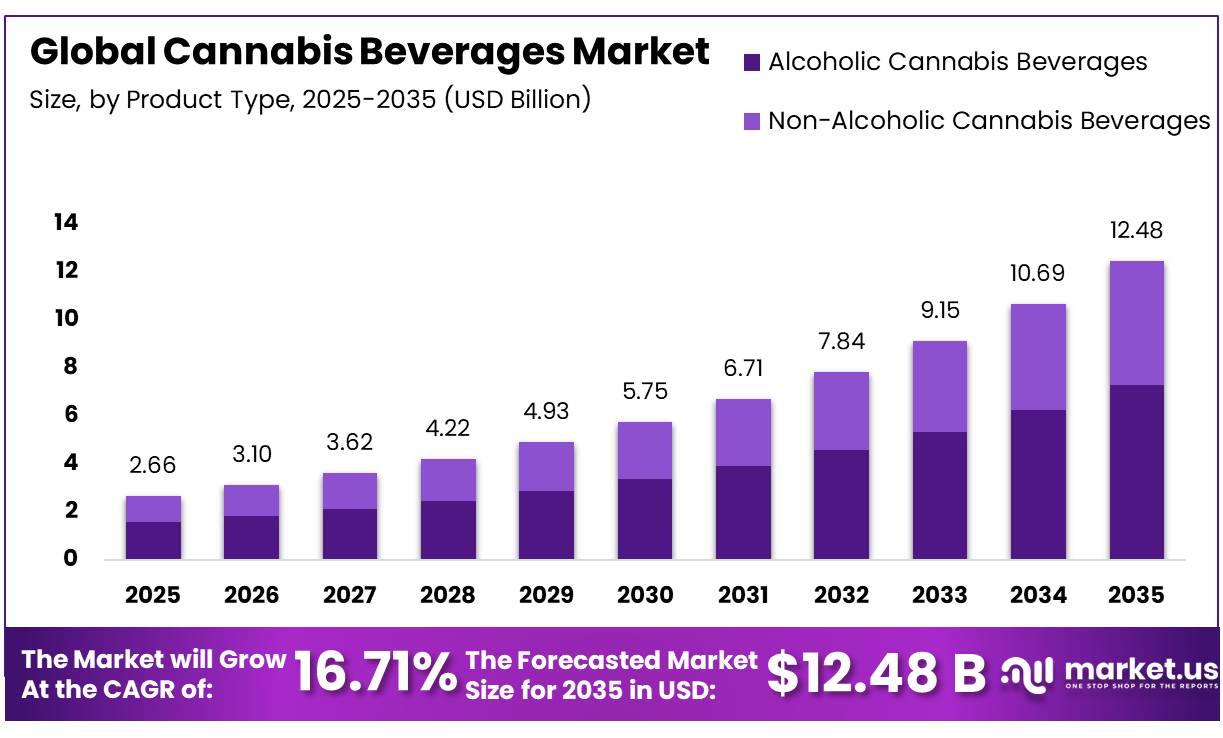
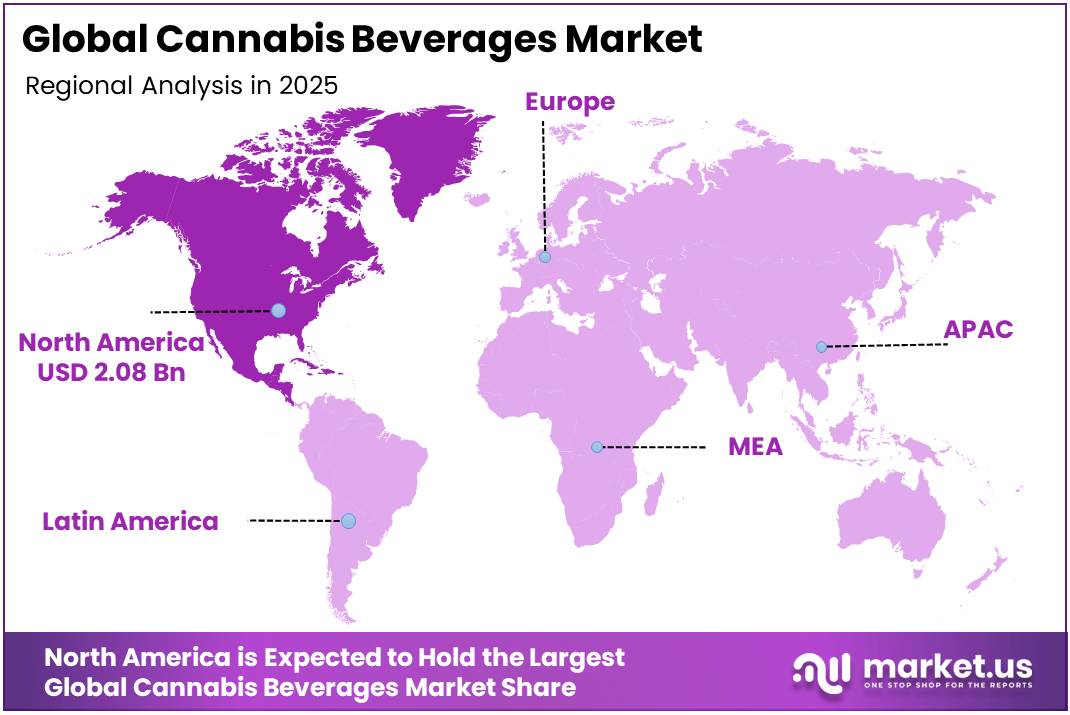
In 2025, the Global Cannabis Beverages Market was valued at USD 2.66 billion, and between 2026 and 2035, this market is estimated to register a CAGR of 16.71%, reaching about USD 12.48 billion by 2035. In 2025, North America led the market, achieving over 78.30% share with a revenue of USD 2.08 billion.
Cannabis beverages are emerging as a specialised part of the legal adult-use and wellness beverage industry. The category includes sparkling drinks, teas, flavoured waters, shots, mocktails and drink mixes containing regulated amounts of tetrahydrocannabinol (THC), cannabidiol (CBD), or both. Their commercial appeal comes from familiar beverage formats, measured serving sizes and smoke-free consumption.
- According to the United Nations Office on Drugs and Crime estimated that 244 million people used cannabis in 2023, equal to about 4.6% of the global population aged 15–64.
Key Takeaways
- The Global Cannabis Beverages Market was valued at USD 2.66 billion in 2025.
- The global market is projected to grow at a CAGR of 16.71% and is estimated to reach USD 12.48 billion by 2035.
- On basis of product type, Alcoholic Cannabis Beverages dominated the market, accounted for 58.4% share of the market in 2025.
- Based on Cannabinoid type, THC-Infused Beverages dominated the market, accounted for 61.8% share.
- Bottles Packaging Type accounted for 46.2% share of the market in 2025.
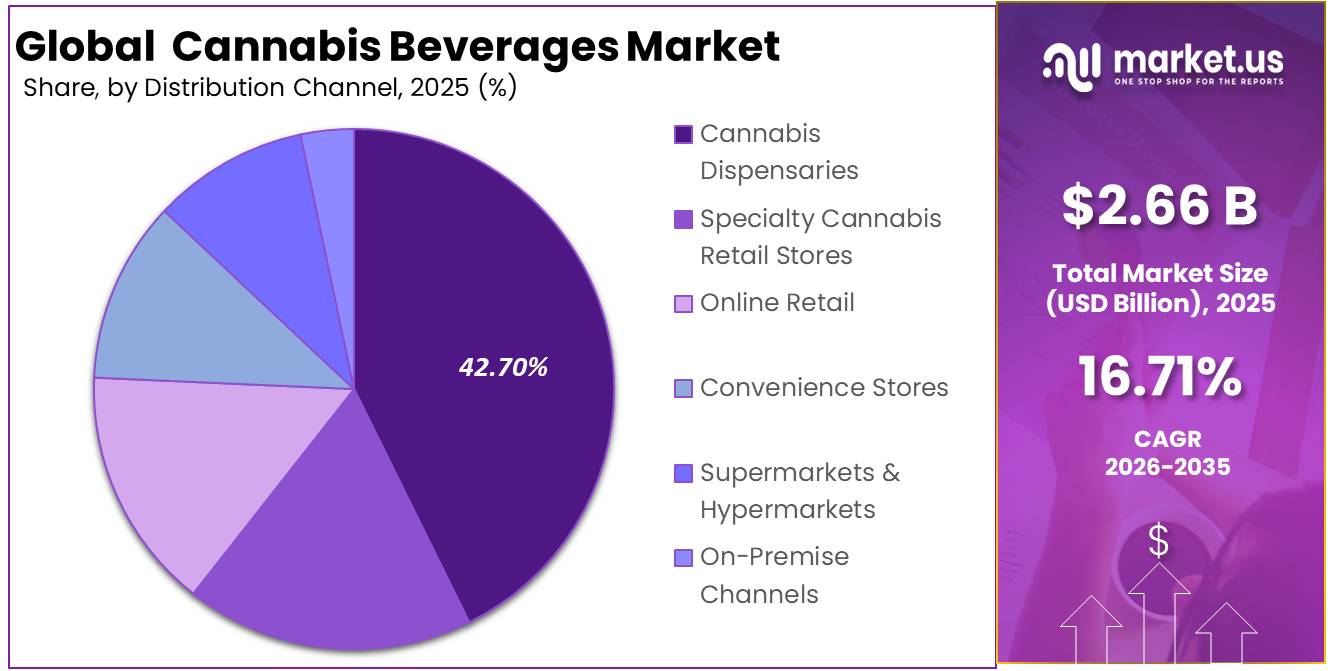
- Cannabis Dispensaries distribution channel dominated the market with 42.7% share.
- Based on consumer Age group, the 21–34 Years age group lead the market with 43.6% share of the market in 2025.
- North America was the most dominant region in the market, accounting for 78.3% share in 2025.
Legal recreational cannabis sales reached CAD 5.5 billion in fiscal 2024/2025, rising 6.1% from the previous year. The category therefore remains smaller than dried cannabis and inhaled extracts, but it has established measurable retail demand and room for greater shelf penetration.
- According to the Canadian Cannabis Survey, published by Health Canada in December 2024 showed continued growth in the regulated market, with 72% of cannabis consumers usually purchasing cannabis from a legal store or website, compared with only 3% who primarily purchased from illegal sources.
This shift improves product traceability, laboratory testing, tax collection and confidence in labelled potency. Canada limits edible cannabis, including beverages, to 10 mg of THC per immediate container and requires compliant, child-resistant packaging.
- As of May 2025, Health Canada states that the effects of cannabis consumed in food or beverages may begin within approximately 30 minutes to 2 hours after consumption, with some effects potentially lasting up to 24 hours depending on the individual, dose, and product formulation.
In the United States, the FDA continues to prohibit the interstate sale of foods with added THC or CBD, creating a fragmented, state-led commercial environment and restricting national beverage distribution.
- In February 2026, EFSA set a provisional CBD intake level of 0.0275 mg per kilogram of body weight per day, or about 2 mg daily for a 70 kg adult; more than 200 CBD novel-food applications had been received, with 17 under risk assessment. This process may eventually support more standardised products, but it also raises the need for stronger safety data, dosage discipline and regulatory investment.
Product Type Analysis
Alcoholic Cannabis Beverages products dominated the market with a 58.4% share due to growing demand for alcohol alternatives.
In 2025, Alcoholic Cannabis Beverages held a dominant market position, capturing more than a 58.4% share. The segment maintained its leadership as more adult consumers looked for alternatives to traditional alcoholic drinks that offer a different social experience. Cannabis-infused beers, wines, spirits, and cocktails have gained attention in regulated markets, especially where recreational cannabis is legally available. Beverage manufacturers have continued introducing products with controlled THC and CBD content, allowing consumers to choose beverages with predictable serving sizes.
- According to Health Canada’s Canadian Cannabis Survey 2024, 21% of Canadians aged 15+ cannabis consumers reported using cannabis beverages, indicating rising acceptance of infused drinks among legal cannabis users. And 57% of cannabis users consumed cannabis through edible or drinkable products, showing increasing interest in non-smoking formats.
Non-Alcoholic Cannabis Beverages are the fastest-growing segment. Growth is being supported by rising consumer preference for functional, low-calorie, and alcohol-free drinks that fit healthier lifestyles. Cannabis-infused sparkling water, teas, coffees, juices, energy drinks, and wellness beverages are attracting consumers looking for relaxation or social occasions without alcohol. Beverage companies are investing in improved formulations, faster-onset technologies, and better taste profiles to expand product appeal.
Cannabinoid Type Analysis
THC-Infused Beverages dominate the market with a 61.80% share, driven by regulated product innovation and expanding legal cannabis sales.
In 2025, THC-Infused Beverages held a dominant market position, capturing more than a 61.80% share. The segment continued to lead as licensed producers expanded beverage portfolios with low-dose THC seltzers, infused beers, and ready-to-drink products designed for adult recreational consumers. Improved nanoemulsion technology has enabled faster onset times and better taste, making THC beverages more competitive with traditional alcoholic drinks.
- According to Statistics Canada, legal recreational cannabis sales reached CAD 5.2 billion during fiscal 2023/2024, representing an 6% increase from the previous fiscal year. This growth indicates continued expansion of Canada’s regulated cannabis industry and may provide a supportive environment for licensed THC beverage manufacturers to strengthen distribution and introduce new products.
CBD-Infused Beverages are the fastest-growing segment. Rising consumer interest in plant-based wellness products and functional drinks has encouraged beverage manufacturers to develop CBD-infused sparkling waters, herbal teas, sports recovery drinks, and flavored beverages with low or no sugar. This shows strong consumer interest in lower-sugar and nutrient-focused products, which may encourage innovation across functional beverage categories.
- According to the International Food Information Council’s 2024 Food & Health Survey, 66% of U.S. consumers reported trying to limit their sugar consumption, while 71% said they were trying to consume protein.
Packaging Type Analysis
Bottles dominate the market with a 46.20% share due to their premium appeal and suitability for cannabis beverages.
In 2025, Bottles held a dominant market position, capturing more than a 46.20% share. The segment remained the preferred choice because bottles provide excellent product protection, preserve flavor and cannabinoid stability, and offer a premium appearance that aligns with high-value cannabis beverages. Glass bottles are widely used for infused wines, beers, and premium ready-to-drink products due to their strong barrier properties against oxygen and moisture. They also support accurate labeling and child-resistant closure systems required in regulated cannabis markets.
Cans are the fastest-growing segment. Beverage manufacturers are increasingly choosing aluminum cans because they are lightweight, easy to transport, highly recyclable, and well suited for ready-to-drink cannabis beverages such as sparkling waters, seltzers, and infused soft drinks. Cans also cool quickly, offer strong protection from light and oxygen, and provide a large surface for branding and product information. Their convenience makes them popular for on-the-go consumption and retail distribution.
Distribution Channel Analysis
Cannabis Dispensaries dominate the market with a 42.70% share due to their regulated product selection and consumer trust.
In 2025, Cannabis Dispensaries held a dominant market position, capturing more than a 42.70% share. The segment remained the leading distribution channel because dispensaries offer consumers access to licensed cannabis beverages with verified product quality, standardized labeling, and knowledgeable staff who can provide guidance on dosage and product selection. These outlets continue to be the primary point of sale for THC-infused beverages in regulated markets, where strict compliance with cannabis laws is required.
- According to Statistics Canada, seasonally adjusted sales at cannabis stores reached approximately CAD 474.0 million in December 2024, rising 8% compared with November 2024 and 9.4% year over year. The continued growth in legal cannabis retail sales reflects expanding consumer purchases through regulated channels, which supports greater shelf availability and commercial opportunities for cannabis beverage products.
Specialty Cannabis Retail Stores are the fastest-growing segment. Growth is being supported by rising consumer demand for premium cannabis products and personalized shopping experiences. These stores typically offer a broader selection of cannabis beverages, including low-dose THC drinks, CBD-infused sparkling waters, functional beverages, and limited-edition products that may not be widely available through other retail channels.
Consumer Age Group Analysis
Consumers aged 21–34 dominate the market with a 43.60% share, supported by higher adoption of alternative beverage choices.
In 2025, the 21–34 age group held a dominant market position, capturing more than a 43.60% share. The segment led the market as younger adult consumers showed greater interest in innovative beverage formats that offer an alternative to traditional alcoholic drinks. This age group has been more willing to explore cannabis-infused sparkling waters, ready-to-drink beverages, and low-dose THC and CBD products designed for social occasions and lifestyle preferences.
- According to Health Canada’s Canadian Cannabis Survey 2024, young adults aged 20–24 recorded the highest prevalence of cannabis use among all adult age groups, highlighting their continued importance to the legal cannabis industry.
The 35–54 age group is the fastest-growing segment. Growth is being driven by increasing interest in premium cannabis beverages that offer convenience, measured cannabinoid content, and alternatives to conventional alcoholic drinks. Consumers in this age group are increasingly choosing products that fit wellness-focused lifestyles, including low-dose THC beverages, CBD-infused drinks, and functional formulations with natural ingredients. Higher disposable incomes and greater preference for premium beverage experiences have also encouraged purchases through licensed retail channels.
Key Market Segments
By Product Type
- Alcoholic Cannabis Beverages
- Cannabis Beer
- Cannabis Wine
- Cannabis Spirits
- Cannabis Cocktails
- Non-Alcoholic Cannabis Beverages
- Cannabis-Infused Carbonated Drinks
- Cannabis Energy Drinks
- Cannabis Tea & Coffee
- Cannabis Functional Beverages
- Cannabis Juice & Water
- Cannabis Sports & Recovery Drinks
By Cannabinoid Type
- THC-Infused Beverages
- CBD-Infused Beverages
- Balanced THC/CBD Beverages
- Minor Cannabinoid Beverages
By Packaging Type
- Bottles
- Cans
- Others
By Distribution Channel
- Cannabis Dispensaries
- Specialty Cannabis Retail Stores
- Online Retail
- Convenience Stores
- Supermarkets & Hypermarkets
- On-Premise Channels
By Consumer Age Group
- 21–34 Years
- 35–54 Years
- Above 55 Years
Driver Analysis
Legal channel expansion for low-dose THC drinks
The strongest near-term driver is the widening formalization of cannabis drink routes inside legal retail systems, because beverages remain a small but rising portion of cannabis consumption and therefore have more headroom than mature inhalable formats. In Canada, beverages were used by 21% of past-year cannabis consumers in 2024 versus only 4% in 2018, a 17 percentage-point increase over six years, while edible cannabis reached 55% penetration among users, showing that ingestible formats have already moved into the mainstream purchase set.
This matters strategically because beverages monetize incremental occasions rather than just replace flower, especially where low-dose formats can serve social, sessionable use cases that resemble beer, seltzer, or RTD consumption patterns. Commercially, this driver improves shelf productivity and frequency economics for licensed operators. Canada’s legal non-medical cannabis market reached $5.5 billion in fiscal 2024/25, up 6.1% year over year, while governments earned $2.5 billion from recreational cannabis-related control and sale mechanisms, up 11.5%, indicating continued institutional support for a scaled regulated market.
Because beverages sit inside the edible/extract ecosystem rather than requiring consumers to adopt a new legal framework, each provincial or state-level retail expansion increases the number of points where branded beverage SKUs can be cross-sold alongside gummies and vapes, supporting the estimated +2.4 percentage-point uplift to forward CAGR
Drivers Impact Analysis
| Driver | (~) % Impact on CAGR Forecast | Geographic Relevance | Impact Timeline |
|---|---|---|---|
| Legal channel expansion for low-dose THC drinks | +2.4% | North America core, Canada lead, U.S. state corridors | Short term (≤ 2 years) |
| Consumer migration toward edible-format cannabis use | +2.0% | Canada core, U.S. regulated states | Medium term (2-4 years) |
| Alcohol-substitution and social-use repositioning | +1.6% | North America core, urban retail clusters | Medium term (2-4 years) |
| Compliance-led trust in tested packaged beverages | +1.3% | Canada core, U.S. dispensary states | Short term (≤ 2 years) |
| Inventory normalization and processor utilization gains | +1.1% | Canada production base, export-adjacent operators | Short term (≤ 2 years) |
| Tightening hemp-intoxicant rules pushing demand into licensed cannabis | +1.9% | U.S. state-by-state, Northeast and Mid-Atlantic first | Short term (≤ 2 years) |
Restraint Analysis
Potency cap compression
Government rulemaking is tightening beverage dose architecture in ways that directly reduce revenue density per unit and slow premiumization: New Jersey capped intoxicating hemp beverages at 5 mg THC per serving and 10 mg per container from May 31, 2026, while Montana reduced ingestible serving limits from 10 mg to 5 mg effective July 1, 2026, and New York guidance for cannabinoid hemp beverages has constrained many products to 1 mg THC per serving and 10 mg per package under specified ratios.
For beverage operators, that forces reformulation, new sensory work to preserve onset and taste at lower cannabinoid loading, and often a 15% to 30% decline in THC-per-SKU monetization unless pack counts or price-per-ounce rise commensurately, which is difficult in a value-sensitive consumer environment. The practical effect is lower basket productivity, slower repeat purchase migration from edibles to beverages, and delayed scale-up of higher-margin functional or social-use beverage formats, supporting an estimated 2.1 percentage-point drag on 2026-based CAGR.
Restraint Impact Analysis
| Restraint | (~) % Impact on CAGR Forecast | Geographic Relevance | Impact Timeline |
|---|---|---|---|
| Potency cap compression | -2.1% | North America core, Canada, U.S. regulated states | Medium term (2-4 years) |
| Testing and compliance cost | -1.7% | U.S. regulated states, Canada | Short term (≤ 2 years) |
| Packaging and labeling rigidity | -1.2% | Canada, U.S. regulated states | Medium term (2-4 years) |
| Channel access restrictions | -2.4% | U.S. fragmented states, Canada retail-controlled provinces | Medium term (2-4 years) |
| Excise and retail tax burden | -1.9% | Canada, selected U.S. states | Medium term (2-4 years) |
| Regulatory fragmentation | -2.6% | U.S. interstate market, EU pilot markets | Long term (≥ 4 years) |
Opportunity Analysis
Functional low-dose formats
CDC notes that 52.5 million Americans used cannabis at least once in 2021, while 2022 BRFSS-derived research found that 41.6% of current users consumed via eating and that about half reported multiple routes of use, showing behavioral openness to non-smoked formats but not yet a fully monetized beverage occasion architecture.
The opportunity emerges if operators standardize 2 mg to 5 mg THC or balanced THC-CBD formats and compete not only against cannabis edibles but also against premium non-alcoholic and relaxation beverages; if even 2% to 3% of U.S. past-year cannabis users migrated one weekly consumption occasion into a packaged beverage at an average realized annual spend of $180 to $260 per user, the added revenue pool could reach roughly $216 million to $410 million before adjacent non-user trial is counted.
Because this model is based on new use-case creation and improved purchase frequency, not on current category momentum, it can reasonably add about 1.9 percentage points to market CAGR through mix enhancement, premium pricing of 8% to 12% over standard edible-equivalent dosage, and lower formulation cost volatility relative to multi-piece edible formats.
Opportunity Impact Analysis
| Opportunity | (~) % Potential CAGR Upside | Geographic Relevance | Execution Window |
|---|---|---|---|
| Mainstream retail conversion | +2.4% | North America core | Short term (≤ 2 years) |
| Functional low-dose formats | +1.9% | Canada, U.S. legal states, EU pilot markets | Short term (≤ 2 years) |
| Route-shift from smoking to drinking | +2.1% | U.S. legal states, Canada | Medium term (2-4 years) |
| Province-state portfolio roll-ups | +1.6% | Canada, U.S. fragmented markets | Medium term (2-4 years) |
| Wellness-age cohort expansion | +1.4% | North America, Oceania | Medium term (2-4 years) |
| Cross-border IP and white-label licensing | +1.8% | EU, LATAM, APAC emerging markets | Long term (≥ 4 years) |
Challenges Analysis
Recall And Label Precision
Cannabis beverages face a persistent execution challenge around label accuracy, cannabinoid homogeneity, and recall exposure because Health Canada maintains formal cannabis recall and adverse-reaction mechanisms and updated voluntary recall guidance, while recent regulatory actions show that THC mislabelling remains a live compliance risk in the wider cannabis product system. Beverage products are especially vulnerable because emulsified cannabinoids must remain stable across shelf life, fill-volume variation, and batch-to-batch mixing conditions, so even a modest analytical drift of 1 to 2 mg THC per unit can trigger disproportionate legal, reputational, and retail delisting consequences in a category built around low-dose precision.
The commercial impact is not category shutdown but recurring friction: more frequent lab verification, tighter in-process controls, reserve inventory for replacement, retailer chargebacks, and slower launch approvals, together justifying an estimated 0.8 percentage-point CAGR drag as operators divert capital from expansion into quality assurance redundancy. The required corporate response is a short-term but resource-intensive upgrade path involving real-time batch analytics, tighter standard deviation targets on cannabinoid dispersion, stronger supplier qualification, and automated compliance documentation that lowers recall probability without materially slowing commercialization speed.
Challenges Impact Analysis
| Challenge | (~) % CAGR Friction Drag | Geographic Relevance | Mitigation Horizon |
|---|---|---|---|
| Potency Ceiling Economics | -1.4% | North America core | Long term (≥ 4 years) |
| Equivalency Purchase Friction | -1.1% | Canada retail channels | Medium term (2-4 years) |
| Fragmented Compliance Pathways | -1.6% | U.S. state markets, EU regulatory hubs | Long term (≥ 4 years) |
| Tax Stamp Cost Burden | -1.0% | Canada licensed producers | Medium term (2-4 years) |
| Recall And Label Precision | -0.8% | North America branded products | Short term (≤ 2 years) |
| Child-Safety Packaging Tension | -0.9% | North America, EU regulated markets | Medium term (2-4 years) |
Geopolitical Impact Analysis
Ongoing Geopolitical Conflicts Increase Supply Chain Costs but Encourage Regional Production.
The ongoing geopolitical conflicts, including the Russia–Ukraine war and heightened tensions in the Middle East, have created indirect challenges for the cannabis beverages market by increasing production and distribution costs. Although cannabis beverages are not directly linked to defense or energy sectors, the industry relies on global supplies of aluminum cans, glass bottles, flavoring ingredients, sweeteners, and packaging materials, all of which have experienced price volatility due to higher energy costs and transportation disruptions.
At the same time, manufacturers have responded by strengthening regional sourcing strategies and reducing dependence on long international supply chains. Companies are increasingly working with domestic packaging suppliers and local ingredient producers to improve supply security and manage costs more effectively. As supply chains gradually adapt and companies continue investing in localized manufacturing and inventory management, the cannabis beverages market is expected to remain resilient while improving its ability to withstand future geopolitical disruptions.
Regional Analysis
North America dominates the Cannabis Beverages Market with a 78.30% share.
In 2025, North America held a dominant market position, accounting for more than 78.30% of the global cannabis beverages market, with a market value of USD 2.08 billion. The region’s leadership is supported by well-established legal cannabis frameworks, a mature retail network, and strong consumer acceptance of cannabis-infused products.
The United States and Canada continue to drive demand through expanding product portfolios that include THC- and CBD-infused sparkling waters, teas, sodas, and ready-to-drink beverages. Licensed cannabis retailers and dispensaries have improved product accessibility, while manufacturers continue investing in premium formulations and low-dose beverages to attract new consumers. These factors continue to strengthen North America’s leadership in the global market.
Europe is expected to be the fastest-growing regional market during the forecast period. Growth is being supported by expanding consumer interest in CBD-based wellness beverages, increasing investments in functional beverage innovation, and gradual regulatory progress across several European countries. As regulatory clarity continues to improve and awareness of cannabis-derived wellness products increases, Europe is expected to witness steady growth, making it one of the most attractive regions for future investment in cannabis beverages.
Key Regions and Countries
- North America
- The US
- Canada
- Europe
- Germany
- France
- The UK
- Spain
- Italy
- Russia & CIS
- Rest of Europe
- APAC
- China
- Japan
- South Korea
- India
- ASEAN
- Rest of APAC
- Latin America
- Brazil
- Mexico
- Rest of Latin America
- Middle East & Africa
- GCC
- South Africa
- Rest of MEA
Key Players Analysis
Green Thumb Industries Inc. continues to strengthen its cannabis beverage business through product innovation and retail expansion. In 2025, the company operated more than 100 retail locations across the United States and maintained operations in 15 U.S. markets. Its beverage portfolio includes THC-infused drinks designed for regulated adult-use markets. Cann Social Tonics is recognized for its low-dose THC and CBD beverages targeted at consumers seeking alcohol alternatives. Most products contain 2 mg THC and 4 mg CBD per 8-ounce can, providing a balanced, sessionable beverage experience. The company has introduced more than 10 flavor varieties and continues to launch seasonal products. Its focus remains on premium ingredients, low calories, and social wellness beverages.
ARTET LLC specializes in premium cannabis aperitifs designed as sophisticated alternatives to traditional alcoholic beverages. In 2025, the company continued expanding its presence in regulated U.S. cannabis markets through licensed dispensaries and delivery platforms.
The Major Players in The Industry
- Canopy Growth Corporation
- Tilray Brands, Inc.
- Aurora Cannabis Inc.
- Cronos Group Inc.
- Curaleaf Holdings, Inc.
- Trulieve Cannabis Corp.
- Green Thumb Industries Inc.
- Keef Brands
- Cann Social Tonics
- Dixie Brands (BellRock Brands)
- Truss Beverage Co.
- VCC Brands (CQ Drinks)
- ARTET LLC
- Pabst Labs
- The Valens Company
- Wynk
- Mary Jones
- Recess
- Daytrip Beverages
- SōRSE Technology Corporation
Key Development
- In March 2026, SNDL reported that Cannabis Operations revenue reached CAD 144.7 million in 2025, increasing 1%, while the group operated 192 cannabis retail locations by March 11, 2026.
- In March 2026, Canopy Growth Corporation strengthened its wider cannabis platform by completing the acquisition of MTL Cannabis. The company issued approximately 2 million shares and paid nearly CAD 18.5 million in cash, while targeting around CAD 10 million in annual cost savings within 18 months.
- In March 2025, Curaleaf introduced Select FormulaX, a hemp‑derived THC energy drink positioned as an uplifting, focused‑effect beverage, expanding its Zero Proof and beverage‑enhancer platform into ready‑to‑drink formats and reinforcing its ambition to permeate the cannabis beverage category nationwide.
Report Scope
| Report Features | Description |
|---|---|
| Market Value (2025) | USD 2.66 Bn |
| Forecast Revenue (2035) | USD 12.48 Bn |
| CAGR (2026-2035) | 16.7% |
| Base Year for Estimation | 2025 |
| Historic Period | 2020-2024 |
| Forecast Period | 2026-2035 |
| Report Coverage | Revenue Forecast, Market Dynamics, Competitive Landscape, Recent Developments |
| Segments Covered | By Product Type (Alcoholic Cannabis Beverages and Non-Alcoholic Cannabis Beverages), By Cannabinoid Type (THC-Infused Beverages, CBD-Infused Beverages, Balanced THC/CBD Beverages, and Minor Cannabinoid Beverages), By Packaging Type (Bottles, Cans, and Others [Tetra Packs, Pouches, Multipack Formats]), By Distribution Channel (Cannabis Dispensaries, Specialty Cannabis Retail Stores, Online Retail, Convenience Stores, Supermarkets & Hypermarkets, and On-Premise Channels), By Consumer Age Group (21–34 Years, 35–54 Years, and Above 55 Years) |
| Regional Analysis | North America – The US & Canada; Europe – Germany, France, The UK, Spain, Italy, Russia & CIS, Rest of Europe; APAC– China, Japan, South Korea, India, ASEAN & Rest of APAC; Latin America– Brazil, Mexico & Rest of Latin America; Middle East & Africa– GCC, South Africa, & Rest of MEA |
| Competitive Landscape | Canopy Growth Corporation, Tilray Brands, Inc., Aurora Cannabis Inc., Cronos Group Inc., Curaleaf Holdings, Inc., Trulieve Cannabis Corp., Green Thumb Industries Inc., Keef Brands, Cann Social Tonics, Dixie Brands (BellRock Brands), Truss Beverage Co., VCC Brands (CQ Drinks), ARTET LLC, Pabst Labs, The Valens Company, Wynk, Mary Jones, Recess, Daytrip Beverages, SōRSE Technology Corporation, Other Players |
| Customization Scope | Customization for segments, region/country-level will be provided. Moreover, additional customization can be done based on the requirements. |
| Purchase Options | We have three licenses to opt for: Single User License, Multi-User License (Up to 5 Users), Corporate Use License (Unlimited Users and Printable PDF) |





































