


Report Overview
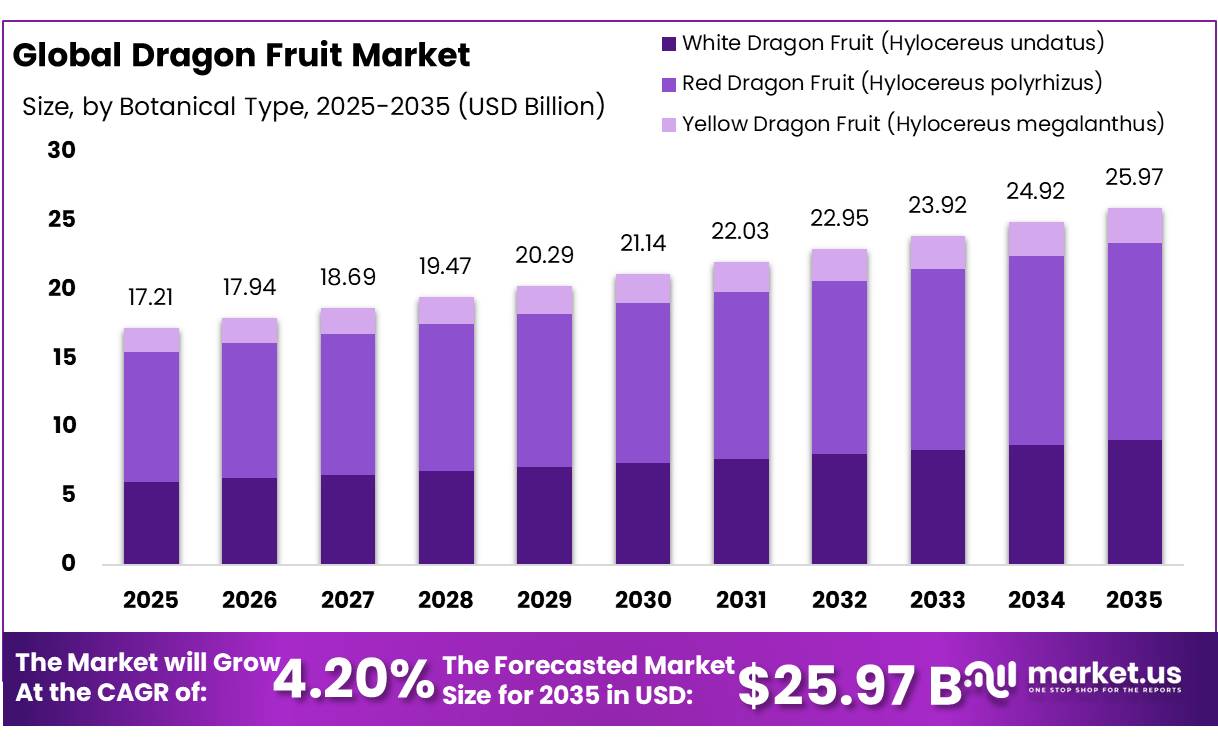
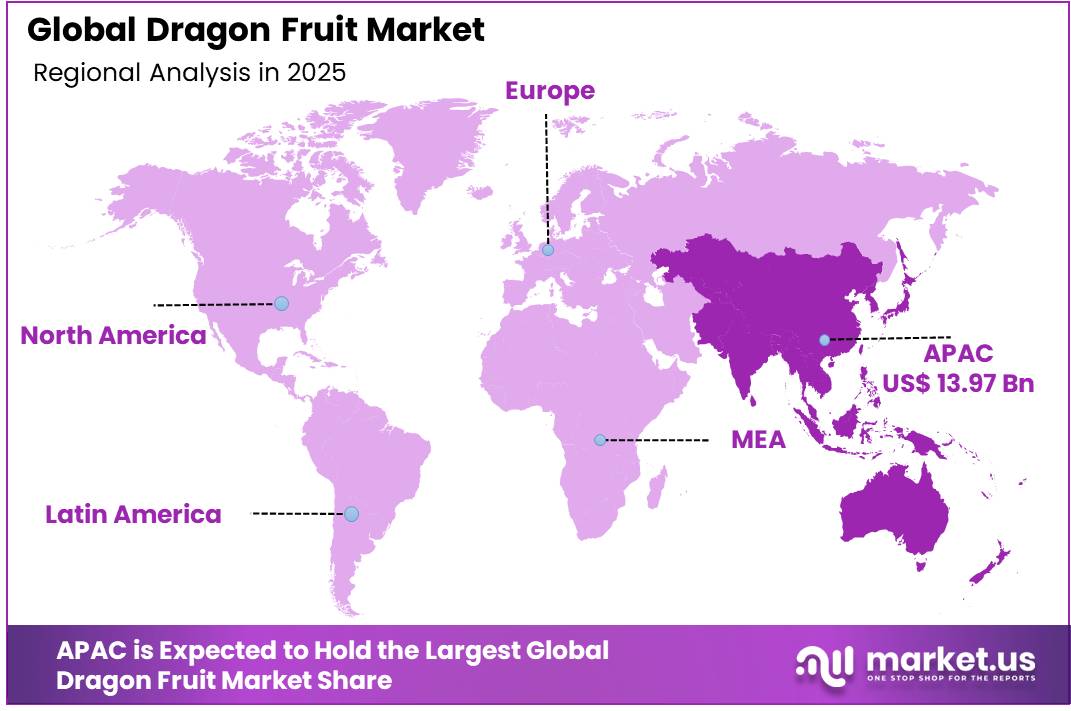
In 2025, the Global Dragon Fruit Market was valued at USD 17.21 billion, and between 2026 and 2035, this market is estimated to register a CAGR of 4.20%, reaching about USD 25.97 billion by 2035. Asia Pacific held a dominant market position, capturing more than a 81.2% share, holding USD 13.97 billion in revenue.
Dragon fruit has moved from a niche tropical crop into a broader food industry covering cultivation, grading, packing, cold storage, transport, retailing, and ingredient processing. Its commercial use now extends beyond fresh fruit into juices, frozen pulp, dried slices, powders, preserves, dairy products, beverages, and peel-based ingredients. FAO identifies dragon fruit within the expanding minor tropical fruit trade recorded under HS code 0810.90, highlighting stronger international demand, wider sourcing, and growing investment in tropical fruit value chains.
- Peru’s Ministry of Production reported that dragon fruit output rose from 156.9 tonnes in 2019 to 4,585.5 tonnes by July 2024. Government-supported technical centres have also developed vegan gelatin from dragon fruit peel, preserves using lower-grade fruit, and a prototype dragon fruit beer, demonstrating opportunities to reduce waste and improve producer income.
Key Takeaways
- The global dragon fruit market was valued at USD 17.21 billion in 2025.
- The global dragon fruit market is projected to grow at a CAGR of 4.2% and is estimated to reach USD 25.97 billion by 2035.
- Based on botanical type, Red Dragon Fruit dominated the global dragon fruit market, accounting for approximately 55% of the total market share.
- Based on product form, Fresh Fruits dominated the market, comprising nearly 70% of the global market share.
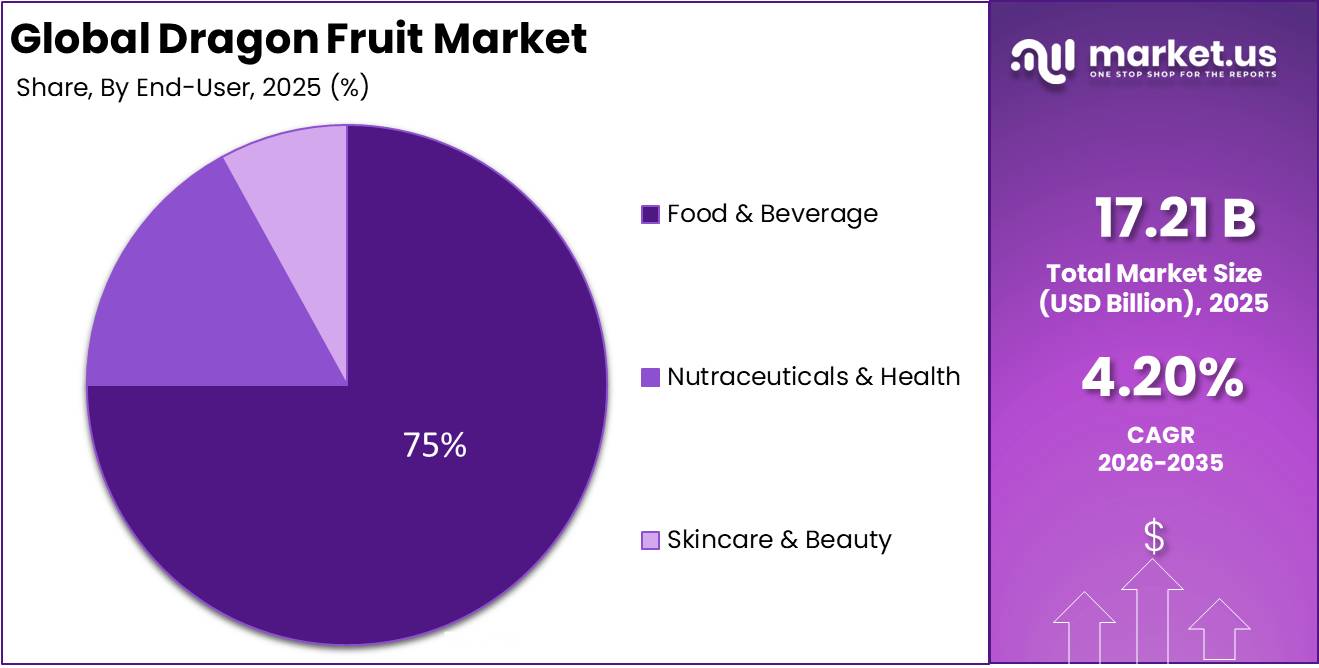
- Based on end-use industry, the Food & Beverage segment held the largest share in the dragon fruit market, accounting for approximately 75% of the total market.
- Based on distribution channel, the Offline / Retail segment dominated the market with around 80% share due to strong supermarket and fresh produce retail penetration globally.
- In 2025, Asia Pacific was the dominant region in the global dragon fruit market, accounting for approximately 81.2% of the total market share.
Demand is being driven by premium fruit consumption, expanding supermarket distribution, interest in colourful natural foods, and the need for differentiated flavours in beverages and processed products. Vietnam’s Ministry of Agriculture and Environment reported fruit and vegetable exports of approximately USD 6.11 billion during the first nine months of 2025, up 8.3% year over year, with dragon fruit identified among the sector’s important export drivers. However, residue compliance, pest management, consistent sweetness, appearance, traceability, and temperature control remain essential for market access.
Future growth opportunities include improved varieties, controlled flowering, efficient irrigation, automated packhouses, branded origin products, and processing of undersized fruit and peels. Peru introduced the NTP 012.201:2025 standard in January 2026 to strengthen good agricultural and post-harvest practices, food safety, sustainability, and export competitiveness. These developments should support higher-value products, longer shelf life, stronger farmer participation, and more resilient dragon fruit supply chains across established and emerging international consumer markets.
Dragon Fruit Market Segmentation
Botanical Type Analysis
Red Dragon Fruit Leads the Botanical Type Segment Through Consumer Demand
In 2025, Red Dragon Fruit (Hylocereus polyrhizus) held a dominant market position, capturing more than a 55% share. By January 2026, the segment continued to benefit from its deep red flesh, attractive appearance, and use in juices, smoothies, desserts, and functional food products. Its natural colour, mildly sweet taste, and antioxidant-rich profile made it a preferred choice for food processors, retailers, and consumers seeking premium tropical fruit options. Wider cultivation across producing countries also supported regular supply and commercial availability.
White Dragon Fruit (Hylocereus undatus) remained the growing segment in January 2026. Its lighter taste, broad consumer acceptance, longer familiarity in international markets, and suitability for fresh consumption supported demand. The variety also benefited from easier handling, wider farm adoption, and expanding placement across supermarkets, foodservice channels, and online grocery platforms, strengthening its role in the botanical type category.
Product Form Analysis
Fresh Fruits Dominate Due to Strong Retail and Consumer Demand
In 2025,Fresh Fruits held a dominant market position, capturing more than a 70% share. During January, the segment benefited from strong consumer preference for natural, ready-to-eat tropical fruits. Fresh dragon fruit remained widely available through supermarkets, fruit markets, foodservice outlets, and online grocery platforms. Its bright appearance, mild sweetness, refreshing texture, and suitability for direct consumption supported regular household demand. Retailers also preferred fresh fruit because it attracts premium pricing and fits growing interest in healthy snacking and visually appealing food products.
Processed & Value-Added remained the growing segment during January. Rising use of dragon fruit in juices, frozen pulp, powders, dried snacks, desserts, jams, and functional beverages supported its expansion. Processing also helps extend shelf life, reduce losses from lower-grade fruit, and create additional income opportunities for growers, exporters, and food manufacturers.
End-User Industry Analysis
Food & Beverage Leads Through Broad Product Use and Consumer Demand
In 2025, Food & Beverage held a dominant market position, capturing more than a 75% share. During January, the segment benefited from the wide use of dragon fruit in fresh servings, juices, smoothies, desserts, yogurts, bakery items, frozen products, and flavored beverages. Its bright color, mild taste, and refreshing texture helped manufacturers create visually attractive products for retail and foodservice channels. Strong demand for natural ingredients, tropical flavors, and convenient fruit-based foods also supported regular purchasing by processors, restaurants, cafés, and households.
Nutraceuticals & Health remained the growing segment during January 2025. Dragon fruit powder, extracts, and dried ingredients gained attention in functional foods, wellness drinks, capsules, and nutrition blends. Its fiber, vitamin, and antioxidant content supported wider product development, while longer shelf life and easier formulation encouraged manufacturers to use processed dragon fruit ingredients across health-focused product ranges and supplement portfolios.
Distribution Channel Analysis
Offline / Retail Leads Through Product Visibility and Immediate Purchase
In 2025, Offline / Retail held a dominant market position, capturing more than a 80% share. During January 2025, the channel remained the main buying route because consumers could inspect freshness, colour, size, and ripeness before purchase. Supermarkets, hypermarkets, local fruit shops, specialty stores, and wholesale markets provided direct product access and supported household buying. Retail displays also helped dragon fruit gain attention as a premium tropical fruit, while established distributor relationships enabled faster movement from farms and packing centres to urban markets. Immediate availability and personal selection continued to strengthen customer confidence.
Online remained the growing segment during January 2025. Rising use of grocery applications, home delivery services, and direct farm platforms improved access for busy urban consumers. Digital product listings, convenient ordering, wider geographic reach, and doorstep delivery supported sales of fresh fruit and processed dragon fruit products.
Key Market Segments
By Botanical Type
- White Dragon Fruit (Hylocereus undatus)
- Red Dragon Fruit (Hylocereus polyrhizus)
- Yellow Dragon Fruit (Hylocereus megalanthus)
By Product Form
- Fresh Fruits
- Processed & Value-Added
By End-Use Industry
- Food & Beverage
- Nutraceuticals & Health
- Skincare & Beauty
By Distribution Channel
- Offline / Retail
- Online
Drivers
FDA Synthetic Dye Ban Catalysing Betacyanin Demand
Dragon fruit betacyanin — specifically extracted using ultrasound-assisted extraction from the peel of Hylocereus polyrhizus, yielding approximately 17–18 mg/100g of betacyanin per batch with an extraction efficiency optimised by the Royal Society of Chemistry via microencapsulation in maltodextrin at 150°C spray drying, preserving 16.62±0.24 mg/100g betacyanin content — provides a technically viable, commercially scalable, and FDA-reviewable natural red colorant that produces the red-violet spectrum precisely in the colour zone vacated by Red No. 40.
The structural business model shift this creates for dragon fruit producers is transformative: peel waste — currently constituting approximately 22–25% of fruit weight and discarded as agricultural waste in most processing operations — becomes a monetisable raw material for betacyanin extract production, with extract commanding estimated USD 120–300 per kg depending on betacyanin concentration and purity, against a zero-cost input base for the peel itself, creating a new high-margin revenue stream that is accretive to the primary fresh fruit P&L and that positions dragon fruit processing operations as ingredient suppliers to the USD 3–5 billion natural food colour industry.
Drivers Impact Analysis
| Driver | (~) % Impact on CAGR | Geographic Relevance | Impact Timeline |
|---|---|---|---|
| FDA Synthetic Dye Ban Betacyanin Demand Surge | +1.8% | North America primary; EU (pre-existing ban); Australia secondary | Short–Medium (≤ 3 years) |
| Superfood & Functional Food Megatrend | +1.5% | North America, EU, Australia primary; APAC urban emerging | Medium term (2–4 years) |
| Processed Value Chain: Powder, Puree & Frozen Expansion | +1.3% | North America, EU, Japan primary; APAC, Middle East secondary | Medium term (2–4 years) |
| Latin America Production Diversification | +1.0% | North America & EU import markets; South America domestic | Medium–Long (2–5 years) |
| Cosmetics & Clean Beauty Adoption | +0.8% | North America, EU primary; South Korea, Japan K-beauty corridors | Medium term (2–4 years) |
| APAC E-Commerce & Modern Retail Channel Penetration | +0.7% | APAC domestic; North America, EU e-commerce import corridors | Short term (≤ 2 years) |
Restraints
U.S. Tariff Disruptions & Phytosanitary Compliance Costs
Taiwan’s Vapor Heat Treatment requirement, documented by the CABI Digital Library quarantine requirements review, mandates that all dragon fruit from Vietnam undergo VHT at 47°C for a minimum period before shipment a thermal treatment that adds USD 0.03–0.07 per kg in processing cost, requires 4–8 hours of treatment time at certified VHT facilities, and marginally accelerates the post-harvest ripening and softening process, effectively reducing commercial shelf life by 1–2 days for VHT-treated consignments relative to non-treated material a regulatory compliance cost that functions simultaneously as a market access prerequisite, a per-unit cost impost, and a supply chain lead-time extension that compounds the cold chain inadequacy restraint documented above.
Restraint Impact Analysis
| Restraint | (~) % Impact on CAGR | Geographic Relevance | Impact Timeline |
|---|---|---|---|
| China Market Concentration & GACC Order 280 | -1.7% | Vietnam, Southeast Asia primary; APAC export corridors | Short–Medium (≤ 3 years) |
| Extreme Retail Price Premium | -1.4% | North America, EU, Japan primary; all non-production markets | Medium term (2–4 years) |
| Post-Harvest Losses & Cold Chain Inadequacy | -1.1% | Southeast Asia, South Asia primary; Africa, South America secondary | Short–Medium (≤ 3 years) |
| Anthracnose & Stem Canker Disease Pressure | -1.0% | Vietnam, Thailand, China primary; Latin America, India secondary | Medium term (2–4 years) |
| Fragmented Smallholder Supply & Quality Inconsistency | -0.8% | Vietnam, Thailand, Colombia, Nicaragua primary | Medium term (2–4 years) |
| U.S. Tariff Disruptions & Phytosanitary Compliance Costs | -0.6% | North America primary; Japan, Taiwan, South Korea secondary | Short term (≤ 2 years) |
Opportunity
Dragon Fruit Seed Oil as a High-Value Cosmetic Ingredient
JETIR’s December 2024 technical review confirmed that dragon fruit seed oil contains a uniquely competitive fatty acid profile oleic acid at approximately 47–50%, linoleic acid at 20–25%, and palmitic acid at 15–18% alongside vitamins C and E at 15–20% concentration by weight, making it chemically similar to rosehip seed oil in its skin-surface barrier reinforcement and anti-aging active profile, while its betacyanin carry-over from the seed provides a mild natural tint that clean beauty formulators can position as a visible bioactive indicator.
Opportunity Impact Analysis
| Opportunity | (~) % Potential CAGR | Geographic Relevance | Execution Window |
|---|---|---|---|
| Dragon Fruit Seed Oil as Cosmetic Ingredient | +1.5% | North America, EU, South Korea, Japan; K-beauty corridors | Medium term (2–4 years) |
| Middle East & GCC Dragon Fruit Powder Penetration | +1.4% | Saudi Arabia, UAE, Kuwait, Qatar primary; Egypt, Jordan secondary | Short–Medium (≤ 3 years) |
| Dragon Fruit Prebiotic Supplement Platform | +1.2% | North America, EU primary; APAC fastest-growing | Medium term (2–4 years) |
| Peel-to-Packaging Circular Valorisation | +1.0% | Vietnam, Thailand primary (co-location); EU green packaging demand | Medium term (2–4 years) |
| Dragon Fruit Wine & Craft Spirits Adjacency | +0.9% | Southeast Asia, Latin America primary; EU, North America craft import channels | Long term (≥ 4 years) |
| ESG-Linked Regenerative Agriculture Premium | +0.7% | Vietnam, Colombia, Thailand origins; EU, North America corporate buyer market | Long term (≥ 4 years) |
Challenge
Artificial Light Pollination Cost & Labour Intensity
Research from the New Zealand Centre for Crop & Food Research confirmed that “for self-incompatible varieties, artificial pollination methods are probably required for fruit production” covering the majority of commercially cultivated Hylocereus undatus white-flesh varieties meaning that on every farm growing self-incompatible varieties, a trained pollination crew must work between 9 PM and 2 AM during every fruiting cycle, hand-transferring pollen between flowers using brushes or cotton swabs at a rate of 80–150 flowers per worker-hour, with each flower requiring individual attention within its single-night viability window.
The PMC-published study on modified compact fluorescent lamps for off-season dragon fruit production confirmed that night-break artificial lighting is the standard commercial mechanism for inducing off-season flowering with the study’s results showing that lighting treatment across the January–March window can maintain “stable productivity during off-season periods” but the electrical cost of operating high-bay CFL or LED lighting at 400–600 watts per 0.1-hectare polling station for 8–10 hours per night across a 30–45 day induction period adds approximately USD 35–80 per 0.1 hectare per induction cycle in electricity costs alone, scaling to USD 350–800 per hectare per off-season production campaign and compounding when two or three off-season campaigns are run per year, generating an annual artificial-lighting electricity overhead of USD 700–2,400 per hectare that does not exist in conventional fruit crops that flower and fruit without artificial stimulation.
Challenges Impact Analysis
| Challenge | (~) % CAGR Friction | Geographic Relevance | Mitigation Horizon |
|---|---|---|---|
| Artificial Light Pollination Cost & Labour Intensity | -1.1% | Vietnam, Thailand, Colombia primary; Australia, Israel secondary | Medium term (2–4 years) |
| China GB 2763-2026 MRL Expansion | -1.0% | Vietnam, Thailand, Malaysia primary; China import market | Short–Medium (≤ 3 years) |
| Consumer Repeat-Purchase Conversion Deficit | -0.9% | North America, EU, Japan primary; all non-production markets | Medium term (2–4 years) |
| Botanical Nomenclature Fragmentation | -0.8% | Global; most acute in North America, EU import channels, Latin American origins | Long term (≥ 4 years) |
| Climate Variability & Thermal Stress | -0.7% | Vietnam, Thailand primary; Colombia, India, Bangladesh secondary | Long term (≥ 4 years) |
| Horticultural Extension Service Gap | -0.6% | India, Bangladesh, Sub-Saharan Africa, Caribbean primary; Latin American expansion geographies | Medium–Long (3–5 years) |
Geopolitical Impact Analysis
Worldwide Trade Disturbances and Agricultural Supply Chain Instability Affecting the Dragon Fruit Market.
The international market for dragon fruit is becoming affected more by geopolitical tensions, global trading policies, and issues with agricultural supply chains. The geopolitics of today include wars such as the one between Russia and Ukraine, which have resulted in an increase in fuel prices, increased transport fees, higher fertilizer costs, and other supply chain issues, all of which affect the global market for fresh fruits. This is due to the fact that dragon fruit relies heavily on refrigerated transport, exports, and international agricultural trading.
The market is further affected by the presence of regulations for exports, the phytosanitary standards and dependence of imports among various other factors in important consuming regions such as North America and Europe. Certain nations within the Asia Pacific region which produce dragon fruits are highly dependent upon foreign export destinations, making them subject to any changes that may occur to trade policies and agricultural imports. Additionally, there is increased pressure from higher levels of inflation and fluctuating currencies worldwide.
Regional Analysis
Asia Pacific Held the Largest Share of the Global Dragon Fruit Market.
Asia Pacific emerged as the dominant market in the global market of dragon fruit in 2025 and captured nearly 81.2% of the overall market share. This dominance is due to the widespread practice of cultivating dragon fruit on a large scale, tropical climate, low agricultural production costs, and export-oriented agricultural practices in countries like Vietnam, Thailand, China, India, Indonesia, and Philippines. Vietnam continues to be one of the major producers and exporters of dragon fruits, exporting its produce to foreign destinations such as China, North America, and Europe.
Import-dependent economies in North America and Europe are considered some of the major markets for dragon fruit due to the increasing consumer preference for exotic fruits, functional nutrition, and healthy foods. Growing health awareness about antioxidant-loaded diets, plant-based diets, and superfoods from tropical regions is driving demand for such foods in both these regions via supermarkets, specialty food stores, and e-commerce. On the other hand, Latin America and Middle East and Africa are observing steady growth in market size owing to growing fruit trading relations, urbanization, and increasing availability of tropical fruits imported into their countries.
Key Regions and Countries Covered
- North America
- The US
- Canada
- Europe
- Germany
- France
- The UK
- Spain
- Italy
- Russia & CIS
- Rest of Europe
- APAC
- China
- Japan
- South Korea
- India
- ASEAN
- Rest of APAC
- Latin America
- Brazil
- Mexico
- Rest of Latin America
- Middle East & Africa
- GCC
- South Africa
- Rest of MEA
Key Players Analysis
The international market for dragon fruits is somewhat fragmented and consists of various players such as international fruit production corporations, exporters of tropical fruits, agricultural unions, and regional firms involved in processing fruits. The competitive dynamics prevailing in this market are mainly influenced by factors like increasing global demand for exotic fruits, international trade in fruits, organic farming, and increasing commercialization of value-added products made from dragon fruits in the food and beverage, nutraceuticals, and cosmetics industries.
There are also increased investments by producers in the use of greenhouse technology, precision farming techniques, post-harvest management practices, and fruit processing in order to enhance quality, extend shelf-life, and compete internationally in the global dragon fruit market. Moreover, increasing collaboration between fruit exporting firms, supermarket retailers, food processors, and Internet-based grocers will only increase the competition and contribute to the expansion of business operations.
Market Key Players
- Fresh Del Monte Produce
- Melissa’s Produce
- Pitaya Plus
- Greenyard
- Camposol
- Sumitomo Corporation
- Goya Foods
- Vina T&T Group
- Sol Organica
- Song Nam ITD Co. Ltd.
- Deccan Exotics
- Nafoods Group JSC
- Green Frontiers (Pvt) Ltd.
- Supple Tek Industries Pvt. Ltd.
- Yanalla Farms
Key Development
- In November 2025, Fresh Del Monte Produce formed a sourcing partnership with THACO AGRI to strengthen tropical fruit supply across Southeast Asia.
- In September 2025, Nafoods Group JSC secured USD 6 million in green financing to expand fruit-processing capacity and reduce post-harvest losses.
- In January 2025, Greenyard started developing a 55,600-square-metre fruit and vegetable centre in the Netherlands with automated storage, packing, and ripening systems.
Report Scope
| Report Features | Description |
|---|---|
| Market Value (2025) | USD 17.21 Bn |
| Forecast Revenue (2035) | USD 25.97 Bn |
| CAGR (2026-2035) | 4.20% |
| Base Year for Estimation | 2025 |
| Historic Period | 2020-2024 |
| Forecast Period | 2026-2035 |
| Report Coverage | Revenue Forecast, Market Dynamics, Competitive Landscape, Recent Developments |
| Segments Covered | By Botanical Type (Red Dragon Fruit (Hylocereus polyrhizus), White Dragon Fruit (Hylocereus undatus), and Yellow Dragon Fruit (Hylocereus megalanthus)), By Product Form (Fresh Fruits and Processed & Value-Added Products), By End-Use Industry (Food & Beverage, Nutraceuticals & Health, and Skincare & Beauty), By Distribution Channel (Offline / Retail and Online). |
| Regional Analysis | North America – The US & Canada; Europe – Germany, France, The UK, Spain, Italy, Russia & CIS, Rest of Europe; APAC– China, Japan, South Korea, India, ASEAN & Rest of APAC; Latin America– Brazil, Mexico & Rest of Latin America; Middle East & Africa– GCC, South Africa, & Rest of MEA |
| Competitive Landscape | Fresh Del Monte Produce, Melissa’s Produce, Pitaya Plus, Greenyard, Camposol, Sumitomo Corporation, Goya Foods, Vina T&T Group, Sol Organica, Song Nam ITD Co. Ltd., Deccan Exotics, Nafoods Group JSC, Green Frontiers (Pvt) Ltd., Supple Tek Industries Pvt. Ltd., Yanalla Farms. |
| Customization Scope | Customization for segments, region/country-level will be provided. Moreover, additional customization can be done based on the requirements. |
| Purchase Options | We have three licenses to opt for: Single User License, Multi-User License (Up to 5 Users), Corporate Use License (Unlimited Users and Printable PDF) |





































