


Report Overview
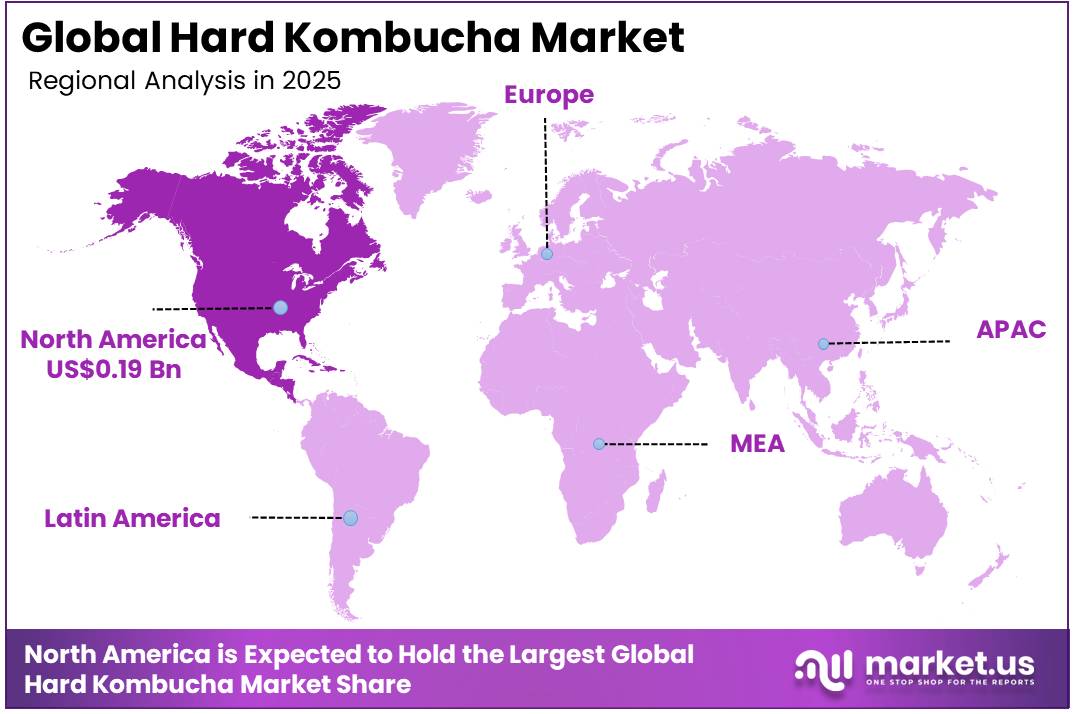
The Global Hard Kombucha Market was valued at USD 0.45 billion in 2025, and between 2026 and 2035, this market is estimated to register a CAGR of 13.5%, reaching about USD 1.97 billion by 2035. North America held a dominant market position, capturing more than a 44.3% share, holding USD 0.19 billion in revenue.
The global hard kombucha market has been gaining strong attention as consumers increasingly look for alcoholic beverages that feel more natural, refreshing, and health-conscious compared to traditional options. Hard kombucha, which combines fermented tea with alcohol, appeals to people who want a balance between taste, wellness, and social drinking.
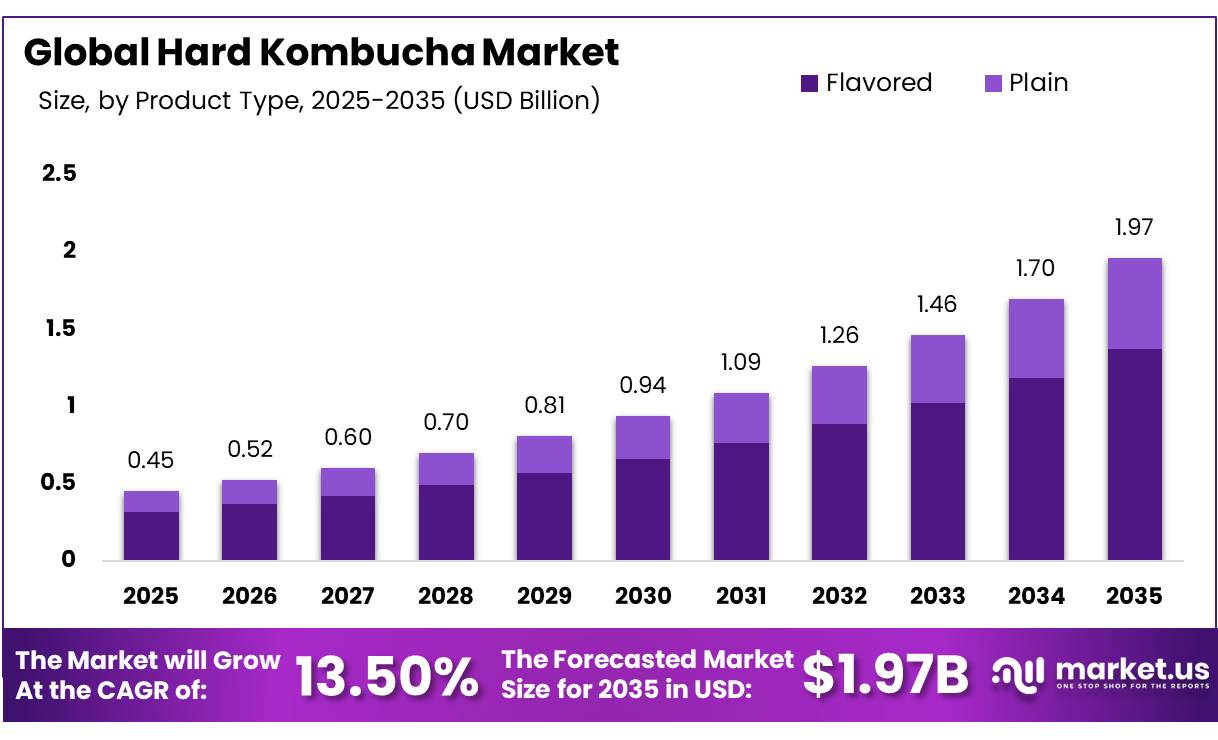
The global hard kombucha industry is evolving as a differentiated niche within alcoholic and functional beverages, shaped by production, packaging, regulatory, and consumer‑health dynamics rather than only revenue metrics. Industrially, hard kombucha typically occupies an ABV band of about 4–7%, aligning with beer and RTD categories while leveraging fermented tea, probiotics, and natural flavor systems to target wellness‑oriented drinkers and experiment‑seeking millennials and Gen Z.
Packaging is dominated by bottled formats, which account for well over two‑thirds of kombucha packaging volumes globally, reflecting their suitability for carbonation management, premium glass positioning, and compliance with labeling requirements for alcoholic beverages. Supermarkets and hypermarkets contribute a substantial share of kombucha distribution, often above 40% of category sales, complemented by e‑commerce and specialty retailers that support small‑batch and craft hard kombucha brands.
Regulators such as the U.S. Alcohol and Tobacco Tax and Trade Bureau treat any kombucha at or above 0.5% ABV as an alcoholic beverage, mandating health warning statements, formula approval, and tax compliance, which directly positions hard kombucha within regulated alcohol rather than soft drinks and shapes future growth opportunities in responsible drinking, transparent labeling, and controlled fermentation standards.
Key Takeaways
- The global hard kombucha market was valued at US$ 0.45 billion in 2025.
- The global hard kombucha market is projected to grow at a CAGR of 13.50% and is estimated to reach US$ 1.97 billion by 2035.
- On the basis of product type, flavored hard kombucha dominated the market, constituting 70% of the total market share.
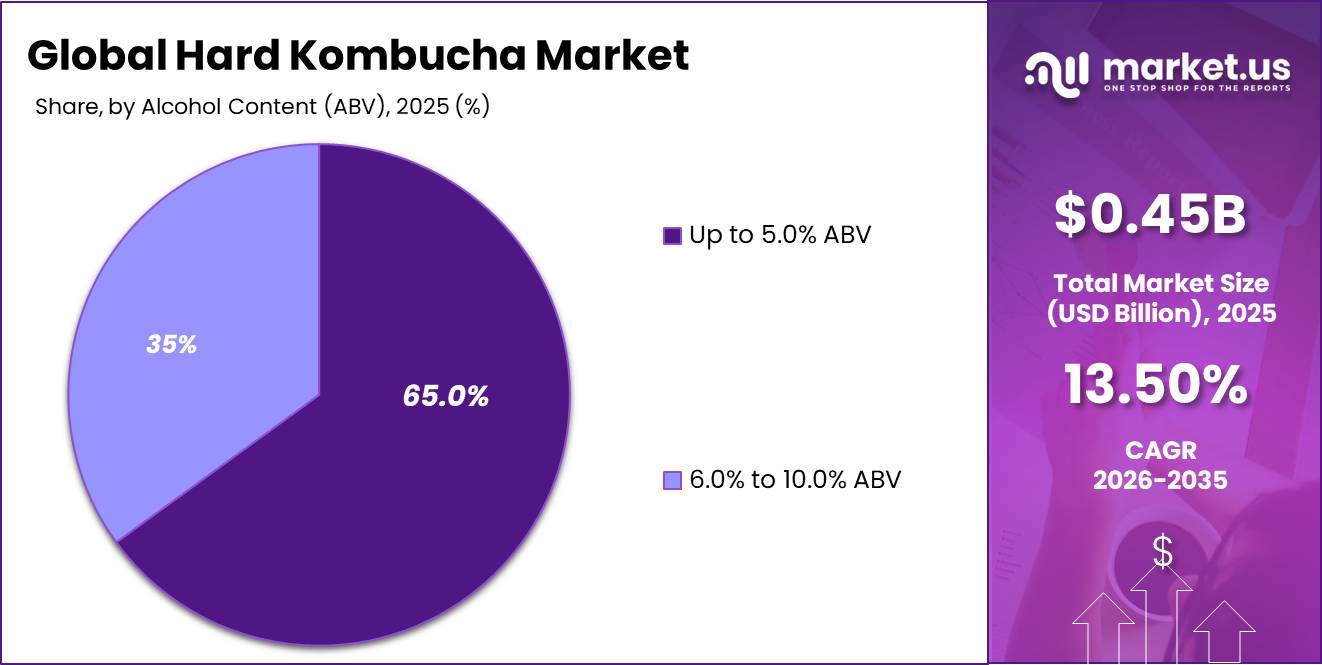
- Based on alcohol content, up to 5.0% ABV hard kombucha dominated the market, with a substantial market share of around 65%.
- Based on category, conventional hard kombucha led the market, comprising 80% of the total market.
- Among distribution channels, food retail held a major share in the hard kombucha market, accounting for 60% of the market share.
- In 2025, North America was the most dominant region in the hard kombucha market, accounting for 44.3% of total global consumption.
Product Type Analysis
Flavored Hard Kombucha Represents the Dominant Segment in the Market
Flavored hard kombucha dominates the global market, accounting for 70% because it makes the drink far more appealing and accessible to everyday consumers. The natural tart and slightly sour taste of kombucha can be off-putting for first-time drinkers, but adding flavors helps soften that intensity and turns it into a more enjoyable, refreshing beverage experience.
Brands are constantly experimenting with a wide range of flavor profiles, including tropical fruits, citrus blends, berries, ginger, floral notes like hibiscus and elderflower, and even wellness-inspired ingredients such as turmeric and adaptogens. This variety helps the product appeal to different age groups and taste preferences while keeping the category exciting and fresh.
Alcohol Content (ABV) Analysis
Up to 5.0% ABV Represents the Most Widely Consumed Alcohol Content Segment
Hard kombucha with lower alcohol content accounted for 65% and has become the leading segment in the global market because it fits naturally with today’s shift toward lighter, more mindful drinking. Many consumers prefer beverages that allow them to enjoy social occasions without the strong effects of traditional alcoholic drinks, and this category delivers exactly that balance.
Another key advantage is its ease of availability and acceptance across retail channels. Lower-ABV hard kombucha is generally easier to distribute and stock in mainstream outlets like supermarkets, cafés, and wellness-focused stores, helping it reach a much wider audience. Its versatility also adds to its appeal, as it can be enjoyed in casual, everyday moments such as meals, outdoor activities, or relaxed gatherings.
Category Analysis
Conventional Hard Kombucha Holds the Dominant Category Position in the Market
Conventional hard kombucha comprises 80%, the largest share of the global market, mainly because it is more widely available and easier on the pocket compared to organic versions. Its affordability and strong presence in everyday retail spaces like supermarkets, convenience stores, and liquor outlets have played a big role in bringing the category into the mainstream.
It also benefits from simpler and more scalable production, since it does not involve the higher sourcing costs and certification requirements linked to organic ingredients. This allows producers to manufacture in larger volumes and keep prices competitive, helping the product reach a much broader audience.
Distribution Channel Analysis
Food Retail Remains the Dominant Distribution Channel for Hard Kombucha Globally
Food retail channels dominate global hard kombucha, accounting for 60% distribution as the product has successfully moved from niche health stores into mainstream grocery spaces. Supermarkets, hypermarkets, and liquor stores play a key role in driving visibility and consumer trial, offering the shelf space, refrigeration, and foot traffic needed to support impulse and repeat purchases.
E-commerce platforms and subscription models allow companies to reach customers without relying heavily on physical retail networks. These channels also help brands build closer relationships with consumers through personalized offerings, repeat delivery options, and stronger storytelling.
Key Market Segments
By Product Type
- Flavored
- Plain
By Alcohol Content (ABV)
- Up to 5.0% ABV
- 6.0% to 10.0% ABV
By Category
- Conventional
- Organic
By Distribution Channel
- Food Retail
- Store-based
- Supermarkets
- Hypermarkets
- Liquor stores
- Non-store-based
- Direct-to-consumer
- Online subscriptions & e-commerce
- Food Service
Market Dynamics
Drivers
| Driver | (~) % Impact on CAGR | Geographic Relevance | Impact Timeline |
|---|---|---|---|
| Health & Wellness Shift Toward Functional Alcoholic Beverages | +3.2% | North America, Western Europe, Australia | Short term (≤ 2 years) |
| Sober-Curious & Moderation Movement Among Millennials & Gen Z | +2.5% | North America, UK, Germany, Australia | Short term (≤ 2 years) |
| Probiotic & Gut Health Awareness Driving Premium Positioning | +2.1% | Global — led by North America & Asia Pacific | Medium term (2–4 years) |
| Craft Beverage Culture & Flavor Innovation Accelerating SKU Velocity | +1.8% | North America, UK, Germany | Short term (≤ 2 years) |
| Retail Channel Premiumization & Natural Grocery Shelf Expansion | +1.4% | North America, Western Europe | Short term (≤ 2 years) |
| Clean-Label & Organic Ingredient Demand Reinforcing Brand Differentiation | +1.0% | Global | Medium term (2–4 years) |
Health & Wellness Shift Toward Functional Alcoholic Beverages
The core accelerant of hard kombucha’s baseline trajectory is the structural realignment of consumer beverage choice away from traditional beer and spirits toward products that deliver a perceivable health rationale alongside alcohol content. Hard kombucha, with its 3–7% ABV range, live active cultures, and organic acid profile including acetic, lactic, and glucuronic acids, occupies a uniquely defensible position at the intersection of the better-for-you (BFY) alcohol segment and the functional beverage category.
This positioning has translated into measurable shelf-mix shifts: natural and specialty grocery chains, which already allocate a disproportionately growing share of chilled beverage real estate to probiotic and low-sugar RTDs, have progressively expanded hard kombucha facings from 1–2 SKUs to upward of 6–10 SKUs per door in high-velocity outlets between 2023 and 2025.
The commercial impact is twofold: higher per-unit retail price points of approximately $4–$7 per 12 oz can versus $1.50–$2.50 for mainstream beer sustain gross margin structures of 45–55% for established producers, while the health-rationale narrative reduces price sensitivity and supports above-average repeat purchase frequency among core users aged 25–44.
Restraints
| Restraint | (~) % Impact on CAGR | Geographic Relevance | Impact Timeline |
|---|---|---|---|
| Multi-Jurisdictional Alcohol Licensing & TTB Compliance Complexity | -2.8% | United States (federal & state level) | Short term (≤ 2 years) |
| Mandatory Alcohol Excise Tax Classification Burden on Small Producers | -1.6% | United States, EU Member States | Short term (≤ 2 years) |
| Restricted On-Premise Distribution in Dry & Partial-Prohibition Jurisdictions | -1.2% | Parts of Middle East, South Asia, select U.S. states | Medium term (2–4 years) |
| High Minimum Capital Outlay for Licensed Production Facility Setup | -1.0% | Global — most acute in Asia Pacific & Latin America | Short term (≤ 2 years) |
| Proposed TTB Mandatory Alcohol Facts Label Overhaul Increasing Compliance Cost | -0.9% | United States | Short term (≤ 2 years) |
Multi-Jurisdictional Alcohol Licensing & TTB Compliance Complexity
Hard kombucha faces a structurally asymmetric regulatory burden relative to nearly every other better-for-you beverage category: the moment a product reaches 0.5% ABV whether at time of bottling or at any point after due to continued live-culture fermentation in the bottle it becomes subject to full TTB oversight under U.S. federal alcohol statutes, including the requirement to operate on a TTB-qualified premises, obtain a Certificate of Label Approval (COLA), comply with the Alcoholic Beverage Labeling Act of 1988, and satisfy mandatory government health warning placement standards per 27 CFR Part 16.
The structural complexity is compounded by the fact that because hard kombucha is typically classified as “beer” under 27 CFR when produced from tea and sugar without malt and hops, it simultaneously escapes the standard FAA Act malt beverage framework yet must still comply with TTB’s mandatory labeling requirements creating a regulatory gray zone requiring specialized legal and compliance counsel that most emerging producers and contract brewers cannot easily absorb.
For a small-to-mid-scale producer targeting 10,000–50,000 BBL annual output, federal and state licensing costs, COLA filing expenses, formula approval timelines of up to 6–8 weeks, and the overlay of state-level alcohol licensing requirements in all 50 U.S. states effectively extend go-to-market timelines by 4–9 months compared to a non-alcoholic functional beverage launch, suppressing the pipeline of new market entrants and constraining the geographic SKU rollout velocity of existing players.
Challenges
| Challenge | (~) % CAGR Friction Drag | Geographic Relevance | Mitigation Horizon |
|---|---|---|---|
| Cold Chain Distribution Dependency | -2.4% | Global — most acute in Asia Pacific, Latin America, MEA | Medium term (2–4 years) |
| Post-Packaging ABV Drift & Quality Inconsistency | -1.8% | Global | Short term (≤ 2 years) |
| Consumer Awareness & Education Gap | -1.5% | Asia Pacific, Latin America, MEA, Southern & Eastern Europe | Medium term (2–4 years) |
| Competing RTD & Hard Seltzer Category Crowding | -1.2% | North America, Western Europe | Short term (≤ 2 years) |
| High COGS vs. Mainstream Alcohol Benchmarks | -1.0% | Global | Medium term (2–4 years) |
| SCOBY Culture Scalability & Batch Consistency Limits | -0.7% | Global — most acute for emerging market producers | Long term (≥ 4 years) |
Cold Chain Distribution Dependency
Unlike shelf-stable RTDs and hard seltzers that tolerate ambient transit at temperatures up to 25°C for extended periods, unpasteurized or minimally pasteurized hard kombucha retains live cultures that continue metabolic activity above approximately 6–8°C, accelerating post-packaging fermentation, driving ABV creep, altering carbonation levels, and degrading flavor profiles within windows as short as 10–14 days at ambient temperature.
The product requires an uninterrupted 2–6°C cold chain from production and distribution to retail and consumption. Refrigerated transport costs about 18–25% more per pallet-mile than dry freight, while cold-storage warehousing carries a 15–30% premium over ambient storage. Chilled retail placement also limits shelf availability to stores with sufficient refrigerated infrastructure.
For producers attempting to expand beyond their home geography, the CapEx required to audit, qualify, and onboard refrigerated third-party logistics (3PL) partners in new regions routinely adds $0.30–$0.55 per unit to landed cost, compressing distributor margin architecture and forcing a choice between sub-optimal ambient shelf trials which risk product quality failures and brand damage or deferring geographic expansion until cold-chain infrastructure investment matures organically.
Opportunities
| Opportunity | (~) % Potential CAGR Upside | Geographic Relevance | Execution Window |
|---|---|---|---|
| On-Premise Hospitality & Food-Service Channel Activation | +2.6% | North America, Western Europe, Australia | Medium term (2–4 years) |
| Functional Variant & Adaptogen-Infused Line Extension (Nootropics, Adaptogens, Electrolytes) | +2.1% | North America, Western Europe, Australia | Medium term (2–4 years) |
| Asia Pacific Market Entry via Fermented-Tea Cultural Affinity | +1.9% | Japan, South Korea, China, India, Southeast Asia | Long term (≥ 4 years) |
| M&A Roll-Up of Undervalued Craft Kombucha & Micro-Brewery Assets | +1.4% | North America, UK, Germany, Australia | Short term (≤ 2 years) |
| Private Label & Contract Brewing for Wellness Retail & Fitness Hospitality Chains | +1.1% | North America, Western Europe | Medium term (2–4 years) |
| E-Commerce & Direct-to-Consumer Subscription Model for Premium SKUs | +0.8% | North America, Western Europe, Australia | Short term (≤ 2 years) |
On-Premise Hospitality & Food-Service Channel Activation
As of 2025, hard kombucha remains underrepresented in bars, restaurants, hotels, fitness venues, and spas, with draft or keg formats available in only a small minority of licensed establishments across North America and Western Europe.
The channel offers stronger economics: on-premise servings typically sell for $9–$16 versus $4–$7 at retail, increasing gross contribution per liter by about 40–60%. Producers could target venue wholesale pricing of $0.20–$0.35 per oz through purpose-built keg formats and bartender education.
Since 2024, the closure of more than 529 U.S. breweries, with further attrition expected through 2026, has created opportunities to acquire or lease brewing sites for hard-kombucha taprooms. Well-operated craft beverage taprooms have historically generated EBITDA margins of 25–40%.
Geopolitical Impact Analysis
Geopolitical Realignment and Supply Chain Fragmentation Reshaping Hard Kombucha Manufacturing
Geopolitical shifts and increasing supply chain fragmentation are significantly influencing the global hard kombucha market. Manufacturers are facing growing challenges related to sourcing ingredients, packaging materials, and fermentation components as international trade tensions, transportation disruptions, and changing regulatory policies continue to affect global supply networks.
Since hard kombucha production relies heavily on specialized ingredients such as organic tea, natural flavor extracts, probiotics, and sustainable packaging materials, any disruption in cross-border supply chains can directly impact production timelines and operational costs.
In response, many companies are rethinking their manufacturing and sourcing strategies by focusing on regional suppliers, localized production facilities, and more resilient distribution networks. Brands are also investing in supply chain transparency and sustainable sourcing practices to reduce dependency on volatile international markets while meeting consumer expectations for ethically produced beverages. y.
Regional Analysis
North America Dominates the Global Hard Kombucha Market, Accounting for 44.3% of Total Global Consumption
North America is widely regarded as the core region of the global hard kombucha market, playing a leading role in shaping its growth, trends, and consumer adoption. This dominance has developed over time, supported by a strong shift toward health-focused lifestyles, higher spending power, and a well-established culture of functional and alternative beverages.
North America’s dominance in the hard kombucha market is not simply a story of geography it is a reflection of a deeply ingrained wellness culture that continues to grow stronger with every passing year. Consumers across the region are not passive drinkers; they are intentional and informed decision-makers who actively seek out beverages that serve a greater purpose beyond refreshment, whether that means supporting gut health, reducing sugar intake, or simply making a smarter choice at the bar.
Key Regions and Countries Covered in this Report
- North America
- The US
- Canada
- Europe
- Germany
- France
- The UK
- Spain
- Italy
- Russia & CIS
- Rest of Europe
- APAC
- China
- Japan
- South Korea
- India
- ASEAN
- Rest of APAC
- Latin America
- Brazil
- Mexico
- Rest of Latin America
- Middle East & Africa
- GCC
- South Africa
- Rest of MEA
Key Players Analysis
The global hard kombucha market is a dynamic, innovation-driven competitive space where a handful of pioneering brands have established clear leadership positions while continuing to face pressure from a growing wave of craft entrants, regional producers, and well-funded new challengers.
The hard kombucha market has seen substantial growth in recent years, driven by increasing consumer demand for alcoholic beverages that are perceived as healthier alternatives, and the key players in this competitive landscape including GT’s Living Foods, JuneShine, Flying Embers, Boochcraft, Wild Tonic, New Holland Brewing, Unity Vibration, and Kombrewcha each bring unique offerings and distinct market positioning to a category that rewards authenticity, quality, and functional credibility above all else.
The market is highly fragmented, with a large number of small and medium-sized players, but is expected to consolidate steadily over the coming years as larger players acquire smaller ones and distribution networks become increasingly centralized around established brand families.
Major Players in the Industry
- Boochcraft
- Flying Ember
- Jiant Hard Kombucha
- JuneShine
- Kombrewcha
- KYLA Hard Kombucha
- Local Roots Kombucha
- Luna Bay Booch
- Strainge Beast Hard Kombucha
- WILD TONIC Jun Kombucha
- Remedy Drinks
- Unity Vibration
- Dr Hops
- Ventura Brewing Company
- Allkind
Key Development
- In May 2025, JuneShine partnered with wellness brand BelliWelli to launch a strawberry dragonfruit hard kombucha with added fiber, highlighting the category’s move toward more functional, ingredient-rich beverage innovation.
- In May 2024, GT’s Living Foods launched its first-ever fan-created SYNERGY Pomelo Pink Lemonade Raw Kombucha following a social media contest that attracted over 17,000 flavor submissions and 25,000 consumer votes.
Report Scope
| Report Features | Description |
|---|---|
| Market Value (2025) | USD 0.45 Bn |
| Forecast Revenue (2035) | USD 1.97 Bn |
| CAGR (2026-2035) | 13.5% |
| Base Year for Estimation | 2025 |
| Historic Period | 2020-2024 |
| Forecast Period | 2026-2035 |
| Report Coverage | Revenue Forecast, Market Dynamics, Competitive Landscape, Recent Developments |
| Segments Covered | By Product Type (Flavored and Plain), By Alcohol Content (Up to 5.0% ABV and 6.0% to 10.0% ABV), By Category (Conventional and Organic), By Distribution Channel (Food Retail, Non-store-based) |
| Regional Analysis | North America – The US & Canada; Europe – Germany, France, The UK, Spain, Italy, Russia & CIS, Rest of Europe; APAC- China, Japan, South Korea, India, ASEAN & Rest of APAC; Latin America- Brazil, Mexico & Rest of Latin America; Middle East & Africa- GCC, South Africa, & Rest of MEA |
| Competitive Landscape | Boochcraft, Flying Embers, Jiant Hard Kombucha, JuneShine, Kombrewcha, KYLA Hard Kombucha, Local Roots Kombucha, Luna Bay Booch, Strainge Beast Hard Kombucha, WILD TONIC Jun Kombucha, Remedy Drinks, Unity Vibration, Dr. Hops, Ventura Brewing Company, and Allkind. |
| Customization Scope | Customization for segments and region/country-level will be provided. Moreover, we can provide further customization to meet your requirements. |
| Purchase Options | We have three licenses to opt for: Single User License, Multi-User License (Up to 5 Users), Corporate Use License (Unlimited Users and Printable PDF) |





































