


Report Overview
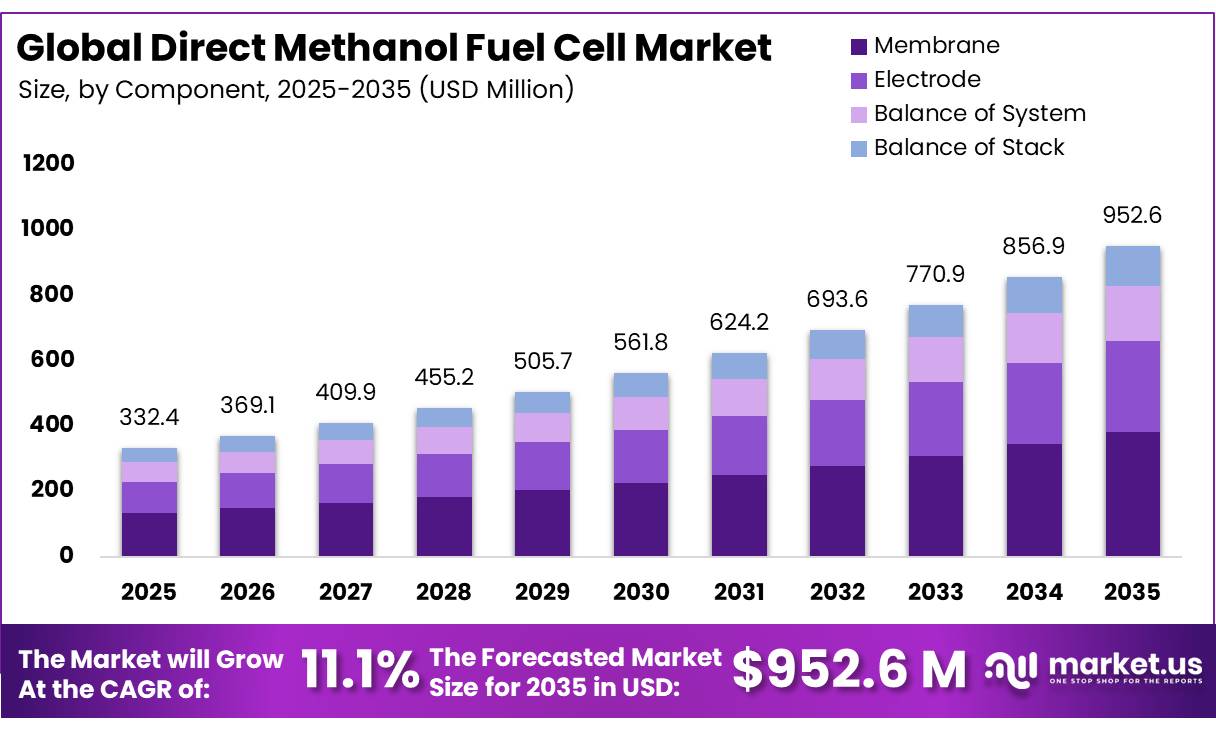
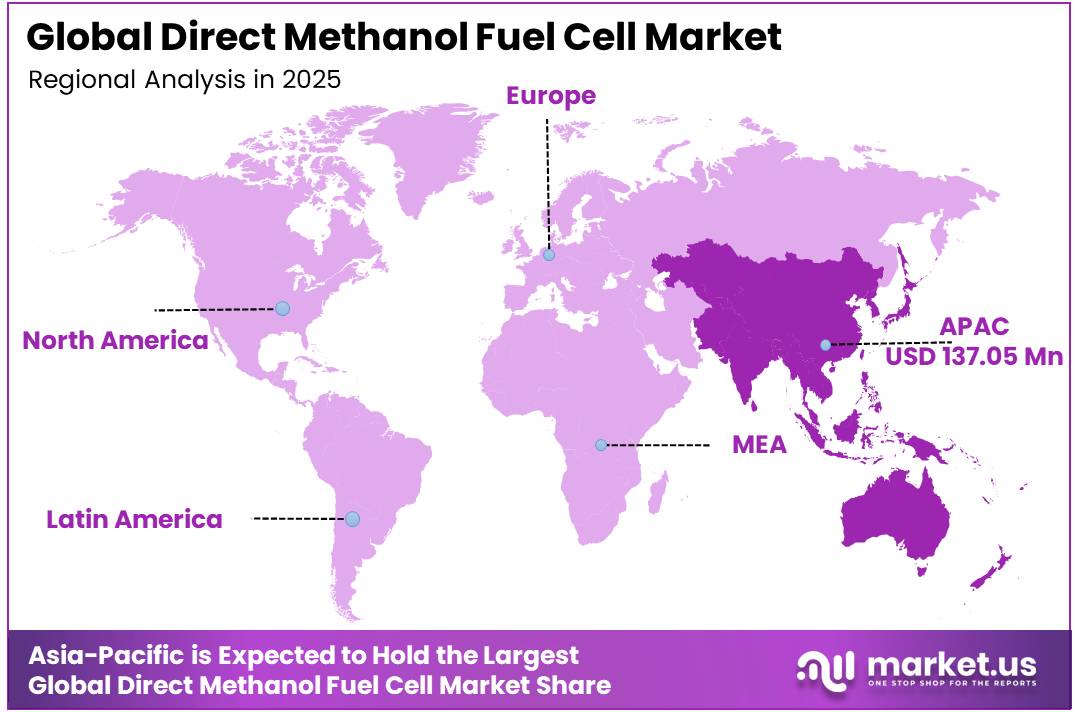
In 2025, the Global Direct Methanol Fuel Cell Market was valued at USD 332.4 Million, and between 2026 and 2035, this market is estimated to register a CAGR of 11.1%, reaching about USD 952.6 Million by 2035. In 2025, Asia-Pacific led the market, achieving over 41.2% share with a revenue of USD 137.05 Million.
Direct methanol fuel cells convert the chemical energy of liquid methanol directly into electricity through an electrochemical process. According to the U.S. Department of Energy, DMFCs feed methanol directly to the anode, eliminating the need for a separate fuel reformer. Methanol also provides higher energy density than hydrogen and is easier to transport as a liquid.
- As of July 2026, the U.S. Department of Energy’s portable fuel-cell technical targets recommended 35% system efficiency and established an ultimate durability target of 5,000 operating hours. The same guidance specified energy-density targets of 650–900 Wh/L, specific-energy targets of 640–650 Wh/kg and manufacturing-cost targets of USD 5–7 per watt for portable fuel-cell systems.
Key Takeaways
- The Global Direct Methanol Fuel Cell Market was valued at US$332.4 Million in 2025.
- The market is projected to grow at a CAGR of 11.1% and is estimated to reach US$952.6 Million by 2035.
- On the basis of Component, Membrane dominated the market, constituting 40.2% of the total market share.
- Based on the Type, Serpentine Flow Field Design dominated the market, with a substantial market share of around 67.5%.
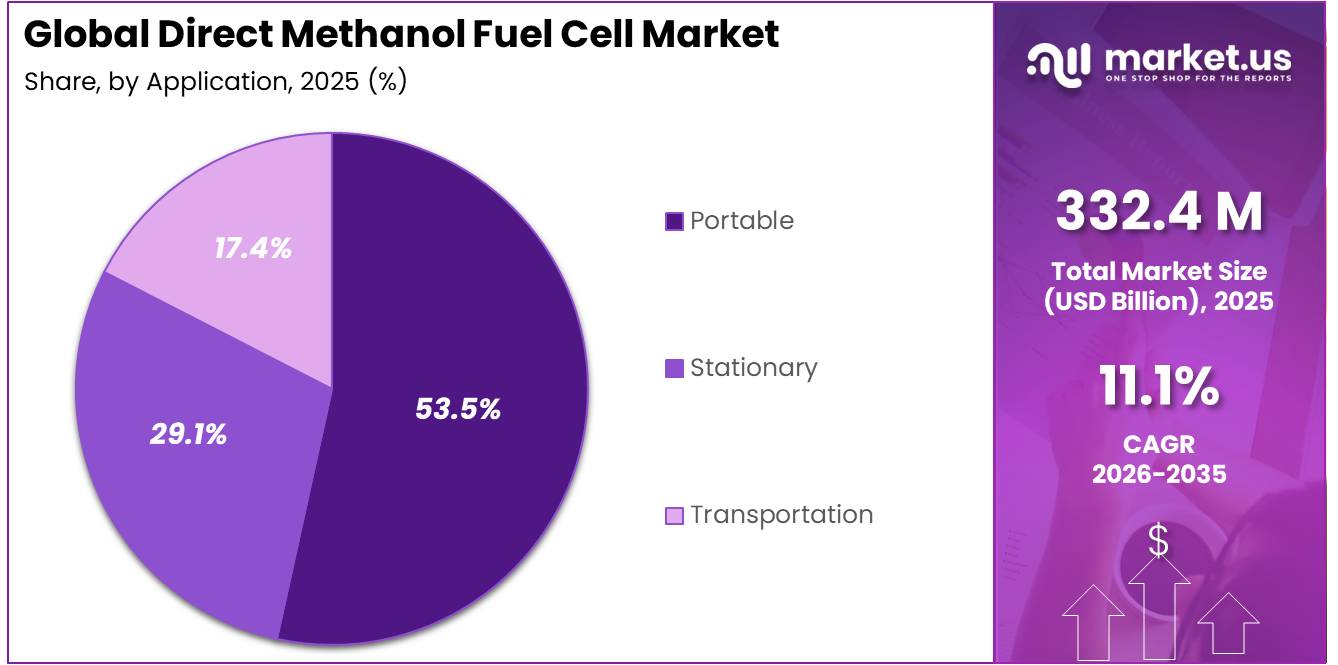
- Based on the Application, Portable led the market, comprising 53.5% of the total market.
- In 2025, Asia-Pacific was the most dominant region in the market, accounting for 41.2% of the total global consumption.
In August 2025, SFC Energy reported that its methanol fuel-cell business for industrial applications in Europe and the United States grew organically by more than 20% during the first half of 2025. This growth reflected increasing demand from civil-security, video-surveillance, data-transmission and digital-infrastructure applications requiring dependable off-grid power.
- In April 2025, SFC Energy received a follow-up order worth EUR 1.5 million for its JENNY and EMILY DMFC systems. The JENNY 600S and JENNY 1200 weighed 1.7 kg and 3.3 kg, respectively, and provided 600 Wh and 1,200 Wh of electrical energy per day. These figures demonstrate the suitability of DMFC technology for field equipment where lower battery weight, quiet operation and extended runtime are important.
In September 2025, SFC Energy presented the EMILY 12000 concept with a nominal output of up to 500 watts and daily electricity production of 12,000 Wh. The system was designed to deliver approximately 4 times the output of the EMILY 3000, while interconnected units could provide up to 5 kW. This product development shows that DMFC manufacturers are gradually moving toward higher-power mobile, stationary and remote applications.
Future growth opportunities are closely connected to renewable methanol production. In March 2026, the Methanol Institute tracked 263 renewable methanol projects with announced capacity of 48.5 million metric tons by 2031. It also identified 18 low-carbon methanol projects representing another 11.2 million metric tons of capacity. These investments could support e-methanol availability and create cleaner fuel pathways for future DMFC deployment.
Component Analysis
Membrane dominates with a 40.2% share due to its central role in proton transfer and fuel-cell efficiency.
In 2025, Membrane held a dominant market position, capturing more than a 40.2% share of the Direct Methanol Fuel Cell Market by component. The membrane acts as the main electrolyte between the anode and cathode, allowing positively charged ions to pass while blocking electrons and unwanted substances. Its quality directly affects methanol crossover, electrical performance, durability, and operating stability. As direct methanol fuel cells are commonly developed for compact and portable power applications, manufacturers continue to favour thin, durable, and highly conductive membrane materials.
In March 2025, the U.S. Department of Energy listed 5 projects receiving USD 150 million under its Fuel Cell Membrane Electrode Assembly and Stack Manufacturing and Automation program. The department also listed 10 projects with USD 82 million for fuel-cell supply-chain development, covering critical fuel-cell materials and components. This investment supports the growing importance of membranes in improving fuel-cell durability, performance, and high-volume production.
Electrode is the fastest-growing segment in the market by component. Its growth is supported by continued work on catalyst loading, surface structure, reaction efficiency, and resistance to methanol-related performance losses. In a direct methanol fuel cell, the anode supports methanol oxidation, while the cathode enables the oxygen-reduction reaction. Better electrode designs can improve power output while reducing the use of expensive catalyst materials.
Type Analysis
Serpentine Flow Field Design dominates with a 67.5% share due to controlled reactant distribution and efficient water removal
In 2025, Serpentine Flow Field Design held a dominant market position, capturing more than a 67.5% share. Serpentine flow field design remained widely preferred in direct methanol fuel cells because its continuous channel path supports controlled methanol and oxygen movement across the active surface. The layout creates stronger pressure differences along the channel, which can improve reactant movement and reduce mass-transfer losses. It also supports the removal of water and reaction products that may otherwise block the electrode surface.
- In July 2025, researchers from the Universidad Politécnica de Madrid reported that reducing the anode serpentine channel depth from 1.5 mm to 0.5 mm increased the peak power density of a 16 cm² direct methanol fuel cell by 14.2%, rising from 33.2 mW/cm² to 37.9 mW/cm².
Parallel Flow Field Design is the fastest growing segment. Its growth is supported by a simple channel structure that allows methanol and oxidants to move through several paths at the same time. This design can be easier to manufacture and adapt for fuel cells with wider active surfaces. Developers are also improving manifold structures and channel dimensions to achieve more uniform flow and prevent uneven fuel distribution. A proper balance between friction and momentum can reduce flow non-uniformity, supporting continued development of parallel designs for compact and scalable direct methanol fuel-cell systems.
Application Analysis
Portable application dominates the Direct Methanol Fuel Cell Market with more than a 53.5% share, supported by compact design and easy liquid-fuel handling.
In 2025, Portable held a dominant market position, capturing more than a 53.5% share of the Direct Methanol Fuel Cell Market. The segment remained ahead because DMFC systems can supply dependable power to battery chargers, communication equipment, laptops, surveillance devices and field electronics where access to the electricity grid is limited. Methanol can be stored and transported as a liquid, making fuel replacement easier during outdoor, military and remote operations.
In May 2026, the European Commission’s CORDIS platform reported that the RESCUE project was developing a transportable methanol- and hydrogen-powered fuel-cell system capable of delivering 50 kW of continuous power and 100 kW of peak power. The system is designed to carry enough methanol for two weeks of operation, maintain at least 99% availability during 2,000 hours of field testing, and achieve a service life of at least 10,000 hours. These performance targets demonstrate the suitability of methanol fuel cells for portable and rapidly deployable power applications.
Stationary is the fastest growing segment in the Direct Methanol Fuel Cell Market. Its growth is supported by increasing demand for continuous electricity at telecommunication sites, remote monitoring stations, residential buildings, commercial facilities and critical infrastructure. Methanol-powered fuel cells can provide electricity with lower noise, fewer moving components and simpler fuel storage compared with conventional generator systems.
Key Market Segments
By Component
- Membrane
- Electrode
- Balance of System
- Balance of Stack
By Type
- Serpentine Flow Field Design
- Parallel Flow Field Design
By Application
- Portable
- Stationary
- Transportation
Driver Analysis
Hydrogen-policy spillover supporting small fuel-cell procurement and validation.
Broader hydrogen and fuel-cell policy is not DMFC-specific, but it materially expands the qualification environment, subsidy stack, and customer familiarity that smaller methanol fuel-cell suppliers can ride. The European Commission states the revised Renewable Energy Directive entered into force in 2023 with binding 2030 renewable-hydrogen uptake targets for industry and transport, while implementation guidance was issued in September 2024 for application by 21 May 2025, and the hydrogen/decarbonised gas market package has been in force since 2024. The same policy architecture targets 10 million tonnes of EU renewable hydrogen production and 10 million tonnes of imports by 2030, creating a much broader institutional market for fuel-cell demonstrations, certification expertise, component sourcing, and public procurement frameworks than existed a few years ago.
In Japan, METI’s strategic energy planning and hydrogen strategy continue to position fuel cells as mobile power sources across transport and equipment contexts, reinforcing Asia’s procurement openness to compact fuel-cell systems even when the program is not methanol-exclusive. Commercially, that spillover reduces customer education cost, shortens technical due diligence, and helps DMFC vendors enter tenders under the broader “low-carbon fuel-cell power” umbrella, supporting roughly +1.3 percentage points of CAGR impact over the medium term.
Drivers Impact Analysis
| Driver | (~) % Impact on CAGR Forecast | Geographic Relevance | Impact Timeline |
|---|---|---|---|
| Portable off-grid power demand backed by liquid-fuel logistics | +1.9% | North America core, EU field operations, APAC remote/industrial corridors | Short term (≤ 2 years) |
| EU maritime fuel-intensity compliance opening methanol-compatible auxiliary niches | +1.6% | EU core, EEA-linked shipping lanes, Mediterranean and North Sea ports | Medium term (2-4 years) |
| Hydrogen-policy spillover supporting small fuel-cell procurement and validation | +1.3% | EU, Japan, South Korea spill-over, selected North America programs | Medium term (2-4 years) |
| High volumetric energy density and rapid refueling improving duty-cycle economics | +1.5% | APAC portable electronics and backup, North America defense/field systems, EU mobile power | Short term (≤ 2 years) |
| Catalyst and membrane efficiency gains reducing methanol crossover and stack loading | +1.4% | Global manufacturing base, especially U.S., EU, Japan R&D-to-commercial pipelines | Medium term (2-4 years) |
| Emissions-control and zero-emission-at-berth rules favoring cleaner auxiliary power substitution | +1.1% | EU ports core, coastal logistics nodes, island grids and harbor services | Long term (≥ 4 years) |
Restraint Analysis
Methanol toxicity compliance
Methanol’s health-risk profile directly raises commercialization friction because U.S. EPA documents acute risks including visual disturbance, neurological injury, and blindness from exposure, while OSHA and NIOSH workplace thresholds hold methanol at 200 ppm over an 8-hour time-weighted average with a 250 ppm short-term ceiling, forcing DMFC manufacturers and integrators to build sealed cartridge systems, leak detection, ventilation controls, labeling, training, and hazardous handling protocols into even small-format products.
In market terms, that pushes bill-of-materials and compliance overhead upward for portable and backup-power deployments, lengthens customer qualification cycles in enterprise and public-sector channels, and limits retail acceptance for open consumer distribution, especially where distributors must underwrite product stewardship and workplace exposure liabilities; the modeled CAGR drag of about 2.1 percentage points reflects slower channel expansion rather than a collapse in core technical demand.
Restraint Impact Analysis
| Restraint | (~) % Impact on CAGR Forecast | Geographic Relevance | Impact Timeline |
|---|---|---|---|
| Methanol toxicity compliance | -2.1% | North America core, EU, Japan, Korea | Short term (≤ 2 years) |
| Membrane crossover losses | -2.4% | Global, especially NA/EU/APAC OEM hubs | Medium term (2-4 years) |
| Fuel logistics cost volatility | -1.8% | EU, Northeast Asia, import-dependent APAC | Short term (≤ 2 years) |
| Hazardous storage and transport burden | -1.5% | North America core, EU, urban APAC | Medium term (2-4 years) |
| Narrow application economics | -2.0% | Global, strongest in mass-market electronics | Medium term (2-4 years) |
| Standards and permitting lag | -1.2% | EU, North America, developed APAC corridors | Long term (≥ 4 years) |
Opportunity Analysis
Telecom backup retrofit
The white space is in retrofitting distributed tower portfolios in 24-hour to 72-hour resilience segments where batteries alone become weight- and recharge-constrained, especially across remote edge networks; a realistic monetizable serviceable market by 2030 is roughly 0.35 million to 0.55 million off-grid or poor-grid telecom sites across India, Southeast Asia, Africa, and selected North American hardening programs, with an attainable DMFC capture of 3% to 5% equating to 10,500 to 27,500 sites and roughly $420 million to $1.05 billion in stack-and-balance-of-system revenue at $40,000 per multi-site-equivalent deployment, plus recurring methanol service revenue of $3,000 to $6,000 per site annually.
If operators can lower truck rolls by 20% to 30%, cut preventive maintenance events from 4-6 visits per year to 2-3, and reduce backup lifecycle cost by 12% to 18% versus diesel-heavy configurations, this can add about 2.4 percentage points to market CAGR above baseline because it creates an aftermarket fleet conversion pool rather than relying on existing portable-power demand already embedded in current forecasts.
Opportunity Impact Analysis
| Opportunity | (~) % Potential CAGR Upside | Geographic Relevance | Execution Window |
|---|---|---|---|
| Telecom backup retrofit | +2.4% | North America core, India, SE Asia, Africa | Short term (≤ 2 years) |
| Data center micro-backup | +1.9% | U.S., EU, Japan, South Korea | Short term (≤ 2 years) |
| Inland marine auxiliary power | +2.1% | EU core, China, Japan | Medium term (2-4 years) |
| Defense-portable power kits | +1.6% | U.S., NATO Europe, India | Medium term (2-4 years) |
| Methanol cartridge model | +2.7% | Japan, EU, North America | Short term (≤ 2 years) |
| Green methanol premium stack | +1.8% | EU, Nordics, South Korea | Long term (≥ 4 years) |
Challenges Analysis
System integration complexity
System integration complexity reflects the non‑trivial engineering and operational work required to embed DMFC systems into existing telecom, defense, mobility, and industrial power architectures, aligning voltage profiles, safety interlocks, remote monitoring, and hybridization with batteries or other backup sources. Practical deployments, such as methanol fuel cell systems powering border protection equipment and mission‑critical communication platforms, demonstrate that DMFC solutions can operate reliably in off‑grid environments but often require custom power conditioning units, control logic to handle variable load profiles, and environmental hardenin, adding integration overhead of 10–20% to hardware bill‑of‑materials and 15–30% to engineering hours compared with plug‑and‑play battery systems. Average integration timelines for complex sites can stretch from 8–10 weeks for conventional backup to 14–20 weeks for fully instrumented DMFC systems, with post‑deployment tuning cycles involving 3–5 site visits and field adjustments, while interoperability with existing SCADA and telecom remote management platforms sometimes demands bespoke interfaces and data models.
This complexity imposes an estimated 0.9 percentage point drag on achievable CAGR because some operators cap DMFC deployment at specific site categories, prefer phased integration across 10–20% of their asset base before scale‑up, and structure contracts to include extended pilot phases, which slows market penetration but keeps continuous sales flowing in targeted segments. Strategically, DMFC suppliers are investing in standardized modular architectures, pre‑certified interface kits for major telecom and industrial control vendors, and digital twins that simulate site‑level performance using historical load profiles, aiming to cut engineering effort per site by 30–40%, halve commissioning iterations, and bring average integration cycles down below 10–12 weeks across most use cases within a 2–4‑year horizon.
Challenges Impact Analysis
| Challenge | (~) % CAGR Friction Drag | Geographic Relevance | Mitigation Horizon |
|---|---|---|---|
| Platinum-group catalyst strain | -1.6% | North America, EU, East Asia | Long term (≥ 4 years) |
| Methanol value-chain volatility | -1.3% | APAC industrial hubs, EU ports | Medium term (2-4 years) |
| Membrane durability bottlenecks | -1.2% | Global early adopters | Long term (≥ 4 years) |
| Applied DMFC talent gap | -1.0% | North America, EU, Japan, India | Medium term (2-4 years) |
| System integration complexity | -0.9% | Telecom & defense corridors | Medium term (2-4 years) |
| Standards & safety harmonization lag | -0.8% | Global, esp. cross-border logistics | Long term (≥ 4 years) |
Geopolitical Impact Analysis
The Russia-Ukraine War Is Reshaping the Direct Methanol Fuel Cell Market.
The war between Russia and Ukraine has moved beyond the battlefield and into chemical supply chains, and the direct methanol fuel cell industry is feeling the pinch. Russia remains one of the world’s largest methanol producers, and repeated drone strikes on its refineries and export terminals through 2026 have squeezed output and disrupted shipping routes that manufacturers once took for granted.
This has pushed component makers to look elsewhere. Middle Eastern and Southeast Asian suppliers are picking up orders that once went to Russian plants, though switching sources takes time and money. Platinum, a key ingredient in fuel cell catalysts, has also seen tighter, pricier trading conditions as sanctions and rerouted logistics ripple through metal markets.
For an industry still working to bring costs down and scale up production, this kind of instability is unwelcome. Companies are now building in supplier backups and holding larger inventories, treating geopolitical risk as a permanent line item rather than a passing concern. The war has, in effect, forced the market to grow up faster on the supply side than it might have otherwise.
Regional Analysis
Asia-Pacific Dominates the Direct Methanol Fuel Cell Market.
Asia-Pacific commanded the Direct Methanol Fuel Cell Market in 2025, accounting for 41.2% of global revenue, valued at US$137.05 Million. This dominance is underpinned by the region’s deep manufacturing base for electronics, telecommunications equipment, and portable power devices, where methanol fuel cells are increasingly favoured for backup and off-grid power applications. Countries such as China, Japan, and South Korea host a dense cluster of component suppliers, catalyst producers, and system integrators, giving the region an integrated supply chain that keeps production costs competitive.
Europe has been identified as the fastest-growing region within the market, driven by a tightening regulatory push toward decarbonisation and reduced reliance on fossil-fuel-based backup power. European governments and industrial users are exploring direct methanol fuel cells as a lower-emission alternative for portable and stationary power needs, particularly in telecommunications, marine, and remote industrial settings where grid access is limited.
Key Regions and Countries Covered
- North America
- The US
- Canada
- Europe
- Germany
- France
- The UK
- Spain
- Italy
- Russia & CIS
- Rest of Europe
- APAC
- China
- Japan
- South Korea
- India
- ASEAN
- Rest of APAC
- Latin America
- Brazil
- Mexico
- Rest of Latin America
- Middle East & Africa
- GCC
- South AfricA
- Rest of MEA
Key Players Analysis
Horizon Fuel Cell Technologies strengthens its position through a broad fuel cell platform rather than a pure DMFC-only portfolio. Founded in 2003 and headquartered in Singapore, the company holds over 350 intellectual-property assets and works with more than 200 cooperative partners. It launched a methanol-reforming fuel cell system, the MFC Mini, in 2015, and its product range now spans from 100 W modules up to 400 kW fuel cell stacks, alongside megawatt-scale stationary and electrolyser solutions.
MeOH Power, Inc. remains a legacy developer associated with direct methanol fuel cell commercialization, particularly for compact portable power systems. According to Soluna Holdings’ SEC filings, Soluna has held approximately 47.5% of MeOH Power, equal to 75,049,937 shares, out of 240,000,000 authorized shares a stake that has stayed unchanged across its filings for several consecutive years.
Bren-Tronics Incorporated contributes to the direct methanol fuel cell ecosystem mainly through military power integration, rugged batteries, and charging systems compatible with fuel-cell inputs. Founded in 1973, the company generated approximately USD 100 million in 2023 sales and employed about 280 people across the United States, France, and the United Kingdom. EnerSys acquired Bren-Tronics in 2024 for USD 208 million, roughly 8.7 times its trailing adjusted EBITDA.
TreadStone Technologies Inc. supports fuel cell commercialization through advanced coatings for metal bipolar plates and current collectors. Founded in 2006, the company was built on the electrochemical coatings expertise of co-founder Dr. Conghua Wang, holder of more than 67 patents, and has secured over USD 12 million in competitive U.S. government grants since 2010. TreadStone markets three coating families DOT, DuraC, and TiOx and its North American facility is scaled to supply more than 1 GW of coated components annually. These capabilities can materially reduce corrosion, resistance, and overall stack costs.
The Major Players in The Industry
- SFC Energy AG
- Samsung SDI
- Ballard Power Systems Inc.
- Oorja Protonics Inc.
- Horizon Fuel Cell Technologies
- Meoh Power, Inc.
- Bren-Tronics Incorporated
- Treadstone Technologies Inc.
- Viaspace Inc.
- I. Du Pont De Nemours and Company
- Ird Fuel Cell A/S
- Johnson Matthey
- Fujikura Limited
- Antig Technology Co. Ltd.
- DuPont Fuel Cell
- Polyfuel Inc
- Other Key Players
Key Development
- In October 2025, SFC Energy AG signed an agreement to acquire a 15% stake in Singapore-based Oneberry Technologies, supporting its expansion into AI-enabled security and autonomous surveillance applications. The acquisition was completed in March 2026 and was supported by a EUR 6.6 million order, while approximately 5,000 EFOY fuel cell systems had already been deployed through the companies’ 15-year
- In March 2025, Samsung SDI began mass production of its new 4695 cylindrical battery, measuring 46 mm in diameter and 95 mm in height, and started supplying the product to a U.S. customer for micro-mobility applications.
Report Scope
| Report Features | Description |
|---|---|
| Market Value (2025) | USD 332.4 Mn |
| Forecast Revenue (2035) | USD 952.6 Mn |
| CAGR (2026-2035) | 11.1% |
| Base Year for Estimation | 2025 |
| Historic Period | 2020-2024 |
| Forecast Period | 2026-2035 |
| Report Coverage | Revenue Forecast, Market Dynamics, Competitive Landscape, Recent Developments |
| Segments Covered | By Component (Membrane, Electrode, Balance of System, and Balance of Stack), By Type (Serpentine Flow Field Design and Parallel Flow Field Design), By Application (Portable, Stationary, and Transportation) |
| Regional Analysis | North America – The US & Canada; Europe – Germany, France, The UK, Spain, Italy, Russia & CIS, Rest of Europe; APAC– China, Japan, South Korea, India, ASEAN & Rest of APAC; Latin America– Brazil, Mexico & Rest of Latin America; Middle East & Africa– GCC, South Africa, & Rest of MEA |
| Competitive Landscape | FC Energy AG, Samsung SDI, Ballard Power Systems Inc., Oorja Protonics Inc., Horizon Fuel Cell Technologies, Meoh Power, Inc., Bren-Tronics Incorporated, Treadstone Technologies Inc., Viaspace Inc., E. I. Du Pont De Nemours and Company, Ird Fuel Cell A/S, Johnson Matthey, Fujikura Limited, Antig Technology Co. Ltd., DuPont Fuel Cell, Polyfuel Inc., and other key players. |
| Customization Scope | Customization for segments, region/country-level will be provided. Moreover, additional customization can be done based on the requirements. |
| Purchase Options | We have three licenses to opt for: Single User License, Multi-User License (Up to 5 Users), Corporate Use License (Unlimited Users and Printable PDF) |





































