


Report Overview
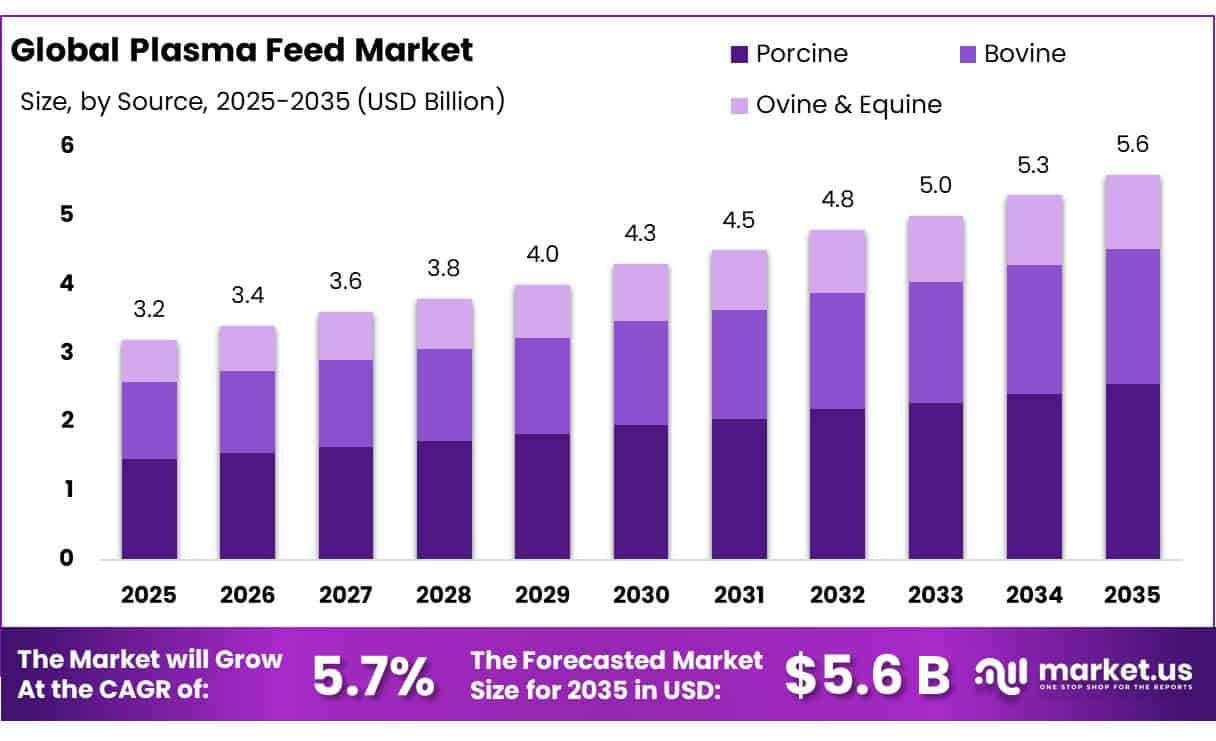
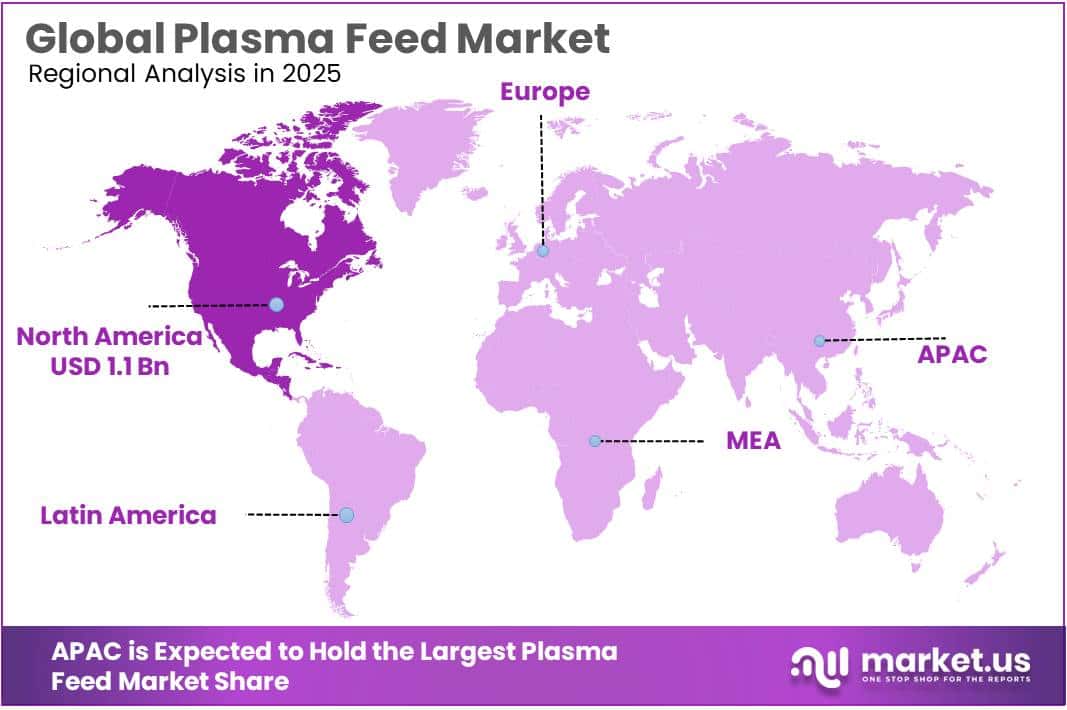
The Global Plasma Feed Market size is expected to be worth around USD 5.6 Billion by 2035, from USD 3.2 Billion in 2025, growing at a CAGR of 5.7% during the forecast period from 2026 to 2035. In 2025, North America held a dominant market position, capturing more than a 35.0% share, holding USD 1.14 Billion revenue.
Plasma feed is a high-value functional animal-nutrition ingredient produced mainly from porcine or bovine blood collected from healthy animals approved for food processing. Manufacturing separates plasma from red blood cells, concentrates the liquid fraction and spray-dries it into a stable protein powder containing immunoglobulins, albumin and other bioactive proteins.
- The International Feed Industry Federation estimates world compound-feed production could reach about 1.4 billion tonnes in 2025, while commercial feed manufacturing generates more than USD 500 billion in annual turnover. IFIF source In Europe, FEFAC reported 147.1 million tonnes of industrial compound feed in 2024, including 47.6 million tonnes for pigs and 49.9 million tonnes for poultry and eggs.
Key Takeaways
- Environmental DNA Market size is expected to be worth around USD 5.6 Billion by 2035, from USD 3.2 Billion in 2025, growing at a CAGR of 5.7%.
- Porcine held a dominant market position, capturing more than a 45.1% share of the Plasma Feed Market.
- Swine Feed held a dominant market position, capturing more than a 24.30% share of the Plasma Feed Market.
- Powder held a dominant market position, capturing more than an 82.00% share of the Plasma Feed Market.
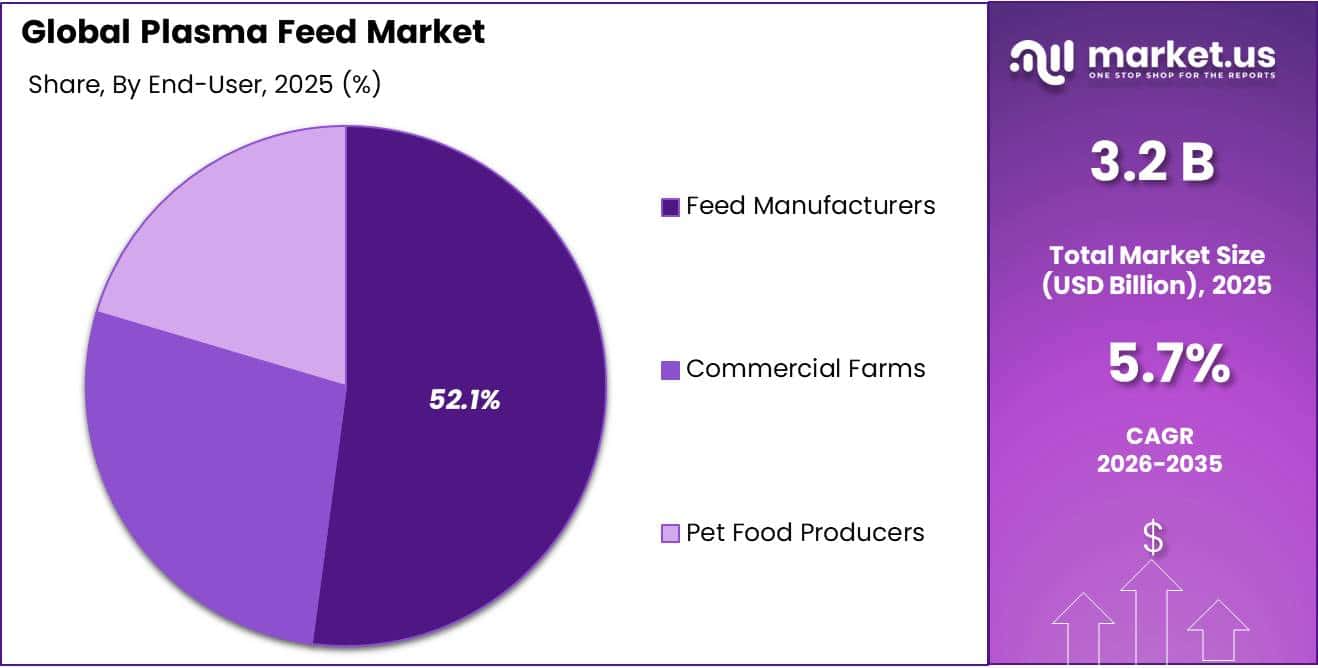
- Feed Manufacturers held a dominant market position, capturing more than a 52.00% share of the Plasma Feed Market.
- North America held a dominant market position, capturing more than a 35.00% share and reaching approximately USD 1.14 billion.
Swine nutrition remains one of the most established uses because weaning creates nutritional and intestinal-health stress. USDA reported a U.S. hog and pig inventory of 75.5 million head in December 2025, including 69.6 million market hogs, with the total herd up 1% year over year. USDA source A 2025 scientific study involving 90 piglets found spray-dried porcine plasma increased first-week feed intake from 215 to 280 g/day and weight gain from 133 to 205 g/day versus the control diet.
- The European Commission targets a 50% reduction in overall EU sales of antimicrobials for farmed animals and aquaculture by 2030. European Commission source EMA reported 3,297.2 tonnes of antimicrobials used across cattle, pigs, chickens and turkeys in the EU in 2024, up 0.94% from 2023.
Supply-side development is becoming more global. APC, a specialist in plasma-derived functional proteins, reports 18 manufacturing facilities across 8 countries and sales coverage in 58 countries. APC source This footprint shows that plasma feed has developed into an internationally supplied specialty-protein business supported by dedicated collection, processing and quality-control systems.
Future opportunities are likely to broaden beyond nursery pigs. FAO reported that aquaculture production of aquatic animals exceeded 100 million tonnes in 2024 for the first time and was valued at USD 371 billion at farm gate. FAO source Growth in aquaculture, poultry starter diets and premium pet foods can support demand for digestible functional proteins.
By Source Analysis
Porcine dominates the Plasma Feed Market with a 45.1% share, supported by a large commercial swine base.
In 2025, Porcine held a dominant market position, capturing more than a 45.1% share of the Plasma Feed Market. Porcine plasma is widely used in feed because it provides highly digestible proteins and functional components that are particularly useful in young-animal nutrition. The large commercial pig population also supports a steady raw-material base for plasma collection and processing.
- According to the USDA National Agricultural Statistics Service, U.S. farms held 74.3 million hogs and pigs as of March 2026, including 68.4 million market hogs. This established livestock base supports the availability of porcine blood plasma for specialized feed ingredients and helps manufacturers maintain commercial-scale production.
Bovine plasma feed remains an important source segment because cattle processing provides a sizeable stream of blood that can be converted into functional feed proteins instead of being treated as a low-value by-product.
USDA reported that the United States had 86.2 million cattle and calves at the beginning of 2026, including 37.2 million cows and heifers that had calved and 27.6 million beef cows. This large cattle population provides a substantial potential raw-material base for bovine plasma recovery and supports further development of value-added plasma feed products.
By Application Analysis
Swine Feed dominates the Plasma Feed Market with a 24.30% share, supported by the large commercial pig population.
In 2025, Swine Feed held a dominant market position, capturing more than a 24.30% share of the Plasma Feed Market. Plasma proteins are widely included in young-pig diets because they provide highly digestible protein and functional components that can support feed intake and early-stage nutrition after weaning. The commercial scale of pig farming also creates steady demand for specialized feed ingredients.
- According to the U.S. Department of Agriculture, the United States had 73.7 million hogs and pigs as of June 2026, of which 67.8 million were market hogs. This large production base continues to support demand for nutritional feed solutions used across nursery and commercial swine operations.
Pet Food is emerging as an important application area for plasma feed because manufacturers are increasingly developing products focused on digestibility, protein quality, palatability and functional nutrition. Plasma-derived proteins can fit premium formulations where animal-origin functional ingredients are used to improve product performance.
A 2026 USDA Foreign Agricultural Service report stated that China imported USD 474.1 million of packaged pet food during 2025, while U.S. pet food exports to China reached USD 244.7 million. The same government report noted that total packaged pet food imports declined by 5.2%, while functional foods and specialized products continued to stand out as important areas of product development.
By Form Analysis
Powder leads the Plasma Feed Market with an 82.00% share due to easier blending, storage, and large-scale feed handling.
In 2025, Powder held a dominant market position, capturing more than an 82.00% share of the Plasma Feed Market. Powder plasma is widely preferred because spray-dried material can be blended more easily with commercial compound feeds, transported efficiently, and stored without the handling requirements associated with liquid ingredients. This format is particularly suitable for starter feeds and other high-value animal nutrition products where uniform ingredient distribution is important.
- Supporting the scale of dry-feed consumption, the USDA Economic Research Service estimated U.S. feed and residual use of the four major feed grains at 159.176 million metric tons for the 2025/26 marketing year, with corn representing more than 97% of that volume.
Liquid plasma represents a more specialized form within the Plasma Feed Market. It can be used where feed manufacturers or animal-production facilities have suitable refrigerated storage, controlled transportation, and nearby processing infrastructure.
In 2025, the European Commission specifically recognized dried, frozen and liquid plasma within blood products used as feed materials and also referred directly to spray-dried plasma in finished feed. This regulatory recognition confirms that liquid plasma has an established place in the animal-feed supply chain, although powder remains more practical for broad commercial distribution.
By End-Use Analysis
Feed Manufacturers dominate the Plasma Feed Market with a 52.00% share, supported by large-scale compound feed production.
In 2025, Feed Manufacturers held a dominant market position, capturing more than a 52.00% share of the Plasma Feed Market. Feed manufacturers remain the main users because powdered plasma can be directly incorporated into standardized formulations for piglets, poultry, aquaculture, and specialty animal diets. Large feed plants also have established systems for ingredient dosing, quality control, storage, and bulk purchasing, making plasma easier to use at commercial scale.
- USDA Economic Research Service data estimated U.S. feed and residual use of corn, sorghum, barley, and oats at 159.176 million metric tons during the 2025/26 marketing year, with corn accounting for more than 97% of the total.
Commercial Farms represent an important end-use segment for plasma feed, particularly in intensive swine and cattle operations where early growth, feed intake, and animal performance are closely managed. Farms can use plasma-containing finished feeds or specialized nutritional programs supplied through feed manufacturers and distributors.
USDA also recorded 94.2 million cattle and calves on U.S. farms in July 2026, demonstrating the large commercial livestock base that requires substantial volumes of nutritionally balanced feed. This scale creates continuing opportunities for functional feed ingredients that support efficient commercial animal production.
Key Market Segments
By Source
- Porcine
- Bovine
- Ovine & Equine
By Application
- Swine Feed
- Pet Food
- Aquaculture
- Poultry Feed
- Ruminant Feed
By Form
- Powder
- Liquid
- Granular / Pellets
By End-Use
- Commercial Farms
- Feed Manufacturers
- Pet Food Producers
Driver Analysis
Post-Weaning Piglet Gut-Health Demand
This changes procurement logic from “lowest protein cost per kilogram” to “cost avoided per piglet”: a 2–6% inclusion rate during the first 7–21 days post-weaning can be economically viable if it reduces treatments, mortalities, underweight pigs, and later sorting costs, particularly in 5,000–50,000-head integrated nursery systems where a 1 percentage-point reduction in morbidity affects hundreds of animals per production cycle.
The business-model consequence is a shift toward premium starter-feed packages, veterinarian-supported feeding protocols, and performance-guarantee contracting rather than bulk plasma sales; suppliers that provide digestibility, immunoglobulin, microbial-testing, and lot-traceability data can sustain estimated 20–40% price premiums relative to conventional plant-protein concentrates.
Global pork production is projected to rise about 0.6% to 120.2 million tonnes in 2026, with Brazil up 3.2%, the United States up 1.4%, and China reaching around 59.5 million tonnes, preserving a large nursery-pig base for functional starter-feed use despite a projected 1.2% EU decline. This performance-led, high-value use case is estimated to contribute +1.6 percentage points to baseline plasma-feed CAGR across China, North America, Europe, Brazil, and Southeast Asia through 2028–2030.
Drivers Impact Analysis
| Driver | (~) % Impact on CAGR Forecast | Geographic Relevance | Impact Timeline |
|---|---|---|---|
| Post-weaning piglet gut-health demand | +1.6% | China, EU, North America, Brazil, Southeast Asia | Medium term (2-4 years) |
| ASF biosecurity and feed-safety protocols | +1.2% | China, Southeast Asia, EU, South Korea, Latin America | Short term (≤ 2 years) |
| Antibiotic-reduction nutrition programs | +1.0% | EU, North America, China, South Korea | Medium term (2-4 years) |
| High-value pet-food palatability inclusion | +0.9% | North America core, EU, Japan, South Korea | Short term (≤ 2 years) |
| Aquaculture functional-protein adoption | +0.8% | China, India, Southeast Asia, Norway, Chile | Long term (≥ 4 years) |
| Traceable rendering supply integration | +0.7% | North America, EU, Brazil, China | Medium term (2-4 years) |
Restraint Analysis
Ruminant Feed-Use Prohibitions
The addressable market for plasma-derived feed ingredients is structurally capped by transmissible-spongiform-encephalopathy safeguards that restrict mammalian proteins in ruminant rations; EU Regulation (EC) 999/2001 retains a permanent ruminant-feed ban, and Regulation (EC) 999/2001 Annex IV additionally prohibits blood products derived from ruminants for non-ruminant feed, while parallel U.S. BSE rules restrict mammalian proteins and specified bovine-risk materials in cattle, sheep, and goat feed.
In economic terms, excluding a major livestock category suppresses potential utilization diversification, raises the volatility of margins when piglet-feed demand contracts, and strands part of the value of bovine slaughter by-products in lower-return channels; the limitation is expected to subtract roughly 1.4 percentage points from theoretical plasma-feed CAGR over the long term across EU, North America, the UK, and similarly regulated APAC markets.
Restraint Impact Analysis
| Restraint | (~) % Impact on CAGR Forecast | Geographic Relevance | Impact Timeline |
|---|---|---|---|
| Ruminant feed-use prohibitions | -1.4% | EU, North America, UK, APAC regulated markets | Long term (≥ 4 years) |
| ASF-linked porcine plasma restrictions | -1.3% | China, Southeast Asia, EU, South Korea, Latin America | Short term (≤ 2 years) |
| Premium pricing versus substitutes | -1.0% | APAC, Latin America, Africa, cost-led swine markets | Short term (≤ 2 years) |
| Biosecurity validation CapEx | -0.8% | Global, acute in export-oriented supply chains | Medium term (2-4 years) |
| Slaughter-blood supply concentration | -0.7% | North America, EU, Brazil, China | Medium term (2-4 years) |
| Species-segregation compliance costs | -0.6% | EU, UK, North America, China | Medium term (2-4 years) |
Opportunity Analysis
Shrimp-Health Feed Platforms
Peer-reviewed work in Pacific white shrimp found that 4.5–6.0% spray-dried plasma inclusion improved body weight, survival, feed conversion, immune response, and resistance to Vibrio parahaemolyticus, while farm-scale Thai black tiger shrimp trials using 4.5% SDPP during days 30–60 post-stocking showed better FCR, lower intestinal and hepatopancreatic Vibrio counts, and two of three plasma-fed ponds remaining AHPND-negative during an outbreak that affected all control ponds.
The economic model is attractive because plasma need not replace bulk fishmeal across the entire diet: a targeted 3–6% inclusion in nursery, stress, or challenge-period feed can be sold with survival and FCR monitoring, allowing suppliers to capture an estimated 30–60% price premium over conventional animal protein while lowering producers’ disease-treatment and mortality costs.
Global aquafeed demand for all fish species rose from about 49.7 million tonnes in 2015 to roughly 87.1 million tonnes in 2025, so capturing even 0.1% of specialist shrimp-feed volume through high-inclusion health diets would create a meaningful new outlet without requiring broad commodity substitution.
Opportunity Impact Analysis
| Opportunity | (~) % Potential CAGR Upside | Geographic Relevance | Execution Window |
|---|---|---|---|
| Shrimp-health feed platforms | +1.5% | China, India, Vietnam, Thailand, Ecuador | Medium term (2-4 years) |
| Premium pet-health formulations | +1.2% | North America, EU, Japan, South Korea | Short term (≤ 2 years) |
| Fractionated immunoglobulin products | +1.0% | North America, EU, China, Brazil | Long term (≥ 4 years) |
| Outcome-linked nursery programs | +0.9% | China, EU, North America, Brazil | Medium term (2-4 years) |
| Certified biosecure trade corridors | +0.8% | China, Southeast Asia, EU, South Korea | Short term (≤ 2 years) |
| Abattoir-to-feed integration roll-ups | +0.7% | Brazil, U.S., EU, China | Medium term (2-4 years) |
Challenges Analysis
Bioactivity–Thermal Safety Balancing
The commercial tension is direct: raising outlet temperature, dwell time, UV-C dose, or secondary heat treatment can improve pathogen-reduction assurance, but excessive treatment risks lower protein solubility, altered molecular conformation, reduced antigen-binding activity, and weaker in-feed performance, whereas insufficient treatment can create regulatory, customer-audit, and ASF-related reputational exposure.
A producer running a 20,000-tonne annual facility can lose an estimated 3–8% of high-value output to downgraded functional activity if process parameters drift beyond validated limits, while a 1–2% decline in nursery-pig performance consistency can be sufficient for a large integrator to switch to soy concentrate, yeast, or hydrolysed protein substitutes.
The required long-term response is real-time moisture and water-activity control, inline temperature mapping, bioactivity assays, UV-C dose validation, retained-sample programs, and multi-hurdle processing designed around activity retention rather than only microbial kill; given the continuing need to optimize safety and functionality simultaneously, this remains a modeled -1.0 percentage-point friction drag on maximum CAGR through the next four years.
Challenges Impact Analysis
| Challenge | (~) % CAGR Friction Drag | Geographic Relevance | Mitigation Horizon |
|---|---|---|---|
| Bioactivity–thermal safety balancing | -1.0% | Global, export-oriented processing hubs | Long term (≥ 4 years) |
| Slaughter-linked supply volatility | -0.8% | U.S., EU, Brazil, China, APAC corridors | Medium term (2-4 years) |
| Batch-functionality standardization | -0.7% | Global, acute in nursery-feed markets | Medium term (2-4 years) |
| Feed-mill segregation logistics | -0.6% | EU, China, North America, Southeast Asia | Medium term (2-4 years) |
| Technical nutrition talent shortage | -0.5% | North America, EU, Brazil, China, India | Long term (≥ 4 years) |
| Multi-species trial validation | -0.4% | Aquaculture APAC, pet-food North America/EU | Long term (≥ 4 years) |
Geopolitical Impact Analysis
The Russia–Ukraine war and continuing Middle East shipping tensions are affecting the Plasma Feed Market mainly through feed costs, transport disruption and tighter supply-chain planning. Plasma feed is a specialty protein, but its demand depends heavily on the economics of livestock and compound-feed production.
- In 2025, Ukraine’s exports of corn, barley, wheat and meslin were 35% below 2020 levels, showing how the war continues to influence agricultural supply flows. Lower or less predictable grain availability can raise formulation costs for pig and poultry producers, making buyers more selective about premium additives such as spray-dried plasma.
Shipping risk is another pressure point. UNCTAD reported that by May 2025, tonnage moving through the Suez Canal remained 70% below 2023 levels, while rerouting increased global shipping distances and kept freight rates volatile. This matters for plasma proteins because many products move through international feed and animal-protein supply chains. Longer routes can increase delivery time, insurance expense and working-capital needs.
Regional Insights
North America Leads with 35.00% Share and USD 1.14 Billion
In 2025, North America held a dominant market position, capturing more than a 35.00% share and reaching approximately USD 1.14 billion. The region benefits from large-scale swine and cattle farming, modern feed mills, and strong adoption of nutritional feed ingredients.
- In June 2026, the United States had 73.7 million hogs and pigs, including 67.8 million market hogs, according to USDA. The U.S. cattle population also stood at 94.2 million head in July 2026, providing a substantial livestock base for feed consumption. These conditions strengthen regional demand for spray-dried plasma used in performance-focused animal diets.
Asia-Pacific is positioned as the fastest-growing regional opportunity as intensive livestock farming and aquaculture increase demand for high-quality feed proteins. FAO reported in 2026 that Asia produced 179 million tonnes of aquatic animals and algae, representing 76% of global production, while aquaculture contributed about 130 million tonnes.
- China alone is forecast to produce 59.5 million tonnes of pork in 2026, highlighting the scale of regional animal feeding requirements. Expanding commercial farms, aquaculture operations, and specialized feed production provide a strong platform for wider plasma-feed adoption. FAO Asia-Pacific Aquaculture Update 2026.
Key Regions and Countries Insights
- North America
- US
- Canada
- Europe
- Germany
- France
- The UK
- Spain
- Italy
- Rest of Europe
- Asia Pacific
- China
- Japan
- South Korea
- India
- Australia
- Rest of APAC
- Latin America
- Brazil
- Mexico
- Rest of Latin America
- Middle East & Africa
- GCC
- South Africa
- Rest of MEA
Key Players Analysis
APC, Inc., part of The Lauridsen Group, is a major specialist in spray-dried plasma and functional proteins for livestock and companion-animal nutrition. The company currently operates 18 manufacturing facilities across 8 countries and sells products in 58 countries. APC states that it is the world’s largest manufacturer of plasma-based functional proteins, with more than 40 years of operating experience. Its global production network, species-dedicated processing, and focus on porcine and bovine plasma strengthen its position in the plasma feed industry.
Darling Ingredients, through Sonac, has a strong position in animal-origin feed ingredients, including proteins, fats, minerals and plasma products. In fiscal 2025, Darling generated USD 6.136 billion in total net sales, while its Feed Ingredients segment contributed USD 3.990 billion and USD 613.854 million in adjusted EBITDA. Sonac supplies feed solutions for pigs, poultry, young animals and aquaculture. This large feed platform gives Darling broad sourcing, processing and distribution capacity for plasma-based and other specialty animal nutrition ingredients worldwide globally.
SARIA Group, including Daka Denmark, operates a broad circular-economy platform that converts animal by-products into feed, pet-food and aquaculture ingredients. SARIA currently has more than 200 sites, 13,000 employees and operations in 26 countries. Daka Denmark, its Nordic business, reported 2025 revenue of DKK 829.9 million, EBIT of DKK 51.1 million and net profit of DKK 56.6 million. Its Daka SARVAL activities process animal co-products into proteins and fats, supporting the group’s position in sustainable animal nutrition supply across Europe.
Top Key Players Outlook
- APC, Inc. / The Lauridsen Group
- Darling Ingredients Inc. / Sonac
- SARIA Group / Daka Denmark
- Veos Group / ACTIPRO
- Lican Alimentos S.A.
- Kraeber & Co. GmbH
- Sera Scandia A/S
- Lihme Protein Solutions A/S
- Puretein Agri LLC
- Rocky Mountain Biologicals
- Shenzhen Taier Biotechnology Co., Ltd.
- Bioiberica S.A.U.
- IQI Petfood
- EcooFeed LLC
- FeedWorks Pty Ltd.
Recent Developments
August 2026, Kraeber’s plasma portfolio includes material originating from 4 animal sources—bovine, porcine, equine and sheep—with liquid plasma stored at -20°C and lyophilized material at 2–8°C.
In July 2026, Sera Scandia A/S accounts showed gross profit of DKK 40.586 million, total assets of DKK 435.283 million, goodwill of DKK 149.216 million, inventories of DKK 114.982 million, and tangible fixed assets of DKK 60.439 million, compared with DKK 50.275 million a year earlier.
Report Scope
| Report Features | Description |
|---|---|
| Market Value (2025) | USD 3.2 Bn |
| Forecast Revenue (2035) | USD 5.6 Bn |
| CAGR (2026-2035) | 5.7% |
| Base Year for Estimation | 2025 |
| Historic Period | 2020-2024 |
| Forecast Period | 2026-2035 |
| Report Coverage | Revenue Forecast, Market Dynamics, Competitive Landscape, Recent Developments |
| Segments Covered | By Source (Porcine, Bovine, Ovine & Equine), By Application (Swine Feed, Pet Food, Aquaculture, Poultry Feed, Ruminant Feed), By Form (Powder, Liquid, Granular / Pellets), By End-Use (Commercial Farms, Feed Manufacturers, Pet Food Producers) |
| Regional Analysis | North America – US, Canada; Europe – Germany, France, The UK, Spain, Italy, Rest of Europe; Asia Pacific – China, Japan, South Korea, India, Australia, Singapore, Rest of APAC; Latin America – Brazil, Mexico, Rest of Latin America; Middle East & Africa – GCC, South Africa, Rest of MEA |
| Competitive Landscape | APC, Inc. / The Lauridsen Group, Darling Ingredients Inc. / Sonac, SARIA Group / Daka Denmark, Veos Group / ACTIPRO, Lican Alimentos S.A., Kraeber & Co. GmbH, Sera Scandia A/S, Lihme Protein Solutions A/S, Puretein Agri LLC, Rocky Mountain Biologicals, Shenzhen Taier Biotechnology Co., Ltd., Bioiberica S.A.U., IQI Petfood, EcooFeed LLC, FeedWorks Pty Ltd. |
| Customization Scope | Customization for segments, region/country-level will be provided. Moreover, additional customization can be done based on the requirements. |
| Purchase Options | We have three licenses to opt for: Single User License, Multi-User License (Up to 5 Users), Corporate Use License (Unlimited User and Printable PDF) |





































