


Report Overview
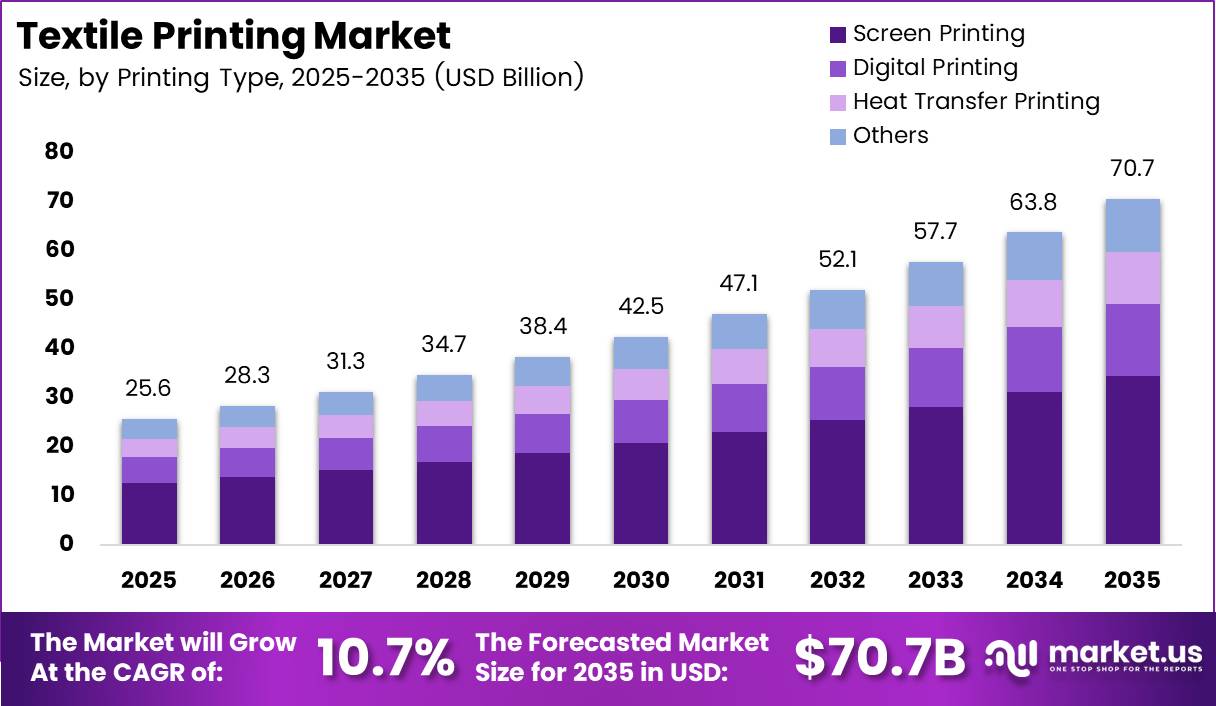
Global Textile Printing Market size is expected to be worth around USD 70.7 Billion by 2035 from USD 25.6 Billion in 2025, growing at a CAGR of 10.7% during the forecast period 2026 to 2035.
The textile printing market covers technologies and equipment used to apply color, pattern, and design onto fabric substrates. This includes screen printing, digital inkjet printing, heat transfer printing, and related methods. End applications span clothing, home decor, soft signage, and industrial textiles, creating a broad commercial base across both consumer and industrial buyers.
The market operates across two structural layers. Equipment manufacturers supply printing machinery and printhead technology. Consumables suppliers provide inks, screens, and transfer films. This two-layer structure means revenue is recurring, as ink and consumable replenishment drives continuous spending beyond the initial capital equipment purchase.
Government policy is tightening environmental standards across major textile manufacturing regions. Regulations targeting wastewater discharge and chemical use are pushing producers away from analog screen printing. This regulatory shift directly benefits digital printing vendors, as digital systems produce less effluent and require fewer chemical post-treatments than conventional analog routes.
E-commerce expansion is reshaping production models across the apparel supply chain. Brands now require short-run, on-demand printing to fulfill personalized orders without holding inventory. This demand for flexible, fast-turnaround production is creating sustained equipment replacement cycles as manufacturers upgrade from fixed-setup analog lines to configurable digital systems.
As reported by FESPA, the EFI Reggiani BOLT single-pass printer reached a milestone of 50 million printed metres. This adoption benchmark signals that single-pass digital technology has crossed the threshold from early adoption into mainstream industrial use, giving investors a measurable signal of commercial maturity.
Data from FESPA shows the EFI Reggiani HYPER scanning printer prints up to 13 linear metres per minute on a 1.5-metre roll, and up to 20 metres per minute when printing two 1.5-metre rolls in parallel. This throughput level closes the productivity gap between digital and analog, removing the primary barrier that previously kept high-volume producers locked into screen printing infrastructure.
Key Takeaways
- The global Textile Printing Market is valued at USD 25.6 Billion in 2025 and is forecast to reach USD 70.7 Billion by 2035.
- The market grows at a CAGR of 10.7% during the forecast period 2026 to 2035.
- By Printing, Screen Printing dominates with a 48.9% share in 2025.
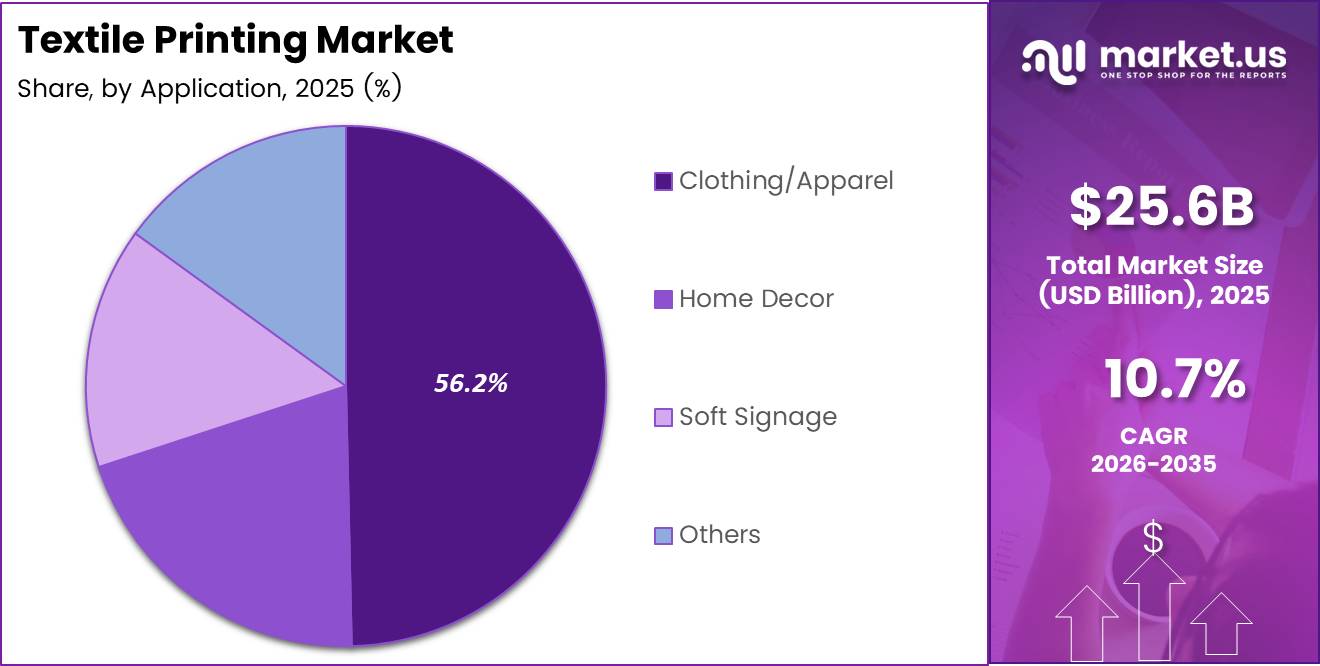
- By Application, Clothing and Apparel holds the dominant position with a 56.2% share in 2025.
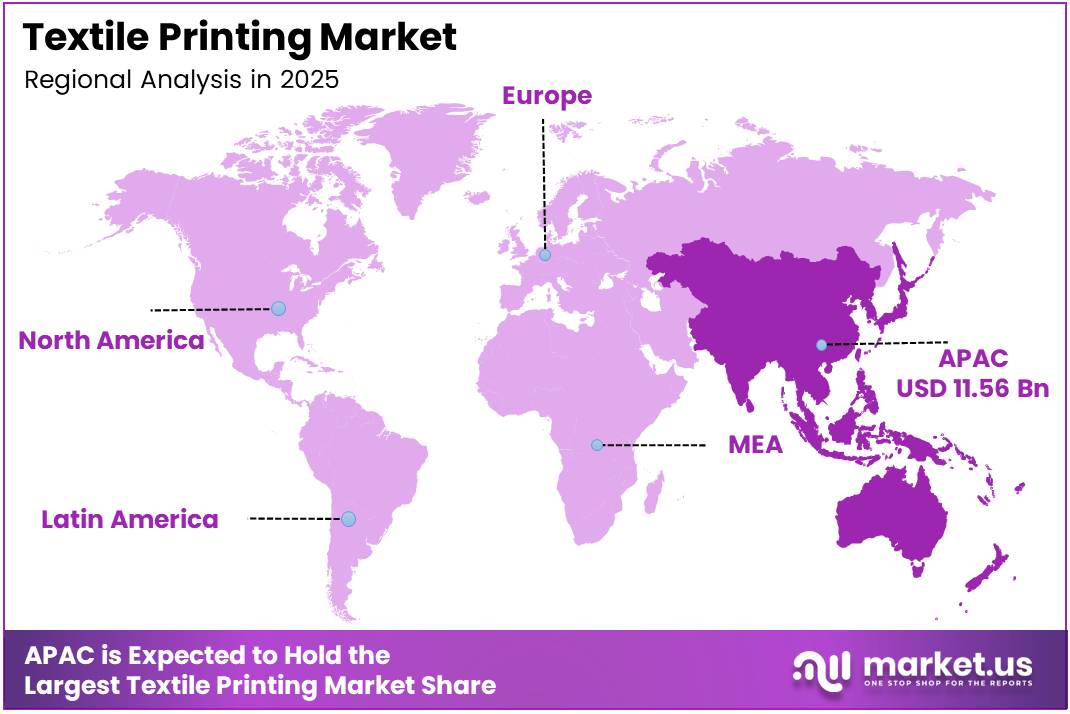
- Asia Pacific leads all regions with a 45.20% market share, valued at USD 11.56 Billion in 2025.
- Digital textile printing can save up to 95% of industrial water usage versus analog screen printing.
- Digital printing emits 2.6 kg CO2e per kg of fabric versus 4.3 kg for screen printing.
Printing Analysis
Screen Printing dominates with 48.9% due to high volume output and low per-unit cost.
In 2025, Screen Printing held a dominant market position in the By Printing segment of the Textile Printing Market, with a 48.9% share. According to our research, analog screen printing accounts for over 94% of the world’s printed fabric by volume. This infrastructure lock-in means that despite the shift toward digital, screen printing equipment vendors retain a large, stable replacement and consumables revenue base for the near term.
Digital Printing serves producers who require short-run flexibility and design variability without screen setup costs. Kornit Digital’s April 2026 acquisition of PrintFactory, a cloud-native workflow and production automation software provider, strengthens end-to-end digital production ecosystems. Buyers investing in digital lines now gain access to integrated software layers that reduce operator skill requirements and improve production tracking.
Heat Transfer Printing serves decoration and sportswear applications where durable, stretch-resistant prints are required on synthetic substrates. The Kornit Tiger600-1800 Pigment system prints up to 220 sqm per hour for poster and soft signage printing. This throughput positions heat transfer and pigment-based systems as productive alternatives for buyers who need both speed and substrate versatility.
Application Analysis
Clothing and Apparel dominates with 56.2% due to high design turnover and personalization demand.
In 2025, Clothing and Apparel held a dominant market position in the By Application segment of the Textile Printing Market, with a 56.2% share. Fashion brands require frequent design refreshes and short production runs to respond to trend cycles. This behavior drives continuous equipment utilization and ink consumption, making apparel the most commercially active end market for printing technology vendors.
Home Decor printing covers curtains, upholstery, bedding, and decorative wall fabrics requiring large-format, high-resolution output. Producers serving this segment benefit from longer print runs per design compared to apparel, which improves equipment utilization rates. However, buyers demand precise color matching across repeat orders, placing a premium on ink consistency and color management software.
Soft Signage covers retail displays, exhibition banners, and architectural fabric installations requiring fast turnaround and vivid color reproduction. This segment benefits directly from single-pass printer speed improvements, as turnaround time is a primary purchase criterion for sign and display buyers. Vendors who offer both high-speed output and wide-format capability hold a structural advantage in soft signage procurement.
Key Market Segments
By Printing
- Screen Printing
- Digital Printing
- Heat Transfer Printing
- Others
By Application
- Clothing/Apparel
- Home Decor
- Soft Signage
- Others
Market Dynamics
Drivers - Environmental efficiency gains and e-commerce personalization demand accelerate digital adoption
According to FESPA, digital textile printing can save as much as 95% of industrial water usage, while energy consumption can be reduced by 75% compared to analog screen printing. This efficiency gap is no longer a sustainability talking point. It is a direct operating cost advantage that manufacturers in water-stressed regions must act on to remain compliant and cost-competitive.
Figures from Carbonfact show digital printing emits 2.6 kg CO2e per kg of fabric, compared with 4.3 kg for screen printing and 3.7 kg for fabric dyeing. Brands with carbon reduction commitments now face structural pressure to shift printing procurement toward lower-emission digital vendors. This creates a supply chain compliance driver that operates independently of cost or performance considerations.
E-commerce apparel sales are pushing brands toward flexible, on-demand manufacturing models. Consumer expectations for personalized products and fast delivery make fixed-run analog production economically impractical. Vendors who position digital printing equipment as a solution to inventory risk, not just print quality, will convert more apparel manufacturers currently evaluating capital equipment purchases.
Restraints - Equipment cost barriers and industrial water pollution liability slow analog-to-digital conversion
High capital costs for advanced digital textile printing equipment remain the primary barrier for small and mid-scale textile producers. Entry-level digital systems require significant upfront investment before any efficiency savings are realized. This cost structure favors large producers who can spread depreciation across high print volumes, leaving smaller operators locked into existing screen printing infrastructure.
As reported by FESPA, average water consumption in digital textile printing is 5 to 9 cc per metre, versus 50 to 60 cc per metre for rotary or flat screen printing. This comparison illustrates the scale of wastewater liability that analog producers currently carry. Producers who delay transition face compounding environmental compliance costs as discharge regulations tighten across APAC and European manufacturing zones.
Based on FESPA data, over 20% of global industrial water pollution is attributable to textile dyeing and treatment, with analog textile production using around 93 billion cubic metres of water annually. This systemic pollution exposure creates regulatory and reputational risk for analog-dependent producers. Investors and brands sourcing from these facilities face supply chain liability that will only increase as environmental reporting requirements expand.
Growth Factors - Energy savings, water reduction milestones, and ink efficiency open new revenue and compliance pathways
FESPA data indicates a digital printing machine uses approximately 0.14 kW per metre printed, while a conventional rotary screen printer uses on average 0.46 kW per metre printed, a power saving of over 63%. For high-volume producers running equipment continuously, this energy differential translates into measurable annual utility cost reductions. This savings case accelerates equipment replacement decisions among energy-cost-sensitive manufacturers.
As reported by Texintel, a Kornit Presto MAX printing over 800,000 square metres of fabric per year saves approximately 5,577,899 litres of water versus conventional processes. This volume-scale water saving makes the business case for digital investment quantifiable beyond capital payback. Producers in water-scarce manufacturing regions can now present water savings as a measurable return on investment to secure capital approval for digital equipment purchases.
Kornit data shows the Kornit Presto MAX reduces white ink laydown by up to 25%. White ink is one of the highest-cost consumables in direct-to-fabric digital printing. A 25% reduction in white ink consumption directly lowers per-metre production cost, improving margin on every order. This consumable efficiency improvement makes digital printing more commercially viable for producers competing on price in commodity apparel segments.
Emerging Trends - High-speed single-pass systems and pigment ink compatibility reshape industrial textile printing standards
FESPA data shows dye-sublimation and pigment-based digital printing systems commonly save 70 to 80 litres of water per metre printed. Disperse, reactive, and acid ink systems save 30 to 40 litres per metre printed. Pigment-based systems therefore offer the strongest water efficiency case. Vendors promoting pigment ink platforms hold a distinct commercial advantage in sustainability-driven procurement processes across European and North American markets.
EFI Reggiani data shows the BOLT XS single-pass printer reaches printing speeds up to 150 m²/min at resolutions up to 600 x 4800 dpi, with up to 28 print heads per color and variable drop size from 5 picolitres. This combination of speed and resolution removes the historic trade-off between throughput and quality. Producers who adopt single-pass systems can now serve both high-volume commodity orders and premium quality accounts from the same equipment platform.
According to FESPA, the Xaar 2002 printhead delivers print speeds up to 75 metres per minute at 720 dpi, enabled by firing frequencies up to 36 kHz. Printhead performance at this level directly determines equipment productivity ceiling. Vendors integrating high-frequency printheads into new platforms gain a throughput advantage that is difficult for competitors to match without significant hardware redesign investment.
Regional Analysis
Asia Pacific Dominates the Textile Printing Market with a Market Share of 45.20%, Valued at USD 11.56 Billion
Asia Pacific holds a 45.20% share of the global Textile Printing Market, valued at USD 11.56 Billion in 2025. The region concentrates the majority of global textile manufacturing capacity across China, India, Bangladesh, and Vietnam. This manufacturing density creates sustained demand for both printing equipment and consumables, making APAC the primary commercial battleground for equipment vendors targeting volume accounts.
North America represents a mature but technology-driven market where brands are replacing aging analog lines with digital systems. Regulatory pressure on chemical discharge and consumer preference for on-demand customized apparel are both accelerating digital adoption. Vendors who offer integrated workflow software alongside hardware are better positioned to win enterprise-scale replacement contracts in this region.
Europe operates under some of the strictest environmental regulations for textile processing globally. The European Green Deal and REACH chemical compliance requirements are pushing textile printers toward waterless and low-effluent digital systems. This regulatory environment creates a structurally favorable procurement climate for digital and pigment-based printing vendors over the forecast period.
Latin America holds smaller production volumes but is expanding its domestic apparel and home textile manufacturing base. Brazil and Mexico are the primary markets, with growth linked to nearshoring trends as global brands reduce dependence on distant Asian supply chains. This structural shift opens entry points for equipment vendors targeting mid-scale producers upgrading from basic screen printing setups.
The Middle East and Africa region is an early-stage market for advanced textile printing technology. GCC countries are investing in domestic textile and fashion manufacturing as part of economic diversification programs. This policy-driven industrial buildout creates greenfield equipment demand, where buyers have no legacy infrastructure to replace, allowing vendors to position digital-first solutions without competing against entrenched analog lines.
Key Regions and Countries
North America
- US
- Canada
Europe
- Germany
- France
- The UK
- Spain
- Italy
- Rest of Europe
Asia Pacific
- China
- Japan
- South Korea
- India
- Australia
- Rest of APAC
Latin America
- Brazil
- Mexico
- Rest of Latin America
Middle East and Africa
- GCC
- South Africa
- Rest of MEA
Key Company Insights
M&R Printing Equipment holds a strong structural position in the screen printing equipment segment through its focus on automatic and manual press systems for high-volume apparel decorators. Its established distribution network and aftermarket parts supply create recurring revenue streams. However, its screen-centric portfolio faces displacement risk as digital adoption accelerates among mid-volume apparel producers.
MHM Industries GmbH competes in the high-end automatic screen printing press segment, targeting commercial textile printers who require precision registration and consistent color output at scale. Its engineering-led approach commands premium pricing, which limits its addressable market to well-capitalized buyers. This narrows its competitive exposure to the high-margin segment but reduces volume upside as lower-cost digital alternatives attract entry-level screen printing customers. The Epson PrecisionCore printhead, delivering droplets as small as 1.5 picolitres, represents the precision benchmark that digital vendors are now using to challenge screen printing’s quality advantage.
Key Players
- M&R Printing Equipment
- MHM Industries GmbH
- Anatol Equipment Manufacturing Co.
- Workhorse Products
- Seiko Epson Corporation
- Kornit Digital
- Durst Group AG
- MIMAKI ENGINEERING CO., LTD.
- Brother Industries, Ltd.
- Ricoh
Recent Developments
- February 2025 – Mimaki Engineering launched the Tx330-1800 and Tx330-1800B direct textile inkjet printers, introducing a waterless textile printing solution capable of printing on a wide range of fabrics with significantly reduced water consumption and enhanced flexibility for on-demand textile production.
- January 2026 – Mimaki Engineering expanded its textile printing portfolio with the launch of the TS330-1800 sublimation transfer printer, a new 1.9-meter-wide model developed for apparel, sportswear, interior textiles, and fabric signage applications requiring high-resolution, high-productivity printing.
- April 2026 – Kornit Digital acquired PrintFactory, a Netherlands-based provider of cloud-native workflow, color management, and production automation software, strengthening its digital textile printing ecosystem and end-to-end production capabilities.
Report Scope
| Report Features | Description |
|---|---|
| Market Value (2025) | USD 25.6 Billion |
| Forecast Revenue (2035) | USD 70.7 Billion |
| CAGR (2026-2035) | 10.7% |
| Base Year for Estimation | 2025 |
| Historic Period | 2020-2024 |
| Forecast Period | 2026-2035 |
| Report Coverage | Revenue Forecast, Market Dynamics, Competitive Landscape, Recent Developments |
| Segments Covered | By Printing (Screen Printing, Digital Printing, Heat Transfer Printing, Others); By Application (Clothing/Apparel, Home Decor, Soft Signage, Others) |
| Regional Analysis | North America (US and Canada), Europe (Germany, France, The UK, Spain, Italy, and Rest of Europe), Asia Pacific (China, Japan, South Korea, India, Australia, and Rest of APAC), Latin America (Brazil, Mexico, and Rest of Latin America), Middle East and Africa (GCC, South Africa, and Rest of MEA) |
| Competitive Landscape | M&R Printing Equipment, MHM Industries GmbH, Anatol Equipment Manufacturing Co., Workhorse Products, Seiko Epson Corporation, Kornit Digital, Durst Group AG, MIMAKI ENGINEERING CO., LTD., Brother Industries, Ltd., Ricoh |
| Customization Scope | Customization for segments, region/country-level will be provided. Additional customization can be done based on requirements. |
| Purchase Options | We have three licenses to opt for: Single User License, Multi-User License (Up to 5 Users), Corporate Use License (Unlimited User and Printable PDF) |





































