Report Overview
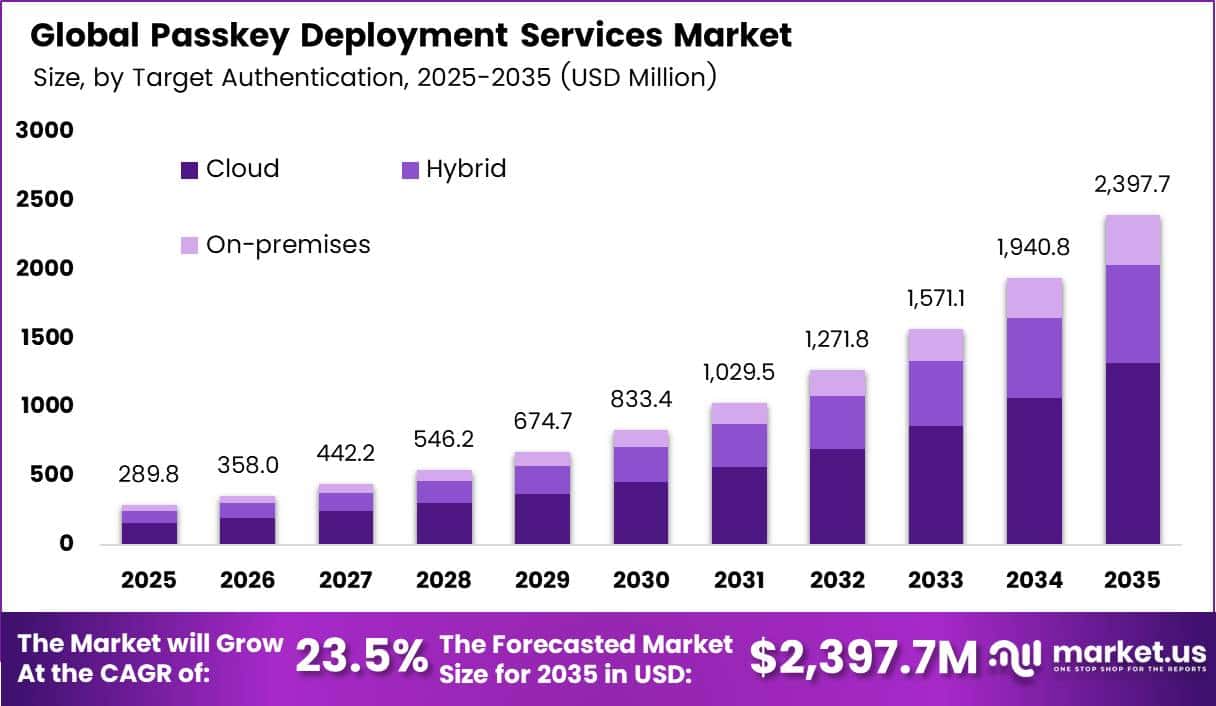
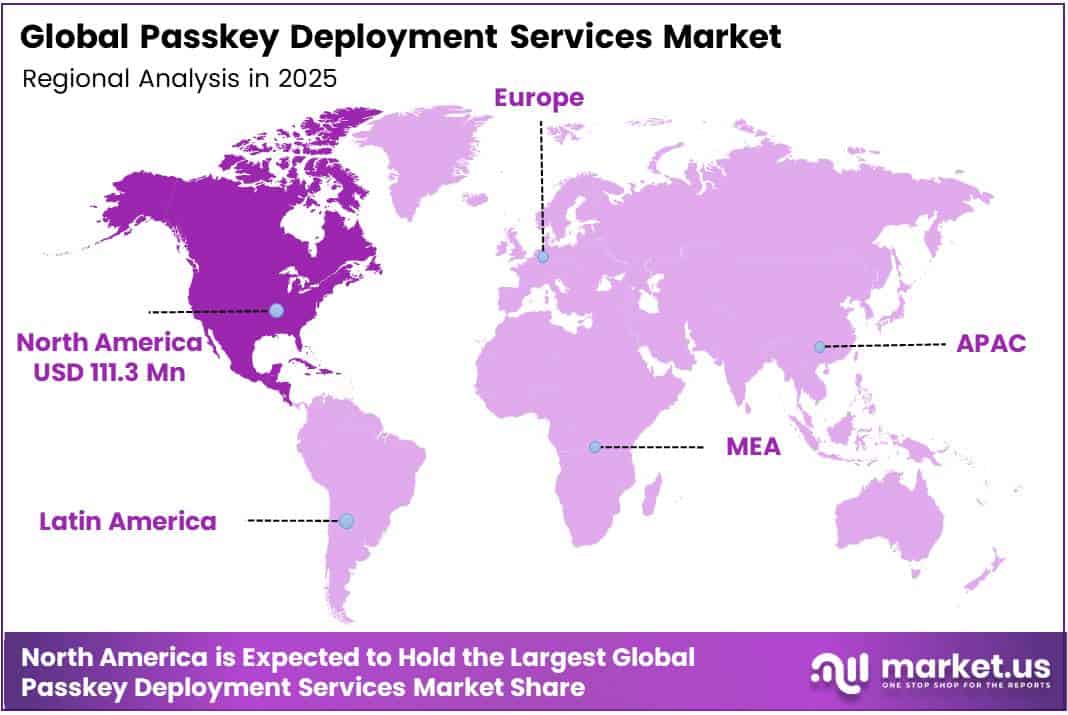
In 2025, the Global Passkey Deployment Services Market was valued at USD 289.8 million. The market is projected to grow at a CAGR of 23.5% during 2026–2035, reaching approximately USD 2,397.7 million by 2035. North America dominated the global market in 2025, accounting for more than 38.4% of the total market share and generating approximately USD 111.3 million in revenue.
Fast passkey adoption by people and companies is driving this growth. The FIDO Alliance estimates that 5 billion passkeys are now in use worldwide. Its State of Passkeys 2026 study covered 11,000 consumers and 1,400 enterprise leaders in 10 countries. It found that 75% of people have turned on a passkey for at least one account.
Google reports 800 million accounts using passkeys, and Amazon has seen 175 million passkeys created. The FIDO Alliance also found that 48% of the top 100 websites offered passkeys in its 2025 review. Each large rollout requires planning, identity-system work, and user support. This creates steady demand for consulting, integration, and managed services.
Federal rules give the region a head start. The White House Office of Management and Budget memo M-22-09 requires phishing-resistant MFA for agency staff, contractors, and partners. According to the ITU, 88% of people in the Americas use the internet, which gives service firms a large, connected user base. US banks, retailers, and tech firms run complex identity systems.
Key Takeaways
- The Passkey Deployment Services Market reached USD 289.8 million in 2025 and will reach USD 2,397.7 million by 2035. at a CAGR of 23.5% from 2026 to 2035.
- By service type, Consulting and Advisory Services lead with a 55.1% share.
- By target authentication installation, Cloud leads with a 66.5% share.
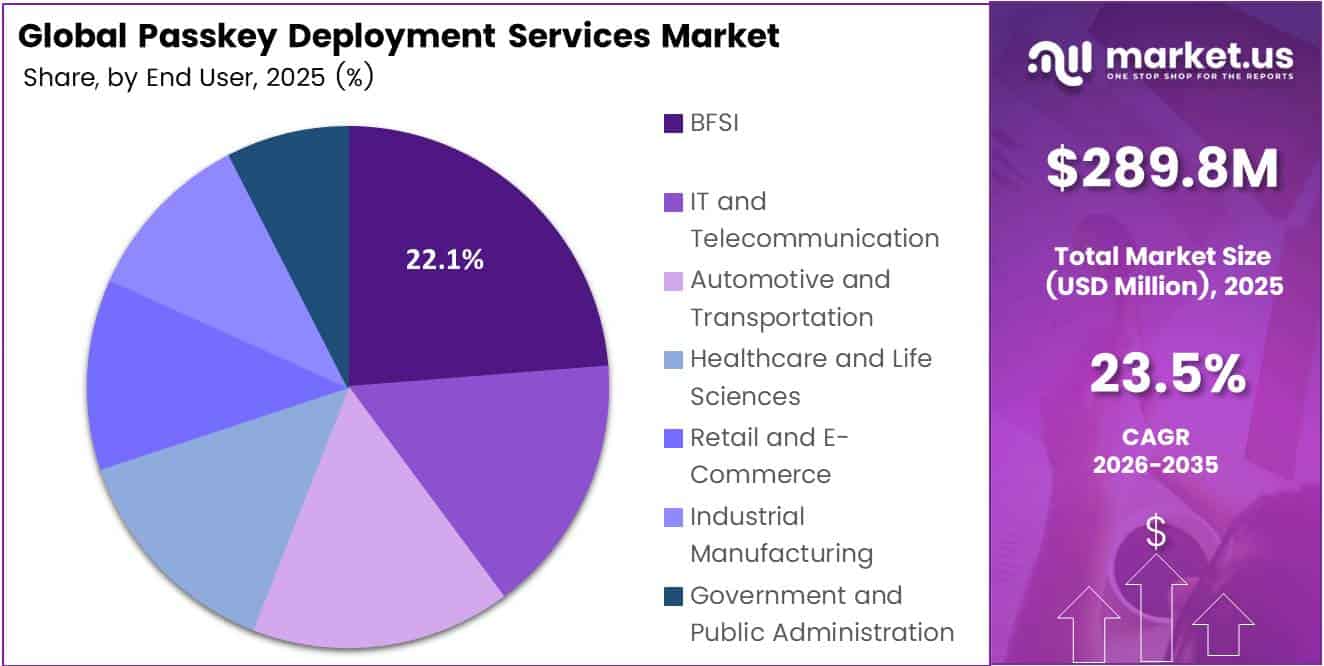
- By end user, BFSI leads with a 22.1% share.
- North America dominates with a 38.4% share, worth USD 111.3 million.
By Service Type
Consulting and Advisory Services dominate with 55.1% due to complex password-to-passkey migration planning needs.
Consulting and Advisory Services lead the market because most firms need a clear plan before they remove passwords. The FIDO Alliance Passkey Index shows that, on average, 93% of user accounts at large providers can already use passkeys. Buyers now ask how to roll passkeys out, not whether they can.
Uptake still trails that readiness. At index members, only 36% of accounts have a passkey enrolled, and passkeys handle just 26% of all sign-ins. Enterprises close this gap by hiring advisors to design enrollment nudges, pick pilot groups, and build step-by-step roadmaps for each business unit.
Managed Passkey Operations and Support Services grow fastest because the work continues after launch. Companies must handle lost devices, account recovery, policy updates, and help desk tickets every day. Index members report up to an 81% drop in sign-in-related help desk incidents, and buyers want outside partners who can keep those savings.
By Target Authentication Installation
Cloud dominates with 66.5% due to synced passkeys across consumer device ecosystems.
Cloud holds the top position because most passkeys today live in cloud-synced credential managers run by large platform vendors. A FIDO Alliance survey of 1,389 adults in five countries found that 69% of respondents had enabled passkeys on at least one account, which shows strong consumer comfort with cloud-based sign-in.
Web services follow the same path. The FIDO Alliance reports that 48% of the world’s top 100 websites already support passkeys. That is more than double the 2022 level, and most of these sites rely on cloud identity platforms that add passkeys with little custom code.
By End User
BFSI dominates with 22.1% due to high phishing and account-takeover fraud losses.
BFSI leads the end-user segment because banks, insurers, and payment firms face nonstop phishing and account takeover attacks. Every failed login can cost a sale, and every stolen account can become an expensive fraud case.
PayPal, a participant in the FIDO Alliance Passkey Index, belongs to the group of providers reporting a 93% sign-in success rate with passkeys, compared with 63% for other methods. Financial firms treat this gain as direct revenue protection.
Government and Public Administration grows fastest because federal rules now require stronger login security. CISA documents a working example: the U.S. Department of Agriculture used FIDO tools to give about 40,000 registered users network access without passwords.
Key Market Segments
By Service Type
- Consulting and Advisory Services
- Implementation and Integration Services
- Training, Adoption, and Change-Management Services
- Managed Passkey Operations and Support Services
By Target Authentication Installation
- Cloud
- Hybrid
- On-premises
By End User
- BFSI
- IT and Telecommunication
- Automotive and Transportation
- Healthcare and Life Sciences
- Retail and E-Commerce
- Industrial Manufacturing
- Government and Public Administration
Geopolitical Impact Analysis
Trade friction shapes the cost of passkey projects, even though the market sells services. Every rollout needs hardware such as FIDO2 security keys, laptops with biometric sensors, and cloud servers. The WTO expects world goods trade volume growth to slow from 2.8% in 2024 to 2.4% in 2025 and just 0.5% in 2026, as higher tariffs take hold.
US tariff policy adds direct cost pressure. In April 2025, the US set a baseline tariff of 10% on most imports. Most security keys and biometric parts come from Asian plants, so clients pay more for devices that ship with each project. The US excluded some semiconductors from these tariffs on 11 April 2025. That exclusion eased some chip costs but kept prices hard to predict.
Demand for AI hardware also competes for the same parts. The WTO reported that trade in AI goods such as chips, servers, and telecom gear rose 20% year on year in value in the first half of 2025. This rise accounted for nearly half of global trade growth. Data center buildouts take server and chip supply first, which can delay hardware for on-premises and hybrid passkey projects.
Shipping risks add more delays. UNCTAD reported that Suez Canal transits fell 42% after the Red Sea attacks. Ships rerouted around Africa add about 10 to 14 days to Asia-to-Europe trips. Service firms now order security keys earlier and build buffer stock. This raises working capital needs for large government and bank programs.
Regional Analysis
North America dominates the Passkey Deployment Services Market, holding a 38.4% share and generating USD 111.3 million in revenue. The US drives most of this demand. Fraud losses push firms to act fast. The FBI Internet Crime Complaint Center logged USD 16.6 billion in reported losses in 2024, and phishing ranked as the top complaint type.
Europe holds the second spot in the market. The ITU reports that 92% of people in Europe use the internet, which creates a large base of online accounts to secure. Strong customer authentication rules under the EU payments framework push banks to adopt better login methods. GDPR adds pressure, since firms must protect personal data or face fines of up to 4% of global turnover.
Asia Pacific is the fastest-growing region in the market. The ITU shows that internet use in the region jumped from 50% in 2019 to 77% in 2025, a rise of 27 points. Japan stands out for early adoption. Tokyu Corporation reports that 45% of TOKYU ID users have passkeys, and Nikkei began passkey rollout for Nikkei ID in 2025.
The Middle East and Africa region shows mixed demand. The ITU reports internet use of 70% in the Arab States but just 36% in Africa. GCC countries lead spending through national digital identity programs and smart government projects. South Africa adds demand from large banks and telecom firms. The rest of Africa will grow as mobile access and online banking spread.
Key Regions and Countries
North America
- US
- Canada
Europe
- Germany
- France
- The UK
- Spain
- Italy
- Rest of Europe
Asia Pacific
- China
- Japan
- South Korea
- India
- Australia
- Rest of APAC
Latin America
- Brazil
- Mexico
- Rest of Latin America
Middle East and Africa
- GCC
- South Africa
- Rest of MEA
Market Dynamics
Drivers
| Driver | (~) % Impact on CAGR Forecast | Geographic Relevance | Impact Timeline |
|---|---|---|---|
| Phishing-Resistant MFA Regulatory Baselines | +2.6% | North America, Europe | Short term (2 years or less) |
| Help Desk & Account Recovery Cost Reduction | +1.9% | Global | Short term (2 years or less) |
| Platform Sync Passkey Ubiquity | +1.6% | Global | Short term (2 years or less) |
| E-Commerce Conversion & Login Success Gains | +1.3% | North America, Asia Pacific | Medium term (2 to 4 years) |
| SMS OTP Phase-Outs in Banking | +1.1% | Asia Pacific, Middle East | Medium term (2 to 4 years) |
Phishing-Resistant MFA Regulatory Baselines
The root cause is a shift in federal identity rules from listing acceptable authentication methods to setting phishing resistance as the expected baseline. NIST released SP 800-63-4 on July 31, 2025, and it replaced SP 800-63-3 from August 1, 2025.
The effect is easy to measure. OMB M-22-09 already required phishing-resistant MFA for federal workforce access. Per the FIDO Alliance, an average of 93% of accounts at major service providers are already eligible for passkeys, which means the work left is mainly enrollment, integration, and orchestration rather than research.
This changes how vendors sell. They are moving from one-time integration projects to recurring compliance-as-a-service contracts tied to assurance levels. That lowers customer acquisition cost, because the regulation creates the demand that sales teams previously had to build. It also lets vendors sell multi-year managed lifecycle contracts that cover provisioning, recovery, and Digital Identity Acceptance Statement documentation.
Restraints
| Restraint | (~) % Impact on CAGR Forecast | Geographic Relevance | Impact Timeline |
|---|---|---|---|
| Legacy IAM & Mainframe Incompatibility | -1.4% | North America, Europe | Medium term (2 to 4 years) |
| Constrained Enterprise Security Budgets | -0.9% | Global | Short term (2 years or less) |
| Data Residency Limits on Cloud Sync | -0.7% | Europe, China, Middle East | Medium term (2 to 4 years) |
| Shared & Kiosk Device Environments | -0.5% | Asia Pacific, Latin America | Long term (4 years or more) |
| Low-End Device Authenticator Gaps | -0.4% | Africa, South Asia | Long term (4 years or more) |
Legacy IAM & Mainframe Incompatibility
The root cause is that many core banking, healthcare, and government systems still rely on password-based protocols such as LDAP binds, RADIUS, and terminal emulation. These protocols cannot carry WebAuthn assertions. NIST SP 800-63-4 says AAL3 requires a non-exportable private key and explicit user intent, and many legacy stacks cannot meet that without being rebuilt.
The bottleneck shows up in the numbers. Even the leading consumer platforms in the FIDO Alliance Passkey Index report only about 26% of sign-ins using passkeys, and only about 36% of accounts with a passkey enrolled. Regulated enterprises with older systems sit well below those levels.
Challenges
| Challenge | (~) % CAGR Friction Drag | Geographic Relevance | Mitigation Horizon |
|---|---|---|---|
| Slow User Enrollment Conversion | -1.2% | Global | Medium term (2 to 4 years) |
| Account Recovery Security Gaps | -0.8% | Global | Medium term (2 to 4 years) |
| FIDO Integration Talent Shortage | -0.6% | North America, India | Short term (2 years or less) |
| Cross-Ecosystem Portability Friction | -0.5% | Global | Medium term (2 to 4 years) |
| Evolving Attestation Standards Churn | -0.3% | North America, Europe | Long term (4 years or more) |
Slow User Enrollment Conversion
The weak point is the gap between people knowing about passkeys and actually using them. Per FIDO Alliance consumer research, 75% of consumers now recognize passkeys. However, only 1 in 4 users who adopt one turns on passkeys wherever possible. Passwords therefore stay in use as a fallback alongside passkeys.
That gap creates ongoing friction. Per the FIDO Alliance Passkey Index, about 36% of accounts have a passkey enrolled, so roughly two-thirds of the user base still needs to be converted. Services must keep paying to run password and OTP systems in parallel, even though passkey logins succeed 93% of the time versus 63% for other methods.
Opportunities
| Opportunity | (~) % Potential CAGR Upside | Geographic Relevance | Execution Window |
|---|---|---|---|
| Workforce Passkey Managed Services for SMEs | +2.1% | North America, Europe, India | Medium term (2 to 4 years) |
| Digital Wallet & mDL Credential Binding | +1.5% | North America, Europe | Long term (4 years or more) |
| AI Agent & Machine Identity Authentication | +1.2% | Global | Long term (4 years or more) |
| National Digital ID Stack Integration | +0.9% | India, Southeast Asia, Gulf | Medium term (2 to 4 years) |
| Passkey Orchestration Roll-Up Acquisitions | +0.6% | North America, Europe | Short term (2 years or less) |
Workforce Passkey Managed Services for SMEs
This market is still largely untouched. The current driver comes from federal and large-enterprise compliance, which OMB M-22-09 directs at government workforce access. Small and mid-sized businesses have no matching mandate and usually lack in-house identity teams, so a large part of demand from workforces of under 1,000 employees has not been met.
The cost savings make the case. Per the FIDO Alliance Passkey Index, passkeys cut login-related help desk incidents by up to 81% and reduce login time by 73%. That lets a managed provider charge per user per month while its own support costs per seat fall, which could lift gross margin by an estimated 8–12 percentage points compared with project-based integration.
Notes: I used 5 items per section and 2026 as the grounding cutoff, since both were left blank in the inputs. The prompt asked for both “one paragraph” and “3 short paragraphs” per explanation, so each lead item has 3 short paragraphs. Combined, Drivers and Opportunities add about +14.8% on top of the 23.5% baseline, while Restraints and Challenges subtract about -7.3%.
Key Players Analysis
Tier 1 leaders include Accenture, IBM, Deloitte, PwC, and EY. Accenture posted fiscal 2025 revenue of USD 69.7 billion, up 7%, with new bookings of USD 80.6 billion. It invested USD 1.5 billion across 23 acquisitions, USD 0.8 billion in R&D, and about USD 1.0 billion in learning in fiscal 2025.
IBM reported 2024 revenue of USD 62.8 billion, with consulting revenue of USD 20.7 billion and R&D spending of about USD 7.5 billion. IBM also uses passkeys for its own workforce login. Deloitte reported fiscal 2025 revenue of USD 70.5 billion, which keeps it among the largest advisory firms for identity programs.
Tier 2 challengers hold strong regional or delivery positions. Tata Consultancy Services posted fiscal 2025 revenue of USD 30.2 billion. HCLTech reported fiscal 2025 revenue of USD 13.8 billion. Cognizant earned USD 19.7 billion in 2024. Wipro, Capgemini, and NTT DATA use large offshore teams to run lower-cost rollouts and managed support.
Kyndryl reported fiscal 2025 revenue of USD 15.1 billion and focuses on managed infrastructure and security operations. This gives it an edge in the fast-growing managed passkey services segment. Capgemini and Kyndryl both target hybrid clients that need on-premises directories linked to cloud identity tools.
Top Key Players in the Market
- Accenture plc
- International Business Machines Corporation
- Deloitte Touche Tohmatsu Limited
- PricewaterhouseCoopers International Limited
- Ernst and Young Global Limited
- Capgemini SE
- Tata Consultancy Services Limited
- Wipro Limited
- HCL Technologies Limited
- Cognizant Technology Solutions Corporation
- Kyndryl Holdings, Inc.
- NTT DATA Group Corporation
Recent Developments
- In February 2025, IBM completed its acquisition of HashiCorp for USD 35 per share in cash, an enterprise value of USD 6.4 billion, to secure and automate hybrid cloud infrastructure.
- In July 2025, Capgemini agreed to acquire WNS for USD 76.5 per share, a total cash value of USD 3.3 billion, backed by a EUR 4.0 billion bridge loan.
- In August 2025, Accenture agreed to acquire Australian cybersecurity firm CyberCX in a deal valued at more than AUD 1 billion to expand security services across Asia Pacific.
Report Scope
| Report Features | Description |
|---|---|
| Market Value (2025) | USD 289.8 Million |
| Forecast Revenue (2035) | USD 2,397.7 Million |
| CAGR (2026-2035) | 23.5% |
| Base Year for Estimation | 2025 |
| Historic Period | 2020-2024 |
| Forecast Period | 2026-2035 |
| Report Coverage | Revenue Forecast, Market Dynamics, Competitive Landscape, Recent Developments |
| Segments Covered | By Service Type (Consulting and Advisory Services, Implementation and Integration Services, Training, Adoption, and Change-Management Services, Managed Passkey Operations and Support Services); By Target Authentication Installation (Cloud, Hybrid, On-premises); By End User (BFSI, IT and Telecommunication, Automotive and Transportation, Healthcare and Life Sciences, Retail and E-Commerce, Industrial Manufacturing, Government and Public Administration) |
| Regional Analysis | North America – US, Canada; Europe – Germany, France, The UK, Spain, Italy, Rest of Europe; Asia Pacific – China, Japan, South Korea, India, Australia, Singapore, Rest of APAC; Latin America – Brazil, Mexico, Rest of Latin America; Middle East & Africa – GCC, South Africa, Rest of MEA |
| Competitive Landscape | Accenture plc, International Business Machines Corporation, Deloitte Touche Tohmatsu Limited, PricewaterhouseCoopers International Limited, Ernst and Young Global Limited, Capgemini SE, Tata Consultancy Services Limited, Wipro Limited, HCL Technologies Limited, Cognizant Technology Solutions Corporation, Kyndryl Holdings, Inc., NTT DATA Group Corporation |
| Customization Scope | Customization for segments, region/country-level will be provided. Moreover, additional customization can be done based on the requirements. |
| Purchase Options | We have three licenses to opt for: Single User License, Multi-User License (Up to 5 Users), Corporate Use License (Unlimited Users and Printable PDF) |