Report Overview
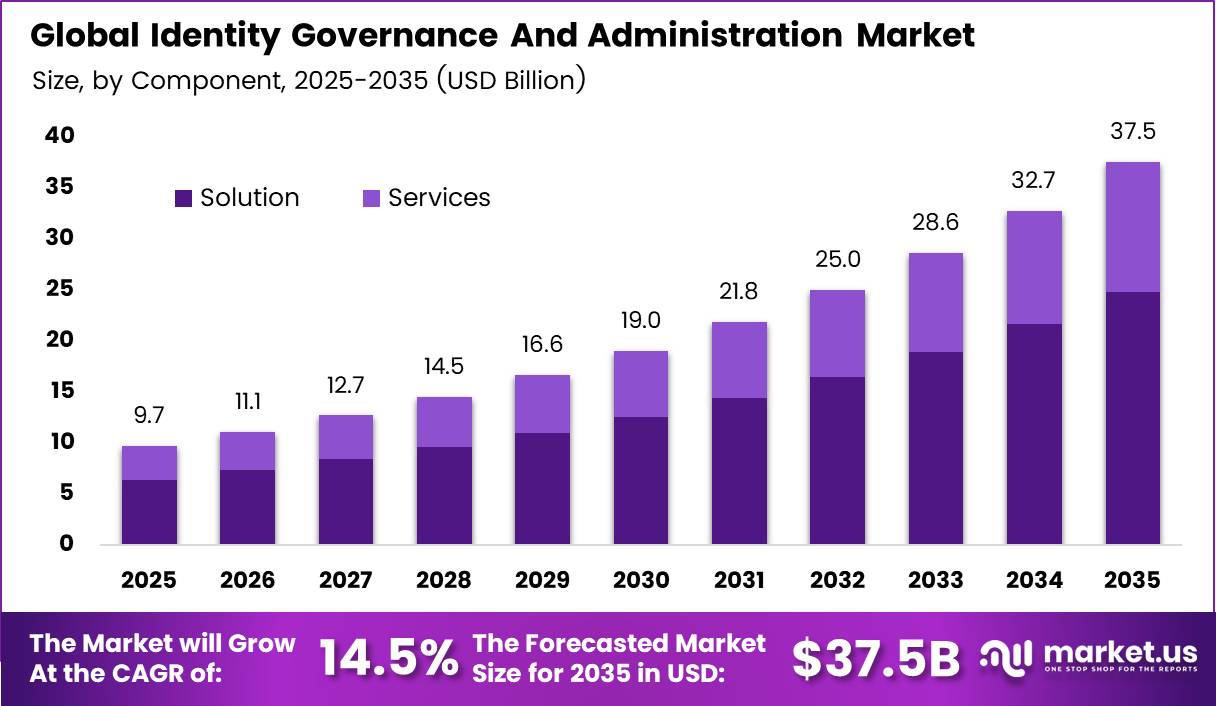
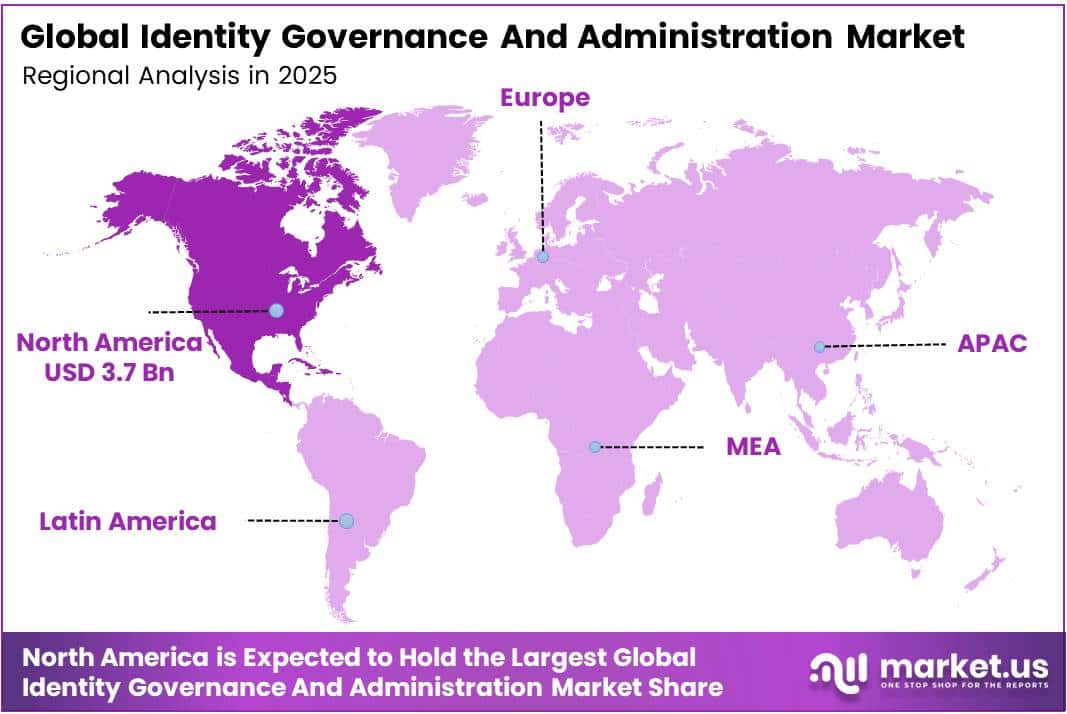
In 2025, the Global Identity Governance and Administration Market was valued at USD 9.7 billion. The market is projected to grow at a CAGR of 14.5% during 2026–2035, reaching approximately USD 37.5 billion by 2035. North America dominated the global market in 2025, accounting for more than 38.0% of the total market share and generating approximately USD 3.7 billion in revenue.
Online activity keeps rising, and so does the number of identities that firms must control. The ITU estimates that about 6 billion people now use the Internet, which is about three-quarters of the world’s population. That figure grew by more than 240 million users in 2024. Each new user adds accounts, roles, and access rights that firms must review and certify.
The North America region faces high cyber fraud costs, and these costs push firms to fund identity controls. The FBI’s 2024 Internet Crime Report logged 859,532 complaints and USD 16.6 billion in losses. Those losses rose 33% from 2023. Phishing ranked as the top crime, with 193,407 complaints. Many of these attacks steal login details, so firms in the US now treat identity as a front line of defense.
Key Takeaways
- The Identity Governance and Administration Market stood at USD 9.7 billion in 2025 and will reach USD 37.5 billion by 2035. at a CAGR of 14.5% from 2026 to 2035.
- Solution leads the component segment with a 66.3% share.
- Cloud leads the deployment segment with a 67.3% share.
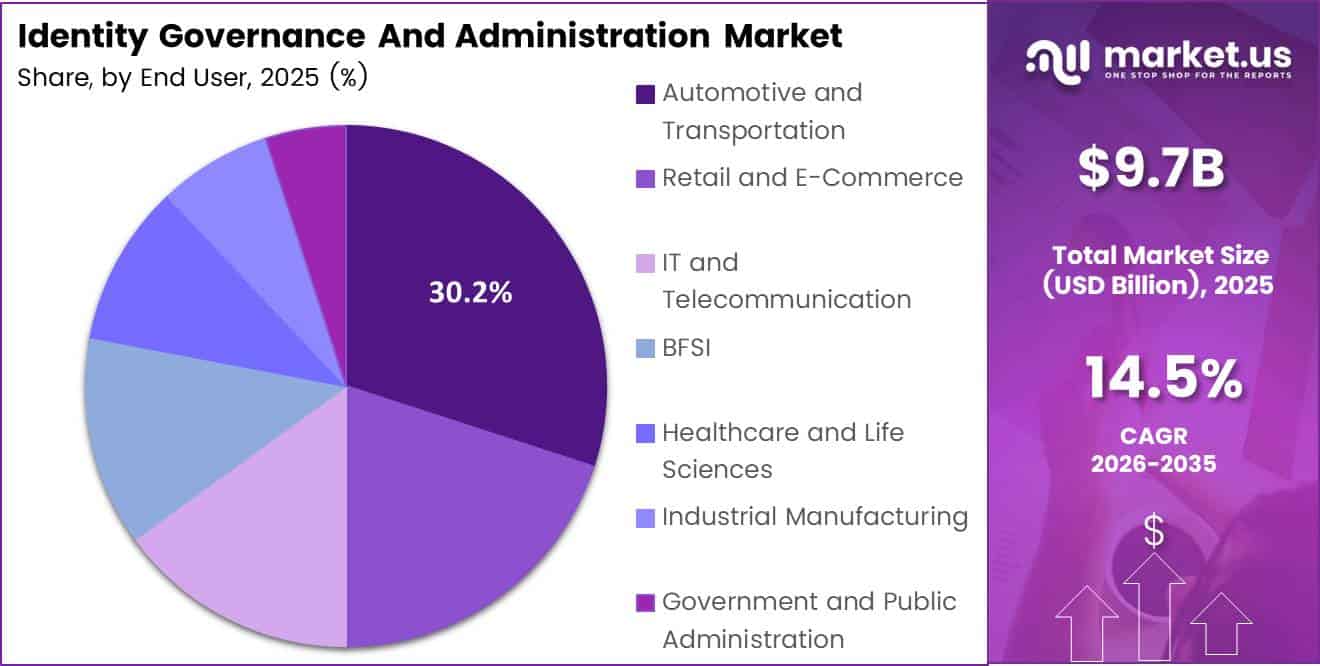
- Automotive and Transportation leads the end user segment with a 30.2% share.
- North America leads with a 38.0% share, worth USD 3.7 billion.
By Component
Solution dominates with 66.3% due to rising credential theft across enterprises.
Solution leads because attackers keep targeting user logins. The 2025 Verizon Data Breach Investigations Report found that credential abuse started 22% of breaches, making it the top entry point. In basic web application attacks, about 88% of breaches involved stolen credentials. Firms address this threat by buying core tools for access review, password control, and role management.
Access certification and password management sit at the center of these purchases. Verizon also found that 46% of compromised systems holding corporate logins were unmanaged devices that stored both personal and work credentials. Buyers need software that finds and removes risky access across every device.
Services grow fastest because many firms lack the in-house skill to run identity programs well. IBM’s 2025 Cost of a Data Breach Report puts the global average breach cost at USD 4.44 million. When a company’s own security team found the breach, the cost fell to USD 4.18 million. These savings push buyers toward consulting, integration, and managed services that build strong detection and governance habits.
By Deployment
Cloud dominates with 67.3% due to scattered data across hybrid environments.
Cloud holds the largest share because company data now lives in many places at once. IBM reports that 30% of breaches involved data spread across public clouds, private clouds, and on-premises systems. Each of these breaches cost an average of USD 5.05 million. Cloud-based governance gives security teams one view of every account, wherever the data sits.
Cloud tools also help firms control unapproved AI apps. IBM found that 20% of the organizations it studied suffered a breach linked to “shadow AI,” meaning tools that staff use without IT approval. Cloud platforms spot and govern these new identities faster than older systems, and vendors push updates without long upgrade cycles.
By End User
Automotive and Transportation dominate with 30.2% due to large, complex supplier access networks.
Automotive and transportation companies lead because thousands of suppliers, dealers, and logistics partners connect to their systems. The 2025 Verizon report shows that breaches involving a third party doubled from 15% to 30%. Carmakers and transport operators must review partner access often, so they invest heavily in identity governance.
Retail and e-commerce grow fastest as online sales keep rising. The U.S. Census Bureau reports that e-commerce sales rose 12.2% in the second quarter of 2026 from a year earlier, while total retail sales grew only 6.7%. Quarterly online sales reached USD 340,244 million. More digital shoppers, seasonal staff, and payment links push retailers to automate account setup and removal.
Key Market Segments
By Component
- Solution
- Access Certification and Review
- Password Management
- Others
- Services
By Deployment
- Cloud
- On-premise
By End User
- Automotive and Transportation
- Retail and E-Commerce
- IT and Telecommunication
- BFSI
- Healthcare and Life Sciences
- Industrial Manufacturing
- Government and Public Administration
- Others
Geopolitical Impact Analysis
Governance platforms run as software, but they still rely on physical goods. These include servers, hardware security modules, and authentication tokens, and most of them travel by sea. Trouble at major shipping routes therefore raises the cost of on-premises deployments. UNCTAD reported that ship tonnage crossing the Gulf of Aden fell 76% by mid-2024. Tonnage through the Suez Canal fell 70%.
Ships now take longer routes, and these routes use up shipping capacity. UNCTAD found that rerouting away from the Red Sea and Panama Canal raised container ship demand by 12% and total vessel demand by 3%. Traffic through the Panama and Suez Canals dropped by over 50% from peak levels. This pushes up freight costs for data center hardware bound for Europe and Asia.
Slower trade growth adds pressure on hardware lead times. UNCTAD projects that seaborne trade will grow by just 2.4% a year from 2025 to 2029, and containerized trade by 2.7%. Slow growth paired with longer routes means buyers wait longer for on-premises gear. This gap favors cloud models, which need no new hardware on site.
Security tensions between nations also change how buyers choose vendors. Firms in regulated sectors now prefer vendors that keep data in local regions. Vendors respond by adding regional cloud zones. Deals in this space also face reviews by several governments. One example is a USD 25 billion identity deal that needed clearance in the US, EU, UK, and Israel. These reviews lengthen deal timelines and shape how firms price products in each market.
Regional Analysis
North America dominates the Identity Governance and Administration Market, holding a 38.0% share and generating USD 3.7 billion in revenue. The US drives most of this demand. Large US firms run thousands of cloud apps, and each app carries user accounts that need regular review. Fraud trends keep pressure on buyers.
The FBI found that cyber-enabled fraud made up 83% of reported 2024 losses, worth USD 13.7 billion. Crypto fraud alone caused USD 9.3 billion in losses, a rise of 66%. Ransomware complaints against critical infrastructure grew 9% from 2023. These numbers push banks, hospitals, and public agencies to tighten who can reach sensitive data.
Major vendors also call the region home, so buyers get quick support and deep partner networks. Large US deals show the region’s pull. The FBI also reported that people aged 60 and over filed 147,127 complaints and lost USD 4.885 billion. Retail banks and payment firms respond by adding identity checks and access reviews. Canada adds steady demand through its banking and public sectors, which follow strict privacy rules.
Asia Pacific grows on the back of fast digital adoption in China, India, Japan, South Korea, and Australia. India’s digital payment systems and Japan’s corporate cloud shift both create millions of new accounts. Retail and e-commerce firms across the region need fast onboarding and offboarding for staff and partners. Data protection laws in India and Australia now require firms to control access to personal data.
Key Regions and Countries
North America
- US
- Canada
Europe
- Germany
- France
- The UK
- Spain
- Italy
- Rest of Europe
Asia Pacific
- China
- Japan
- South Korea
- India
- Australia
- Rest of APAC
Latin America
- Brazil
- Mexico
- Rest of Latin America
Middle East and Africa
- GCC
- South Africa
- Rest of MEA
Market Dynamics
Drivers
| Driver | (~) % Impact on CAGR Forecast | Geographic Relevance | Impact Timeline |
|---|---|---|---|
| Shift from Term Licenses to SaaS IGA Platforms | +2.8% | Global, led by North America and Europe | Short term (2 years or less) |
| EU NIS2 and DORA Access Governance Mandates | +2.2% | Europe, with spillover to multinational firms | Short term (2 years or less) |
| Identity-Centric Breaches Driving Zero Trust Budgets | +1.9% | Global | Short term (2 years or less) |
| Convergence of IGA, PAM and Access Management Suites | +1.4% | North America, Europe | Medium term (2 to 4 years) |
| SOX, HIPAA and Audit-Driven Access Certification | +1.1% | North America, Asia Pacific | Short term (2 years or less) |
| Data Protection Laws in India and the GCC | +0.9% | Asia Pacific, Middle East | Medium term (2 to 4 years) |
Shift from Term Licenses to SaaS IGA Platforms
The move away from on-premises IGA started because legacy deployments were expensive to maintain and needed constant connector customization. Buyers now prefer cloud-native platforms that bill ratably and remove the upfront term-license spike.
SailPoint’s investor disclosures show how fast this is happening: fiscal 2026 ARR reached $1.125 billion, up 28% year over year, while SaaS ARR grew 38% to $746 million and made up about 90% of net new ARR.
The trend continued into later quarters. Per SailPoint’s Q3 2026 earnings materials, total ARR reached $1.23 billion with 25% growth, SaaS made up 69% of the ARR mix, and $1M+ ARR customers grew 27%. The company’s own cash-flow reporting shows operating cash moving from a $47 million deficit to $83 million year-to-date, a sign that subscription delivery improves cash conversion.
The business model is changing as a result. Vendors are no longer driven by one-time license bookings. They now compete on net revenue retention, reported at 113% in company filings, and on average ARR per SaaS customer of about $380,000. This makes expansion revenue more valuable than new-logo volume and lowers blended customer acquisition cost in each renewal cycle.
Restraints
| Restraint | (~) % Impact on CAGR Forecast | Geographic Relevance | Impact Timeline |
|---|---|---|---|
| High Total Cost of Ownership and Long Deployments | -1.6% | Global, acute in SMEs | Short term (2 years or less) |
| Tight IT Budgets under Elevated Interest Rates | -1.2% | North America, Europe | Short term (2 years or less) |
| Data Residency Limits on Cloud IGA Hosting | -0.8% | Europe, China, Middle East | Medium term (2 to 4 years) |
| Legacy Mainframe and Custom App Incompatibility | -0.7% | Global, BFSI and public sector | Medium term (2 to 4 years) |
| Procurement Freezes in Public Sector Budgets | -0.5% | North America, Latin America | Short term (2 years or less) |
High Total Cost of Ownership and Long Deployments
The root cause is integration complexity. A full IGA rollout has to connect with HR systems of record, ERP, directories, and hundreds of applications. Enterprise programs commonly take 9 to 18 months, and services fees can equal 1x to 2x first-year subscription value. ISACA’s governance guidance under NIS2 and DORA also requires senior-management accountability, which adds another layer of program oversight.
This creates a hard approval barrier for mid-market buyers. With US Federal Reserve policy rates still restrictive, finance teams apply higher hurdle rates and push multi-year security projects out by 2 to 3 budget cycles.
The strategic cost is lower margins for vendors and integrators. Many absorb 10% to 15% in services discounts to close deals, and buyers delay IGA spending in favor of cheaper, single-feature access tools. Some pipeline is lost entirely instead of just being postponed.
Challenges
| Challenge | (~) % CAGR Friction Drag | Geographic Relevance | Mitigation Horizon |
|---|---|---|---|
| Identity Security Talent Shortage | -1.1% | Global | Long term (4 years or more) |
| Role Explosion and Entitlement Sprawl | -0.7% | Global, large enterprises | Medium term (2 to 4 years) |
| Poor HR Source Data Quality | -0.5% | Global | Medium term (2 to 4 years) |
| Access Review Rubber-Stamping Fatigue | -0.4% | North America, Europe | Short term (2 years or less) |
| Fragmented Multi-Cloud Entitlement Models | -0.4% | North America, Asia Pacific | Medium term (2 to 4 years) |
Identity Security Talent Shortage
The weakness is structural. IGA programs need people who understand role engineering, connector development, and audit control mapping, and few practitioners have all three skills. ISC2 workforce studies estimate the global cybersecurity workforce gap at roughly 4.8 million professionals, and identity skills are among the hardest to hire for.
This creates measurable friction. Projects that lack certified implementers often run 20% to 30% past schedule, and US Bureau of Labor Statistics data shows information security analyst wages growing faster than the overall IT average. Cloud Security Alliance survey data adds that fewer than 25% of organizations have formally documented policies for creating or removing AI identities.
Opportunities
| Opportunity | (~) % Potential CAGR Upside | Geographic Relevance | Execution Window |
|---|---|---|---|
| Governance of AI Agents and Non-Human Identities | +2.4% | Global, led by North America | Medium term (2 to 4 years) |
| Packaged Mid-Market and SME IGA Offerings | +1.3% | Asia Pacific, Latin America, Europe | Medium term (2 to 4 years) |
| MSSP-Delivered Identity Governance as a Service | +0.9% | Global | Short term (2 years or less) |
| Tuck-In M&A of Specialist NHI Startups | +0.7% | North America, Israel | Short term (2 years or less) |
| Sovereign Cloud IGA for Regulated Sectors | +0.6% | Europe, Middle East, India | Long term (4 years or more) |
Governance of AI Agents and Non-Human Identities
This is still white space. Most IGA revenue today comes from governing human workers, while service accounts, API keys, and autonomous agents mostly sit outside formal certification cycles. Industry tracking puts the ratio of non-human to human identities at up to 144 to 1, with NHIs growing 44% year over year. Separate surveys put the ratio between 80 to 1 and 109 to 1.
Monetization has started, but adoption is still early. SailPoint’s investor disclosures show AI-identity ARR growing more than 50% and contributing about 17% of net new ARR. The company also completed a $123 million acquisition of Entro to extend governance to machine entities. Okta’s public-sector guidance likewise calls for extending IGA to pipelines and AI agents through just-in-time access and short-lived credentials.
The unit economics favor this opportunity. Pricing per governed identity across a machine population many times larger than the human workforce could lift per-account contract value by 3x to 5x. Automated lifecycle controls could also cut cost per certified entitlement by 40% to 60%, which would add an estimated 4 to 6 percentage points of gross margin for vendors that sell NHI governance as a premium module.
Key Players Analysis
CyberArk Software Ltd. leads Tier 1. Its total revenue reached USD 1.001 billion in 2024, up 33% from USD 751.9 million in 2023. Subscription revenue grew 55% to USD 733.3 million. Annual recurring revenue rose 51% to USD 1.169 billion. CyberArk spent USD 243.1 million on R&D in 2024, which equals 24.3% of revenue.
Palo Alto Networks bought CyberArk for about USD 25 billion, its largest deal ever. The price was a 26% premium. Each CyberArk shareholder received USD 45.00 in cash plus 2.2005 Palo Alto shares per share. The deal made identity security a core part of a larger platform.
Ping Identity Holding Corp. and ForgeRock (Thales Group) also hold Tier 1 scale. Thoma Bravo bought Ping for USD 2.8 billion and ForgeRock for USD 2.3 billion, then merged ForgeRock into Ping. Ping now manages over 8 billion accounts.
Saviynt Inc. leads Tier 2. It raised USD 700 million at a value of about USD 3 billion to speed up product work and AI tools. One Identity LLC now runs as an independent company with a new global head office in Cork, Ireland. Hitachi ID Systems, Evidian (Atos), Quest Software Inc., Micro Focus (OpenText), and RSA Security LLC hold niche positions in password management and access review.
Top Key Players in the Market
- One Identity LLC
- Saviynt Inc.
- CyberArk Software Ltd.
- Ping Identity Holding Corp.
- ForgeRock (Thales Group)
- Hitachi ID Systems
- Evidian (Atos)
- Quest Software Inc.
- Micro Focus (OpenText)
- RSA Security LLC
Recent Developments
- In July 2025, Palo Alto Networks signed a deal to buy CyberArk Software Ltd. for about USD 25 billion in cash and stock.
- In October 2025, Ping Identity agreed to buy Keyless, a London biometric login firm whose software secures about 50 million logins each month.
- In December 2025, Saviynt Inc. raised USD 700 million in a KKR-led Series B round at a value of about USD 3 billion.
- In October 2026, Proofpoint agreed to buy Varonis Systems, a data access governance firm, for USD 6.3 billion, with closing expected in the first half of 2027.
Report Scope
| Report Features | Description |
|---|---|
| Market Value (2025) | USD 9.7 Billion |
| Forecast Revenue (2035) | USD 37.5 Billion |
| CAGR (2026-2035) | 14.5% |
| Base Year for Estimation | 2025 |
| Historic Period | 2020-2024 |
| Forecast Period | 2026-2035 |
| Report Coverage | Revenue Forecast, Market Dynamics, Competitive Landscape, Recent Developments |
| Segments Covered | By Component (Solution, Access Certification and Review, Password Management, Others, Services); By Deployment (Cloud, On-premises); By End User (Automotive and Transportation, Retail and E-Commerce, IT and Telecommunication, BFSI, Healthcare and Life Sciences, Industrial Manufacturing, Government and Public Administration, Others) |
| Regional Analysis | North America – US, Canada; Europe – Germany, France, The UK, Spain, Italy, Rest of Europe; Asia Pacific – China, Japan, South Korea, India, Australia, Singapore, Rest of APAC; Latin America – Brazil, Mexico, Rest of Latin America; Middle East & Africa – GCC, South Africa, Rest of MEA |
| Competitive Landscape | One Identity LLC, Saviynt Inc., CyberArk Software Ltd., Ping Identity Holding Corp., ForgeRock (Thales Group), Hitachi ID Systems, Evidian (Atos), Quest Software Inc., Micro Focus (OpenText), RSA Security LLC |
| Customization Scope | Customization for segments, region/country-level will be provided. Moreover, additional customization can be done based on the requirements. |
| Purchase Options | We have three licenses to opt for: Single User License, Multi-User License (Up to 5 Users), Corporate Use License (Unlimited Users and Printable PDF) |