Report Overview
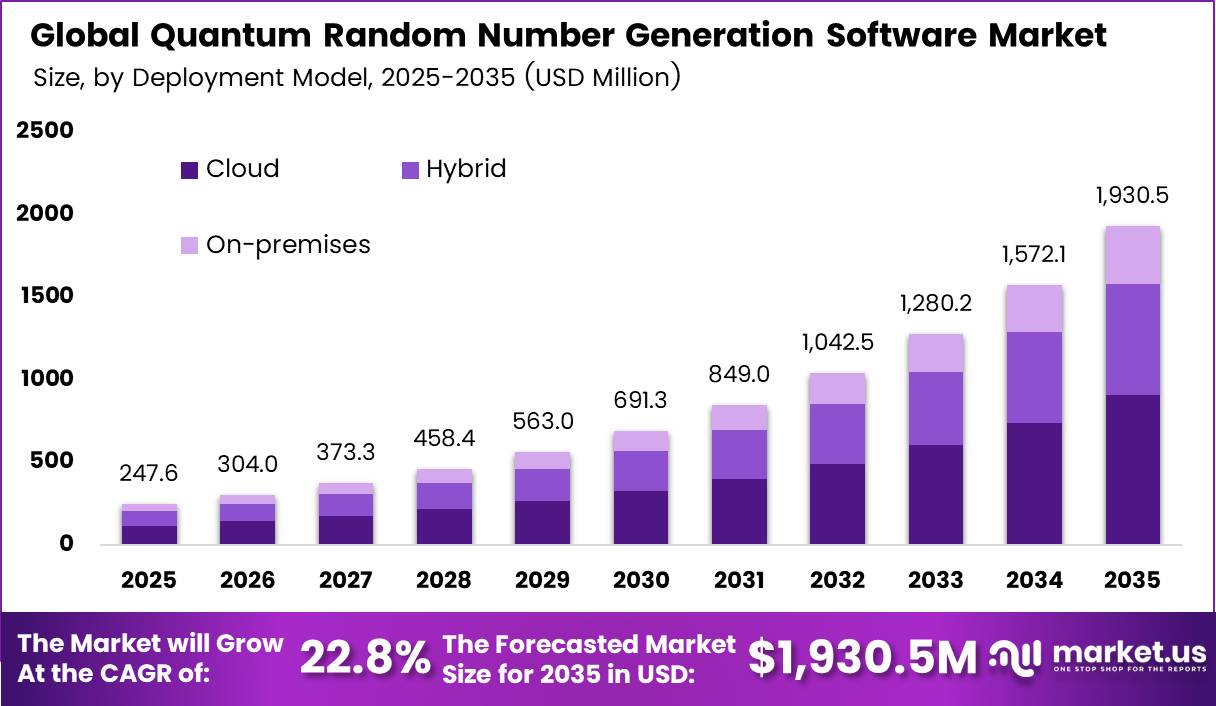
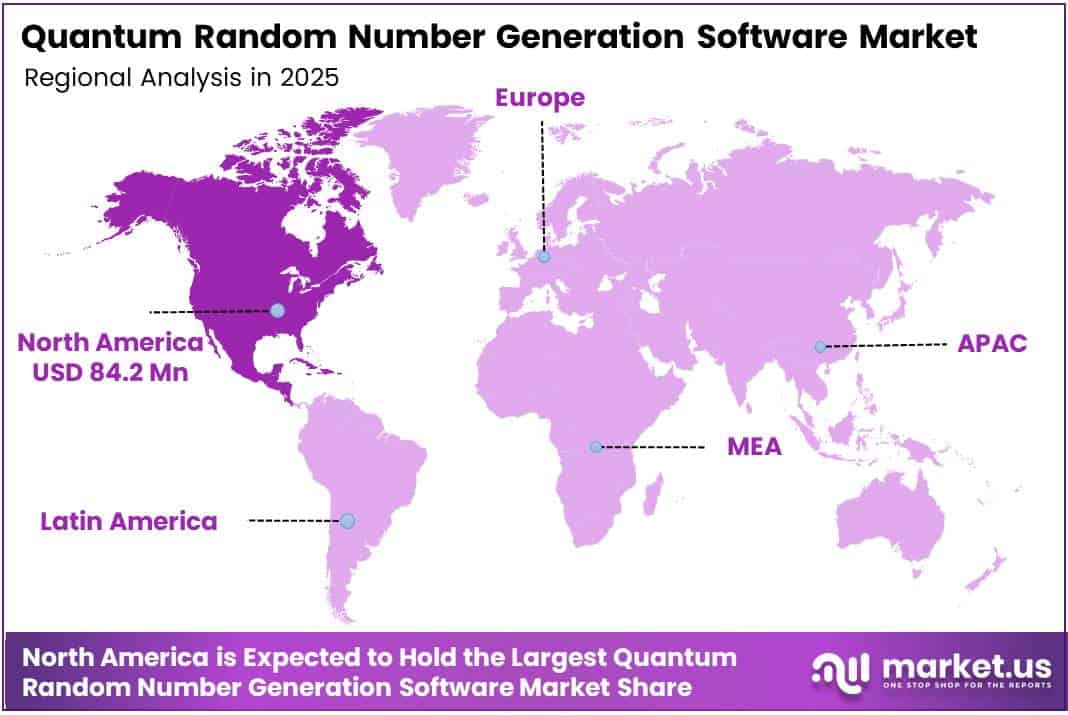
In 2025, the Global Quantum Random Number Generation Software Market was valued at USD 247.6 million. The market is projected to grow at a CAGR of 22.8% during 2026–2035, reaching approximately USD 1,930.5 million by 2035. North America dominated the global market in 2025, accounting for more than 34.0% of the total market share and generating approximately USD 84.2 million in revenue.
More people online means more data to protect, and that drives the growth. According to the ITU, about 6 billion people used the Internet in 2025, up from 5.8 billion in 2024. The ITU also reports that the online population grew by more than 240 million people in a single year. Each new user adds logins, payments, and encrypted sessions, and every one of them needs strong random keys.
The North America region gains from deep digital use and heavy spending on quantum technology. The ITU found that 94% of people in high-income countries use the Internet, compared with only 23% in low-income countries.
The US and Canada sit firmly in the high-income group, so they have dense enterprise and cloud users who need quantum-safe security. US companies also invest at large scale. IonQ, a US quantum firm, reported USD 3.36 billion in financing inflows in FY2025. That gives US buyers and vendors a strong base of capital and technical talent.
Key Takeaways
- The market stood at USD 247.6 million in 2025 and will reach USD 1,930.5 million by 2035. at a CAGR of 22.8% from 2026 to 2035.
- By offerings, software leads with a 68.7% share.
- By deployment model, cloud leads with a 68.2% share.
- By end user, IT and telecommunications lead with a 24.4% share.
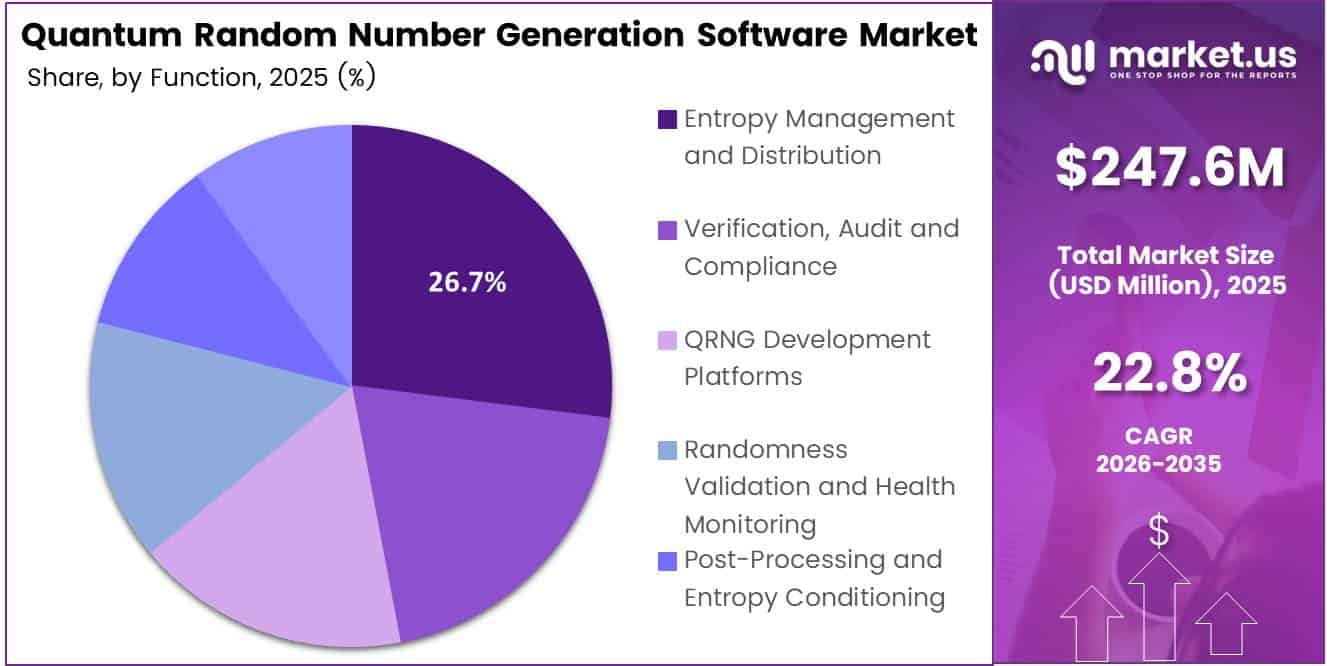
- By function, entropy management and distribution lead with a 26.7% share.
- North America leads with a 34.0% share and USD 84.2 million in revenue.
By Offerings
Software dominates with 68.7% due to ready-to-deploy entropy APIs for existing systems.
Software leads offerings because firms can plug quantum entropy into current apps, key managers, and security stacks through simple APIs, with no new hardware rack for each user. The wider digital economy creates steady demand for this layer. GSMA estimates that mobile technologies and services generate USD 6.5 trillion in value, or 5.8% of global GDP, and every one of those digital transactions depends on strong random keys.
The pressure to modernize keeps rising. GSMA projects mobile’s contribution to reach almost USD 11 trillion, or 8.4% of GDP, by 2030. As digital value grows, so does the cost of weak keys, and that pushes more firms to buy expert help.
By Deployment Model
Cloud dominates with 68.2% due to pay-as-you-go entropy delivered over APIs.
Cloud leads deployment because users can pull quantum random numbers on demand, with no device to buy, house, or maintain. Small teams and large firms alike pay only for what they use. This model fits a world where ITU estimates almost three-quarters of the global population is now online, and nearly every online service needs fresh keys for logins, payments, and data links.
Reach will keep widening. ITU still counts 2.2 billion people offline, mostly in low- and middle-income countries, so each new wave of users adds demand for secure cloud services. On-premises setups will hold a steady base among defense and critical-infrastructure users that cannot send keys to an outside provider.
By End User
IT and Telecommunications dominate with 24.4% due to massive encrypted traffic across carrier networks.
IT and Telecommunications lead end users because carriers and cloud firms run the largest volume of encrypted traffic in the world. Every call, message, and data session needs random keys. Telecom operators also have the budgets and skilled staff to test new security tools early, and they can share the cost across millions of subscribers, which puts them at the front of QRNG adoption.
Healthcare and Life Sciences is the fastest-growing end user. Patient records hold value for decades, so hospitals worry about “harvest now, decrypt later” attacks, where criminals steal data today and break it with quantum computers later. Drug makers also guard costly trial data and patents.
The US Department of Health and Human Services received 663 reports of breaches affecting 500 or more people in 2024. Those breaches touched about 242.9 million individuals, and hacking was the top cause. Health systems now treat quantum-safe randomness as a basic part of patient trust, while BFSI follows close behind as banks protect card and payment flows.
By Function
Entropy Management and Distribution dominates with 26.7% due to every encryption key needing trusted entropy.
Entropy Management and Distribution leads functions because every encryption key starts with a random seed, and firms need a safe way to create, store, and share that seed across many sites. Central tools let security teams send fresh entropy to servers, devices, and cloud workloads from one place, which cuts errors and saves time.
Verification, Audit, and Compliance is the fastest-growing function. NIST published 3 post-quantum standards, FIPS 203, FIPS 204, and FIPS 205, in August 2024, and it plans to remove quantum-vulnerable algorithms from its standards by 2035. NIST has also chosen 3 digital-signature algorithms, with FN-DSA moving toward FIPS 206. Buyers must now prove their random sources meet tested rules, not just claim it.
Key Market Segments
By Offerings
- Software
- Services
By Deployment Model
- Cloud
- Hybrid
- On-premises
By End User
- IT and Telecommunication
- Healthcare and Life Sciences
- BFSI
- Automotive and Transportation
- Retail and E-Commerce
- Industrial Manufacturing
- Education and Research Institutions
- Others
By Function
- Entropy Management and Distribution
- Verification, Audit and Compliance
- QRNG Development Platforms
- Randomness Validation and Health Monitoring
- Post-Processing and Entropy Conditioning
- Others
Geopolitical Impact Analysis
Geopolitical tension shapes this market through chips and servers. QRNG software runs on quantum entropy hardware, cloud servers, and secure chips. The WTO reports that trade in AI-enabling goods, such as semiconductors and servers, grew 16% in value in 2024 and 31% in 2025. It then jumped 67% year on year in the first half of 2026.
That surge creates fierce competition for chip supply. The WTO states that AI-enabling goods made up 47% of global merchandise trade growth in the first half of 2026. QRNG vendors compete with AI hyperscalers for the same foundry slots and server parts. When supply runs tight, entropy devices and the software built around them cost more and take longer to deploy.
Many QRNG vendors depend on a few Asian foundries. Quantum eMotion, a Canadian firm, sends its 65-nm QRNG chip to TSMC in Taiwan for fabrication. Any stress across the Taiwan Strait would directly hit product roadmaps for vendors in North America and Europe. This risk pushes buyers toward hybrid and cloud models, which spread entropy sources across several sites.
Conflict also affects the wider trade outlook. In spring 2026, the WTO forecast only 1.9% growth in merchandise trade, citing war in the Middle East. It later raised that forecast to 3.9%. These swings make hardware costs hard to predict, so vendors favor subscription software that keeps their pricing stable for buyers.
Regional Analysis
North America dominates the Quantum Random Number Generation Software Market, holding a 34.0% share and generating USD 84.2 million in revenue. The US drives most of this demand. Large banks, defense agencies, and cloud providers in the US want quantum-safe keys before quantum computers can break today’s encryption. US vendors back this demand with real money.
Asia Pacific is the fastest-growing region in the Quantum Random Number Generation Software Market. China leads through QuantumCTek, which runs large quantum communication networks. India grows through QNu Labs, which has raised USD 14.0 million across 2 funding rounds. The ITU reports that 5G now reaches more than half of the world’s population.
Europe holds a strong second position because it has a deep base of QRNG specialists. The ITU reports that 85% of urban residents worldwide use the Internet, versus 58% in rural areas. Europe’s highly urban economies sit at the top of this range, which keeps secure digital traffic volumes high across Germany, France, and the UK.
Key Regions and Countries
North America
- US
- Canada
Europe
- Germany
- France
- The UK
- Spain
- Italy
- Rest of Europe
Asia Pacific
- China
- Japan
- South Korea
- India
- Australia
- Rest of APAC
Latin America
- Brazil
- Mexico
- Rest of Latin America
Middle East and Africa
- GCC
- South Africa
- Rest of MEA
Market Dynamics
Drivers
| Driver | (~) % Impact on CAGR Forecast | Geographic Relevance | Impact Timeline |
|---|---|---|---|
| Standardized entropy integration architectures | +0.9% | Global; US-led security ecosystems | Short term (2 years or less) |
| Post-quantum cryptographic migration projects | +0.7% | Global; government and financial services | Short term (2 years or less) |
| Existing quantum-device software attachment | +0.6% | North America, Europe, East Asia | Short term (2 years or less) |
| Centralized enterprise randomness administration | +0.5% | Global; multi-platform enterprises | Medium term (2 to 4 years) |
| Source-diversification security policies | +0.3% | Global; security-sensitive institutions | Medium term (2 to 4 years) |
Standardized entropy integration architectures
NIST’s July 2024 public draft established implementation guidance for four random-bit-generator construction classes, reducing architectural ambiguity around external initialization, on-demand entropy, continuous entropy and chained generators.
This supports a shift from bespoke device integration toward reusable software licensing and support, although NIST does not prescribe that business model. All table percentages are analyst-assigned percentage-point sensitivities, not institutional forecasts or measured causal contributions, anchored to the supplied 22.8% baseline CAGR and evidence available through October 2026.
Driver sensitivities total +3.0 percentage points, opportunity sensitivities +2.0, restraints -2.0, and challenges -1.5; treating these as conditional deviations rather than additions already embedded in the baseline gives an upside-only case of 27.8%, a downside-only case of 19.3%, and a combined sensitivity of 24.3%. These are scenario bounds, not a revised central forecast.
Restraints
| Restraint | (~) % Impact on CAGR Forecast | Geographic Relevance | Impact Timeline |
|---|---|---|---|
| Bundled classical randomness substitutes | -0.70% | Global; mainstream enterprise applications | Short term (2 years or less) |
| Validation-dependent procurement exclusion | -0.50% | US, Canada; validation-sensitive buyers | Short term (2 years or less) |
| Unavailable physical entropy access | -0.35% | Global; software-only deployment environments | Short term (2 years or less) |
| External-service procurement prohibitions | -0.25% | Global; isolated and classified networks | Short term (2 years or less) |
| Locked embedded-platform purchasing cycles | -0.20% | Global; long-lived industrial systems | Medium term (2 to 4 years) |
Bundled classical randomness substitutes
The immediate sales barrier is functional substitution: Linux kernel documentation describes established random-number interfaces, allowing applications to obtain randomness without purchasing a separate quantum-specific software layer.
Consequently, neither ordinary cryptographic deployment nor post-quantum migration automatically creates incremental QRNG software revenue. The modeled -0.70-percentage-point sensitivity is an analyst assumption representing lost standalone purchases where existing interfaces satisfy buyer requirements.
Challenges
| Challenge | (~) % CAGR Friction Drag | Geographic Relevance | Mitigation Horizon |
|---|---|---|---|
| Continuous entropy health assurance | -0.5% | Global; production cryptographic deployments | Medium term (2 to 4 years) |
| Remote delivery latency variability | -0.4% | Global; distributed service deployments | Short term (2 years or less) |
| Heterogeneous device interface maintenance | -0.3% | Global; multi-device software portfolios | Medium term (2 to 4 years) |
| Specialist assurance engineering scarcity | -0.2% | North America, Europe, Asia-Pacific | Long term (4 years or more) |
| Customer workload benchmarking complexity | -0.2% | Global; heterogeneous application estates | Medium term (2 to 4 years) |
Continuous entropy health assurance
The structural vulnerability is that a functioning software interface does not, by itself, establish the quality of its underlying physical entropy source. NIST’s entropy-source recommendation requires source assessment, supporting documentation, and laboratory examination, meaning assurance depends on evidence about the source rather than output appearance alone.
The modeled -0.50-percentage-point friction is therefore an analyst sensitivity for continuing engineering, diagnostic, and support work, not a published failure rate or a second deduction for initial procurement validation. Unlike a procurement exclusion, this challenge persists after a sale.
Opportunities
| Opportunity | (~) % Potential CAGR Upside | Geographic Relevance | Execution Window |
|---|---|---|---|
| Verifiable public-randomness workflow subscriptions | +0.7% | Global; public allocation and independent audits | Medium term (2 to 4 years) |
| Simulation reproducibility software packages | +0.5% | North America, Europe, Asia-Pacific | Medium term (2 to 4 years) |
| Privacy-preserving analytics seed orchestration | +0.35% | Global; research and sensitive-data analytics | Long term (4 years or more) |
| Quantum-education laboratory software licensing | +0.25% | Global; universities and technical institutes | Medium term (2 to 4 years) |
| Independent entropy incident forensics | +0.2% | Global; insurers and investigation teams | Long term (4 years or more) |
Verifiable public-randomness workflow subscriptions
The untapped opportunity is paid workflow assurance around public randomness, not resale of an already accessible random-bit stream. NIST’s June 2025 announcement describes CURBy as a free public service suitable for applications such as jury selection and public resource allocation.
University of Colorado Boulder researchers and their collaborators reported 7,434 successful protocol executions from 7,454 attempts over 40 days, a 99.7% success rate, with 512 bits emitted per successful pulse. Separately, NIST’s beacon architecture provides signed, timestamped, publicly accessible pulses, supplying a technical basis for auditable workflow products.
Under an illustrative analyst unit-economic assumption—not an institutional forecast reusable verification connectors could reduce delivery effort per comparable workflow by 15–25% and improve gross margin by 3–5 percentage points if pricing and service quality remain stable, supporting the modeled +0.70-percentage-point upside.
Key Players Analysis
Tier 1 market leaders include ID Quantique, QuantumCTek, and QuintessenceLabs, because they have the widest global reach. ID Quantique now operates under IonQ, which owns a controlling stake. IonQ reported revenue of USD 130.0 million in FY2025, up from USD 43.1 million in FY2024. Part of that growth came from acquisitions, including IDQ.
IonQ backs its quantum security business with heavy spending. It spent USD 305.7 million on R&D in FY2025, up 123% from USD 136.8 million. That R&D bill came to more than 2 times its revenue. IonQ agreed to pay up to about 5.2 million shares for the IDQ stake, and it also agreed to buy Oxford Ionics for USD 1.075 billion in June 2025. This deal flow gives IDQ’s QRNG products a much larger sales channel.
Tier 2 challengers include Quside, Qrypt, QNu Labs, Quantum Dice, Crypta Labs, KETS, Quantropi, Quantum eMotion, and Qutools. These firms win through niche strengths in chip-based entropy, cloud entropy delivery, or regional government work. Quantum eMotion raised close to CAD 10.0 million in February 2025 to build its QRNG product line.
Smaller challengers rely on venture funding instead of large revenue bases. QNu Labs serves Indian defense and banking clients with QKD, QRNG, and post-quantum cryptography. Quantum eMotion targets DeFi and federal certification paths. In this tier, competition centers on certified entropy speed and on audit-ready software.
Top Key Players in the Market
- ID Quantique SA
- QuintessenceLabs Pty Ltd
- Quside Technologies S.L.
- Qrypt Inc.
- QNu Labs Private Limited
- Quantum Dice Ltd.
- Crypta Labs Limited
- KETS Quantum Security Limited
- Quantropi Inc.
- Quantum eMotion Corp.
- QuantumCTek Co., Ltd.
- Qutools GmbH
Recent Developments
- In February 2025, Quantum eMotion Corp. closed a private placement of 13,333,333 units at CAD 0.75 each, raising CAD 9,999,999.75 to support its QRNG business.
- In April 2025, QNu Labs Private Limited raised a USD 7.0 million Series A round to grow its QKD, QRNG, and post-quantum cryptography offerings.
- In May 2025, IonQ completed its purchase of a controlling stake in ID Quantique SA from SK Telecom. It issued about 4.2 million shares at closing in an all-stock deal.
- In June 2025, Quantum eMotion Corp. announced CAD 12 million in new funding, which included a 4,000,000-unit placement at CAD 1.50 per unit.
Report Scope
| Report Features | Description |
|---|---|
| Market Value (2025) | USD 247.6 Million |
| Forecast Revenue (2035) | USD 1,930.5 Million |
| CAGR (2026-2035) | 22.8% |
| Base Year for Estimation | 2025 |
| Historic Period | 2020-2024 |
| Forecast Period | 2026-2035 |
| Report Coverage | Revenue Forecast, Market Dynamics, Competitive Landscape, Recent Developments |
| Segments Covered | By Offerings (Software, Services); By Deployment Model (Cloud, Hybrid, On-premises); By End User (IT and Telecommunication, Healthcare and Life Sciences, BFSI, Automotive and Transportation, Retail and E-Commerce, Industrial Manufacturing, Education and Research Institutions, Others); By Function (Entropy Management and Distribution, Verification, Audit and Compliance, QRNG Development Platforms, Randomness Validation and Health Monitoring, Post-Processing and Entropy Conditioning, Others) |
| Regional Analysis | North America – US, Canada; Europe – Germany, France, The UK, Spain, Italy, Rest of Europe; Asia Pacific – China, Japan, South Korea, India, Australia, Singapore, Rest of APAC; Latin America – Brazil, Mexico, Rest of Latin America; Middle East & Africa – GCC, South Africa, Rest of MEA |
| Competitive Landscape | ID Quantique SA, QuintessenceLabs Pty Ltd, Quside Technologies S.L., Qrypt Inc., QNu Labs Private Limited, Quantum Dice Ltd., Crypta Labs Limited, KETS Quantum Security Limited, Quantropi Inc., Quantum eMotion Corp., QuantumCTek Co., Ltd., Qutools GmbH |
| Customization Scope | Customization for segments, region/country-level will be provided. Moreover, additional customization can be done based on the requirements. |
| Purchase Options | We have three licenses to opt for: Single User License, Multi-User License (Up to 5 Users), Corporate Use License (Unlimited Users and Printable PDF) |