


Report Overview
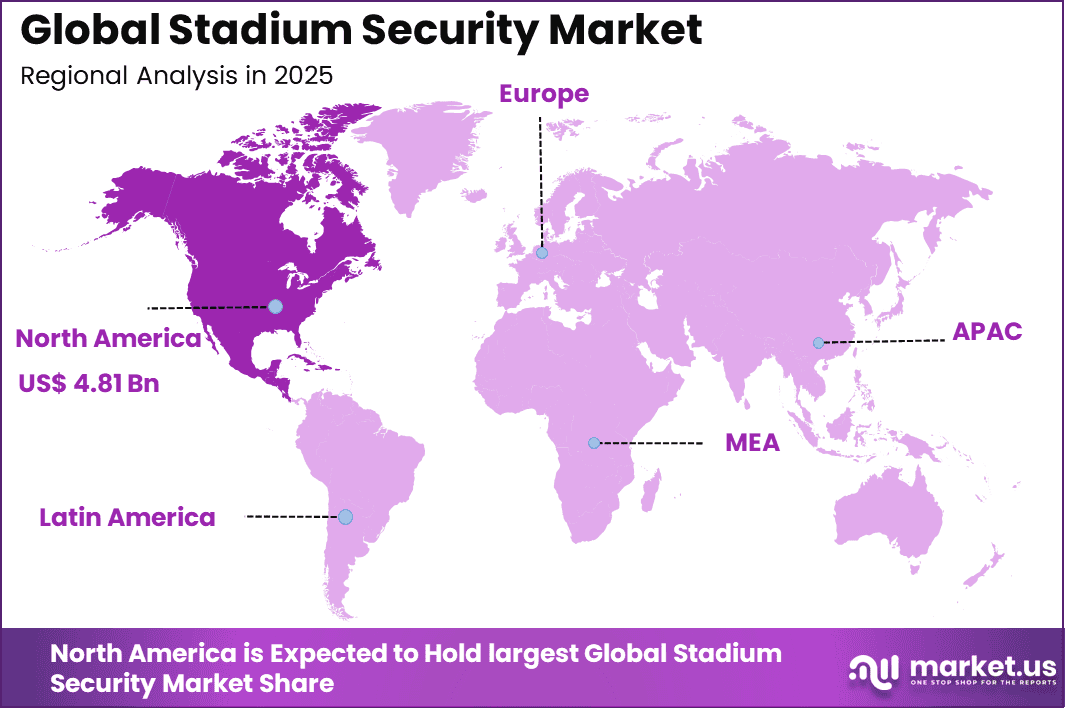
The Global Stadium Security Market size is expected to be worth around USD 37.79 billion by 2035, from USD 12.61 billion in 2025, growing at a CAGR of 11.6% during the forecast period from 2025 to 2035. North America held a dominant market position, capturing more than a 38.2% share, holding USD 4.81 billion in revenue.
Stadium Security refers to the systems, processes, and personnel used to ensure safety at sports and entertainment venues. It includes surveillance, access control, crowd management, and emergency response planning. These measures are designed to prevent threats, manage large gatherings, and maintain a secure environment for fans, staff, and participants during events.
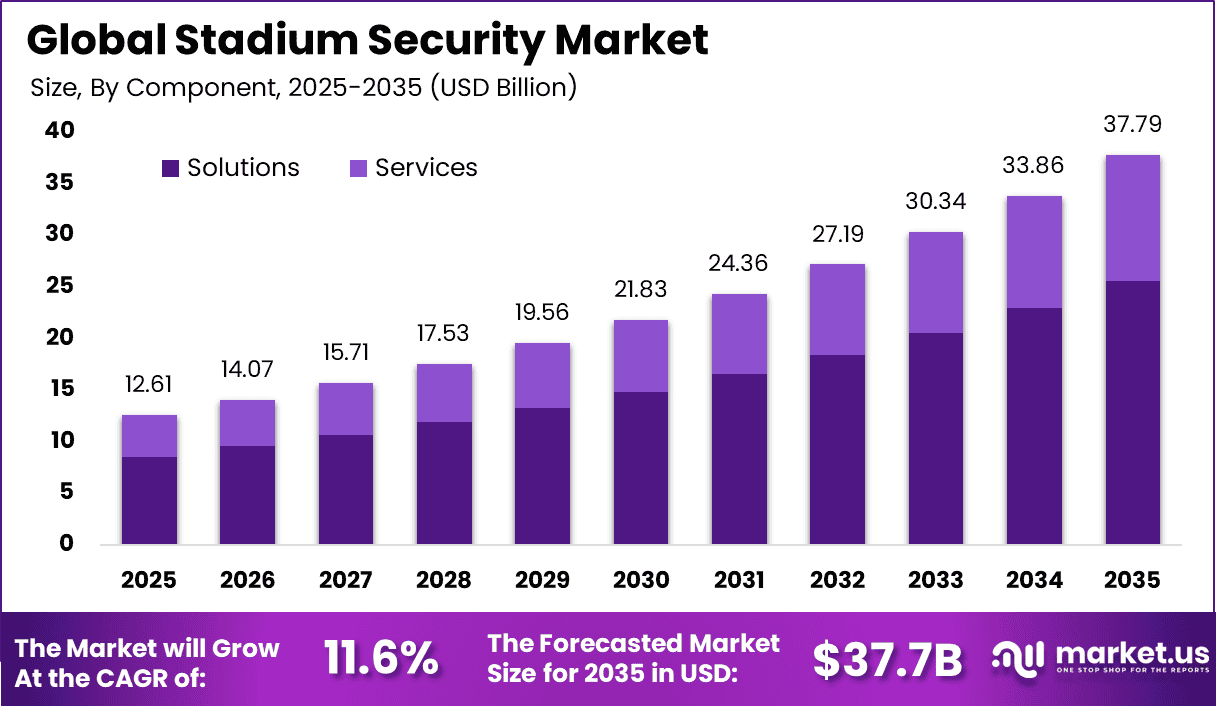
Rising crowd sizes are pushing stadium security systems to evolve, as events now attract tens of thousands more fans than a decade ago. Growing risks such as crowd unrest or external threats, seen in over 20% of major matches worldwide, are increasing vigilance. Past incidents have highlighted vulnerabilities, encouraging venues to strengthen infrastructure and adopt more advanced protection strategies.
The market for Stadium Security is driven by the growing need to manage large crowds safely and prevent potential risks during events. Rising attendance, stricter safety regulations, and increasing focus on real-time monitoring are encouraging venues to upgrade their systems. At the same time, demand for smoother entry and better fan experience is supporting continued investment in advanced security solutions.
Demand for stadium security intensifies during peak seasons, when venues manage double the traffic compared to non-event periods. High occupancy levels, often reaching 90% in leading stadiums, require efficient crowd handling and rapid response systems. At the same time, fans expect seamless entry experiences, which increases pressure on operators to balance convenience with strict safety protocols.
For instance, in January 2026, Hikvision introduced a stadium‑focused AI threat‑detection stack that combines wide‑area surveillance, perimeter analytics, and AI‑powered video search for rapid forensic investigation. The solution is being piloted in large Asian and Middle Eastern arenas, with North American partners eyeing it for use in multi‑stadium events and international tournaments.
Key Takeaway
- In 2025, the Solutions segment held a dominant market position, capturing a 67.8% share of the Global Stadium Security Market.
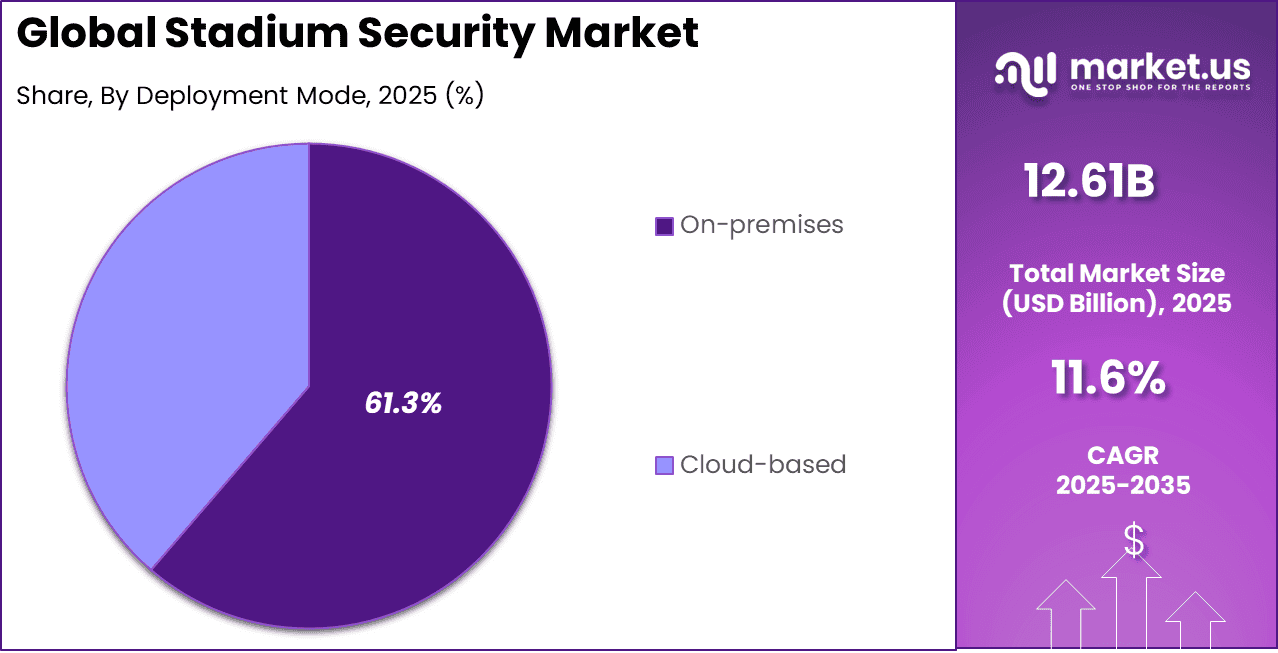
- In 2025, the On-Premises segment held a dominant market position, capturing a 61.3% share of the Global Stadium Security Market.
- In 2025, the Greater than 50,000-seats segment held a dominant market position, capturing a 43.7% share of the Global Stadium Security Market.
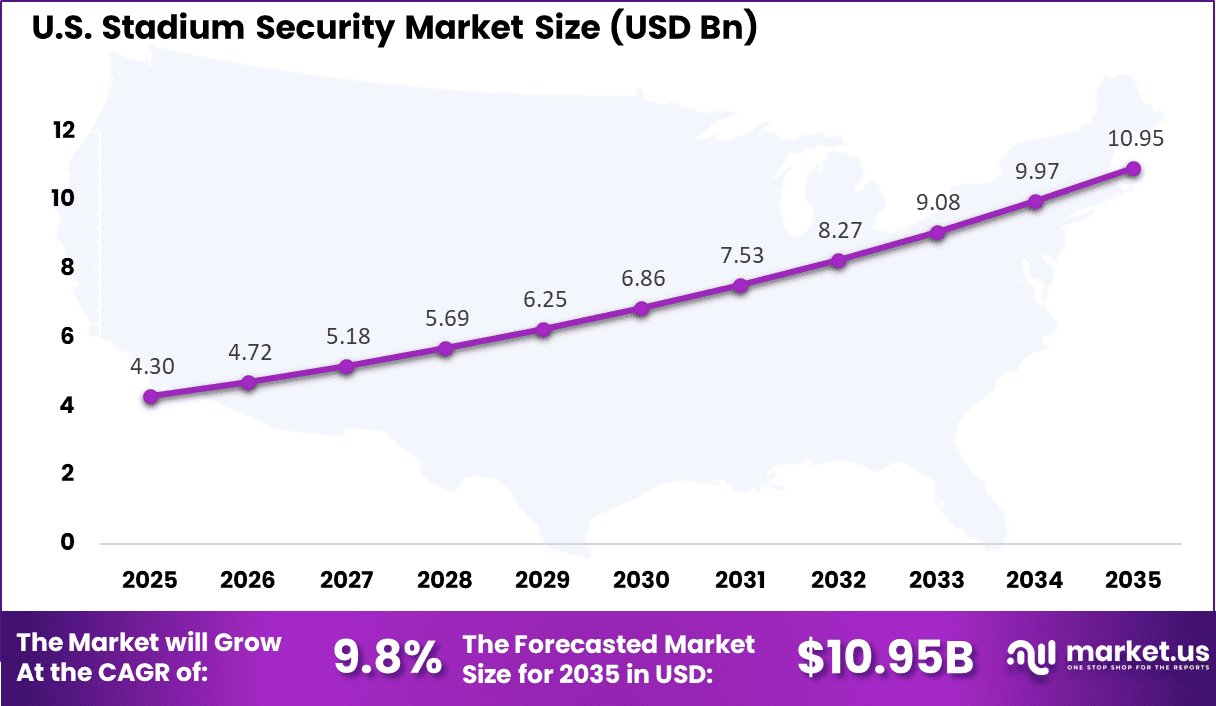
- The U. S. Stadium Security Market was valued at USD 4.30 billion in 2025, with a robust CAGR of 9.8%.
- In 2025, North America held a dominant market position in the Global Stadium Security Market, capturing more than a 38.2% share.
Role of Generative AI
Generative AI is reshaping stadium security by identifying risks before they escalate into real incidents. It monitors crowds in real time, detects unusual behavior, and predicts potential disruptions using past event data. With over 61% of stadiums adopting this technology, security teams are becoming more efficient without increasing workforce requirements.
It also supports facial verification at entry points and improves accuracy in bag scanning, reducing false alerts that slow operations. During high-attendance matches, response times have improved significantly. This leads to smoother crowd management, stronger control for operators, and a safer, more seamless experience for fans across venues.
Investment and Business Benefits
Investment opportunities are expanding as stadiums modernize by combining traditional security personnel with advanced technologies. Regular system upgrades create continuous demand, especially in areas like perimeter monitoring and crowd flow management. With event numbers rising by 15% yearly, vendors offering flexible solutions, training, and rapid deployment systems are well-positioned to benefit from sustained infrastructure spending.
Enhanced stadium security delivers measurable business benefits by reducing operational risks and lowering insurance premiums by 20-25%. Improved safety measures also build stronger fan confidence, which supports repeat attendance and higher ticket sales. In addition, smoother event operations minimize disruptions, allowing operators to focus on maximizing revenue from concessions and merchandise activities.
Regional Analysis
In 2025, North America held a dominant market position in the Global Stadium Security Market, capturing more than a 38.2% share, holding USD 4.81 billion in revenue. This dominance is due to the strong presence of large stadiums, advanced security infrastructure, and early adoption of smart surveillance technologies across North America.
The region also benefits from high spending on public safety, strict event security standards, and strong demand for crowd management systems during major sports and entertainment events. In addition, frequent upgrades in access control, video monitoring, and emergency response planning continue to support the region’s leading position in the market.
For instance, in March 2026, Avigilon Corporation enhanced stadium security across North American venues by deploying its AI-driven video analytics platform at major U.S. sports arenas. The system provides real-time threat detection and crowd monitoring, significantly improving response times during high-attendance events. This deployment reinforces North America’s leadership in advanced surveillance technology for stadium safety.
U.S. Stadium Security Market Size
The market for Stadium Security within the U.S. is growing tremendously and is currently valued at USD 4.30 billion. The market has a projected CAGR of 9.8%. The market is growing due to rising concerns around crowd safety, threat prevention, and emergency preparedness at large sports and entertainment venues. Stadium operators are investing more in surveillance, access control, screening systems, and real-time monitoring tools to manage growing attendance levels. Stronger compliance needs, higher fan expectations for safe entry, and the shift toward smarter venue operations are also supporting steady market expansion across the country.
For instance, in September 2025, Teledyne FLIR LLC supplied thermal imaging systems to support crowd management at major U.S. music venues and stadiums. Their advanced thermal cameras enable early detection of overcrowding and emergencies. Oregon-based FLIR reinforces U.S. leadership in thermal security applications.
Key Regions and Countries
North America
- US
- Canada
Europe
- Germany
- France
- The UK
- Spain
- Italy
- Russia
- Netherlands
- Rest of Europe
Asia Pacific
- China
- Japan
- South Korea
- India
- Australia
- Singapore
- Thailand
- Vietnam
- Rest of APAC
Latin America
- Brazil
- Mexico
- Rest of Latin America
Middle East & Africa
- South Africa
- Saudi Arabia
- UAE
- Rest of MEA
Component Analysis
In 2025, the Solutions segment held a dominant market position, capturing a 67.8% share of the Global Stadium Security Market. This dominance is due to the growing need for integrated systems that bring multiple security functions into one platform. Stadium operators prefer unified tools that allow faster monitoring, better coordination, and improved response during live events. These systems help manage large crowds while ensuring smooth communication between security teams.
Solutions continue to gain importance as venues focus on prevention and early detection of risks. Advanced monitoring tools improve visibility across entry points, seating areas, and surrounding zones. This allows security teams to act quickly and maintain control during high-pressure situations, making solution-based systems essential for modern stadium operations.
For Instance, in April 2026, Axis Communications AB unveiled AI-powered cameras tailored for stadium surveillance. These edge devices process video feeds on-site to detect unusual crowd movements and alert teams instantly. Stadium operators love how this cuts response times during tense matches, making venues safer without constant human oversight.
Deployment Mode Analysis
In 2025, the On-Premises segment held a dominant market position, capturing a 61.3% share of the Global Stadium Security Market. This dominance is due to the strong need for direct control over security systems and sensitive data within stadium environments. On-premises setups allow operators to manage access, monitor activities, and maintain privacy without relying on external networks. This approach is widely preferred where strict safety protocols must be followed.
Many stadiums already have existing infrastructure, which supports continued use of on-premises systems. Expanding current setups is often easier than shifting to new models. This ensures consistent performance, stable operations, and better system reliability, which are critical for handling large-scale events without disruption.
For instance, in March 2026, Dallmeier electronic GmbH & Co. KG launched rugged on-premises recorders built for harsh venue environments. They handle constant vibrations and crowds while storing footage securely in-house. This reliability draws praise from tech crews who need gear that just works.
Stadium Capacity Analysis
In 2025, The Greater than 50,000 Seats segment held a dominant market position, capturing a 43.7% share of the Global Stadium Security Market. This dominance is due to the higher complexity involved in managing security for large-capacity stadiums. These venues require wider coverage across multiple zones such as gates, seating areas, and external surroundings. The need for coordinated control increases as crowd size grows, making advanced systems more essential.
Large stadiums also face greater pressure to maintain smooth crowd movement and avoid congestion during events. Strong monitoring systems help track flow and detect issues early. This improves response time and ensures better safety management, allowing operators to handle high attendance levels with greater confidence and efficiency.
For Instance, in September 2025, Hanwha Vision Co., Ltd. introduced wide-area thermal cameras for mega-venues. These scan massive seating bowls to spot heat signatures in low light, ideal for night events with 50,000-plus fans. Operators report fewer blind spots, easing worries over perimeter breaches.
Key Market Segments
By Component
- Solutions
- Video Surveillance Systems
- Access Control Systems
- Perimeter Intrusion Detection Systems
- Alarm and Notification Systems
- Cybersecurity and Network Monitoring
- Others
- Services
- Managed Services
- Professional Services
By Deployment Model
- On-premise
- Cloud-based
By Stadium Capacity
- Less than 30,000 Seats
- 30,000–50,000 Seats
- Greater than 50,000 Seats
Emerging Trends
Stadiums are increasingly adopting AI-based video systems that monitor both internal areas and external perimeters simultaneously. These systems can detect threats such as unauthorized access or crowd congestion within seconds. Around 72% of new security upgrades now focus on intelligent monitoring, reflecting a clear shift toward proactive and real-time surveillance capabilities.
Another emerging trend is the integration of AI with automated access control systems, enabling rapid lockdown of zones during alerts. Technologies like low-light imaging enhance visibility in challenging conditions, such as night events or smoke. This combination has improved coordinated response capabilities by 58%, supporting faster and more reliable security operations.
Growth Factors
Growing risks from large crowds and external threats are driving the adoption of multi-layered security systems supported by real-time analytics. Incidents related to crowd behavior and occasional attacks have increased awareness among operators. Regulatory standards now apply to over 90% of major venues, ensuring consistent implementation of structured safety protocols.
At the same time, rising fan attendance is creating demand for scalable and efficient security solutions. Advanced analytics reduce reliance on manual staffing while expanding monitoring coverage. This balance between efficiency and safety has supported steady market expansion, as venues aim to manage higher volumes without compromising operational control.
Market Dynamics
Drivers - Rising Security Threats
Rising security threats are increasing the need for stronger protection across stadiums and large event venues. Operators are becoming more alert to risks linked with crowd violence, unauthorized entry, suspicious activity, and external disruptions. This growing risk environment is pushing venues to improve readiness and strengthen everyday security operations.
As stadium events attract larger audiences, even small incidents can escalate quickly if control measures are weak. This is encouraging venue managers to adopt better surveillance, screening, and emergency response systems. The need to prevent disruption and protect visitors is becoming a major force behind continued market growth.
For instance, in September 2025, Avigilon Corporation rolled out new AI tools that spot trouble in crowds right away. Their system links video feeds to alert staff before small issues turn big at busy games. This helps stadiums handle more fans safely without constant worry. Teams feel ready for whatever comes up during events.
Restraint - High Setup Costs
High setup costs remain a major restraint in the stadium security market, especially for venues with limited budgets. Installing advanced monitoring systems, access controls, screening equipment, and communication tools often requires a large upfront investment. For many operators, this creates a financial barrier that slows the pace of modernization.
The cost burden also extends beyond equipment, as training, maintenance, and system upgrades add to long-term expenses. Smaller venues may struggle to justify these investments when balancing other operational needs. As a result, cost pressure continues to limit wider adoption of advanced security systems in some parts of the market.
For instance, in March 2025, Genetec Inc. launched a modular security platform that spreads out the expense over time. Venues can start small and add pieces as budgets allow, easing the upfront hit. This approach lets even mid-sized stadiums upgrade without draining funds right away. It keeps operations smooth while building better protection step by step.
Opportunities - Smart Tech Integration
Smart technology integration is creating strong opportunities in the stadium security market. Venues are looking for systems that can connect cameras, access control, analytics, and alerts into one coordinated structure. This approach improves visibility and helps security teams respond faster and more accurately during crowded live events.
It also supports better planning and smoother operations by reducing manual effort and improving situational awareness. As venues seek more efficient ways to manage safety, demand is increasing for integrated platforms that combine intelligence with practical control. This creates room for continued innovation and wider system adoption.
For instance, in January 2026, Axis Communications AB fitted a major stadium with cameras that blend real-time analytics into daily operations. The setup ties license plate checks and facial scans to one control room for seamless flow. Staff now manage entries and watch crowds with less effort. It opens the door for venues to mix safety with fan perks like quick access.
Challenges - Coordination During Live Incidents
Coordination during live incidents remains a serious challenge for stadium security teams. When a disruption happens in a crowded venue, quick communication between staff, law enforcement, and emergency responders becomes essential. Delays or confusion in decision-making can increase risk and make the situation harder to control.
This challenge becomes greater when multiple zones, entry points, and crowd movements must be managed at the same time. Security teams need clear protocols and reliable communication tools to act in a unified manner. Maintaining order during a fast-moving incident remains one of the most difficult parts of stadium security.
For instance, in July 2025, Hangzhou Hikvision Digital Technology Co., Ltd. introduced software that syncs multiple teams during fast-moving events. It shares live views across devices so guards and emergency crews stay on the same page amid chaos. This cuts confusion when seconds count in packed stands. Practice runs show quicker responses that save the day.
Key Players Analysis
One of the leading players in March 2026, Genetec expanded its stadium security offering with a unified command‑and‑control platform that ties together access control, video surveillance, and incident‑management workflows in one interface. Several major U.S. and Canadian stadiums signed long‑term contracts, driven by Genetec’s ability to correlate AI‑driven alerts across multiple systems for faster, more coordinated crowd‑safety responses.
Top Key Players in the Market
- Avigilon Corporation
- Genetec Inc.
- Axis Communications AB
- Hangzhou Hikvision Digital Technology Co., Ltd.
- Zhejiang Dahua Technology Co., Ltd.
- Dallmeier electronic GmbH & Co. KG
- AxxonSoft Limited
- Rapiscan Systems, Inc.
- Evolv Technologies Holdings, Inc.
- Xtract One
- Senstar Corporation
- BriefCam Ltd.
- Hanwha Vision Co., Ltd.
- Bosch Security Systems GmbH
- NEC Corporation
- Teledyne FLIR LLC
- Gallagher Group Limited (Security Division)
- IDEMIA Group S.A.S.
- Magal Security Systems Ltd.
- Fortem Technologies, Inc.
- Others
Recent Developments
- In March 2026, Avigilon rolled out a new stadium‑grade AI‑enabled video analytics suite integrating its high‑resolution cameras with real‑time crowd‑flow algorithms for large venues. The platform is now being deployed at several North American sports complexes to automate loitering detection, unauthorized access alerts, and safety‑zone monitoring, reducing manual operator load while improving incident response time.
- In February 2026, Axis launched a new generation of ruggedized, stadium‑specific IP cameras featuring wider dynamic range, low‑light optimization, and AI‑on‑the‑edge analytics for real‑time license‑plate and mask detection at entry points. The products are being integrated into smart stadium tenders in North America, positioning Axis as a go‑to vendor for video infrastructure in large‑capacity venues.
Report Scope
| Report Features | Description |
|---|---|
| Market Value (2025) | USD 12.6 Billion |
| Forecast Revenue (2035) | USD 37.7 Billion |
| CAGR(2025-2035) | 11.6% |
| Base Year for Estimation | 2025 |
| Historic Period | 2020-2024 |
| Forecast Period | 2025-2035 |
| Report Coverage | Revenue forecast, AI impact on Market trends, Share Insights, Company ranking, competitive landscape, Recent Developments, Market Dynamics, and Emerging Trends |
| Segments Covered | By Component (Solutions, Services), By Deployment Model (On-premise, Cloud-based), By Stadium Capacity (Less than 30,000 Seats, 30,000–50,000 Seats, Greater than 50,000 Seats) |
| Regional Analysis | North America – US, Canada; Europe – Germany, France, The UK, Spain, Italy, Russia, Netherlands, Rest of Europe; Asia Pacific – China, Japan, South Korea, India, New Zealand, Singapore, Thailand, Vietnam, Rest of Latin America; Latin America – Brazil, Mexico, Rest of Latin America; Middle East & Africa – South Africa, Saudi Arabia, UAE, Rest of MEA |
| Competitive Landscape | Avigilon Corporation, Genetec Inc., Axis Communications AB, Hangzhou Hikvision Digital Technology Co., Ltd., Zhejiang Dahua Technology Co., Ltd., Dallmeier electronic GmbH & Co. KG, AxxonSoft Limited, Rapiscan Systems, Inc., Evolv Technologies Holdings, Inc., Xtract One, Senstar Corporation, BriefCam Ltd., Hanwha Vision Co., Ltd., Bosch Security Systems GmbH, NEC Corporation, Teledyne FLIR LLC, Gallagher Group Limited (Security Division), IDEMIA Group S.A.S., Magal Security Systems Ltd., Fortem Technologies, Inc., Others |
| Customization Scope | Customization for segments and region/country levels will be provided. Moreover, customization can be tailored to the requirements. |
| Purchase Options | We have three licenses to opt for: Single User License, Multi-User License (Up to 5 Users), Corporate Use License (Unlimited Users and Printable PDF) |





























