


Report Overview
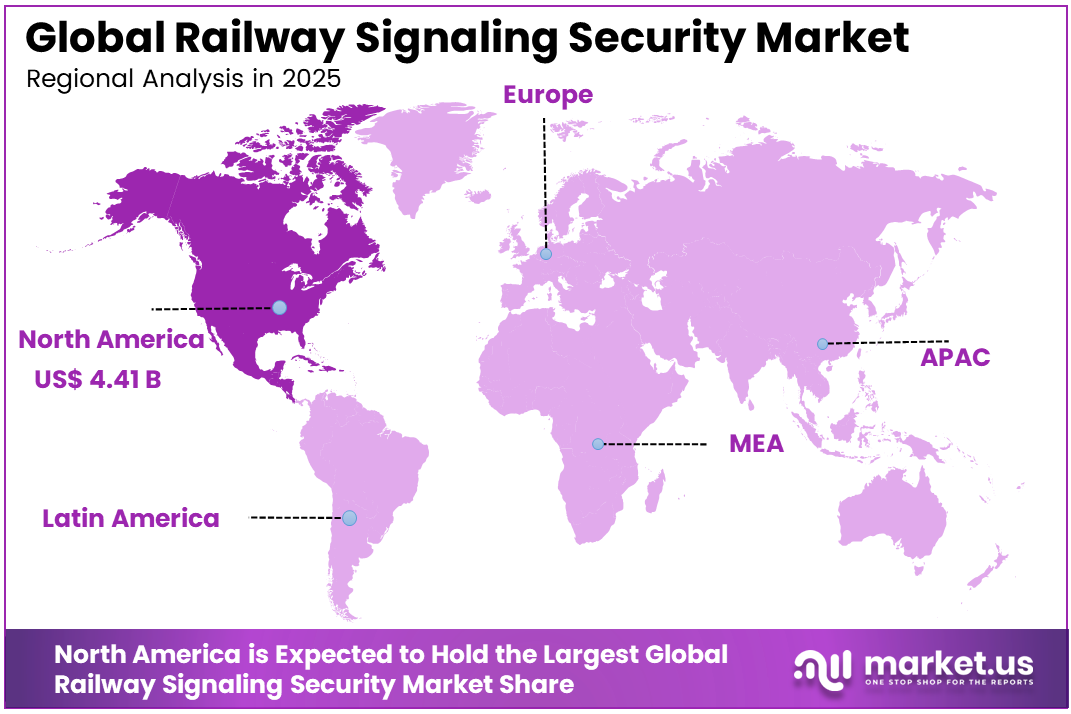
The Global Railway Signaling Security Market size is expected to be worth around USD 31.84 billion by 2035, from USD 12.73 billion in 2025, growing at a CAGR of 9.6% during the forecast period from 2025 to 2035. North America held a dominant market position, capturing more than 34.7% share and generating USD 4.41 billion in revenue.
Railway Signaling Security refers to the protection of train control, signaling, communication, and monitoring systems from cyber threats, technical failures, and unauthorized access. It helps ensure safe train movement, accurate route control, reliable signal operations, and continuous rail services across passenger, freight, metro, and high-speed rail networks.
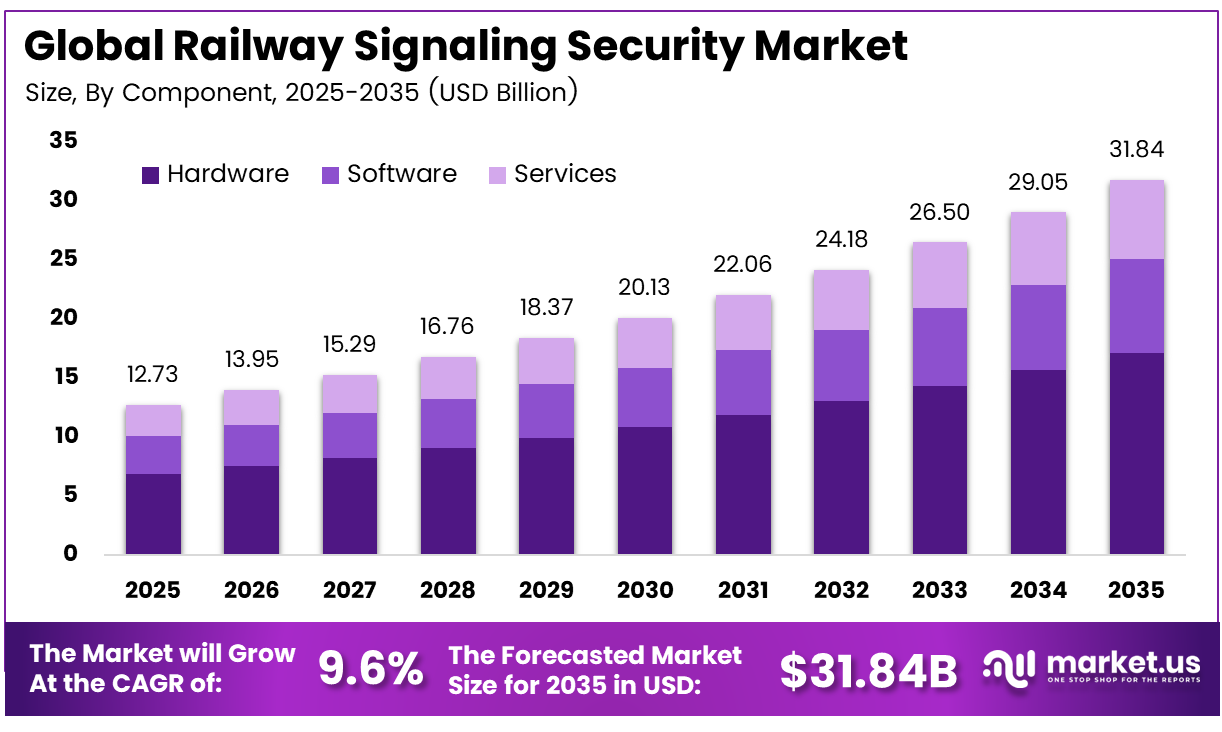
Top driving factors include growing passenger numbers, rising freight movement on the same tracks, and stricter safety expectations. Rail operators are under pressure to improve control systems because even a single collision can affect 1000 or more travellers and create long service disruptions, financial losses, and public safety concerns.
The market for Railway Signaling Security is driven by the growing need to protect digital rail networks from cyber threats, system failures, and operational disruptions. As rail operators shift toward electronic interlocking, automatic train protection, and connected control systems, secure signaling becomes essential for safe train movement, better punctuality, and reliable passenger and freight services.
Demand is rising as many rail networks still depend on legacy relay or mechanical systems. Operators are shifting toward electronic interlocking, automatic train protection, and continuous train monitoring. These upgrades help reduce signal passed at danger incidents by over 50 percent, while improving safety, reliability, and daily traffic control.
For instance, in January 2026, MERMEC Group continued to expand its diagnostics and signaling footprint, leveraging smart track‑monitoring systems that feed into interlocking and train protection strategies. By pairing measurement trains with digital signaling analytics, MERMEC helps infrastructure managers detect faults earlier and maintain higher safety margins on busy corridors.
Key Takeaway
- In 2025, the Hardware segment held a dominant market position, capturing a 53.9% share of the Global Railway Signaling Security Market.
- In 2025, the Automatic Train Protection segment held a dominant market position, capturing a 38.4% share of the Global Railway Signaling Security Market.
- In 2025, the Urban Rail segment held a dominant market position, capturing a 35.7% share of the Global Railway Signaling Security Market.
- In 2025, the On-Premises segment held a dominant market position, capturing a 70.2% share of the Global Railway Signaling Security Market.
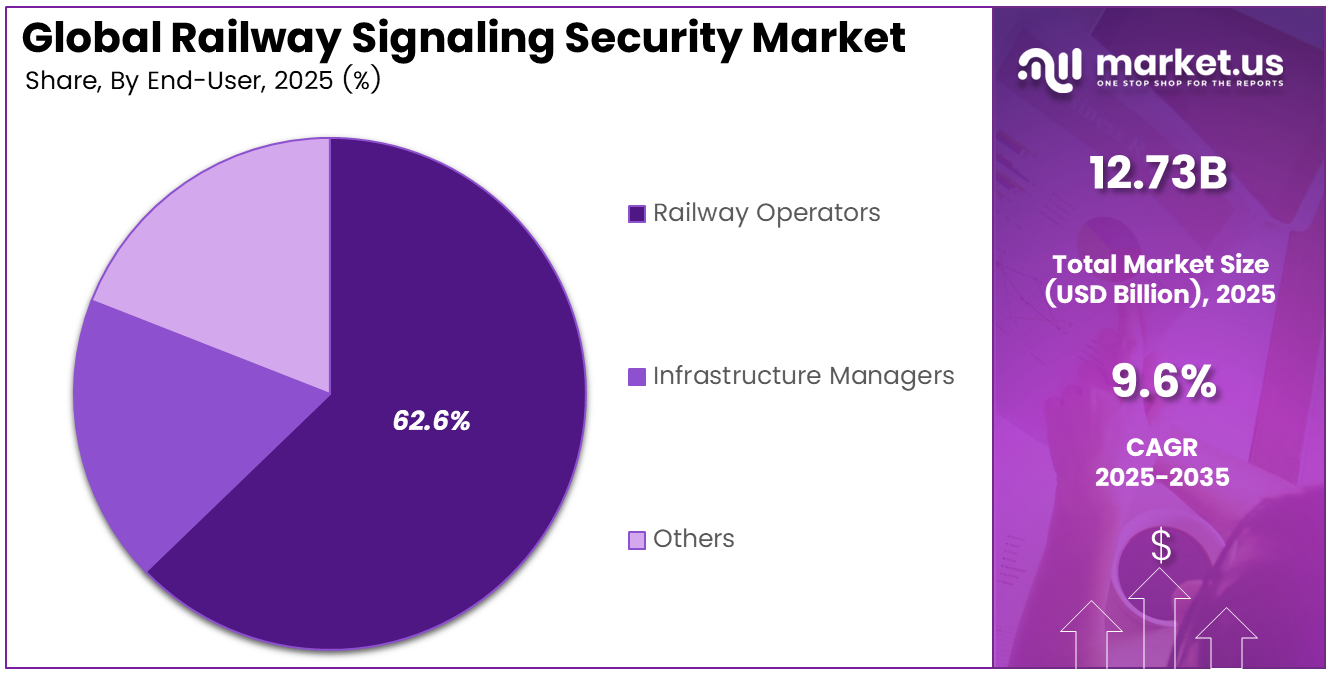
- In 2025, the Railway Operators segment held a dominant market position, capturing a 62.6% share of the Global Railway Signaling Security Market.
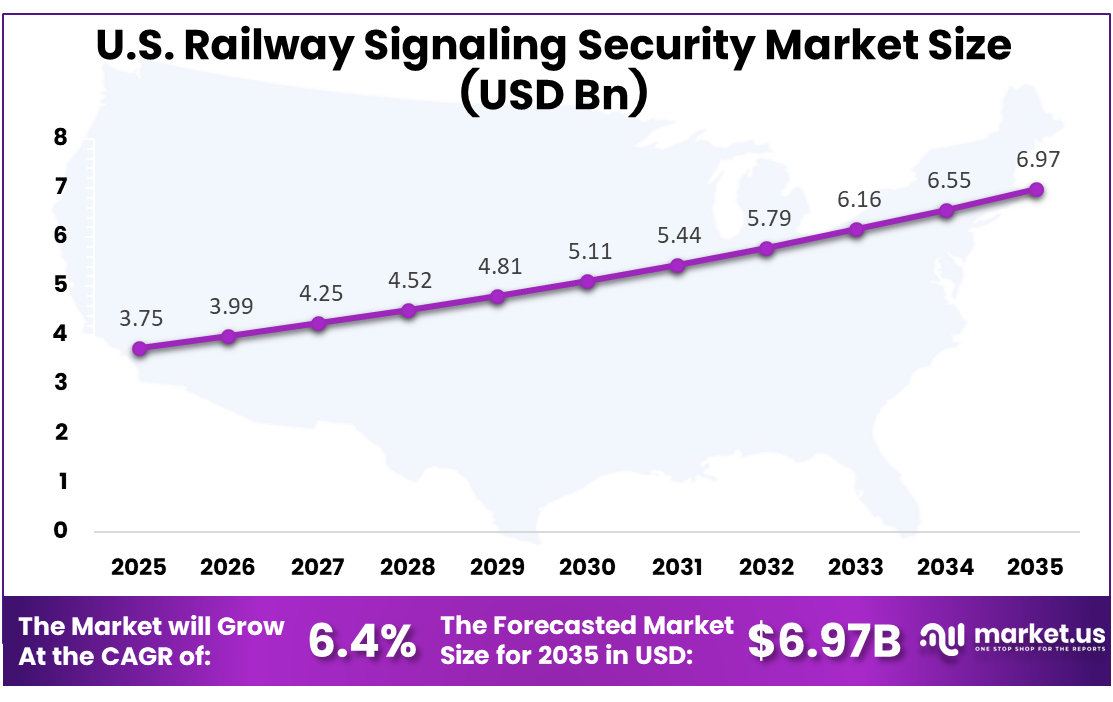
- The U.S. Railway Signaling Security Market was valued at USD 3.75 billion in 2025, with a robust CAGR of 6.4%.
- In 2025, North America held a dominant market position in the Global Railway Signaling Security Market, capturing more than a 34.7% share.
Role of Generative AI
Generative AI is becoming important in railway signaling security as systems move from basic automation to live learning. AI-driven analytics can cut anomaly detection time by more than 40% and reduce false alarms by close to 30%, helping control rooms identify unusual route commands and timing issues faster.
It also helps field teams turn complex technical logs into clear repair guidance. Early use in rail operations shows AI-assisted tools can speed up incident reporting and root cause documentation by around 20% and improve first-time fix rates by roughly 15%, supporting safer and more disciplined maintenance work.
Investment and Business Benefits
Investment opportunities are growing in cyber secure signalling software, intrusion detection, field equipment monitoring, cloud-based diagnostic tools, and retrofit projects. Strong potential is seen in replacing old signalling assets with certified safety systems across thousands of stations and track blocks, especially where aging infrastructure limits efficiency and operational visibility.
Business benefits include fewer accidents, reduced downtime, better asset utilisation, and more on-time arrivals. Modern railway signalling allows trains to run closer together while maintaining safe operating margins. This helps operators increase line capacity, improve passenger confidence, and manage heavier traffic without major expansion of existing track infrastructure.
Regional Analysis
In 2025, North America held a dominant market position in the Global Railway Signaling Security Market, capturing more than 34.7% share and generating USD 4.41 billion in revenue. This dominance is due to strong rail modernization programs, high safety standards, and rising investment in digital signaling systems. The region also has large freight corridors, busy urban transit networks, and growing cyber risk concerns, which support steady adoption of secure signaling solutions.
For instance, in December 2025, Wabtec completed the Frauscher acquisition, integrating its sensing and axle-counting portfolio into Wabtec’s Digital Intelligence business. This integration strengthens North America’s position in secure, fail-safe signaling architectures, enabling more accurate train localization, intrusion detection, and safer operations across busy mainlines and metro networks.
U.S. Railway Signaling Security Market Size
The market for Railway Signaling Security within the U.S. is growing tremendously and is currently valued at USD 3.75 billion; the market has a projected CAGR of 6.4%. The market is growing due to rising rail modernization, higher passenger safety needs, and the wider use of digital train control systems. U.S. operators are upgrading old signaling assets to improve route control, reduce delays, and protect connected rail networks from cyber risks while supporting safer freight and passenger movement.
For instance, in March 2025, Wabtec Corporation reinforced U.S. leadership in railway signaling security with its next-generation Positive Train Control 2.0 platform, enhancing real-time monitoring, collision avoidance, and network resilience across North American freight and passenger lines. This software-centric upgrade strengthens safety compliance while expanding Wabtec’s digital signaling footprint in the region.
Component Analysis
In 2025, the Hardware segment held a dominant market position, capturing a 53.9% share of the Global Railway Signaling Security Market. This dominance is due to the critical role of physical signaling assets in rail safety. Interlocking units, trackside equipment, onboard devices, sensors, and control panels form the main operating layer of railway signaling security. These systems help manage train routes, signal commands, and safe movement across busy rail networks.
Hardware demand also remains strong because many rail networks are replacing older equipment with safer and more reliable systems. Operators prefer durable field devices that can work in harsh rail environments. As signaling becomes more connected, secure hardware is needed to protect both safety functions and operational continuity.
For instance, in January 2026, Alstom completed a major resignalling project around Cambridge in the UK, replacing older assets with modern electronic interlockings and secure trackside systems. The work shows how large hardware renewals are a practical pathway to embed stronger safety and security features in existing networks.
Signaling Type Analysis
In 2025, the Automatic Train Protection segment held a dominant market position, capturing a 38.4% share of the Global Railway Signaling Security Market. This dominance is due to the strong safety role of automatic train protection in preventing unsafe train movement. It supports speed supervision, signal compliance, and braking control when risk is detected. This makes it highly important for networks that need stronger protection against driver error and operational mistakes.
Automatic train protection is also being adopted because operators want better control over train movement on busy routes. It helps improve safety discipline without fully depending on manual response. As railway systems become faster and more automated, this signaling type is expected to remain a core security layer.
For instance, in January 2025, Siemens Mobility was awarded several contracts for the HS2 high-speed network in the UK, including Automatic Train Operation over ETCS Level 2. The project highlights how next-generation ATP and ATO solutions are central to safer and more controllable train movements on complex routes.
Application Analysis
In 2025, the Urban Rail segment held a dominant market position, capturing a 35.7% share of the Global Railway Signaling Security Market. This dominance is due to the high traffic pressure faced by metro and city rail systems. Urban rail networks need frequent train services, shorter waiting times, and safe movement in dense areas. Secure signaling supports closer train spacing while helping operators maintain safety during peak passenger movement.
Urban rail also requires strong monitoring because delays or faults can affect thousands of daily passengers. Signaling security helps control train flow, reduce service disruption, and support better incident response. As cities expand their public transport systems, secure signaling becomes essential for reliable urban mobility.
For instance, in February 2025, Hitachi Rail secured a contract to modernise San Francisco’s Muni network with its SelTrac CBTC train control technology. This urban rail upgrade underscores the growing role of advanced signaling in busy city systems, where reliability, safety, and secure operation are tightly linked.
Deployment Mode Analysis
In 2025, the On-Premises segment held a dominant market position, capturing a 70.2% share of the Global Railway Signaling Security Market. This dominance is due to the safety-critical nature of railway signaling operations. Many operators prefer on-premises systems because they offer direct control over infrastructure, data access, and system performance. Local deployment is also useful where low latency and continuous availability are required for train control.
On-premises solutions remain important because rail operators often follow strict safety, compliance, and access control rules. These systems allow better supervision of interlocks, control rooms, and operational networks. They also help reduce dependence on external connectivity for functions that must remain stable at all times.
For instance, in October 2025, Siemens showcased cloud-ready but security-focused signaling platforms, including interlocking and CBTC solutions, at a major rail event in India. While these systems use modern connectivity, they are usually deployed under tight operator control, showing how on-premises and closely managed setups remain important.
End-User Analysis
In 2025, the Railway Operators segment held a dominant market position, capturing a 62.6% share of the Global Railway Signaling Security Market. This dominance is due to the direct responsibility of railway operators for train safety and service reliability. Operators manage signaling assets, route control, maintenance planning, and emergency response. Their daily role makes them the main users of secure signaling systems across passenger and freight networks.
Railway operators also invest in signaling security to reduce failures, improve punctuality, and protect critical assets. Secure systems help them respond faster to faults and manage growing traffic more safely. As rail networks modernize, operators continue to lead adoption because they carry the operational and safety risk.
For instance, in December 2025, Alstom’s metro trains and signaling system entered service on Bhopal’s first metro line, directly supporting the local operator’s new network. The project shows how operators depend on integrated train and signaling packages to run safe services, while gradually strengthening protection for their control assets.
Emerging Trends
Emerging trends are shaped by digital signaling platforms such as ERTMS, CBTC, and PTC. Digital and communication-based signaling already covers more than 50% of new mainline and urban projects across advanced networks, increasing the need for cyber protection across connected and safety-critical rail assets.
Cybersecurity is now being built into signaling design from the start. In some leading networks, over 60% of planned signaling upgrades include dedicated cybersecurity scopes, such as network segmentation, encryption, monitoring, and response planning for control centers, interlockings, radio block centers, and onboard units.
Growth Factors
Growth is supported by rail infrastructure expansion and the shift toward automated signaling. In regions upgrading old systems, more than 70% of resignalling budgets now include cyber protection, including hardened devices, secure remote access, and safer diagnostic tools for busy corridors with rising train density.
Reported attacks on transport infrastructure are also raising awareness among rail regulators and operators. Public critical infrastructure data shows yearly cyber incident growth in the high single-digit range, encouraging more stable spending on detection platforms, secure architectures, and resilience planning instead of short-term responses after outages.
Key Market Segments
By Component
- Hardware
- Software
- Services
By Signaling Type
- Automatic Train Protection
- Positive Train Control
- Communication-Based Train Control
- European Train Control System
- Others
By Application
- Urban Rail
- Mainline Rail
- High-Speed Rail
- Freight Rail
- Others
By Deployment Mode
- On-Premises
- Cloud
By End-User
- Railway Operators
- Infrastructure Managers
- Others
Market Dynamics
Drivers - Rising Digitization and Cyber Threat Exposure
Rising digitization is increasing the need for stronger railway signaling security. Modern signaling now depends on connected control centers, communication networks, onboard systems, and trackside equipment. As these systems become more software-based, the risk of cyber intrusion, unauthorized access, and service disruption also increases.
Rail operators are therefore treating signaling security as part of safety planning. Digital train control can improve capacity and reliability, but it also creates new entry points for attackers. Strong monitoring, secure access, and protected communication are becoming essential to keep train movement safe and stable.
For instance, in November 2025, CAF Signalling and Cellnex Telecom successfully validated the Optio CBTC system over a private 5G network. Moving train control data onto high‑bandwidth, IP‑based radio improves capacity and flexibility, but it also introduces new cyber risks, encouraging closer attention to encryption, key management, and segmentation in future CBTC deployments.
Restraint - Complex Legacy Infrastructure
Many railway networks still depend on older relay-based, mechanical, or mixed signalling systems. These assets were built mainly for safe operation, not modern cyber protection. Adding new security tools is difficult because systems must remain available while upgrades, testing, and certification work are completed.
Legacy infrastructure also creates integration issues between old field equipment and modern digital platforms. Operators must avoid service disruption while improving protection. This makes deployment slower, costlier, and more complex, especially across large rail networks where several generations of signalling technology may operate together.
For instance, in January 2026, Alstom completed a major re‑signalling programme on the Farncombe to Petersfield route in the UK, replacing older assets with modern signalling and level crossings. The project illustrates how complex, dispersed legacy equipment requires long blockades and careful staging, which can slow broader cyber‑secure signalling rollouts across national networks.
Opportunities - AI-Driven Threat Detection
AI-driven threat detection creates a strong opportunity for railway signaling security. AI tools can study large volumes of network logs, control commands, and equipment behavior to detect unusual activity faster. This helps operators identify early warning signs before they turn into safety or service problems.
The opportunity is also growing because control rooms receive many alerts from connected systems. AI can help reduce noise, support faster investigation, and guide engineers with clearer context. When used carefully, it can improve response quality while allowing human teams to focus on the most serious signaling risks.
For instance, in December 2025, Hitachi Rail secured a framework agreement with SBB to roll out advanced digital signalling technology across the Swiss network. Although focused on control and capacity, the programme provides a platform for applying AI‑supported diagnostics and cyber monitoring to keep the upgraded digital signalling environment resilient.
Challenges - Aligning Safety, Security, and Operations
Aligning safety, security, and operations is a key challenge in railway signaling security. Any cybersecurity measure must support safe train movement without slowing essential control functions. Security updates, access rules, and monitoring tools must be carefully tested before deployment.
Rail operators also need close coordination between signaling engineers, cybersecurity teams, and operations staff. Each group has different priorities, but the system must work as one. Without this alignment, security programs may create operational friction or fail to address real safety-critical risks.
For instance, in May 2024, Wabtec highlighted that its IEC 62443‑4‑1 certification covers risk management, incident response, and supply‑chain security throughout the product lifecycle. This work illustrates the organisational challenge of coordinating engineering, safety, and operations teams so that cybersecurity practices support, rather than disrupt, railway service delivery.
Key Regions and Countries
North America
- US
- Canada
Europe
- Germany
- France
- The UK
- Spain
- Italy
- Russia
- Netherlands
- Rest of Europe
Asia Pacific
- China
- Japan
- South Korea
- India
- Australia
- Singapore
- Thailand
- Vietnam
- Rest of APAC
Latin America
- Brazil
- Mexico
- Rest of Latin America
Middle East & Africa
- South Africa
- Saudi Arabia
- UAE
- Rest of MEA
Key Players Analysis
One of the leading players in February 2026, ABB Ltd. advanced its position in rail infrastructure by promoting integrated power and control solutions that interface with modern signaling, such as secure traction substations and SCADA systems. These platforms help operators monitor assets in real time and coordinate with interlocking and train control for safer, more stable service.
Top Key Players in the Market
- Alstom
- Siemens Mobility
- Hitachi Rail
- Bombardier Transportation
- Thales Group
- CAF Signalling
- Nippon Signal Co., Ltd.
- Wabtec Corporation
- ABB Ltd.
- Kyosan Electric Manufacturing Co., Ltd.
- Mermec Group
- CRSC (China Railway Signal & Communication Corporation)
- Ansaldo STS
- Hollysys Automation Technologies
- General Electric (GE Transportation)
- EKE-Electronics
- Larsen & Toubro Limited (L&T)
- Quester Tangent
- Siemens AG
- Alcatel-Lucent Enterprise (ALE International)
- Other Major Players
Recent Developments
- In April 2026, Alstom secured multiple signaling contracts, including CBTC upgrades for Paris Metro Line 8 and advanced ETCS‑based control for high‑speed corridors such as the new tunnel in Łódź, Poland. These wins reinforce Alstom’s role in digital train control and safety‑critical signaling across both urban and mainline networks.
- In March 2026, Siemens Mobility successfully demonstrated automated train operation (ATO) over ETCS on a Nordic mainline route in Finland. The pilot shows how Siemens is using ETCS and digital interlocking to increase capacity, safety, and energy efficiency, positioning the company at the forefront of next‑generation signaling security solutions.
Report Scope
| Report Features | Description |
|---|---|
| Market Value (2025) | USD 12.73 Billion |
| Forecast Revenue (2035) | USD 31.84 Billion |
| CAGR (2026-2035) | 9.6% |
| Base Year for Estimation | 2025 |
| Historic Period | 2020-2024 |
| Forecast Period | 2026-2035 |
| Report Coverage | Revenue Forecast, Market Dynamics, Competitive Landscape, Recent Developments |
| Segments Covered | By Component (Hardware, Software, Services), By Signaling Type (Automatic Train Protection, Positive Train Control, Communication-Based Train Control, European Train Control System, Others), By Application (Urban Rail, Mainline Rail, High-Speed Rail, Freight Rail, Others), By Deployment Mode (On-Premises, Cloud), By End-User (Railway Operators, Infrastructure Managers, Others) |
| Regional Analysis | North America (US and Canada), Europe (Germany, France, The UK, Spain, Italy, and Rest of Europe), Asia Pacific (China, Japan, South Korea, India, Australia, and Rest of APAC), Latin America (Brazil, Mexico, and Rest of Latin America), Middle East & Africa (GCC, South Africa, and Rest of MEA) |
| Competitive Landscape | Alstom, Siemens Mobility, Hitachi Rail, Bombardier Transportation, Thales Group, CAF Signalling, Nippon Signal Co., Ltd., Wabtec Corporation, ABB Ltd., Kyosan Electric Manufacturing Co., Ltd., Mermec Group, CRSC (China Railway Signal & Communication Corporation), Ansaldo STS, Hollysys Automation Technologies, General Electric (GE Transportation), EKE-Electronics, Larsen & Toubro Limited (L&T), Quester Tangent, Siemens AG, Alcatel-Lucent Enterprise (ALE International), Other Major Players |
| Customization Scope | Customization at the segment and region/country levels will be provided. Moreover, customization can be tailored to the requirements. |
| Purchase Options | We have three licenses to opt for: Single User License, Multi-User License (Up to 5 Users), Corporate Use License (Unlimited Users and Printable PDF) |





























