Report Overview
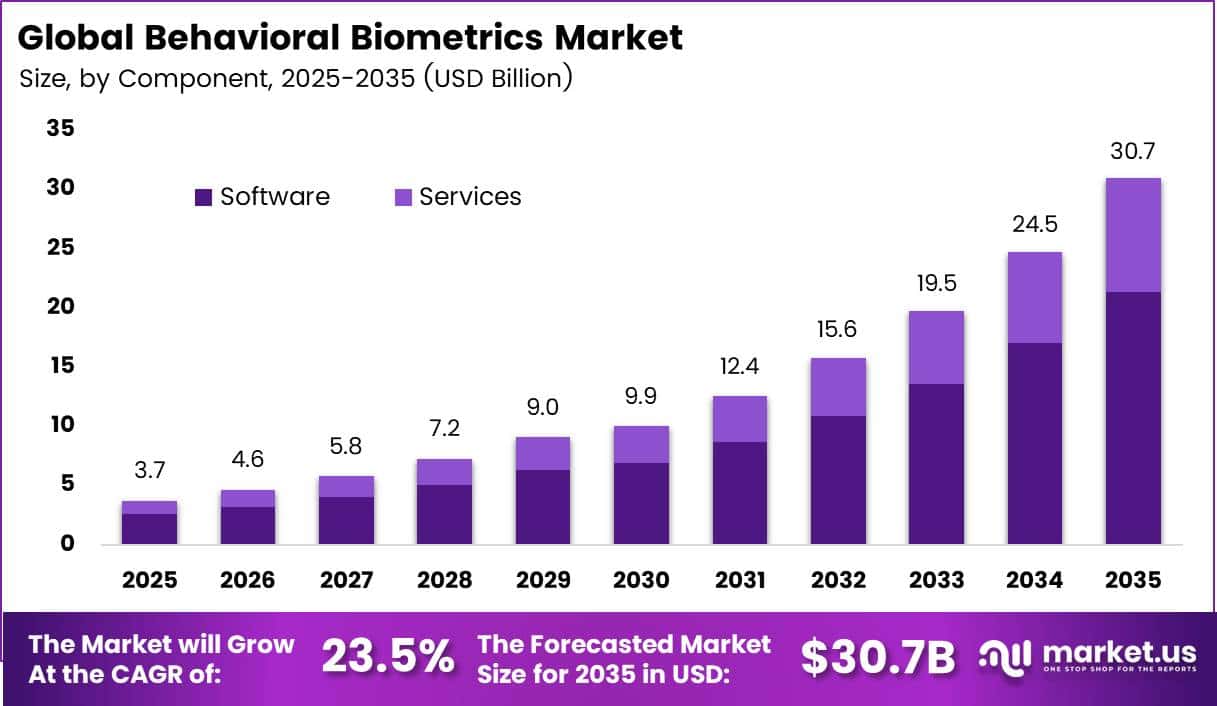
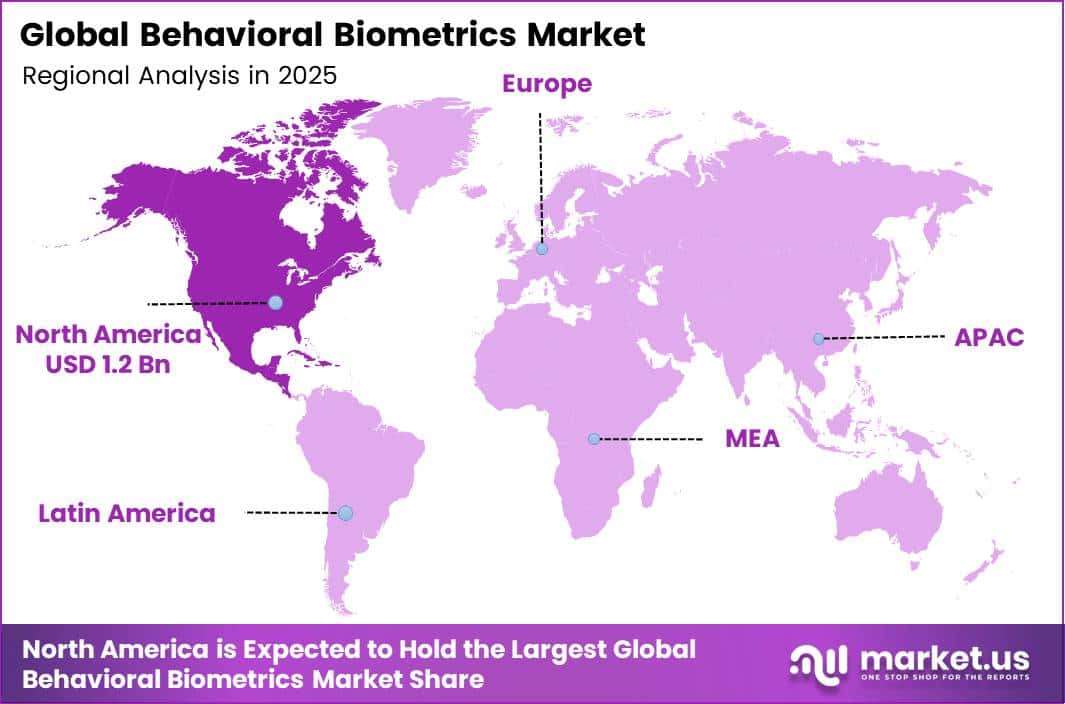
In 2025, the Global Behavioral Biometrics Market was valued at USD 3.7 billion. The market is projected to grow at a CAGR of 23.5% during 2026–2035, reaching approximately USD 30.7 billion by 2035. North America dominated the global market in 2025, accounting for more than 33.6% of the total market share and generating approximately USD 1.2 billion in revenue.
Behavioral biometrics checks how a person types, swipes, speaks, and moves a mouse, and confirms their identity without a password. Online fraud is the main reason for this growth. The FBI Internet Crime Complaint Center received 859,532 complaints in 2024, with reported losses of USD 16.6 billion. That is a 33% rise over 2023.
The North America region has the largest base of digital banking users and the highest fraud exposure. The FBI reported that Americans over 60 lost about USD 7.7 billion to cyber-enabled fraud in 2025, up 37% from 2024. Scams that coach victims to approve payments themselves get past one-time passwords.
Behavioral signals such as hesitation, pauses while someone gives instructions, and odd typing rhythm can catch them. US banks also face strict rules on knowing their customers. These rules make continuous, low-friction checks a standard purchase for large financial institutions in the region.
Key Takeaways
- The Behavioral Biometrics Market reached USD 3.7 billion in 2025 and will hit USD 30.7 billion by 2035. at a CAGR of 23.5% from 2026 to 2035.
- Software leads the Component segment with a 69.7% share.
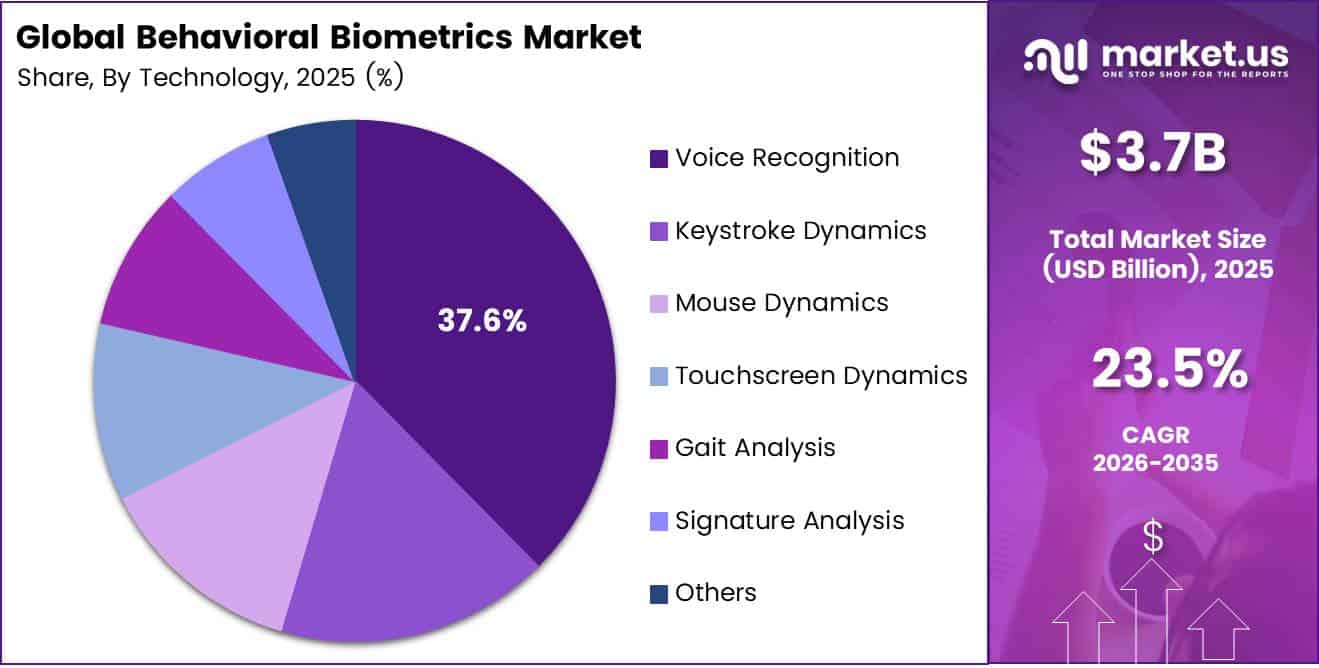
- Voice Recognition leads the Technology segment with a 37.6% share.
- On-Premises leads the Deployment Mode segment with a 64.1% share.
- Large Enterprises lead the Organization Size segment with a 72.5% share.
- Identity Proofing leads the Application segment with a 33.7% share.
- BFSI leads the End-Use Industry segment with a 25.7% share.
- North America leads with a 33.6% share and USD 1.2 billion in revenue.
By Component
Software dominates with 69.7% due to real-time scoring of every user session.
Software leads because banks and online firms need tools that watch user behavior across every login and payment. The FBI Internet Crime Complaint Center logged 859,532 complaints in 2024, with reported losses of $16.6 billion, a 33% jump over 2023. Firms respond by buying software that scores each session, flags odd typing or swiping, and blocks risky actions before money leaves an account.
Services grow fastest as firms look for expert help to tune models, cut false alarms, and run tools every day. UK Finance reports that its members stopped £1.45 billion of unauthorised fraud in 2024, saving 67p of every £1 attacked. Results like these depend on skilled teams that set rules, train staff, and manage alerts.
By Technology
Voice Recognition dominates with 37.6% due to rising phone scams targeting call centers.
Voice Recognition holds the top spot because banks, telecom firms, and help desks still handle huge numbers of phone calls. Callers often pretend to be trusted staff, and voice tools check who is really speaking. The FTC received close to 850,000 imposter scam reports in 2024, and those scams caused $2.95 billion in losses.
Touchscreen Dynamics grows fastest because most daily banking and shopping now happens on phones. These tools study swipe speed, finger pressure, and tap rhythm without asking users to do anything extra. ITU data shows that 5G now reaches more than half of the world’s people and makes up over one-third of all mobile broadband subscriptions.
By Deployment Mode
On-Premises dominates with 64.1% due to strict data control rules in banking.
On-Premises leads because banks, insurers, and public agencies want full control over sensitive behavior data. Many rules require firms to keep customer records inside their own data centers. UK Finance found that unauthorised fraud cases rose 14% to 3.13 million in 2024, with losses of £722 million.
Cloud-Based deployment grows fastest because it offers quick setup, lower upfront costs, and easy scaling when traffic spikes. ITU estimates that about 6 billion people use the internet in 2025, up from 5.8 billion in 2024. Every new user adds more logins, payments, and digital sessions that firms must check. Cloud platforms handle these growing loads without new hardware.
By Organization Size
Large Enterprises dominate with 72.5% due to high fraud exposure and big budgets.
Large Enterprises lead because they serve huge customer bases, run many apps, and manage complex payment flows. Criminals target them often, and one attack can cost millions. The FBI recorded $2.77 billion in business email compromise losses in 2024, which made it the second costliest scam type.
Small and Medium Enterprises (SMEs) grow fastest because cloud tools and pay-as-you-go pricing now make advanced security affordable. Smaller firms face the same fraud waves as large ones. UK Finance reports that criminals stole £1.28 billion through payment fraud in 2025, an increase of 4%.
By Application
Identity Proofing dominates with 33.7% due to rising identity theft during account opening.
Identity Proofing leads because firms must confirm that a new user is a real person before they open an account. Fake and stolen identities cause major losses at this first step. The FTC’s Consumer Sentinel Network received 1.1 million identity theft reports in 2024, out of 6.47 million total consumer reports.
Fraud Detection and Prevention grows fastest as scams shift toward instant payments and digital assets. FBI data shows 149,686 complaints tied to cryptocurrency in 2024, with losses of $9.3 billion. Criminals now move funds within minutes, so firms need tools that track behavior through the whole session and stop risky transfers before they settle.
By End-Use Industry
Banking, Financial Services, and Insurance (BFSI) dominates with 25.7% due to high payment fraud and strict regulations.
BFSI leads because banks, insurers, and payment firms handle money directly, which makes them prime targets. The FTC found that bank transfers and payments caused the highest aggregate fraud losses in 2024, at over $2 billion. Investment scams cost consumers another $5.7 billion.
Financial firms also follow strict know-your-customer and anti-money laundering rules, so they adopt behavior tools early. These tools protect mobile banking, card payments, and loan applications. Retail and e-commerce add steady demand too, as U.S. online retail sales reached $340.2 billion in the second quarter of 2026.
Healthcare grows fastest as hospitals and insurers move patient records and portals online. The U.S. Department of Health and Human Services counted 663 large breaches in 2024, affecting about 242.9 million people. Hacking caused 81% of these reports. Hospitals now use behavior checks to stop stolen staff logins, protect patient portals, and meet stricter access control rules.
Key Market Segments
By Component
- Software
- Services
By Technology
- Voice Recognition
- Keystroke Dynamics
- Mouse Dynamics
- Touchscreen Dynamics
- Gait Analysis
- Signature Analysis
- Others
By Deployment Mode
- Cloud-Based
- On-Premises
By Organization Size
- Large Enterprises
- Small and Medium Enterprises (SMEs)
By Application
- Identity Proofing
- Continuous Authentication
- Fraud Detection and Prevention
- Risk and Compliance Management
By End-Use Industry
- Banking, Financial Services, and Insurance (BFSI)
- Retail and E-commerce
- Healthcare
- Government and Defense
- IT and Telecommunications
- Others
Geopolitical Impact Analysis
Behavioral biometrics runs mostly as software, but it depends on physical hardware. Data centers, servers, smartphones, and sensor chips all cross contested trade routes. UNCTAD reported that Red Sea attacks forced ships around Africa, which adds about 12 days to an Asia-to-Europe trip. That is roughly a 30% rise in transit time. The longer trips cut effective global container capacity by about 9%.
The drop in trade was sharp. UNCTAD found that Suez Canal transits fell 42% from their 2023 peak. Container tonnage through the canal fell 82% by early 2024. A round trip between India and Europe grew from 56 to 63 days, which needs a 9th ship to keep the same schedule. Server racks and edge devices for on-premises bank deployments now arrive later in European and Asian projects.
Tariffs add more cost. The United States set a baseline import tariff of 10% in April 2025. This raises landed costs for imported servers and networking gear. On-premises deployments hold a large share of this market, so banks carry more of this hardware cost than cloud buyers do. Some buyers now shift workloads to cloud regions so they avoid buying hardware up front.
Freight costs also shape pricing. The World Shipping Council noted that Cape routes can add up to 17 days to some voyages. Egypt’s Suez revenue fell 61% to USD 3.99 billion in 2024, which shows how much trade moved to other routes. Vendors pass part of these costs into multi-year license and support contracts.
Regional Analysis
North America dominates the Behavioral Biometrics Market, holding a 33.6% share and generating USD 1.2 billion in revenue. The US drives most of this demand. US banks, card networks, and fintechs process huge digital volumes, which gives fraud teams a strong reason to score every session. Mastercard alone processed about 175 billion transactions in 2025.
It has invested more than USD 12.6 billion in cybersecurity since 2019. Large US banks lead adoption. BioCatch added 90 new customers in 2025, including Wells Fargo, so three of the four largest US banks by assets now use its platform. Business email compromise alone cost US victims about USD 2.8 billion in 2024, which keeps fraud budgets high.
Asia Pacific is the fastest-growing region in the Behavioral Biometrics Market. India’s UPI handled more than 18 billion transactions a month in 2025, according to NPCI. That volume creates a huge attack surface. China, Japan, South Korea, and Australia add mobile-first banking users. Japan’s cashless payment ratio passed 40% in 2024, according to METI. Touchscreen and keystroke tools fit these mobile-heavy markets well.
Europe holds the second largest position. The European Central Bank and the European Banking Authority reported card fraud of about EUR 1.8 billion in recent reporting periods. The UK, Germany, and France lead demand. UK banks now refund authorized push payment scam victims up to GBP 85,000, so they have a strong reason to detect scams early.
Key Regions and Countries
North America
- US
- Canada
Europe
- Germany
- France
- The UK
- Spain
- Italy
- Rest of Europe
Asia Pacific
- China
- Japan
- South Korea
- India
- Australia
- Rest of APAC
Latin America
- Brazil
- Mexico
- Rest of Latin America
Middle East and Africa
- GCC
- South Africa
- Rest of MEA
Market Dynamics
Drivers
| Driver | (~) % Impact on CAGR Forecast | Geographic Relevance | Impact Timeline |
|---|---|---|---|
| Mandatory APP Fraud Reimbursement Liability Shift | +2.8% | UK, EU, Australia | Short term (2 years or less) |
| Deepfake-Enabled Account Takeover Surge | +2.2% | Global | Short term (2 years or less) |
| Continuous Authentication in CIAM Architectures | +1.6% | North America, Europe | Medium term (2 to 4 years) |
| Real-Time Payment Rail Expansion | +1.4% | India, Brazil, Southeast Asia | Short term (2 years or less) |
| Passwordless & Passkey Migration | +1.0% | Global | Medium term (2 to 4 years) |
Mandatory APP Fraud Reimbursement Liability Shift
Fraud liability has moved off the consumer and onto the bank’s balance sheet. Under the Financial Services and Markets Act 2023, the Payment Systems Regulator made reimbursement of authorised push payment scam victims mandatory, with claims capped at £85,000, refunds due within 5 business days, an optional excess of up to £100, and costs split 50/50 between the sending and receiving payment providers.
The cost is now high and measurable. UK Finance reported APP fraud losses of £576.4 million, up 19%, across 248,070 cases. Banks reimbursed £354.3 million in 2025, or 61% of losses, and the PSR recorded 89% reimbursement of in-scope fraud over the first 15 months.
Restraints
| Restraint | (~) % Impact on CAGR Forecast | Geographic Relevance | Impact Timeline |
|---|---|---|---|
| Biometric Privacy Litigation & Consent Mandates | -1.6% | US (Illinois, Texas), EU, India | Short term (2 years or less) |
| EU AI Act Biometric Categorisation Limits | -0.9% | European Union | Medium term (2 to 4 years) |
| Data Localisation & Cross-Border Transfer Bans | -0.6% | India, China, Middle East | Short term (2 years or less) |
| Tier-2 Bank & Credit Union Budget Freezes | -0.4% | North America, Europe | Short term (2 years or less) |
| Accessibility & Disability Discrimination Exposure | -0.3% | US, UK | Medium term (2 to 4 years) |
Biometric Privacy Litigation & Consent Mandates
Biometric privacy law treats keystroke rhythm, swipe pressure, and gait as biometric identifiers. Collecting them therefore requires explicit consent under GDPR Article 9, the Illinois Biometric Information Privacy Act, and India’s Digital Personal Data Protection Act. Under the DPDP Act, major violations involving unconsented biometric processing carry penalties of up to ₹250 crore.
The result is a hard stop during procurement. Illinois court records show BIPA statutory damages of $1,000 per negligent violation and $5,000 per reckless one, counted per collection event. For a deployment with 1 million users, that means theoretical exposure in the billions. Legal reviews in regulated deals can stretch from about 3 to 9–12 months, and some buyers abandon deployments outright.
Vendors absorb the cost. Consent orchestration, on-device feature hashing, and indemnity clauses can compress gross margins by an estimated 4–6 percentage points, according to disclosures in identity vendors’ annual reports. Enterprises in high-exposure US states and EU member states hold back CapEx until model-retention policies have been audited.
Challenges
| Challenge | (~) % CAGR Friction Drag | Geographic Relevance | Mitigation Horizon |
|---|---|---|---|
| AI Synthetic Session Spoofing | -1.4% | Global | Medium term (2 to 4 years) |
| False Positive Customer Friction | -0.8% | Global | Short term (2 years or less) |
| Fraud Data Science Talent Gap | -0.6% | North America, Europe, India | Long term (4 years or more) |
| Cross-Device Model Drift | -0.5% | Asia-Pacific, Latin America | Medium term (2 to 4 years) |
| Legacy Core Banking Integration | -0.4% | Europe, Japan, Middle East | Long term (4 years or more) |
AI Synthetic Session Spoofing
Attackers now use generative AI to produce synthetic user sessions that imitate legitimate behaviour while embedding subtle fraudulent patterns across several biometric dimensions. This weakens the core assumption behind behavioral biometrics: that human interaction signals cannot be copied.
The friction is measurable. Detection models need retraining roughly every 4–8 weeks instead of every 6–12 months. Based on cloud providers’ GPU pricing disclosures, adversarial red-team simulation adds an estimated 15–25% to R&D spending. Each 1 point of lost detection precision lets losses through that the bank must then refund.
Opportunities
| Opportunity | (~) % Potential CAGR Upside | Geographic Relevance | Execution Window |
|---|---|---|---|
| Agentic AI Human-vs-Agent Verification | +1.9% | Global | Medium term (2 to 4 years) |
| Mule Account Detection Consortium Networks | +1.2% | UK, EU, India, Australia | Short term (2 years or less) |
| Healthcare & Telehealth Identity Assurance | +0.9% | North America, Europe | Medium term (2 to 4 years) |
| Digital Public Infrastructure Integration | +0.8% | India, Southeast Asia, Africa | Long term (4 years or more) |
| Workforce Insider Threat Monitoring | +0.7% | North America, Europe | Medium term (2 to 4 years) |
Agentic AI Human-vs-Agent Verification
This is still white space, not a current driver. Today’s deployments ask whether a session belongs to the account holder. Autonomous AI agents that shop, pay, and book on a user’s behalf raise a different question: is this a human? No settled standard exists yet. Payment network developer announcements and NIST digital identity guidelines are only beginning to address delegated agent credentials.
The unit economics differ from today’s per-login model. Scoring each agent-delegated transaction could lift revenue per user by an estimated 2–3x. Because these inference workloads can reuse existing behavioural models, marginal cost per call could fall by an estimated 30–40%, which could expand gross margin by an estimated 5–8 percentage points.
Key Players Analysis
Tier 1 leaders combine large balance sheets with deep fraud data. Mastercard owns NuData Security and paid USD 2.65 billion for Recorded Future, which adds threat data from 1,900 clients in 75 countries. FICO reported fiscal 2025 revenue of USD 1.99 billion, up 16%. It spent USD 188.3 million, or 9.5% of revenue, on R&D. Its Software segment ARR reached USD 747.3 million.
BioCatch is the pure-play leader. Permira bought a majority stake in 2024 at a USD 1.3 billion valuation. BioCatch reached USD 185 million in ARR in 2025, and its mid-market partner business grew ARR by 60%. Visa’s USD 2.4 billion offer values it about 85% above Permira’s entry price.
Tier 2 challengers hold niche positions. OneSpan reported USD 243.2 million in 2025 revenue, flat with 2024. Plurilock reported about CAD 61 million in fiscal 2025 revenue. Prove Identity, ThreatMark, Callsign, Zighra, TypingDNA, SecureAuth, and DataVisor compete on specific use cases such as keystroke checks, mobile identity, and fraud analytics in single regions or sectors.
Top Key Players in the Market
- BioCatch Ltd.
- LexisNexis Risk Solutions (BehavioSec)
- Mastercard Incorporated (NuData Security)
- Fair Isaac Corporation (FICO)
- Ping Identity (SecuredTouch)
- Prove Identity (UnifyID)
- ThreatMark
- Callsign Inc.
- Zighra Inc.
- Plurilock Security Inc.
- TypingDNA
- SecureAuth Corporation
- IBM Corporation
- DataVisor Inc.
- OneSpan Inc.
Recent Developments
- In August 2025, Plurilock Security Inc. agreed to sell Plurilock Security Private Limited and some CloudCodes assets to Scope Technologies Corp. for CAD 1.6 million.
- In October 2025, Plurilock Security Inc. closed a debenture financing, issuing 3,000 units at CAD 1,000 each for gross proceeds of CAD 3 million.
- In February 2026, OneSpan Inc. reported full-year 2025 revenue of USD 243.2 million, level with 2024.
- In August 2026, Visa signed a definitive agreement to buy BioCatch Ltd. for USD 2.4 billion in cash. It expects the deal to close by its fiscal second quarter of 2027.
- In September 2026, Quantum eMotion Corp. agreed to buy all of Plurilock Security Inc.’s shares for about CAD 33.8 million, paid about 30% in cash and 70% in stock.
Report Scope
| Report Features | Description |
|---|---|
| Market Value (2025) | USD 3.7 Billion |
| Forecast Revenue (2035) | USD 30.7 Billion |
| CAGR (2026-2035) | 23.5% |
| Base Year for Estimation | 2025 |
| Historic Period | 2020-2024 |
| Forecast Period | 2026-2035 |
| Report Coverage | Revenue Forecast, Market Dynamics, Competitive Landscape, Recent Developments |
| Segments Covered | By Component (Software, Services); By Technology (Voice Recognition, Keystroke Dynamics, Mouse Dynamics, Touchscreen Dynamics, Gait Analysis, Signature Analysis, Others); By Deployment Mode (Cloud-Based, On-Premises); By Organization Size (Large Enterprises, Small and Medium Enterprises (SMEs)); By Application (Identity Proofing, Continuous Authentication, Fraud Detection and Prevention, Risk and Compliance Management); By End-Use Industry (Banking, Financial Services, and Insurance (BFSI), Retail and E-commerce, Healthcare, Government and Defense, IT and Telecommunications, Others) |
| Regional Analysis | North America – US, Canada; Europe – Germany, France, The UK, Spain, Italy, Rest of Europe; Asia Pacific – China, Japan, South Korea, India, Australia, Singapore, Rest of APAC; Latin America – Brazil, Mexico, Rest of Latin America; Middle East & Africa – GCC, South Africa, Rest of MEA |
| Competitive Landscape | BioCatch Ltd., LexisNexis Risk Solutions (BehavioSec), Mastercard Incorporated (NuData Security), Fair Isaac Corporation (FICO), Ping Identity (SecuredTouch), Prove Identity (UnifyID), ThreatMark, Callsign Inc., Zighra Inc., Plurilock Security Inc., TypingDNA, SecureAuth Corporation, IBM Corporation, DataVisor Inc., OneSpan Inc. |
| Customization Scope | Customization for segments, region/country-level will be provided. Moreover, additional customization can be done based on the requirements. |
| Purchase Options | We have three licenses to opt for: Single User License, Multi-User License (Up to 5 Users), Corporate Use License (Unlimited Users and Printable PDF) |