Report Overview
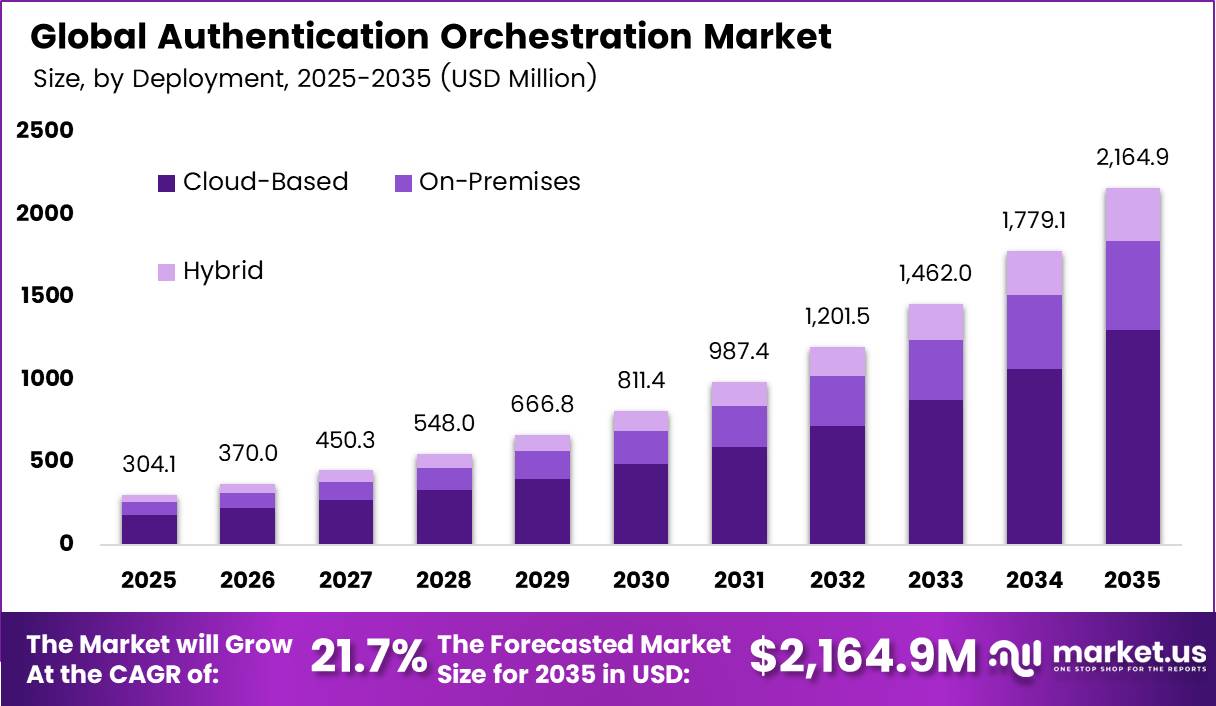
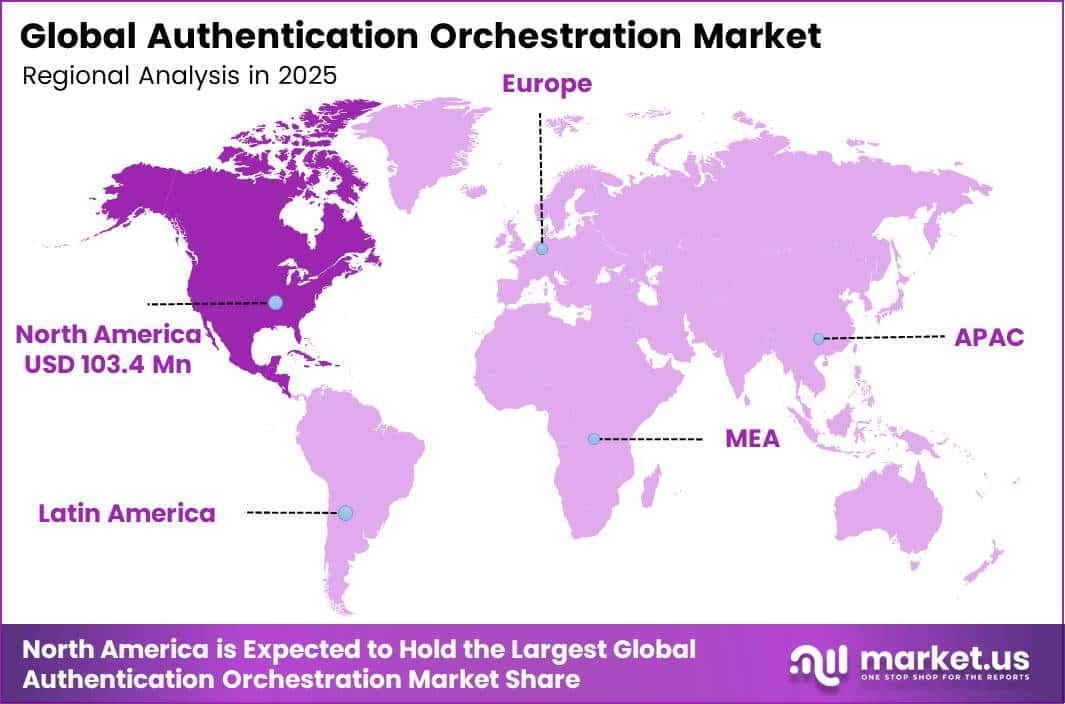
In 2025, the Global Authentication Orchestration Market was valued at USD 304.1 million. The market is projected to grow at a CAGR of 21.7% during 2026–2035, reaching approximately USD 2,164.9 million by 2035. North America dominated the global market in 2025, acphishing-resistant MFAcounting for more than 34.0% of the total market share and generating approximately USD 103.4 million in revenue.
More users and more digital channels drive this growth. According to the ITU, about 6 billion people used the internet in 2025, up from 5.8 billion in 2024. The online population grew by more than 240 million people in a single year.
The ITU also reports that 5G now reaches more than half of the world’s people. Each new user brings new logins across banking, shopping, and work apps. Firms need one layer that links many login methods, like passkeys, biometrics, and one-time codes. Authentication orchestration fills that gap. It lets teams add or swap login tools without rewriting each app.
High fraud losses push firms in the region to spend on identity security. The FBI’s Internet Crime Complaint Center logged 859,532 complaints in 2024. Reported losses hit a record USD 16.6 billion, a 33% jump from 2023. Phishing and spoofing topped the list with 193,407 complaints.
Business email compromise alone cost victims USD 2.77 billion. These numbers show why US banks, retailers, and insurers want stronger, phishing-resistant logins. Orchestration platforms help them roll out these controls fast across every customer channel.
Key Takeaways
- The Authentication Orchestration Market reached USD 304.1 million in 2025 and will reach USD 2,164.9 million by 2035. grow at a CAGR of 21.7% from 2026 to 2035.
- By Component, Software leads with a 67.3% share.
- By Deployment Model, Cloud leads with a 60.2% share.
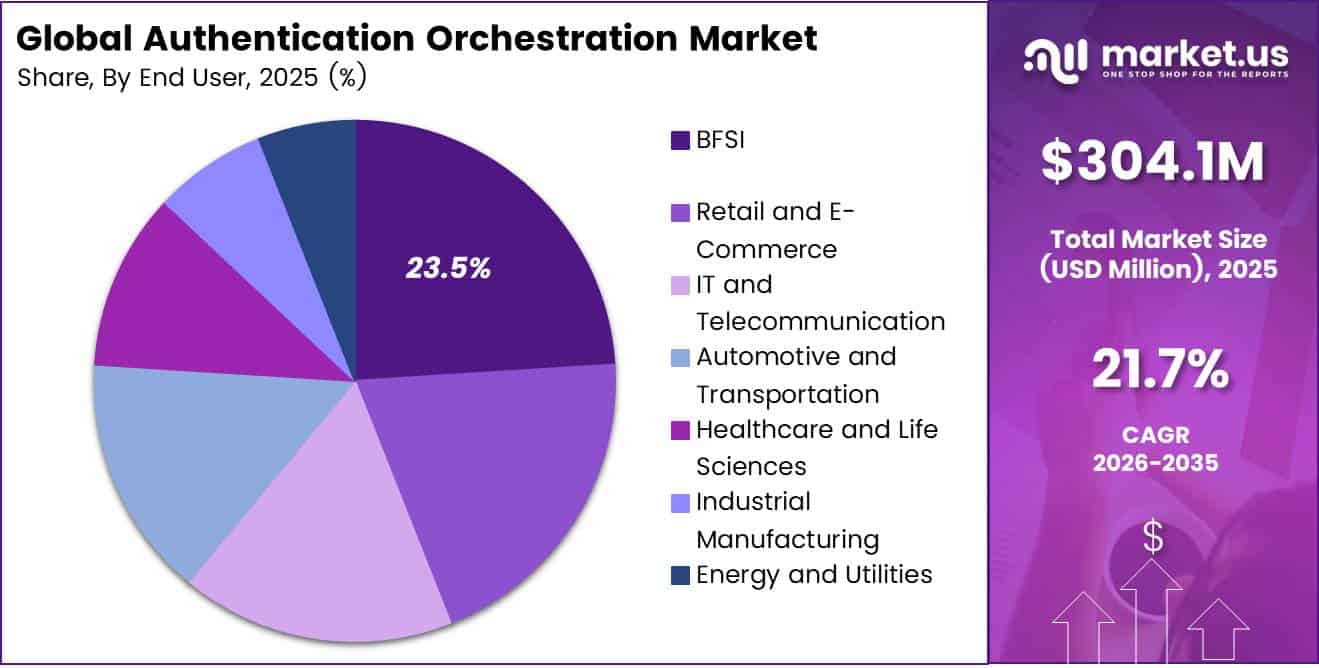
- By End User, BFSI leads with a 23.5% share.
- North America leads with a 34.0% share and USD 103.4 million in revenue.
By Component
Software dominates with 67.3% due to centralized policy control across login methods.
Software holds the largest share because buyers want one central platform that links passwords, passkeys, biometrics, and risk checks into a single login flow. Online fraud keeps pushing this need upward. The FBI’s Internet Crime Complaint Center logged 859,532 complaints in 2024, with reported losses of $16.6 billion, a 33% jump from 2023.
Services grow fastest because many companies lack the skilled staff to design, connect, and run these platforms. The U.S. Bureau of Labor Statistics projects jobs for information security analysts to grow 28.5% between 2024 and 2034, adding 52,100 roles.
By Deployment Model
Cloud dominates with 60.2% due to fast setup and elastic login scaling.
Cloud leads this segment because most companies already run their core apps on cloud platforms, and they want login controls to sit close to those apps. Eurostat reports that 52.74% of EU enterprises used paid cloud services in 2025, up 7.42 percentage points from 2023. Among large EU firms, the rate reached 77.6% in 2023.
Verizon’s 2025 Data Breach Investigations Report found that third-party involvement in breaches doubled from 15% to 30%, based on 12,195 confirmed breaches. Hybrid orchestration lets companies apply the same rules to staff, partners, and older systems without a full cloud move. It also gives teams a safe, step-by-step path to modernize.
By End User
BFSI dominates with 23.5% due to strict regulation and high-value fraud exposure.
BFSI holds the top share because banks, insurers, and payment firms face strict rules and the highest fraud risk. Every payment, loan request, and account change needs a strong identity check. India shows the scale clearly: the Reserve Bank of India reports that UPI handled 185.8 billion transactions in FY2025, a 41% rise over the prior year.
Retail and E-Commerce grows fastest because online shopping keeps expanding and attackers target shopper accounts. The U.S. Census Bureau estimates that e-commerce sales reached $1,233.7 billion in 2025, equal to 16.4% of total retail sales. In the second quarter of 2026, online sales climbed 12.2% year over year.
Key Market Segments
By Component
- Software
- Services
By Deployment Model
- Cloud
- Hybrid
- On-premises
By End User
- BFSI
- Retail and E-Commerce
- IT and Telecommunication
- Automotive and Transportation
- Healthcare and Life Sciences
- Industrial Manufacturing
- Energy and Utilities
- Others
Geopolitical Impact Analysis
Trade tensions shape the cost of the hardware behind authentication orchestration. This hardware includes security keys, smart cards, HSMs, and the servers that run identity platforms. The WTO raised its 2025 merchandise trade growth forecast to 2.4%, but it cut the 2026 forecast to just 0.5%, down from 2.5% in April. The WTO says the full impact of higher tariffs may land in 2026.
AI demand adds pressure on chip supply. The WTO found that trade in AI-related goods rose 20% year on year in value in the first half of 2025. These goods made up nearly half of global trade growth. Identity vendors now compete with AI data center builders for the same chips and servers. This raises hardware prices for on-premises and hybrid deployments.
Shipping routes also add delays. UNCTAD reported that ship tonnage through the Gulf of Aden and the Suez Canal fell 76% and 70% against late 2023. Ship capacity arriving around the Cape of Good Hope rose 89%. The World Shipping Council notes that the Cape route can add up to 17 days to some voyages. Hardware tokens built in Asia now reach European buyers weeks later.
Higher freight costs feed into prices too. UNCTAD estimated that if higher container rates continued through 2025, global consumer prices could rise 0.6%. These pressures push buyers toward cloud software and passkeys, which need no shipping at all. That shift supports the strong Cloud share in this market.
Regional Analysis
North America dominates the Authentication Orchestration Market, holding a 34.0% share and generating USD 103.4 million in revenue. The US hosts most of the leading identity vendors, and its buyers face heavy fraud pressure.
FBI data shows that cyber-enabled fraud caused almost 83% of all reported losses in 2024, or about USD 13.7 billion. Ransomware complaints rose 9% to 3,156, and the FBI found 67 new ransomware variants that year. People over age 60 lost nearly USD 5 billion. Banks and retailers respond by adding step-up checks for risky logins.
Asia Pacific is the fastest-growing region in the Authentication Orchestration Market. India leads the digital payments surge. NPCI data shows that UPI processed 228.3 billion transactions in 2025. December 2025 set a record at 21.63 billion transactions. Every payment needs a secure login and approval step. Yubico’s Asia Pacific sales rose to SEK 184.4 million in 2025 from SEK 158.9 million, with India driving growth.
Europe holds a strong second position, led by Germany, France, and the UK. Strict data rules push firms to use strong customer checks for online payments. ITU data shows that 94% of people in high-income countries use the internet. That high usage creates a dense base of digital logins. Yubico reported EMEA sales of SEK 531.1 million in 2025, or 28.2% of Q4 sales.
Key Regions and Countries
North America
- US
- Canada
Europe
- Germany
- France
- The UK
- Spain
- Italy
- Rest of Europe
Asia Pacific
- China
- Japan
- South Korea
- India
- Australia
- Rest of APAC
Latin America
- Brazil
- Mexico
- Rest of Latin America
Middle East and Africa
- GCC
- South Africa
- Rest of MEA
Market Dynamics
Drivers
| Driver | (~) % Impact on CAGR Forecast | Geographic Relevance | Impact Timeline |
|---|---|---|---|
| Zero Trust Mandates and Phishing-Resistant MFA Enforcement | +3.1% | North America, Europe | Short term (2 years or less) |
| Identity-Centric Breach Escalation | +2.6% | Global | Short term (2 years or less) |
| Multi-Cloud and Hybrid IAM Fragmentation | +2.2% | North America, Europe, APAC | Medium term (2 to 4 years) |
| Digital Payment Strong Authentication Rules | +1.8% | Europe, India, Southeast Asia | Short term (2 years or less) |
| Passkey and FIDO2 Mainstream Adoption | +1.5% | Global | Medium term (2 to 4 years) |
| No-Code Identity Journey Builders | +1.1% | North America, Western Europe | Medium term (2 to 4 years) |
Zero Trust Mandates and Phishing-Resistant MFA Enforcement
The root cause is regulation. OMB Memorandum M-22-09 required US federal agencies to deploy phishing-resistant MFA by the end of FY2024, and CISA’s Zero Trust Maturity Model 2.0 makes identity the first of its 5 pillars.
The cost of falling short drives demand. Under NIS2, essential entities face fines of up to 2% of global turnover, according to the European Commission’s directive text. A typical large enterprise runs 3 to 5 separate identity providers, and wiring each one into conditional, risk-based policies one by one can push integration costs up by roughly 30% to 40%.
This is changing how vendors sell. Buyers are moving away from perpetual on-premises access-management licenses toward SaaS orchestration subscriptions. Okta’s investor filings show subscription revenue above 95% of the total, with net retention near 106%.
Restraints
| Restraint | (~) % Impact on CAGR Forecast | Geographic Relevance | Impact Timeline |
|---|---|---|---|
| Legacy Directory and Mainframe Lock-In | -1.9% | North America, Europe, Japan | Medium term (2 to 4 years) |
| Constrained Security Budgets in Mid-Market | -1.5% | Global | Short term (2 years or less) |
| Data Localization and Cross-Border Transfer Limits | -1.2% | China, India, Middle East, EU | Medium term (2 to 4 years) |
| Biometric Data Processing Prohibitions | -0.8% | EU, US States | Short term (2 years or less) |
| Bundled IAM Suites from Hyperscalers | -0.7% | Global | Short term (2 years or less) |
Legacy Directory and Mainframe Lock-In
Many large organizations still run core access control on on-premises Active Directory, LDAP stores, and mainframe security products such as RACF and ACF2. The Federal Reserve’s operational resilience supervisory work and IBM’s annual filings both show mainframe systems still processing a majority of core banking transactions in mature economies.
Moving off them is slow and expensive. Migrations take about 12 to 24 months, and dual-running identity stores can raise transition costs by roughly 25%, per the UK National Cyber Security Centre’s legacy modernization guidance and the US GAO’s federal IT modernization reviews.
The GAO has repeatedly reported that more than 70% of federal IT spending goes to operating and maintaining existing systems. Vendors are left with smaller pilot deployments, and the professional-services work needed for custom connectors compresses margins by an estimated 4 to 6 percentage points.
Challenges
| Challenge | (~) % CAGR Friction Drag | Geographic Relevance | Mitigation Horizon |
|---|---|---|---|
| Identity Security Talent Shortage | -1.4% | Global | Long term (4 years or more) |
| AI-Driven Deepfake Bypass Attacks | -1.1% | Global | Medium term (2 to 4 years) |
| Orchestration Latency and Resilience | -0.8% | North America, APAC | Medium term (2 to 4 years) |
| Inconsistent Interoperability Standards | -0.7% | Global | Medium term (2 to 4 years) |
| User Friction and Abandonment | -0.5% | Consumer markets, APAC, LATAM | Short term (2 years or less) |
Identity Security Talent Shortage
Policy-driven, multi-provider identity design is a specialist skill, and those specialists are scarce. ISC2’s Cybersecurity Workforce Study put the global workforce gap at about 4.8 million professionals in 2024, up about 19% year over year. The US Bureau of Labor Statistics projects information security analyst jobs will grow about 33% over the decade.
The shortage shows up directly in deployment timelines. CompTIA workforce tracking and the US NICE framework data show identity and access management among the hardest-to-fill security roles, with vacancies often open for 90 to 120 days. Each open architect role can delay orchestration rollouts by an estimated 1 to 2 quarters and lower realized platform usage.
Opportunities
| Opportunity | (~) % Potential CAGR Upside | Geographic Relevance | Execution Window |
|---|---|---|---|
| Non-Human and AI Agent Identity Orchestration | +2.4% | North America, Europe, APAC | Medium term (2 to 4 years) |
| Digital Public Infrastructure and eID Wallet Integration | +1.7% | EU, India, Southeast Asia | Medium term (2 to 4 years) |
| Usage-Based Pricing for SMB Channels | +1.2% | Global | Short term (2 years or less) |
| Healthcare and OT Identity Verticalization | +1.0% | North America, Europe, Middle East | Long term (4 years or more) |
| Fraud-Signal Marketplace Monetization | +0.8% | Global | Medium term (2 to 4 years) |
Non-Human and AI Agent Identity Orchestration
CyberArk’s investor disclosures report machine identities outnumbering human identities by more than 80 to 1 in enterprises. Palo Alto Networks’ move to acquire CyberArk, announced in 2025, also points to rising strategic value in this space.
The IETF OAuth working group and the OpenID Foundation are extending delegated authorization to agent-to-agent workflows. Policy-based orchestration of workload credentials could cut credential-related incident costs by an estimated 20% to 30%.
Pricing per agent or per transaction, rather than per human seat, could lift the average contract value of a mature account by about 15% to 25%. Because automated provisioning needs little extra support, gross margins could expand by 3 to 5 percentage points, and the cost to serve each identity falls as agent volumes grow.
Key Players Analysis
Tier 1 leaders combine global reach with large identity budgets. Microsoft reported fiscal 2025 revenue of USD 281.7 billion, up 15%. It spent USD 32.49 billion on R&D, about 11.5% of revenue. Microsoft bundles Entra ID with its Microsoft 365 Commercial platform. This gives it a huge built-in base for login and access tools.
Okta leads among pure-play identity vendors. It posted fiscal 2026 revenue of USD 2.919 billion, up 12%. Subscription revenue reached USD 2.855 billion. Okta paid USD 54 million in cash for Axiom Security and recorded USD 40 million of goodwill. The deal extends Okta into privileged access.
CyberArk changed the top tier when Palo Alto Networks bought it for about USD 25 billion. Holders received USD 45.00 in cash and 2.2005 Palo Alto shares per share. Before the deal, CyberArk spent USD 165 million in cash on Zilla, plus a USD 10 million earn-out. IBM, Cisco, and Thales round out Tier 1 with wide enterprise and government reach.
Tier 2 challengers win in niche segments. Yubico leads in hardware keys with 2025 net sales of SEK 2,218.0 million. Its subscription revenue rose to SEK 339.6 million, or 15.3% of sales. Ping Identity, ForgeRock, and Transmit Security focus on customer identity orchestration. Entrust, OneSpan, HID Global, and RSA serve banks and regulated firms with strong authentication.
Top Key Players in the Market
- Okta, Inc.
- Microsoft Corporation
- Ping Identity Corporation
- IBM Corporation
- Transmit Security, Inc.
- Cisco Systems, Inc.
- Thales
- CyberArk Software Ltd.
- RSA Security LLC
- ForgeRock, Inc.
- Entrust Corporation
- OneSpan Inc.
- HID Global Corporation
- Yubico AB
Recent Developments
- In February 2025, CyberArk Software Ltd. acquired identity governance firm Zilla Security for USD 165 million in cash, plus an earn-out of up to USD 10 million tied to performance goals.
- In February 2026, Palo Alto Networks completed its CyberArk acquisition, paying USD 45.00 in cash and 2.2005 shares for each CyberArk share, and made identity security a core platform pillar.
- In March 2026, Okta, Inc. reported fiscal 2026 revenue of USD 2.919 billion, up 12%, with subscription revenue of USD 2.855 billion.
Report Scope
| Report Features | Description |
|---|---|
| Market Value (2025) | USD 304.1 Million |
| Forecast Revenue (2035) | USD 2,164.9 Million |
| CAGR (2026-2035) | 21.7% |
| Base Year for Estimation | 2025 |
| Historic Period | 2020-2024 |
| Forecast Period | 2026-2035 |
| Report Coverage | Revenue Forecast, Market Dynamics, Competitive Landscape, Recent Developments |
| Segments Covered | By Component (Software, Services); By Deployment Model (Cloud, Hybrid, On-premises); By End User (BFSI, Retail and E-Commerce, IT and Telecommunication, Automotive and Transportation, Healthcare and Life Sciences, Industrial Manufacturing, Energy and Utilities, Others) |
| Regional Analysis | North America – US, Canada; Europe – Germany, France, The UK, Spain, Italy, Rest of Europe; Asia Pacific – China, Japan, South Korea, India, Australia, Singapore, Rest of APAC; Latin America – Brazil, Mexico, Rest of Latin America; Middle East & Africa – GCC, South Africa, Rest of MEA |
| Competitive Landscape | Okta, Inc., Microsoft Corporation, Ping Identity Corporation, IBM Corporation, Transmit Security, Inc., Cisco Systems, Inc., Thales, CyberArk Software Ltd., RSA Security LLC, ForgeRock, Inc., Entrust Corporation, OneSpan Inc., HID Global Corporation, Yubico AB |
| Customization Scope | Customization for segments, region/country-level will be provided. Moreover, additional customization can be done based on the requirements. |
| Purchase Options | We have three licenses to opt for: Single User License, Multi-User License (Up to 5 Users), Corporate Use License (Unlimited Users and Printable PDF) |