Report Overview
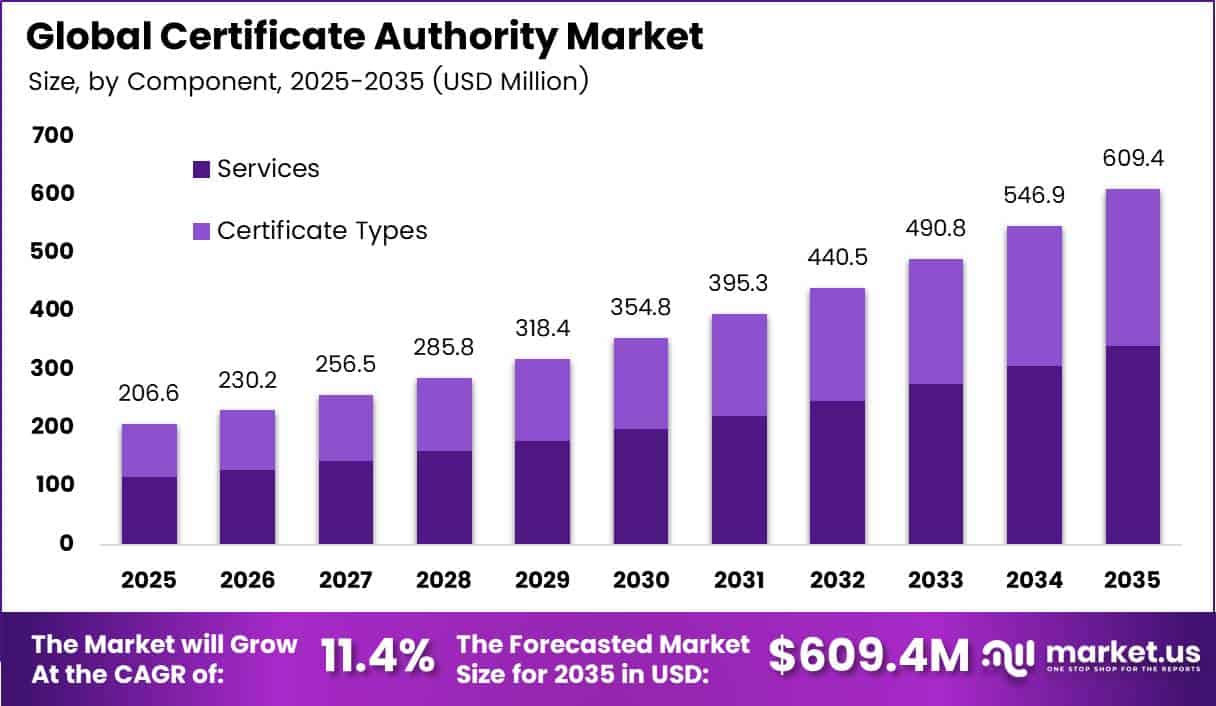
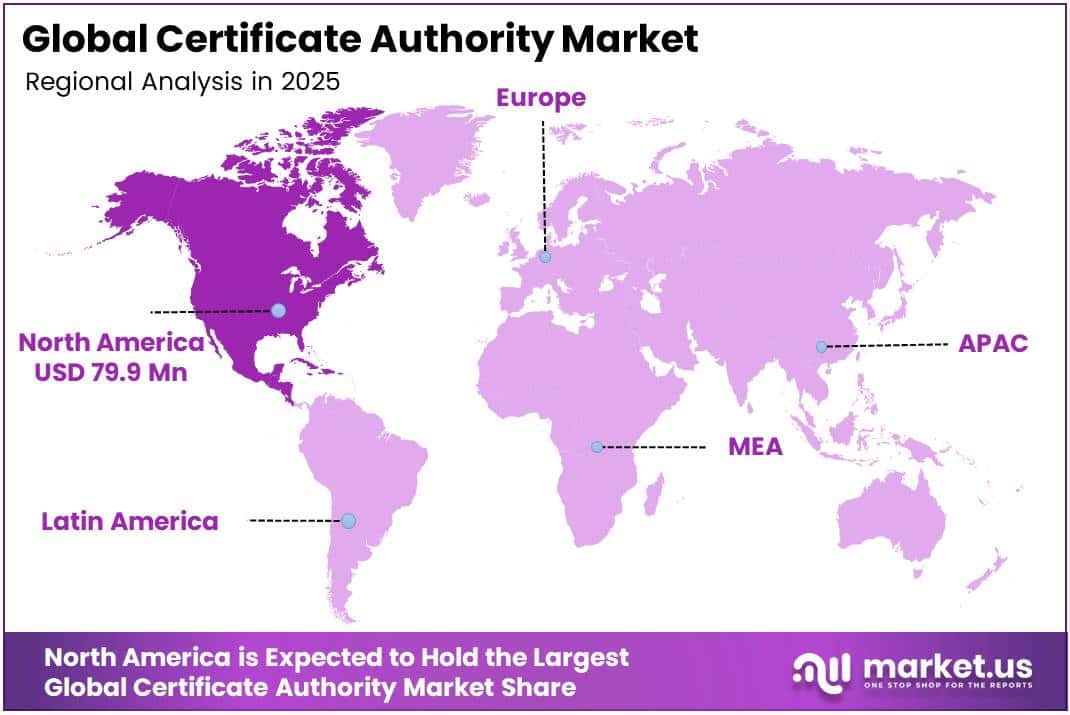
In 2025, the Global Certificate Authority Market was valued at USD 206.6 million. The market is projected to grow at a CAGR of 11.4% during 2026–2035, reaching approximately USD 609.4 million by 2035. North America dominated the global market in 2025, accounting for more than 38.7% of the total market share and generating approximately USD 79.9 million in revenue.
More people online and more encrypted websites drive this growth. According to the ITU, 6 billion people used the internet in 2025, up from 5.8 billion in 2024. The world added more than 240 million new users in a single year. Each new user visits banking portals, shopping sites, and apps that need trusted digital certificates.
The Internet Security Research Group reported that Let’s Encrypt grew from serving 492 million websites to 762 million in 2025. That jump of about 55% shows how fast the encrypted web keeps expanding. Higher certificate volume lifts demand for paid validation, lifecycle tools, and managed services across every industry.
The North America region is home to the browser and platform owners that set global trust rules. Apple, Google, Microsoft, and Mozilla all backed the latest CA/Browser Forum vote to shorten certificate lifespans. These firms decide which certificate authorities their browsers trust, so US policy choices shape demand worldwide.
The ITU reports that between 88% and 93% of people in the Americas use the internet. Let’s Encrypt, a US nonprofit, handled over 4 billion certificate status requests per day at the start of 2025, or about 50,000 every second. This deep digital base and strong rule-making power keep North America in front.
Key Takeaways
- The Certificate Authority Market reached USD 206.6 million in 2025 and will hit USD 609.4 million by 2035. The market will grow at a CAGR of 11.4% from 2026 to 2035.
- By Component, Services lead with a 56.5% share.
- By Certificate Validation Level, Domain Validation leads with a 52.3% share.
- By Deployment Model, Cloud leads with a 57.3% share.
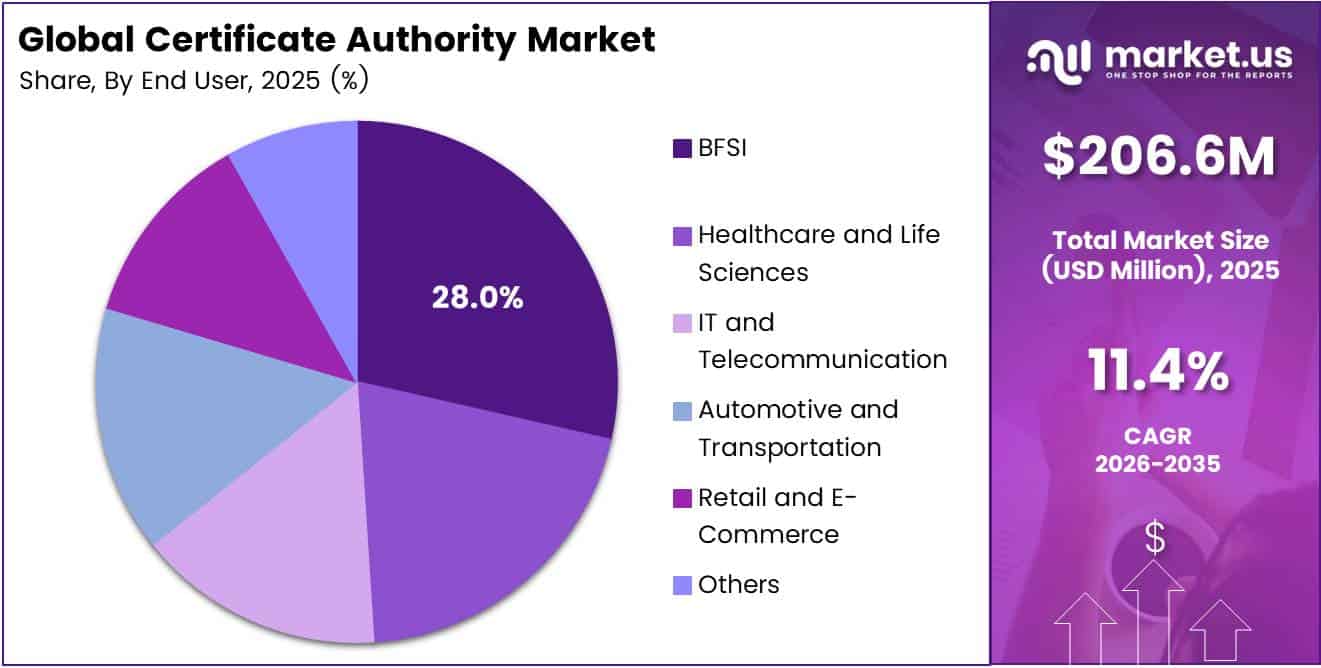
- By End User, BFSI leads with a 28.0% share.
- North America leads with a 38.7% share and USD 79.9 million in revenue.
By Component
Services dominates with 56.5% due to recurring certificate management and renewal needs.
Services leads with a 56.5% share because companies need ongoing help to find, renew, and manage certificates across websites, business software, and connected devices. Buying a certificate covers only part of this work. Security teams must also track expiry dates, handle changes, and remove certificates when access ends.
Certificate Types also gain demand as businesses secure websites, software releases, email, and user access. However, the supplied input does not name a fastest-growing component, and the cited industry rules do not establish one. Services therefore offers a clear growth case, but any claim that it grows fastest would require separate segment growth data.
By Certificate Validation Level
Domain Validation dominates with 52.3% due to simple domain checks and easier automation.
Domain Validation holds the supplied 52.3% share because it meets a common need: securing website connections after checking control of a domain. It avoids the wider business identity checks that higher validation levels require. This narrower process suits companies that manage many websites and need repeatable certificate workflows.
The CA/Browser Forum’s schedule also reduces the period for reusing domain validation information to 10 days by March 2029. That change strengthens the case for automated checks rather than repeated manual work.
By Deployment Model
Cloud dominates with 57.3% due to centralized management across distributed business systems.
Cloud leads with a 57.3% share because companies can manage certificates through a central service without running every supporting system themselves. This model suits businesses with remote teams, changing software needs, and workloads across several locations.
Eurostat reports that 45.2% of EU enterprises bought cloud services in 2023, an increase of 4.2 percentage points from 2021. These figures measure wider cloud adoption, not certificate authority spending. Still, they show a larger base of companies using cloud systems that need secure connections and clear access controls.
By End User
BFSI dominates with 28.0% due to sensitive transactions and strict identity checks.
BFSI leads with the supplied 28.0% share because banks, insurers, and financial service firms must protect transactions and control access across customer and business systems. Certificates support secure website connections, software trust, and system identity. The World Bank reported that 76% of adults worldwide held an account in 2021.
Healthcare and Life Sciences, the fastest-growing category, faces rising pressure to protect patient information and secure links between care providers, laboratories, and business partners. The US Department of Health and Human Services recorded 663 large health information breaches during 2024. Hacking and IT incidents accounted for 81% of these reports.
Key Market Segments
By Component
- Certificate Types
- SSL/TLS Certificates
- Code-Signing Certificates
- Secure Email Certificates
- Authentication Client Certificates
- Services
By Certificate Validation Level
- Domain Validation
- Extended Validation
- Organization Level
By Deployment Model
- Cloud
- Hybrid
- On-premises
By End User
- BFSI
- Healthcare and Life Sciences
- IT and Telecommunication
- Automotive and Transportation
- Retail and E-Commerce
- Others
Geopolitical Impact Analysis
Certificate authorities sell digital trust, but they still rely on physical hardware. Hardware security modules, servers, and secure chips protect root keys and signing systems. In January 2026, the US placed a 25% tariff on certain advanced computing chips under Section 232. Use in US data centers is exempt, but other imported chips used in signing appliances and secure hardware can face higher landed costs.
Shipping disruption adds more pressure. UNCTAD reported that Suez Canal transits stayed about 70% below 2023 levels as of May 2025. Ships now sail around the Cape of Good Hope, which adds roughly 10 days to Asia-to-Europe routes. Hardware security modules and secure servers for European and Middle Eastern data centers now take longer to arrive.
Trade policy uncertainty also slows enterprise buying. In April 2025, the WTO cut its forecast for 2025 world goods trade volume to a 0.2% decline. Exporters and logistics firms delayed IT projects, which pushed some certificate lifecycle upgrades into later budget cycles. Yet cross-border trade still needs signed invoices, secure email, and code signing, so core demand held steady.
Energy costs shape service pricing. The IEA estimates that data centres used about 415 TWh of electricity in 2024, a figure it expects to more than double to about 945 TWh by 2030. Cloud certificate platforms run inside these facilities. Power price swings tied to conflict and gas supply raise hosting costs, which pushes certificate authorities toward multi-year contracts that lock in prices.
Regional Analysis
North America dominates the Certificate Authority Market, holding a 38.7% share and generating USD 79.9 million in revenue. The US drives most of this demand, and Canada adds steady demand from its banks and public sector. New industry rules now push every US and Canadian business to renew certificates far more often.
The maximum public TLS certificate life dropped from 398 days to 200 days. It will fall again to 100 days. By 2029, domain validation reuse will shrink to just 10 days. These steps move firms from yearly renewals to renewals about every month. Manual tracking with spreadsheets cannot keep up at this pace. Large banks, insurers, and hospitals run thousands of certificates across cloud, data center, and device fleets.
Asia Pacific is the fastest-growing region in the Certificate Authority Market. China, Japan, South Korea, India, and Australia lead regional demand. The ITU reports that 77% of people in Asia Pacific use the internet, which leaves room for millions of new users. Fast growth in digital payments, e-commerce, and cloud services raises the need for SSL/TLS and code-signing certificates.
Key Regions and Countries
North America
- US
- Canada
Europe
- Germany
- France
- The UK
- Spain
- Italy
- Rest of Europe
Asia Pacific
- China
- Japan
- South Korea
- India
- Australia
- Rest of APAC
Latin America
- Brazil
- Mexico
- Rest of Latin America
Middle East and Africa
- GCC
- South Africa
- Rest of MEA
Market Dynamics
Drivers
| Driver | (~) % Impact on CAGR Forecast | Geographic Relevance | Impact Timeline |
|---|---|---|---|
| Shorter public TLS certificate lifetimes | +0.65 percentage points | Global browser-trusted ecosystem | Short term (2 years or less) |
| Enterprise private-PKI outsourcing | +0.40 percentage points | North America, Europe, developed Asia-Pacific | Medium term (2 to 4 years) |
| Cloud-native workload identity expansion | +0.35 percentage points | Global cloud-intensive enterprises | Short term (2 years or less) |
| Existing software-signing assurance demand | +0.25 percentage points | Global software supply chains | Short term (2 years or less) |
| Established electronic-signature certificate adoption | +0.20 percentage points | Europe, India, Latin America | Medium term (2 to 4 years) |
Shorter public TLS certificate lifetimes
The CA/Browser Forum’s April 2025 adoption of shorter certificate lifetimes created an immediate commercial catalyst. Maximum public TLS certificate validity fell from 398 days to 200 days, increasing annualized replacement frequency from approximately 0.92 to 1.83 certificates per continuously covered endpoint.
The IETF’s ACME specification enables automated domain verification and issuance, supporting a shift toward recurring managed issuance, policy enforcement, and deployment services. The estimated +0.65-percentage-point CAGR contribution is an analyst sensitivity, not an institutional forecast.
All adjustments represent percentage-point sensitivities around the supplied 11.4% baseline, rather than independently additive forecasts. Drivers total +1.85 points, restraints −1.15 points, challenges −0.90 points, and opportunities +1.20 points. Holding other assumptions constant, the positive-only and negative-only scenarios yield 14.45% and 9.35%, respectively; neither replaces the baseline forecast.
Restraints
| Restraint | (~) % Impact on CAGR Forecast | Geographic Relevance | Impact Timeline |
|---|---|---|---|
| Free domain-validation certificate substitution | −0.45 percentage points | Global public-web certificate segment | Short term (2 years or less) |
| Browser-root admission barriers | −0.25 percentage points | Global prospective public-CA entrants | Long term (4 years or more) |
| Sanctions-linked customer exclusions | −0.20 percentage points | Restricted jurisdictions and counterparties | Short term (2 years or less) |
| Closed national trust-service procurement | −0.15 percentage points | Jurisdictions with domestic accreditation requirements | Medium term (2 to 4 years) |
| Upfront assurance costs blocking smaller entrants | −0.10 percentage points | Emerging markets and specialist CA entrants | Medium term (2 to 4 years) |
Free domain-validation certificate substitution
The Internet Security Research Group’s free, automated public-certificate service directly substitutes for paid, undifferentiated domain-validation issuance, blocking some certificate-only purchases rather than delaying deployment. According to ISRG’s annual reporting published in 2026, its service had issued more than 7 billion certificates cumulatively and frequently issued more than 8 million daily.
Free issuance establishes a zero-price reference point for competing certificate-only offerings. In an illustrative analyst scenario, 10% customer substitution reduces an exposed portfolio’s issuance revenue by 10%, assuming equal revenue per customer and unchanged prices for remaining customers.
The estimated market-level CAGR drag is −0.45 percentage points, recognizing that organizational validation, contractual support, and other differentiated services are not equivalent to basic domain validation. The strategic consequence is margin pressure on certificate-only products and a stronger need to monetize independently valuable assurance and service commitments.
Challenges
| Challenge | (~) % CAGR Friction Drag | Geographic Relevance | Mitigation Horizon |
|---|---|---|---|
| Revocation Distribution Reliability | −0.30 percentage points | Global public-trust infrastructure | Short term (2 years or less) |
| Legacy Application Enrollment Interoperability | −0.20 percentage points | Global established enterprise estates | Medium term (2 to 4 years) |
| Specialist PKI Talent Scarcity | −0.15 percentage points | Global, particularly smaller security teams | Medium term (2 to 4 years) |
| Hardware Key Custody Integration | −0.15 percentage points | Regulated enterprises and distributed infrastructure | Medium term (2 to 4 years) |
| Subscriber Identity Verification Exceptions | −0.10 percentage points | Cross-border organizational certificate issuance | Short term (2 years or less) |
Revocation Distribution Reliability
The structural vulnerability lies between a CA recording a revocation and relying parties reliably receiving that status, creating ongoing infrastructure and incident-response work without stopping certificate sales. The CA/Browser Forum requires revocation within 24 hours for specified circumstances and within 5 days for other listed conditions, making incident classification.
The IETF’s OCSP specification enables online certificate-status checks without downloading certificate revocation lists. Mozilla’s CRLite uses locally stored revocation information refreshed every 12 hours, averaging approximately 300 kB of daily downloads, including a roughly 4 MB snapshot every 45 days.
The estimated −0.30-percentage-point CAGR friction reflects analyst judgment about recurring engineering, monitoring, and resilience expenditure, rather than a measured industry-wide cost. Managing this drag requires sustained investment in redundant publication pipelines, incident rehearsals, and measurable status-propagation performance.
Opportunities
| Opportunity | (~) % Potential CAGR Upside | Geographic Relevance | Execution Window |
|---|---|---|---|
| Post-quantum certificate migration services | +0.45 percentage points | Global, led by government and regulated enterprises | Medium term (2 to 4 years) |
| Factory-provisioned industrial device identities | +0.25 percentage points | Manufacturing hubs and industrial exporters | Medium term (2 to 4 years) |
| White-label CA services for underserved channels | +0.20 percentage points | Emerging-market service providers and regional integrators | Medium term (2 to 4 years) |
| Cross-border trust-service interoperability | +0.15 percentage points | International digital-trade corridors | Long term (4 years or more) |
| Specialist trust-provider consolidation | +0.15 percentage points | Fragmented regional and vertical trust-service markets | Medium term (2 to 4 years) |
Post-quantum certificate migration services
NIST finalized its first 3 principal post-quantum cryptography standards in August 2024, establishing the technical foundation for migration, not its completion across public certificate ecosystems. NIST’s ML-DSA standard supports post-quantum digital signatures, creating a basis for future certificate-signing implementations.
An illustrative analyst scenario assumes reusable tooling cuts delivery labor per migrated endpoint by 15%–25%. If labor initially accounts for 40% of service revenue and prices remain unchanged, gross margin improves by approximately 6–10 percentage points, before additional platform, support, and compliance costs.
These are not NIST forecasts: the estimated +0.45-percentage-point CAGR upside depends on converting migration capabilities into incremental paid services rather than absorbing them into existing contracts.
Key Players Analysis
Tier 1 market leaders include DigiCert, Sectigo, GoDaddy, GlobalSign, and the Internet Security Research Group. DigiCert filed 81 new patent applications in FY2025, with 10 focused on post-quantum cryptography and 9 on AI and machine learning. The company also acquired Vercara to add UltraDNS, then bought Valimail to expand into email authentication.
Sectigo doubled the size of its enterprise operations when it bought the Entrust public certificate business. GoDaddy, which bundles certificates with domains and hosting, reported USD 5.0 billion in FY2025 revenue, up 8.3%, with net income of USD 875.0 million. The Internet Security Research Group leads in volume through Let’s Encrypt, which has issued more than 7 billion free certificates since launch.
Tier 2 challengers include Entrust, IdenTrust, Actalis, SSL.com, Trustwave SecureTrust, Network Solutions, and WISeKey. Entrust exited public certificates to focus on identity and post-quantum data security. WISeKey reported FY2025 revenue of USD 19.3 million, up 62%. Its subsidiary SEALSQ produced USD 18.3 million of that total, up 66%, but posted a net loss of USD 34.2 million as it funded post-quantum chip programs.
Regional players compete on local trust and compliance. Actalis serves Italian and European qualified certificate needs, while SSL.com and Network Solutions target small and mid-sized US firms. Shorter certificate lifespans now favor vendors with strong automation, which raises the bar for smaller challengers.
Top Key Players in the Market
- DigiCert Inc.
- Sectigo Ltd.
- GoDaddy Group
- GlobalSign K.K.
- Entrust Corp.
- IdenTrust Services LLC
- Internet Security Research Group
- Actalis S.p.A
- SSL.com LLC
- Trustwave SecureTrust
- Network Solutions LLC
- WISeKey International Holdings Ltd.
Recent Developments
- In April 2025, the CA/Browser Forum, with backing from Sectigo, approved Ballot SC-081v3 by 29 votes to 0, cutting the maximum TLS certificate life from 398 days to 47 days by March 2029.
- In September 2025, Sectigo completed the migration of the Entrust public certificate business, moving all customers and partners onto Sectigo Certificate Manager after doubling its enterprise operations.
- In September 2025, the Internet Security Research Group issued more than 10 million Let’s Encrypt certificates in a single day for the first time.
- In April 2026, WISeKey International Holding reported audited FY2025 revenue of USD 19.3 million, up 62%, driven by PKI and post-quantum products.
Report Scope
| Report Features | Description |
|---|---|
| Market Value (2025) | USD 206.6 Million |
| Forecast Revenue (2035) | USD 609.4 Million |
| CAGR (2026-2035) | 11.4% |
| Base Year for Estimation | 2025 |
| Historic Period | 2020-2024 |
| Forecast Period | 2026-2035 |
| Report Coverage | Revenue Forecast, Market Dynamics, Competitive Landscape, Recent Developments |
| Segments Covered | By Component (Certificate Types (SSL/TLS Certificates, Code-Signing Certificates, Secure Email Certificates, Authentication Client Certificates), Services); By Certificate Validation Level (Domain Validation, Extended Validation, Organization Level); By Deployment Model (Cloud, Hybrid, On-premises); By End User (BFSI, Healthcare and Life Sciences, IT and Telecommunication, Automotive and Transportation, Retail and E-Commerce, Others) |
| Regional Analysis | North America: US, Canada; Europe: Germany, France, The UK, Spain, Italy, Rest of Europe; Asia Pacific: China, Japan, South Korea, India, Australia, Singapore, Rest of APAC; Latin America: Brazil, Mexico, Rest of Latin America; Middle East & Africa: GCC, South Africa, Rest of MEA |
| Competitive Landscape | DigiCert Inc., Sectigo Ltd., GoDaddy Group, GlobalSign K.K., Entrust Corp., IdenTrust Services LLC, Internet Security Research Group, Actalis S.p.A., SSL.com LLC, Trustwave SecureTrust, Network Solutions LLC, WISeKey International Holdings Ltd. |
| Customization Scope | Customization for segments, region/country-level will be provided. Moreover, additional customization can be done based on the requirements. |
| Purchase Options | We have three licenses to opt for: Single User License, Multi-User License (Up to 5 Users), Corporate Use License (Unlimited Users and Printable PDF) |