Report Overview
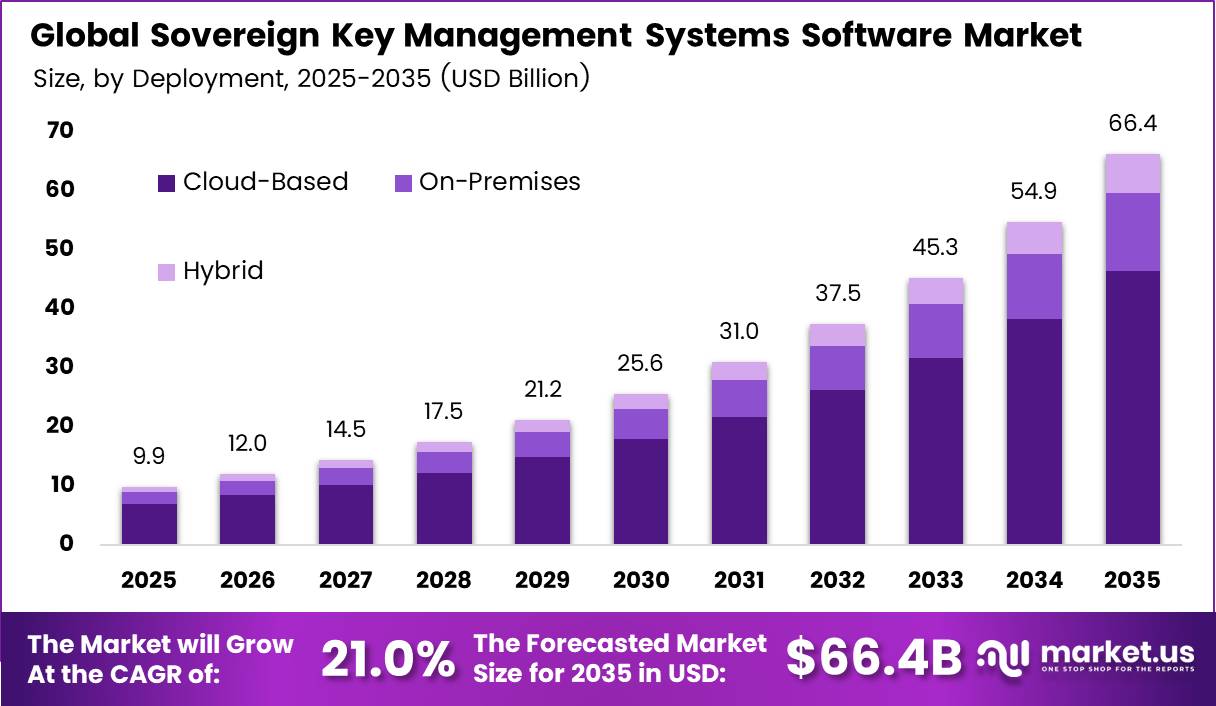
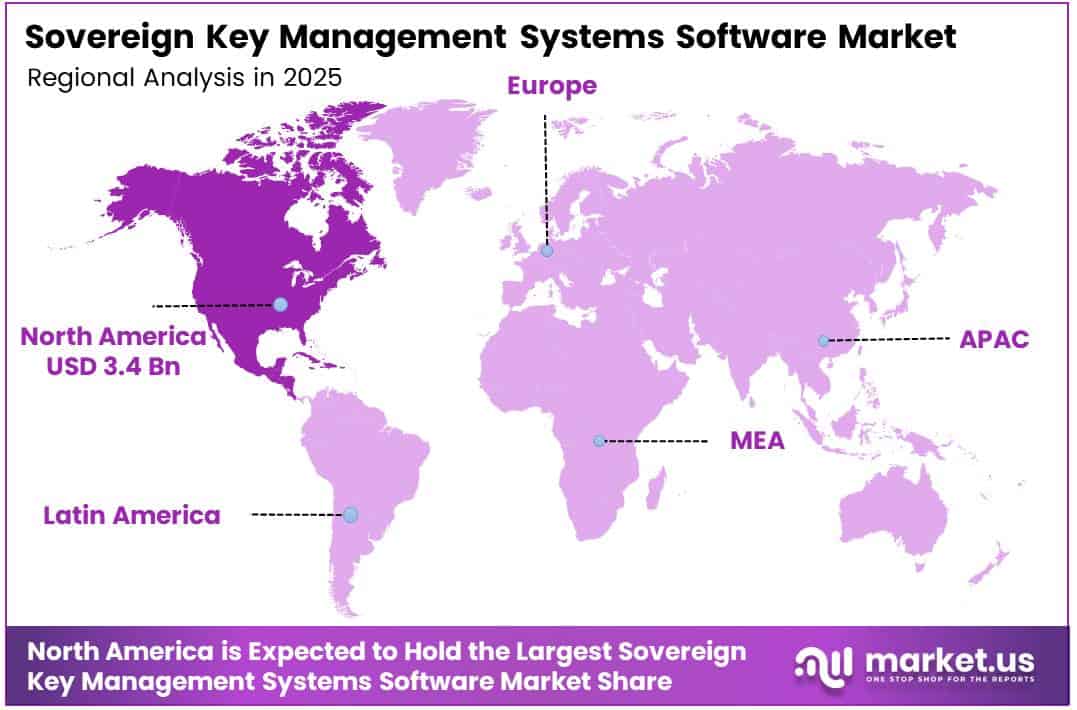
In 2025, the Global Sovereign Key Management Systems Software Market was valued at USD 9.9 billion. The market is projected to grow at a CAGR of 21.0% during 2026–2035, reaching approximately USD 66.4 billion by 2035. North America dominated the global market in 2025, accounting for more than 34.0% of the total market share and generating approximately USD 3.4 billion in revenue.
Rising breach costs push this demand. IBM’s Cost of a Data Breach Report 2025 shows the global average breach cost at USD 4.44 million. Healthcare remains the costliest industry. Large security firms also keep putting money into cryptography.
Thales spent more than EUR 1.3 billion on self-funded R&D in 2025, equal to 6.0% of sales. Its 2025 sales reached EUR 22,136 million, up 7.6%. Banks, hospitals and cloud providers now want keys that stay under their own legal control. This shift moves budgets toward sovereign key management, HSM software and crypto agility tools.
The US carries the highest financial risk from weak key control. IBM reports that the average US breach cost rose 9% to a record USD 10.22 million in 2025, up from USD 9.36 million. US federal rules also speed up demand. NIST released 3 post-quantum standards (FIPS 203, 204 and 205) in August 2024. It plans to phase out RSA and ECC by 2030 and ban them by 2035.
Key Takeaways
- The Sovereign Key Management Systems Software Market reached USD 9.9 billion in 2025 and will reach USD 66.4 billion by 2035. at a CAGR of 21.0% from 2026 to 2035.
- By Offerings, Software leads with a 72.1% share.
- By Deployment Model, Cloud leads with a 71.1% share.
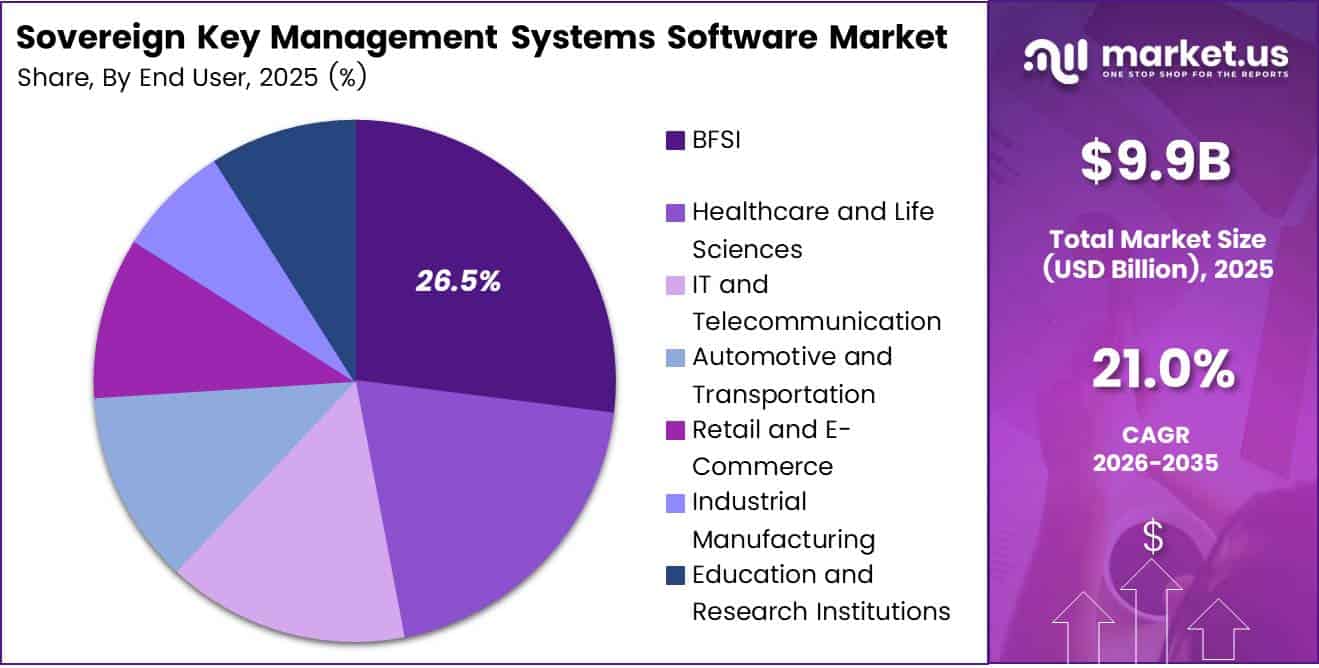
- By End User, BFSI leads with a 26.5% share.
- North America leads with a 34.0% share and USD 3.4 billion in revenue.
By Offerings
Software dominates with 72.1% due to urgent post-quantum encryption migration needs.
Software leads because every new encryption rule first becomes a software update. In August 2024, NIST published 3 final post-quantum standards: FIPS 203, FIPS 204, and FIPS 205. Firms now need key management software to find, rotate, and replace old keys across systems.
Enterprise, cloud, and HSM management tools provide a single place to control keys under local law. That central control is the core of sovereign key management. Services are the fastest-growing offering. NIST IR 8547 plans to deprecate 112-bit security RSA and ECC methods by 2030 and disallow them by 2035.
By Deployment Model
Cloud dominates with 71.1% due to scalable key-as-a-service with regional controls.
Cloud leads because regulated firms want fast, low-cost key control that grows with their workloads. The EU Digital Operational Resilience Act has applied since 17 January 2025 and covers about 20 types of financial entities.
Hybrid is the fastest-growing deployment model. Many governments and critical firms want to keep root keys on local hardware while running apps in public clouds. The EU NIS2 Directive, which applies from October 2024, widens cyber duties to 18 critical sectors.
By End User
BFSI dominates with 26.5% due to strict payment and data residency mandates.
BFSI leads because banks protect huge payment flows with encryption keys every second. The SWIFT network links more than 11,500 financial institutions in over 200 countries and territories. Each message depends on strong key control. Central banks and regulators also demand local key custody, so BFSI firms spend early and heavily on sovereign key platforms.
Healthcare and Life Sciences is the fastest-growing end user. The US HHS Office for Civil Rights logged 663 large breaches of patient data that occurred in 2024. Those breaches affected about 242.9 million people, and hacking or IT incidents caused 81% of them. Hospitals, insurers, and drug makers now face rising pressure to encrypt records and control who holds the keys.
Key Market Segments
By Offerings
- Software
- Enterprise Key Management Software
- Cloud Key Management and KMaaS
- Hardware Security Module (HSM) Management Software
- Secrets and Certificate Lifecycle Management Software
- Cryptographic Posture Management Software
- Other
- Services
By Deployment Model
- Cloud
- Hybrid
- On-premises
By End User
- BFSI
- Healthcare and Life Sciences
- IT and Telecommunication
- Automotive and Transportation
- Retail and E-Commerce
- Industrial Manufacturing
- Education and Research Institutions
- Others
Geopolitical Impact Analysis
Trade tensions now shape the cost of the hardware behind key management. Higher US “reciprocal” tariffs took effect on 7 August 2025. The WTO cut its 2025 merchandise trade growth forecast to 0.9% from a pre-tariff estimate of 2.7%. Buyers rushed orders, and US imports rose 11% in the first half of 2025. HSM appliances, servers, and secure chips all moved early, which raised inventory costs for vendors.
Shipping risk adds more delay. UNCTAD found that Suez Canal transits fell to 33 per day by mid-October 2024, which was 57% below the peak. The World Shipping Council notes that the route around the Cape of Good Hope can add up to 17 days to some voyages. HSM units built in Europe and Asia now take longer to reach buyers, which slows on-premises rollouts.
Freight pressure also lifts prices. UNCTAD estimated that the Red Sea and Panama Canal crises raised demand for container-ship capacity by 12%. It warned that global consumer prices could rise 0.6% by late 2025. Vendors pass part of this cost into hardware and support contracts.
AI spending partly offsets the drag. The WTO raised its 2025 trade forecast to 2.4% after trade volumes grew 4.9% in the first half, led by semiconductors and servers. Sovereignty rules and transport risk together push buyers toward cloud and hybrid key services hosted inside their own countries.
Regional Analysis
North America dominates the Sovereign Key Management Systems Software Market, holding a 34.0% share and generating USD 3.4 billion in revenue. The US drives most of this demand. Federal agencies, large banks, and hyperscale cloud firms all run huge key estates.
National Security Memorandum 10 told agencies to list their weak cryptographic systems once a year. NSA’s CNSA 2.0 sets quantum-safe targets for national security systems. These rules turn key management into a funded, audited task instead of an IT side project. US firms also lead cloud adoption, which fits the 71.1% cloud deployment share.
Asia Pacific grows on fast digital payments and new privacy laws. IBM puts the average breach cost in India at USD 2.51 million. India’s DPDP Act allows penalties of up to INR 250 crore per breach. China’s Cryptography Law has been in effect since 1 January 2020 and requires approved local algorithms. Japan, South Korea, and Australia push banks toward local key custody, and that lifts demand for in-country HSM and KMaaS.
Europe holds the second position on the back of strict digital sovereignty rules. DORA has applied since 17 January 2025 and covers more than 22,000 financial entities. NIS2 extends security duties across 18 sectors. Germany, France, and Switzerland host strong HSM makers such as Utimaco in Aachen and Securosys in Zurich.
Key Regions and Countries
North America
- US
- Canada
Europe
- Germany
- France
- The UK
- Spain
- Italy
- Rest of Europe
Asia Pacific
- China
- Japan
- South Korea
- India
- Australia
- Rest of APAC
Latin America
- Brazil
- Mexico
- Rest of Latin America
Middle East and Africa
- GCC
- South Africa
- Rest of MEA
Market Dynamics
Drivers
| Driver | (~) % Impact on CAGR Forecast | Geographic Relevance | Impact Timeline |
|---|---|---|---|
| EU Data Act and DORA Key-Custody Mandates | +3.2% | Europe, UK | Short term (2 years or less) |
| Sovereign Cloud Region Buildouts by Hyperscalers | +2.6% | Europe, Middle East, APAC | Short term (2 years or less) |
| National Data Localization Laws | +2.1% | India, Saudi Arabia, Indonesia, China | Medium term (2 to 4 years) |
| Extraterritorial Access Concerns (CLOUD Act Exposure) | +1.7% | Europe, Canada, Japan | Short term (2 years or less) |
| Post-Quantum Cryptography Migration Mandates | +1.4% | North America, Europe | Medium term (2 to 4 years) |
| Public-Sector Classified Workload Cloud Adoption | +1.1% | Global | Medium term (2 to 4 years) |
EU Data Act and DORA Key-Custody Mandates
This driver comes from two EU rules that now apply at the same time. The Digital Operational Resilience Act took effect in January 2025. According to the European Supervisory Authorities’ implementing technical standards, it requires more than 22,000 EU financial entities to show that they control the encryption keys behind outsourced ICT services. The Data Act became applicable in September 2025.
Company filings and earnings calls from listed security vendors in 2024 and 2025 describe recurring revenue reaching roughly 60% to 70% of the mix. Customer acquisition cost is also falling. Per European Banking Authority supervisory guidance, compliance-led procurement cuts sales cycles from about 12 to 18 months down to 6 to 9 months. This lets vendors bundle key-custody attestation with audit-reporting modules at 15% to 25% higher contract values.
Restraints
| Restraint | (~) % Impact on CAGR Forecast | Geographic Relevance | Impact Timeline |
|---|---|---|---|
| Cryptographic Export Controls on HSM Hardware | -1.8% | China, Russia, Middle East, Restricted Jurisdictions | Short term (2 years or less) |
| Lengthy FIPS 140-3 and Common Criteria Certification Queues | -1.5% | North America, Europe | Short term (2 years or less) |
| Constrained Public-Sector IT Budgets | -1.2% | Europe, Latin America, Africa | Short term (2 years or less) |
| Domestic-Vendor-Only Procurement Rules | -0.9% | China, India, France, Gulf States | Medium term (2 to 4 years) |
| High Upfront Total Cost of Ownership for SMEs | -0.7% | Global | Medium term (2 to 4 years) |
Cryptographic Export Controls on HSM Hardware
Sovereign key management depends on tamper-resistant hardware security modules, and these fall under Category 5 Part 2 of the US Export Administration Regulations, administered by the Bureau of Industry and Security, and under the Wassenaar Arrangement dual-use lists. Licensing for restricted end users can take 60 to 180 days, and some destinations are barred outright.
China’s Commercial Cryptography Regulations, as revised by the State Council, effectively shut foreign key managers out of critical-information-infrastructure deployments. Per national customs export data, the US, Germany and France supply roughly 70% or more of the world’s certified HSM shipments.
Deals in blocked markets are therefore not just delayed but lost to domestic suppliers. Company annual reports point to deferred revenue recognition, idle inventory carrying costs of 3% to 5%, and gross-margin erosion of about 200 to 300 basis points from parallel regional SKUs. Vendors also postpone capital spending on local data centers in restricted regions.
Challenges
| Challenge | (~) % CAGR Friction Drag | Geographic Relevance | Mitigation Horizon |
|---|---|---|---|
| Cryptography Talent Shortage | -1.4% | Global | Long term (4 years or more) |
| Multi-Cloud Key Interoperability Gaps | -1.1% | North America, Europe | Medium term (2 to 4 years) |
| Fragmented Sovereignty Definitions | -0.9% | Europe, APAC | Medium term (2 to 4 years) |
| Semiconductor Secure-Element Supply Volatility | -0.6% | Global | Short term (2 years or less) |
| Legacy Application Integration Complexity | -0.5% | Global | Medium term (2 to 4 years) |
Cryptography Talent Shortage
The ISC2 Cybersecurity Workforce Study estimates a global shortfall of about 4.8 million cybersecurity professionals. Applied cryptography and PKI engineers are among the rarest of these roles. National labor market data from the US Bureau of Labor Statistics put information security analyst job growth at around 33% per decade, which is far faster than the rate at which specialists are being trained.
Implementation timelines stretch 20% to 35%, and specialist salary premiums of 25% to 40% cut into professional-services margins. Vendors are responding over the long term with automation-first platforms, managed key-custody services, and university partnerships aligned with ENISA’s European cybersecurity skills framework.
Opportunities
| Opportunity | (~) % Potential CAGR Upside | Geographic Relevance | Execution Window |
|---|---|---|---|
| Sovereign AI Model and Inference Key Custody | +2.4% | Europe, Gulf States, India, Japan | Medium term (2 to 4 years) |
| Key-Management-as-a-Service for Mid-Market Regulated Firms | +1.6% | Europe, North America | Short term (2 years or less) |
| Confidential Computing Attestation Bundles | +1.2% | Global | Medium term (2 to 4 years) |
| Digital Public Infrastructure and CBDC Key Systems | +1.0% | India, Southeast Asia, Africa, Latin America | Long term (4 years or more) |
| Regional Vendor M&A Roll-Ups | +0.8% | Europe, Middle East | Medium term (2 to 4 years) |
Sovereign AI Model and Inference Key Custody
Per European Commission AI Office guidance, providers must secure their models and document cybersecurity measures. The OECD AI Policy Observatory tracks more than 60 national AI strategies, many of which fund state-backed sovereign compute. NVIDIA earnings calls also point to sovereign AI demand from governments across Europe, the Gulf and Asia.
Securing GPU clusters would bring in per-workload and per-token key-operation pricing. Company investor materials suggest software-only orchestration could deliver gross margins of 80% to 85%, compared with roughly 55% to 60% for hardware-bundled HSM deals. Cost per protected workload could also fall by 30% to 40% through cloud-native confidential-computing integration.
Key Players Analysis
Thales S.A. leads Tier 1. Its Cyber and Digital segment posted EUR 3,852 million in 2025 sales, down 4.3% from EUR 4,024 million. Cyber sales reached EUR 1,455 million, and Digital Identity reached EUR 2,397 million. The segment earned EUR 526 million in adjusted EBIT, a 13.7% margin. Group R&D spending reached EUR 1,328 million, or 6.0% of sales. Cyber Products returned to growth in Q4 2025.
Entrust Corporation and Utimaco IS GmbH round out Tier 1 with global HSM fleets. Both are private and do not publish full results. Utimaco sharpened its focus by carving out Utimaco Telecom Solutions, which began operating as a separate company on 1 October 2025. That move leaves Utimaco focused on information and data security.
Tier 2 challengers win in cloud native and niche segments. Fortanix has raised USD 121 million in equity, including a USD 90 million Series C in August 2022. Akeyless Security raised a USD 65 million Series B, which brought its total to USD 80 million, and later added a Deutsche Bank strategic investment of undisclosed size.
Keyfactor bought InfoSec Global and CipherInsights in May 2025 to lead cryptographic posture management. Securosys, Cryptomathic, WinMagic, DuoKey, Sepior and Unbound Security serve focused needs such as Swiss-hosted HSM clouds, payment key management and multiparty computation. Public financial data for these firms is limited.
Top Key Players in the Market
- Thales S.A.
- Entrust Corporation
- Fortanix, Inc.
- Utimaco IS GmbH
- Securosys SA
- Keyfactor, Inc.
- WinMagic Corp.
- DuoKey SA
- Akeyless Security Ltd.
- Cryptomathic A/S
- Sepior ApS
- Unbound Security Ltd.
Recent Developments
- In May 2025, Keyfactor acquired 2 companies, InfoSec Global and CipherInsights, from Quantum Xchange to add cryptographic discovery and posture management to its PKI platform.
- In October 2025, Utimaco completed the sale of its Utimaco TS lawful interception unit to INVISION and PINOVA, with the new firm operating on its own from 1 October 2025.
- In October 2025, Akeyless launched an AI Agent Identity Security offering, including SecretlessAI, to protect the secrets that AI agents use.
- In August 2026, Thales launched Luna 8, the first next-generation HSM on its new platform, built for the move to post-quantum cryptography.
Report Scope
| Report Features | Description |
|---|---|
| Market Value (2025) | USD 9.9 Billion |
| Forecast Revenue (2035) | USD 66.4 Billion |
| CAGR (2026-2035) | 21.0% |
| Base Year for Estimation | 2025 |
| Historic Period | 2020-2024 |
| Forecast Period | 2026-2035 |
| Report Coverage | Revenue Forecast, Market Dynamics, Competitive Landscape, Recent Developments |
| Segments Covered | By Offerings (Software (Enterprise Key Management Software, Cloud Key Management and KMaaS, Hardware Security Module (HSM) Management Software, Secrets and Certificate Lifecycle Management Software, Cryptographic Posture Management Software, Other), Services); By Deployment Model (Cloud, Hybrid, On-premises); By End User (BFSI, Healthcare and Life Sciences, IT and Telecommunication, Automotive and Transportation, Retail and E-Commerce, Industrial Manufacturing, Education and Research Institutions, Others) |
| Regional Analysis | North America – US, Canada; Europe – Germany, France, The UK, Spain, Italy, Rest of Europe; Asia Pacific – China, Japan, South Korea, India, Australia, Singapore, Rest of APAC; Latin America – Brazil, Mexico, Rest of Latin America; Middle East & Africa – GCC, South Africa, Rest of MEA |
| Competitive Landscape | Thales S.A., Entrust Corporation, Fortanix, Inc., Utimaco IS GmbH, Securosys SA, Keyfactor, Inc., WinMagic Corp., DuoKey SA, Akeyless Security Ltd., Cryptomathic A/S, Sepior ApS, Unbound Security Ltd. |
| Customization Scope | Customization for segments, region/country-level will be provided. Moreover, additional customization can be done based on the requirements. |
| Purchase Options | We have three licenses to opt for: Single User License, Multi-User License (Up to 5 Users), Corporate Use License (Unlimited Users and Printable PDF) |