Report Overview
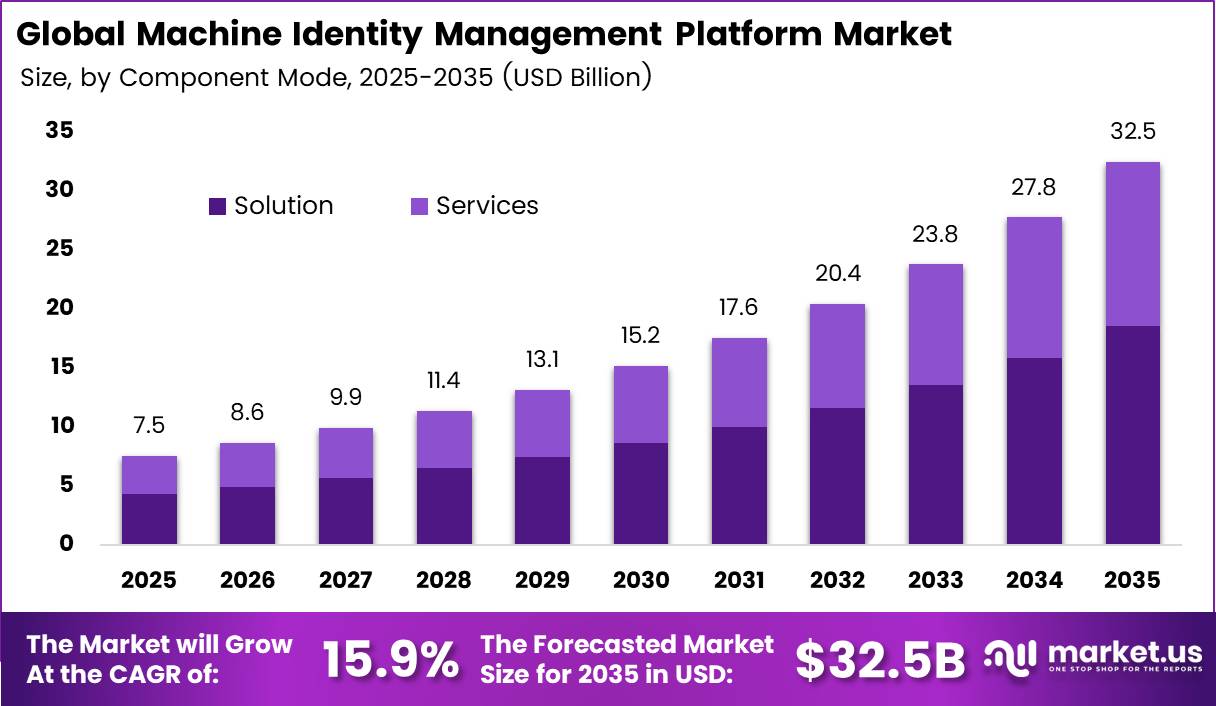
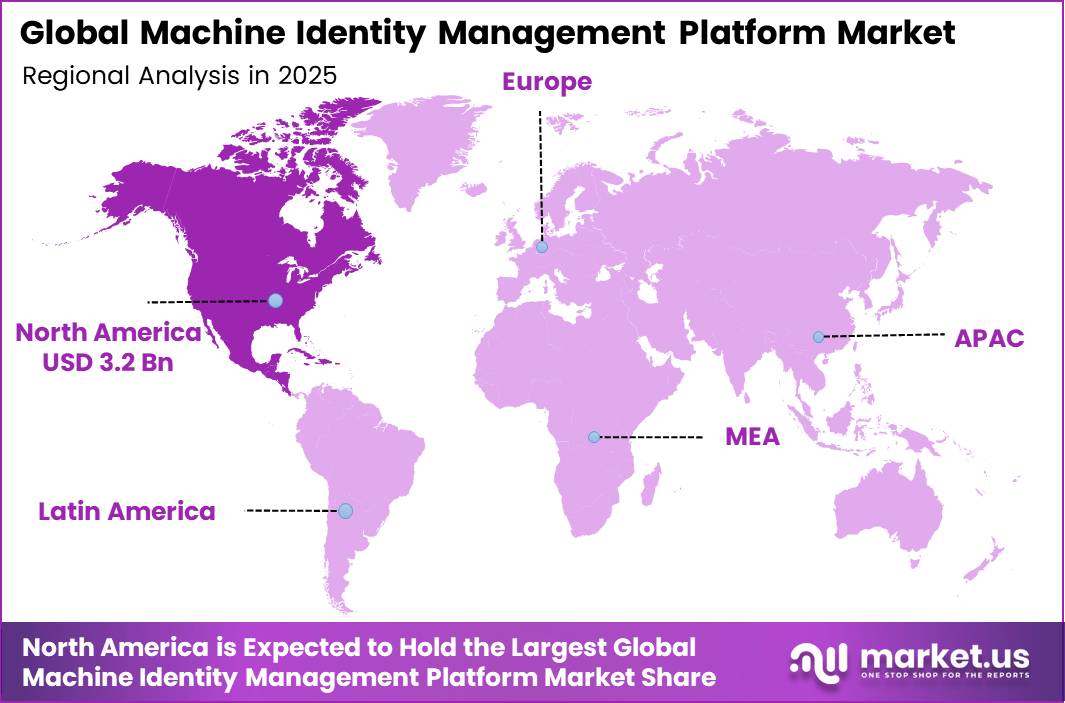
In 2025, the Global Machine Identity Management Platform Market was valued at USD 7.5 billion. The market is projected to grow at a CAGR of 15.9% during 2026–2035, reaching approximately USD 32.5 billion by 2035. North America dominated the global market in 2025, accounting for more than 43.2% of the total market share and generating approximately USD 3.2 billion in revenue.
Fast growth in digital use drives this demand. The ITU reported that about 6 billion people used the internet in 2025, up from 5.8 billion a year earlier. Every new user relies on apps, APIs, cloud workloads, and certificates, and each of these needs a trusted machine identity. Companies now run far more bots, service accounts, and AI agents than staff.
Corporate filings show that machine identities outnumber human identities by more than 80 to 1 in many large firms. Banks, telecom operators and cloud providers must find, rotate and govern millions of keys and certificates. Manual tools cannot keep up, so buyers move to automated platforms. The region has the deepest cloud and cybersecurity spending base in the world.
The OECD reports that the United States spends more than 3% of GDP on research and development, which supports early adoption of new security tools. Most leading vendors and hyperscale cloud firms are based in the region. Palo Alto Networks alone reported USD 11.48 billion in fiscal 2026 revenue, which shows the scale of local security demand.
Key Takeaways
- The Machine Identity Management Platform Market stood at USD 7.50 billion in 2025 and will reach USD 32.50 billion by 2035. grow at a CAGR of 15.9% from 2026 to 2035.
- By component, Solution leads with a 56.4% share.
- By deployment, Cloud leads with a 57.6% share.
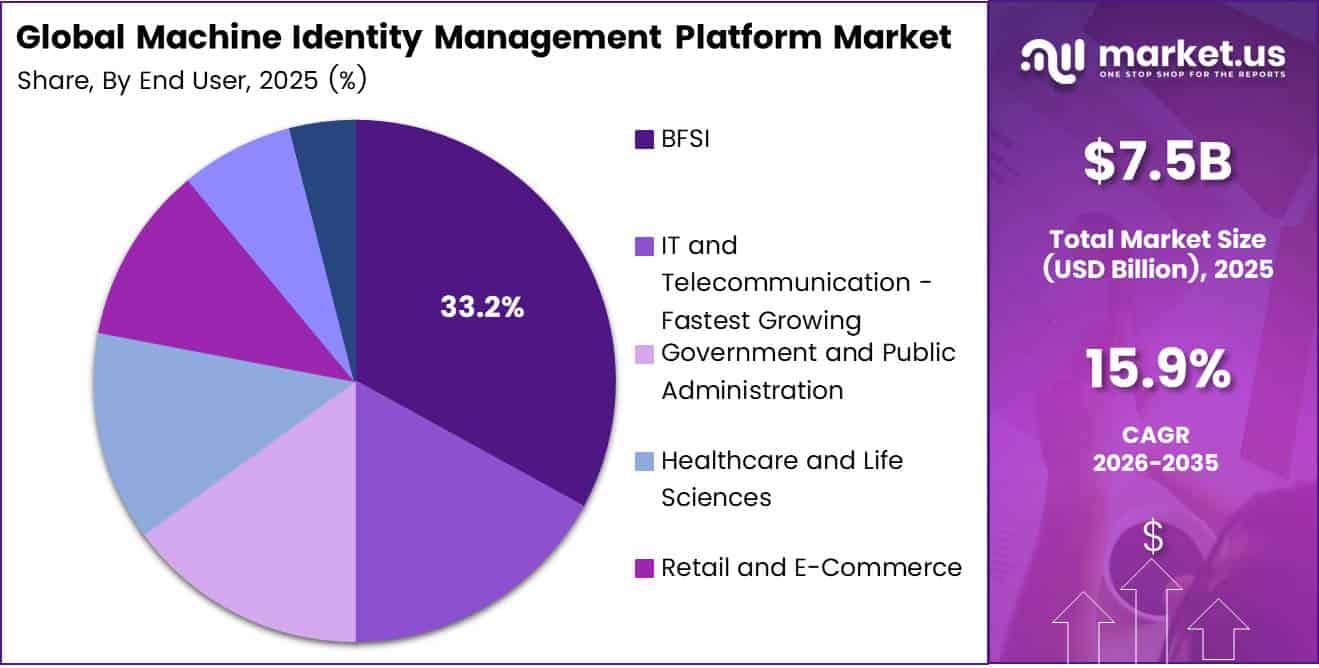
- By end user, BFSI leads with a 33.2% share.
- By identity type, Application and Service Identities lead with a 28.4% share.
- North America dominates with a 43.2% share and USD 3.24 billion in revenue.
By Component
Solution dominates with 56.4% due to automated certificate and key lifecycle control.
Solution holds the largest share because firms need one platform to find, issue, renew, and revoke machine credentials at scale. Manual tracking no longer works. Cloud Security Alliance research shows that machine identities outnumber human users by a median of 45 to 1, up from 17:1 in its 2023 baseline.
Services is the fastest-growing component because most security teams lack the skills to deploy these tools alone. Of 420 CISOs surveyed, 53% said they could confidently list fewer than half of their machine identities. That gap pushes buyers toward discovery audits, integration work, and managed service contracts.
By Deployment
Cloud dominates with 57.6% due to fast-growing cloud-native workloads and containers.
Cloud deployment leads because most new machine identities now start life inside cloud workloads. Cloud tools scale on demand and update without hardware, which suits teams that rotate thousands of credentials every day.
The risk in cloud settings is also high. CSA research found that non-human identities can outnumber humans by 144 to 1 in cloud-native environments, up from 92 to 1 in the first half of 2024. That is a 56% rise in a single year.
On-premises is growing fastest because regulated buyers want full control over their root keys and signing systems. Breach costs are driving this caution. The FBI logged 859,532 internet crime complaints in 2024, with losses of $16.6 billion, a 33% jump from 2023. Defense agencies, central banks, and critical plants often keep private certificate authorities and hardware security modules in-house.
By End User
Banking, Financial Services, and Insurance (BFSI) dominates with 33.2% due to strict payment and data compliance rules.
BFSI leads because banks run huge numbers of APIs, payment links, and hardware security modules that must stay trusted at all times. In one published audit, a Fortune 500 financial firm held over 4.2 million non-human identities against about 50,000 human accounts.
Fraud pressure keeps BFSI budgets high. The FBI reported 149,686 cryptocurrency fraud complaints in 2024, with $9.3 billion in losses. Banks and insurers answer this threat with tighter machine credential controls.
By Identity Type
Application and Service Identities dominate with 28.4% due to widespread service accounts across enterprise systems.
Application and Service Identities lead because nearly every business app, database, and backend job uses a service account to connect. A Venafi survey of 800 security leaders found that 88% see access tokens and their linked service accounts as the next big target for attackers.
Real incidents confirm the danger. In the same study, 56% of firms said they had a security incident tied to service account identities in the past year. AI Agent Identities are the fastest-growing type because companies now deploy autonomous agents that call APIs, read data, and act without a person in the loop. Each agent needs its own scoped credentials, tokens, and audit trail.
Key Market Segments
By Component
- Solution
- Services
By Deployment
- Cloud
- On-premise
By End User
- Banking, Financial Services, and Insurance (BFSI)
- IT and Telecommunication
- Government and Public Administration
- Healthcare and Life Sciences
- Retail and E-Commerce
- Energy and Utilities
- Industrial Manufacturing
- Others
By Identity Type
- Application and Service Identities
- AI Agent Identities
- API Keys and OAuth Token Identities
- Workload and Container Identities
- Machine Certificates
- Secrets, Passwords, and Access Tokens
- SSH Keys and Cryptographic Keys
- Other Identity Types
Geopolitical Impact Analysis
Trade fights between the US and China raise costs for the hardware behind machine identity platforms. In April 2025, US tariffs on many Chinese goods rose to 145% before a May truce cut them to about 30%. Hardware security modules, servers and secure chips that store root keys often use parts from Asia. Vendors that ship on-premise appliances face higher landed costs and must reprice their contracts.
Shipping delays add more pressure. UNCTAD reported that Red Sea attacks pushed ships around the Cape of Good Hope, which added 10 to 14 days to Asia-to-Europe trips. Container rates on some routes more than doubled at their peak. These delays slow deliveries of hardware security modules and edge gateways for factory and energy sites.
Wider trade is also slowing. In April 2025, the WTO forecast that world merchandise trade would fall by 0.2% in 2025, compared with earlier growth hopes of about 3%. Weaker trade squeezes IT budgets in export-heavy industrial firms. Some of these firms delay large on-premise PKI upgrades and choose subscription cloud tools that need less upfront spending.
Data sovereignty rules are rising as alliances shift. Governments in Europe, the Gulf and India now want encryption keys held inside their own borders. The IMF warns that geoeconomic fragmentation could cut global output by up to 7% over the long term. Vendors respond by building local data centers and in-region key vaults.
Regional Analysis
North America dominates the Machine Identity Management Platform Market, holding a 43.2% share and generating USD 3.24 billion in revenue. The US drives most of this demand. Large banks, cloud providers, and federal agencies run millions of workloads, APIs, and service accounts. Federal zero trust policy requires agencies to verify every device and workload before granting access.
The US also hosts the main hyperscale cloud firms, so new workload and container identities appear here first. Palo Alto Networks paid about USD 25 billion for CyberArk, which shows the scale of investment in identity security in the region. Venture money also flows strongly into new players such as Aembit, which has raised close to USD 45 million to secure workload access.
Asia Pacific is the fastest-growing region in the market. China, India, Japan and South Korea add cloud workloads, 5G networks and digital payments at a rapid pace. India’s UPI processed more than 200 billion transactions in 2025, and each one relies on secure machine-to-machine trust. Japan and South Korea invest heavily in smart factories that need device certificates.
Europe holds a strong second position in the market. Germany, France and the UK lead adoption through banking, car manufacturing and public sector demand. The EU NIS2 Directive covers 18 critical sectors and requires strict cyber risk controls, which pushes firms to manage certificates and keys. The EU Digital Operational Resilience Act sets new IT risk rules for financial firms.
Key Regions and Countries
North America
- US
- Canada
Europe
- Germany
- France
- The UK
- Spain
- Italy
- Rest of Europe
Asia Pacific
- China
- Japan
- South Korea
- India
- Australia
- Rest of APAC
Latin America
- Brazil
- Mexico
- Rest of Latin America
Middle East and Africa
- GCC
- South Africa
- Rest of MEA
Market Dynamics
Drivers
| Driver | (~) % Impact on CAGR Forecast | Geographic Relevance | Impact Timeline |
|---|---|---|---|
| Mandated Shrinkage of Public TLS Certificate Lifespans | +2.4% | Global | Short term (2 years or less) |
| Explosion of Non-Human Identities in Multi-Cloud Workloads | +1.9% | North America, Europe, Asia-Pacific | Short term (2 years or less) |
| Operational Resilience and Cyber Regulation Enforcement (NIS2, DORA) | +1.2% | Europe | Short term (2 years or less) |
| Zero Trust Architecture Mandates in Public Sector | +0.9% | North America, Asia-Pacific | Medium term (2 to 4 years) |
| Identity Security Platform Consolidation by Major Vendors | +0.7% | North America, Europe | Medium term (2 to 4 years) |
Mandated Shrinkage of Public TLS Certificate Lifespans
The CA/Browser Forum approved Ballot SC-081 in April 2025. It cuts the maximum validity of public TLS certificates from 398 days to 200 days from March 15, 2026, then to 100 days in 2027 and 47 days by 2029. Domain-validation reuse periods fall to 10 days, as written in the Forum’s Baseline Requirements text.
The quantitative effect is large. An enterprise running 10,000 public certificates goes from about 9,200 renewals a year to more than 77,000 under a 47-day regime, which is roughly an 8x increase in renewal events. Google Chrome root program policy statements and Apple root store policy disclosures both backed the shorter lifespans.
Restraints
| Restraint | (~) % Impact on CAGR Forecast | Geographic Relevance | Impact Timeline |
|---|---|---|---|
| Constrained Security Budgets Under Elevated Interest Rates | -1.1% | Global | Short term (2 years or less) |
| Data Sovereignty Bans on Foreign-Hosted Key Management | -0.6% | Europe, China, Middle East, India | Medium term (2 to 4 years) |
| Legacy On-Premise PKI Lock-In Contracts | -0.4% | North America, Europe | Short term (2 years or less) |
| Export Controls on Cryptographic Software | -0.3% | China, Russia, Sanctioned Markets | Long term (4 years or more) |
| Low Willingness to Pay Among SMEs | -0.3% | Latin America, Africa, Southeast Asia | Medium term (2 to 4 years) |
Constrained Security Budgets Under Elevated Interest Rates
The root cause is the tighter monetary cycle. Policy rates peaked at 5.25–5.50% in US Federal Reserve data and 4.00% on the European Central Bank deposit facility. IMF World Economic Outlook revisions also put global growth near 3.0–3.2%.
The bottleneck shows up in buying cycles. Earnings calls from listed identity and security vendors through 2024 and 2025 reported enterprise sales cycles stretching by 20–30%. They also described more deals being split into phased, multi-year tranches and more procurement sign-off layers on contracts above $250,000.
The business impact is delayed security CapEx, as buyers cover only the compliance-critical certificates first. Vendors face 3–5 percentage points of gross-margin compression from deeper multi-year discounts and longer proof-of-concept periods. Annual contract value bookings shift by 2–3 quarters, and vendor investor decks report net revenue retention slipping from above 120% toward 110–115%.
Challenges
| Challenge | (~) % CAGR Friction Drag | Geographic Relevance | Mitigation Horizon |
|---|---|---|---|
| Cryptographic and PKI Talent Shortage | -0.9% | Global | Long term (4 years or more) |
| Machine Identity Discovery Blind Spots | -0.5% | Global | Medium term (2 to 4 years) |
| Fragmented Multi-Cloud Interoperability | -0.4% | North America, Europe, Asia-Pacific | Medium term (2 to 4 years) |
| Unclear Ownership Across DevOps | -0.3% | North America, Europe | Short term (2 years or less) |
| Secrets Sprawl in CI/CD | -0.2% | Global | Short term (2 years or less) |
Cryptographic and PKI Talent Shortage
The structural weakness is that PKI and cryptographic engineering is a small, specialised field. ISC2 workforce studies estimate a global cybersecurity workforce gap of about 4.8 million professionals. Professionals fluent in certificate authority hierarchies, HSM operations and protocol-level cryptography make up only a small part of that pool.
The friction can be measured in deployment and pay. Public filings and investor decks from identity vendors show enterprise rollouts needing 6–12 months of professional services. US Bureau of Labor Statistics occupational wage data for information security analysts puts median pay above $120,000, and cryptography specialists earn a 15–25% premium on top of that.
Over the long term, vendors need to adjust. They will have to build low-code policy engines, AI-assisted remediation, and managed PKI services so that customers need fewer specialists, and they should aim to cut implementation hours by 30–40%.
Opportunities
| Opportunity | (~) % Potential CAGR Upside | Geographic Relevance | Execution Window |
|---|---|---|---|
| Post-Quantum Cryptography Migration Services | +1.8% | North America, Europe, Asia-Pacific | Medium term (2 to 4 years) |
| Identity Governance for Agentic AI Workloads | +1.3% | Global | Short term (2 years or less) |
| Industrial IoT and OT Device Identity | +0.8% | Europe, Asia-Pacific, Middle East | Long term (4 years or more) |
| Automotive and Connected Vehicle Certificate Management | +0.5% | Europe, China, North America | Long term (4 years or more) |
| MSSP-Delivered Machine Identity for Mid-Market | +0.4% | India, Southeast Asia, Latin America | Medium term (2 to 4 years) |
Post-Quantum Cryptography Migration Services
Post-quantum migration is still largely untapped. NIST finalised FIPS 203, FIPS 204 and FIPS 205 in August 2024, and NIST IR 8547 proposes deprecating RSA and ECC by 2030 and disallowing them by 2035. Even so, most enterprises have not yet built a cryptographic inventory. Spending today is still mostly at the assessment stage, not production migration, so this is white space rather than an active driver.
The demand trigger is backed by statute and agency timelines. NSA’s CNSA 2.0 advisory sets quantum-resistant algorithm adoption for national security systems between 2025 and 2033. The US Office of Management and Budget memorandum M-23-02 requires federal agencies to submit annual cryptographic inventories.
The monetisation potential is attractive. Crypto-agility modules can be priced at a 20–35% premium per managed identity. Software-led inventory scanning can carry gross margins near 80–85%, compared with 60–65% for services-heavy PKI deployments. Automated hybrid-certificate re-issuance could cut the cost per migrated endpoint by 40–50% compared with manual cutover, a range consistent with the cost profiles in vendor investor-day disclosures.
Key Players Analysis
Palo Alto Networks leads Tier 1 after it closed its USD 25 billion CyberArk deal on February 11, 2026. CyberArk shareholders received USD 45.0 in cash plus 2.2005 Palo Alto shares for each CyberArk share. Palo Alto reported USD 11.48 billion in fiscal 2026 revenue. It now places the CyberArk certificate lifecycle business, renamed Next-Generation Trust Security, inside its Network and AI Security unit.
Keyfactor, DigiCert, Sectigo and Entrust also sit in Tier 1 for PKI and certificate lifecycle management. In May 2025, Keyfactor bought 2 companies, InfoSec Global and CipherInsights, to add cryptographic discovery and quantum-safe readiness to its platform. These firms compete on public trust certificates, private PKI, and post-quantum migration tools for large banks and governments.
Tier 2 includes AppViewX, GlobalSign, SSH Communications Security, and Akeyless. These firms hold strong niche positions in certificate automation, SSH key control, and secrets management. SSH Communications Security focuses on privileged access and quantum-safe encryption for European and Asian clients. Akeyless competes with cloud-native, vaultless secrets management.
A fast-rising Tier 2 group targets non-human and AI agent identities. Astrix Security raised a USD 45 million Series B, bringing total funding to USD 85 million. Clutch Security raised a USD 20 million Series A, taking its total to USD 28.5 million. Aembit has raised close to USD 45 million for workload access control.
Top Key Players in the Market
- Palo Alto Networks
- Keyfactor, Inc.
- AppViewX, Inc.
- DigiCert, Inc.
- Sectigo Limited
- Entrust Corporation
- GlobalSign, Inc.
- SSH Communications Security Corporation
- Akeyless Security Ltd.
- Aembit, Inc.
- Astrix Security, Inc.
- Clutch Security, Inc.
Recent Developments
- In January 2025, Clutch Security raised USD 20 million in Series A funding led by SignalFire, lifting its total funding to USD 28.5 million to secure API keys, tokens, and service accounts.
- In May 2025, Keyfactor acquired 2 companies, InfoSec Global and CipherInsights, to add cryptographic discovery and posture management to its PKI and certificate platform.
- In July 2025, Palo Alto Networks signed a deal to acquire CyberArk for about USD 25 billion in cash and stock, offering USD 45.00 in cash and 2.2005 shares per CyberArk share.
- In November 2025, Palo Alto Networks agreed to acquire Chronosphere for about USD 3.35 billion to add observability data for AI and cloud workloads.
Report Scope
| Report Features | Description |
|---|---|
| Market Value (2025) | USD 7.5 Billion |
| Forecast Revenue (2035) | USD 32.5 Billion |
| CAGR (2026-2035) | 15.9% |
| Base Year for Estimation | 2025 |
| Historic Period | 2020-2024 |
| Forecast Period | 2026-2035 |
| Report Coverage | Revenue Forecast, Market Dynamics, Competitive Landscape, Recent Developments |
| Segments Covered | By Component (Solution, Services); By Deployment (Cloud, On-premises); By End User (Banking, Financial Services, and Insurance (BFSI), IT and Telecommunication, Government and Public Administration, Healthcare and Life Sciences, Retail and E-Commerce, Energy and Utilities, Industrial Manufacturing, Others); By Identity Type (Application and Service Identities, AI Agent Identities, API Keys and OAuth Token Identities, Workload and Container Identities, Machine Certificates, Secrets, Passwords, and Access Tokens, SSH Keys and Cryptographic Keys, Other Identity Types) |
| Regional Analysis | North America – US, Canada; Europe – Germany, France, The UK, Spain, Italy, Rest of Europe; Asia Pacific – China, Japan, South Korea, India, Australia, Singapore, Rest of APAC; Latin America – Brazil, Mexico, Rest of Latin America; Middle East & Africa – GCC, South Africa, Rest of MEA |
| Competitive Landscape | Palo Alto Networks, Keyfactor, Inc., AppViewX, Inc., DigiCert, Inc., Sectigo Limited, Entrust Corporation, GlobalSign, Inc., SSH Communications Security Corporation, Akeyless Security Ltd., Aembit, Inc., Astrix Security, Inc., Clutch Security, Inc. |
| Customization Scope | Customization for segments, region/country-level will be provided. Moreover, additional customization can be done based on the requirements. |
| Purchase Options | We have three licenses to opt for: Single User License, Multi-User License (Up to 5 Users), Corporate Use License (Unlimited Users and Printable PDF) |