Report Overview
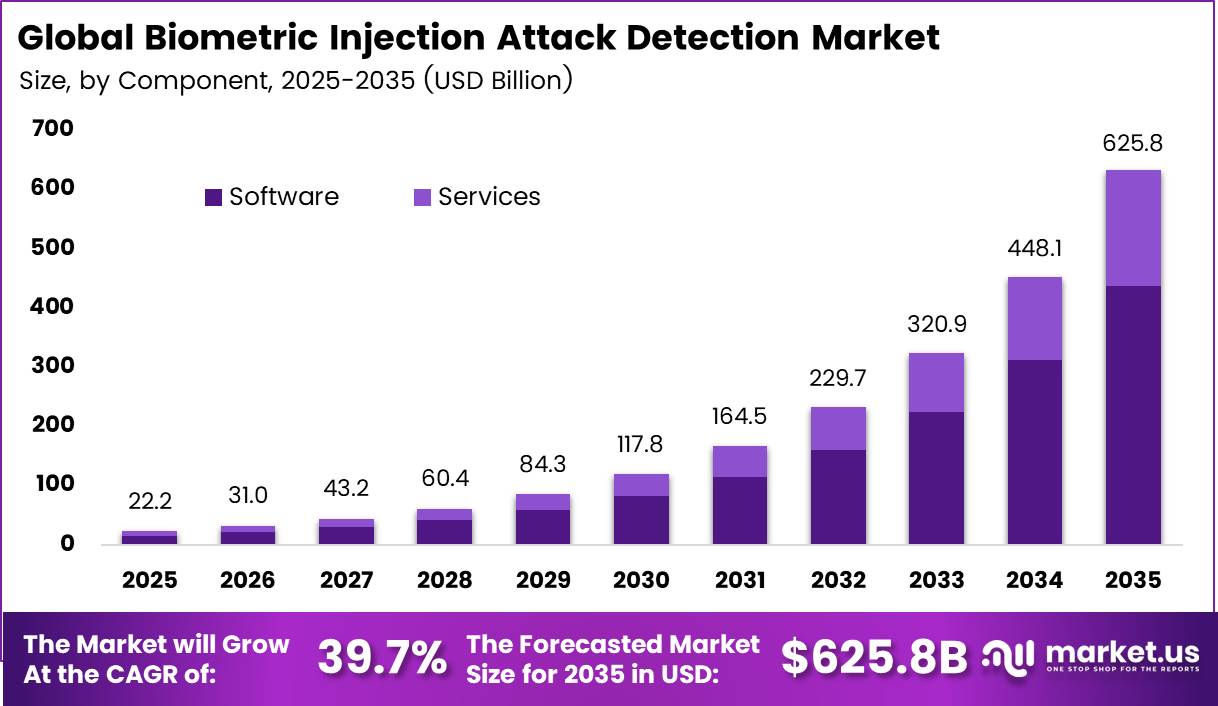
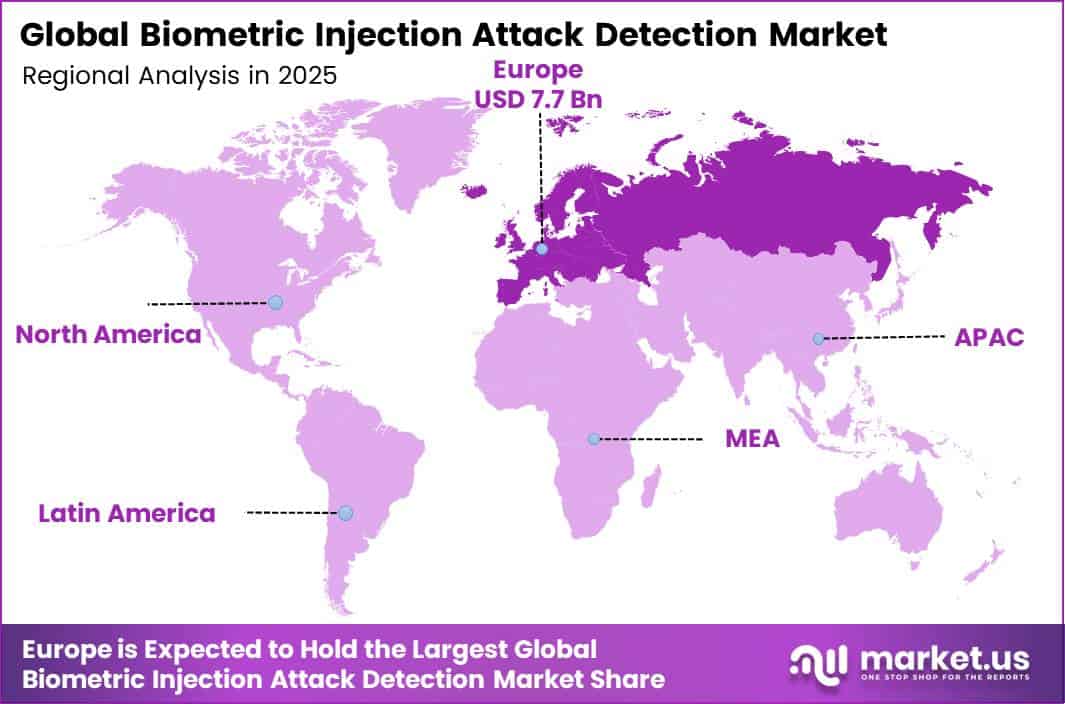
In 2025, the Global Biometric Injection Attack Detection Market was valued at USD 22.2 billion. The market is projected to grow at a CAGR of 39.7% during 2026–2035, reaching approximately USD 625.8 billion by 2035. Europe dominated the global market in 2025, accounting for more than 35.0% of the total market share and generating approximately USD 7.7 billion in revenue.
Digital onboarding drives this demand. According to the ITU, 6 billion people used the internet in 2025, and the online population grew by more than 240 million in one year. Each new digital user adds to the number of selfies and video checks that fraudsters can target. Entrust’s 2025 Identity Fraud Report shows that a deepfake attempt happened every five minutes in 2024.
Digital document forgeries rose 244% year over year, and deepfakes made up 40% of all biometric fraud. Fraudsters often push these deepfakes into the camera feed through injection attacks, mostly with virtual cameras. That is why banks and other regulated firms now buy tools that check whether the capture stream is real.
The Europe region has a large and mature digital user base. The ITU reports that 88% to 93% of people in Europe use the internet. Among people aged 15 to 24, internet use in Europe has passed the 95% universality mark. This near-full adoption puts banking, government, and travel services online at scale, and every one of these services needs liveness and injection checks.
Key Takeaways
- The Biometric Injection Attack Detection Market was worth USD 22.2 billion in 2025 and will reach USD 625.8 billion by 2035. The market will grow at a CAGR of 39.7% from 2026 to 2035.
- By component, software leads with a 68.7% share.
- By biometric modality, facial biometrics leads with a 76.9% share.
- By deployment mode, cloud-based leads with a 61.8% share.
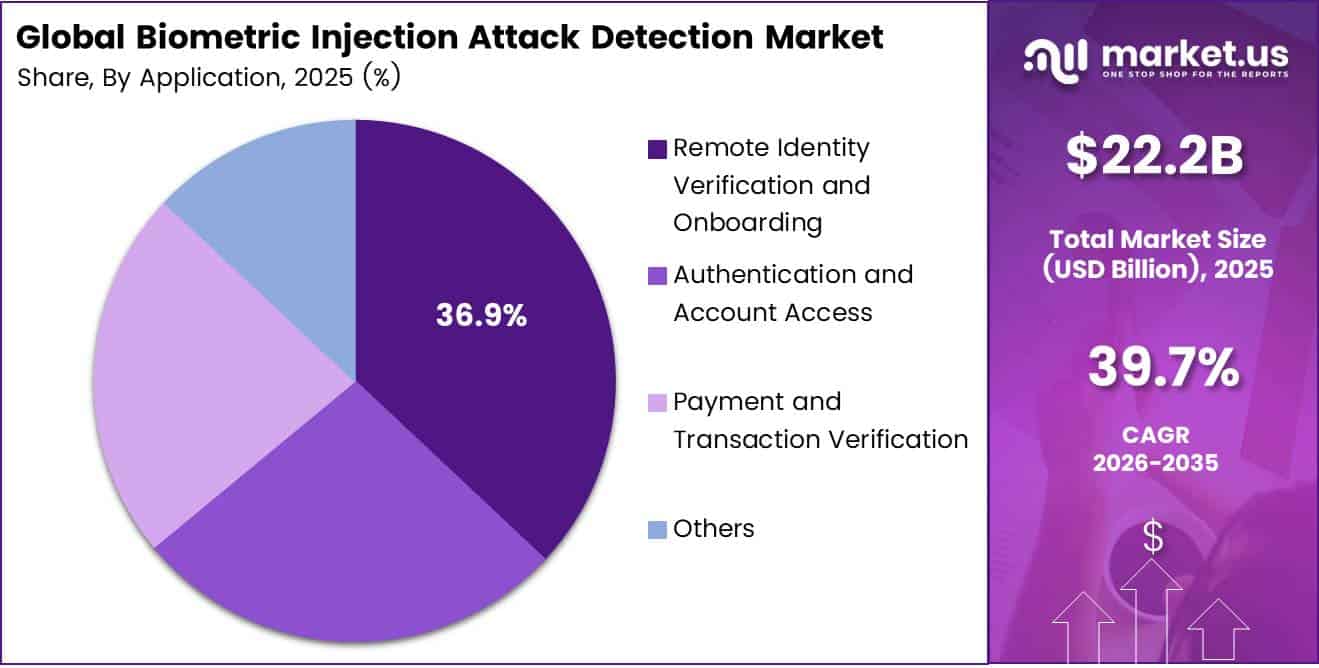
- By application, remote identity verification and onboarding lead with a 36.9% share.
- By end-use industry, BFSI leads with a 29.6% share.
- Europe leads with a 35.0% share and USD 7.77 billion in revenue.
By Component
Software dominates with 68.7% due to easy SDK integration across apps.
Software holds the largest share because every biometric check now needs code that can spot fake camera feeds, virtual cameras, and deepfake videos before they reach the matching engine. In 2024, the FBI’s Internet Crime Complaint Center logged 859,532 complaints and record losses of $16.6 billion, a 33% rise over 2023.
Services grow the fastest because many firms cannot build and tune these defenses on their own. Eurostat data shows that 77.6% of large EU enterprises bought cloud services in 2023, while only 41.7% of small firms did. That gap shows that smaller players lack in-house skills, staff, and budgets to run advanced security tools.
By Biometric Modality
Facial biometrics dominate with 76.9% due to selfie-based checks on every smartphone.
Face checks lead because users only need a phone camera. No extra hardware is required. India’s UIDAI shows how fast this works at scale. Aadhaar face authentication hit a record 15.87 crore transactions in June 2025, up from 4.61 crore in June 2024. The total then passed 200 crore transactions by August 2025.
Multimodal biometrics grow the fastest because a single factor is easier to fake than two or three combined. ITU reports 112 mobile-cellular subscriptions and 95 mobile broadband subscriptions per 100 people worldwide in 2024. Most of these devices carry cameras, microphones, and fingerprint sensors together. Security teams use this hardware mix to check face, voice, and touch in one flow.
By Deployment Mode
Cloud-Based dominates with 61.8% due to fast updates against new attacks.
Cloud tools lead because injection attacks change every few weeks, and cloud vendors can push new detection models to all clients overnight. Buyers skip server costs, long installs, and manual patching. This speed matters when fraud rings release fresh deepfake tools all the time.
Business comfort with the cloud keeps rising too. Eurostat reports that 52.74% of EU enterprises used paid cloud services in 2025, a gain of 7.42 percentage points over 2023. As more firms move their core apps online, they also prefer to plug in identity checks as a hosted service.
Hybrid models grow the fastest because large public and regulated users want cloud speed but must keep sensitive biometric records under their own control. India shows the scale of such systems. Aadhaar logged 231 crore authentications in November 2025, close to 8.5% more than a year earlier.
By Application
Remote Identity Verification and Onboarding dominate with 36.9% due to rising fake account opening attempts.
Onboarding leads because the first step of any digital account is the easiest place for criminals to slip in a fake face or a stolen ID. Once a fake account gets approved, it can launder money, take loans, or open more accounts. So firms put their strongest checks at sign-up.
Digital sign-up volumes keep growing. India’s Press Information Bureau reported 37.3 crore e-KYC transactions in April 2025, 39.7% more than a year earlier. Each one of these remote checks needs proof that a live person, not an injected video, sits behind the camera.
Payment and transaction verification grows the fastest as fraud moves from sign-up to the moment money leaves an account. The FBI recorded 149,686 crypto-related complaints in 2024, with losses of $9.3 billion, up 66% from the prior year.
By End-Use Industry
Banking, Financial Services, and Insurance (BFSI) dominates with 29.6% due to high-value fraud targeting customer accounts.
BFSI leads because banks and insurers face strict know-your-customer rules and hold the money that criminals want most. Every lender, broker, and insurer now checks new customers remotely. That gives attackers many chances to try deepfakes and spoofed camera feeds.
Older customers face especially heavy losses. The FBI found that people aged 60 and above filed 147,127 complaints in 2024 and lost about $4.885 billion. Regulators and boards push financial firms to protect these customers, so BFSI keeps the biggest security budgets in this market.
Healthcare grows the fastest because patient portals, telehealth visits, and online prescriptions all depend on proving who is on the screen. The U.S. Department of Health and Human Services counted 663 large breaches in 2024, which affected about 242.9 million people. Stolen health records help criminals build fake identities that can pass weak checks.
Key Market Segments
By Component
- Software
- Services
By Biometric Modality
- Facial Biometrics
- Voice Biometrics
- Fingerprint Biometrics
- Iris Biometrics
- Multimodal Biometrics
- Others
By Deployment Mode
- Cloud-Based
- On-Premises
- Hybrid
By Application
- Remote Identity Verification and Onboarding
- Authentication and Account Access
- Payment and Transaction Verification
- Others
By End-Use Industry
- Banking, Financial Services, and Insurance (BFSI)
- Government and Public Sector
- Healthcare
- Retail and E-commerce
- IT and Telecommunications
- Others
Geopolitical Impact Analysis
Geopolitical tension hits this market mainly through hardware and compute supply. Detection software runs on GPUs, servers, and camera modules, and all of these move through trade routes that face strain. The WTO reports that world merchandise trade volume grew 4.6% in 2025. That beat its earlier 2.4% forecast because AI-related goods offset the drag from higher tariffs.
The AI boom now competes with detection vendors for the same chips. The WTO found that trade in AI-enabling goods rose 67% year over year. These goods made up 47% of merchandise trade growth in the first half of 2026. Most of this supply comes from a few places, so buyers of inference servers face long lead times and less room to negotiate prices.
Energy and price shocks add cost pressure. The WTO saw trade value rise 15% in the first half of 2026, while volume grew only 3.5%. Higher energy prices drove much of that gap. Cloud providers pass rising power costs on to customers, and cloud deployment holds most of this market. The Middle East conflict will also cut that region’s imports by 15.4% and its exports by 17.2% in 2026.
Shipping disruption slows hardware delivery. Rerouting Asia-to-Europe vessels around the Cape of Good Hope adds 10 to 14 days to transit time. This delays shipments of camera and server parts to European data centers. The WTO now expects trade volume to grow 3.9% in 2026, up from 1.9% in March, and supply chains have adapted.
Regional Analysis
Europe dominates the Biometric Injection Attack Detection Market, holding a 35.0% share and generating USD 7.7 billion in revenue. Rising deepfake fraud drives this lead. Sumsub data shows that deepfake fraud attempts rose 96% in France and 94% in the UK in 2025. Spain saw an 84% rise and Germany a 53% rise.
North America is a large, bank-led market. Incode and AuthenticID together serve eight of the 10 largest US banks. They also protect eight of the top nine telecom firms in North America. Entrust puts the fraud rate in the Americas at 6.2%, which pushes lenders to add injection checks at onboarding.
Asia Pacific holds the highest fraud pressure of any region. Entrust puts the average fraud rate for APAC businesses at 6.8%, the highest of all regions. The ITU reports that 77% of people in Asia Pacific use the internet, so many people are still coming online. The WTO expects Asia to lead 2026 trade with import growth of 9.5% and export growth of 9.9%.
Key Regions and Countries
North America
- US
- Canada
Europe
- Germany
- France
- The UK
- Spain
- Italy
- Rest of Europe
Asia Pacific
- China
- Japan
- South Korea
- India
- Australia
- Rest of APAC
Latin America
- Brazil
- Mexico
- Rest of Latin America
Middle East and Africa
- GCC
- South Africa
- Rest of MEA
Market Dynamics
Drivers
| Driver | (~) % Impact on CAGR Forecast | Geographic Relevance | Impact Timeline |
|---|---|---|---|
| Generative AI Deepfake Injection Surge | +4.2% | Global | Short term (2 years or less) |
| Remote Digital Onboarding Expansion | +3.1% | North America, Europe, APAC | Short term (2 years or less) |
| Injection Attack Certification Standards | +2.4% | Europe, North America | Medium term (2 to 4 years) |
| eIDAS 2.0 Digital Identity Wallet Rollout | +2.0% | Europe | Medium term (2 to 4 years) |
| Virtual Camera and Emulator Tool Proliferation | +1.6% | Global | Short term (2 years or less) |
| Banking KYC Fraud Loss Escalation | +1.3% | APAC, Middle East, Latin America | Short term (2 years or less) |
Generative AI Deepfake Injection Surge
The main cause is that face-swap and synthetic-video tools have become cheap and widely available. Attackers now feed manipulated streams straight into the capture pipeline through virtual cameras, which goes around presentation attack detection designed only for physical spoofs.
The US Treasury and Europol threat assessments for 2024 and 2025 flagged injection-based biometric bypass as a fast-growing attack vector. Vendor disclosures in annual reports from identity verification providers listed in 2025 put injection attempts at a growing double-digit percentage of all biometric fraud attempts, with year-on-year growth of more than 200% in some reporting periods.
The quantitative effect is that buyers now treat injection detection as a separate line item rather than a feature bundled into liveness checks. Average per-verification fees for layered liveness plus injection detection run roughly 15% to 30% higher than passive liveness alone, based on pricing patterns visible in earnings calls of listed identity platforms.
Restraints
| Restraint | (~) % Impact on CAGR Forecast | Geographic Relevance | Impact Timeline |
|---|---|---|---|
| Biometric Data Privacy Litigation Exposure | -2.6% | North America | Short term (2 years or less) |
| EU AI Act Biometric Use Prohibitions | -1.8% | Europe | Short term (2 years or less) |
| Data Localization Mandates | -1.2% | APAC, Middle East | Medium term (2 to 4 years) |
| SME Security Budget Constraints | -0.9% | Emerging Markets | Short term (2 years or less) |
| Procurement Freezes in Public Sector | -0.6% | North America, Europe | Short term (2 years or less) |
Biometric Data Privacy Litigation Exposure
The root cause is statutory biometric privacy law, especially the Illinois Biometric Information Privacy Act. Under it, courts can award liquidated damages of USD 1,000 per negligent violation and USD 5,000 per intentional or reckless violation.
Texas Attorney General enforcement under CUBI produced settlements in the hundreds of millions in 2024. State legislative trackers kept by the National Conference of State Legislatures show more than 15 states introducing biometric-specific bills during 2025.
The strategic impact shows up as delayed or reversed deployments in high-exposure states. Vendors carry extra indemnification and insurance costs that compress gross margins by an estimated 2 to 4 percentage points, and buyers postpone budget commitments until consent workflows are re-engineered.
Challenges
| Challenge | (~) % CAGR Friction Drag | Geographic Relevance | Mitigation Horizon |
|---|---|---|---|
| Adversarial AI Arms Race | -2.2% | Global | Long term (4 years or more) |
| Specialized Talent Shortage | -1.4% | North America, Europe, India | Medium term (2 to 4 years) |
| Android Device Fragmentation | -1.0% | APAC, Africa, Latin America | Medium term (2 to 4 years) |
| False Rejection User Friction | -0.8% | Global | Short term (2 years or less) |
| Interoperable Testing Gaps | -0.6% | Global | Medium term (2 to 4 years) |
Adversarial AI Arms Race
The structural weakness is that detection models are trained on known generation artifacts. Each new diffusion or neural-rendering release cuts those artifacts, so detection accuracy decays faster than it would for traditional signature-based security.
The friction is quantitative. Vendors report retraining cycles shrinking from roughly 6 months to under 8 weeks. GPU compute for continuous adversarial training can take 10% to 18% of R&D budgets, per R&D disclosures in listed vendors’ annual reports. Red-team staffing adds further fixed cost.
Opportunities
| Opportunity | (~) % Potential CAGR Upside | Geographic Relevance | Execution Window |
|---|---|---|---|
| Enterprise Workforce and Helpdesk Verification | +3.0% | North America, Europe | Medium term (2 to 4 years) |
| Video Conferencing Deepfake Detection Integration | +2.3% | Global | Medium term (2 to 4 years) |
| National Digital ID Stack Integration | +1.9% | India, Southeast Asia, Africa | Long term (4 years or more) |
| Fraud Insurance and Liability Bundling | +1.2% | North America, Europe | Medium term (2 to 4 years) |
| Healthcare Telemedicine Identity Assurance | +0.9% | North America, Europe | Long term (4 years or more) |
Enterprise Workforce and Helpdesk Verification
This is still largely untapped. Current injection detection spending sits mostly in customer-facing KYC, while employee onboarding, password resets, and privileged-access recovery still depend on knowledge-based checks or manual video calls.
The FBI Internet Crime Complaint Center has warned since 2022 about deepfake applicants in remote hiring. The US Department of Justice’s 2024 and 2025 actions against North Korean IT worker schemes affected more than 300 companies. CISA advisories have repeatedly identified helpdesk social engineering as an initial access vector in major ransomware incidents.
That could lift recurring revenue visibility and expand gross margins by an estimated 5 to 8 percentage points through lower variable compute per user. OEM integrations could also cut customer acquisition costs by 25% to 40%. Capturing this needs deliberate partnerships with workforce identity platforms.
Key Players Analysis
Tier 1 leaders have the largest revenue and global reach. IDEMIA Public Security earned EUR 711 million in FY2025, with adjusted EBITDA of EUR 112 million. In April 2026, Amadeus agreed to buy the business for EUR 1.2 billion, plus an earn-out of up to EUR 150 million. Entrust also stands in this tier, with its fraud research tracking global deepfake volumes.
Mitek Systems posted record FY2025 revenue of USD 179.7 million, up 4%. SaaS revenue rose 21% to USD 77.0 million. Mitek spent USD 18.1 million on R&D in the first half of FY2025. In its fiscal third quarter of 2026, revenue rose 18% to USD 54.0 million.
Tier 2 challengers hold strong niche or regional positions. Facephi grew revenue by almost 25% to EUR 36 million in 2025, its best year so far. Its revenue CAGR from 2020 to 2025 reached 37.7%. Incode bought AuthenticID in August 2025, though it did not disclose the deal value. Before the deal, Incode was growing at 80% a year organically.
iProov passed 1 million daily transactions in 2025. Incode and AuthenticID together ran over 4.1 billion identity checks in 2024. FaceTec, Jumio, Veriff, AU10TIX, BioID, Innovatrics, ID-Pal, Oz Forensics, and Regula compete on liveness accuracy and deepfake detection.
Top Key Players in the Market
- iProov Limited
- FaceTec, Inc.
- BioID GmbH
- Incode Technologies, Inc.
- Innovatrics s.r.o.
- Mitek Systems, Inc.
- Facephi Biometría, S.A.
- Jumio Corporation
- Entrust
- AU10TIX
- ID-Pal
- Oz Forensics
- Regula
- Veriff
- IDEMIA Public Security
Recent Developments
- In August 2025, Incode Technologies bought AuthenticID. The combined firm ran over 4.1 billion identity checks in 2024 and serves eight of the 10 largest US banks.
- In December 2025, Mitek Systems reported record FY2025 revenue of USD 179.7 million, with SaaS revenue up 21% to USD 77.0 million.
- In March 2026, iProov announced that its platform passed 1 million daily biometric verification transactions in 2025.
- In April 2026, Amadeus agreed to buy IDEMIA Public Security for EUR 1.2 billion, plus an earn-out of up to EUR 150 million.
Report Scope
| Report Features | Description |
|---|---|
| Market Value (2025) | USD 22.2 Billion |
| Forecast Revenue (2035) | USD 625.8 Billion |
| CAGR (2026-2035) | 39.7% |
| Base Year for Estimation | 2025 |
| Historic Period | 2020-2024 |
| Forecast Period | 2026-2035 |
| Report Coverage | Revenue Forecast, Market Dynamics, Competitive Landscape, Recent Developments |
| Segments Covered | By Component (Software, Services); By Biometric Modality (Facial Biometrics, Voice Biometrics, Fingerprint Biometrics, Iris Biometrics, Multimodal Biometrics, Others); By Deployment Mode (Cloud-Based, On-Premises, Hybrid); By Application (Remote Identity Verification and Onboarding, Authentication and Account Access, Payment and Transaction Verification, Others); By End-Use Industry (Banking, Financial Services, and Insurance (BFSI), Government and Public Sector, Healthcare, Retail and E-commerce, IT and Telecommunications, Others) |
| Regional Analysis | North America – US, Canada; Europe – Germany, France, The UK, Spain, Italy, Rest of Europe; Asia Pacific – China, Japan, South Korea, India, Australia, Singapore, Rest of APAC; Latin America – Brazil, Mexico, Rest of Latin America; Middle East & Africa – GCC, South Africa, Rest of MEA |
| Competitive Landscape | iProov Limited, FaceTec, Inc., BioID GmbH, Incode Technologies, Inc., Innovatrics s.r.o., Mitek Systems, Inc., Facephi Biometría, S.A., Jumio Corporation, Entrust, AU10TIX, ID-Pal, Oz Forensics, Regula, Veriff, IDEMIA Public Security |
| Customization Scope | Customization for segments and region/country-level will be provided. Moreover, additional customization can be done based on the requirements. |
| Purchase Options | We have three licenses to opt for: Single User License, Multi-User License (Up to 5 Users), Corporate Use License (Unlimited Users and Printable PDF) |